Cast Out With Only $5 and Two Children, She Had Nowhere to Go — Until One Strange Offer Helped Her Build What No One Could Take Away

Part 1
The bill lay on the table between them like something Margit Lindqvist had been told not to touch.
Five dollars. Folded once, pressed flat by a woman’s pale fingers, set down with the precision of someone disposing of a debt rather than offering charity.
Margit looked at the money. Then at Cordelia Ashgrove, who had laid it there.
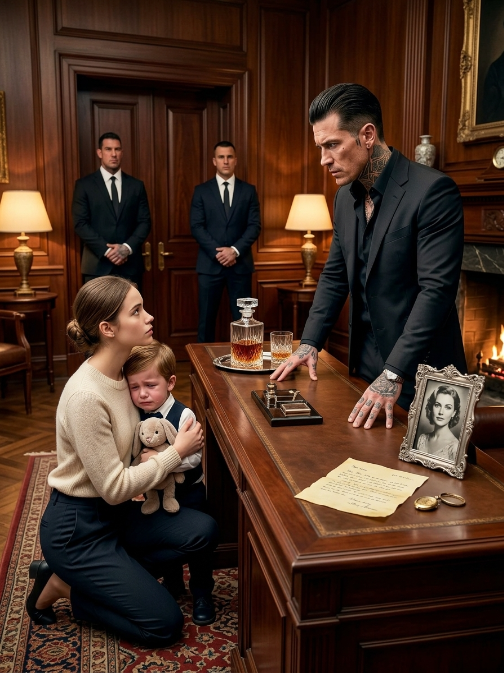
The parlor smelled of starch and old smoke. Everything in this house wore Cordelia’s stamp — the black mourning ribbon wound around the staircase, the chairs nobody ever sat in without an invitation, the silence that behaved itself because Cordelia had trained it to. Even grief stood up straight in this room.
Eleven months ago, a falling pine had taken Margit’s husband down in the north timber stand during a late storm, and by the time the men carried him home on a wagon plank, she had already known from their faces what word she’d be wearing for the rest of her life.
Widow.
Burden.
Her son Aksel was seven. Her daughter Liv was four, and still slept clutching a corn-husk doll her father had made the Christmas before he died, its hair braided from yarn, its eyes two careful dots of blue paint. Liv called it Mormor, after her father’s grandmother — the old woman who had taught Margit more about surviving hard ground than anyone else alive.
Cordelia sat in her high-backed chair by the cold hearth, spine straight, hands folded white over black silk.
“You’ve had nearly a year to grieve my son,” she said. “That’s longer than most women get.”
“My situation is plain enough,” Margit said.
“Do not speak to me as an equal.”
Behind Margit, near the window, stood Edmund Ashgrove — tall, gray, hollowed out by a lifetime of losses he’d never once put into words. His knuckles whitened against the sill. He had loved his son in the careful, useless way of men who only learn the word *love* once a grave has made it safe to say.
He didn’t speak. He never did, when Cordelia’s voice filled a room.
“The children are Ashgroves by blood,” Cordelia continued. “That’s the only mercy in this whole mess. Young enough still to be shaped properly.”
“Properly.”
“Without your influence. Without bare feet in creeks and Norwegian nonsense. Without that old woman’s superstitions filling their heads.”
“Mormor’s songs were a comfort to them.”
“Mormor is dead.”
The hall clock struck four behind them, and Margit counted the chimes because counting was safer than answering.
“What is it you want from me, Mrs. Ashgrove?”
Cordelia lifted the bill between two fingers and set it down again, final as a door closing.
“I want you out of this house by sundown. Take the children, if you insist — when the money is gone, when you’re cold enough and hungry enough and ashamed enough, you’ll bring them back. I will raise them properly.”
“Magnus loved me.” The words slipped out before Margit could stop them.
Cordelia’s smile sharpened to something almost satisfied. “Magnus was a fool. Fools die young.”
Behind her, Edmund made a small broken sound — not quite a protest, nowhere near enough to matter. Margit turned away before she could look at him too long and lose what little composure she had left.
She packed in twelve minutes. Any longer and she’d have sat down on the bed and come apart entirely. Two carpet bags. Her work dress. The children’s spare clothes. Magnus’s knife. A tin of buttons. The blue shawl his grandmother had left her.
“Mama,” Aksel asked from the landing, “why is Grandmother shouting?”
“She isn’t shouting.”
“Her face is.”
Seven years old, and already he understood that faces could hit harder than hands.
Margit knelt and pressed one palm to his shoulder, the other to Liv’s cheek. “We’re going on an adventure,” she told them. “Just the three of us.”
“Where?”
“I don’t know yet.”
“For how long?”
“I don’t know that either.” She gave him the only honest thing she had left. “But we’ll be together.”
Liv nodded once, solemn, clutching her doll like a verdict.
At the front door, Edmund stood waiting in his coat, and for one wild second Margit thought he might finally find his spine. Instead he only opened the door, and as she passed, he whispered so low she nearly missed it.
“Magnus loved you for a reason. None of us ever looked closely enough to see it.”
The door closed behind them.
Every respectable door in Hollow Pine closed that same way before sundown. The boarding-house keeper paled at the sight of the children. The general store shut early at two in the afternoon. The bank wouldn’t receive her. Even the reverend could only offer the dry woodshed behind the church, blankets left quietly on the back step, an understanding that no one would acknowledge any of it aloud.
Cordelia Ashgrove owned that town the way frost owns a window — not by deed, but by creeping into every corner until nobody dared offer warmth.
Only Greta Halvorsen, the blacksmith’s wife, stepped onto her porch while her husband worked the forge and pressed a warm loaf of rye into Margit’s hands without a word.
That night, in the church woodshed, Liv lifted her doll toward the dark rafters. “If Papa can see me, I’ll hold her up so he can see her too.” Margit turned her face into the blanket so her daughter wouldn’t hear her cry.
Near three in the morning, with the straw gone brittle in the cold, she heard her husband’s grandmother’s voice in memory: *The earth gives to those who ask with their hands, not their mouths.* The old woman had crossed an ocean at sixteen with two dresses and enough stubbornness to build a life from rock.
A woman with nowhere to stand was at everyone’s mercy.
A woman who owned even one poor scrap of earth had a beginning.
By morning, Margit knew exactly what she was going to do with five dollars — and what nobody in Hollow Pine yet understood was that the land they’d call her foolishness would, within a single dry season, bring half the county to her door begging for what she’d found beneath it.
Part 2
The land agent laughed when she told him her budget.
“Five dollars won’t buy you mud in this county.”
“Then show me the worst piece no one wants.”
He pulled a ledger down, smiling like a man enjoying arithmetic done at someone else’s expense. “Forty acres past Miller’s Creek. The old Bergstrom place. Cabin floods constant — water through the floorboards, year-round. Bergstrom dug ditches, cursed the devil, finally just walked off and left it.”
“Write the deed.”
“Mrs. Lindqvist, it’s unlivable.”
She set her five dollars on his desk. “So was yesterday.”
The cabin sat four miles out, one room with a sleeping loft, moss climbing the base logs, the tin roof rusted through. Water covered the floor in a shining, moving sheet — not standing, not stagnant, but flowing, rising near one corner and vanishing under the far wall.
Liv splashed straight in barefoot. “It’s cold, Mama!”
Cold. In August.
Margit knelt and pressed her palm to the wet boards, and memory opened — Mormor behind the old springhouse years before, laying her hand against stone: *Moving water comes from deep. Water that moves is water that lives.*
The town called it a curse because water had found the wrong building.
Margit called it a spring, and that single afternoon she decided to give it a proper home — a stone basin in the corner, fieldstone walls fitted without mortar, a cedar overflow channel, a cold shelf above the flow where milk and butter would keep through any heat.
Other women had root cellars. She would have a river running under her kitchen.
The work nearly broke her. Three weeks standing in water that never warmed, prying rotten boards, hauling stone while Aksel sorted them by size and Liv scrubbed each one with solemn devotion, setting the corn-husk doll on a dry shelf to supervise.
On the fourth day Margit sat down in the cold water and cried into her own hands — silently, the kind of crying that happens only after strength has entirely run out.
“Are you the kind of broke that needs fixing,” Liv asked from the ladder, “or the kind that needs a hug?”
“The second kind.”
Liv climbed down, soaked her nightgown crossing the floor, and pressed the doll’s painted face to her mother’s cheek. “Papa says you’re not allowed to stop. He says you’re the strongest person he ever saw.”
By the end of the third week, the basin stood finished — a hundred and eighty stones fitted and sealed, clear spring water bubbling up and spilling bright over the lip.
“Mama,” Aksel said, “it’s beautiful.”
It was. For the first time since Magnus died, Margit looked at something her own hands had made and saw not survival, but the beginning of something else entirely — though she had no way of knowing yet that within weeks, every well in the county would run dry while hers ran stronger, or that the woman who’d thrown five dollars at her like spare change would one day arrive at this very basin begging for a single cup of water.
Part 3
Edmund Ashgrove came with cedar boards, alone, his face older than it had looked the night she left. Aksel lowered the hatchet he’d been swinging at weeds.
“I saw smoke from your chimney every morning,” Edmund said. “Cordelia says you’ll be back before frost.”
“Cordelia is wrong.”
“I know.” The words seemed to surprise him as much as her. He unloaded the cedar with shaking hands. “I owe you an apology. Thirty years I’ve stood by windows saying nothing while she found fault with everyone I loved. I don’t know yet how to stand up in my own house. So I brought cedar instead, because it’s what I know how to do.”
“Thank you, Edmund.”
After he rode away, Aksel asked, “Is Grandpa a bad man?”
“No. A scared one. Scared men do nothing when they should do something — that’s not the same as bad, but it isn’t good either.”
“Can scared men stop being scared?”
“Little by little. Like stones in a wall. One brave thing holds up the next.”
A young doctor named Caleb Ferris arrived soon after, having heard three conflicting versions of Margit’s disgrace and decided any town so eager to steer him away had likely pointed at the wrong person. He found her wet to the elbows beside a fieldstone basin.
“Constant flow, fifty-two degrees,” she told him.
He laughed in astonishment. “Mrs. Lindqvist, do you understand what you have? Fever treatment. Cholera season insurance. The difference between mourning and morning.”
“I have not had an adult conversation in weeks,” she admitted. “Keep speaking.”
“I am here,” he said simply, and rolled up his sleeves to carry cedar.
Cordelia learned of his visits within days and marched into his office to threaten his practice. By morning every appointment on his book had been canceled. He came to Margit’s yard that afternoon anyway, tired but unbroken.
“I can return to the city,” he said. “I don’t want to.”
“Why?”
He only asked where the next trough went.
Greta Halvorsen finally stopped hiding too, walking four miles with a rhubarb pie. She confessed, sitting on the bench by the door, that Magnus had once ridden through the night to fetch medicine for her own sick son and made her swear never to tell, because his mother would disapprove of the Halvorsens.
Margit had never known. A widow, two children, a frightened father-in-law, a doctor losing his practice, and a blacksmith’s wife who’d decided shame weighed more than consequence — that was how the first circle formed around the spring.
Then the rain simply stopped falling, and didn’t start again for thirty-eight days.
Part 4
It began as absence — no clouds, then no clouds for two weeks, then Miller’s Creek cracking into gray plates. Wells started failing one by one across Hollow Pine, including, at last, Cordelia’s own — the deepest private well in the county, coughing brown and going silent while she worked the pump handle until her palms blistered, saying nothing, pumping again.
Four miles out, Margit’s spring strengthened instead. The basin that had flowed steady now surged so hard it threatened to outrun its own channel.
“Mama, I thought we fixed it,” Aksel said, ankle-deep in overflow.
“The drought is pressing the deep water down,” she told him, breathless with disbelief. “Shallow wells fail. This one runs from somewhere the dry season can’t reach. It has to go somewhere — and it’s coming here.”
“Are we going to sell it?”
Seven years old, already learning the world tried to price everything it feared.
“No,” Margit said. “Some things are given, not sold. This might be the most important thing we ever do.”
The first to come was a young mother carrying a baby too weak to cry, having walked four miles in shimmering heat. Margit caught her before she fell, lowered the feverish infant into the cold spring water, and sent Aksel riding for Dr. Ferris on the pony his grandfather had quietly left them weeks before. By sundown the baby had nursed twice.
“That would have been a funeral tomorrow,” Ferris said afterward, the sky burning red over dry grass.
“We saved her,” Margit said.
“You saved her. I helped.”
By the end of the week, seventeen families had filled their jugs at her basin. Some apologized. Most didn’t. She wasn’t running a confessional. She was running a spring.
Cordelia did not come — until the day Edmund arrived with three hollow-eyed grandchildren visiting from out of town, the pantry’s last jug already given away, and Cordelia beside them in full mourning black, sitting rigid as though arriving at her own trial.
“Don’t let her in,” Aksel said.
“If your father were standing here, what would he do?”
His jaw trembled. “He’d let her drink.”
Before Margit could move, Liv crossed the yard barefoot with the tin cup, gave the youngest child water first, then turned to her grandmother.
“Do you want water too?”
Fifty years of a face built to silence rooms came apart in front of everyone in less than a second. Cordelia’s mouth opened. Her chin dropped. One hand rose toward something no longer there, and fell back into her lap.
“Come in,” Margit said. “All of you. There’s water enough.”
Inside, holding the trembling cup, Cordelia finally spoke. “My own mother-in-law put me in the back room when I married into this family. Made me eat in the kitchen for six months. Called me common. I swore no one would ever make me feel small again — and I became her. I didn’t see it. Not until a four-year-old handed me water and I saw myself at twenty-two, thirsty and ashamed and waiting for someone to look at me kindly.”
She wept — not with dignity, not as an Ashgrove, but like someone who had finally found the end of a very long, dark hallway.
“What do I do,” she whispered.
“Today you drink,” Margit said. “Tomorrow you come back. When the wells run again, we’ll talk about the rest.”
The rain came on the forty-fifth day, three drops on the tin roof becoming a thousand, the smell of wet earth rising like a held breath finally released. Beneath the floor, the spring kept moving — unbothered by drought, uncelebrating of rain, simply alive.
Part 5
The town turned the way dry ground turns after rain — first at the surface, then deeper than anyone expected. Storekeepers rode out with apologies. The reverend preached about wells in dry places without once needing to say Cordelia’s name.
At Thanksgiving, Cordelia invited Margit and the children to dinner, and stood at the head of her own table to say it plainly in front of everyone: “I told this woman she was worth five dollars. She turned a flood into a spring, and saved my grandchildren, my neighbors, and God forgive me, she saved me. From this day she is not my daughter-in-law. She is my daughter.”
Edmund stood before she’d even finished. “No one is leaving.”
Margit married Caleb Ferris the following spring. Edmund walked her down the aisle and wept the whole way. Cordelia sat in the front pew in lavender instead of black, and never wore mourning again.
The cabin grew — a second room, a proper pantry over the spring, a porch, eventually a second story raised by Aksel’s own sons decades later. But the original basin stayed exactly where Margit had built it, renewed every few years by careful hands, known across three counties as a place farmers came during dry spells and mothers came with feverish children, where Cordelia herself eventually taught other women how to listen for moving water beneath August grass.
Aksel grew tall and quiet, learning to hear water the way his sister once heard it sing, walking dry fields until he’d stop and say only, “There” — and men would dig, and more often than not, water would come. Liv became a teacher for over forty years, taking her students to stand silently beside moving creeks each spring. “Listen,” she’d tell them. Some only heard a creek. Some heard more.
Margit and Caleb had a daughter together, named for the grandmother whose voice had started it all, who grew up to deliver thousands of babies in the city and kept a tin cup of cold water beside every laboring mother she ever attended.
“A small thing,” she’d say.
“Small things,” Margit always answered, “are what people remember when the hour is hard.”
Cordelia lived eleven more years, Edmund holding her hand at the end. At her graveside he told the gathered town, “The woman she became, she had to become against a lifetime of practice. I never saw anything braver.” Four years later, at his own funeral, Aksel said his grandfather had brought cedar before he could bring words, and in the end had brought all of himself — dying a good man not because he’d always been one, but because he’d chosen, late, to become better. Someone began clapping softly in the back pew. Then everyone did.
Margit lived to see the cabin become a landmark. On her last morning, her daughters helped her down to the pantry and sat her on the stool Caleb had built decades before, and she placed her feet in the basin water one final time.
Cold. As cold as the first August day she’d stepped into a cursed cabin with two children, one carpet bag, and an entire town waiting for her to fail.
“Do you remember what Mormor said?” she whispered.
“Water that moves is water that lives,” Liv answered, pressing her forehead to her mother’s hand.
The spring kept moving beneath the floor, past stone and pitch and cedar, past drought and rain, past every soul who had once believed five dollars was the measure of a woman’s worth.
It had been there long before any of them.
It would go on flowing long after.