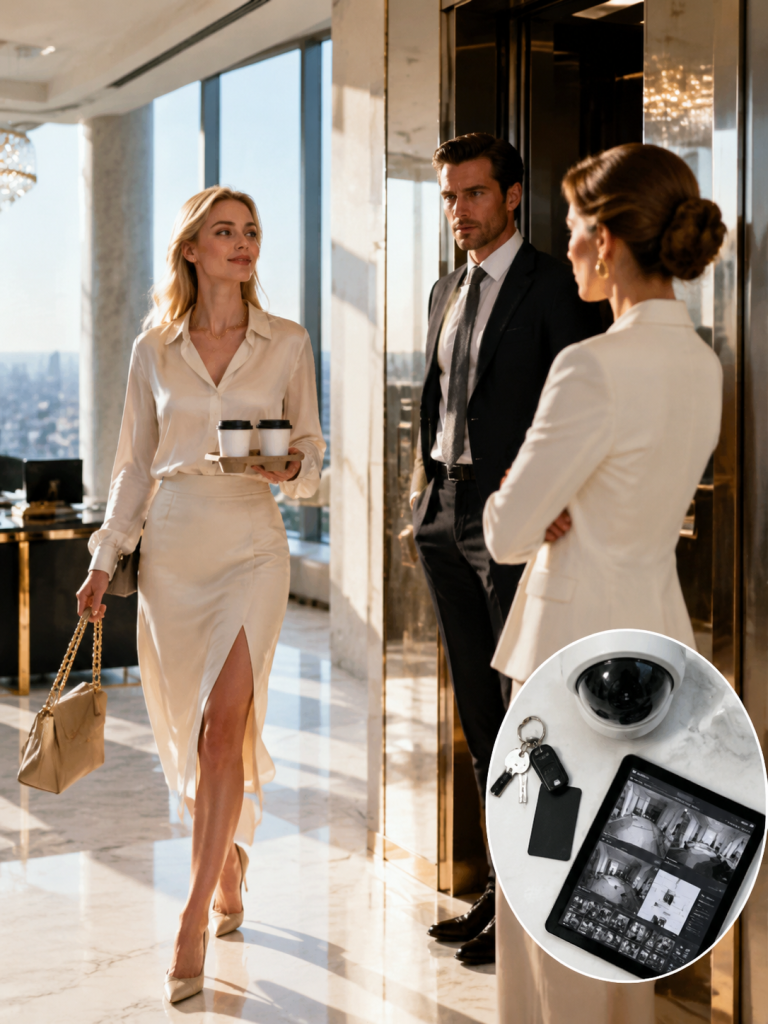
My Ex Threatened Me in the Elevator—Unaware the Mafia Boss Was Standing Behind Him

## PART 1
He had my wrist before I made it ten steps.
I had been so careful. Eight months of mapping routes, memorizing which hotels Connor frequented, learning the rhythms of a city that was his in ways that it had never been mine. Eight months of rebuilding myself into someone who didn’t flinch at a particular quality of footsteps on marble. And then the service elevator at the Aldric was under maintenance, and the kitchen staff redirected me through the main lobby, and suddenly all that careful architecture was worthless.
I was carrying three stacked pastry boxes. My grandmother’s recipes, two weeks of grocery money, the desserts for a private event on the fourteenth floor. Sixteen steps to the elevator bank. I was counting.
“Cleo.”
*Don’t turn. Keep walking.*
“Cleo, I know you hear me.”
His hand found my arm and Connor Moore was never someone who left marks — he was too deliberate for that, too practiced in the particular art of control that doesn’t show. His grip was firm enough to stop me. Not firm enough for anyone watching to look twice.
“You’re going to make me drop these,” I said.
My voice came out steadier than I deserved.
“Then put them down.”
“They’re worth more than your suit.”
A lie. His suit cost more than my rent. But it made him release me for exactly one second, and I moved — not running, because running in a hotel lobby with three pastry boxes is its own catastrophe, but fast, the way I’d learned to move through the world since leaving him. Purposeful. Certain. As if I knew where I was going.
Ten steps. Seven. Five.
The elevator opened with a soft chime and I threw myself through the doors without looking, managing by some miracle to keep the boxes level, and collided directly with the chest of the man already inside.
He caught the boxes.
That was the first thing I registered: not his height, not his face, not the quality of his suit — just his hands, quick and careful, plucking the stacked containers from my unsteady grip with the precision of someone who had caught things before.
“I’m sorry,” I started, reaching for them. “I didn’t—”
“Cleo.”
Connor’s voice came from the lobby, closer now, and the man holding my pastry boxes looked past me toward the sound. Something changed in his expression. Small, controlled, but I felt it in the air between us like a shift in pressure.
His hand moved.
He pressed the button for the doors to close, and then he positioned himself between me and the narrowing gap — not aggressively, not dramatically, just with the calm certainty of someone who had decided where he was standing and saw no reason to move.
Connor’s hand appeared in the gap. The doors caught it, bumped, began to retract.
“Don’t,” the man said.
One word. Quiet enough that I almost missed it. But Connor went still, and the doors closed, and the elevator began to move, and I pressed my back against the rear wall and tried to remember how to breathe.
The man turned to look at me.
He was older than I’d registered in the chaos — mid-forties, dark hair with silver at the temples, a face that was interesting rather than conventionally handsome. Sharp jaw. Eyes that were somewhere between brown and black, very still, cataloguing everything they saw. He wore a charcoal suit with the ease of someone who had stopped thinking about what he was wearing years ago.
He was still holding my pastry boxes.
“Thank you,” I managed.
“What floor?”
“Fourteen. Kitchen access. I have a delivery.”
He pressed the button. The elevator climbed.
“Your ex?” he asked.
“Ex-fiancé. Former. I gave the ring back eighteen months ago.” I was talking too fast, the adrenaline converting itself into words. “I’ve been avoiding him, but the service elevator was closed and they redirected me through the lobby and I didn’t know he was—”
“He’s staying on the sixth floor,” the man said.
I stopped.
“How do you know that?”
“I know who stays in my hotel.”
His hotel.
I looked at him differently.
“Nico Cavalieri,” he said, before I could ask. He said the name as if it were simply a fact, not something that carried weight. But I watched his face as he said it, and I watched him watching me to see if I recognized it.
I didn’t. Not yet.
“Cleo Marchand,” I said. “Though I suspect you already know that.”
Something moved in his expression.
“You are perceptive.”
“You caught three stacked pastry boxes one-handed without spilling anything. You’re not a civilian. And you looked at my ex like you were running a calculation, not like you were startled.” I met his eyes. “Who told you my name?”
He was quiet for a moment that felt longer than it was.
“The desserts,” he said finally. “For the Beaumont anniversary dinner six weeks ago. Someone served Provençal lavender tarts that I have been thinking about since. I asked the host. The host asked the caterer. The caterer said a woman named Cleo Marchand made them.”
I stared at him. “You’ve been looking for me for six weeks because of a tart.”
“Because of a tart that tasted like something I had almost forgotten.” He looked at the boxes in his hands. “Are these from the same recipe?”
“Different recipe. Same grandmother.”
The elevator stopped. Floor fourteen, kitchen access.
The doors opened to a service corridor and a waiting prep cook who looked at Nico Cavalieri with the particular expression of someone who had not expected to see their employer arriving via the kitchen elevator holding pastry boxes.
Nico handed the boxes to the prep cook with the same careful handling he’d used to catch them.
“Ensure these reach the private dining room intact,” he said. Then he looked at me. “Make your delivery. When you’re done, come back to this elevator. I’d like to finish our conversation.”
“We weren’t having a conversation,” I said. “You were telling me things about myself I didn’t ask you to know.”
“Then tell me something I don’t know,” he said. “When you come back.”
The elevator doors closed between us.
I stood in the corridor for a moment, the prep cook watching me with frank curiosity, and tried to understand what had just happened.
I had run from Connor into a stranger who knew my name, whose hotel I was standing in, who had been looking for me for six weeks because of something my grandmother taught me to make in a kitchen in Provence.
The pastry boxes were already on their way to the dining room.
I had no particular reason to go back to that elevator.
I went back anyway.
—
## PART 2
He wasn’t in the elevator.
He was waiting beside it — standing in the service corridor with his jacket still immaculate and his phone in his hand, which he pocketed when he saw me.
“You came back,” he said.
“I’m not sure why.”
“I am.”
He gestured toward a door at the end of the corridor. “There’s a sitting room this level uses for private guests. Quieter than the lobby.”
The room was small and overfurnished, the kind of space that existed to be useful rather than impressive. He closed the door and we sat across a low table from each other, and he looked at me the way he’d looked at the elevator doors — with complete, unhurried attention.
“Ask your questions,” he said. “You have them.”
“The man downstairs. Connor. What did you mean that you know who stays in your hotel?”
“I meant exactly that. He checked in two days ago. Business stay.”
“If you knew he was here and you knew who I was, why didn’t you warn me?”
“I didn’t know you were making a delivery today. The vendor file showed a standard booking for next week.” His expression didn’t change, but something behind it did. “When I saw you cross the lobby I recognized you from the photograph. I was on my way to intercept before he reached you.”
“You were too slow.”
“By approximately seven seconds. Yes.”
I studied his face. “You’re describing surveillance of both me and my ex-fiancé as if it’s a normal thing to do.”
“It’s how I understand my environment.”
“That’s one way to describe it.”
“What would you call it?”
“Unsettling,” I said. “Extremely unsettling. Possibly useful. I haven’t decided yet.”
He almost smiled. Not quite. “Your ex. What does he want from you?”
“The same thing he’s always wanted. To have me back where he put me.” I looked at my hands. “We were together three years. He’s from a family that treats people like assets. I left, he didn’t accept it, and he’s been finding ways to appear in my periphery ever since. Very politely. Never anything I could document.”
“What happened today when he grabbed you?”
“Nothing I can prove. He would say we were having a conversation.”
Nico was quiet.
“He is not staying in this hotel by accident,” he said.
The words landed wrong.
“What do you mean?”
“The booking was made four days ago. Two days after your delivery confirmation for this event was filed.” He leaned forward slightly. “Someone gave him your schedule.”
Ice moved through me.
“Who would have access to—”
“Someone in my vendor management system.” His voice was very controlled. “I’m looking into it. But I wanted you to know.”
“Why?”
“Because you deserve to know the size of what you’re dealing with.”
“And what are you offering to do about it?”
He was quiet for a moment that felt considered rather than hesitant.
“There is a situation,” he said, “that I need to explain to you. It concerns your grandmother.”
I went very still.
“My grandmother has been dead for four years.”
“Yes.” He reached into his jacket pocket. Set a photograph on the table between us. It was old — faded, printed on the thick paper of two decades ago. A bakery front in Provence. The sign above the door read *Marchand et Filles.*
My grandmother’s bakery. Before she came to New York.
“How do you have this?” I asked.
“Because,” he said, “a man named Vasil Dragan has been looking for this building for twelve years. And last week, he discovered that the current owner of the original Marchand business records is a woman named Cleo Marchand, who makes Provençal pastries in New York City.” He met my eyes. “He is not Connor Moore. He is significantly more dangerous. And the reason he wants you has nothing to do with me, except that you are now in my hotel, which makes you temporarily my concern.”
“What does he want from my grandmother’s records?”
“I’ll explain everything,” Nico said. “But first I need to know — do you actually have them? The business records from Provence?”
I thought about the box in my storage unit. The one I’d never opened because grief was its own kind of locked door.
“Yes,” I said slowly. “I think I do.”
Nico sat back. Something complicated moved through his expression.
“Then we have a problem that is larger than your ex-fiancé,” he said. “And I think you should hear about it somewhere more secure than a hotel sitting room.”
He stood.
“Come to dinner tonight. My residence. I’ll explain everything.”
“I don’t know you.”
“No. But you know my name, and you can look it up, and what you find will tell you I’m not someone who needs to manufacture reasons to harm a pastry chef.” He looked at me steadily. “Your grandmother’s bakery was used as a front for a financial network twenty years ago. She didn’t know. Dragan did. And the documentation of that network — who was involved, where the money moved — is sitting in a box you inherited and never opened.”
The room felt suddenly very small.
“Why are you telling me this?”
“Because Dragan sent someone to your apartment building yesterday,” Nico said. “They were watching. Not moving yet. But watching.”
—
## PART 3
I looked him up on my phone in the elevator going down to the lobby.
Nico Cavalieri. Third-generation hospitality. Hotels in seven cities. Educated in Rome and London. One marriage, ended twelve years ago. No children named publicly. His photograph in business journals showed the same controlled face I’d just been sitting across from, calibrated to reveal nothing.
Then I went further, the way you go further when you’re looking for the thing someone would prefer you not find.
There were articles from the early 2000s. His father, Ottavio Cavalieri. Investigations that had gone nowhere, charges that had dissolved, a business empire that had expanded precisely where other businesses contracted. The Cavalieri family name appeared in the footnotes of stories about money that moved in unusual directions.
I saved the most useful articles and put my phone away.
The lobby was clear. Connor was gone. A man near the door who was not hotel staff caught my eye briefly and looked away — Nico’s people, I understood. Watching to make sure I got out.
I got out.
My roommate Priya was already home when I reached our apartment, and I sat down at the kitchen table and told her everything. She listened without interrupting, which was unusual for her, and when I finished she said: “You’re going to go to dinner.”
“I’m deciding.”
“No, you’ve decided. You’re managing the feeling of having decided.”
She was right. I knew she was right. The box in my storage unit had been sitting there for four years with my grandmother’s handwriting on the side, and I had never opened it because it hurt too much. Now someone wanted what was inside it, and the only person who had given me a straight answer about why was a man with a complicated family history who had caught my pastry boxes in an elevator.
“What if he’s using me?” I asked.
“To do what? You don’t have anything anyone wants until he tells you that you do.” Priya looked at me. “He told you about Dragan before you agreed to anything. That’s not how you manipulate someone.”
“Unless it’s a longer play.”
“Everything is a longer play, Cleo. The question is whether this particular player is playing against you or for you.”
I went to dinner.
—
The address was a brownstone in the West Village, older than the surrounding renovated blocks, with a garden that had survived decades of New York real estate pressure. A man I hadn’t met let me in — not a housekeeper, something more alert than that — and led me through rooms that were genuinely lived in: books stacked with bookmarks in them, a coat draped over a chair, a kitchen that smelled of something slow-cooked.
Nico was in that kitchen.
He had changed into a dark shirt with the sleeves rolled up, which was the first time I had seen him in anything other than a suit jacket, and he was stirring something with the careful attention of a man who had decided this mattered.
“You cook,” I said from the doorway.
“My mother insisted. She said relying on other people to feed you makes you dependent.”
“Mine used to say something similar.”
He turned. Looked at me the way he had looked at me in the hotel corridor — complete attention, nothing wasted.
“You looked me up,” he said.
“Of course.”
“And you came anyway.”
“I came because I want to know about my grandmother. And because someone was watching my building yesterday.” I sat at the counter. “Tell me about Vasil Dragan.”
He put lids on the pots and came around to the other side of the counter. The story he told was methodical and unglamorous: twenty years ago, a financial network had used small legitimate businesses across southern Europe to move money that had no clean origin. The businesses were chosen for their obscurity and their trustworthiness — family operations, generational, the kind of place where cash transactions didn’t raise questions. The network’s documentation had been distributed across the participating businesses, each holding one piece.
My grandmother’s bakery in Provence had been one of them. She hadn’t known. The liaison had been a man she trusted, a childhood friend who had presented it as a legitimate investment opportunity and handled all the paperwork himself.
“She signed documents she didn’t read fully,” Nico said. “Not unusual. Not culpable. But the documents exist.”
“And Dragan wants them.”
“Dragan was involved in the network on the distribution side. The documentation would tell him who the principals were. People he could pressure, blackmail, or eliminate depending on what served him.”
“Why now?”
“Because he’s been rebuilding something that fell apart eight years ago. He needs those names to reactivate old connections or close old debts.” Nico met my eyes. “And because one of the principals is still very active and very powerful, and Dragan believes having leverage over him would solve several problems simultaneously.”
“Who is it?”
A pause.
“My father,” Nico said.
The kitchen was very quiet.
“Your father was part of this network.”
“On the financing side. He was younger then. He’s made significant changes to his operations since.” Nico’s voice was level. “I’m not asking you to trust him. I’m telling you the reason Dragan wants those documents is that they would give him a weapon to use against my family.”
“And you want the documents yourself.”
“I want them destroyed,” he said. “Completely. Nothing in them is useful or true anymore — the network hasn’t functioned in fifteen years. But in Dragan’s hands, they’re a tool. In no one’s hands, they’re history.”
I sat with that.
“You could have found a different way to approach me,” I said. “You’ve known my name for six weeks. You could have called. Sent someone. Made a business offer.”
“Yes.”
“But you waited until I ran into your elevator.”
“I was still deciding whether to approach you at all.” He looked at me steadily. “What you inherited from your grandmother was hers. The documents are yours to do with as you choose. I wasn’t going to take that from you without your knowledge.”
“That’s a more ethical position than I expected, given the context.”
“I contain contradictions.”
Despite everything, despite the evening and Dragan and Connor and the box in my storage unit that had somehow become the center of this, I found myself thinking about a tart. About lavender from my grandmother’s garden dried in the sun. About the way she had taught me that cooking was memory, that the right combination of things could make someone feel seen across an impossible distance.
“He came to the hotel because of my delivery schedule,” I said. “Dragan, I mean. Not Connor.”
“Connor’s presence was separate. Worse timing.”
“Two separate men using two separate methods to find me in the same building on the same afternoon.”
“I’m aware how that looks.”
“It looks like I need to make some decisions.” I met his eyes. “What are you actually offering me? Not about the documents. About Connor.”
“I already have someone looking into how he obtained your schedule,” Nico said. “That breach will be addressed. As for Connor himself — he understands now that you’re connected to people he would prefer not to antagonize.”
“You did that already?”
“Between the elevator and your delivery being completed. Yes.”
“That was fast.”
“It was important.”
I thought about Priya’s question: playing against you or for you. And I thought about the way Nico had handled the pastry boxes — not as objects, but as things that mattered to me, therefore worth caring about.
“The documents,” I said. “I’ll open the box. Not tonight — I need to do that alone, with enough time to sit with whatever’s in it. But I’ll look, and if they’re there, I’ll decide what to do.” I paused. “I’m not agreeing to just hand them over. That’s my grandmother’s history. I need to read it before I decide what it means.”
“That’s completely reasonable,” Nico said. “Take whatever time you need.”
“And if Dragan moves before I’m ready?”
“He won’t get to you.”
“You can guarantee that?”
“I can guarantee that the people watching your building are now my people, not his. And that he knows it.” He held my gaze. “Which will slow him significantly. He’s bold, but he’s not reckless.”
I looked at him across the kitchen counter. At the cooking pots still on the stove and the books visible through the doorway and the garden outside the window where someone had clearly spent years tending things that needed tending.
“Tell me about my grandmother’s bakery,” I said. “What do you actually know about it?”
Something shifted in his expression — genuine, this time, unguarded.
“The records show it opened in 1967. It ran for thirty-one years before she came to New York. It was known for Provençal pastries, obviously. The lavender fields nearby supplied the local trade.” He paused. “And at some point in the mid-nineties, a man named Éric Bonard, who had known her since childhood, persuaded her to open a small investment account attached to the business. She signed the papers without fully understanding them. She was sixty-two. She trusted him.”
“He used her.”
“Yes.”
“Did she ever find out?”
“I don’t know,” Nico said. “The documentation would tell us what she signed. Not what she knew.”
I thought about my grandmother’s hands. Flour-dusted, sure, moving through recipe gestures the way some people moved through prayers.
“She never mentioned business problems,” I said quietly. “She talked about the bakery like it was the cleanest thing she’d ever built.”
“Because it was,” Nico said. “What happened to it wasn’t her doing. It was done to her.”
Something in my chest loosened slightly.
“Dinner,” I said. “You were cooking something.”
“Osso buco. My mother’s recipe.” A pause. “You don’t have to stay.”
“I know.” I didn’t move. “Tell me how your mother taught you to cook.”
We ate at the kitchen table, not the formal dining room. He told me about his mother, who had died when he was twenty and left him with a handwritten recipe book and strong opinions about osso buco and the conviction that knowing how to feed yourself was the foundation of knowing how to take care of yourself. I told him about my grandmother, about standing on a stool to reach the pastry marble, about learning ratios by feel before I understood what ratios were.
We talked about food the way some people talked about religion — like it was the real thing beneath the practical thing, the part that carried meaning when words couldn’t.
I left at ten. The man who wasn’t a housekeeper walked me to the street, where a car was already waiting.
“I didn’t arrange that,” I said.
“Mr. Cavalieri anticipated you might need it,” the driver said.
I got in.
—
I opened the box on a Saturday, when Priya was at her sister’s and the apartment was quiet.
It took me two hours to go through everything. My grandmother’s handwriting on thirty years of papers — recipes, correspondence, accounts. And near the bottom, in a folder she had labeled in French with the kind of careful precision she brought to everything: *Documents pour Éric, 1994.*
Six pages. A business account in the bakery’s name. Signature pages she’d clearly signed without reading all of them, her name in her distinctive handwriting at the bottom of documents that were otherwise in dense legal French.
And in the margins of the final page, in her handwriting, added years later by the ink color: *Je ne savais pas. Je ne savais jamais.* I didn’t know. I never knew.
She had found out eventually. She had written it down. And she had kept the documents anyway, because she kept everything, because she believed that history, even ugly history, deserved to be held.
I photographed every page and sent them to Priya with a message explaining everything. Then I called Nico.
He answered on the second ring.
“The documents exist,” I said. “She didn’t know. She wrote that herself in the margin.”
“I’m glad you found that.”
“I want to meet with a lawyer before I decide anything. Someone who’s not connected to you or Dragan or any of this.”
“That’s the correct instinct. I can recommend—”
“My own lawyer,” I said. “From my own research.”
A brief pause. “Even better.”
“And I want you to explain to me what happens to Dragan if I hand these over to an authority instead of to you or destroying them.”
He was quiet for a moment. “That would be complicated.”
“I need to understand complicated.”
“Then I’ll explain it. All of it. Over dinner, if you’ll come again.”
“Tell me one thing first. The network your father was involved in. Is it completely over?”
“Yes.”
“How completely?”
“Eight years ago, when I found out the full scope of it, I gave my father a choice. Change every part of what he was doing, with documentation I could verify, or I would provide everything I had to the relevant authorities myself.” Nico’s voice was very even. “He changed.”
“And you believe him?”
“I verified him. There’s a difference.”
I sat with that for a moment.
“The tart,” I said. “The one from the Beaumont dinner. The lavender came from my grandmother’s garden. I dried it myself from seeds she brought over when she immigrated.”
“I know. That’s what I meant when I said it tasted like something I’d almost forgotten.”
“What had you forgotten?”
He was quiet for a moment that felt genuine.
“That things could be made with that kind of care,” he said. “That the intention behind something was visible in how it tasted.”
I looked at the folder on my kitchen table. My grandmother’s handwriting in the margin. *I didn’t know. I never knew.*
“Come to the storage unit with me tomorrow,” I said. “There’s more in the box. I haven’t gone through everything. I want someone there who understands what they’re looking at.”
“I’ll be there.”
“And Nico.”
“Yes.”
“If any of this is designed to manipulate me, I will find out. I am better at reading people than I look.”
“I know,” he said. “That’s part of why I’ve been thinking about those tarts for six weeks.”
—
Three months of evenings in his kitchen.
That was how Priya described it when she was being imprecise. What it actually was: three months of untangling my grandmother’s history from the thing that had been done to it, of documents reviewed by an independent lawyer who confirmed that my grandmother had been defrauded, of a formal complaint filed with international financial authorities that Nico’s legal team helped me navigate without controlling.
Dragan received a visit from people I never met. The details were not shared with me, and I didn’t ask for them. What I knew was that the watching stopped.
Connor received a different kind of visit — legal, documented, from a lawyer who explained in very specific terms what constituted harassment and what the consequences would be. He relocated to London three weeks later.
The box from my storage unit sat on my counter for a month while I read through everything inside it, piece by piece. My grandmother’s life in paper: decades of recipes, correspondence with her suppliers, letters from people she’d known in Provence. And the documents, isolated in their separate folder, sealed away from the rest as if she’d known they didn’t belong with the true record of what she’d built.
I destroyed them. Not for Nico. Not for his father. Because they were fraudulent, and my grandmother’s business deserved to be remembered without them.
I told Nico when it was done, over dinner — his kitchen, his osso buco, a bottle of wine from a region he said he’d visited once and never forgot.
“Thank you,” he said.
“It was my decision to make.”
“Yes. I know.” He looked at me. “I wasn’t thanking you for making it the way I would have wanted. I was thanking you for trusting the process.”
“I trusted my lawyer and the independent review.”
“And the person who told you the truth when he didn’t have to.”
I thought about the elevator. The pastry boxes and the closed doors and a man who had said, with complete calm, *you’re with me now* — meaning in that moment, in that immediate crisis, not as a permanent claim. He had been careful about the difference ever since.
“I have a question,” I said.
“Ask it.”
“The lavender tart. If you hadn’t tried it six weeks before the elevator. If I’d just been a stranger running from her ex. Would you have helped me anyway?”
He considered this honestly. “Yes. Not the same way. But yes.”
“Why?”
“Because he had your arm and you had three pastry boxes and nowhere to go.” He looked at me steadily. “That’s sufficient.”
The bakery I’d been planning for three years had its first investor meeting four months after the elevator. My lawyer — the independent one, mine — reviewed everything. The terms were straightforward, equity stake, creative autonomy preserved, repayment schedule structured around realistic projections.
Nico was not the investor. He had offered; I’d declined, because entanglement was a different thing from trust, and I needed to keep them separate.
He understood. That was the thing I kept coming back to: he understood.
The space I found was in Carroll Gardens, a neighborhood that reminded me a little of my grandmother’s descriptions of Provence — not in any literal way, but in the quality of the light through the windows in the morning, the way the street slowed down around it. I signed the lease on a Tuesday and called my grandmother’s name out loud in the empty space, because she deserved to know.
Priya came to see it and cried, which she denied.
Nico came and stood in the middle of it and said: “The counter should face the window.”
“It was already going to face the window.”
“Good.”
We stood there in the empty space, afternoon light across the raw floors, and I thought about the elevator again. The moment the doors had closed. The complete quiet of being safe after being afraid.
“Tell me something I don’t know,” he had said, outside the elevator on the fourteenth floor.
I had been learning things to tell him ever since.
—
The bakery opened on a Saturday in May.
I named it *Nonna’s Garden* — unsubtle, accurate, exactly right. The menu was Provençal, adapted for the season, everything made from memory and from the recipe books that had survived an ocean crossing and forty years and a box I’d been afraid to open.
The lavender macarons sold out in two hours.
Priya worked the counter in the morning rush, because she had insisted and I had given up arguing. The kitchen was mine — small, precise, organized the way my grandmother had taught me, by touch and smell and the specific logic of someone who understood that order in a kitchen was a form of love.
Nico came at ten, after the first rush, when the space had quieted to a comfortable busy.
He sat at the counter with coffee and a macaron and read the morning paper, which was very much not what powerful men who owned hotel chains were typically photographed doing on a Saturday morning. One person recognized him. He signed an autograph with good grace and went back to his paper.
I came out from the kitchen when things settled.
“Well?” I said.
He finished the macaron. Set down the paper.
“She would be proud of you,” he said.
I had not expected that specific answer. My throat did something complicated.
“You didn’t know her.”
“I know what she made,” he said. “Which means I know what she was. The rest is just biography.”
He looked at me across the counter — the same look he’d had in the elevator, in his kitchen, in the storage unit where we’d gone through papers together, in every conversation over three months of evenings. Complete attention. Nothing wasted.
“I should get back to the kitchen,” I said.
“You should.”
“Tonight. If you want to come for dinner. I’ll cook.”
A pause.
“Here?”
“My apartment. Priya will be out.” I held his gaze. “I make very good osso buco. Different method than yours, but I’m willing to defend it.”
He smiled. Actually smiled, not the almost-smile I’d been learning to read for three months, but the real one, which transformed his face into something that had nothing to do with power or control or the careful management of information.
“What time?” he asked.
“Seven.”
“I’ll bring wine.”
“From the region you visited once and never forgot?”
“Yes.”
I went back to the kitchen.
Outside, through the pass-through window, I could see Priya serving customers with the particular joy of someone who had watched a thing become real after years of planning. The lavender on the counter — dried from my grandmother’s seeds, grown in a pot on my fire escape — caught the morning light.
My grandmother had built something beautiful and someone had tried to use it for ugly purposes and she had written in the margin *I didn’t know* and kept the proof anyway, because some things deserved to be witnessed even when they were painful.
I had opened the box. I had read everything. And I had built something of my own with what I found inside — not the documents, not the fraud, but the recipes and the letters and the seeds she’d carried across an ocean.
That was what survived. That was what mattered.
The timer went off and I turned back to my work, flour on my hands, my grandmother’s instructions in my head, building something good out of everything she’d left behind.