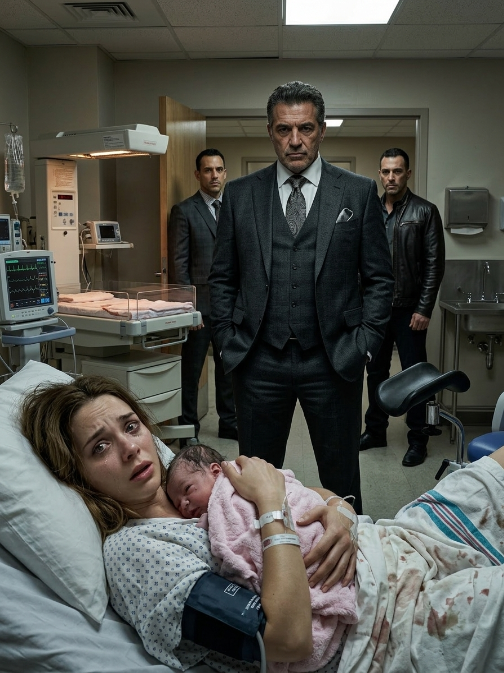
I HID UNDER MY OWN BED TO CATCH WHOEVER WAS TERRORIZING MY WIFE — THEN I HEARD HER BEG THEM TO STOP

**PART 1**
I hid beneath my own bed after a neighbor swore she’d heard my wife screaming every afternoon, convinced she’d simply mistaken ordinary noise for gossip. I believed my enemies could never reach the woman I loved, because I’d built my entire life around keeping her safe from them. I was wrong. Before that night ended, I would hear my wife’s voice beg, *”Please… stop,”* and understand that the greatest threat had been living inside my own house the whole time.
My name is Julian Cross.
To most of Chicago, I was a ghost wrapped in expensive suits and whispered rumors — the city’s most feared boss, the man who controlled territories and settled wars without ever raising his voice, the man whose entrance emptied a room of noise. At home, none of that mattered. To my wife, Naomi, I was simply her husband.
I’d spent years keeping my world as far from her as I could manage. We lived in a quiet neighborhood outside the city where our house looked exactly like everyone else’s. I left before sunrise, came home long after dark, and told myself distance was the price of keeping her safe.
Then my neighbor stopped me at the front gate.
“Julian,” Mrs. Alderman said, her face unusually pale, “I’m sorry to interfere. But every afternoon I hear a woman screaming inside your house.”
I frowned. “That’s impossible.”
She didn’t blink. “Then you don’t know what’s happening under your own roof.”
Her words followed me the rest of the day. When I finally came home, Naomi greeted me with the same gentle smile she always wore — kissed my cheek, asked about my day, served dinner as if nothing in the world had shifted an inch. I almost told her what Mrs. Alderman had said. Instead I let it go. Easier to believe my neighbor had imagined it.
Two days later, she was waiting at the gate again. “I heard her today,” she whispered. “Crying, *’Please… leave me alone.’* Julian, you have to check.”
That evening I found Naomi curled on the living room couch, reading. “Everything okay?” I asked.
She looked up and smiled. “Everything’s fine.”
*Fine.* The word echoed in my head long after she fell asleep beside me.
The next morning I pretended to leave for a meeting. My car disappeared around the corner before I parked it two streets over, walked back through the rear entrance, and quietly locked the door behind me. The house was silent. Too silent. I searched every room. Nothing.
Then an idea struck me — one I’m not proud of. I slipped into our bedroom and crawled beneath the bed, into the shadows where nothing could see me.
Minutes passed. Then the front door opened. Soft footsteps climbed the stairs. Someone entered the bedroom. The mattress dipped above me. A muffled sob broke the silence, then another.
My hands closed into fists in the dark.
It was Naomi.
Through the narrow gap beneath the bed frame, all I could see were her bare feet on the hardwood, and she was crying so hard she could barely breathe. Then I heard the words that turned my blood to ice.
“Please… stop.”
A long pause. Then, between broken sobs: “I won’t let them use him against me. I won’t betray my husband.”
Every instinct I’d spent decades sharpening as a boss screamed the same conclusion. This wasn’t fear on its own.
It was blackmail. And whoever had reached my wife believed I still knew nothing about it.
I came out from under the bed before I’d finished thinking it through, and Naomi startled so hard she nearly fell off the mattress. Her phone clattered to the floor, a voice still tinny and distorted coming through the speaker before the call cut dead.
“Julian—”
“How long,” I said, and my voice came out rougher than I meant it. “How long have they been calling you?”
She didn’t answer right away, which told me everything the silence needed to. I picked up her phone. The number was blocked. Of course it was.
“Three weeks,” she finally said. “They said if I told you, they’d hurt you. And if I didn’t do what they wanted, they’d hurt you anyway. I didn’t know which lie to believe, so I just — I tried to hold both of them off at once.”
“What do they want?”
Naomi’s hands twisted in her lap. “Records. Something about my mother. Something called Meridian.” She looked up at me, eyes red-rimmed and exhausted in a way I hadn’t let myself notice for weeks. “Julian, I think my father might still be alive.”
I called Marcus, my head of security, before she’d finished the sentence.
He arrived within the hour, and by then Naomi had told me everything the callers had said — fragments about her mother’s old hospital bills, a company called Meridian Freight Holdings, a silver key she’d never seen, and a name I hadn’t heard spoken aloud in fifteen years: Walter Ellison, her father, who I’d always understood to be long dead.
“Her father’s grave is real,” Marcus said carefully, once Naomi had gone upstairs to wash her face. “I saw the records myself when we did the background work before the wedding.”
“Records can be built,” I said. “I’ve built a few myself.”
We were still talking it through when the doorbell rang.
Marcus reached for his weapon out of habit. I waved him off and answered it myself.
A man stood on the porch holding a paper grocery bag, and the moment I saw his face I understood why Naomi kept a photograph of her father in a silver frame on the hallway table. He was older than that photograph — silver at the temples now, deep lines carved around his mouth — but the eyes were unmistakable. Gray-blue. Gentle. Fixed on the space just past my shoulder with the stunned grief of a man looking at something he’d given up hoping to see again.
The bag slipped from his grip. Oranges rolled across the porch and down the steps.
“I know what you were told,” he said.
Marcus stepped between us instantly. “Stay where you are.”
The man stopped, looked from Marcus to me, and something like recognition crossed his face. “You’re Julian Cross.”
I didn’t answer. Behind me, I heard Naomi’s footsteps on the stairs, then her voice.
“Dad?”
**PART 2**
For several seconds nobody moved. Rain had started tapping softly at the windows. One orange rolled to a stop against the doorframe.
The man stood just inside the threshold now, hands open at his sides as if any sudden movement might send Naomi running. “My father died when I was nine,” she said again, quieter this time, steadier — though I could feel the tremor running through the hand she’d slipped into mine.
“I know what you were told,” Walter Ellison said again. “I know more about your life than I ever wanted to know from a distance.”
“That isn’t an answer.”
“No.” His voice cracked on the word. “It isn’t.” He looked down at the scattered oranges. “I used to bring these to your mother. She hated apples.”
Something shifted in Naomi’s face — small, almost invisible, but I saw it. Her mother had hated apples. She’d mentioned it exactly once in the years I’d known her, pushing a slice of pie away at some dinner party neither of us remembered afterward.
“I’m not asking you to trust me,” Walter said. “Not yet. Please — let me explain why I disappeared.”
“Disappeared.” The word seemed to wound her worse than *died* ever had.
Marcus glanced toward the street. “We should close the door.” I stepped past Walter and did it myself. The lock clicked with a finality that felt louder than it should have.
Naomi released my hand — not for distance from me, I understood, but because she needed both hands free to hold herself together. She walked into the living room and sat on the edge of an old chair, dust rising faintly from the cushion.
Walter remained standing until she said, “Sit,” and then he obeyed — not beside her, but across the room. Marcus stayed near the hallway. I took the seat beside my wife.
Walter folded his hands, unfolded them. “My name is Walter Ellison,” he began.
Naomi gave a short, disbelieving laugh. “I know my father’s name. I went to his funeral.”
“I know.”
“You know?”
“I watched from across the street.”
Naomi stood so fast the chair legs scraped the floor. “You *watched?*”
I rose with her. Walter didn’t — seemed to understand that standing now would look like a challenge. “I was told I couldn’t approach you.”
“By whom?”
“Your mother.”
“My mother would never have done that.”
“She did it to protect you.”
“Everyone keeps saying they protected me.” Her voice broke on the last word. She turned to the window, her reflection ghosting faintly in the glass. “My husband protected me by deciding what I was allowed to know. My mother protected me by telling me my father was dead. And now you’re going to tell me you protected me by letting me believe it.”
Walter’s shoulders bent. “Yes.”
“That is not protection.”
“No,” he said softly. “It became something else.”
The honesty quieted the room. He looked older in that silence — not in his face, but in the way he carried the regret.
“I wasn’t a good man when you were young,” he said. “Not in the ways that mattered.”
“You were a mechanic.”
“I was. I was also in debt.”
“To whom?” Marcus asked.
Walter looked at me. “To people connected to Meridian Freight Holdings.”
The name landed over the room like a weight. Naomi glanced at me. I kept my face still, though something cold moved through my chest.
“I borrowed money after my garage started failing,” Walter continued. “Small loan at first. Then penalties. Favors. Deliveries I was told not to question.”
“What kind of deliveries?” Marcus asked.
“Envelopes. Boxes. Once, a set of financial records.”
“Illegal?”
“I believed so.”
“Believed, or knew?”
Walter met his eyes. “I knew enough.”
Naomi sat again, though she kept her body angled away from him. “What does that have to do with my mother?”
“Diane found out.” He looked at the marks on the doorframe rather than at either of us. “She always knew when I was lying. I could come home at midnight, say the garage kept me late, and she’d look at my shoes, the way I set down my keys, and know.”
Something soft crossed Naomi’s face. “She did that to me too.”
Walter almost smiled. “Yes.” The smile faded fast. “When she learned I was moving packages for Meridian, she demanded I stop. I promised I would. By then, leaving wasn’t simple.”
I understood that phrase better than most people would. *Not simple* rarely meant dramatic danger — more often it meant a man trapped by debt and shame and the fear that one confession would take down every relationship he had left.
“Your name wasn’t attached to the company then,” Walter said, looking at me.
“It was my company,” I said.
“On paper. Desmond Vale ran the daily operations.”
Naomi looked between us. “You knew that?”
“I knew he managed it. I didn’t know he was using it to pressure ordinary people.”
Walter nodded slowly. “He said you didn’t concern yourself with details.”
The accusation landed because it was true. In those years I’d valued results over methods, told myself distance preserved my own innocence. It had only made ignorance convenient.
“What happened?” Naomi asked.
“I tried to leave. Desmond said the debt could vanish if I made one final delivery.”
“To whom?” Marcus asked.
“Diane.”
Naomi went still.
“She’d started collecting information about Meridian,” Walter said. “Names, payments, forged property transfers. She told me if anything happened to me, she’d take it to the authorities herself. She didn’t want money. She wanted us free.” He looked toward a small door tucked beneath the staircase behind him — a door that, I realized, must lead somewhere in this house he’d apparently owned in secret for years. “She hid copies in this house.”
“There’s a hidden room,” Naomi said.
“Yes.”
“What was in the records?”
“I never saw all of it. Desmond suspected she had them but couldn’t find where.”
“And the silver key,” Marcus said. “Where does that come in?”
“It opens that door. Diane gave it to me. I mailed it to Julian.”
Every eye in the room turned to Walter.
“Why?” I asked.
“Because Diane believed you were the only person Desmond feared disappointing.”
I almost laughed at the bitterness of the misunderstanding. “Desmond never feared disappointing me.”
“He feared losing his place beside you.”
That, I could believe.
“Diane thought you had no idea what Meridian had become,” Walter went on. “She wanted the records to reach you without Desmond knowing.”
“Did they?”
“No. Because I failed her again.” He leaned forward, elbows on his knees. “The night before I was supposed to meet you, Desmond’s men found me. They didn’t hurt me. Didn’t need to. They showed me photographs of Naomi walking home from school. Said if I vanished, the debt vanished too. If I stayed, they’d make sure you both paid for what Diane had done.”
“So you left,” Naomi said.
“I thought I was choosing the only path that kept you safe.”
“You let us bury an empty coffin.”
Walter closed his eyes. “Yes.”
A long silence stretched out. Outside, a bus passed at the end of the street, its brakes sighing and fading.
We spent the next hour in the hidden room beneath the stairs — a narrow stairway that opened into a low basement chamber lined with mostly empty shelves, a wooden desk under a hanging bulb, dust covering every surface except a single clean rectangle where something had recently been lifted away.
Marcus noticed it first. “Someone’s been down here.”
“That’s impossible,” Walter said.
“Nothing about this morning has been impossible,” Naomi murmured, already moving to the shelves. An old sewing tin near the back held photographs, receipts, and a bundle of cassette tapes tied in blue ribbon. She lifted one — her mother’s handwriting across the label: *FOR NAOMI — WHEN SHE IS READY.*
We found a cassette player in the desk drawer, dusty but working. Naomi’s hands shook loading the tape. I stood behind her, one hand on her shoulder. Walter stayed across the room, unsure whether he’d earned the right to come closer.
She pressed play.
Static, then Diane Ellison’s voice — soft, tired, alive in the particular way old recordings make the dead seem only one room away.
*”Naomi. If you’re listening to this, then you’ve learned that some of what I told you wasn’t true. I wish I could explain this without hurting you. I told you your father died because I believed the people watching us would lose interest if they thought our family was already broken. He agreed to leave. Neither of us understood how long the lie would last.”*
Walter turned away, shoulders trembling.
*”Your father made mistakes. So did I. But he loved you. Every decision we made after that began with your name, even the wrong ones. Meridian paid for my treatment. Julian Cross arranged it, though I don’t believe he meant to buy my loyalty with it. I met Desmond Vale because he offered to help your father disappear safely. I later learned he’d created most of the problems he claimed to solve. He wanted the records I’d collected. I refused. I believed they proved Meridian had been used to control families through debt and forged property agreements. Some families lost their homes. Some lost businesses. Some just lived afraid. I decided to give the records to Elias — to Julian — because I believed he’d stop it if he knew. Maybe that was foolish. Maybe it was hope. There’s one other truth, Naomi. One I could never write down—”*
The tape cut to silence.
Naomi pressed play again. Nothing. Marcus took the cassette and held it to the light. “It’s been physically cut. Recently, from the look of the splice.”
Walter stared at the clean rectangle on the desk. “There was a gray metal case here. About this long.” He measured with his hands. “That’s where Diane kept the original records.”
“And now it’s gone,” Naomi said.
“No sign of forced entry,” Marcus said, scanning the floor. “Who has a key?”
“Only me,” Walter said.
“Not anymore,” Naomi replied, looking at the open door.
“I didn’t take it,” Walter said quickly.
“I believe you,” Naomi said — and seemed surprised by her own words as much as anyone. “I don’t know why. Maybe because you look as lost as I feel.”
We searched another hour. Marcus found dust patterns suggesting the case had been removed within the past week, and a faint shoe print near the far wall too small to be Walter’s. Naomi found a notebook of her mother’s — grocery lists and medication times mixed with strings of initials and dates. One set repeated often: *V.H.* Another appeared beside several entries: *J.C.*
My initials. The entries beside them didn’t match anything I remembered authorizing. One line read: *J.C. — LAKEVIEW SCHOOL FUND — 40,000 — RETURNED?* Another: *J.C. — ALDERMAN PROPERTY — DO NOT SIGN.*
Alderman. Our neighbor.
I looked at Naomi. “She knew your mother?”
“Not that I know of.”
Marcus photographed the page. “We should speak with her.”
“She’s the one who told Julian about the screaming,” Naomi said.
“Which may be coincidence,” Marcus said.
“Or she knew I was receiving calls,” Naomi replied, and the thought clearly unsettled her more the longer she sat with it.
Walter went pale when we said the name aloud. “Margaret Alderman?”
“You know her?”
“She worked for Meridian. An accountant — quiet, careful. Diane trusted her.”
“Why didn’t I know that?” I asked.
“Desmond dismissed her before the company closed.”
Naomi lifted the notebook. “Did she help my mother collect these records?”
“I think so,” Walter said.
Marcus glanced toward the stairs. “Then our helpful neighbor may know a great deal more than she’s admitted.”
We climbed back up into daylight not long before noon, and it was there — Walter making coffee at my kitchen counter, Naomi opening the box of letters he’d finally handed over, dozens of them, some sealed, some never even placed in envelopes — that Mrs. Alderman herself appeared at her gate across the street, pruning shears in hand, and dropped them the instant she saw Walter Ellison get out of my car.
“You’re alive,” she breathed.
“So are you,” Walter said, and something in his sad smile told me this reunion had been fifteen years in the making.
She crossed the lawn, struck him lightly on the shoulder with the flat of her hand — “You foolish man” — and then hugged him anyway.
Naomi stared, astonished. “You knew my father?”
“I helped your mother hide him,” Mrs. Alderman said. “I moved to this street to watch over you. Your mother asked me to.”
“And you lived next to me for fifteen years and never told me.”
“I was afraid Desmond was still watching.”
“He was,” Walter said quietly.
We moved the whole gathering inside, around the same kitchen table where Naomi and I had eaten dinner the night before pretending nothing was wrong. Walter across from us now. Mrs. Alderman beside him. Diane’s notebook in the center of the table between us all.
I opened it to the Alderman property entry. “What does this mean?”
Mrs. Alderman’s lips trembled reading it. “My husband and I nearly lost our home. Meridian claimed we’d guaranteed a business loan we never signed.”
“Desmond forged it?” Marcus asked.
“Yes. Diane found the original documents. Julian’s initials had been used to approve the foreclosure.”
“I never approved that.”
“I know.”
“How do you know?”
“Because Diane showed you the file herself.”
I stared at her. “No. She didn’t.”
“She met you at St. Gabriel’s Hospital. Three days before she died.”
Naomi turned to me slowly. “Did you meet my mother?”
A memory surfaced, unwelcome and slow — a thin woman in a blue scarf near a vending machine, in a hospital corridor where I’d gone to argue about billing with an administrator years ago. She’d stopped me, asked if I was Julian Cross, and when I said yes she’d pressed a sealed envelope into my hand and told me not to trust the man who’d delivery it to me.
I’d thought she was confused. I’d handed the envelope straight to Desmond Vale without opening it.
The shame arrived complete and immediate. “Yes,” I said. “I met her.”
“What did she give you?”
“An envelope.”
“Where is it?”
“I gave it to Desmond.”
Walter closed his eyes. Mrs. Alderman looked devastated. “That was the first set of records.”
I stood and walked to the counter, gripping the edge of it, and for once no one tried to stop me. Diane had placed the truth directly in my hands, and I had carried it, unopened, straight to the man she feared most.
“Julian,” Naomi said behind me.
I turned. Her face held pain, but not contempt.
“I didn’t know,” I said.
“I believe you.”
“You shouldn’t.”
“Maybe not. But I do.” She crossed the room. “You made a mistake.”
“A costly one.”
“Yes. But maybe Desmond would have lied anyway, and you’d have believed him regardless.”
“I did believe him.”
“I know.” She put her hand flat against my chest. “Start by not hiding the next truth.”
“I won’t.” It wasn’t a promise to become a different man overnight. Only a promise about the next choice. Sometimes that’s the only honest thing a person can give.
Marcus’s phone rang. He stepped into the hallway, and when he came back his face had changed.
“What happened?” I asked.
“The private vault downtown was accessed this morning.”
My stomach tightened. “The silver key?”
“Gone. Someone signed in under Nathan’s name.” He turned his screen toward us. “But look at the security still.”
The image showed a man in the vault lobby wearing Nathan’s coat, Nathan’s cap. The face underneath belonged to someone else entirely.
Walter leaned closer. Mrs. Alderman gasped. Naomi’s hand slipped from mine.
I stared at the photograph. Older than the last time I’d seen him. Thinner. But unmistakable.
“Who is he?” Naomi asked.
I could barely make myself say the name. “My brother.”
“You told me your brother died.”
“I believed he did.”
On Marcus’s screen, the man in the photograph turned toward the camera. In one hand, the silver key. In the other, the missing gray case from beneath Walter’s house.
Then Marcus’s phone buzzed with a new message from the same blocked number that had been calling Naomi for three weeks.
One sentence.
*Ask Julian what really happened to Caleb.*
**PART 3**
The name hit the kitchen like a struck bell.
Caleb.
I hadn’t said that name aloud in fifteen years, not since the funeral I’d arranged myself, not since I’d stood over an empty stretch of ground in a cemetery two counties away and told myself the closed casket was mercy, not evidence.
“Julian.” Naomi’s voice was careful now, the way you’d talk to someone standing too close to a ledge. “Who’s Caleb?”
“My younger brother.” My own voice sounded like it belonged to someone else. “He worked for me. Ran collections in the south district. Fifteen years ago he disappeared during a dispute with a rival crew. I was told he’d been killed and the body disposed of so there’d be nothing to bury.” I looked at the photograph still glowing on Marcus’s screen. “I built a mausoleum for a headstone with nothing under it. I have grieved that man for fifteen years.”
“Then who’s this?” Mrs. Alderman asked, though something in her face told me she’d already guessed.
Walter answered before I could. “Desmond didn’t work alone. He needed someone on the inside of your organization who could move money and men without raising questions. Someone with your name already half-built into the company.”
The pieces slid into place with a sickness I felt in my teeth. “Caleb never died. Desmond turned him.”
“Or Desmond gave him a reason to let people believe he had,” Marcus said quietly. “Either way, he’s been operating under other names inside your own organization for fifteen years. Which means he’s had fifteen years of access.”
Naomi’s hand found mine again, and this time I held on like it mattered, because it did.
“Why now?” she asked. “Why surface after fifteen years, why the calls, why my mother’s records?”
“Because your mother’s case has my initials on a forged foreclosure,” I said slowly, “and Desmond’s dead — has been for six years, a heart attack no one questioned. Which means whoever’s running what’s left of Meridian’s old machine needs those records buried permanently before anyone official goes looking. And the one person who could authenticate every forged signature in that gray case—”
“Is you,” Walter finished.
“Or my brother,” I said. “Who’s spent fifteen years learning to sign my name better than I do.”
We didn’t sleep that night. Marcus pulled every employment record, every alias, every wired payment his people could trace before dawn, and by the time the sky started going gray outside the kitchen window we had a location — a warehouse on the old shipping corridor south of the river that Meridian had technically sold off nine years earlier and that, according to utility records no one had thought to check, had never actually stopped drawing power.
“You don’t have to come,” I told Naomi, already knowing what she’d say.
“You don’t get to decide that for me anymore,” she said. “Not today.”
Walter came too, though I told him twice he didn’t need to. “She’s my daughter,” he said simply. “I’ve spent fifteen years watching from across a street. I’m not doing that today.”
Mrs. Alderman stayed behind with the notebook, the letters, and a phone line open to Marcus’s people, in case anyone came looking for what was left in that house.
The warehouse was quieter than I expected for a place holding fifteen years of secrets. Marcus’s men took the perimeter. I went in through the loading door myself, Naomi a half-step behind me despite every instinct I had telling me to put her somewhere safer.
Caleb was waiting at a folding table in the middle of an otherwise empty floor, the gray case open in front of him, the silver key resting on top of a stack of files like a paperweight. He looked up when the door opened, and for one unbearable second he was nineteen years old again, laughing at something in our mother’s kitchen, before the years came back into his face all at once.
“You found me faster than I thought you would,” he said.
“You wanted me to find you,” I said. “Otherwise you’d never have sent that message.”
Something that might have been relief crossed his face, quickly buried. “I’ve spent fifteen years cleaning up other men’s lies, Julian. I wanted you to have to look at one of your own for once.”
“I never lied to you.”
“You let me disappear and called it grief instead of asking a single question.”
The accusation landed the way Walter’s had earlier that same impossibly long day — because it was at least partly true. I had accepted the easy story instead of the harder one. I had built my whole adult life on the principle of not asking questions I didn’t want answered, and it had cost this family, and mine, fifteen years apiece.
“Desmond told me you were already dead,” Caleb said. “Told me the only way to keep you from finding out what he’d actually done — the debts, the forgeries, Diane Ellison — was to let you go on believing it too. I was twenty-two, Julian. I believed him the same way you did.”
“And now?”
“Now Desmond’s gone, and the men who inherited his mess want those records buried for good, and they don’t much care whose hands do the burying.” He nudged the gray case an inch toward the center of the table. “I’ve spent six months making copies. I was never going to hand this over to them. I just needed you to actually come find out why.”
Naomi stepped forward before I could stop her. “My mother died believing no one would ever see what was in that case.”
Caleb looked at her for a long moment — really looked, the way a man looks at someone he’s spent years watching only through other people’s photographs. “Diane Ellison was the only person in this whole rotten machine who never once lied to protect herself,” he said. “Everything in here proves it.”
He slid the case fully across the table.
What followed took the better part of a month rather than a single dramatic night — federal filings, a quiet meeting with an assistant district attorney who owed Marcus a favor from another life, restitution slowly clawed back for families whose homes and businesses had been signed away with a dead man’s forged initials. Mrs. Alderman got her deed cleared inside three weeks. Walter Ellison sat beside his daughter through every one of the harder conversations that followed, not trying to erase fifteen years, only trying, finally, to be present for whatever came next.
Caleb didn’t come home to my house, not right away, and maybe not ever the way either of us might once have imagined. But he came to dinner, eventually, on a night in early spring when the whole ugly machine had finally been dismantled down to its last forged signature — sat across the same kitchen table where his name had first come back into our lives as a threat, and left, a few hours later, having laughed once, briefly, at something Naomi said, in a way that sounded almost like the boy I remembered.
“We’re not the same men we were fifteen years ago,” he told me on the porch before he left.
“No,” I agreed. “I’m hoping that’s the point.”
Naomi found me there a few minutes later, wrapped in the sweater she’d stolen from my closet years ago and never given back, and settled against my side the way she used to before either of us had learned what silence could cost a marriage if it went on long enough unchallenged.
“I keep thinking about what my mother said on that tape,” she said. “Every decision we made began with your name, even the wrong ones.”
“I think about that too.”
“I don’t think love is supposed to mean deciding things for someone else,” Naomi said. “I think it’s supposed to mean deciding things together, even when together is harder.”
I thought of every year I’d spent building walls around her out of something I’d been calling protection, and how much of it had actually just been fear wearing a nicer name.
“Together,” I said. “Starting now.”
She laughed, tired and real, and leaned her head against my shoulder, and for the first time in longer than I could honestly account for, the quiet in our house didn’t feel like something I’d built to keep her safe.
It felt like something we’d finally built together.