A Wild Stallion Threw Every Skilled Rider — Then It Walked Straight to the Woman Who Couldn’t Even Ride

PART 1
The dust hung heavy over the corral, turning the late afternoon sun into a dull golden haze. Another cowboy hit the ground with a thud that echoed off the barn walls, and the black stallion reared above him, mane flying like dark fire. Sarah stood at the fence, knuckles white against the rough wood, watching a thirteenth man fail where twelve had already failed before him.
She was seventeen years old, and she had never stayed on a horse longer than a few seconds before being thrown. Her brothers called her hopeless. Her father, the rancher Robert McCry, barely looked her way anymore — not out of cruelty, just the particular exhaustion of a man who’d stopped expecting anything different. The McCrys had tamed this stretch of Texas for three generations. Their youngest couldn’t sit a saddle without falling out of it.
At the dinner table, Jack and Thomas made their usual jokes. *Maybe we should get her a rocking horse,* Jack would say, and the table would laugh, and Sarah would stare at her plate and pretend the words didn’t land somewhere soft and unguarded. Even the ranch hands went quiet when she passed, the particular quiet of people trying not to say something unkind out loud.
Her mother had been the only one who never made her feel small for it. Before she died two years earlier, she’d told Sarah, “You’re not missing courage, sweetheart. You just feel things deeper than most.” Sarah didn’t fully understand what that meant. She only knew it was the one thing anyone had ever said about her that didn’t feel like a diagnosis.
Something happened to her in a saddle that she couldn’t explain and couldn’t control — a fear that didn’t come from her mind but from somewhere underneath it, and the horses always knew. They turned restless the second she settled her weight on their backs, as if her body were confessing something she’d never said out loud.
The black stallion had appeared months earlier, running with a small herd of mustangs near the northern border of the ranch — a coat that shimmered like midnight, a way of holding his head that made grown men go quiet. The ranch had lost half its cattle to a brutal winter, and Robert McCry saw the stallion as a way to put the McCry name back where it belonged. When they finally cornered him in a canyon, he fought with something closer to intelligence than panic. He bit through rope. He kicked through gate rails. No man could hold his gaze for long.
Robert offered a thousand dollars and a share of the ranch to whoever broke him. Every cowboy in the county came. Every one of them left with something bruised — ribs, pride, or both.
At night, once the lamps went dark and the noise settled into the ordinary creak of the ranch, Sarah started sneaking to the corral alone. She’d sit on the top rail and watch him pace the fence line in the moonlight, wild and unowned, and something about the loneliness in his eyes felt exactly like something she recognized in her own chest. She began leaving apples on the post. For over a week he ignored them, tossing his head like the gesture insulted him. Curiosity, it turned out, was patient with its own hunger. One night he finally stepped close enough to take one.
She sat frozen while he ate, his breath warm in the cool dark. When he lifted his head and looked at her, neither of them moved for a long moment. Her heart was beating so hard it hurt. She reached out slowly, and he didn’t pull away — his nose brushed her palm, soft as something that had decided, on its own terms, to stop being afraid of her.
After that night, everything changed, quietly, on nobody’s schedule but the horse’s. Sarah started spending every spare minute at his corral, talking to him about her mother, her father’s silence, the particular ache of being the family’s disappointment out loud in front of a creature who couldn’t repeat any of it. He began answering in small ways — a tilt of the head, a step closer, the way he’d follow the sound of her voice before he’d follow anything else. She touched his neck, then his flank, then his mane, and the ranch hands started noticing what she was doing before she’d told a single one of them.
Her father watched from a distance and said nothing, but his eyes followed her now in a way they hadn’t in two years.
Weeks passed. The stallion’s wildness didn’t disappear — it just stopped being aimed at her. Sarah used no rope, no spurs, nothing but patience and the specific attention of someone who had spent her whole life being underestimated and had decided, this once, to underestimate nothing back.
Then one morning she woke with a stillness in her chest she had never felt before a horse in her life. She knew, the way you know weather is about to change, that it was time. Word moved through Red Creek faster than she could saddle anything. By noon, every hand on the ranch, every neighbor, every cowboy who’d already lost to that stallion once was lined up along the corral fence to watch her lose to him too.
PART 2
Jack leaned against the rail, smirking. “Five seconds,” he muttered to Thomas. “That’s how long she’ll last.”
Their father stood apart from the crowd, arms crossed, face unreadable in the way that could have meant anything.
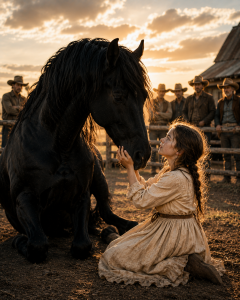
Sarah stepped into the corral carrying nothing but a rope halter she’d braided herself. No saddle. No bridle. The stallion stood waiting, coat catching the light, and when she approached, he didn’t rear, didn’t snort, didn’t do any of the things twelve men’s ribs had already taught the whole county to expect. He lowered his head.
The crowd went silent in a way Sarah had never heard a crowd go silent for her before.
She slipped the halter over his muzzle, climbed the fence, rested a hand against his neck, and pulled herself up onto his back. He didn’t move. She leaned forward, cheek against his mane, feeling his heartbeat steady under her own, and whispered something no one else was close enough to hear.
Then he walked — not a buck, not a rear, just a slow, even circle around the corral, dust lifting soft at their feet, while every person at that fence watched a girl they’d already decided was hopeless sit a horse that had broken twelve grown men without once looking like she was holding on for her life.
It wasn’t force keeping her there. Everyone watching could see that, even if none of them had the words for it yet. It was something closer to being asked, and answering yes.
For the first time in her life, Sarah didn’t fall.
The silence after the stallion finally stopped lasted long enough that the wind through the dry grass was the only sound left in the corral. Then someone whispered, “Did you see that?” and the whole thing broke open — murmurs, disbelief, Jack and Thomas staring with the smirks wiped clean off both their faces.
Sarah slid down into the dust, knees trembling, not from fear. The stallion turned his head and pressed his muzzle against her shoulder, gentle in a way that felt almost deliberately human, and it was that gesture — not the ride itself — that finally put tears in her eyes.
Her father climbed the fence. The crowd went quiet again, watching a man known for saying almost nothing walk toward his daughter with an expression on his face that none of them, and maybe not even Sarah, had ever seen him wear.
He stopped a few feet away. “How did you do that?” His voice came out rougher than he meant it to.
Sarah swallowed. “I didn’t make him do anything,” she said. “I just listened.”
Robert McCry looked at the horse standing calm and unrestrained beside his daughter — the same horse that had broken every man who’d tried to claim him — and something in his face wasn’t just pride. It was closer to regret, the kind a man carries when he realizes, publicly, in front of half the county, exactly how long he’d been looking past the one child who needed him to look.
He didn’t get the chance to say which one it was. Because that night, while the ranch was still buzzing over what they’d all watched happen in broad daylight, the sky over Red Creek turned the color of a bruise, and by the time the first thunder cracked, nobody was thinking about the stallion at all — they were counting how many cattle they were about to lose to the dark.
PART 3
The men began to cheer before Sarah had even wiped the dust off her hands. Someone shouted, *”She did it!”* and it spread through the crowd the way news always spreads on a ranch — fast, loud, and slightly disbelieving of itself. The cowboys who’d been thrown days earlier shook their heads and laughed, not unkindly, the laugh of men admitting they’d been wrong about something in a way that didn’t cost them anything to admit. Sarah felt her chest swell, and it took her a moment to understand the feeling wasn’t pride. It was simpler than that. For the first time in years, she felt seen.
That evening the ranch buzzed with talk while the sun went down orange and red over the hills. The stallion grazed near the fence, his coat catching the last light like something liquid. Sarah sat close by, not feeling like a hero, just feeling something she hadn’t had much practice with — peace.
Her father found her as the first stars came out. He stood beside her a long time without speaking, which for Robert McCry was its own kind of sentence.
“Your mother would have been proud,” he said finally.
Sarah blinked hard. “You really think so?”
“I know it.” He was quiet a moment. “She always said you had a way of feeling what other folks couldn’t.”
“Guess she was right.” Sarah smiled, and for the first time in a long while it wasn’t a smile she had to build on purpose.
“He’s not broken, Pa,” she said, nodding at the stallion. “He’s just free in a different way.”
Her father nodded slowly, like he was turning the idea over and finding he agreed with it more than he expected to. “Maybe that’s the way it should be.”
Things shifted after that, not all at once, but steadily. Sarah still rose before dawn, still worked until dark, still did every chore she’d always done — but the ranch hands looked at her differently now. Some asked her opinion instead of avoiding her entirely. Jack stopped with the jokes. One evening he handed her a saddle blanket embroidered with her initials, not saying much beyond a mumbled *thought you should have this,* which from Jack was closer to an apology than anything a McCry man usually managed out loud.
The stallion — she’d started calling him Ransom — became her shadow. He waited by the gate while she fed the cattle, followed when she carried water, came when she whistled from clear across the pasture. He never let anyone else near him. Not her brothers. Not her father. Not even the gentlest hand on the ranch. Only Sarah.
Peace on a ranch never lasts long, and it didn’t here either.
Three weeks after the corral, a storm rolled in off the plains at night, the kind that turned the sky the color of a fresh bruise before the first crack of thunder even hit. Lightning split the dark in sheets. The cattle panicked before anyone had a chance to react, and the herd broke through the lower fence line, stampeding for the open prairie — and beyond it, the canyon rim.
The ranch went from asleep to chaos in under a minute. Men grabbed lanterns and ran for the stables, shouting into wind that ate half of what they said. Sarah came out of the barn barefoot, hair whipping across her face, and found Jack already mounted, yelling over his shoulder.
“They’ll head for the canyon if we don’t turn them!”
“Stay back, Sarah!” her father shouted from somewhere in the dark. “It’s too dangerous!”
She was already running for Ransom’s pen.
The stallion stood tense at the noise, eyes wide at every crack of thunder, and for one long second Sarah understood that this was the actual test — not the corral, not the crowd, but whether the trust they’d built in quiet moonlight would hold up when the world was loud and the stakes were real. She swung the gate open.
“Come on, boy,” she said, breathless. “They need us.”
He didn’t hesitate. He lowered his head and let her up bareback in the dark, and she rode him out into rain that stung like gravel, following the sound of hundreds of hooves toward a canyon rim none of them could see yet.
Lightning lit the field white for half a second — long enough to show her the herd, a churning black mass driving straight for the edge. “Easy, boy,” she whispered, and pressed her knees against him. “We can do this.”
He surged forward like the storm had been waiting for permission to let him move. They cut into the flank of the herd, and Sarah leaned low and shouted and waved, turning the lead cattle a few feet at a time, praying the ground held under them both. The earth shook. The storm roared overhead. Ransom never faltered, never spooked, never once acted like the animal that had put twelve men in the dirt three weeks earlier.
Jack caught sight of her through the sheeting rain. “Sarah! You’re insane!”
She didn’t answer. She kept moving, circling, turning the herd a section at a time, and the other riders — men who three weeks ago wouldn’t have followed her lead across an empty field — started following it now, because in that storm, at that hour, she was the one who clearly knew what she was doing.
It took minutes that felt like an hour before the herd’s panic finally broke and the cattle began to slow, turning back toward the valley instead of the drop. When the last of them swung safely away from the rim, Sarah pulled Ransom up, chest heaving, rain running down her face, and understood in the next flash of lightning exactly what they’d just done. Hundreds of animals, a fraction of a second from the edge, turned back by a girl and a horse nobody had trusted three weeks earlier.
Back at the ranch, soaked through and shaking, she slid down from Ransom’s back to find her father waiting under the barn awning, eyes wide with something that wasn’t just relief.
“You could have been killed,” he said, and his voice actually trembled.
“You taught me to take care of what’s ours,” Sarah said simply. “Tonight that included them.”
He looked at her for a long moment. Then he pulled her into a rough, sudden embrace, rain and horse and dust all mixed together in the space between them.
“You’re your mother’s daughter,” he said quietly.
Behind them, Ransom stood steaming in the cool night air, dark eyes calm and watchful, like he already understood something the humans were still catching up to.
No one in Red Creek laughed at Sarah McCry again after that night.
The morning after the storm came in gold across the plains, the air smelling of wet earth and the particular relief of a disaster that didn’t happen. No cattle lost. No riders hurt. Sarah stood at the corral fence watching Ransom graze, hair still damp, and for once everything simply felt right.
Her father came out of the barn, shoulders straighter than she remembered them being in years. “Town’s talking,” he said. “Word travels fast about what you did.”
“Let them talk,” Sarah said, and found she meant it.
“They’re saying you and that horse saved more cattle than ten men could have.” He paused, voice rough in a way she was starting to recognize as the closest he got to sentiment. “I don’t know if that’s true. But I know I’ve never been prouder.”
It hit her harder than any applause from the corral had. She had spent years chasing an approval that always seemed to be standing just out of reach, and now it had found her on a morning she hadn’t been trying for it at all.
Word of what happened traveled well past Red Creek over the following weeks. Ranchers from neighboring counties rode in to see the girl who’d tamed the unbreakable stallion, wanting to know her method. Sarah always gave them the same honest, unglamorous answer. “I didn’t tame him. I learned to listen.” Some thought that was nonsense. The ones who stayed long enough to actually watch her work usually stopped thinking that. She didn’t force anything, didn’t rush, treated every animal like it had a reason for whatever it was doing, and waited for that reason to show itself before she asked for anything back.
Ransom never wore a bit. Never took a whip. He stayed wild at the root of him — but gentle, specifically and only, with her. Sometimes she thought he understood her before she’d finished forming the thought herself.
By summer, riders from across Texas were bringing their roughest, most stubborn horses to the McCry ranch to learn what she did differently. Some called her strange. Some called her gifted. Nearly all of them left having changed at least one thing about how they handled an animal.
Her brothers were among the first to admit they’d had it backward. One evening, brushing Ransom’s mane beside her, Jack said quietly, “You showed us something we didn’t understand. We thought riding was about control. You proved it’s about faith.”
“It’s about both,” Sarah said, handing him the brush. “You can’t guide what you don’t respect.”
From that day, even Jack started handling the horses differently. So did Thomas. Fewer bucking fits. Fewer broken spirits — animal or otherwise.
That autumn, a stranger rode into Red Creek — a tall man with a scarred jaw and a horse that fought its own reins like it was trying to escape something no rope could reach. He claimed he’d come from a wealthy outfit farther south, having heard about the girl who could gentle anything.
“They say you can gentle any animal,” he said. “Handle this one, I’ll pay whatever you ask.”
Sarah studied the horse — its eyes wild, but wild in the specific, cornered way of something hurt rather than something mean. “He’s not dangerous,” she said quietly. “He’s hurt.”
The man laughed. “He’s dangerous. That’s what he is. No woman’s fixing that.”
Her father, standing nearby, narrowed his eyes. “Careful how you speak.”
“It’s all right, Pa.” Sarah walked toward the horse slowly, voice even. “Easy now. Nobody’s going to hurt you.”
The animal snorted, every muscle strung tight — and then, before the stranger could get another word out, lowered its head slightly toward her open hand.
The man’s laughter died in his throat. He dismounted, shaking his head. “Well, I’ll be damned.”
Her father stepped up beside her, pride plain on a face that had spent most of Sarah’s life keeping it hidden. “Told you she was special.”
That night Sarah sat by the fence, watching the stars come up over the plains, Ransom quiet and solid beside her. She thought about the distance between the girl who used to be thrown in under ten seconds and the woman sitting here now — not because anything about her had changed overnight, but because someone, something, had finally decided she was worth trusting first.
She rested a hand on his neck. “You chose me when no one else did,” she said softly. “Guess we both needed that.”
He flicked an ear, breathed warm against her shoulder, and for a long while neither of them moved, still and content under a Texas sky that had, for once, nothing left to prove.
Years passed the way they do on a working ranch — steadily, without asking permission, turning girls into women and stallions into something closer to old friends than wild things. The story of Sarah McCry and the black stallion got told in ranch houses and saloons and around more campfires than she ever kept track of, usually bigger with each telling. But the version she liked best was always her father’s, because he never called it a story about taming a horse. He called it a story about a girl who found her own strength in a world that kept asking her to be someone else, and about the particular courage it takes to stay exactly as different as you are until the right thing recognizes you for it.
The ranch became known, eventually, as a place where horses were handled as partners instead of conquests — where a rope halter and patience did more than any bit ever had. Long after Sarah’s hair had gone the color of frost and her hands had gone lined with decades of it, Ransom still roamed beside her, wild in the ways that mattered and never once truly owned, but always, without question, home.
On quiet evenings, when the sun dropped low and the air cooled off the plains, neighbors still swore they could see the two of them out riding — girl and horse, one silhouette against a sky the color of embers, moving like they’d never once needed anyone’s permission to belong to each other.
THE END