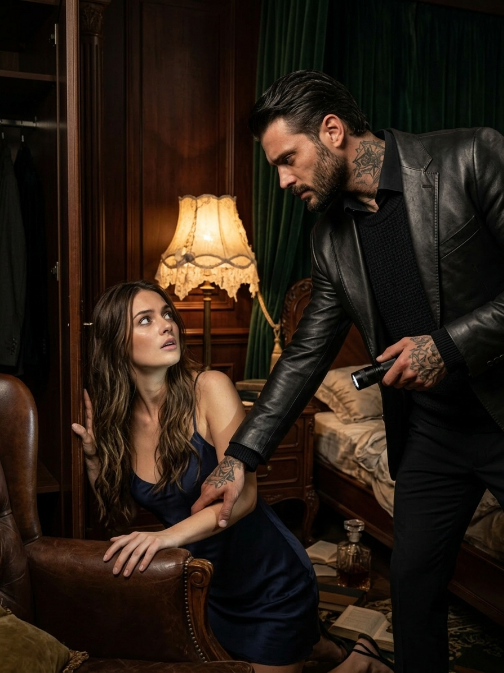
The Homeless Girl Screamed at the Mafia Boss’s Wife’s Funeral—Then the Face in the Coffin Exposed a Terrifying Lie

PART 1
Luca Ferrara had not slept in three days.
He stood at the front of Our Lady of Victories in Boston’s South End with his hands folded at his waist and his face arranged into the expression he had built over twenty years of being the most feared man in the city — cold, controlled, unreachable — and he thought about a cup of coffee Sofia had left on the kitchen counter the morning they said she died.
Still warm when he came downstairs.
That was the thing he couldn’t move past. The coffee, still warm, and the note she’d left saying she’d be back by noon, and the call that came at 10:47 from an officer who had the particular careful voice of someone who has been trained to deliver news that can’t be fixed.
The accident, they said.
The car, they said.
Unrecognizable.
He had identified her by her wedding ring.
Now the ring was on his finger, which Sofia had laughed at once in their early years, saying it was the most sentimental thing about him and the only thing she would never let him live down.
Two hundred people filled the pews behind him.
Not ordinary mourners. Men whose names appeared in federal files without charges attached. Women with the particular composure of people who had learned that composure was the only luxury that couldn’t be taken. Soldiers. Lawyers. The kind of clergy who had learned when to ask questions and when to let the candles speak for themselves.
His sister Giulia stood at his right side, one hand resting on his arm.
She was thirty-two, elegant in black, her face a study in grief that looked exactly right.
Luca had not been able to feel grateful for her presence.
He could not feel much of anything.
The priest was speaking.
Luca was looking at the white coffin, draped in enough white flowers to build a small house, and he was thinking about the particular way Sofia smelled in the morning — warm, faintly like the gardenia soap she ordered from a shop in Lisbon — and whether that was a thing that would eventually stop mattering or whether it would stay sharp forever, and he was deciding that he did not know yet.
Then the doors at the back of the church opened.
Not gently.
They opened the way things open when the person pushing them does not have enough weight to do it properly and is using everything they have anyway.
A child came through.
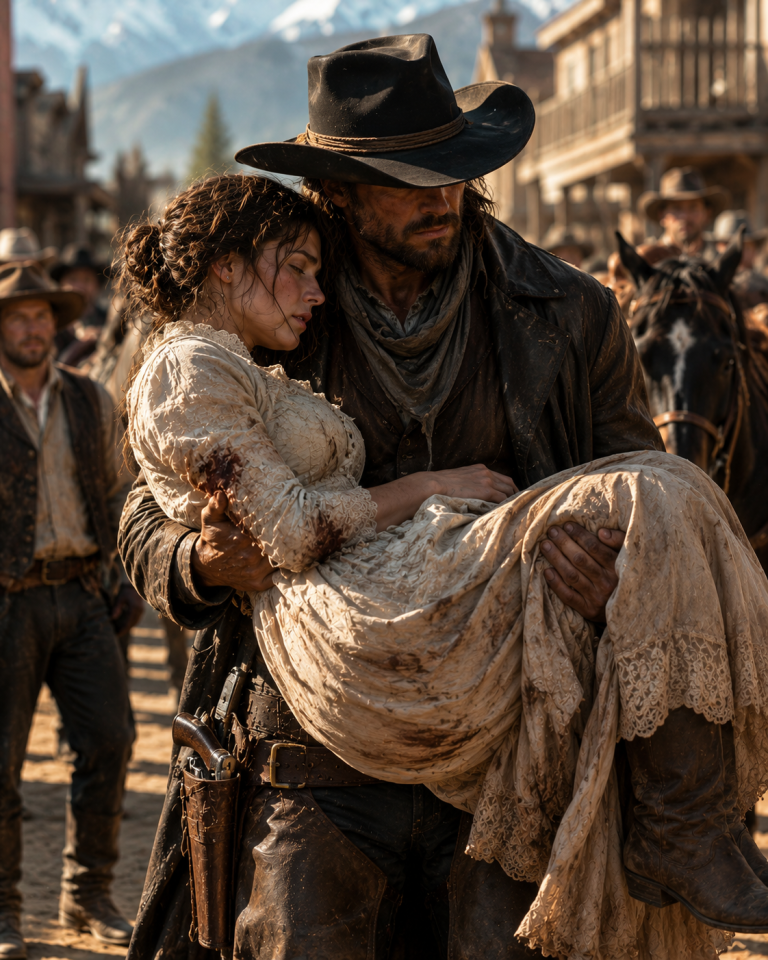
Barefoot. She was moving fast enough that the security guard at the entrance reached for her arm and she ducked under it without breaking stride — not a practiced move, just the reflexive agility of a small person who had learned that being grabbed had consequences.
She was maybe eight. Her coat was a man’s jacket, clearly found rather than chosen, reaching nearly to her knees, torn at the shoulder seam. Her hair was loose and dark and tangled. Her face had the quality Luca had seen once before, in a photograph of his own father taken during the worst years — the quality of someone who has been chronically cold and hungry for long enough that they have stopped mentioning it.
She ran halfway down the aisle before anyone managed to move toward her.
“Stop!” she shouted.
The word hit the stone walls and scattered.
Two hundred heads turned.
“That’s not her!”
The priest stopped mid-sentence.
Luca turned.
The girl was trembling — visibly, from her shoulders down — but she had planted her feet on the marble floor with the specific determination of someone who has decided this is the thing they are doing today regardless of the consequences.
“She’s alive!” the girl said. “I saw them take her. I saw it.”
Giulia’s hand tightened on Luca’s arm.
“Street child,” she said quietly, with the particular precision of someone presenting a category rather than a person. “She wandered in. Get her out, Luca, before she ruins this.”
His men moved.
The girl held up both hands.
“License plate,” she said, louder. “Seven Alpha nine-four-four. Black Escalade. Two men. One had a tattoo. A scorpion. Here.” She pointed to the inside of her left wrist.
In the third row, Nico Sardo moved.
It was small. Barely a shift. He pulled his left cuff lower with two fingers, the motion of a man adjusting by reflex when a reflex is the wrong thing to use.
Luca had known Nico Sardo for eleven years. He knew every tell the man had.
He raised his hand.
His men stopped.
The cathedral went so quiet Luca could hear the candles.
He stepped away from the coffin.
He walked toward the girl with the measured pace he used when he wanted to give a room time to understand what was about to happen — slow, deliberate, his shoes on the marble the only sound. When he reached her, he stopped and then did the thing that made every person in those pews go still in a different way.
He lowered himself to one knee.
The most feared man in Boston at eye level with a barefoot child.
“Tell me everything,” he said. “Every word.”
The girl’s name was Paz Rivera.
Her eyes moved to the coffin, then back to him.
“Three days ago,” she said, “near the CVS on Tremont. I saw your wife come out. She was pregnant. She gave me money for my abuela’s medicine last week and said she’d be there on Thursdays. I went back to thank her.”
She reached into the pocket of the oversized jacket.
A bracelet. Silver. A small bird in mid-flight, wings spread.
Luca could not breathe.
He had given that bracelet to Sofia on their wedding night. He had said something embarrassingly sentimental about it, something about a bird that had never been put in a cage, and Sofia had laughed and said that was the most he had revealed about himself in a single sentence and she was writing it down.
“She dropped it,” Paz said. “When they grabbed her. She dropped it and she looked at me before the door closed.”
“What did she say?” Luca asked.
Paz’s eyes filled.
“She didn’t say anything out loud. But I knew what she meant.”
Luca took the bracelet from the girl’s hand with the care of someone handling something that would shatter if he moved too fast.
Then he stood.
“Open the casket,” he said.
Giulia stepped forward.
“Luca, please, this is completely—”
“Open it,” he said.
His men moved. Flowers fell. The white lid was lifted.
The woman inside was beautiful. Dark hair. Pale skin. Her hands folded with deliberate peace over her chest. At any distance, at any moment of reduced attention, she could pass.
Luca looked at the inside of her left wrist.
Sofia had a small crescent-shaped birthmark there, the size of a thumbnail, which she always said looked like a crooked moon.
This woman’s wrist was smooth.
“Close the doors,” Luca said.
He didn’t raise his voice.
He never had to.
Every exit locked in under fifteen seconds.
He looked down at Paz Rivera, eight years old, barefoot on marble that cost more than any apartment she had ever lived in, still trembling, still planted.
“You stay with me,” he said.
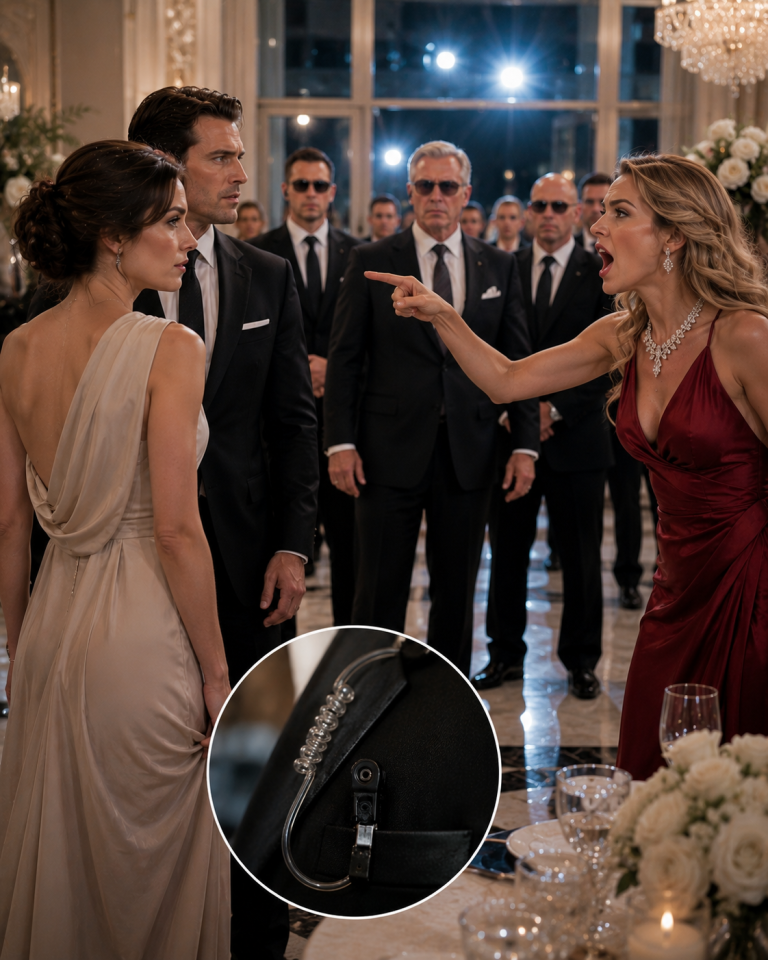
Giulia’s voice came from behind him, pitched to sound reasonable.
“Luca. She’s a child from the street. You can’t trust—”
“She’s the only person in this room who told me the truth.”
—
PART 2
Father Cavallo confessed in four minutes.
He was sixty-seven years old, a priest who had performed baptisms and last rites for three generations of Ferrara family, and when Luca sat across from him in the back office and said one word — *explain* — the priest came apart with the specific efficiency of a man who had been carrying a weight he was not built for.
“Judge Marsh,” he said. “Sofia’s father.”
Henry Marsh had been a federal judge before retirement. Meticulous. Well-regarded. The kind of man who had been photographed beside senators and used the photographs as wallpaper in his office. He had never forgiven Sofia for choosing the life she chose, which meant forgiving her for choosing Luca.
“His plan,” Father Cavallo said. “Sofia’s death, staged. A substitute from county records. A burial with closed casket originally — Sofia insisted it be open for Luca. Then Sofia would disappear under a new identity with the baby.”
Luca sat very still.
“She was afraid,” the priest continued. “Not of you. Of what your enemies might do to the child. She thought if she ran — if you believed she was gone — they would stop looking for leverage through her.”
The words reached Luca at a specific depth.
Sofia had smiled at breakfast.
Sofia had kissed him goodnight.
Sofia had let him put his hand on her belly in the dark and feel the small hard kick of something becoming a person.
And through all of it, she had been planning.
“What went wrong?” he asked.
Father Cavallo’s hands shook.
“Someone else took her first. Before the staged accident. Real men. The plan went wrong because someone else already knew where she would be.”
Luca turned.
Paz stood in the doorway.
She had been listening.
“The man with the scorpion,” Paz said carefully. “He wasn’t alone.”
Luca looked at her.
“There was a car behind the Escalade. I didn’t think about it before.” She paused. “A woman was in the front passenger seat. She had her window down. When Sofia came out of the CVS, the woman in the car did something with her hand.” Paz demonstrated — a small, deliberate gesture, like pointing without pointing. *There.*
Luca went absolutely still.
“What did the woman look like?”
Paz looked at the floor.
Then she looked at the door behind Luca, in the direction of the cathedral, in the direction of the elegant woman in black who had stood at Luca’s right arm through the entire service.
She didn’t say anything.
She didn’t need to.
Nico Sardo was brought in next.
He sat straight-backed, his expression held together with the discipline of a man who had survived eleven years of Luca’s proximity. When Luca told him to roll up his sleeve, Nico did it without argument.
The tattoo was there.
A scorpion, inside his left wrist, dark lines blurred slightly with age.
Paz looked at it, then looked up.
“He was near the CVS,” she said carefully. “But he wasn’t the one who grabbed her. The scorpion man who grabbed her was younger. Thinner. Different face.”
The identification was imprecise.
But Luca believed her, because she was the only one in the room who had been trying to be accurate rather than trying to survive.
The tech specialist entered with a tablet.
The plate led through three shell layers to Anton Brell.
The name moved through the room like smoke.
Brell had been trying to absorb the Ferrara South End operation for four years. He had been patient about it, which made him more dangerous than impatient rivals. He had waited for the right moment and found it in a planned disappearance that had been leaked to him from inside the household.
“Brell has my wife,” Luca said.
But the question that mattered more was how Brell had known exactly where to be at exactly the right time.
And Paz Rivera was looking at the door again.
—
PART 3
Luca found Yolanda, the Ferrara housekeeper of fourteen years, in the kitchen of the Beacon Hill house.
She confessed before he finished the question.
She was sixty, solid, a woman who had cleaned blood from expensive floors without once asking whose it was. She cried the way people cry when they are past concealment — in gulps, her hands flat on the counter.
They had threatened her grandchildren. Not her. Her grandchildren, by name and school schedule, which meant someone had done research.
She had passed Sofia’s Thursday schedule to a number she was told to never call twice.
“Who gave you the number?” Luca asked.
She shook her head.
Not because she didn’t know.
Because she was afraid of the name.
Luca looked at her for a long time.
“They said there are worse things,” she whispered.
He left her in the kitchen.
Luca called Henry Marsh from the library.
The former judge answered immediately, which meant he had been waiting.
“You’ve opened the casket,” Marsh said.
“You tried to steal my wife and my child.”
“I tried to save them from the world you built around them.”
“You failed.”
A long pause.
Then: “We traced Brell to a cold storage facility in Charlestown. Two access points. At least fifteen men inside. A direct approach gets her killed.”
“I know.”
“There’s a service tunnel under the south end of the building,” Marsh said. “Old infrastructure. I have the schematics.”
A small voice came from the doorway.
Paz stood there in the oversized jacket, the tactical vest Luca’s men had insisted on hanging off her shoulders, a flashlight in one hand.
“I know that building,” she said. “There are crawl spaces under the old loading docks. Homeless people use them. I used them last winter.” She held up the flashlight. “If there’s a way under it, I can find it.”
Giulia, who had been standing near the window in controlled silence for the last two hours, stepped forward.
“Absolutely not. You’re going to trust a child—”
“She’s already proven herself tonight,” Luca said. “More than most people in this room.”
Giulia’s expression flickered.
Something moved behind it.
Paz saw it.
She didn’t say anything.
But she remembered it.
The crawl spaces beneath the Charlestown facility smelled of rust and standing water and the particular cold that lives underground in New England winters.
Paz led.
She moved the way she moved through the city above — quickly, with the economy of someone for whom navigation had always been survival. Left where the pipe made a sound like breathing. Under the collapsed section that looked impassable but wasn’t. Flat on your stomach for the stretch where the ceiling dropped to eighteen inches.
Luca watched her from behind.
He had ruled half of Boston by understanding which people were what they appeared to be and which people were something else entirely underneath.
This child was something else entirely.
Sofia had seen it from a street corner in the cold.
He was only seeing it now.
Twenty minutes in, Paz raised her hand.
Voices ahead. Two guards moving through a side corridor, flashlight beams cutting across the dark.
She clicked her light off.
Everyone stopped.
In the narrow space, pressed against a concrete wall, she reached back in the dark and found Luca’s sleeve.
*Not yet.*
He didn’t move.
The guards passed.
Paz led them deeper.
At the end of the main crawl, a rusted grate blocked the way up.
Through the floor above: footsteps, voices, and then — under all of it — a sound that made the air in Luca’s lungs go solid.
A woman’s voice. Brief. Cut off.
His men removed the grate.
They came up into the facility.
The fight lasted six minutes.
Brell’s people came from the upper platforms and the equipment bays. Luca’s team moved with the specific efficiency of people who had prepared for exactly this layout. Marsh’s men took the east access. Luca moved through the center of it.
Paz hid behind a stack of pallets, both hands pressed flat over her ears.
Then she saw the door.
Steel, industrial, in the northeast corner. Two guards outside. One of them had a tattoo on his inner wrist — not a scorpion, she could see from here, but something with similar lines, a different animal.
She pressed the radio to her mouth.
“Luca. Northeast corner. Steel door. Two guards.”
Across the facility floor, through the smoke and noise, he turned.
His eyes found the door.
Nothing slowed him after that.
The door came apart.
Sofia Ferrara was inside.
She was tied to a support column, her wrists wrapped with rope that had been cinched and not thought about since — raw, red, the marks of something not designed for precision. Her face was bruised on the left side. She was dehydrated. Her hands had been positioned low, consciously, the way someone does when the thing they are protecting is inside themselves.
She was alive.
She looked up when the door came down.
“Luca.”
Her voice was wrecked from hours of not being used for anything it wanted to say.
He crossed the room and cut the rope and she came against him without being guided.
He held her the way he had been trained not to hold things — without restraint, without reserve, his face in her hair.
“I was trying to leave,” she said. “I was scared. I didn’t know what else to do.”
“I know,” he said. “I know. You were protecting the baby.”
“I should have told you I was scared.”
“We’ll figure out what you should have done later. Right now you’re here.”
The doctor who had come with Marsh’s team checked her pulse, her blood pressure, then pressed a stethoscope to her abdomen.
Sofia watched the doctor’s face.
Luca watched Sofia’s face.
“Fetal heartbeat is strong,” the doctor said. “She needs IV fluids and monitoring, but both are stable.”
Luca closed his eyes.
That was the moment something that had been locked in his chest for three days cracked open and let air in.
Paz appeared in the doorway.
Filthy. The tactical vest hung to her knees. She had a small cut on one hand from the crawl space grate. She held the flashlight pointed at the floor like she wasn’t sure whether she was allowed to come in.
Sofia looked at her.
“You,” Sofia said softly. “From the CVS. You came to the pharmacy to thank me.”
Paz nodded.
“You saw them take me.”
Paz nodded again.
“And you went to the funeral and you—” Sofia stopped. Her voice broke, just once, before she held it. “You stopped them from burying me.”
“I saw your eyes,” Paz said. “Before they shut the door.”
Sofia reached out her hand.
Paz hesitated.
Then she crossed the room.
Sofia held her.
Not with the careful formality of a grown woman handling someone small. With both arms, fully, the way you hold something you came close to not having a chance to hold.
“You saved me,” Sofia said into Paz’s hair. “You saved both of us.”
—
Anton Brell was brought to his knees in the service yard.
The expensive suit was torn at the shoulder. A cut ran from his left eye to his jaw. He looked up at Luca with the expression of a man running calculations on whether charm still worked in this situation.
“Ferrara. Let’s be practical. Territory. Money. Whatever you name.”
“You touched my wife.”
Brell’s expression adjusted.
“You held her in a concrete room,” Luca said. “You let them put rope around her wrists. Her baby is eight months.”
“It was—”
“Don’t say business.”
Brell went quiet.
“You don’t die tonight,” Luca said. “Death would be a mercy. You’ll live long enough to watch every account freeze. Every building change hands. Every man who took your money explain to someone else why.” He paused. “By the end of the week, the South End belongs to Sofia.”
Brell stared.
“My wife,” Luca said, “decided she needed to run from my world. She’s not going to need to run from it anymore.”
—
The mansion on Marlborough Street was a different place in the days that followed.
Sofia recovered slowly, then quickly, in the way of people who are physically strong and determined to get back to their child before the child arrived. The doctor came twice daily. Marsh came once, sat at the foot of the bed, and said things to his daughter that were long overdue.
Luca did not sleep well.
He did not expect to, not yet. There was still the question of the leak — how Brell had known about the Thursday route, the specific timing, the precise position of Sofia on Tremont Street. Clara the housekeeper had been the conduit. But Clara hadn’t chosen the target. Clara had only reported the schedule to a number someone else had given her.
Paz came to him in the hallway outside the library on the third day.
She had been given a room to sleep in, which she had accepted with the polite suspicion of someone not used to rooms being offered. She was wearing borrowed clothes that actually fit, which had taken until the second day to locate. She carried her flashlight even though she didn’t need it.
She had been thinking, she said.
“There was a car behind the Escalade,” she said. “I told you about the woman’s hand. The gesture.”
“Yes.”
“She was in the front seat. Passenger side. When Sofia came out of the CVS, she did this.” Paz demonstrated again — the small, deliberate indication. *That one. Her.*
“You’ve already told me this.”
“I know. But I’ve been thinking about where the car was parked.” Paz looked at the floor, then at him. “It was parked exactly where you would park if you were watching for someone who was about to come out of the pharmacy for the first time. Not someone you’d been following. Someone you knew the exact schedule of.”
Luca was quiet.
“And the woman,” Paz said, “was wearing a black dress. Nice. Like for a church.”
It landed slowly, then all at once.
Three days before the funeral. A black dress.
The kind you would already be wearing if you were about to attend a memorial.
The kind you would already have laid out because you already knew one was coming.
Luca walked to his sister’s room.
Giulia was there, sitting at the vanity, composed in the way she had been composed all week — the grief she had performed at the cathedral, the steady hands, the careful expressions. She looked up at him in the mirror.
“You let them know where she was,” Luca said.
Giulia set down the hairbrush.
“Luca—”
“You didn’t plan it. Brell found a use for the information you gave him. But you gave it.”
Her face did something complicated.
She turned from the mirror.
“You were different after her,” Giulia said. “You were always—” She stopped. Restarted. “After her, you became something I didn’t recognize. You started building things that had nothing to do with the family. You became careful in ways that had to do with her and not us. She changed you.”
“Yes,” Luca said. “She did.”
“I told someone in Brell’s organization that Sofia went to Tremont on Thursdays.” Giulia’s voice was very even. “I didn’t know what they would do with it. I told myself I didn’t know.”
“You knew.”
She looked at him.
“You did something to his wife,” Luca said. “Three days after Sofia came home, the soup. Yolanda saw something in the kitchen that Paz confirmed when we showed her the bottle. You were waiting to see if the rescue worked before you tried again.”
Giulia’s composure finally broke — not into grief, but into something rawer than that.
“You were going to leave me behind her,” she said. “Baby. New house somewhere safe. A new world for them. And I would become the thing at the edge of it.”
“You were always going to have a place here.”
“Not the same place.”
He looked at his sister for a long time.
The girl he had raised after their parents died. The woman who had stood at his right arm through every important day of his adult life.
“No,” he said finally. “Not the same place. Sofia was my wife. The child will be my child. That changes what they are to me. That doesn’t end what you are.”
Giulia looked at the floor.
“But you did what you did,” he said. “And Sofia almost didn’t come home.”
He opened the door.
The men waiting outside knew what they were there for.
“Alive,” Luca said. “She answers for what she did.”
Giulia said his name as they walked her out.
He did not follow.
—
The weeks after were for rebuilding.
Not the empire — that had continued operating, as empires do, because they are larger than any single crisis. What needed rebuilding was the human interior of things.
Sofia came home in the second week. Paz and her grandmother Concha came in the fourth, to an apartment on the first floor of a building the Ferrara organization owned in the South End, two blocks from the pharmacy where Sofia had stopped on a Thursday afternoon and kneeled on a dirty sidewalk to talk to a small person the rest of the city walked past.
The apartment had heat. Working locks. A refrigerator that was full when they arrived.
Concha cried and held Sofia’s hands and said things in Spanish that Paz translated approximately as *you didn’t have to* but that Sofia heard as *thank you.*
Luca stood in the hallway outside and listened to the sound of it.
Brell’s operation was absorbed over thirty days, through documentation and leverage rather than violence — largely because Sofia had asked for a different approach, and Luca, slowly and with considerable effort, had found a way to provide it.
Three former Brell properties on the waterfront became a legal aid center, a community health clinic, and a warm-room shelter for people who needed somewhere to go in winter. The clinic was named after Concha Rivera, who had never set foot in it but whose granddaughter had slept under cold buildings so she could keep buying her grandmother’s heart medication.
Henry Marsh was not forgiven.
But he was allowed to sit in the hospital room when the baby was born, which was a kind of beginning.
The baby was a girl.
Sofia named her Luce — light in Italian — because, she said, there had been a great deal of darkness and she wanted the name to mean something about where they were headed rather than where they had been.
Luca held his daughter in the hospital room with the careful hands of someone who had never been afraid of anything and was now afraid of everything.
Paz stood on the chair by the window so she could see.
“Can I?” she asked.
Sofia held out the baby.
Paz sat down and took her — surprisingly steady, the steadiness of a child who had been trusted with fragile things and had understood the weight of that.
She looked down at Luce for a long moment.
“Hi,” she said. “I’m your friend.”
Luca made a sound.
Sofia, who had seen him hold himself together in situations that would have broken most men, looked at her husband.
His face was not controlled.
His face was entirely undone.
“Good,” she said softly.
He looked at her.
“You finally look like yourself,” she said.
He sat on the edge of the bed and put one hand on her shoulder and one hand gently beside Paz’s on the blanket around his daughter.
Outside, Boston was doing what it always did — continuing, indifferent to the particular upheavals of its people, the harbor moving cold and dark, the city lights holding against the December sky.
Inside the hospital room, a barefoot child who had once slept under a cold building had a name, a warm bed, and a baby to hold.
And the most feared man in the city had learned, late and expensively, what his wife had understood from the first moment she knelt on a dirty sidewalk:
That the most important person in a room was often the one nobody had thought to watch.
That a small person, carrying nothing but the truth, was the most dangerous thing in the world.
And that love — real love, the kind that required you to actually see the person in front of you — was not something you could protect by running from it.
Only by staying.
Only by remaining.
Only by being the kind of person who still reached for someone’s hand in the dark, regardless of what the dark contained.