She Thought She Was Safe—Until the Mafia Boss Found Her Hiding

## PART 1
My entire life changed because of peonies.
If I had ordered them on time, I would not have needed to run to the supplier before closing. If I had not needed to run to the supplier, I would not have taken the shortcut through the alley on Crane Street. If I had not taken that shortcut, I would not have noticed the warehouse door hanging three inches open, the voices inside, the quality of the silence just before the crack of a gunshot.
And I would not have met the eyes of the man holding the gun.
Two seconds. That was all it took. His gaze found mine across the dark alley with the particular precision of someone who tracked threats the way other people tracked exits, and I understood in those two seconds that witnessing what I had just witnessed was not something I was meant to survive.
I ran.
I do not remember making the decision. One moment I was standing with a bag of peonies and a half-formed thought about ivory ribbons, and the next my work shoes were slapping against wet pavement and my lungs were already burning and two — maybe three — sets of footsteps were behind me growing closer.
I had been a florist for eight years. I was not in good shape for flight.
I ran anyway.
I lost my bag somewhere near Atlantic Avenue. My phone had been dead since noon. I had no money, no ID, no way to call anyone, and the footsteps behind me had not slowed. I turned corners without thinking, following instinct and desperation, until the neighborhood changed — brownstones giving way to older, heavier properties, iron fences, security cameras at every angle.
Headlights swept across the street ahead.
They were trying to box me in.
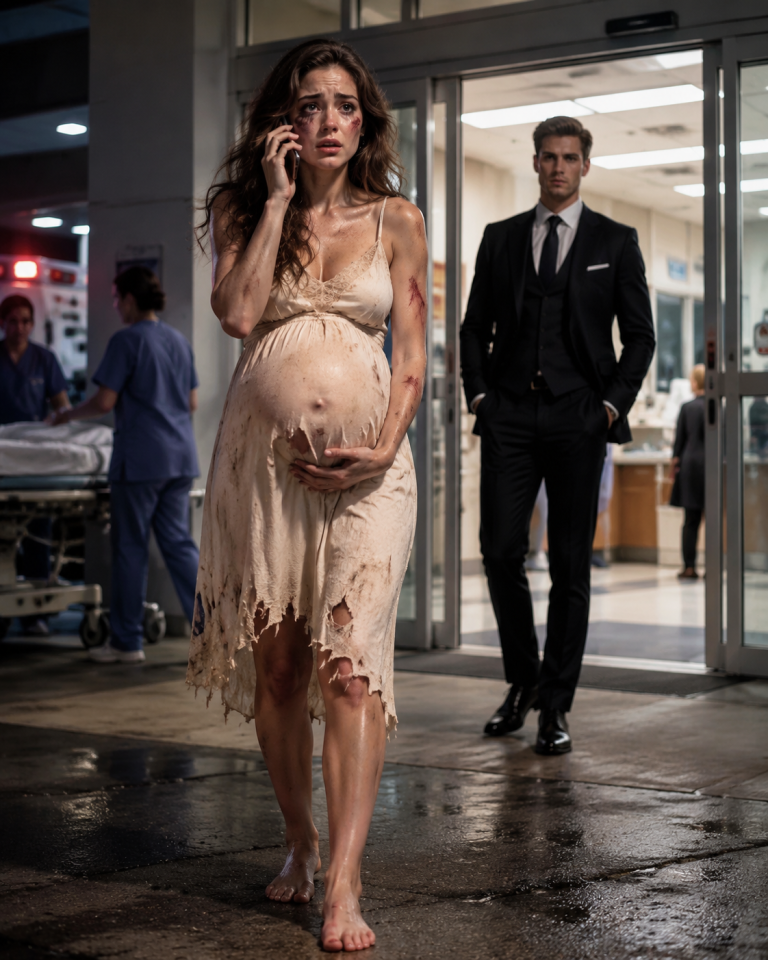
I veered toward the nearest property — a house set far back from the road, behind a gate that was closed but had a gap in the surrounding hedge barely wide enough to squeeze through. Thorns pulled at my apron, my hair, the backs of my hands. I went through anyway.
The garden beyond was dark and very still. The house it led to was lit from within, massive, old, the kind of building that had been designed to resist not just weather but consequence.
Someone was home. Someone who spoke in low, rapid Russian through a window I could not see.
More danger, my brain said.
But the footsteps outside the hedge were getting louder, and the back door was unlocked, and I was out of options.
I went inside.
The kitchen was all marble and stainless steel and the kind of silence that comes from expensive insulation. I moved through it without touching anything, following some animal instinct for deeper cover, up a back staircase and down a hallway, until I found a room draped in dust covers with the curtains drawn.
The bed was enormous.
I was under it in seconds, pressing myself against the wall, pulling the hanging edge of the duvet down to cover the gap. The floor was cold against my cheek. I put my hand over my mouth and breathed as shallowly as I could and waited.
Time became very strange.
I may have been there for twenty minutes or two hours when I heard the footsteps. Heavy. Deliberate. Up the stairs, down the hall, a pause outside the door.
The door opened.
Light.
Polished shoes crossed the floor — very expensive shoes, the kind I had only ever seen on customers who rented out entire botanical gardens for their weddings. The bed shifted as someone sat on the edge.
A lighter clicked. I smelled cigarette smoke.
Then:
“You can come out now.”
The voice was deep, Russian-accented, and so completely calm it was more frightening than shouting would have been.
I did not move.
“I know you’re there. I’ve known since you came through the kitchen.”
He let a long exhale of smoke drift toward the floor.
“You have ten seconds to come out on your own. After that, I come in after you. Your choice.”
I closed my eyes.
“Seven. Six. Five.”
The bed shifted again. I saw his shoes turn toward me.
I was out before he reached four.
I emerged in the worst possible way — slow, ungraceful, covered in dust and dry tears and the remnants of whatever I had scraped against in the hedge. I sat up on my knees and looked at the man standing over me and the breath went out of my body entirely.
He was very tall. That was the first thing. Silver-blond hair clipped close to his head. A face that could have been beautiful if it had not been so clearly designed for something more functional than beauty — all planes and angles and the kind of stillness that does not come from peace. Tattoos climbed his neck, Russian letters and symbols I could not read.
His eyes were gray. The specific gray of winter ice over deep water.
He looked at me the way certain men look at problems they are calculating solutions for.
“Interesting place to die,” he said.
“I’m not here to die,” I said, which came out considerably louder than I intended.
Something shifted in his expression. Just slightly.
He crouched, bringing himself to my eye level.
“Who sent you?”
“No one sent me. I was running. Men were chasing me.” The words tumbled out because terror had burned away everything careful. “I saw something I wasn’t supposed to see, and they chased me, and I didn’t know where else to go. Please. I’ll leave right now. I’ll forget this entire night.”
He studied me.
“What did you see?”
“A man being shot. Warehouse on Crane Street, maybe forty-five minutes ago.”
A pause. Something moved behind his eyes.
“Describe the shooter.”
I described him — the height, the dark hair, the scar along his cheekbone, the red shirt, the snake tattoo on his left hand.
The man in front of me went absolutely still.
“Kaspar’s man,” he said, more to himself than to me.
Then he stood to his full height and looked down at me with an expression I could not read at all.
“Get up,” he said. “We have things to discuss.”
He extended his hand.
I looked at it the way you look at something that might or might not be a trap.
“Who are you?” I asked.
“Nikolai Voss.” His hand did not move. “This is my house you broke into.”
Something that was not quite a smile crossed his face.
“And you, little florist, have just become the most inconvenient thing to happen to me in years.”
—
## PART 2
The study smelled of old wood and tobacco. The fire in the hearth was unreasonably large for the season. Two glasses of something amber already sat on the desk, though I had not seen anyone pour them.
Nikolai settled into the chair behind the desk and looked at me across it with those winter-gray eyes, and I understood that wherever this conversation went, I was not going to be the one directing it.
“Your name.”
“Wren. Wren Callaway.”
“The florist.”
“How—”
He nodded at my apron. I had forgotten I was still wearing it. *Wren’s Blooms, Red Hook.* Printed in small letters above a sprig of lavender.
“I know the shop,” he said. “I’ve had flowers sent from there. Arrangements for funerals.”
He looked at me with a quality of attention that felt like being very slowly taken apart.
“I attend many funerals, Ms. Callaway.”
The implication settled in the room between us.
“What happens now?” I asked.
“That depends on what you understand.” He steepled his fingers. “You witnessed a murder committed by a man who works for Kaspar Lenov. Kaspar runs the largest competing criminal organization in this city. He will not let you live. The man you saw will identify you. They will hunt you until you cannot be hunted anymore.”
“I could leave the city. Disappear.”
“You have no money, no identity documents that can’t be traced, and no skills for evading men who do this professionally.” He said it without judgment. “You would be dead within four days.”
“So what are my options?”
“One option. Stay here, under my protection, while I deal with the situation.”
“Deal with it how?”
“In the way appropriate to the circumstances.”
“And I’m supposed to just trust you? A man whose name I learned sixty seconds ago?”
“You’re supposed to trust that I’m the only alternative you have.” He rose and moved around the desk, stopping a deliberate distance away. “Kaspar’s men are still outside this property. They will be there until morning, at minimum. You cannot leave tonight. So the real question is not whether you trust me. The question is whether the man who wants you dead for what you know is a more compelling reason to stay than I am.”
I looked at him.
“What do you get out of protecting me?”
“An eyewitness to Kaspar’s operation. Leverage I didn’t have before tonight.”
“That’s honest at least.”
“I find honesty more efficient than its alternatives.”
He moved toward the door.
“Gregor will show you to a room. Tomorrow we discuss terms.”
“Terms?”
He paused without turning around.
“Nothing is provided without expectation of return, Ms. Callaway. Not even survival. Sleep on that.”
He left.
I sat alone in his study with the fire and the amber liquid I had not touched and the knowledge that I had just made the most dangerous bargain of my life.
And the very strange realization that I was, for the first time in hours, not afraid.
The fear had been replaced by something I could not immediately name.
It felt almost like the way I felt when I found the right flower for a difficult arrangement.
Like recognition.
—
## PART 3
### The First Morning
The room they gave me was larger than my apartment. I stood in the center of it at 3 AM and did not sleep.
By dawn I had catalogued the following: a closet with clothes in my size still tagged from a store I had never been inside; a bathroom with products that cost more than my monthly grocery budget; a window overlooking the eastern side of the property where a man in a dark jacket walked the perimeter every twenty minutes; and the specific quality of silence that belongs to houses where the people inside have learned not to make noise.
Nikolai was already at breakfast when the man he called Gregor walked me to the dining room. Huge windows. The ocean visible in the distance, pale and cold under a gray April sky. Nikolai read a physical newspaper, which struck me as both anachronistic and somehow right.
“You didn’t sleep,” he said without looking up.
“No.”
“Sit. Eat.” He turned a page. “Exhaustion affects judgment. Your judgment is currently the only thing keeping you useful.”
I sat at the far end of the table, which was long enough that it required a slight elevation of voice to be heard. I was not going to give ground on that.
“What happens to me when I stop being useful?”
He looked up for the first time.
“That is a more intelligent question than most people ask me in the first twenty-four hours.” He set the newspaper aside. “The honest answer is that your usefulness is contingent on how long Kaspar remains a threat. When he is no longer a threat, you are no longer a witness. You become simply a person who can return to her ordinary life.”
“How long?”
“Weeks, perhaps months.”
“My shop—”
“Has an automatic delivery hold as of this morning. I have people who handle practical matters.” He poured coffee with the precision of someone who did not like imprecision in small things either. “Your neighbor, an elderly woman — Mrs. what?”
I stared at him.
“Mrs. Albright. How do you know about—”
“Kaspar’s men went to your building last night. They questioned people in the hallway. She was not home, which means she has family she visits on Tuesdays.”
“Her daughter in Queens.”
“Then she is safe for now.” He pushed the coffee toward the empty space nearest him, a wordless invitation to move closer. “When that changes, I’ll have her moved.”
“You’ll have her moved,” I repeated. “To where?”
“Somewhere comfortable. Somewhere Kaspar’s people won’t find her.” He looked at me steadily. “I protect what falls under my roof. She’s adjacent.”
I watched him.
“You said it was because she might tell them something useful. That it was strategic.”
“I said that, yes.”
“But that’s not the whole reason.”
He reached for his own coffee. Said nothing.
“Why would you bother with someone else’s eighty-year-old neighbor if it was purely strategic? The strategic calculation doesn’t require her to be comfortable.”
Nikolai set his cup down very precisely.
“You should eat,” he said. “The eggs will get cold.”
I moved to the chair closer to him and ate my breakfast.
I did not push the question.
But something in the room had shifted.
—
### What the Study Revealed
Three days into my captivity — and I was honest with myself about calling it that, because leaving was not currently an option — I stopped lying awake counting exits and started paying attention to the house.
It was a strange house for a man in Nikolai’s position. Every room where he spent time had books in it, not decorative books arranged by spine color, but read books: dog-eared, annotated, arranged by argument rather than aesthetics. The kitchen, which he rarely used but sometimes sat in, had a window garden someone had been growing herbs in — the pots were ceramic, handmade, the kind bought from a market rather than a store. The library on the second floor was full of his mother’s things. He had told me this on day two with the flatness of someone reporting a fact, but I had noticed the way he ran his hand along one particular shelf without looking, the automatic gesture of someone touching something they cannot bring themselves to look at directly.
Her name had been Sasha. There were photographs in the library, in frames that matched the aesthetic of the rest of the house but were positioned at exactly the right height for a woman a full foot shorter than Nikolai to have arranged them.
“You miss her,” I said on day four, in the library where I had taken to spending my evenings.
He was in the chair across from mine. I was reading a collection of Russian poetry I could not understand, because the wear on the pages told me someone had loved it.
“That is not relevant to our arrangement,” he said.
“It’s not about the arrangement. I’m not trying to negotiate anything.” I ran my thumb along the spine. “I’m just noticing.”
He looked at me with the particular attention I was learning to read — not the threat-assessment quality from the first night, but something slower, something that was weighing rather than calculating.
“Sasha Voss died three years ago,” he said finally. “Cancer.” He paused. “I had access to every specialist, every treatment. None of it was sufficient.”
“I’m sorry.”
“I don’t want condolences.”
“I know. I’m giving them anyway.” I met his gaze steadily. “There’s a difference between wanting something and needing to receive it.”
A very long silence.
“You’re more perceptive than you look,” he said.
“I’m a florist. People tell me things they don’t tell their therapists. They’re ordering flowers for events that matter to them — weddings, funerals, anniversaries, apologies. They’re usually in a state where the walls are down.”
“And what have I told you?”
“Nothing, yet. But I’m learning the house.”
He looked at me.
“And what does the house tell you?”
“That the man who lives here is not the man everyone outside it thinks he is.” I paused. “Or rather — he is that man. But he’s also this one. Both things are true at the same time.”
The fire crackled. Outside, the April rain had started again.
“You should be more careful,” Nikolai said, but the warning had no edge to it.
“About what?”
“About seeing through walls. In my world, that makes you dangerous.”
“Does it?”
“In the best possible way.” He looked at me with an expression that made my pulse do something irregular. “That also makes you dangerous.”
—
### The Ice Cracks
The kiss happened on the ninth night.
I had not planned it. I do not think he had either, though with Nikolai planning was hard to distinguish from instinct — everything he did had the quality of decision-making at a level below conscious thought.
I had been in the library again. He had been at the desk by the window, writing letters by hand, which turned out to be something he did on Sunday evenings. I had finally asked him to read me something from one of the poetry books, and he had looked at me for a long moment before opening the worn Akhmatova collection and reading two poems in a low voice, translating them line by line in the same breath, his accent turning the English into something almost musical.
When he finished he set the book down and looked at me.
“Come here,” he said.
He had not used that particular tone before. Not commanding. Not indifferent. Something stripped of both.
I stood and crossed the room and when I stopped in front of him he looked up at me for a moment from the chair and then rose, and we were very close, and he said:
“Tell me to stop.”
“I can’t,” I said.
“Why not?”
“Because I don’t want you to stop.”
He kissed me with the focused intensity he brought to everything, which meant completely, which meant as though nothing else in the room existed.
Afterward we sat in the leather chair that was just large enough for both of us, tangled together, and talked until the fire burned down to embers. He told me about his father, who had raised him by turning everything soft into a vulnerability to be eliminated — including Sasha’s influence, including Dmitri’s gentleness, including Nikolai’s own capacity for anything that resembled care. He told me about the first man he killed, which was not something people usually disclosed, and I listened without looking away.
I told him about the foster homes after my parents died, each one with its own texture of provisional warmth, and about finding flowers when I was fourteen — a job at a market stall, the first time I understood that something could be both beautiful and functional. I told him I had been building an ordinary life deliberately, brick by careful brick, because ordinary felt safe.
“And now?” he asked.
I looked around the library that had been his mother’s.
“Now I’m not sure ordinary was what I wanted,” I said. “Or maybe I just needed to discover what the alternative looked like.”
He held me tighter.
“I’m a very poor alternative.”
“You’re the one I found,” I said. “I’ll work with what I have.”
—
### Kaspar’s Answer
The attack came three days later, which Gregor later said had been anticipated — Kaspar’s organization typically moved within two weeks when a threat had been identified and located.
I was in the greenhouse I had discovered attached to the kitchen wing, doing the thing I needed to do when I was anxious, which was arrange something. I had found clay pots and soil and several overgrown herbs that had been neglected since Sasha died, and I was repotting them and trying not to think about what Nikolai and Gregor were discussing in the study.
The explosion came from the east gate.
The sound was not loud exactly — more like the house absorbing a blow, a structural shudder followed by the immediate organized response of a building designed to survive this kind of event. Alarms, then their deliberate silencing. Voices in the hallway.
Gregor appeared in the greenhouse doorway at a controlled run.
“Ms. Callaway. The tunnel. Now.”
“Where is Nikolai?”
“Where he needs to be.” He took my arm, not roughly. “You are my responsibility. Come.”
The tunnel was under the garden, accessed through a door behind the cold storage room, down a flight of stairs that smelled of stone and old mortar. Gregor’s flashlight cut through the dark. Above us, filtered through earth and foundation, I could hear the distant sounds of violence.
“He’ll be okay,” Gregor said, which told me he had heard me breathing.
“You don’t know that.”
“I’ve been with Nikolai Voss since he was twenty-three years old. I have said that sentence more times than I can count.” A pause. “I have never been wrong yet.”
The safe house was three blocks away and three years more ordinary than anything Nikolai owned — a regular apartment building, a regular door, a kitchen with a regular coffee maker. Gregor installed me in the second bedroom and handed me a gun I barely knew how to use and a phone with two numbers programmed in it.
“Anyone who comes through that door who isn’t me or him,” he said, “shoot.”
“I’m a florist.”
“I know. Point, hold your breath, pull the trigger. You’ll be fine.”
He locked me in and left.
I sat on the edge of the bed and listened to the city outside and made myself breathe slowly, and I thought about the specific quality of Nikolai’s hands when they were not engaged in violence or strategy — careful, deliberate, the kind of hands that turned the pages of poetry books at a particular pace because the poems deserved it.
The door opened at 2 AM.
I had the gun raised before I was fully standing.
Nikolai walked through.
He was marked — a cut above his eye still bleeding, his shirt torn at the shoulder, the kind of exhaustion that lives below the surface. But he was standing. He was looking at me with the only expression that was entirely unguarded on his face, the one I had seen on the ninth night and in fragments since, the one that looked like relief so profound it had nowhere left to go.
I put the gun down.
I went to him.
He held me against his chest with both arms and his heart was going very fast.
“Kaspar?” I said.
“Won’t be a problem.” He pressed his face into my hair. “It’s finished.”
“Are you hurt?”
“Nothing significant.”
“Let me see.”
I examined his face in the bathroom light while he stood still with the patience of someone who had decided, somewhere in the past two weeks, that allowing this particular form of care was permissible.
“You should have stayed,” he said. “Here.”
“I did stay here. I’ve been here for three hours staring at walls.”
“I meant you shouldn’t have been in a safe house at all. You should have been somewhere further away, somewhere you didn’t have to listen to—”
“I didn’t want to be further away.” I looked at him directly. “Stop deciding what’s best for me without asking.”
A silence.
“That’s a reasonable demand,” he said finally.
“I have more of them.”
“I assumed.”
He caught my hand where it pressed the cloth against his cut, covering it with his own.
“Wren.”
“Don’t say I deserve better than this.”
“I was going to say I love you.” He said it with the precision he brought to everything important. “I wanted to say it before I decided whether it was wise.”
“And is it wise?”
“No,” he said. “But I find I don’t care.”
“I love you too,” I said. “I’ve known for about a week. I’ve been deciding whether to tell you.”
“What decided you?”
“You read me Akhmatova and translated it simultaneously without making it seem effortful.” I pressed my forehead to his. “That was the thing.”
The sound he made was not quite a laugh but was the closest thing to one I had heard from him.
“That’s a very specific threshold.”
“I’m a specific person.”
He kissed me, gently because of the cut, and I held his face in my hands and thought: *this is the wrong alley, the wrong night, the impossible man* — and all three of those things were exactly what had brought me here.
—
### What We Built Next
The transition took eight months.
Nikolai had been planning it in some form for years, he told me — not out of a specific moral awakening but because the mathematics of his position had a long-term trajectory he did not find favorable. Men in his business died or became men he would not recognize. He had been calculating his exit since his mother’s death, waiting for the conditions that would make it viable.
I was not, he was careful to clarify, the sole reason. I was the accelerant.
“You made the math feel worth doing,” he said.
“That might be the most romantic thing you’ve ever said to me.”
“I have said more romantic things.”
“The Akhmatova was more romantic.”
“The Akhmatova was poetry. That doesn’t count.”
“It absolutely counts.”
Dmitri arrived six weeks after the attack on the compound, which had been repaired with a thoroughness that left no visible evidence of damage. He was lighter than Nikolai in every way — lighter in coloring, lighter in manner, carrying the specific ease of someone who had escaped the worst of their father’s expectations.
He stopped dead when he saw me.
“The rumors are true,” he said.
“What rumors?”
“That my brother, who has spent fifteen years being the most impenetrable person in four boroughs, is apparently undone by a florist who broke into his house.”
“I didn’t break in,” I said. “The door was unlocked.”
Nikolai appeared from the study. “Dmitri. I wasn’t expecting you.”
“I know.” Dmitri embraced him, which clearly surprised Nikolai, who received it with the brief awkwardness of someone unaccustomed to being hugged. “I came to make sure you were alive. And to meet this woman, who I’m told said to your face on day two that you were lonely.”
“I did say that,” I confirmed.
“How are you still breathing?”
“Apparently it was the right thing to say.”
Dmitri looked between us with the expression of someone solving a pleasing equation.
“He’s different,” he said to me, quietly, while Nikolai went to get glasses. “I don’t know what you did exactly. But he’s different.”
“He was always different,” I said. “He was just very well hidden.”
“You make it sound simple.”
“It’s not simple. But the truth usually isn’t hidden as deeply as people think.” I thought about eight months of knowing Nikolai — the Russian poetry, the careful hands, the way he had ordered Mrs. Albright a comfortable apartment two weeks into my stay without announcing it. “He knew what he was doing. He just needed someone to see that it wasn’t the whole of him.”
Dmitri looked at me with something like awe.
“Will you come to my wedding?” he asked. “I’m getting married in the spring. She’s a pediatrician and she thinks I’m in import/export. I would very much like to have someone at the table who can help me explain things if necessary.”
“Delighted,” I said.
Nikolai reappeared with glasses. He handed one to Dmitri, one to me, kept one for himself, and said: “We’ll be at your wedding.”
Dmitri blinked. “I just asked her, I hadn’t—”
“You were going to.”
A pause.
“Fair,” Dmitri said.
We had dinner. Dmitri told stories about growing up that made Nikolai’s face do things I had only seen in private, the slight softening around his eyes that he had not yet learned to fully manage. I watched them together and understood that the distance between them had been a specific kind of wound — not hatred, not indifference, but the scar tissue of two people who had survived the same thing in different ways and not known how to come back to each other until now.
—
### What the Garden Grew Into
The shop reopened six months after the night I witnessed Kaspar’s man commit a murder in a warehouse on Crane Street.
It was larger than it had been — Nikolai had, without my specifically asking, purchased the space next door when it came available, and suggested I might want more room. He said it as if it were a practical observation and not a gift of significant proportion. I told him he was impossible and thanked him and designed a greenhouse section that opened directly onto the back courtyard.
We lived between two places that first year: his house in Brooklyn, where the garden I had begun was slowly becoming the thing I had described in the ruins of the compound that afternoon — vegetables, herbs, roses I cut fresh for the vases throughout the house — and a smaller apartment in Red Hook, near the shop, for the days when early deliveries made the commute impractical.
He came to the shop sometimes. He stood in the doorway of the workroom and watched me arrange things, and when clients were not there he would pick up flowers I set aside and ask what they were for, and I would tell him, and he would file it somewhere.
“You’re learning,” I said one afternoon.
“I’m observing.”
“Same thing, with you.”
He picked up a ranunculus from the trimming pile, turning it by the stem. “This one.”
“The Devereaux anniversary. Forty years. The wife hates lilies, loves anything layered.”
“The petals look like they go on forever.”
“That’s what I’m going for.”
He put it down with the precise care he used for things that mattered.
“Tell me something,” he said.
“What?”
“When you’re making something for forty years of marriage — what do you think about?”
I considered the question.
“I think about what will still be true in forty years,” I said. “Not what’s fashionable now. Not what photographs well. What will still mean what it meant when someone looks at the arrangement and remembers the day.”
He looked at the work table for a long moment.
“I don’t have a ring,” he said.
I put down my scissors.
“Yet,” he added. “I don’t have one yet. I’ve been thinking about what would be appropriate and I haven’t arrived at the correct answer, and I’m aware the process of waiting for the correct answer is itself a choice I’m making, so I’m telling you that before I’m ready to ask properly, I’m telling you the question is coming.”
I looked at him.
“That was a very formal way to tell me you want to marry me.”
“I wanted to be clear.”
“You were clear.”
“And?”
“And I’ve been ready to say yes for four months,” I said. “Take your time finding the ring.”
He crossed the workroom and kissed me in the middle of the ranunculus arrangement, which meant I had to redo three stems afterward, which I did not mind at all.
—
### Lily
The wedding happened in September in the garden.
I made every arrangement myself, which meant I was doing floral work until 10 PM the night before. Nikolai found me in the greenhouse at midnight eating crackers and reviewing the ceremony timeline and said: “Come to bed. The flowers will still be here tomorrow.”
“I just need to finish the arch.”
“The arch is finished. You finished it an hour ago and then unfinished it and refinished it twice.”
“It wasn’t right.”
“It was perfect. You’re nervous.”
I looked up at him.
“Of course I’m nervous. I’m getting married tomorrow.”
“To me.”
“To you. Specifically.” I set down the crackers. “Which is a different category of nervousness than just getting married.”
He came and sat on the potting bench beside me.
“Elaborate.”
“Marrying someone ordinary is nervous because it’s a large commitment and commitments are frightening. Marrying you is nervous because you are not ordinary and I love you so specifically, the exact version of you, that I’m aware in a way I wasn’t before of how unlikely it was that we found each other.”
He was quiet for a moment.
“I think about that too,” he said finally. “The wrong alley. The unlocked door. The fact that I had been in that bedroom once in the past year, on that particular night.” He looked at the greenhouse around us, at the herbs and the roses and the clay pots she had made that were now mine. “If any of it had been slightly different.”
“It wasn’t,” I said.
“No.” He took my hand. “It wasn’t.”
We were married in the afternoon under the arch I had finished three times. Gregor stood at the back with an expression that suggested deep emotion that he was managing successfully. Dmitri was best man, his pediatrician wife beside him, both of them crying at different moments for different reasons. Mrs. Albright sat in the front row in the chair we had brought for her, wearing her good coat, dabbing her eyes with a handkerchief she had embroidered herself.
Nikolai had brought her to the ceremony personally. She had hugged him, which he had received with the uncertain dignity of someone receiving a gift they had not been told was coming.
The vows were mostly traditional. Nikolai’s one addition, spoken in the low voice he used when something actually mattered:
“I promise to let you see me. All of it. Even the parts I would prefer to keep managed.”
I said: “I promise to keep looking even when you think you’re hidden.”
We meant both things entirely.
—
### Three Years Later
Our daughter was born on a Tuesday morning in March.
She had her father’s coloring — very pale, the silver-blond hair coming in fine and almost translucent. She had, unmistakably, his quality of attention: even at three months she watched the world with a focused stillness that made the pediatrician comment.
She also had an apparent strong opinion about peonies, which she grabbed for with both hands at four months whenever I brought them into the house, and which made Nikolai laugh every single time.
We named her Sasha.
I had not suggested it. He had said it the night she was born, quietly, looking at her in the way he looked at things that mattered most — very directly, with his full attention, not looking away.
“Sasha,” he said.
“Yes,” I said.
“You’re certain?”
“It was your first thought,” I said. “That means it’s right.”
On a Sunday afternoon three years into marriage, I found them in the library.
Sasha was on his lap in the leather chair, the one large enough for two adults that had never quite stopped being the chair where Nikolai and I stayed up too late talking. She was very serious about the book she was holding upside down, turning the pages with the focused purpose of someone who has not yet learned that she cannot read but has not been informed of this fact.
Nikolai was watching her with the expression that was still the best thing I had ever seen on his face — the one that appeared when he was not managing anything, not calculating, not containing. The expression that said: this is the thing I would not have known to want.
He looked up when I came in.
“She found the Akhmatova,” he said.
“Of course she did.”
I crossed the room and squeezed into the chair beside him, which required considerable maneuvering with a toddler involved. Sasha accepted my presence without looking up from her reading.
“I’ve been thinking,” Nikolai said.
“About what?”
“About the night you hid under my bed.”
“I think about it too.”
“I said it was an interesting place to die.”
“You did.”
“I was wrong about the interesting part.” He looked at Sasha, who was now explaining something to the book. “This is interesting. That night was just the beginning.”
I leaned my head against his shoulder.
Outside the library window, the September garden was still in bloom — the roses I had planted from cuttings, the herb beds, the ranunculus along the stone path. The greenhouse attached to the kitchen caught the afternoon light.
We had built it from a wrong turn and a dead phone and a warehouse door standing three inches open.
We had built it from terror and the particular mercy of a man who had looked at a frightened woman hiding under his bed and decided she was valuable.
We had built it from peonies, which I had finally gotten around to ordering properly, and which grew now in three raised beds visible from the library window.
“Interesting place to start,” I said.
Nikolai turned to look at me with those winter-gray eyes that had learned to be warm.
“The best possible start,” he said.
Sasha turned her book right-side up, examined it briefly, and turned it upside down again.
We did not correct her.
**THE END.**
—
—