He Called Her Worthless and Offered Her to a Mafia Boss to Clear a Gambling Debt — the Boss Dropped a Million Dollars to Prove Him Wrong


—
PART 1
The air inside the warehouse tasted like copper and cheap cigars, the kind of thick, unbreathable atmosphere that clung to clothes and seeped into pores, ensuring anyone inside carried the stench of their mistakes home with them — assuming they made it home.
Nora stood perfectly still in the corner, her feet screaming in the four-inch heels Greg had insisted she wear. *It shows respect,* he’d told her in the cab, hands already shaking, eyes darting at passing headlights. *You dress up for these people. You make them think we belong.*
She didn’t belong here. She was a high school art teacher who bought her groceries with coupons. Greg was a mid-level commercial real estate broker whose ambition violently outpaced his competence, and tonight that ambition had hit a brick wall at a hundred miles an hour.
Sitting across from Greg at the poker table were three men. Two were muscle — thick necks, tailored suits straining at the shoulders, eyes dead and unblinking. The third sat in the center. Julian. Nora didn’t know his last name. Greg had only ever referred to him in hushed, terrified whispers. *Julian holds the paper. Julian owns the block. Julian doesn’t ask twice.*
He didn’t look like a monster. A passerby might have taken him for an architect, or a surgeon. Impeccably clean, dark hair brushed back and threading silver at the temples, a charcoal suit cut close to a lean athletic frame. He wasn’t drinking the amber liquor the others were — just sparkling water with a twist of lemon, untouched by his right hand. He’d barely spoken all night. He just watched.
Greg’s hands were sweating as he pushed his final stack of chips forward — a pathetic little pile, a fortress of sand against an incoming tide. “Call,” he croaked.
Julian didn’t smile. He turned his cards over. A full house, aces full of kings. Efficient. Brutal. Final.
Greg’s jaw slacked, the color draining from his face. “That’s — that’s three hundred thousand total, with the previous markers.”
“Three-forty,” one of the thick-necked men corrected, his voice gravel grinding in a cement mixer. “Interest compounds weekly, Gregory.”
“I don’t have it.” The admission fell from his lips like a stone. “I need a few days. I have a property closing in Midtown, commercial zoning, it’s huge, it’s a guaranteed payout.”
Julian took a slow sip of his water and set the glass down precisely on the coaster. “You don’t have a property closing, Greg. You lost your broker’s license three weeks ago.”
Nora’s breath hitched. She stared at the back of Greg’s head. He’d left the apartment every morning at 7:30 in a suit. He’d complained about clients. He’d asked her to cover rent for the third month running because his commission was delayed.
Greg whipped around, finally looking at her, desperation morphing into something ugly and cornered. “I can give you collateral,” he said, voice rising in pitch, pointing a trembling finger at her. “Take her.”
The room went dead silent. Even the ventilation seemed to mute itself.
“What? Take her?” Greg repeated, standing, leaning over the table. “She’s pretty. She cleans up nice. You run clubs, right? Put her to work. Take her for a month, a year, whatever clears the slate. Just wipe the three-forty and we’re good.”
Nora’s mind fragmented. Five years. She’d nursed him through pneumonia. Worked night shifts at a bakery to pay for his real estate courses. Defended him to her friends and family, telling them he was just misunderstood, under a lot of pressure. Now he was tossing her across a poker table to pay off a gambling debt.
One of the musclemen snorted. “We ain’t running a brothel, you pathetic piece of—”
“She’s a teacher,” Greg yelled, entirely losing his grip on reality. “She’s smart. She can keep books. She can do whatever you want.”
“Greg,” Nora whispered, her own voice thin and frail, disgusting her.
“Shut up, Nora,” he snapped, not even looking back at her. “I’m trying to save our lives here. You think I want to do this? You don’t contribute anything. You draw little pictures and grade fingerpaintings while I’m out here trying to build a future.” He turned back to Julian, slamming his hands on the table. “Just take her. She’s worthless to me anyway. She’s worthless.”
The word bounced off the concrete walls.
Julian looked at Greg. Then, slowly, his gaze shifted past the sweating man and landed on Nora. His eyes were entirely flat, dark, unreadable, devoid of pity — that was the worst part. Pity she could have fought. This was an appraisal, the way a jeweler examines a stone for fractures, for clarity.
Nora didn’t look away. Her hands curled into fists, fingernails biting half-moons into her palms. She refused to cry. She would not give Greg the satisfaction, and she would not show weakness to the monster at the table. She lifted her chin, meeting Julian’s dead stare. *I am not a poker chip,* she resolved. *I am a human being.*
Julian held her gaze for three agonizing seconds. Then he stood.
—
PART 2
When Julian rose, the air in the room shifted — not a sudden violent movement, but the smooth fluid motion of a predator deciding the hunt was over. He buttoned his jacket. Greg stumbled back over his chair leg.
“I just need quiet,” Julian said. He didn’t raise his voice, but the command sliced through Greg’s babbling like a straight razor.
Julian walked past Greg entirely, straight toward the corner where Nora stood pinned by the shadows. Every instinct told her to run for the steel door at the end of the warehouse, but her legs were lead. He stopped two feet away, smelling of expensive dry cleaning and cold rain, a faint scar cutting through his left eyebrow.
“What is your name?”
“Nora.” Her voice didn’t shake. A small victory, and she clung to it.
“Nora.” He tested it, not a compliment or an insult, just data. “Are you aware of the debt this man has accrued?”
“No. I thought he sold office spaces.”
Julian’s lips twitched — not a smile, just a brief disturbance in the granite of his face. “He sells nothing but lies, Nora. To you, mostly.” He turned to Greg. “You evaluate poorly, Gregory.” He snapped his fingers, and a fourth man stepped from the shadows carrying two heavy canvas duffel bags, dropping them at Greg’s feet. Thud. Thud.
“What — what is this?”
Julian withdrew a slim silver lighter, turning it over without lighting anything. “You called her worthless. You offered her to me to clear a three-hundred-forty-thousand-dollar debt.”
“Yes — yes, exactly. A straight trade.”
“No. It is not a straight trade, because you possess the economic foresight of a desperate junkie.” He gestured at the bags. “Unzip them.”
Greg scrambled to his knees and yanked the zipper. Nora gasped — banded stacks of hundreds, row after row, more money than she had ever seen in her life. Movie money. Unattainable wealth sitting in a dirty duffel bag on a warehouse floor.
“There is exactly one million dollars in those bags,” Julian said, his voice vibrating in Nora’s chest. “Minus the three-forty you owe me. The remaining six hundred sixty thousand is yours to keep.”
Greg stared, uncomprehending. “Mine? Why?”
“Because I am buying her.”
The words hit Nora like a physical blow. Buying. Like a car. Like a painting.
Greg let out a breathless, manic laugh. “You’re — you’re paying me a million bucks for her.” He looked at her, a sickening grin stretching across his face. “I told you, Nora. I told you we’d get out of this.” Back to Julian: “Deal. Deal. Take her. She’s yours.”
Julian stepped forward. The heel of his shoe came down hard on Greg’s fingers, still resting on the open bag. Greg screamed, a high reedy sound of pure agony, and Julian didn’t lift his foot — he pressed down, leaning into it, his face remaining entirely expressionless.
“I am not giving you this money because she is for sale,” Julian said quietly, looking down at the writhing man. “I am giving you this money to establish a baseline of reality. You called her worthless. I am proving, empirically, that you are a blind, stupid man. I am paying a million dollars to watch you realize that the most valuable thing in your pathetic life was standing right behind you, and you threw it away.”
He removed his foot. Greg curled up, sobbing, cradling his hand.
Julian looked at one of his men. “Count the three-forty. Leave him the rest. Then break his other hand. If he is seen in this city again — kill him.”
He turned back to Nora, still trembling. He didn’t reach for her, didn’t offer his hand. “We are leaving.”
She didn’t look back at Greg as she walked toward the steel door. Behind her, a bone snapped, followed by a muffled shriek. She didn’t flinch. To her own surprise, she felt absolutely nothing for the man bleeding on the floor. Five years of love had evaporated in five minutes, burned away by betrayal and the harsh glare of a warehouse light.
Outside, a black SUV idled at the curb, exhaust pluming white in the cold. Julian stood by the open rear door — not holding it out of chivalry. Waiting for his cargo to load.
Nora stopped on the sidewalk, arms crossed over her thin dress. “I’m not going with you.”
“You have forty-three dollars in your checking account, Nora,” Julian said, resting a hand on the car door. “Your lease is in his name, and the men inside that warehouse will not distinguish between Gregory and Gregory’s girlfriend if they decide six hundred thousand isn’t enough to soothe their pride.”
“You looked into my bank account.”
“I hold a debt for a man. I look into everything that man touches. Get in the car.”
“You bought me,” she spat, disgust finally breaking through her shock. “You dropped a million dollars on the floor like I was a piece of meat at an auction.”
“I dropped a million dollars to break a man’s spirit,” Julian corrected, maddeningly calm. “You were the instrument of that breaking. Do not mistake a tactical display of wealth for human trafficking. I don’t buy people, Nora. They are a terrible return on investment.” He tapped the roof of the car. “Get in, or walk back to Brooklyn in those ridiculous shoes. I frankly do not care which you choose.”
He slid into the back seat, leaving the door open. Nora looked down the desolate, industrial street — empty and dark — then back at the warm amber glow spilling from the SUV.
She made a choice. Not a good one. The only one that didn’t involve freezing to death or getting murdered by mobsters.
She climbed in.
—
PART 3
The door shut with a heavy, pressurized thunk that isolated them from the noise of the city. The leather seats were heated. It smelled of worn leather and the faint citrus of Julian’s cologne. As the SUV pulled away, Nora pressed herself against the opposite window, watching streetlights flicker across his face while he read something on his phone, entirely unbothered by her presence.
“So what happens now?” she finally asked. “If I’m not a slave and I’m not a prostitute, what am I — a pet?”
“You are a liability that I just spent a million dollars to acquire,” Julian said, not looking up, “which makes you my problem.”
“I didn’t ask to be acquired. I didn’t ask to witness a grown man try to pawn his loyal partner off to save his kneecaps.”
“Yet here we are.” He locked his phone and looked at her, his eyes darker in the dim light of the car. “You gave up five years of your life for a parasite.” Not an insult — an autopsy of her past. “You worked double shifts. You paid his debts. You let him convince you that your own dreams, your art, your career, was secondary to his hustle.”
“How do you know about my art?”
“I told you. I know everything he touches.” He leaned forward slightly. “Gregory looked at you and saw a shield — something to throw in front of the bullets meant for him. He saw you as worthless because he is fundamentally incapable of recognizing value.”
“And what do you see?” she asked, barely a whisper, hating how desperate she sounded, hating that she was asking a mafia boss for validation. But the ground had vanished beneath her feet, and she was free-falling.
For the first time all night, the cold, calculating mask slipped a fraction. Something heavy moved behind his gaze — something that looked remarkably like anger, though not directed at her.
“I see someone who doesn’t know how to fight for herself yet,” Julian said. “I see loyalty wasted on a fool.” He looked away, out at the traffic. “I don’t abide waste, Nora. Tomorrow we fix your life. Tonight you sleep.” He reached into the console, pulled out a thick wool blanket, and tossed it into her lap.
She caught it, heavy and warm, and pulled it around her shoulders, realizing for the first time how exhausted she truly was, her adrenaline crashing, leaving her hollow and aching. She looked at the man beside her — feared, ruthless, having just broken a man’s bones and dropped a fortune on a dirty floor. A monster by every definition. But as she closed her eyes, letting the hum of the engine pull her under, she realized something terrifying.
For the first time in five years, she felt safe.
—
Waking up was a slow, brutal inventory. First the physical — a dull rhythmic ache in her head, swollen feet, blisters stinging against the sheets. Then the environmental — heavy cool sheets smelling of unscented detergent, a firm mattress, no traffic noise, no rattling radiator. Finally the memory: the poker table, the duffel bags, the sound of Greg’s hand splintering under a leather shoe.
Nora sat up, dragging the duvet to her chin, taking in a bedroom that looked less like a home and more like a high-end hotel suite waiting for its next anonymous guest. Floor-to-ceiling windows framed the Manhattan skyline, gray and bruised under early clouds. No photographs, no books, no clutter. A room devoid of history.
A polite double knock made her flinch. “Come in.”
A woman in her late fifties entered, gray dress, kind eyes, strictly professional posture, carrying a tray. “Good morning, miss. Coffee, black. A carafe of water. Two aspirin. My name is Helen. Mr. Russo requested I check on you. He is waiting in the dining room when you are ready.”
*Russo. Julian Russo.* The name finally anchored the ghost to reality.
“Where are we?”
“Tribeca.” Helen opened a closet, revealing new clothing, tags still on. “I took the liberty of guessing your sizes based on what you arrived in. There are toiletries in the bathroom. Take your time.” She left quietly.
Nora stared at the coffee. She didn’t want to drink it. She didn’t want to wear his clothes. She wanted to wake up in her cramped, drafty Brooklyn apartment. But that apartment was gone, tethered to a man who’d sold her for a fraction of what he owed. She took the aspirin. She drank the coffee. She showered in seamless black marble, scrubbing until her skin turned pink, trying to wash off the scent of the warehouse, the memory of Greg’s sweat.
She dressed in dark jeans and a gray cashmere sweater that cost more than her monthly rent. It fit perfectly. That unsettled her more than if it hadn’t.
She found Julian at a massive oak table, reading a tablet, sleeves rolled to the elbows over forearms corded with muscle and faint scars. The suit jacket was gone, but the aura of suppressed violence remained.
“Sit.” He didn’t look up.
She pulled out the far chair. “You bought me a wardrobe.”
“I provided basic necessities,” he corrected, scrolling. “Your previous clothing was compromised by the environment of the warehouse, and frankly, it looked cheap. If you are going to reside here, you will not look like a victim.”
“I am a victim. You abducted me.”
He locked the tablet and set it face down, looking at her. The flat, dead eyes were gone, replaced by sharp, calculating intelligence. “You got into my car,” he said calmly. “You could have walked. You evaluated the risks and made a choice. That makes you a survivor, Nora. Stop clinging to the victim narrative. It serves no tactical purpose.” He slid a manila folder down the table. “Open it.”
Inside: a new driver’s license, a passport, a sleek black credit card. Her names, but the address was the penthouse.
“Your old life is currently being dismantled by my associates,” Julian explained, sipping his coffee. “Your lease is broken. Your belongings worth keeping will be placed in storage. The school where you teach has received a formal letter of resignation, citing a family emergency.”
Nora shot to her feet, her chair scraping. “You quit my job. You have no right. That was mine. That was the only thing Greg didn’t ruin.”
He didn’t flinch. “Your school is a public building with no security. Greg owes money to people far less disciplined than I am. When he eventually resurfaces — and he will, because rats always seek food — he will look for you. He will bring his mess to your classroom. Do you want to expose children to that?”
Nora froze. The fire in her chest turned to ice. She pictured her third graders. She pictured the men from the warehouse walking into the art room. She sat back down, hating that he was right, hating the cold, undeniable logic of his world.
“So I’m a prisoner.”
“You are a guest,” Julian said. “You have a card with a fifty-thousand-dollar limit. You can leave this apartment whenever you wish, provided you take Thomas with you.” He gestured toward the hallway where a massive suited man stood silently by the elevator. “You will not contact your old friends. You will not look for Gregory. You will use this time to figure out what your life is actually worth now that you aren’t spending it carrying a dead weight.”
“And what do you get out of this?” Nora narrowed her eyes. “Men like you don’t do charity.”
He looked at her for a long time, the silence stretching until it felt fragile. “I despise watching potential decay,” he said, voice dropping a fraction. “And I owed myself a reminder that not everything in this city has a price tag. You are my reminder, Nora. Do not disappoint me by being useless.” He picked up his tablet and walked out, leaving her alone with a new identity and a sprawling, empty cage.
—
Three weeks passed. The penthouse didn’t feel like a home — it felt like a waiting room in purgatory. The first week Nora simply slept, her body finally relieved of the chronic terror of keeping Gregory afloat. By the second, the silence began to deafen her. She paced the perimeter, watching the city move hundreds of feet below, a living organism she was no longer part of. Thomas, her shadow, was polite but uncommunicative. Helen brought food. Julian was a ghost — gone before she woke, back long after she’d retreated to her room.
By the third week, she was losing her mind. She found him in his home office late on a Tuesday night, door ajar, the room smelling of old paper, leather, and black coffee, stacks of redacted ledgers surrounding him as he rubbed the bridge of his nose.
“If you need something, tell Helen,” he said, not looking up.
“I don’t need anything. I want a job.”
He stopped writing, slowly raising his head. “Excuse me?”
“I’m going insane,” Nora said, crossing her arms, standing her ground under his heavy gaze. “I am not a house cat. I can’t sit around spending your money on clothes I have nowhere to wear. I want to work.”
“You are currently hiding from three different syndicates who would love to use you as leverage against me. You aren’t working.”
“I meant *here*.” She pointed at the towering stacks on his desk. “I managed the logistics for a school art department on a budget of zero. I managed Greg’s chaotic, fraudulent finances for five years. I know how to find patterns. Let me help.”
He leaned back, studying her — the same appraising look from the warehouse, but without the cruelty this time. A genuine calculation. “This isn’t grading fingerpaintings, Nora.”
“I know. It’s money laundering or smuggling or whatever it is you do to afford an apartment that costs more than the GDP of a small island.”
A sharp, barking laugh escaped him — shocking, rough, rusted from disuse, transforming his face into something younger, entirely human for a split second. “It’s a restaurant supply company,” he said, the ghost of the smile lingering. “Legitimate, mostly. Provides the cover for the less savory operations. But the margins are bleeding, and my accountant is either incompetent or stealing from me.” He slid a heavy leather-bound ledger across the desk. “You want a job? Find the leak. You have forty-eight hours. If you fail, you go back to watching daytime television.”
Nora walked forward and picked up the ledger. It was heavy.
“And if I find it, we discuss a salary,” Julian said, turning back to his own paperwork. “You will be paid exactly what you are worth. Not a penny more.”
For two days she barely slept, camped out at the far end of the dining table with highlighters, a calculator, a whiteboard from Helen, diving into a mess of phantom vendors, duplicate invoices, erratic fuel charges. Numbers didn’t lie. They didn’t make promises they couldn’t keep. They didn’t gamble away their futures in dirty warehouses.
Thursday night at 11, she walked into his office and dropped the ledger on his desk.
“Page forty-two,” she said, voice raspy but firm. “Vendor payouts to a company called Apex Logistics. They invoice you for refrigerated transport every week, but look at the fuel receipts.”
He opened the book, tracing her yellow-highlighted column.
“Fuel usage doesn’t match the mileage for refrigerated trucks,” she explained, leaning over, close enough to catch his cologne again — cold rain and citrus. “They’re billing you for heavy freighters, but the receipts suggest standard box trucks. The temperature logs are falsified. They aren’t hauling perishables. They’re hauling dry goods and pocketing the difference. Roughly eighty thousand a month.”
Julian stared at the numbers for a long time, the room growing heavy with sudden, dangerous electricity. He didn’t look angry. He looked entirely cold.
“Thomas,” he called. The giant appeared instantly. “Get a car ready. We need to visit the owner of Apex Logistics.”
Thomas nodded and vanished. Julian closed the ledger and finally looked up at Nora, who suddenly understood what she’d set in motion. She’d found a thief. In her world, you fired a thief. In Julian’s world, they destroyed them.
“What are you going to do to him?” she asked, taking a step back.
“I am going to close an unprofitable account,” Julian said, standing, buttoning his jacket. “That is the reality of the work you asked to do, Nora. Every number has a consequence. Every error bleeds.” He stopped at the doorway without turning around. “Your logic is flawless. Your attention to detail is sharp. I will have a contract drafted tomorrow. Fifty thousand a year to start. Welcome to the firm.”
He walked down the hall. Nora stood alone with the heavy ledger, having wanted to feel useful, to take control of her life. Now she had a job working for a monster.
And heaven help her, she was good at it.
—
Winter settled over New York like an iron blanket. Two months into her employment, Nora’s life had folded into a bizarre, high-stakes routine — auditing legitimate fronts, finding inefficiencies, structuring payrolls, essentially serving as the shadow CFO of a criminal organization. The fear had dulled into a strange, hyper-focused adrenaline. Julian was no longer a ghost; they spent hours arguing over tax structures and shell corporations. He was ruthless, demanding, uncompromising — but he listened when she spoke. He didn’t interrupt. He didn’t belittle her. For a man who ruled through intimidation, he treated her mind with absolute reverence. It was intoxicating.
But the cage, however gilded, was still a cage.
“I need to go out,” Nora announced one Tuesday, pulling on a heavy wool coat while Julian read the newspaper over espresso.
“Thomas is available to drive you,” he said, not lowering the paper.
“I don’t just want to drive. I need to walk. I need art supplies — real ones. There’s a store in Soho. It’s a Tuesday morning. It’ll be empty.”
He lowered the paper, studying the determination in her posture. “Take Garrett as well.” Garrett was new to the detail, younger, faster, eyes constantly scanning the perimeter like a nervous hawk.
“Fine.”
The Soho streets were cobblestone and quiet, slick with melting frost. Walking into the art supply store felt like stepping into a past life — linseed oil, raw canvas, graphite hitting her like a physical blow. She closed her eyes, just breathing it in, then spent an hour picking up heavy-body acrylics, sable brushes, three large primed canvases. For the first time in months, her fingers itched to create something that wasn’t a spreadsheet.
Garrett waited by the door, out of place among the watercolor papers.
At the register, pulling out the black metal card, a voice cut through the quiet. “Well, well, well. Look who moved up in the world.”
The blood froze in Nora’s veins. She turned slowly. Ricky — one of Greg’s old associates, a low-level bottom-feeder who ran illegal dice games — looked worse than she remembered, straggly hair, dirty puffer jacket, eyes manic and darting.
“Greg’s been looking for you, sweetheart,” he sneered, stepping closer, smelling of stale beer. “He’s in a bad way. Lost the use of his right hand. Funny that. Said you ran off with the heavy hitters.” His eyes dropped to the black card in her hand, a greedy light sparking in his pupils. “Looks like he was right. You holding out on us, Nora? Greg owes a lot of people. You think you can just walk away while we starve?” He grabbed her wrist.
He didn’t even get to squeeze. Garrett crossed fifteen feet of retail space in a fraction of a second, grabbed Ricky by the throat with one hand, lifted him to his toes, and slammed him backward into an easel display. Wood splintered, canvases tumbled, the cashier screamed.
“Do not touch her,” Garrett said, entirely devoid of emotion, a chilling echo of Julian’s demeanor.
Ricky gagged, clawing uselessly, his face turning purple.
“Garrett, stop! You’re going to kill him!” Nora yelled.
Garrett didn’t release the pressure, looking at her, waiting for a direct order.
“Let him go.”
He released his grip. Ricky collapsed among the broken wood, wheezing. Garrett retrieved Nora’s bags, dropped a stack of hundreds on the register — “for the damages” — placed a hand lightly on her back, and said, “We are leaving now.”
The ride back was a suffocating blur, her hands trembling in her lap. She wasn’t just an accountant. She wasn’t just a guest. The violence wasn’t theoretical anymore. It walked right beside her, ready to break a man’s neck in an art store.
When they entered the penthouse, Julian was already in the foyer, his face an unreadable mask of cold fury — the kind that didn’t yell, but burned everything it touched to ash.
“Garrett, wait outside.” The door clicked shut.
Julian closed the distance in three strides, not touching her, but overwhelming, vibrating with tightly coiled tension. “Are you hurt?” A harsh whisper.
“No. Garrett handled it.”
“You shouldn’t have been there,” he said, jaw flexing. “You are not a civilian, Nora. You cannot wander the streets pretending the past is dead. The past doesn’t die. It waits.”
“I was buying paint!” she shouted, the adrenaline finally breaking into tears she refused to shed, dropping the bags to the floor. “I wanted one normal hour. I am trying to build something out of the wreckage. Julian, I am doing your books, I am living in your fortress, but I am not yours to lock away.”
“You are mine,” Julian roared. The sound shattered the immaculate silence of the penthouse — not the roar of a boss claiming property, but the raw, desperate sound of a man terrified of losing something.
Nora froze. The echo hung between them, heavy and dangerous. Julian stopped breathing, realizing what he’d said. The cold armor cracked down the center. He stepped back, running a hand through his hair, ruining it.
“You are my responsibility,” he corrected, voice dropping low and defeated, looking at the floor. “When I was twenty-two, I let someone walk out of a safe house because they wanted to feel normal for an hour. They wanted to buy a book.” He looked back at her, the dead eyes gone, replaced by hollow, consuming grief. “They were mailed back to me in pieces.” A pause. “I do not abide waste, Nora. I do not abide losing what I have decided to protect. You want to paint — paint here. I will buy you the entire damn store. But do not ask me to gamble with your life so you can feel normal.”
He turned and walked away, disappearing down the hallway. Nora stood in the foyer, the bags at her feet. The cage hadn’t been built to keep her in. It was built to keep the monsters out. And the man who built it was the most terrified of them all.
—
The penthouse began to smell like turpentine and raw ambition. Nora claimed the northeast corner of the living room, shoving a six-thousand-dollar leather armchair aside to make room for an easel. For days she simply stared at the blank canvas, terrified of the truth it demanded. Then, on a Friday night, while the city roared silently outside the thick glass, she picked up a palette knife and painted the suffocating grip of a warehouse — jagged, violent strokes of charcoal and crimson, the heavy weight of a million dollars crashing against concrete.
Julian never complained about the stray drop of cerulean staining the imported rug. He would sit on the sofa, mineral water in hand, and watch her work, never offering critiques, treating her creative process with the same quiet intensity he applied to his ledgers.
“Who was it?” Nora asked one evening, not looking away from the canvas.
The silence stretched so long she thought he wouldn’t answer.
“My younger brother,” Julian finally said, the words dragged over broken glass. “Leo. He was nineteen. He hated the life — the noise, the paranoia. He wanted to study architecture. I told him he could, but he had to stay close, keep the detail with him.” He set his glass down, ice clinking sharply. “One afternoon he bribed his security detail to look the other way. He just wanted to go to a bookstore in the Village by himself. Sit in a cafe and read without two armed men breathing down his neck.” He leaned forward, elbows on his knees. “The family we were at war with didn’t care that he was a civilian. They only cared that he shared my blood. It was a message.”
Nora turned to face him. The cold, impenetrable mafia boss was gone, replaced by a man hollowed out by a decade of survivor’s guilt.
“I bought you from a man who treated you like garbage,” Julian said, looking up, eyes entirely defenseless. “I told myself it was to prove a point to Gregory. A tactical display. That was a lie.” He stood, walking slowly toward her easel, stopping close enough that she could feel the heat radiating off his chest. “I saw someone drowning for the sake of a man who didn’t care. And I couldn’t watch it happen again. I locked you in this tower because I thought I could control the variables. I thought if I built the walls thick enough, the world couldn’t get in.”
Nora reached out, fingers stained with black paint, and pressed her palm flat against the center of his chest, over his heart, beating steady and heavy. “You can’t control the variables, Julian. You can only choose who you stand in the crossfire with.”
He looked down at her hand, then up into her eyes. The space between them evaporated.
He didn’t kiss her gently. There was no hesitation, no polite inquiry — he kissed her like a man dying of thirst, hands gripping her face, thumbs tracing her jaw. It tasted of bitter espresso and suppressed ruin. She kissed him back with equal ferocity, grabbing his lapels, anchoring herself. Five years she’d spent shrinking, making herself small for Greg’s fragile ego. Julian didn’t want her small. He wanted all of her — the anger, the intelligence, the mess.
When they broke apart, the air felt altered. He rested his forehead against hers, breathing ragged. “I am a bad man, Nora. I do terrible things to keep this empire standing.”
“I know,” she whispered, still clutching his shirt. “But you’re the only honest monster I’ve ever met.”
The moment shattered with the shrill ring of his encrypted phone.
—
“Russo,” he answered. Nora watched the vulnerability vanish, the granite mask sliding back into place, his jaw clenching tight enough to crack teeth. “Where? How many?” He listened another ten seconds and hung up without another word.
“What is it?”
“That was Thomas. Greg is back in the city.”
Her blood ran cold. “You broke his hand. You told him you’d kill him.”
“I did,” Julian said, pulling a steel lock box from beneath the console table, keying in a code. Inside: a matte black handgun, two spare magazines. “But desperation makes men stupid. He didn’t come alone. He went to the Baroni family — the syndicate that runs the docks. He sold them the routes you’ve been auditing.”
The breath left her lungs. The logistics routes — the lifeblood of Julian’s cash flow, both clean and dirty.
“How could he possibly know the routes?”
“He didn’t. But he knew you were the one auditing them. He told the Baronis that my new accountant is the weak link. They’re hitting the primary warehouse in Queens tonight.”
“The warehouse with the server.” Nora stepped forward. “Julian, the entire backup ledger is on that local server. If they take that, they have every piece of leverage they need to dismantle you.”
“I am aware.” He shoved the spare magazines into his coat. “Garrett and Thomas are meeting me downstairs. We are going to wipe the server and burn the building before the Baronis arrive.”
“I’m coming with you.”
“Absolutely not.”
“Julian, the server is encrypted with a rolling cipher,” she argued, grabbing her coat. “You don’t have the key. I do. If you try to brute-force it, the fail-safe locks the drive and broadcasts the data to the cloud. You need me to wipe it clean.”
He turned, eyes flashing with raw fury. “I am not taking you into a war zone.”
“You just said it yourself — you can’t control the variables. This is my work, Julian. It’s my ledger. Let me fix this.”
He stared at her, the ticking clock in his head practically audible. He swore violently in Italian. “If you leave my sight for a single second, I will lock you in a vault for the rest of your life. Do you understand me?”
“Drive.”
—
The Queens warehouse sat on the edge of the East River — a massive modern logistics hub, rows of shipping containers stacked three high forming a labyrinth of corrugated steel. Garrett killed the headlights, coasting through a cut chain-link gate into shadow.
“Perimeter looks clear, boss,” Thomas muttered through night-vision optics. “But the gate was cut. Somebody’s already inside.”
“Move fast. Stay quiet,” Julian ordered, looking at Nora. “You stay behind me always.”
They slipped into the freezing river wind, the air thick with brine and diesel, navigating silent aisles of shelving toward the server room — a reinforced steel box on concrete pillars in the middle of the warehouse floor. Julian took point at the stairs, weapon raised, slicing the corner. “Clear.”
Inside, bathed in the cool blue light of server racks: “Do it,” Julian told her. “Wipe it all.”
Nora threw herself into the rolling chair, fingers flying across the keyboard, the rolling cipher demanding a twelve-step authentication process she’d designed herself. “Three minutes,” she said, eyes locked on the screen.
“We don’t have three minutes,” Garrett said from the doorway.
A sharp crack shattered the silence. The office window exploded inward. Nora screamed, ducking under the desk as glass rained down. “Contact!” Thomas roared, firing a burst into the dark. The return fire was overwhelming — sparks flying, bullets chewing into the server racks, drywall shredding, the noise apocalyptic.
Julian dragged her flat against the reinforced wall beneath the window, covering her body with his own. “Keep typing!”
She reached up blindly, unable to see the screen, working from memory. Enter. Tab. Access code. Execute.
“Got him!” Thomas shouted, dropping a man on the catwalk — but two more replaced him.
“They’re flanking the stairs,” Garrett warned, firing steady shots out the door.
Amid the chaos, a megaphone-amplified voice echoed through the warehouse, reedy and desperate. “Nora, I know you’re up there. I tried to tell them you were just a stupid teacher, but they wanted the books. Just give them the drives, Nora. They said they’d let me go if I bring them the drives.”
Cold, absolute disgust washed over her. He hadn’t changed. Still trying to use her as a shield to save his own miserable life.
“Wipe it,” Julian commanded, firing over the ledge.
She slammed the enter key. The server lights flashed red, then went dark, fans winding down to nothing. Data bleached into oblivion.
“It’s done. We move!”
They couldn’t go down the stairs — Baroni muscle had it choked off. “The freight window,” Julian shouted. Garrett kicked the release latch on a loading door meant for forklifts, opening onto a fifteen-foot drop to a stack of wooden pallets.
“Go.” Julian pushed her toward the ledge. She jumped, landing hard, the impact jarring her spine. Garrett landed beside her, pulling her behind a forklift. Thomas jumped next, catching a burst of gunfire in the shoulder as he hit the ground, dropping his rifle.
“Thomas!” Julian roared from the ledge — and didn’t jump. He turned back, laying down suppressive fire to cover Thomas’s retreat.
“Julian, jump!” Nora screamed from the floor.
A shadow emerged from the stairwell behind him. Greg — holding a cheap revolver in his left hand, his right still bound in a filthy cast, shaking violently. “I just need the drives.”
“Julian, behind you!”
He spun as Greg pulled the trigger in a spasm of pure terror. The shot went wild, catching Julian high in the ribs, just under his arm. He stumbled, dropping his gun, grabbing his side as blood bloomed through his coat — but he didn’t fall. He looked at Greg the way a god looks at an insect.
Greg stared at the gun in his own hand, horrified by what he’d done, backing into a desk chair.
Julian stepped forward, ignoring the blood, grabbed Greg by the throat with one hand, and lifted him clean off his feet. “You evaluate poorly, Gregory,” he whispered — and threw him backward through the shattered window. Fifteen feet down to the concrete. A sickening wet crunch. Greg didn’t move again.
Julian swayed on the ledge, his strength finally failing, and pitched forward.
“Catch him!” Nora screamed. Garrett lunged, catching Julian before his head hit the pallets.
“The sirens!” Thomas gasped, clutching his shoulder. In the distance, police cruisers wailed through the night. Without the element of surprise, and with the servers dark, the Baroni hitmen cut their losses, fleeing footsteps echoing toward the back exits.
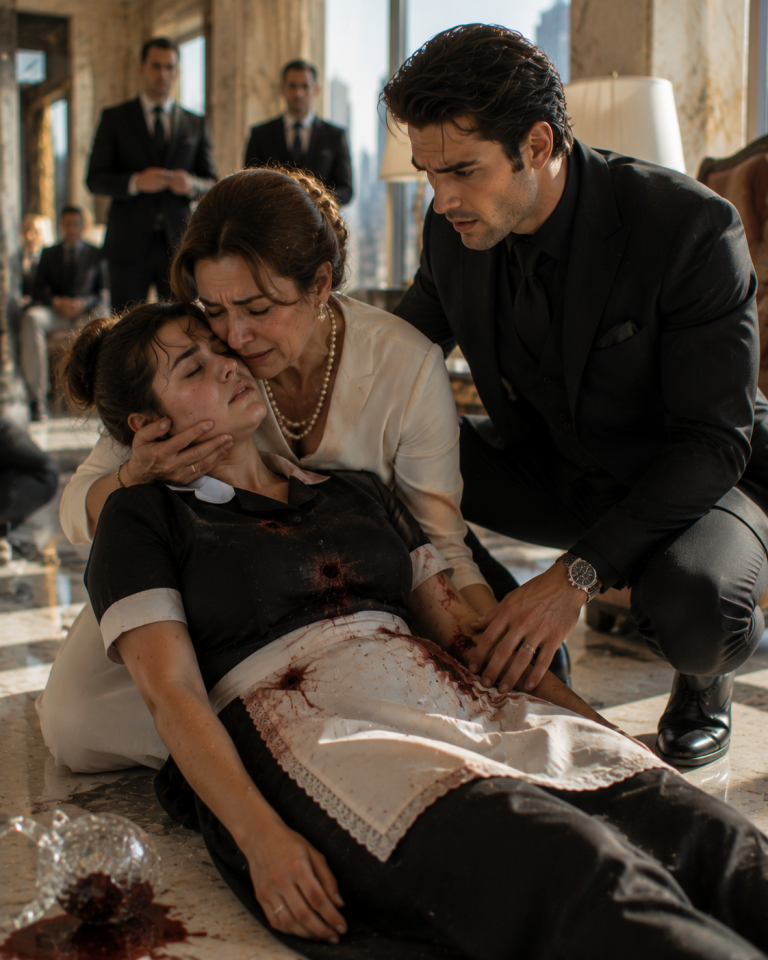
Nora dropped to her knees beside Julian, his face chalk white, blood pooling beneath him. She tore off her scarf, pressing it brutally hard against the wound. He gasped, eyes rolling back.
“Stay with me! You don’t get to die. You bought this mess. You don’t get to leave me with it. Open your eyes.”
He forced them open, a weak, bloody smile touching his lips. “Bossy,” he wheezed.
“Garrett, get the car,” Nora ordered, entirely taking command. “Thomas, wrap your shoulder. We are leaving right now.” She looked down at the feared mafia boss, the monster — her monster. “I’ve got you,” she whispered, leaning down until her forehead touched his. “I’ve got you.”
—
The private clinic sat in a soundproofed basement beneath a veterinary hospital in Brooklyn, smelling of bleach and iodine. Nora sat in a hard plastic chair for six hours, her hands still stained with dried blood and titanium white paint, unwashed on purpose — a physical reminder that it was real.
The doctor came out pulling off his mask. “He’ll live. Bullet cracked a rib, missed the lung by a fraction of an inch. He lost a lot of blood, but he’s stubborn. He’s awake.”
Julian lay in a sterile, bright room, hooked to an IV and a heart monitor beeping steady and reassuring, his chest heavily bandaged, pale, exhausted, and incredibly human. He turned his head as she entered. The flat, dead eyes were gone permanently. He looked at her like she was the only fixed point in a spinning world.
She sat carefully on the edge of the bed and took his hand without a word. His grip was weak but immediate, fingers lacing through hers.
“The server,” he rasped.
“Wiped clean. The police found the warehouse. They found a few bodies. They found Greg.”
His jaw tightened. “Is he dead?”
“Broken spine,” Nora said coldly, feeling nothing for the man on the warehouse floor. “He’s paralyzed. Under police guard at Bellevue. He’s going to spend the rest of his life in a prison hospital.”
“Good.” He breathed out. Silence settled, broken only by the monitor. “You didn’t run,” he said, studying her face. “When the shooting started, you had a clear path out the loading dock. You could have vanished into the city. You had my credit card. You could have started over.”
“I did start over,” Nora said, squeezing his hand. “My life is in the penthouse, surrounded by ledgers and ruined rugs. I am exactly where I want to be.”
He looked at her hands — dried blood flaking off her skin, mixed with paint. The visual manifestation of who she had become. The artist and the survivor.
“Fifty thousand a year is an insult,” Julian said softly.
Nora blinked. “Excuse me?”
“For a CFO who takes fire to protect the firm’s assets.” A faint smirk played on his pale lips. “It’s a pathetic valuation. You need a raise.”
She let out a wet, choked laugh, a tear finally escaping down her dirty cheek. “I don’t want a salary,” she said, leaning closer, her voice steady, fierce, entirely without fear. “I want equity. I want a seat at the table. I wiped the Baronis out of the logistics hub. I hold the cipher to your entire empire. And I saved your life. I am not an employee, Julian. I am a partner.”
He stared at her — the fire in her eyes, the woman who had stood trembling in a warehouse three months ago, entirely replaced now by someone who looked ready to claim a throne.
He lifted his free hand, wincing at the pain in his ribs, cupped the back of her neck, and pulled her down.
“Deal,” he whispered against her lips.
He kissed her, sealing the contract in blood, trust, and a love forged in the darkest corners of the city.
The ledger was finally balanced. Nora had been appraised, tested, pushed to the bleeding edge — and in the end, the man who owned the city learned the truth. She wasn’t worthless. She was priceless.
THE END