Waitress Highlighted Words on the Mafia Boss’s Bill—“Gunman Behind You. Deal Gone Wrong. Exit Now”

## PART 1
She had learned to read danger the way other people read weather.
Not from any class. Not from the criminology textbooks stacked on her nightstand back at the apartment. From a childhood spent in a house where the wrong kind of silence arrived before the wrong kind of sound, and the distance between the two was always exactly enough time to get her younger sister into the bathroom with the door locked.
Her name was Nadia Voss. Twenty-four years old. Forensic psychology student at Charleston University, working dinner service four nights a week at Palazzo to cover tuition and rent and the gap between what her scholarship paid and what a city like Charleston actually cost.
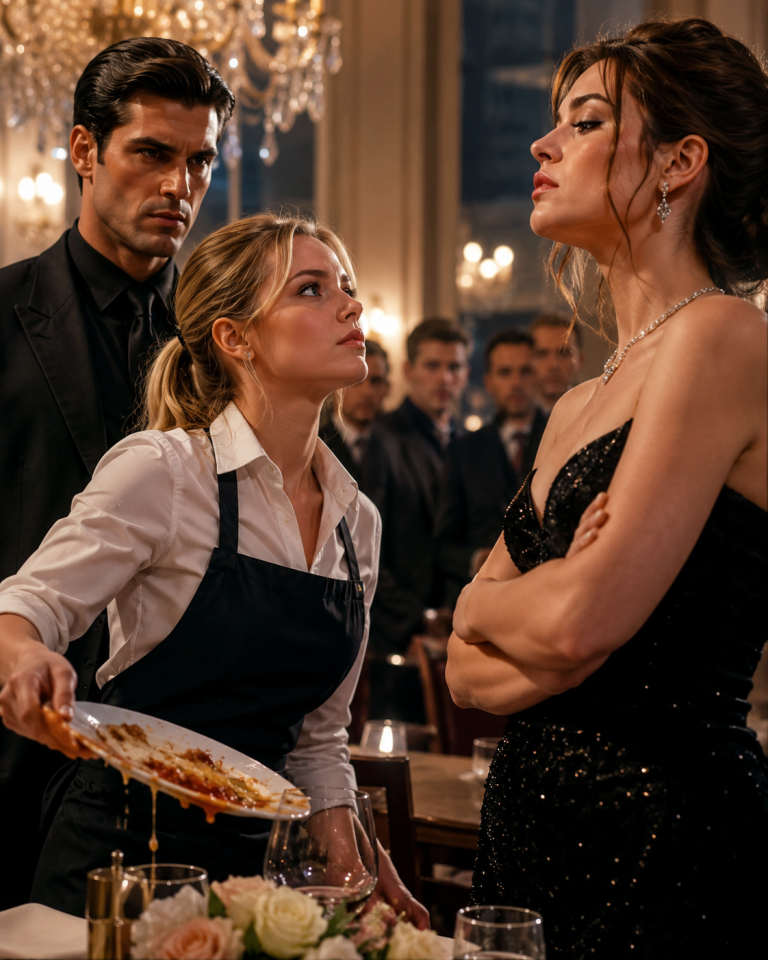
The restaurant occupied a former antebellum townhouse two blocks from the Battery, the kind of place that had been absorbing old money and fresh crimes for over a century and had learned to make both feel elegant. Hardwood floors dark with age. Chandeliers that threw amber across white tablecloths. A wine list that cost more than her monthly rent. Outside, the harbor moved at its own slow pace, and the salt air drifted through the balcony doors and mixed with the smell of browned butter and hundred-year secrets.
Nadia moved through it all with the practiced economy of someone who understood that invisibility was not failure.
Invisibility was information.
She had been serving him for almost two years.
He came every Wednesday.
Same corner table. Left side of the room, chair angled toward both the entrance and the side hallway. Back never fully to the wall, but close. He ordered still water at room temperature, the lamb chops with the herbs on the side, and an espresso at the end poured into a cup that had been rinsed with warm water first. He never sent anything back. Never complained. Never made eye contact with servers longer than the four seconds required to communicate a request.
His name, according to the reservation system, was simply R. Vance.
Among the staff, he was the Architect.
Not because anyone knew what he built. Because the room always restructured itself around him the moment he arrived. Loud guests grew quieter. The sommelier stood straighter. Even the jazz trio near the bar seemed to calibrate its tempo to something more controlled.
Nadia had studied him for two years the way she studied case files.
Not with admiration.
With attention.
She noticed that he arrived exactly twelve minutes before his reservations, never earlier. That he spent the first three minutes studying the room before opening his menu. That he never removed his jacket. That his left hand rested always near the table’s edge — not dramatic, just positioned. And that he tipped precisely eighteen percent, always in cash, always in bills that had been counted before he arrived, which told her his relationship with precision was not occasional. It was constitutional.
He was the most controlled person she had ever observed.
Which made the other man at the bar on a Wednesday in October so conspicuous it almost hurt to look at.
She noticed him before she had a name for the feeling.
He was too ordinary.
Not naturally ordinary — deliberately so, the way someone assembles a disguise from a mental checklist of inconspicuous elements. Dark jacket. Plain shirt. Bar stool second from the end. A bourbon he had not touched. His attention did not move around the room the way a bored diner’s attention does. It stayed in one orbital pattern around the corner table, never landing on it directly, which is the visual behavior of someone who has been told not to stare.
Nadia set a bread basket at table twelve and watched his reflection in the long mirror behind the bar.
His right hand was inside his jacket pocket.
The bourbon had been sitting so long the ice was gone.
Her professor had given a lecture in September about pre-attack behavioral indicators. Stillness as a sign not of calm but of compression. The way the body holds itself when it is about to act. She had taken twelve pages of notes and highlighted seven passages.
She was living inside page four right now.
She walked to the service station.
Her hands were completely steady, which surprised her, given that her heart was doing something architectural and structural to her ribcage.
She pulled up the Architect’s bill on the screen.
Food total. Wine. Tax. Service.
The receipt printed long.
She looked at the bottom third. White space. Quiet margin where the specials were sometimes described.
She thought about what would happen if she walked away.
Nothing, probably. Maybe everything. She did not know for certain what she was looking at. She could be wrong. She could be a criminology student with a pattern-recognition problem and an overactive threat response, warning a powerful man about a bourbon drinker with cold fingers.
Or she could be right.
She picked up a pen.
Found the printed description of the lamb special. *Pan-seared rack. Rosemary jus. Truffle roasted fingerlings.*
Three words had enough space between them.
She wrote small. Precise. The handwriting she used for exam essays when she needed every millimeter to count.
*Man at bar. Right pocket. Watching you.*
She folded the folder.
She carried it to his table.
When she set it down, she did not try to make eye contact. She simply let her index finger rest against the edge of the folder for one beat longer than necessary — not touching him, just marking: *this matters, look at this, now.*
She stepped back.
Moved to table nine.
Refilled the water glasses with hands that did not shake.
Behind her, she heard the folder open.
She did not turn around.
Somewhere across the room, the bourbon drinker shifted on his stool.
His right hand moved inside his pocket.
And then, without looking toward the corner table, Nadia walked to the service hallway and pressed herself against the wall and counted her own heartbeats and wondered whether she had just done the bravest thing of her life or the last.
—
## PART 2
The evening broke in four seconds.
She felt it more than saw it — the specific quality of silence that precedes violent action arriving in a room like a pressure drop, the moment before thunder when every animal in earshot already knows what’s coming even though the air hasn’t moved yet.
Then it moved.
A barstool scraped.
A glass hit the floor.
Two men who had been seated at separate tables rose in the same instant, and Nadia recognized from the synchronization that they had never been diners.
From the service hallway, she heard a door at the back of the restaurant swing open. The side exit near the wine storage.
Then a sound that the restaurant noise couldn’t fully absorb.
Then the jazz kept playing.
That was what Nadia would remember. The jazz kept playing, the way it always did, indifferent and expensive, while the manager appeared at the edge of the dining room with his face arranged in the specific blankness she now understood was not composure but rehearsal.
“Ladies and gentlemen, we apologize for the interruption. Due to a kitchen situation, we’ll be closing early this evening.”
Nobody argued.
Old Charleston money understood what coded language protected.
Nadia collected her section’s bills by reflex, hands moving through familiar motions while her mind refused to stay in the present moment. The dining room emptied with elegant and practiced speed. Within fifteen minutes, she was alone at her service station with her tip envelope and the quiet noise of a restaurant resetting itself over something no one would name aloud.
Her locker contained an envelope when she reached the break room.
She hadn’t left anything in her locker.
Inside: a keychain, silver, solid, heavier than it looked. Engraved with a single letter: *V.* No note. No explanation. No name.
She held it in both hands for a moment.
Then she put it in her pocket, went home, and bolted the door and pressed a chair beneath the handle and lay on her bed for six hours without sleeping.
In the morning, there was no news story.
No police report.
No headline about Palazzo or the Battery or a man found three blocks away.
Only a printed notice on the restaurant door.
*Closed for private event. Reopening Thursday.*
Nadia stood in front of it for a long moment.
Then she took out her phone and opened her behavioral analysis notes from September and read the section on how criminal organizations used visible normalcy as a pressure system and thought: I have been studying these structures from the outside.
I just stepped through the wall.
And when her professor began his lecture the following Tuesday on loyalty formation and the psychology of obligation in closed systems, she sat in the third row and realized with uncomfortable clarity that she was no longer taking purely academic notes.
She was taking field notes.
The question was what she intended to do with them.
—
## PART 3
The Architect returned the following Wednesday.
Alive.
Unhurried.
Immaculate.
He looked, if anything, like a man who had attended a mildly inconvenient meeting and managed it without altering his schedule.
Four men occupied tables around him, positioned with the specific casual wrongness of people whose job was to appear to be something other than what they were. Another stood near the bar. One at the entrance, examining the menu stand with excessive attention.
The room reorganized itself the moment he entered.
It always did.
But now Nadia organized herself around it differently.
She brought his water.
He said, “The lamb again, I think.”
“Of course.” She moved to place the bottle on the table.
“Unless,” he added, “you would recommend something else.”
She paused.
Two years of Wednesdays, and he had never asked her opinion about the menu.
She met his eyes.
Gray. Precise. Not cold in the way vacant people are cold. Cold in the way instruments are cold — maximally sensitive, minimally impeded by feeling.
“The duck has been exceptional this week,” she said. “Chef’s working with a new source.”
“Then the duck.”
She started to step back.
“Nadia Voss,” he said.
She stopped.
Her name in his mouth felt like a file drawer opening.
“Criminal psychology student,” he continued, voice low. “You work Tuesdays, Wednesdays, and Fridays. You take an eight-fifteen morning section before your evening shifts. You are financing your own education.” A pause. “You have an excellent eye.”
“You investigated me.”
“After an event like Wednesday, I investigate everyone who was present.”
“And?”
“And you were the only one who saw him before he moved.”
Nadia set the water bottle down carefully.
“I want you to know,” she said, with the same low register he was using, “that I didn’t do it for your benefit specifically. I did it because I couldn’t watch someone get killed and pretend I hadn’t seen it coming.”
He considered that.
“Most people in your position would have looked away.”
“Most people haven’t spent their lives noticing what happens just before things get very bad.”
Something shifted in his expression. Not softened — registered.
“The keychain,” he said.
“I have it.”
“If you press the engraving, there is a number inside.”
“I found it.”
“Use it if the situation requires.”
“What situation would require it?”
His eyes moved briefly toward the window, toward the harbor moving dark beyond the glass.
“The man you identified was working for a family called Varro,” he said. “They have been tracking our operations for six months. They identified you from the restaurant’s surveillance within forty-eight hours of the incident.”
The restaurant noise seemed to get quieter.
“They think you work for you,” Nadia said.
“In their framework, anyone who warns me is already mine.”
“And are they a threat to me specifically?”
“Yes.”
She absorbed that.
“Then I need information,” she said. “Not protection. Information. I need to understand what I’m actually inside so I can make decisions about how to navigate it.”
He looked at her for a long moment.
“Most people ask me for protection,” he said.
“I’m not most people.”
That sentence landed somewhere in him. She could tell not from his expression, which barely changed, but from the brief pause before he replied — the pause of a man encountering a variable he had not precalculated.
“No,” he said. “You are not.”
His name, he told her at the end of the meal when she brought his espresso and the warmed cup, was Ronan Vance.
Not the full shape of who he was. But a beginning.
She said, “I already knew the initial.”
The corner of his mouth moved.
“Of course you did.”
She went home and memorized the number inside the keychain and bought a prepaid phone with cash the next morning and hated herself only briefly for how instinctive the precaution had become.
—
Detective Hargrove found her on campus.
She was coming out of a criminal evidence seminar with a headache and a stack of printed case studies, walking toward the quad in the low afternoon light, when she heard someone call her name from the wrong direction.
He was standing against the wall near the building’s side entrance. The kind of plainclothes detective costume assembled from confident posture and a belt clip. Mid-forties. Face professionally friendly.
“Ms. Voss,” he said.
“Detective.”
“Hargrove. Charleston PD.”
“I know.”
One eyebrow lifted. “Law enforcement background?”
“Criminal psychology,” she said. “Good retention.”
“Interesting field for someone working at Palazzo.”
“Students need income.”
“Twice-weekly Palazzo waitress, criminal psychology major, top fifteen percent of her class.” He said it like he was reading from a file, because he was. “Tell me about Wednesday.”
“I was working service. It was a quiet night until it wasn’t.”
“What did you see?”
“A kitchen situation, according to management.”
“Is that what they’re calling it?”
“That’s what the sign said.”
Hargrove studied her.
“You serve Ronan Vance’s table.”
“I serve the corner section. He prefers that section.”
“Two years of preferences.”
“Consistent customers request consistent servers.”
“Ms. Voss,” he said, shifting his weight, “people who get close to Vance tend to travel in one of two directions. Some disappear. Some move up quickly. There’s rarely a third option.”
Nadia looked at him directly.
“I’m a waitress and a student, Detective. Not a third option.”
“Yet.”
The word sat there.
“That sounds like advice,” she said.
“It is advice. Choose your associations carefully before the shape of them gets permanent.”
“Thank you,” she said. “I’ll keep that in mind.”
She walked away before he could see that her hands had tightened around her notebook.
The envelope arrived that Thursday through the restaurant manager, who delivered it with the practiced blankness of a man who had learned not to read things addressed to other people.
Inside: a leather portfolio.
Inside that: a letter from Charleston University’s financial aid office confirming a fully processed scholarship covering her remaining tuition — anonymous donor, university-processed, traceable to nothing.
And a note in Ronan’s handwriting.
*For the education you’re already using.*
She carried it home.
She set it on her kitchen table.
She sat across from it for an hour.
Then she picked up the burner phone.
He answered on the second ring.
“Thank you,” she said. “I’m not accepting it.”
A brief pause.
“May I ask why?”
“Because I don’t want to owe you something I didn’t choose to take on. If there’s no obligation attached, you’d have sent it anonymously to the financial aid office without telling me. You told me because you want me to know it came from you.”
Another pause. Longer.
“Yes,” he said.
“Then I’ll pay it back. Structured repayment. My terms. I’ll send you a proposal.”
He was quiet for long enough that she wondered if the call had dropped.
“No one has ever offered to repay me,” he said.
“Most people you deal with can’t afford to.”
“You can’t either.”
“Not yet,” she said. “But I’d rather owe you money on paper than gratitude in practice. Those are very different currencies.”
She could hear something in the silence that followed — not quite amusement, something more considered.
“Send the proposal,” he said.
She spent an hour writing it.
Fixed monthly amount beginning six months from now. No interest. No penalties for emergency deferrals. Full documentation on both sides. She sent it to the email address the note provided.
He responded within the hour.
*Accepted. One amendment: the first six months are a grant, not a loan. The remaining balance is the loan. Non-negotiable.*
She wrote back: *Fine. But I’m choosing my own attorney to document it.*
He wrote: *Expected nothing less.*
—
She accepted a meeting at his house three weeks later.
Not because she had been summoned. Because the Varro threat had grown specific enough that operating without better information had become more dangerous than the alternative. The preliminary movement near her apartment — a car she didn’t recognize, parked twice in the same week in the same position — had moved the calculation.
Ronan’s estate was outside the city proper, down a road flanked by old-growth live oaks that turned the late afternoon gold into something almost theatrical. The house itself was not ostentatious. Low stone. Wide porches. Gardens maintained with the same mathematical discipline she had noticed in him. Security present but not performed — cameras integrated into architecture, two men visible, probably four more she couldn’t see.
He was on the porch.
Without a jacket for the first time she’d seen. White shirt, sleeves folded back. He looked less like the Architect in this light and more like a man who had designed himself from the outside in and was only now, occasionally, allowing the outside to loosen slightly.
“You were followed,” he said.
“I know.”
“You noticed them.”
“I took three different routes and spent forty minutes at a coffee shop on King Street until the silver sedan stopped appearing in my vicinity.” She climbed the porch steps. “I think they were logging destinations rather than attempting a follow.”
Something that might have been approval moved through his expression.
“Yes,” he said. “They want to know your patterns, not your location. They already have your location.”
That information arrived unpleasantly in her stomach.
Inside, the house smelled of old paper and cedar and something faintly citrus. A dining room had been set for two with the specific intentionality of a person who did not do things carelessly. Food was already plated.
Nadia stood at the threshold.
“I’m not here as a guest,” she said.
“I know.”
“Then why the table?”
“Because it’s seven p.m. and you haven’t eaten since noon.”
She blinked.
“How do you know that?”
“You had a seminar until five-thirty, went directly to the coffee shop, and came here. You don’t eat at seminars.”
She looked at him.
“That is both thorough and slightly unsettling.”
“Sit down, Nadia.”
She sat.
He told her about Varro over a meal she ate with more appetite than she’d expected, given the subject matter. An expanding criminal organization. Younger than the old Charleston families. Less interested in institutional respect, more interested in territory. They had been probing Ronan’s operations for two years and escalating for six months. Wednesday had been their first overt action — a message, not just an assassination attempt. Sending someone to his table in a public restaurant said: *we are not afraid of witnesses.*
“What do they know about me?” she asked.
“They know you serve his table. They have assessed you as either a trained operative or an amateur who got lucky.”
“Which do you think?”
“Neither,” he said. “You are a trained observer who made a moral decision. That is more unpredictable than either category.”
She filed that.
“What’s the actual threat level to me?”
“Moderate at the moment. It becomes high if they conclude you have ongoing information access.”
“Which I don’t.”
“Which you do,” he said, “if you continue to consult with me.”
There it was.
On the table, finally.
“Is that what this is,” she said. “A consultation.”
“I have a proposal.”
She looked at him.
“I am restructuring some of my operations toward the legitimate side. Business analysis, security consulting, behavioral risk assessment. I need someone who understands the psychology of closed systems and can advise on personnel. Officially, through a legal consulting firm. Documented. Accountable. Nothing that would compromise your licensing or your academic trajectory.”
“And unofficially?”
“Your eye,” he said simply. “What you did in that restaurant, the assessment you made in real time under pressure — I have paid significantly for that quality of judgment from people with far more experience. It is rarer than it should be.”
Nadia looked at her plate.
“I am studying to work within the legal system,” she said. “Not around it.”
“I know. Which is why I am asking you to work within it. With me.”
“The Varro threat changes the negotiation.”
“Yes.”
“If I am already at risk, then declining doesn’t make me safe. It just makes me uninformed.”
“Yes.”
She looked at him directly.
“I need written terms. My attorney, not yours. Clear scope. Clear limits. If you ever try to involve me in anything illegal, the agreement terminates and I report what I know to Hargrove.”
Ronan studied her.
“You would report me.”
“If you crossed the lines I’m setting. Yes.”
He was quiet for a moment.
“Most people in your position would not say that to my face.”
“Most people in my position have more to lose than I do,” she said. “I’m building a career that depends on my credibility. Protecting that is worth more to me than protecting your feelings about your privacy.”
The silence between them had a specific quality she was still learning to read in him. Not anger. Not offense. The particular interior stillness of a man encountering someone who speaks to him without the performance of deference, and finding it startling.
“Acceptable,” he said.
“Don’t sound surprised.”
“I’m not surprised,” he said. “I’m reassessing.”
She looked at him over the table.
“That is the most honest thing you’ve said to me since you told me my name.”
Something in his face shifted.
Not a smile. But the territory where a smile would eventually be.
“Send me the contract requirements,” he said. “I’ll have my legal team prepare a draft for your review.”
“My legal team reviews the draft.”
“Your legal team,” he repeated, as if noting it.
“I said I’d hire one. I said it to Detective Hargrove before I said it to you.”
“I heard.”
“You read the transcript?”
“We were discussing your situation. He mentioned it.”
She absorbed that.
“You have access to police transcripts.”
“I have access to information,” he said carefully. “Not all of it through channels you would endorse.”
“At least you didn’t pretend.”
“Lies waste time.”
It was, she would realize later, the most consistently true thing about him.
—
The Varro situation escalated six weeks after the meeting.
Not at her apartment. Not at the university. At Palazzo itself, on a Wednesday evening when three men entered through the service entrance during a shift change and two others appeared at the front of the restaurant at the same moment.
Nadia was mid-service when she registered the pattern.
Service entrance at the back, front door, and the secondary entrance through the bar were all covered simultaneously — which meant a coordinated pressure approach, designed to prevent retreat through any single exit.
But the kitchen had a grease exit to the delivery alley. An old door, heavy, usually propped partially open during dinner service because the venting was insufficient.
And the delivery alley connected to the service road that ran behind four buildings to the harbor street.
Ronan’s two table men were already moving.
Nadia set down the dessert tray she was carrying and spoke in the low, flat register she had learned from three months of thinking constantly about this exact kind of moment.
“Kitchen exit. Delivery alley. Harbor street.” She said it to the nearest of his men without looking at him. “Tell him to go ahead of the coordinated sweep. They’ve covered the obvious exits but not the service road because it dead-ends on paper.”
The man looked at her.
Then he spoke into his collar.
Nadia picked up the dessert tray and walked it to table eleven and set it down and smiled and apologized for the slight delay and watched in her peripheral vision as Ronan rose from his table and walked not toward any of the monitored exits but toward the kitchen corridor.
The manager appeared two minutes later with his familiar closed expression.
“Ladies and gentlemen—”
The dining room emptied with the elegant efficiency that came from a clientele who had been in this situation before or understood instinctively that they had not come to Palazzo to be witnesses.
Outside, blue lights appeared at the far end of the street.
Anonymous call to police about trespassing in progress at the Palazzo service entrance.
Nadia had made the call herself from the server’s station during the sixty seconds she had between assessing the threat and delivering the dessert.
She clocked out forty minutes later.
Ronan was waiting outside the harbor entrance.
He was standing at the stone wall above the water with his hands in his pockets and his jacket collar up against the October cold, looking like a man who had just survived an attempt on his life and considered that a moderate inconvenience.
“You called the police,” he said.
“Yes.”
“Before telling my men.”
“At the same time. The simultaneous approach required a simultaneous response. Your men could handle the exit routing. Only I could make the call without it being traced to your organization.”
He looked at the harbor.
“Two of the Varro men were arrested at the service entrance. The other three dispersed before they could be identified.” He paused. “You turned their coordinated strike into a legal liability.”
“That was the point.”
“Where did you learn that?”
“From watching what happens when power collides with visibility,” she said. “Varro was counting on a private confrontation. Public consequences are a different equation entirely.”
Ronan turned from the water.
“The threat level has decreased for now,” he said. “Varro will recalibrate. They are not patient, but they are not stupid. Public exposure changes their cost-benefit analysis.”
“Then the window before recalibration is when I should be most careful.”
“Yes.”
“And you?”
“I am always careful,” he said. But something in his tone was different than it would have been six weeks ago. Less armored.
They walked along the harbor wall together without planning to.
The water was black and the boat lights made slow reflections on the surface, and the city behind them threw its old gold light into the sky, and Nadia thought about the life she had been building toward — the degree, the licensing, the careful professional future she had assembled from the wreckage of an unsafe childhood — and tried to locate where exactly this had become adjacent to it rather than separate from it.
“You did not have to stay in service tonight,” Ronan said.
“I had tables.”
“You knew what was coming.”
“I knew what might be coming. The tables were still my responsibility until the situation made them not.”
He looked at her.
“Why does that matter to you?”
Nadia considered.
“Because the women who taught me to notice danger,” she said, “were the same women who kept showing up to their shifts even when showing up was hard. The two things aren’t separate to me.”
Something in his face did what it did sometimes — registered something, held it, didn’t perform with it.
“You grew up around violence,” he said.
“Yes.”
“And you chose to study it professionally.”
“The best way to understand something is to take it apart carefully.”
“And me?” he asked. “Are you taking me apart carefully?”
She glanced at him.
“I’ve been taking you apart since the first Wednesday you sat in my section.”
“And what have you found?”
“A man who built enormous systems of control because control is what kept him safe in circumstances that didn’t offer much else.” She kept her voice level. “Which means the systems work until they encounter something they can’t control. And then they fail catastrophically unless there’s also a capacity for adaptation.”
He was quiet.
“You are describing a structural vulnerability,” he said.
“I’m describing something you probably already know about yourself.”
The harbor wall curved ahead of them. The lights from Fort Sumter sat on the water in the distance.
“I have not been taken apart by anyone,” he said, “in a very long time.”
“I know,” she said. “It shows.”
He stopped walking.
She stopped two steps later and turned.
He was looking at her with the expression she had begun to recognize as his equivalent of complete attention — all the usual management stripped back to something more direct and therefore more dangerous.
“What would you require,” he said, “to stay.”
“In the city?”
“In this.”
She looked at him.
“Honesty,” she said. “About what this is. No polished versions for my benefit. What it actually costs and who it actually harms and where the lines are that you won’t cross and where the ones are that you already have.”
He nodded.
“Autonomy,” she continued. “I make my own decisions about what I’m part of. You consult me, you don’t instruct me.”
“Agreed.”
“And progress,” she said. “Not perfection. But actual, visible, documented movement toward legitimate operations. Not as cover. As actual redirection of resources and attention.”
He held her gaze.
“I can commit to all of those.”
“I know you can commit to them,” she said. “I’m asking whether you intend to.”
The harbor moved below them.
Somewhere across the water, a light moved slowly along the channel.
“Yes,” he said.
Single word.
No embellishment.
She believed it precisely because he did not try to make it sound larger than it was.
—
That was eleven months ago.
The contract had been drawn up, reviewed, amended by her attorney, counter-amended by his, and signed by both in a conference room that felt appropriately neutral. She had continued her graduate seminar in forensic psychology. She had continued her shifts at Palazzo two nights a week — not because she needed the income anymore, but because she wanted the independence it represented and because it kept her grounded in the precise present-moment attention that had started everything.
Ronan had moved three major operations into legitimate territory. Not quickly. Not cleanly. With the specific grinding difficulty of systems that had been built to avoid documentation being forced into documentation. She had sat in more meetings than she had expected, asked questions no one else had thought to ask, and occasionally made recommendations that arrived at the same conclusion through a different route than anyone else in the room had considered.
The Varro family had been significantly weakened by a series of federal arrests that she had no direct knowledge of and had not asked about. Detective Hargrove had interviewed her twice more. Both times she had answered accurately and carefully and left his office without the sick feeling of having said something wrong.
She finished her graduate thesis in the spring.
*Behavioral Loyalty Structures in Closed Criminal Organizations: A Comparative Study of Coercion, Obligation, and Voluntary Participation.*
Her advisor wrote in the margin of the final draft: *Unusually grounded empirical analysis for a theoretical framework. Where is the fieldwork?*
She noted, in the acknowledgments section, the unnamed consulting work that had informed her understanding of the material.
On the night she defended successfully, Ronan was in the back row of the seminar room.
He left before the reception.
He had sent flowers ahead of time. White camellias. A Charleston flower. He knew she would have found ostentatious ones inappropriate.
She found the camellias appropriate.
That evening, they sat on the harbor wall with coffee and the city arranging itself behind them in its old, layered way, all history and hustle and the particular southern light that made even difficult things look more resolved than they were.
“What happens next?” he asked.
“Private consulting,” she said. “Forensic psychology. Behavioral risk assessment. Criminal defense support, eventually.” She looked at the water. “Legal. Ethical. Mine.”
“Of course.”
“And the work with you continues on the current terms, reviewed annually.”
“Of course.”
She looked at him.
“You say that like it’s obvious.”
“Your terms have been reasonable,” he said. “More than reasonable.”
“Your compliance has been better than I expected.”
“You expected very little.”
“I expected exactly as much as was warranted,” she said, “and you exceeded it.”
He was quiet for a moment.
“I have not told many people what I am actually attempting,” he said. “Most people in my world would consider it weakness.”
“It is not weakness,” she said. “It is the more difficult thing. Which is why most people don’t attempt it.”
He looked at her with the expression she had learned to identify as him being more present than his face typically revealed.
“I am trying,” he said, “to become something better than what I built.”
“I know,” she said. “I can see it.”
“Does that matter to you?”
She thought about the honest answer.
“Yes,” she said. “It matters considerably.”
He reached over and covered her hand with his.
Not dramatically.
Not as a statement.
Simply a hand over a hand in the quiet dark above the harbor.
She let it stay.
Then she turned her palm and held his.
Below them, the Charleston harbor moved in its slow, unhurried way, carrying history and light and the particular mixture of beauty and damage that all old cities carry if you know how to look at them.
Once she had been a criminology student with tired feet and overdue textbooks and a lifetime of experience reading danger in the spaces between ordinary things.
Then she circled three words on a check and warned a dangerous man and stepped through a door she had not known was there.
The story people would tell later would make it romantic in all the wrong ways. They would say the waitress caught the assassin. They would say the mob boss fell for the student. They would say danger had a beautiful face.
They would miss the real thing entirely.
The real thing was quieter and harder.
The real thing was a woman who had grown up learning that invisible people see everything, using that skill to save a life she didn’t owe anything to, and then refusing every form of the story that would make her a supporting character in someone else’s narrative.
She had seen the threat.
She had issued the warning.
She had set the terms.
She had stayed because she chose to.
That was the whole story.
Not the corner booth.
Not the keychain.
Not even the man beside her, who was complicated and trying and increasingly, in small undramatic ways, becoming someone worth standing next to.
The story was a woman who had been taught that survival meant disappearing and had decided, at twenty-four, in a restaurant by the harbor on a Wednesday in October, that she was done disappearing.
And from that night forward, no one in her orbit made the mistake of looking through her again.
—