He Came Down the Mountain for Flour and Bullets — Then Rode Home With the Woman Everyone Had Abandoned

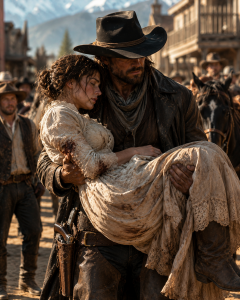
—
PART 1
Ronan Vance had been running for eleven years, and Red Mercy was a transaction, nothing more. You went in, exchanged what you had for what you needed, and left. He hadn’t planned on the general store being anything else.
The place smelled the way civilization always did to him now — tobacco, tallow candles, something damp under the floorboards. Three men played cards in the back. A woman pulled her children close against the dry goods shelves. Old Henley studied a newspaper with the deliberate focus of a man trying to become invisible. And in the center of the room, blocking the aisle, stood a man Ronan clocked as trouble before he’d taken two steps through the door — thick through the chest, a knife worn slightly forward on his belt, the kind you were meant to notice, wearing the expression of someone enjoying himself.
Backed against the counter with nowhere to go stood a woman. Mid-twenties, dark hair coming loose, a dress mended past the point of original cloth. No tears. No pleading. Just flat, cold eyes watching the man in front of her like she was cataloging him for later use.
“Thomas’s debt don’t disappear just because Thomas did,” the man said, conversational, which was worse than angry. “Widow or not, the obligation transfers.”
“Thomas has been dead four months,” she said. Steady, not brave. Brave suggested effort.
“I told the boys over at the Kingfisher I had a debt to collect,” the man went on. “Told them the debtor’s widow was a handsome woman with nowhere particular to go. They seemed interested in a working arrangement.” He paused. “My name is Silas Grady, and I always collect.”
Ronan stood there four seconds. He counted them — a habit, when deciding whether to do something he knew he shouldn’t. Then he crossed the store.
“What’s the debt?”
Grady looked him over — the worn coat, the fur hat, the rifle — and arrived at a comfortable conclusion. “Friend, this is between me and the widow.”
“I’m asking what the debt is.”
Something recalibrated behind Grady’s eyes. “Forty-two dollars. Plus interest owing from Thomas Cross’s loans. I’m a fair man — I haven’t added the full interest.”
“I’ll pay it.”
The store went silent enough that Ronan could hear the lamp hissing. Grady blinked — the blink of a man whose script had just been taken from him. Ronan reached into his coat and set a bundle of beaver pelts on the counter. “That’s worth sixty at current prices. Take the forty-two and leave the change with Henley.”
“You don’t even know this woman.”
“No.”
“Then why—”
“Because forty-two dollars is forty-two dollars,” Ronan said, holding his gaze, “and because I don’t like the way this conversation was going.”
Grady’s jaw tightened. His hand drifted toward the knife handle, less automatic now, more deliberate. “You’re making an error. You don’t know who I am in this town.”
“I know what you are. Same thing exists in every town.” Ronan didn’t raise his voice. “You know what the furs are worth. Take the money or don’t. But you’re done here.”
The silence stretched. Grady looked at Henley, looked at the furs, ran the calculation men like him always ran — pride against practicality — and arrived at whatever forty-two dollars in certain money makes inevitable. He took the furs. “This doesn’t end a thing,” he said to the room, or to Ronan, or to Evelyn Cross — hard to tell which — and left.
“I didn’t ask for that,” she said, once the door had closed.
“No. I wasn’t going to let him.”
“What do you want for it?”
“Nothing.”
“Men don’t spend sixty dollars on nothing.”
“Forty-two,” he said. “And I just told you what I want for it.”
She was quiet a moment, something shifting in her expression — less cataloging now, more like he’d introduced a variable she hadn’t accounted for. He went back to his supply list. She didn’t leave.
“Where are you going?” she asked finally.
“Mountains. Black Hollow Pass.”
“I’ve got nowhere,” she said, flat, without self-pity. “Thomas’s brother wants the house. Town constable answers to the mine company. I’ve got six dollars in a tin under the floorboard, and nothing else.”
Ronan stood at the shelf with his hand on a bag of coffee and stared at the wall of merchandise for a long moment. Then he turned around.
“I live alone,” he said. “Up on the ridge, there’s a cabin.” He stopped, more aware than he wanted to be of how long it had been since he’d explained himself to anyone. “It’s not comfortable. It’s cold. It’s a long way from anything. And I don’t know you.”
“No,” she said. “And I’m not in the habit of—”
“I understand that. It would be—” he searched for the word and settled for honest. “Hard.”
Something shifted in her expression. Not warmth exactly, but something that wasn’t purely calculation either.
“I know hard,” she said.
—