He Came Down the Mountain for Flour and Bullets — Then Rode Home With the Woman Everyone Had Abandoned

PART 2
“The horse leaves at first light,” he said. “Stables on the south end. If you’re there, you’re there. If you’re not, you’re not.” He picked up the coffee and went back to his list.
She was there. He found her sitting on a fence post at six in the morning with a canvas bag at her feet and a beat-up Winchester across her knees, held like a tool she was accustomed to rather than a prop for making a point. She’d braided her hair under a hat and pulled a man’s coat over her dress.
“Is that loaded?” he asked.
“Wouldn’t be much use if it wasn’t.”
“Can you ride?”
“Not well. I can stay on. That’s what I can promise.”
The climb was brutal — the trail more suggestion than path, the temperature dropping twelve degrees in an hour above the tree line, the wind coming at an angle that took physical effort just to hold. When her horse balked on a narrow ledge above a thirty-foot drop, she didn’t panic and didn’t pretend she wasn’t scared. She just said, quietly and precisely, “Tell me what to do.” He told her. She did it.
They reached the cabin at dusk — small, built into the ridge, roof heavy with two decades of moss, one window covered in oiled paper because glass was seventeen dollars a pane. She looked at it a long time.
“You live here?”
“Yes.”
“All right,” she said, and picked up her bag.
Not what he’d expected. No horror, no second-guessing — just *all right*, as if the cabin were simply the next fact in an ongoing series of facts to be dealt with. Inside, when he offered her the single sleeping platform, she refused it, found boards in the lean-to, and built her own low frame by nightfall, padded with folded blankets.
“Why did you do it in the store?” she asked that first night, in the dark, on opposite sides of the cabin.
He thought about it, actually thought, because he didn’t have a clean answer. “I don’t know,” he said, which was the most honest thing he had.
The first snow began outside the oiled-paper window, quiet, without ceremony, and didn’t stop for four days.
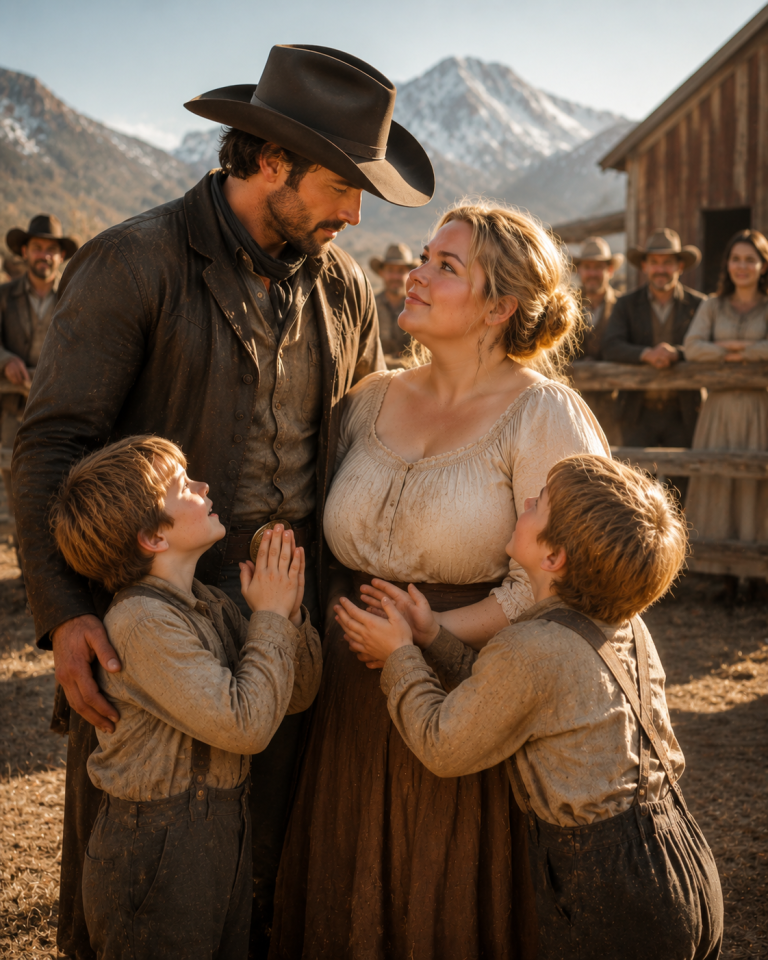
She turned out to be useful in a way he hadn’t calculated for — not performing effort to justify her presence, just doing what needed doing because the mountain didn’t allow standing around wondering whether you wanted to. She hauled wood without being asked. She mended his grain sacks with a needle and wax thread, stitches neat and close. The cabin’s particular silence changed shape around her — no longer only solitary.
Three weeks in, checking his farthest trap line in weather that turned faster than he’d read it, Ronan went down on one knee seventy yards from the cabin, his hands past numb, his legs no longer reliable. She’d been watching from the window for an hour. She came out without a coat, got her shoulder under his arm, and got him inside, and held his hands in a basin of warm water until the feeling came back in ugly stages.
“You don’t have to explain it to me,” she said, when he tried. “You were wrong about the timing, and the mountain nearly killed you. Now you’re inside. That’s all that matters.”
That night, weeks later, with the wind finally down and the cabin quiet for the first time in what felt like a season, he told her something he hadn’t told anyone in eleven years.
“I had a partner,” he said. “Before the mountain. His name was Cal. We were trapping together in the lower range, my first season up this way.” He looked at the ceiling. “There was an accident. The kind that happens fast.”
—