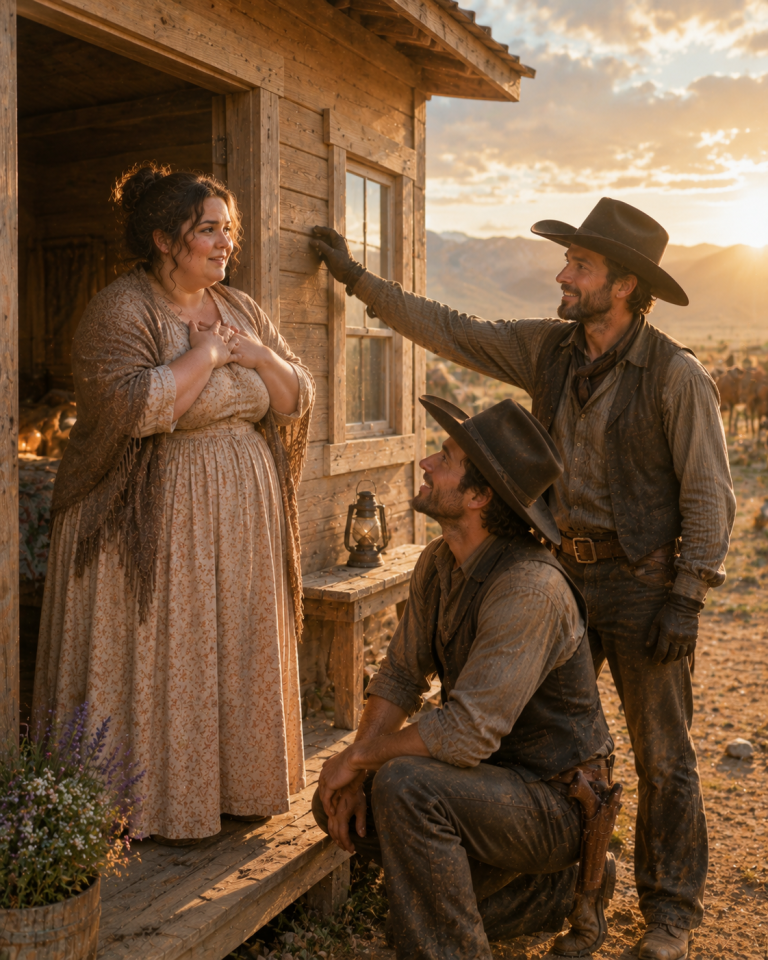
He Came Down the Mountain for Flour and Bullets — Then Rode Home With the Woman Everyone Had Abandoned

PART 3
“The kind you spend years afterward finding different versions of,” he said, “trying to construct the one where you made a different choice and it came out different.”
She had turned to look at him fully now.
“It doesn’t come out different,” he said. “I’ve known that for years. But knowing a thing and believing it all the way down—” He stopped.
“Aren’t the same thing,” she said quietly.
“No.”
The stove glowed. The wind pushed at the wall and found no way in. Outside, the mountain endured and asked nothing of anyone. Eventually they both lay back down, and the quality of the silence had changed — less pressurized, like something let out of a closed space had finally dissipated where it couldn’t concentrate into something unbearable.
Winter deepened into the specific committed cold of January in the Black Hollow range — the kind that got inside the cabin walls overnight and made the morning fire feel like an argument rather than a solution. He was rationing food without telling her he was rationing it. She was doing the same thing without telling him, serving herself calibrated portions slightly less than her body wanted, and neither of them named it out loud, because naming it wouldn’t have changed the math and would only have made the other feel worse.
They cooked together in the evenings, or occupied the same space while food got made, dividing tasks through gesture and proximity rather than discussion. She was the better cook, which was not a high bar against his approach of pure caloric content, but she paid attention to what was in the pot, adjusted things, and the beans tasted different than when he made them, which he noticed and did not say out loud. What surprised him most was the quiet — not the absence of noise, since the mountain was never truly silent, but the quality of silence between two people, which he’d forgotten could be something other than solitary.
She came with him on the trap lines when weather allowed, learning the routes, the productive sets from the maintenance ones. “Why do you put these ones here?” she asked one morning, crouched beside a set along the upper creek.
“Look at the bank,” he said. “Slide marks. They come down here every three or four days. You don’t put the trap where you want to catch them. You put it where they already are.”
She was quiet a moment, thinking it over. “That works for people too,” she said. “Grady found the places Thomas already was. The saloon, the card tables. He didn’t create the problem. He just put himself in the path of it.” She stood, brushed snow from her knees. “Does that make him less of what he is?”
“No,” Ronan said.
What they did instead was trap harder, and prepare. Because both of them understood, without discussing it directly for the first two months, that Silas Grady was not a man who let forty-two dollars rewrite his plans. The money had been a postponement, not a resolution. When Ronan finally said so out loud in late January, she only said, “I know that too. And he won’t come alone.” She’d already figured that. “So we need to be ready.”
He taught her the revolver — a cavalry .44, heavier than the rifle, more recoil, built for a hand doing several other things at once under pressure. “It kicks,” he warned. “It’ll move you. If you’re surprised by it, the second shot won’t go where you want.”
Her first shot went wide by four feet and sat her back on her heels. She said nothing, just looked at where it had gone, looked at the gun, tried again. It was, he thought, probably how she’d survived Thomas Cross and Silas Grady and Red Mercy and the mountain itself — not by being exceptional, but by refusing to stop.
By the third morning of practice he noticed she hissed every time the gun came back. “Your shoulder.”
“It’s fine.”
“It’s not.” He made her show him. What he found was older than wood-cutting strain — a joint damaged before she ever came to the mountain, healed crooked, now absorbing the recoil of a .44 daily.
“How,” he said. Not quite a question, because he could see that it was deliberate, and asking her to confirm it outright would only make it harder to say.
“The second year,” she said finally, “when Thomas started losing more than winning, he—” She stopped. “He was sorry after. He was always sorry after.” She pulled her coat back over the shoulder. “It doesn’t matter. It healed wrong. I didn’t have the money to see a doctor, and by the time I had enough, it had already—” She stopped again. “I manage it.”
“I know you manage it.”