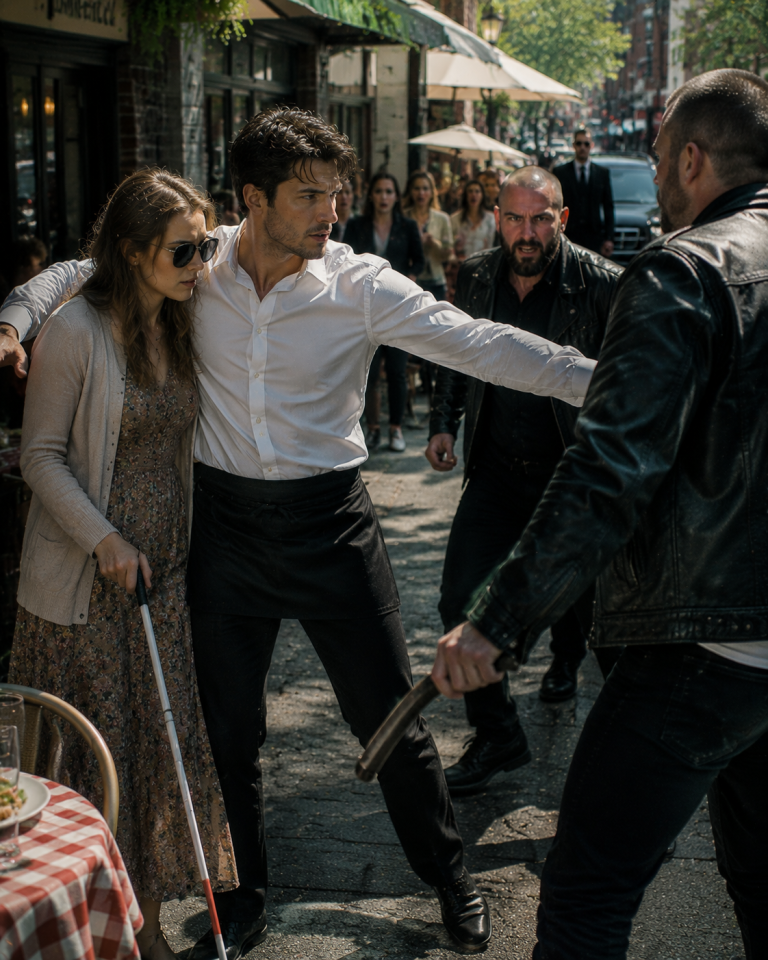
A Poor Waitress Freed a Bound Stranger and His Loyal Dog — Then Discovered She Had Saved the Mafia Boss

CHAPTER 1
August Voss owned every boat that docked in Ironwood Bay, every hand that held a mooring line, every signature that got signed after midnight. Until the morning they found him face down on the ice, bound with his own rope, his two massive mastiffs collapsed on either side of him like statues someone had pulled down. They hadn’t left him there to kill him. They’d left him there so the whole town could see that even August Voss could be brought to his knees.
He should have died in the twenty-below cold. He didn’t, because Ruth Penhal, twenty-seven and walking home along the waterfront at two in the morning because she couldn’t afford gas, saw him lying there and stood over him forty seconds before she understood what she was looking at.
Then she knelt.
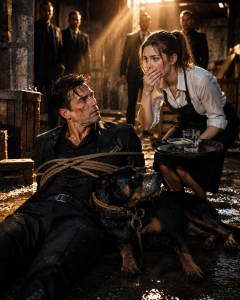
The only knife she carried was the pairing knife from her apron pocket, dulled from eight hours of cutting lemons, its blade barely two and a half inches. The rope wasn’t ordinary — mooring line frozen to something closer to iron than fiber — and it took forty seconds to saw through the first length alone, each strand breaking with a dry crack like a snapping bone. When the last one gave and his hand dropped into the snow, she saw his fingers had gone purple-black to the second knuckle. She pressed two fingers to his throat and found nothing. Then, after a long moment, one slow heartbeat. Then another.
He was alive. Both dogs were alive too — barely. The larger one, Cota, breathed in shallow pulls beneath his heavy folds of frozen skin. The female, Vesper, turned one clouded eye toward Ruth without seeing her.
That was when the warehouse wall behind her lit up. Ruth didn’t turn around; she’d lived in this town twenty-seven years and knew what pale headlights sweeping low across rotted wood meant before her mind gave it a name. She dropped flat against Voss’s chest and held her breath while the beams passed over them once, slowed, and swept back the other way. They weren’t passing by. They were checking.
Between the wind and the idling engine, she opened her eyes a crack and saw it: a small red light suspended beside the passenger seat, sixty-five feet away. A phone, held at eye level, recording. Long enough to be sure the image was clear. Then the light went dark, the engine faded toward North Harbor Road, and Ruth understood something that turned the night over inside her: nobody films a corpse. They film a message. And a message needs someone to receive it.
Her thumb found her phone and pressed nine, one — and stopped there, trembling, hovering over the third number. She had called that number once before, two years ago, and remembered exactly what happened next: burned coffee at the police station, a sixty-two-page file she’d spent eleven months building on the mud dumping that was killing this bay, a man who flipped through it with one finger like junk mail, told her the sea didn’t care who was good or bad, and closed her father’s case three weeks later with two words. Accidental death. Signed by the same man.
Calling that number tonight wouldn’t summon help. It would deliver August Voss straight back into the hands of whoever had left him here — and deliver her along with him, because she was the only person alive who knew someone had filmed it.
She turned the phone off.
Across the harbor, one lit window still glowed — Howerin’s Bakery, an old woman and her granddaughter shaping dough in the steam. Ruth watched three seconds, the most expensive three seconds she owned that night, understanding that warmth still existed only because some people hadn’t kept walking.
Then she found warehouse number seven, a hundred and fifteen feet away, and did the math her body already knew: she weighed a hundred and fifteen pounds. She dragged Vesper across on a frozen tarp first, foot by foot. Cota — too heavy to move — watched his mate disappear across the ice and crawled after her anyway, inch by inch, instinct succeeding where strength had failed.
The last trip was for the man. His heels dug weakly into the ice and pushed as she pulled, unconscious but not gone. At sixty-six feet, her hand brushed something hard in his coat pocket — not a weapon, a pocket watch, its case scratched bare, its glass cracked, its hands frozen at eleven-oh-four. She didn’t understand it. She put it back and kept pulling.
She dragged all three of them through the broken sliding door at 2:51 in the morning, wedged a length of scrap wood across the entrance, and sat down against the metal wall to breathe. Outside, the wind was changing its voice. Inside, on a concrete floor coated in salt and dust, three living things lay motionless, and the woman who had just saved all of them had no idea which door she had just opened.