A Hungry Baby Was Left Crying in the Grass — Then a Lonely Cowboy Gave Up the Only Warmth He Had

—
**PART 1
The Dakota sun did not forgive. It sat directly overhead, turning the grass into a sheet of trembling gold, and Ethan Cole had been riding through it for three straight days when the sound reached him.
At first he thought it was a hawk. Prairie hawks screamed like that sometimes, thin and looping on the wind. He almost let it go. Almost nudged Dakota forward toward Elkhorn Ridge, toward the wages waiting for him there, toward the next stretch of nowhere he intended to drift through once he’d been paid.
Then the cry came again, and something in his chest recognized it before his mind did.
That wasn’t a bird.
He pulled his horse up hard. His hand found the rifle at his saddle out of old habit, the same habit that had kept him alive through country that didn’t care whether a man lived or died. Out here, sound could be a trick. Bandits used birdcalls, used crying, used anything that would make a man walk toward his own throat being cut.
But this cry did not sound like a trap. It sounded like something running out of time.
“Easy, boy,” he murmured, swinging down from the saddle. He moved through the grass low and quiet, scanning the gold for anything that didn’t belong. The seed heads whispered against his legs. The crying rose and fell, and between one rise and the next, it stopped.
Not softened. Stopped.
Ethan broke into a run.
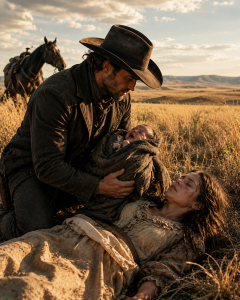
He found them in a shallow dip in the land, where the grass folded down like it was trying to hide them. A woman lay on her side, dark hair matted with sweat, her lips cracked and bleeding, her bare feet raw from walking on ground never meant for bare feet. Beside her, wrapped in a shawl gone gray with dust, a baby no older than a few months waved small fists at the sky and cried a cry with nothing left behind it.
“Jesus,” he breathed, dropping to his knees.
He found the woman’s pulse first — faint, fast, but there. Relief hit him harder than he expected for a stranger he’d never met. Then he lifted the baby, and she was so light it frightened him, her skin hot under his palms, her mouth opening and closing on nothing.
“It’s all right, little one,” he said, though he had no idea if that was true. “I’ve got you.”
The baby’s eyes — startling blue even now — fixed on him with a focus that seemed too old for something so small. Her crying eased, just slightly, as though she’d been waiting for exactly this and hadn’t quite believed it would come.
He looked at the woman again. No supplies. No horse. No shelter. Whoever she was, she and this child had been left here to die, and the ground told the story plainly enough that a slow-burning anger settled into Ethan’s chest and stayed there.
He wrapped the baby in his own coat, got the woman onto Dakota with more strength than grace, and rode.
The ride to town stretched long and merciless. He talked the whole way, to the woman who couldn’t hear him, to the baby who wouldn’t stop crying, to himself, because silence felt like giving up. *There’s a doctor in Elkhorn Ridge,* he told them. *Doc Morrison. He’ll know what to do.*
By the time the town’s gray wooden buildings rose on the horizon, the baby had gone quiet in a way that scared him more than her crying ever had.
Doc Isaac Morrison took one look at what Ethan carried through his door and moved without a single wasted second. His wife Martha took the baby to feed her while Morrison worked over the woman — cleaning wounds, cooling fever, dripping water between cracked lips one careful drop at a time.
It was evening before the woman stirred. Her eyes opened, unfocused, panicked.
“My baby,” she gasped. “Where’s my baby?”
“Right here,” Martha said, bringing the basket close. “Safe. Fed. She’s going to be fine.”
The woman’s hand shook as she reached for the basket, too weak to finish the motion. Then her eyes found Ethan across the room, and she went still.
“You,” she whispered. “You found us.”
“Just happened to be riding through,” Ethan said, uncomfortable under the weight of her gratitude.
“No.” Her voice was barely more than breath, but there was iron underneath it. “Others rode past us. Hours before you came. I saw them. I tried to call out.” Her eyes didn’t leave his face. “They looked right at us and kept riding.”
The room went very quiet.
“Who were they?” Ethan asked.
The woman’s gaze flicked toward the window, toward the darkening prairie beyond it, and something in her expression closed like a door.
“If I tell you,” she said, “you won’t be able to walk away from this. Neither of us will.”
—
**PART 2
She didn’t say anything else that night. Morrison insisted on it — she was too weak, the fever might still be circling back, and whatever she was carrying could wait until morning.
It couldn’t, not really. Ethan sat outside the medical office long after the lamps inside had dimmed, turning her words over. *Others rode past us. They looked right at us and kept riding.* Not strangers who’d failed to notice a woman in the grass. Men who had seen her and chosen to leave.
That wasn’t an accident. That was an order somebody gave and somebody followed.
By morning the fever had broken, and the woman — pale, but alert now in a way that made the fear in her eyes even harder to look at — asked for him directly.
“My name is Clara,” she said, when Martha had stepped out to give them privacy. “Clara Whitmore. I was married at eighteen. My husband’s name is Marcus.”
She said the name the way people said things they’d learned not to say too loudly.
“He’s not a farmer,” she went on. “Not a rancher. He’s a man with railroad money and friends in territorial offices, and he does not lose things he considers his.” Her hand found the basket where Lucy slept. “I ran from him three days ago. He didn’t chase me himself. He sent men ahead to make sure I never made it anywhere that mattered.”
“The riders,” Ethan said slowly.
“He pays people to see nothing,” Clara said. “It’s cheaper than chasing a wife across a continent, and it looks better if she simply — disappears in the wilderness. An unfortunate accident. No one asks questions of a grieving widower.”
Ethan’s jaw tightened. “He wanted you dead.”
“He wants Lucy,” Clara said, and for the first time her composure cracked. “A daughter is an heir with his name on her, whether I’m alive to raise her or not. I was never the point. I was only ever in the way of the point.”
Ethan sat with that for a long moment; the rage in him had a shape now, a name, a face he’d never seen and already hated.
“He’ll know you survived,” he said. “Word travels.”
“Yes,” Clara said quietly. “And when he learns his men failed, he won’t send them again.”
“What will he do?”
Clara looked down at her sleeping daughter, and when she looked back up, the fear in her eyes had hardened into something closer to certainty.
“He’ll come himself,” she said. “And when he does, he won’t come asking. He’ll come with papers that say I belong to him and a story already prepared for anyone who asks why a respectable man is retrieving his unstable, wandering wife.”
She reached out then, gripping Ethan’s sleeve with a strength that startled him.
“You don’t know what you’ve stepped into,” she said. “I need you to understand that before you decide whether to walk away.”
Outside the window, the town of Elkhorn Ridge was waking up to an ordinary morning — smoke rising from chimneys, a dog barking somewhere down the street — entirely unaware that somewhere east of them, a wealthy man was about to discover that the wife he’d left for dead was still breathing, and that he would stop at nothing to finish what his hired men hadn’t.
—
**PART 3
Ethan didn’t walk away.
He told himself later it wasn’t a decision so much as the absence of one — there had never really been a version of that morning where he collected his wages and rode north toward Montana the way he’d planned. Clara’s grip on his sleeve loosened only when he said, plainly, “I’m not going anywhere,” and something in her face — disbelief warring with a hope she clearly didn’t trust — told him she’d expected a different answer.
“You don’t know him,” she said again.
“No,” Ethan agreed. “But I know what I found in that grass, and I know men like that don’t stop just because a woman finally gets lucky. So we don’t wait for lucky to run out.”
Sheriff Thomas Wade came by within the hour, drawn less by curiosity than by a doctor’s message that trouble might be riding toward his town. He was a burly man with a face like weathered fence post and eyes that missed very little.
“Doc tells me there’s a husband somewhere behind all this,” Wade said, when Ethan laid it out for him on the boardwalk outside Morrison’s office. “Money. Connections. Men willing to leave a woman to die rather than risk being seen helping her.”
“That’s the shape of it,” Ethan said.
“And you’re planning on standing in the middle of that.” It wasn’t a question.
“Somebody has to.”
Wade studied him a long moment, the way a man studies a horse he isn’t sure is broke yet. “Then you’d better do it smart, not just stubborn. A man with Marcus Whitmore’s kind of money doesn’t need a gun to take a woman apart. He needs a lawyer and a story people want to believe.”
It was Morrison, that evening, who said the word none of them had said yet.
“There’s a way to give her real legal standing,” he said, over cups of coffee gone cold in his office. “Marriage. If Clara were married — properly, legally, with witnesses — Marcus’s claim on her stops being simple. He’d have to fight a second legal marriage in a territory that isn’t obligated to bow to whatever he arranged back in Pennsylvania.”
The room went quiet. Martha’s eyes moved to Ethan and stayed there.
“Who would marry her?” she asked softly, though her tone said she already knew.
Clara, propped up in the makeshift bed with Lucy dozing in the basket beside her, shook her head hard enough to hurt herself. “No. I won’t ask that of a stranger. It’s too much. Too dangerous.”
“You’re not asking,” Ethan said, before he’d fully decided to say it. “I’m offering.”
Every head in the room turned to him at once.
“Ethan, you can’t,” Clara said, eyes wide with something between horror and disbelief. “You’d be binding yourself to a woman you barely know, with a child that isn’t yours, running from a man who will try to ruin you for it. Your whole life would change.”
“My life already changed,” Ethan said quietly. “It changed the moment I heard her crying in that grass. I’m not looking to go back to who I was before that.”
Wade was watching him carefully. “You understand what you’d be taking on? If Marcus challenges this in court, you’ll need to convince a judge it’s real. Not paper. Real.”
“Then we make it real,” Ethan said.
Clara searched his face for a long moment — for pity, for some hidden hunger, for anything like the men she’d already learned to fear. Whatever she was looking for, she didn’t find it, and what she found instead brought tears to eyes that had clearly forgotten what it felt like to be offered a choice instead of an order.
“Why?” she whispered. “Why would you do this for us?”
“Because I can’t unhear that cry,” Ethan said. “And I can’t walk away knowing what’s waiting for you if I do.”
—
Three days later, Judge Willard Thornton — a stern circuit judge passing through for routine hearings — performed a brief, business-like ceremony in a room above the general store, witnessed by half the town. Clara wore a pale blue dress Martha had helped stitch together. Ethan wore his cleanest shirt, his hands unsteady in a way that had nothing to do with fear of Marcus.
“Before I begin,” Thornton said, eyeing them both, “I want it understood this union is entered freely, not as some legal maneuver.”
“It’s both,” Ethan answered honestly. “Clara needs protection from a man who’s already tried to have her killed. But I’m not standing here against my will. I want this marriage.”
Clara, when asked, said the truest thing she could manage. “He’s shown me more kindness in three days than I had in years of my first marriage. I’m choosing this freely.”
It was enough for Thornton. The rings were plain iron bands from the town blacksmith. The kiss that sealed it was brief and careful — a gesture of partnership rather than passion, and Ethan understood that, and didn’t push for anything more.
That night, lying in their new room with Lucy’s cradle between them like an agreed-upon border, Clara said quietly into the dark, “I need you to know something. I’m not ready to be a wife to you. Not in every way that word means.”
“I’m not asking you to be,” Ethan said. “I married you to keep you safe. Everything else, we figure out at your pace. If ever.”
“That’s not fair to you.”
“Let me decide what’s fair to me,” Ethan said. “That’s what partners do.”
Whatever answer she’d expected, it clearly wasn’t that one, and the silence that followed had less fear in it than the one before.
—
Marcus Whitmore arrived in Elkhorn Ridge nine days later in a carriage too fine for the dust it rolled through, flanked by nothing but his own composure — tall, dark hair silvering at the temples, dressed like a man who’d never once had to raise his voice to get what he wanted.
“My wife and daughter,” he told Sheriff Wade, all cultured concern. “I’ve been frantic. She’s been unwell since the birth — some kind of hysteria. Wandered off in Deadwood. I only just learned she might be receiving care out here.”
“Interesting story,” Wade said. “Differs some from what we’ve heard.”
Marcus’s eyes moved past the sheriff and found Ethan. “And you would be?”
“The one who found your wife and daughter,” Ethan said. “Lying half-dead in the prairie grass, five miles from town. No water. No supplies. No horse. Left there.”
Something flickered behind Marcus’s composed face — there and gone before it could be called an expression. “Clara must have wandered farther than I realized.”
“Or she was running,” Ethan said. “From someone.”
The temperature of the conversation dropped several degrees. Marcus’s smile thinned to something colder. “Whatever lies my wife has told you—”
“I haven’t heard any lies,” Ethan cut in. “Just facts. Bruises. Fear. A woman desperate enough to walk into the wilderness with an infant rather than stay with her husband.”
Clara chose that moment to step out onto the boardwalk, pale but steady, Martha at her shoulder. Marcus’s face transformed at the sight of her — hunger and fury warring beneath a mask that was cracking in front of the whole street.
“I’m not your wife anymore, Marcus,” Clara said, her voice shaking but clear. “I left you. I choose to stay here.”
“You don’t get to choose,” Marcus said, low and dangerous now, the charm gone entirely. “You belong to me. The child belongs to me.”
Ethan stepped between them. “That’s enough.”
Marcus looked at him with something close to hatred. “You have any idea who you’re dealing with?”
“A man who beats women and abandons them in the wilderness,” Ethan said flatly. “A man who’s about to learn that doesn’t play well out here.”
Marcus’s hand twitched toward his coat. Ethan’s hand dropped to his gun belt. For one taut second, the street held its breath. Then Marcus, seeing the numbers weren’t in his favor, stepped back, his composure sliding back into place like a mask returning to a shelf.
“Very well,” he said. “We’ll do this legally. I’ll return with documentation of our marriage, proof of paternity, and a court order if necessary.” His eyes cut to Ethan. “And you’ll learn what happens to men who interfere in matters that don’t concern them.”
His carriage rolled out of town in a cloud of dust, leaving behind a silence thick with everything that hadn’t been said yet.
That night, with Lucy asleep between them, Clara finally broke down. “He’ll come back with the law on his side,” she whispered. “And they’ll make me go with him.”
“No,” Ethan said, gripping her hand across the cradle. “We’ll fight him. We’ll fight him and we’ll win.”
“With what? He has money, power, the law.”
“We have the truth,” Ethan said. “And we have each other. That has to be enough.”
—
It wasn’t, not on its own — Morrison made that clear over dusty law books borrowed from Judge Thornton. Dakota marriage law and Pennsylvania marriage law didn’t simply cancel each other out; a court would have to weigh one against the other, and a conservative judge might easily side with the older, more conventional claim.
“There’s one thing that might tip it,” Morrison said. “If Clara testifies to the abuse herself. Cruelty is grounds for setting aside a marriage in some courts. But she’d have to say it out loud, in front of strangers, with Marcus sitting there listening.”
When Ethan raised it with her, Clara’s reaction was immediate and physical — she went pale, her arms tightening around Lucy.
“I can’t,” she said. “Stand there and describe what he did to me while he watches? I can’t give him that kind of power over me again.”
“You wouldn’t be giving him power,” Ethan said gently. “You’d be taking it back. Telling your truth where it can actually change something.”
It took her three more days to agree, and when she finally did, it was for one reason only. “For Lucy,” she said. “So she never grows up thinking that’s what love looks like.”
They found a lawyer in Deadwood — Samuel Brennan, young, sharp-eyed, with a reputation for taking cases everyone else called hopeless. He listened to the whole story without interrupting, his jaw tightening as Clara described years compressed into a handful of sentences: the broken ribs, the two failed escapes, the second one ending eight months pregnant with Marcus tracking her down before she’d gotten out of the state.
“This is worse than I expected,” Brennan said finally. “Which helps us and hurts us in equal measure. The evidence is damning. But his lawyers will paint you as unstable, hysterical, exaggerating to justify running off with another man.” His eyes moved to Ethan. “They’ll say you took advantage of a vulnerable woman.”
“That’s not what happened,” Ethan said.
“I believe you,” Brennan said. “Belief and proof are different animals in a courtroom.”
A territorial marshal delivered the summons on a gray October morning. The case would be heard in Rapid City in three weeks, before Judge Augustus Crane — a man known, Wade warned them bluntly, for old-fashioned convictions about the sanctity of a first marriage and a wife’s place beside her legal husband.
“If anyone was going to rule for Marcus,” Wade said, “it’s him.”
The three weeks that followed were a slow tightening of nerves. Clara’s nightmares worsened. Lucy, sensing her mother’s fear the way children do, grew fussier, clinging harder. Ethan spent his evenings hunched over borrowed law books with Morrison, trying to understand a legal system that seemed built, at every turn, to favor the man with more money.
The night before they left for Rapid City, Ethan found Clara packing with shaking hands, tears sliding silently down her face.
“I can’t do this,” she said. “Stand in that courtroom and relive it all and risk losing anyway.”
He crossed the room and, breaking their unspoken rule for the first time, pulled her into his arms. She stiffened, then collapsed against him, sobbing into his shirt.
“You survived years with him,” Ethan said quietly. “You walked into the wilderness with a newborn rather than stay. You can do this too.”
“Hold me,” she whispered. “Not like a husband holds a wife. Just — like someone holds a person who’s scared.”
He did, fully clothed, all night, her heartbeat slowing gradually against his side while Lucy slept in her cradle nearby, and in the morning they left for Rapid City to fight for everything they’d built in a month that felt, by then, like it had lasted years.
—
The trial ran three days before Clara took the stand. Marcus’s lawyer opened with a story polished smooth: a devoted husband, a wife undone by postpartum hysteria, a opportunistic cowboy who’d taken advantage of her confusion to trap her in a fraudulent second marriage. It was, delivered by a man who clearly knew how to work a courtroom, uncomfortably convincing.
Brennan’s answer was quieter, and it landed harder. “What happened,” he told the court, “is that a woman fleeing years of brutal abuse was left to die in the wilderness by the very man now claiming to be worried for her welfare. What happened is that a decent man heard a baby crying and couldn’t ride past it. You’ll have to decide which story makes sense.”
Clara’s testimony, when it came, was delivered in a voice that shook but never broke — years of violence laid out in clinical, unbearable detail while the courtroom sat in silence around her. The cross-examination that followed was designed to dismantle her, question by question.
“You never reported this abuse to authorities. Why not, if it was as severe as you claim?”
“Because I was afraid he’d kill me if I tried,” Clara said. “And because I knew no one would believe me over a respected man.”
“Isn’t it true you married Mr. Cole specifically to evade your legal husband? That this marriage is a calculated strategy rather than a genuine one?”
Clara hesitated — Ethan saw the trap closing around her — and then answered with something sharper than the lawyer expected.
“It was both,” she said. “Yes, I needed protection. Yes, marrying Ethan gave me legal standing I didn’t have. But I also married him because he showed me kindness when I’d forgotten what that felt like, because he gave me choices instead of taking them away. So yes, it was strategy. It was also real.”
The lawyer was still recovering from that answer when a deputy marshal burst into the courtroom and handed Judge Crane a document that changed the entire shape of the case. Marcus, it turned out, was wanted in Pennsylvania on fraud charges tied to his railroad investments — charges that painted the respectable, wronged husband in a considerably different light.
Crane’s ruling, when it finally came two days later, was not the sweeping victory anyone had dared hope for, but it was enough. Clara had shown sufficient evidence of cruelty to justify her flight from her first marriage. Her marriage to Ethan Cole, unconventional in timing but entered freely, was ruled valid and binding. Marcus’s parental rights over Lucy were suspended pending the outcome of his criminal charges.
The courtroom erupted. Marcus did not take it quietly.
“This isn’t over,” he told them that night, in a note left on their hotel room pillow after someone had picked the lock while they were out. *You’ve won a battle. Watch your back, cowboy. Watch your wife. Accidents happen on the frontier.*
They left Rapid City before dawn.
—
Marcus came for them four months later, not with lawyers this time but with two hired men and a look in his eyes that had nothing reasonable left in it. He rode up to Morrison’s house in the dead of night, where Clara and Lucy had been staying since word reached them that he’d made bail and vanished from Rapid City.
“Send out my wife and daughter,” he shouted, “or we’re coming in.”
Wade met him at the door, badge catching the lamplight. “You lost your case in court. This isn’t legal, and you know it.”
“I don’t care about legal,” Marcus said, and something in his voice had come completely unmoored. “I care about what’s mine.”
Guns came up on both sides. For one frozen second the night held nothing but the possibility of blood. Then Clara stepped out onto the porch with Lucy in her arms, and every argument anyone had prepared went quiet at once.
“Clara, no,” Ethan started, but she was already past him.
“Stop this,” she said, and her voice, though it shook, did not break. “This is my home. These are my people. You need to leave.”
What followed was not a negotiation. It was Clara finally saying, out loud, in front of the man who’d spent years teaching her not to, everything she had never been allowed to say before — that his violence had been his choice, not her fault; that she was no longer afraid of what he could do to her; that if he pushed further, she would take her testimony to every court and every newspaper willing to listen until his name meant nothing but disgrace.
It was the second threat, not the first, that broke something in him. Marcus’s hired men, unwilling to die for a custody dispute that had clearly become something uglier and more personal, rode off into the dark without him. Alone, facing a porch full of armed, unwavering people, Marcus finally lowered his gun.
“So that’s it, then,” he said, and for the first time he sounded old.
“It is,” Clara said. “Goodbye, Marcus.”
He turned his horse and rode into the darkness — not fleeing, not charging, simply leaving, defeated in a way no court ruling had quite managed to accomplish.
—
He never came back.
Word reached them through Brennan, months later, that Marcus had been acquitted on a technicality, then quietly returned east to salvage what remained of his business reputation. The threat, real as it had been, simply ran out of road.
What grew in its place, slowly and without any single dramatic turn, was a life neither of them had expected to want. Clara began teaching — three students at first, meeting in their front room, then eight, then twelve, her confidence blooming in work she’d once only dreamed of. Ethan bought land on the edge of town, one small parcel at a time, toward a future he could finally picture clearly enough to build toward.
Trust came in increments too small to name individually — Clara reaching for his hand on an evening walk because she wanted to, not because she needed steadying; a kiss, tentative and unhurried, on a warm spring evening six months after the confrontation on Morrison’s porch.
“I love you,” she told him afterward, wonder still raw in her voice, like she’d forgotten the shape of the words. “I didn’t think I could. But I do.”
“I love you too,” Ethan said. “Have for a while now. Didn’t want to rush you by saying it.”
A year after he’d heard a baby’s cry cut through the Dakota wind, Ethan Cole sat on the porch of a house they’d built with their own hands, watching the sun paint the prairie gold and crimson the same way it had the day everything began. Lucy toddled across the yard, calling him *Papa* with no idea their family had started in anything but the most ordinary way.
Clara’s hand found his. “I’m pregnant,” she said quietly. “About two months. I wanted to be sure before I told you.”
Ethan felt the breath leave him entirely. “We’re going to have another baby.”
“If you’re happy about it.”
“Clara.” He pulled her and Lucy both into his arms, careful of the new life already growing between them. “I’m thrilled. Absolutely thrilled.”
That evening, as the stars came out over the same wide, indifferent prairie that had once nearly taken everything from them, Clara asked him — as she often did now, a kind of ritual between them — to tell the story again. About the day he found them. About the sound that made him stop when a hundred other sounds hadn’t.
He told it the way he always did, ending where he always ended it: with a small hand closing around his thumb, and something shifting permanently in the bedrock of who he was.
“Do you ever regret it?” she asked. “Giving up your freedom for a woman with so many problems?”
“Not once,” Ethan said. “Not for a single second. Before you, I was just drifting. Now I have everything I didn’t know I was missing.”
Inside the house, Lucy had fallen asleep on the rug, worn out from a full day of being exactly as loved as a child should be. Ethan carried her to bed, Clara’s hand still in his, the porch light behind them the only thing marking where their small, hard-won world ended and the vast dark prairie began — the same prairie that had once tried to kill them, now simply home, holding nothing more dangerous than the sound of a family breathing quietly in the dark.
THE END