HE PAID $10 FOR A SILENT GIRL AT A CATTLE AUCTION — THEN DISCOVERED SHE COULD SEE THINGS THAT HADN’T HAPPENED YET

—
PART 1
The auction yard smelled like sweat and manure and men who hadn’t bathed in a week. Caleb Ror stood at the edge of it all, hat pulled low, hands shoved in his coat pockets, waiting on nothing but a horse.
He didn’t come to town for company. Three years of bad cattle deals had cured him of that. He came for one animal — steady, unshaken by wind or shadow — and he meant to be back on the road before dark.
The auctioneer’s voice cut through the heat like a rusted saw. Lot after lot. Caleb watched a sorrel mare circle the pen with her eyes rolling white, already ruined by somebody’s cruelty, and turned to walk away.
That’s when he saw her.
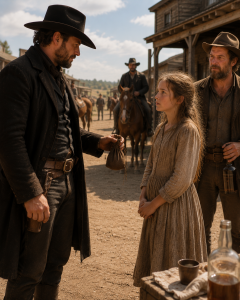
At first she was only a shape — thin, small, pressed against the fence post like she was trying to disappear into the wood grain itself. Barefoot. Dress faded to the color of old bone. A rope circled her wrist, the other end held loose in the fist of a drunk named Pete Garrison, a man who’d lost his farm two seasons back and never stopped losing things since.
She didn’t look up. Didn’t move. Just stood there with her shoulders curved inward and her hair hanging like a curtain she could hide behind.
Pete saw Caleb staring and grinned, a wet gap-toothed thing.
“You interested, Ror?” His voice carried. A few heads turned. “Found her wandering the flats three days back. Ain’t said a word since. She’s simple. But she can work.”
He yanked the rope. The girl stumbled, caught herself, went still again. Didn’t cry out. Didn’t even flinch.
Something cold settled low in Caleb’s stomach.
“I’m looking for a horse,” he said.
“Horses cost money.” Pete’s laugh wheezed out of him. “This one, I’ll take five dollars and call it charity.”
Five dollars. The price of a broken plow.
Caleb should have walked. Should have found his mare, paid, and ridden home to the quiet hundred acres that asked nothing of him. But the girl lifted her head — just slightly, just enough — and her eyes met his.
They weren’t empty.
That was the thing that stopped him cold. He’d braced for the dull glaze of someone beaten past caring. Instead he found something sharp. Watchful. Like she was weighing him and already knew the answer.
“She got a name?” he heard himself ask.
Pete shrugged. “Didn’t ask. Don’t matter, does it?”
Nearby, a rancher named Huitt spat tobacco into the dirt. “Turn her loose, Pete. Let the wolves have her. Save somebody the trouble.” Laughter rippled through the crowd.
Caleb’s jaw locked.
“Ten dollars,” he said.
The laughter died. Pete blinked like the words hadn’t landed right.
“You serious?”
“Ten dollars. Take it or don’t.”
Pete’s grin came back sharper, greedier, but something about the stillness in Caleb’s face made him nervous instead of bold. He untied the rope, tossed it toward Caleb the way a man hands off a dog nobody wants.
“She’s yours. Good luck.”
Then he was gone, swallowed by the crowd before Caleb could change his mind.
Caleb stood there holding the frayed end of rope, staring down at the girl who hadn’t moved an inch. He cleared his throat.
“You got a name?”
Silence.
“Can you talk?”
Nothing. He sighed, coiled the rope. “All right. Come on, then.”
She followed him without a sound.
The ride back took three hours. She sat in the wagon bed with her knees pulled to her chest, watching the endless scrub roll by, never once asking where they were going. It gave Caleb too much time to think about what the hell he’d just done — spent money he couldn’t spare on a girl he didn’t need, all because of a look in her eyes he couldn’t explain and couldn’t shake.
That night, in the dim spare house his father built, she wrote her name in the dust on the table. Slow. Deliberate. A curve, a line, another curve.
*Leora.*
She couldn’t speak. But she could write, and she ate like someone who hadn’t had a full meal in weeks — because she hadn’t. Caleb gave her the bed and took the floor, told himself it was temporary. Told himself there’d be a family in town looking for her by morning.
He didn’t believe it even as he thought it. Nobody looked for girls like her.
He woke to the smell of coffee. The fire was stoked, a pot was on, and Leora stood at the stove in bare feet, cooking eggs he didn’t own from a hen house he didn’t remember checking that morning.
He didn’t know it yet — wouldn’t know it for weeks — but the quietest thing he’d ever brought home was about to turn his whole world inside out.
Because three days later, in his own barn, kneeling in the straw beside a cow dying in labor, Leora placed her hand flat against Caleb’s chest to stop him from moving.
And looked at him with eyes that already knew exactly how the next fifteen minutes would go.
—
PART 2
The calf came out alive.
That part, Caleb could explain — barely. Some women had a gift for animals, a calm that settled a herd. What he couldn’t explain was the humming. Low, wordless, a sound that seemed to come from somewhere underneath the air itself, and the way the dying cow’s breathing slowed to match it like the two of them were tied by a string he couldn’t see.
He didn’t ask her about it that night. Didn’t know how to start a question like that.
Two weeks in, he stopped pretending he understood what was happening under his own roof and just accepted it. Accepted her. Because there was more — so much more he hadn’t told anyone yet, not even the men who nodded to him in town.
There was the morning she grabbed his arm before he could ride out to the north pasture, shook her head, pointed him west instead. An hour later he found three cattle tangled in a ravine that would have killed them by nightfall. She hadn’t guessed. She’d known.
There was the storm.
It rolled in with no warning — no thunder building, no wind easing into it, just a wall of rain that hit like the sky had cracked open. Leora grabbed his arm, hard, urgent, and hauled him out into the downpour toward the barn before he understood what was happening.
Ten seconds later, lightning split the old oak at the edge of the property — the exact spot he’d been standing under not fifteen minutes earlier, checking the horses.
He turned to her, soaked to the bone, heart still hammering.
“How did you know?”
She didn’t answer. She never did. Just looked at him with those eyes that saw something the rest of the world couldn’t.
And that was the moment Caleb understood something that turned his blood cold in the middle of a rainstorm:
She hadn’t heard the storm coming.
She’d felt it. Seen it. Known it, the way a person knows something that already happened — except it hadn’t happened yet.
He told himself it didn’t matter. Told himself a girl who saved lives, who healed sick children with nothing but crushed herbs and a hum under her breath, couldn’t be anything but good, whatever she was.
But word travels in a town small enough that everyone already knows everyone else’s business. And the first time he walked into the general store and felt the room go quiet — every eye sliding toward him, every conversation dying mid-sentence — he understood that acceptance and fear are neighbors, and fear is a much louder tenant.
“Heard you got yourself some help out at the ranch,” the shopkeeper said, careful as a man handling a loaded gun. “Quiet girl, they say. Don’t talk.”
“That’s right,” Caleb said. “She works hard.”
“Where’d she come from?”
“Does it matter?”
But it did matter. It mattered to men who didn’t like mysteries, who’d rather burn something down than admit they didn’t understand it.
And three nights later, Caleb Ror would wake to the smell of smoke, and find out exactly how far a scared town was willing to go.
—
PART 3
The barn burned on a night with no moon.
Caleb woke to the smell before he heard anything — that thick, wrong smell of hay and wood catching fast — and by the time he threw the door open, flame had already crawled up the walls and was licking at the roofline, sending sparks spiraling into a black sky. Inside, the horses were screaming.
“No—” The word tore out of him before his boots hit the ground.
He ran for the trough, filled a bucket, hurled it at the flames. It did nothing. He filled it again. Nothing. The fire had a head start no single man with a bucket could catch.
Leora appeared at his shoulder, her face bone-white in the firelight. He grabbed for her, meaning to pull her back, but she was already moving past him — straight toward the barn.
“Leora, no—”
She didn’t stop. She walked into the burning building the way another person might walk through an open doorway on an ordinary afternoon, and for three full seconds Caleb’s heart simply stopped working.
Then he heard it. That low, steady humming, cutting under the roar of the fire like a thread pulled taut. And impossibly — he would swear to this for the rest of his life, though no one who hadn’t seen it would ever believe him — the flames began to pull back. Not dying. Retreating, like something invisible was holding them at bay.
Leora came out leading all three horses. Calm. Unburned. Untouched.
She got them clear, turned back once toward the barn still smoldering behind her, and then her knees buckled.
Caleb caught her before she hit the ground.
She was cold — too cold, colder than a person standing twenty feet from a fire had any right to be — and her skin, when he checked with shaking hands, was unmarked. Not a single burn. Just unconscious, breathing shallow, like whatever she’d spent to hold those flames back had come out of somewhere deep and finite inside her.
He carried her inside, laid her on the bed, covered her in every blanket the house owned, and sat beside her until dawn with his hands still trembling.
*What the hell was she?*
And, more urgently — because he’d found kerosene near the barn’s back wall the moment the sun came up, poured deliberate and low along the base of the wood — *who had done this to her?*
**
She woke near noon. He told her about the kerosene the second her eyes opened, watched her face go still in that particular way it did when something frightened her too much to show it plainly.
“They’re done talking,” Caleb said. “They’re taking action. We’re leaving tonight. I’ll pack what we can carry, we’ll head west, find somewhere nobody’s heard your name.”
Leora sat up slowly, and shook her head.
“Leora—”
She stood, swaying, walked to him, and placed her hand flat over his heart the way she always did when words weren’t enough. And he felt it again — not thought, not language, but pure feeling pouring through her palm into his chest.
Not fear. Not resignation.
*Resolve.*
“They almost killed you,” he said, voice rough.
She nodded. *They’ll try again,* her eyes said, plain as any sentence.
“And you’re still not leaving?”
Another nod.
“Why? Why stay where they hate you? Where they want you gone?”
She pressed her hand harder against his chest, and this time the understanding arrived whole and sudden: *because of him.* She was staying because leaving meant leaving him, and that was a price she wasn’t willing to pay.
His throat closed around something he didn’t have a name for.
“You’re an idiot,” he said quietly. “You know that?”
Her mouth curved — a real smile, small but real, the first one he’d seen from her in the month since the auction yard.
“We’re both idiots,” he muttered, and pulled her into a hug, quick and awkward and entirely genuine. She stiffened for half a second, then let herself lean into it.
“All right,” he said into her hair. “We stay. But we do this smart. No more strangers, no more risks, until this blows over.”
She pulled back and looked at him with an expression that plainly meant: *You know I’m not going to stop helping people.*
He sighed. “Then I’m not leaving your side. Wherever you go, I go.”
She nodded, satisfied, and went back to bed.
Caleb grabbed his rifle and walked out into the gray morning to keep watch over the ashes of his barn. They’d have to come through him first. He intended to make sure they regretted it.
**
The meeting happened four days later, and Caleb found out about it from the one man in the valley he never expected to warn him.
Harlon rode up to the fence with his hands raised before Caleb had even leveled the rifle at him.
“Not here to cause trouble,” Harlon said. “Here to warn you. There’s a meeting tonight, at the church. About the girl.”
“What kind of meeting?”
“The kind where they decide what to do about her.” Harlon’s face was grim. “Coulter’s been stirring people up. Saying she caused the drought. Saying she’s the reason old man Patterson’s wife died of fever last spring. They’re blaming her for every bad thing that’s happened in two years.”
“That’s insane.”
“I know. But scared people don’t think straight, and I heard talk of *removing* her. One way or another.”
Caleb’s blood went cold. “They’re going to kill her.”
“Maybe. Maybe just run her out of town. Either way — be ready.”
“Why tell me this?”
Harlon met his eyes. “Because she saved my daughter’s life, and I won’t stand by and watch them hurt her for it.”
He rode off before Caleb could find the words to thank him properly.
Inside, he found Leora kneading dough, and told her everything. She listened without visible fear, and when he finished, instead of answering, she took his hand and led him outside, up the small rise that overlooked the whole valley — the distant town, the scattered farms, the endless dry scrubland stretching toward the horizon.
She pointed at the town. Then she shook her head and pointed again — not at the buildings, but at the people scattered within them.
*Not a mob,* her gesture said. *Individuals. People I’ve helped. People who owe me.*
“You think they’ll stand up for you?”
She didn’t answer. Just watched the sun sink with those steady, knowing eyes, and Caleb — who had seen too much cruelty in his life to trust in strangers’ gratitude — held his rifle a little tighter and prepared for the worst anyway.
**
The riders came at dusk. At least twelve of them, moving in a slow dark line across the valley floor, and Caleb’s stomach dropped the moment he counted them.
“They’re not waiting for any church meeting,” he said.
Leora stood beside him on the porch, hands clenched at her sides, face unreadable.
He went inside for his rifle, checked the ammunition with hands that moved on instinct while his mind raced. Fifteen men. All armed. All angry. This wasn’t a conversation. This was a reckoning.
“Stay behind me,” he told her when he came back out.
She didn’t move.
“Leora. Please.”
She looked at him a long moment, then took exactly one step back. It would have to be enough.
Coulter dismounted first at the fence line, Boon and Vickers and the Webb brothers fanning out behind him.
“We had a meeting,” Coulter called. “Took a vote. Town’s decided that girl can’t stay here anymore.”
“The town doesn’t get to decide what happens on my land.”
“She’s a threat,” Boon said. “People are scared. They want her gone.”
“Scared of what? A girl who’s healed half of you?”
“She’s cursed us,” Thomas Webb spat. “Ever since she showed up, things have gone wrong. Crops failing. Animals dying.”
“You’re blaming her for a drought.”
“How do you explain what she does, Ror?” Coulter’s voice was ice. “The way she knows things before they happen. Heals with nothing but a touch. That’s not natural.”
“Maybe not,” Caleb said. “But it isn’t evil either.”
Vickers stepped forward, older, weathered, tired in a way that made him more dangerous than the younger men. “We’re not here to debate. We’re here to take her. Peacefully, if possible.”
Caleb raised the rifle. “Not happening.”
Hands moved toward holsters all along the line.
“Don’t be stupid, Ror,” Coulter said. “There’s fifteen of us and one of you.”
“Then I better make my shots count.”
The silence that followed had a texture to it, thick enough to choke on. And then a voice cut through it from behind the mob.
“You’ll have to go through me, too.”
Harlon rode up, rifle resting across his saddle, and stopped beside the others without dismounting.
“Harlon,” Coulter said, startled. “What are you doing?”
“Standing up for someone who doesn’t deserve this.”
“She’s dangerous—”
“She saved my daughter’s life,” Harlon said flatly. “I’m not forgetting that because you’re scared.”
“Me neither,” called a second voice — a young woman on horseback, the mother of the sick baby Leora had healed weeks before, pulling up beside Harlon with her jaw set. “She healed my son when the doctor said there was nothing to be done. I won’t let you hurt her.”
More riders appeared over the ridge. One, then two, then five more — people Leora had helped, people who owed her a debt no fear could erase. They formed a loose, armed line between Coulter’s men and the house.
Caleb’s throat tightened. She’d been right. Not everyone had forgotten.
Coulter looked around at his own shrinking confidence. “You’re all making a mistake.”
“Maybe,” Harlon said. “But it’s ours to make.”
For a long, tense moment the two lines simply stared each other down across the dusk. Then Coulter spat into the dirt, turned, and swung back up onto his horse.
“Let’s go.”
“What?” Thomas Webb looked at him, incredulous. “We came all this way—”
“I said let’s go.”
The hostile riders wheeled and vanished into the gathering dark, but the look Coulter threw back over his shoulder promised this was far from finished.
**
It wasn’t finished. Fear, cut back like a weed, only grew stronger roots.
Five days later, smoke rose over the ridge from Harlon’s direction — thin, dark, deliberate. Caleb and Leora rode hard and found the man’s barn already collapsing into embers, his wife shielding their daughter from the heat, his face twisted with grief and fury.
“Came in the night,” Harlon said, voice raw. “Didn’t say a word. Just poured kerosene and lit it.”
He turned to Leora, and for one terrible second Caleb thought he might blame her too. Instead his expression only softened.
“I’m sorry. I thought standing up for you would be enough. Didn’t think they’d come after me for it.”
Leora placed her hand on his arm. Harlon let out a shaking breath.
“I don’t regret it,” he said. “What I said in that church — I meant it.”
More small cruelties followed over the coming days. A cut fence on the property of the woman with the healed baby. Cattle turned loose from the pens of a rancher who’d spoken up. Windows broken at Martha’s bakery in the dead of night. Every attack small, petty, and unmistakably a message: *stand with the girl and you’ll pay.*
The town began to fracture down the middle. Some dug in, defiant. Others went quiet, afraid. A few turned against Leora outright, deciding safety mattered more than gratitude.
Caleb watched it all with a slow-burning frustration that had nowhere to go. They’d won the yard standoff — and Coulter was tearing that victory apart one act of intimidation at a time.
“We can’t keep living like this,” he said one night, cleaning his rifle for the fourth time that day. “As long as you’re here, as long as people support you, he’s going to keep hurting anyone who stands with you.”
Leora set down the shirt she was mending. Her jaw was tight.
“I’m not saying you should leave,” Caleb added quickly. “I’m saying we need to end this. Permanently. I just don’t know how yet.”
She stood, walked to the window, stared out into the dark for a long time. When she turned back, there was something new in her eyes — not fear, not sadness. *Determination.*
She picked up a piece of charcoal and wrote on the table, slow and deliberate.
*I will go to them.*
“No.”
She underlined it.
“Leora, we’ve talked about this. You can’t walk into that town alone—”
She held up a hand, stopping him, then kept writing. *Not to fight. To show them.*
“Show them what?”
She searched for words, then wrote: *Who I am. What I am. No more hiding.*
**
Leora disappeared before dawn.
Caleb woke to an empty bed and a fist of panic closing around his chest. He searched the house, the yard, the barn — nothing — then saddled his horse and rode for town with every terrible possibility racing through his head.
He found her three miles out, kneeling beside a dried creek bed that hadn’t held water in over a year, hands pressed flat against the cracked earth, eyes closed, body perfectly still.
“Leora.” Nothing. “What are you doing out here?”
Her eyes opened slowly, and she looked at him like part of her was somewhere else entirely. She placed one hand against his chest and pointed at the ground with the other, and sensation flooded through him — water, cold and clean, moving deep beneath the surface, trapped, waiting.
“There’s water down there?”
She nodded.
“Even if you’re right — that creek’s been dry a year. The whole region’s in drought. If there was water, someone would’ve found it by now.”
She only looked at him, steady, certain. She wasn’t guessing. She *knew.*
“How are you going to reach it?”
She gestured for him to step back, knelt again, pressed both palms flat to the cracked earth, closed her eyes, and began to hum.
It was different this time — deeper, more resonant, a sound Caleb felt in his sternum before he heard it with his ears. The ground trembled, faint at first, then stronger. The earth split, not violently but deliberately, as though something below were pressing its way up on purpose.
Water seeped through the cracks. Slow, then faster. Within the hour a small stream ran where dust had sat for a year.
Leora swayed. He caught her before she fell.
“You did it,” he breathed. “You actually did it.”
She was pale, exhausted — but there was a light in her eyes he’d never seen there before. Pride. She had done something impossible, and she had done it for people who had tried to burn her alive.
**
Word spread before noon. By midday, dozens of people had gathered at the creek — first to see the miracle, then to see the girl who’d made it happen. She sat on a rock beside the water, still weak, while Caleb stood guard at her shoulder.
Reverend Mills was among the first to arrive. He stared at the flowing water, then at Leora. “How?”
She only shook her head.
Then Coulter rode up.
He dismounted slowly, walked to the creek’s edge, stared at the water a long moment, expression unreadable. When he finally looked at Leora, his voice had lost every trace of its old certainty.
“You did this?”
She nodded.
“Why? After everything we did to you?”
She picked up a stick and wrote in the dirt: *Because you need it.*
Coulter stared at the words. Then, in front of the entire gathered crowd, he sank to his knees.
“I’m sorry,” he said, voice breaking. “For all of it. I was wrong about you. About everything.”
Leora stepped forward and rested her hand on his head — not a blessing, not forgiveness, just acknowledgment. Coulter looked up at her with tears cutting tracks through the dust on his face.
“How do I make this right?”
She wrote again: *Help me. Help them.*
“How?”
She gestured to the crowd, to the town beyond it. *Tell them the truth.*
Coulter stood, turned to face the people who had once followed him into Caleb’s yard with weapons drawn.
“I’ve been a fool,” he called out. “Worse than a fool. I let fear make me cruel, let pride make me blind. This woman could have let us die of thirst. Could have let our crops fail, our children sicken. She didn’t. She saved us — even though we didn’t deserve it. I’m done fighting her. Done spreading fear. Anyone who wants to keep hurting her, or the people who stand with her, will have to go through me first.”
One by one, the men who’d ridden with him stepped forward and knelt. Thomas Webb. Sam Webb. Boon. Ashamed, quiet, changed.
Leora watched them, then turned and walked back toward the ranch without a word.
Caleb caught up to her. “That was incredible. You changed everything.”
She shook her head, pointed at her own chest. *Just the beginning.*
**
Over the following weeks, something remarkable took root. Leora stopped simply healing people and started teaching them — which plants grew where and why, how to read weather before it arrived, how to listen to land and animals and water the way she did. The ranch became a school. People came not just from town but from farms and settlements miles distant, drawn by stories of the girl who’d brought water up from stone.
Caleb, despite himself, was swept into it too. He taught men to repair equipment and build things that would last, taught boys to handle horses and read the sky. Without ever meaning to, his solitary hundred acres became the center of something far larger than himself — mornings full of children learning herbs, afternoons of crop rotation and water conservation, evenings of shared meals and shared knowledge.
One evening, as the last visitors rode off and the sky went gold and orange, Caleb found Leora on the porch steps.
“Tired?”
She nodded, but smiled — a real smile.
“This is what you wanted, isn’t it,” he said. “Not just to be accepted. To be useful.”
She leaned her head on his shoulder. He took her hand, and she spelled letters slowly against his palm with one finger.
*W-E.*
“We,” he repeated.
She nodded firmly, then kept spelling.
*B-U-I-L-T T-H-I-S.*
“I just gave you the space. You did the rest.”
She shook her head and spelled again.
*Y-O-U S-A-W M-E.*
The words landed harder than they had any right to. He’d seen her before anyone else had — before the miracles, before the teaching, before the whole valley learned her name. And that had been the beginning of everything.
He squeezed her hand. “Yeah. I guess I did.”
**
Winter came gentle that year, softened by a community that had finally learned to carry weight together instead of alone. Leora paced herself, let others share the burden, and began — slowly, rarely, but unmistakably — to use her voice. Rough. Uncertain. But hers.
By spring, construction began on a real meeting hall, dozens of hands raised to build it — townsfolk, ranchers, even Coulter’s former followers working side by side. Coulter himself came almost every day, quieter now, more thoughtful, a changed man wearing the same face.
“How do you do it?” he asked Caleb once, during a water break. “Live with someone who can see things you can’t.”
“Terrified me at first,” Caleb admitted. “Then I realized — she could’ve used what she has to control people. Manipulate them. Take advantage. She never did. She used it to help. That tells you who she really is.”
By May the hall stood finished — simple, sturdy, full of light. The whole community gathered for its opening. Leora stood at the front and spoke, her voice still soft but steady now.
“Thank you,” she said, “for giving me a home. For letting me help. For teaching me that being different doesn’t mean being alone.”
There wasn’t a dry eye in the room.
**
That autumn, working together on a fence line, Caleb set down his hammer.
“I’ve been thinking,” he said. “About us. About making this official.”
Leora looked at him, curious.
“I want to marry you.” The words rushed out before he could second-guess them. “I know it’s not traditional. I know we’re already living this life together. But I want everyone to know it. Want it to be real in every way there is.”
“It already is real,” she said softly — aloud, the words quiet but clear.
“I know. But I want to stand in front of everyone and say I choose you. That I’ll keep choosing you, every day.”
Her eyes filled. “Is that a yes?” he asked, suddenly nervous as a boy.
She laughed — a sound he still heard too rarely — and nodded. “Yes.”
They married a month later in the hall they’d built together. Mills performed the ceremony. Martha’s cake could have fed twice the crowd that came. When Mills asked if Caleb took Leora as his wife, he said *I do* without a flicker of hesitation. When he asked Leora, she looked at Caleb with those same sharp, knowing eyes from the auction yard and answered clearly, in her own voice:
“I do.”
**
Years folded into each other after that, the way they do when a life finally settles into something worth keeping. The meeting hall grew. Leora trained others who could share the work, and the children she’d taught grew up teaching children of their own. Gray came into Caleb’s hair. Lines gathered gently at the corners of Leora’s eyes.
Some mornings he’d wake to find her already outside, watching the sunrise with that same quiet intensity she’d carried the day they met — and he’d join her, and they’d stand in silence, holding hands, watching the world wake up. Those were his favorite moments. Not the celebrations. The quiet.
One late-summer evening, many years after that first auction, they sat together on the porch, watching the sun go down over a valley they had built into something green and alive, voices still drifting from the hall where a class was in session.
“Do you ever miss it?” Caleb asked. “The quiet. Just you and me.”
“Sometimes,” Leora admitted. “But I wouldn’t trade this.”
“Me neither.”
She leaned against him. “You know what I think about? That day at the auction. When you bought me.”
He winced. “I hate thinking of it like that.”
“You did, though.” Matter-of-fact, without bitterness. “But you also saw me. Not as property. Not as a mystery or a threat. Just as a person who needed help.”
“You needed a lot more than help.”
“So did you.”
“Yeah,” he admitted. “I guess I did.”
“We healed each other,” she said. “That’s what I think. I helped your body. You helped my soul.”
“That’s the most poetic thing you’ve ever said.”
She laughed. “Don’t get used to it.”
They sat as the first stars came out, and Caleb thought about everything they’d built — not just the hall, the gardens, the community, but something harder to name. A place where being different wasn’t something to fear. Where understanding mattered more than conformity. Where people cared for one another not out of obligation, but because, somewhere along the way, they’d chosen to.
It wasn’t perfect. There were still disagreements, still hard days, still moments of doubt. But perfection had never been the point. Connection was the point. Choosing kindness, over and over, even in uncertainty.
“I love you,” Caleb said suddenly. He wasn’t the type to say it easily, and she looked at him, surprised, before her face softened into something warm.
“I love you too.”
Later, at the door, he paused and looked back once more over the valley — dark now, dotted with lantern light from the hall, the creek she’d called up from stone still running steady in the distance.
Somewhere out there, he thought, there were other people like Leora. Different. Misunderstood. Afraid. And maybe, just maybe, there were other people like him — people who could choose to see past their fear, offer help instead of judgment, and build something better out of nothing but a rope, a barefoot girl, and ten dollars in worn bills.
If it could happen here, in this hard and unforgiving valley, it could happen anywhere.
He closed the door behind him and followed her inside.
THE END