Cowboy Found a Homeless Woman Sleeping in a Church — Then Took Her Home Instead of Condemning Her

—
PART 1
The storm hit Oak Haven like a fist.
By the time Silas Vance shouldered open the doors of the Holy Redeemer Church, the wind had turned to knives and the whole town had gone dark behind shuttered windows. He wasn’t a praying man. He hadn’t set foot in a church since they lowered his wife into the ground five winters back. But the livery was full, the saloon was too loud for his patience, and the hotel clerk had looked at him the way Oak Haven always looked at him — like a debt they hadn’t decided how to collect.
So he came here. To the one door in town that was supposed to open for anybody.
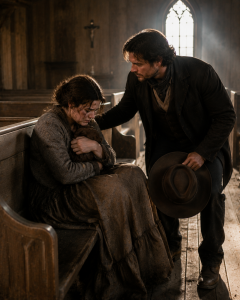
The sanctuary was black except for the coal-red glow of the stove near the altar. Silas crossed toward it, spurs ticking softly against the floorboards, and that’s when he heard it — a breath, ragged and small, swallowed fast like someone trying not to be heard.
He struck a match.
In the last pew, wrapped in a moth-eaten shawl that belonged to the poor box, a woman flinched from the light. Her lips were the color of skim milk. Her hands were wound in torn strips of petticoat, and the white cloth had gone dark at the knuckles.
She wasn’t dressed for Oak Haven. Blue silk, ruined and mud-caked, but silk all the same. City clothes. Clothes that didn’t belong within two hundred miles of a Wyoming blizzard.
“Go away,” she whispered. “The Reverend said I couldn’t stay past midnight.”
Silas’s jaw tightened. “Reverend Pendagast turned you out. In this.”
“He said the church is for the righteous.”
He looked at the bruise blooming along her jaw, purple going to yellow at the edges. Old enough to have started healing. Fresh enough to still hurt.
“You’ll freeze before the sun clears the steeple,” he said.
“I have nowhere else.” Her voice cracked, but something underneath it didn’t. “Unless you’re planning to shoot me — leave me be.”
He studied her a long moment. He knew that look. He’d worn it himself, the year Martha died — the look of something cornered, deciding whether to run or bite.
He shrugged off his buffalo coat and dropped it over her shoulders. The weight of it made her gasp.
“I ain’t going to shoot you,” he said. “And I ain’t leaving you here to turn into an icicle for the Reverend to find come morning. Got a cabin ten miles up the ridge. Warm. Food. That’s all I’m offering.”
“Why?”
“I don’t much care what this town thinks of me. Especially folks who put a woman out in the snow.”
The wind screamed against the windows. For a long minute that was the only answer either of them gave. Then the pew creaked.
“My name is Juliana,” she said.
He didn’t turn around. He just nodded, like a man accepting terms.
“Let’s go, then. Horses are getting restless.”
He helped her up into the wagon under a sky the color of a fresh bruise. As they pulled away from the church, Silas caught the curtain in the parsonage window twitch — Pendagast, watching from behind his own glass, warm and dry and ashamed of nothing. Silas held his stare until the curtain dropped.
Then he drove them both out of Oak Haven and didn’t look back.
He didn’t know yet what he was driving toward. He didn’t know that the woman huddled in his coat had a name sewn into more than just her conscience — that somewhere behind those frightened green eyes was a secret with the weight of a hanging rope, one that belonged to a man whose name was spoken in Oak Haven only in low voices, and only when the doors were shut.
He didn’t know that five years after fire took his wife and his future in the same night, the same hand that lit that match was about to reach for him again.
All Silas Vance knew, climbing the switchback trail toward his cabin with a stranger shivering at his back, was that something in him — some old, buried instinct he thought the winter of his grief had killed for good — had woken up the second he struck that match in the dark.
He thought he was giving a scared woman a warm bed for the night.
He had no idea he’d just lit the fuse on the same war that had already cost him everything once before.
By the time dawn broke gray over the Dragoon Range, Juliana would tell him a name that changed everything — a name attached to a fortune, a badge, and a lie so big it had already buried one wife in Oak Haven soil.
Silas Vance was about to find out just how far that lie was willing to reach to bury a second.
—
PART 2
The cabin was warm by the time Juliana stopped shaking.
Silas set a plate of salt pork and beans in front of her and watched her eat like a woman who hadn’t trusted food in days — fast, hunched, guarding the plate with her forearm before catching herself and reaching, too late, for the napkin he’d already set beside her.
The slip told him more than she meant it to. Wherever she’d come from, somebody had taught her which fork to use. Hunger had stripped that lesson clean off her, just for a second.
“You can stay as long as you need,” he said, pouring coffee. “But you work. I don’t carry dead weight.”
“I can work. I can cook, mend, read—”
“Don’t need much reading done up here.” He leaned back, chair groaning under him. “Can you shoot?”
She froze. “Why would I need to shoot?”
“Because a woman in a dress worth more than my ranch, hiding in a church with busted knuckles, didn’t just trip and fall.” He watched her over the rim of his mug. “Somebody’s looking for you, Juliana. When they find you, I need to know if you’re going to be behind me loading, or screaming.”
She set the fork down. The fear came back into her face, sharp and cold as the wind outside.
“His name is Ambrose Sterling.”
The name landed in the cabin like a stone dropped down a well. Silas didn’t move, but something behind his eyes went very still.
Ambrose Sterling wasn’t just a mayor. He owned the rail lines. He owned the judges. He owned most of the sheriffs inside a hundred miles, and every man in the territory knew it, even the ones who pretended not to.
“I’m his wife,” she said.
Silas’s mug stopped halfway to his mouth. He looked at her properly for the first time — really looked. She couldn’t be more than twenty-two. Sterling was pushing sixty.
“He’s a monster,” she said, and now that the dam had cracked, the rest came in a flood. “He beats his servants. He steals land. Three nights ago I found his real ledger — the one that shows he’s been selling government rifles to the raiders, stirring up trouble on purpose so the army sends more money. Money he pockets.”
Silas set the mug down slow. This wasn’t a runaway wife anymore. This was treason, sitting at his table in a borrowed coat.
“I took it,” she whispered. “I ran. I made it as far as Oak Haven, but his men are tracking me. I lost the ledger crossing the river when my horse spooked. But I know what’s in it. And he’ll kill me to make sure it stays buried.”
Silas stood and walked to the window, staring out at ten miles of snow between his cabin and a war he’d spent five years trying to forget.
Because he knew exactly what Ambrose Sterling was capable of when someone told him no.
He knew it because five years ago, Sterling’s land company had come to buy the water rights running through Silas’s valley. His wife, Martha, had refused to sell.
A week later, their barn burned down. With her inside it.
The sheriff had called it an accident.
Silas had spent five years unable to prove otherwise.
Now the woman sitting at his table was telling him she had proof — real proof, the kind that could hang a man like Sterling instead of just burying his victims quietly under a ruling of bad luck.
He reached for the shotgun on the wall.
Because somewhere out in that storm, hoofbeats were already closing on the ridge — and Silas Vance was about to find out exactly how far a man like Sterling would go to make sure the truth stayed as dead and buried as everyone he’d already killed to keep it that way.
—
PART 3
**I.**
Five riders came up the ridge at first light, and Silas Vance was already at the window before the echo of their hooves finished bouncing off the canyon walls.
“Five,” he said, counting. “Dusters, rifles. They ain’t here for coffee.”
He turned to Juliana, and whatever softness had crept into his voice at supper the night before was gone, burned off like morning fog.
“Get in the cellar. Under the rug. Don’t make a sound unless the house burns down around you. Go.”
She didn’t argue. She’d learned, in three days of running, exactly how much time arguing cost. She dropped through the trapdoor and pulled the bearskin rug back into place above her head, and in the dark and the dust she pressed her palm flat against her own mouth and listened to her heartbeat try to outrun the silence.
Above her, boots crossed the floor. A door creaked open.
Silas stepped out onto the porch with the shotgun held easy across his forearm, like a man greeting neighbors instead of an execution squad. He recognized the rider in front before the man even reined in — Caleb Thorne, Sterling’s head enforcer, a man who’d built a reputation on enjoying his work a little too much.
“Morning, gentlemen,” Silas called, voice level as the barrel he wasn’t quite pointing at anyone yet. “You’re trespassing.”
Caleb’s stallion sidestepped, and Caleb let it, smirking down from the saddle. “Silus Vance. Still playing cowboy up here in the rocks.” His eyes swept the porch, the shuttered windows, the smoke curling from the chimney. “We’re looking for a runaway. Little thing. Pretty face. Belongs to somebody important.”
“Don’t see no property here,” Silas said. “Just me and my misery.”
“Reverend Pendagast says a wagon left the church last night. Says it looked a lot like yours. Says he saw a woman climb in.”
“Reverend drinks too much communion wine.”
Caleb’s smile thinned to a blade. “We can do this easy, or we can burn this shack down with you in it. Hand her over. Sterling pays well for loyalty.” A pause, meaningful. “Pays even better for silence.”
Silas thumbed back both hammers. The double click cracked through the cold air like a second gunshot.
“You tell Sterling the only thing he’s getting off this mountain is a funeral, he takes one more step.”
Caleb weighed it — five men against one, but one man with the high ground, a shotgun, and by all appearances not one thing left in the world to lose. Men like that didn’t bluff. Everybody in the territory knew that about Silas Vance, even the men who worked for Ambrose Sterling.
“Have it your way.” Caleb wheeled his horse. “We’ll be back. Bring a cannon next time.”
Silas didn’t lower the shotgun until the riders had shrunk to specks on the white ridge below. Then he stomped twice on the floorboards, and the trapdoor lifted, and Juliana came up pale and shaking and alive.
“They’re gone. For now.” He was already pulling a saddlebag down, filling it with ammunition, jerky, a coil of rope. “But they’ll block the pass by noon. We can’t stay.”
“Where do we go?”
“Old mining tunnel cuts through the ridge to the rail line on the other side. Collapses a lot. Full of rats.” He didn’t look up from the packing. “It comes out near enough to catch the freight to Denver.”
“We’re running.”
“No.” He strapped his holster tight against his thigh, and when he finally looked at her, there was something in his face she hadn’t seen yet — not kindness, exactly. Resolve. “You said the key’s in Denver. Then we go to Denver. We get that box, we get the marshal, and we finish this the right way.”
“That’s suicide.”
He settled a battered cowboy hat down over her dark hair, tucking a stray lock beneath the brim to hide her face from the road.
“Sleeping in a church pew waiting to die,” he said. “That’s suicide. This is justice.”
**II.**
The mouth of the Broken Leg Mine was little more than a scar in the mountainside, half-buried behind dead scrub oak and drifted snow. Silas led the horses to a rock overhang fifty yards off and loosened their cinches with hands that moved fast but not careless.
“If I ain’t back in three days,” he murmured against his mare’s neck, “you kick that fence down and find your own way.”
Juliana stood at the tunnel mouth, watching cold, stale air breathe out of the dark like something alive. The last three days had stripped away everything that used to define her — the velvet cushions, the warm hearths, the version of herself that smiled at dinner parties while her husband destroyed lives one deed at a time. What was left standing at the edge of that hole in the mountain felt like someone she was only beginning to meet.
“Three miles,” Silas said, lighting a rusted lantern. The flame caught, throwing shadows across a jaw lined with old scars. “Air’s thin, timbers are old. We walk single file — I go first. I stop, you stop. I tell you to run, you don’t look back. You just run. Understand?”
“I understand.”
They went in.
The wind cut off behind them like a door closing. For the first hour there was only the crunch of loose shale under their boots, the drip of water through stone, and the long dancing shadows the lantern threw against walls that had once held a fortune in silver and now held nothing but rot.
“Silas.” Juliana’s voice came out smaller than she meant it to, swallowed by the dark. “Why did he kill her? Your wife.”
His shoulders tensed, but he didn’t stop walking.
“Land we had wasn’t just grazing ground. Controlled the water rights for the whole lower valley. Sterling wanted to dam it, divert the flow up to his mines. Martha told him no. Told him the farmers downriver would starve.” He stepped over a rotted support beam. “Sterling don’t take kindly to no. Sent men to cut fences, poison a few head of cattle. We held firm.” A pause, and when he spoke again his voice had gone somewhere flat and far away. “Then came the fire.”
“I’m sorry.”
“Don’t be sorry.” The words came out rough as gravel. “Be angry. Sorry don’t load a gun. Anger does.”
The tunnel narrowed. They dropped to a crouch through a stretch where the ceiling sagged on timbers gone soft as wet cardboard, and Juliana felt the mountain pressing down against her spine, her breath coming quick and shallow —
Then the boom hit.
A dull, bone-deep thud shuddered through the rock, and dust sifted down from the ceiling in a fine gray rain.
“What was that?” she gasped.
“Dynamite.” Silas’s voice had gone grim as the walls around them. “They found the entrance. They’re sealing it behind us.”
“They’ll kill us.”
“No.” He grabbed her wrist and hauled her forward, faster now. “They think it’s a dead end. They’re just closing the door. Problem is, that shock wave’s gonna bring the whole mountain down whether they mean it to or not.”
The ground shuddered again, harder. A crack split the ceiling above them and widened with a sound like the earth itself tearing open.
“Run!”
They ran. Behind them, the roar of collapsing rock chased them through the vein like a living thing, closer with every stride. Juliana stumbled, tore open her knee on the shale — and Silas hauled her up without breaking stride, half-carrying her toward a pinprick of daylight that seemed impossibly far and then suddenly, blessedly close.
They burst out of the tunnel mouth into blinding white just as the mountain groaned and sealed the exit behind them in a wall of dust and boulders.
They tumbled down a snowbank together, rolling to a stop near the rusted iron of an old rail line, and lay there gasping, coated in dust, alive.
“You okay?” Silas wheezed.
Juliana pushed herself upright, wiped a streak of grime across her cheek, and looked back at the mountain that had nearly buried them both.
“I’m angry,” she said.
Silas managed something that might, in a kinder light, have passed for a smile.
“Good. Keep that.” He got to his feet, offered her a hand up. “Train comes in an hour.”
**III.**
The 4:15 freight didn’t stop for passengers at the old miners’ junction, but it slowed enough, on the grade, for the desperate to jump it.
Silas caught the iron handle of an open boxcar and swung himself up, then reached back down for Juliana. She didn’t hesitate — she threw herself at the moving train and his grip closed around her forearm like a vice, hauling her up into the dark, straw-filled car.
They collapsed against the wall, chests heaving, the clack of the wheels beneath them steady as a second pulse. The car was empty except for crates of machinery stamped with the Sterling Enterprises seal.
“Irony,” Silas muttered, reading the stamp. “Riding to his execution in his own carriage.”
The wind whipped through the open door as the sun sank, and they huddled together for warmth in the corner, sharing what was left of the buffalo coat. Distance had a way of dissolving out here — rancher and lady, gunman and runaway, all of it stripped down to two people trying not to freeze.
“What’s truly in the ledger?” Silas asked, after a long while.
Juliana looked down at her hands. “Names. Dates. Mostly land deeds. He’s not just selling rifles to the raiders — he’s using the unrest as an excuse to declare land unsafe, seize it under emergency law, buy it for pennies, then sell the mineral rights east.” She lifted her eyes to him. “He’s stealing the whole territory, acre by acre.”
“He tried to do it to you.”
“He did do it to me.” The correction was quiet, absolute. “He just burned my world down first.”
“I never knew what he really was,” she said. “I was a trophy. My father was a judge in St. Louis — marrying me gave Ambrose legitimacy. Three years I smiled at his dinner parties while he destroyed people’s lives. When I found that book, I realized the wine I’d been drinking was paid for in blood.”
“You found a conscience,” Silas said. “Most folks never do.”
“He’ll kill you, Silas. If we walk into Denver, we’re walking into his den. The conductor, the station master — they all take his coin.”
Silas checked the loads in his Colt for the tenth time since they’d boarded.
“Then we don’t get off at the station.”
Near midnight, the train began to slow on the outskirts of Denver, gaslight glowing gold along the horizon, a city that looked peaceful from a distance and was anything but, up close, to a man who knew who owned it.
“We jump before the yard,” Silas said. “Ride in, the Pinkertons’ll be waiting.”
The train lurched before they could move. Brakes screamed, sparks showering from the wheels as the whole engine ground to a violent, unscheduled halt.
“Trouble.” Silas shoved Juliana behind a crate.
Lantern light cut through the slats. Boots crunched on gravel. A voice bellowed orders to check every car — a voice Silas recognized instantly, and hated instantly, and had half expected all along.
Caleb Thorne. He’d taken the direct pass on fresh horses while they were buried alive in the mountain, and he’d beaten them here.
“They’re searching the train,” Silas whispered. “We’re trapped.”
He looked at the crates, then grabbed a pry bar he’d taken from the mine entrance and levered the lid off one, dumping out gears and machine parts, burying them in the corner beneath loose straw.
“Get in.”
“Both of us won’t fit.”
“Get in.” It wasn’t a request.
She climbed into the crate. He piled straw over her and set the lid back down, unnailed but heavy enough to pass. Then he stood in the center of the empty car with nothing to hide behind at all, just as a hand seized the door and slid it wide open.
“Well, well.” Caleb climbed in, two deputies behind him with Winchesters leveled. “End of the line, Vance.”
“Tickets were too expensive anyway.”
Caleb’s eyes swept the car. “Where is she?”
“Died in the mine. Cave-in. I barely made it out.”
Caleb crossed the distance in two strides and backhanded him across the face, hard enough to split his lip. Silas didn’t flinch, didn’t so much as spit the blood before swallowing his own answer.
“Bad liar, Vance. Doesn’t matter. We’ll find her.” Caleb turned to his men. “Take him to the warehouse. Sterling wants to skin this buck himself.” Then, to the deputy nearest the straw pile: “Tear this car apart. If she’s hiding, I want her found.”
Silas’s heart slammed against his ribs as one of the deputies began kicking through the straw in the corner, working his way steadily toward the crates.
“Leave it,” Caleb snapped, before the man got there. “She ain’t here. If she was, Vance would’ve come out shooting. He gave up too easy.” A shrug, careless as a man discussing weather. “She probably froze on the ridge.”
They shackled Silas’s hands behind his back and dragged him out into the night. As they hauled him toward the waiting wagon, he looked back once at the crate, praying without words that the housewife from St. Louis had enough grit left to finish this without him.
**IV.**
Juliana waited until the voices faded and the train shunted forward into the main yard before she pushed the crate lid off and climbed out into the industrial dark of the Denver rail district — brick factories, coal smoke, the smell of a city that never once thought about who paid for its progress.
She knew where they’d take him. Sterling owned a warehouse near the river, the foundry, a place for business he didn’t want witnessed. She’d overheard him mention it once, in passing, the way powerful men mention the places where they do their worst work.
But she couldn’t go there. Not yet.
Silas had bought her this chance with his own body. She meant to spend it wisely.
She kept to the alleys, head down, looking exactly like what she’d become — a beggar in a ruined silk dress — until the marble columns of the First National Bank came into view, gilded gold by the rising sun. It wouldn’t open for another hour. Across the street, two men in long coats loitered by the entrance, smoking, doing a poor impression of men with nowhere to be.
Hired guns. Sterling had the bank watched.
She felt the hopelessness rise in her chest like water — and then she remembered what Silas had told her in the cabin, in another life, three days ago. *The US Marshal.* Elias Hood. Too stubborn to bribe, too mean to threaten.
His office was three blocks away. She ran the whole way.
She burst through the door hard enough to startle the young clerk out of his chair.
“I need to see Marshal Hood.”
“He’s having his breakfast, miss, if you’ve got a complaint about a vagrant—”
“Tell him Juliana Sterling is here.” Her breath came ragged. “Tell him I have the Apache ledger.”
The clerk’s eyes went wide, and he vanished into the back room. A moment later a bear of a man emerged, white-mustached, eyes like flint, taking her in — the bruises, the dirt, the fire underneath both.
“Mrs. Sterling.” Hood’s voice was a low rumble. “Half the territory’s looking for you. Your husband says you were kidnapped by a madman.”
“My husband is the madman, Marshal. And he has Silas Vance. He’s going to kill him.”
“Vance is a wanted man.”
“Vance saved my life.” She didn’t blink. “I have proof of treason. Proof my husband’s been selling arms to the enemy and stealing land under color of law. The proof’s in a safety deposit box, and his men are watching the bank.”
Hood studied her for a long, weighing moment — the kind of look that had made or broken a hundred men before her. He saw no deception in her face. Only desperation, and underneath it, something harder.
“If you’re lying to me, Mrs. Sterling, I’ll arrest you myself.”
“If I’m lying,” she said, “I’m dead anyway.”
Hood grabbed his hat and a double-barreled shotgun off the rack behind him.
“Saddle up, boys. We’re going to the bank.” His eyes cut to Juliana as his deputies scrambled. “Then we’re going to the foundry.”
**V.**
The foundry was a cavern of rust and river-damp air, and Silas Vance hung from a chain looped over a rafter, his toes scraping the floor, his face a ruin of blood and bruising.
Ambrose Sterling sat in a velvet armchair someone had carried in especially for the occasion, silver-haired, immaculately groomed, a cigar burning between two fingers, watching Silas sway the way another man might watch a fish on a line.
“Where is she, Mr. Vance?” Sterling asked, pleasant as a man asking the time.
“Told you. Fell. Ravine. Dead.”
“I don’t believe you.” Sterling nodded, and Caleb Thorne stepped forward and drove a fist into Silas’s ribs hard enough to fold him around the pain. Silas groaned but didn’t break.
“She has the key, doesn’t she,” Sterling mused, rolling the cigar between his fingers. “Going for the box even now. It’s a pity — my men are at the bank. When they bring her here, I’ll make you watch while I educate her on the duties of a wife.”
“You’re a small man, Ambrose.” Silas spat blood onto the concrete. “Hiding behind money and hired guns.”
Sterling’s genteel mask cracked, just slightly. “I built this territory. I brought civilization to this wasteland. If a few savages and dirt farmers have to die to make way for progress, that is the price of history.”
“Ain’t progress.” Silas met his eyes through the blood running into his own. “It’s just theft.”
Sterling drew a pearl-handled revolver from inside his coat, unhurried, almost bored. “I’m tired of this. Goodbye, Mr. Vance.”
The hammer clicked back.
The warehouse doors exploded inward.
A wagon rammed through the splintering wood, and gunfire erupted before the dust even settled — Marshal Hood standing atop the wagon bed, shotgun roaring, deputies pouring in around him, taking cover behind crates as Sterling’s men scattered fire in every direction. Bullets sparked off iron girders. Caleb Thorne swung his rifle toward Hood — and a single shot cracked from the shattered doorway, precise and sure, and spun Caleb around clutching a ruined shoulder.
Juliana stood framed in the wreckage of the door, a smoking Winchester in her hands — the same rifle she’d once sworn she didn’t know how to fire.
“Ambrose!”
Sterling turned, and for one unguarded second his composure fell away entirely — shock, then calculation, then the cold arithmetic of a cornered man watching his own men drop or throw down their weapons around him.
He lunged for Silas, hauling the wounded man up by the chain as a shield, revolver jammed against his temple.
“Back off!” His voice cracked wide open. “I’ll kill him. I swear it!”
The shooting stopped. Every gun in the room held its fire.
Juliana stepped forward, rifle steady, leveled at the only man who had ever made her feel small.
“Let him down, Ambrose.”
“You ungrateful wretch. I gave you everything.”
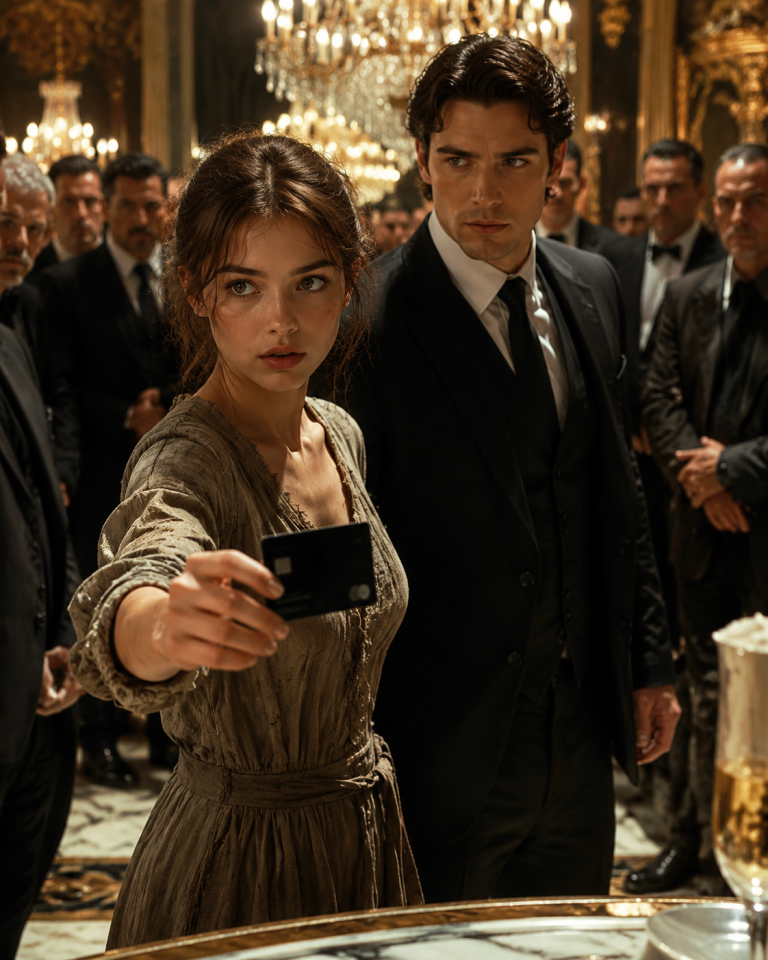
“You gave me a cage.” She reached into the bodice of her ruined dress and drew out a thick, folded envelope. “I went to the bank with the Marshal. We opened the box. We have the ledger. We have the letters to the tribal chiefs. It’s over.”
“That evidence is circumstantial. I own the judges—”
“Not the federal ones,” Marshal Hood called, stepping closer, shotgun trained steady. “Treason’s a hanging offense, Mayor.”
Sterling’s hand shook. He pressed the revolver harder against Silas’s skull.
“I’m not going to prison. If I go down, he comes with me.”
Silas, barely conscious, found Juliana’s eyes across the wreckage of the warehouse. He saw the hesitation there — she had a shot, but it was a hard one, a risky one, the kind that could go wrong in a hundred small ways.
“Shoot,” he whispered.
“I can’t—”
“*Shoot!*”
He summoned whatever strength his battered body had left and swung his legs up, driving both boots into Sterling’s chest. The impact knocked the two men apart just far enough — Sterling stumbled, his revolver firing wild into the rafters —
And Juliana didn’t hesitate a second time. She squeezed the trigger.
The bullet caught Sterling in the leg, shattering his knee. He went down screaming, the gun clattering from his hand, and the marshals swarmed over him before he’d even finished falling, pinning him to the filthy floor of the warehouse he’d built his empire on the ashes of other people’s lives.
Hood cut Silas down. He crumpled into the marshal’s arms, but his eyes never left Juliana as she crossed the room and dropped to her knees beside him, taking his ruined face in both hands, tears finally breaking loose and mixing with the blood on his skin.
“We did it,” she sobbed. “We did it.”
Silas managed something that was almost, finally, a real smile.
“Told you,” he rasped, “you could shoot.”
**VI.**
The gavel fell in the federal courthouse in Denver with a sound like a coffin nail driven home — a sound that echoed clean across the territory and marked, for anyone paying attention, the end of an era built on fear and other people’s silence.
It took three grinding months. The trial became the spectacle of the decade — a parade of witnesses, downtrodden farmers and nervous bank clerks, all of them emboldened by the testimony of one woman who sat in the stand with a spine of steel and gave her account of the beatings, the hidden ledgers, the treason dressed up as commerce, in a voice so clear it left the defense attorney with nothing to say.
She gave her name to the court as Juliana Vance — her maiden name, spoken plainly, like a door closing behind her for good.
*Guilty. On all counts.* Treason, conspiracy, murder.
The courtroom didn’t erupt. It went silent — the particular silence of people realizing the monster under the bed was finally, truly gone.
Ambrose Sterling was sentenced to hang at the first thaw of spring.
Back in Oak Haven, the change came like a fever breaking. Reverend Pendagast, stripped of his pulpit by a diocese that could no longer look away, slipped out of town in the dead of night on a borrowed mule, a carpetbag of stolen altar silver clutched to his chest. A new sheriff took the badge — Tom Miller, a blacksmith with hands like anvils and a reputation nobody’s money could buy.
For Silas, the victory tasted like ash and iron. Weeks in a Denver hospital knit his ribs back together, though they’d ache for the rest of his life whenever the barometer dropped, and a jagged white scar now split his eyebrow, giving his face a permanent look of quiet skepticism.
When he finally rode back into Oak Haven, the town didn’t look away from him anymore. Men who used to cross the street tipped their hats. The shopkeeper refused to take his money for a sack of coffee beans — *it’s on the house, Mr. Vance, for what you did, for stopping him* — and Silas, uncomfortable with gratitude in a way he’d never learned to be with violence, simply nodded and rode on up to the solitude of the high ridge.
He didn’t think of himself as a hero. He thought of himself as a man who’d finally fired the last shot he owed.
**VII.**
Spring came to the Dragoon Range with a violent burst of color — Indian paintbrush and bluebells flooding the valley floor, the creek roaring with meltwater, the whole mountain shrugging off a winter that had taken far more than snow.
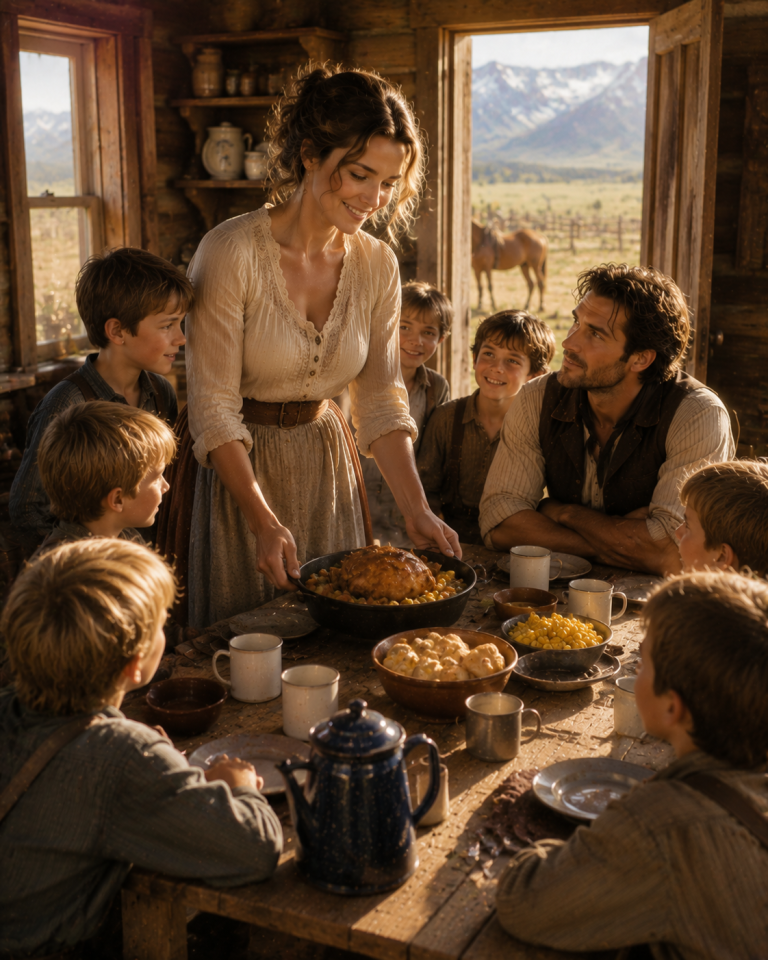
Silas spent his days repairing what the season had neglected — new boards on the porch, fences mended, brush cleared from the small plot where Martha was buried. He carved her name deep into a fresh cedar cross, and for the first time in five years, standing over her grave, the apology he usually offered — for living, for failing to protect what was theirs — didn’t come.
“I finished it, Martha,” he said instead, to the wind. “The man who took it all. He’s gone. The valley’s safe.”
He stood there a long time, listening to the hawks. For the first time since the fire, the weight on his chest had lifted into something else entirely — something that felt, terrifyingly, like a future. Blank. Unwritten.
The creak of wagon wheels broke the quiet. Silas turned, hand drifting toward a hip that no longer wore a gun belt for the daily chores. A simple buckboard was working its way up the switchback trail, pulled by a steady mule — not the marshal’s buggy, not a supply run.
He walked down to the porch, wiped his hands on a rag, and waited.
The driver set the brake and climbed down, and Silas felt something in his chest give a single hard thump.
Juliana.
But not the terrified creature he’d pulled from a church pew, and not the soot-streaked warrior who’d shot her own husband to save his life. This was a woman who had found her footing under her own weight — yellow calico dress the color of the wildflowers around her, sturdy boots that had seen real miles, dark hair braided back from a face that had lost its gauntness and gained a kind of clear-eyed steadiness that hadn’t been there before.
She tied the mule to the rail and stopped at the foot of the porch steps. Silas stayed on the top one, the distance between them holding everything they’d survived together.
“Heard you got the deed to the ranch back,” he said, voice rougher than he meant it.
“I did.” She shielded her eyes against the sun. “Federal government voided all of Ambrose’s land seizures. Titles went back to their owners yesterday. I wanted to deliver yours myself.”
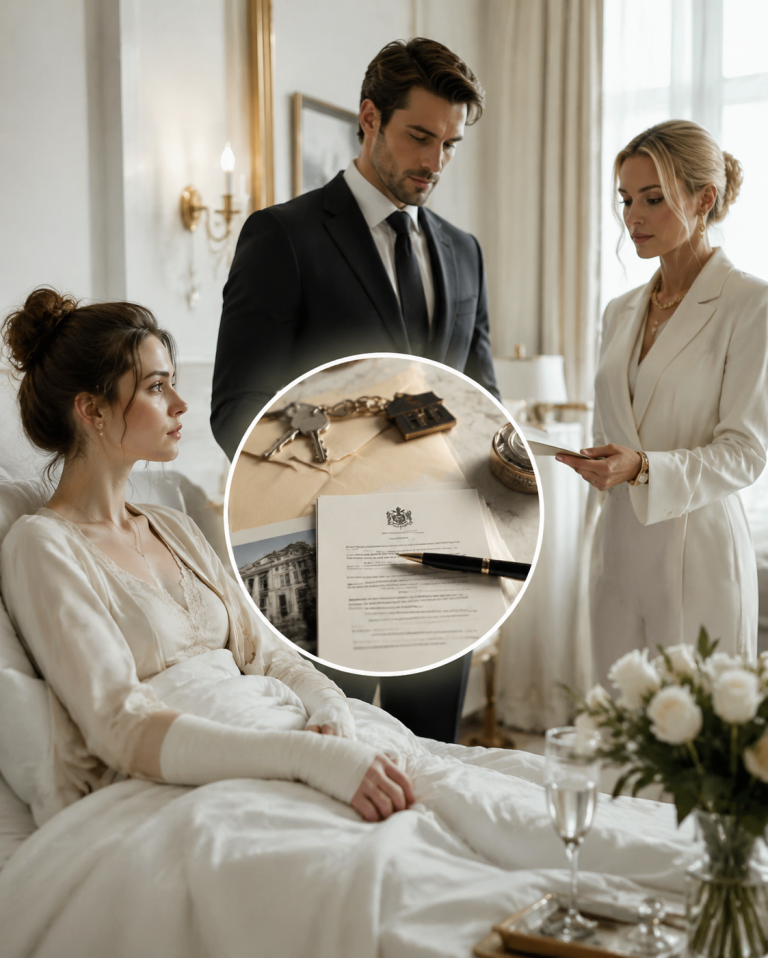
She pulled a thick envelope from her satchel and set it on the porch rail.
“And the rest?” he asked.
“Liquidated.” Something hard and satisfied moved behind her eyes. “Every account, every asset, every stick of furniture in that mansion — it’s going into a trust. Repaying the farmers he cheated. The families of the men who died in his unsafe shafts. I made sure of it personally.”
“You walked away with nothing.”
“I walked away with my life.” She let that sit a moment before correcting herself, some of her certainty faltering for just a second. “And my name.”
She reached into the satchel again, more hesitant this time, and drew out a heavy leather-bound volume — scorched along one edge, water-stained, the gold lettering on the spine still faintly legible.
“I found this in the rubble of your cabin,” she said, holding it out. “I remembered you reading it, that first night, before the world caught fire again. Thought you might want it back.” A pause. “A piece of the scholar. Not the gunman.”
Silas came down the steps slowly and took the book, his thumb tracing the damaged spine. It was a relic of a man he’d stopped being the night Martha died — and by bringing it back to him, Juliana was telling him, without saying it outright, that man could still exist.
“Thank you,” he said.
The silence that followed wasn’t awkward. It was the comfortable kind — the silence between two people who’d been through the same fire and come out the other side still standing.
“Where you headed?” he asked finally.
“Back to St. Louis, I figured. My father would take me back now the scandal’s settled.”
She turned to look out over the valley instead of at him, the wind pulling loose strands of hair across her face.
“I went back for a week. To settle things.” A breath. “But the city — it was loud, Silas. Cobblestones, carriages, all that chatter that says nothing at all. I couldn’t breathe there anymore. Kept dreaming about sagebrush. The wind in the canyon.”
She turned her green eyes back to him, steadier now than he’d ever seen them.
“I don’t fit in those parlors anymore. Don’t want to drink tea and pretend the world’s polite. It isn’t. It’s hard.” A faint smile. “But up here, at least it’s honest.”
Silas said nothing, just watched her — the strength settled into her shoulders now, the resolve that had replaced the fear in her jaw. She wasn’t a runaway anymore. She was a woman who’d faced death and chosen, deliberately, to keep living.
“I heard rumors,” she went on, a playful edge creeping into her voice. “Folks in town say there’s a stubborn rancher up on the high ridge trying to bring a cattle operation back from the dead. Say he needs hands. Somebody who can keep his books, cook a meal that isn’t burnt beans, handle a rifle if the wolves come down out of the hills.”
Silas looked down at the ruined Shakespeare in his hands, then out at the wide, empty horizon of a ranch that had always been too much work for one man.
“Pay’s terrible,” he said, fighting a smile that wanted out anyway. “Winters are brutal. And the boss — well. He’s been known to be a difficult man.”
She climbed the last step and stood beside him, her shoulder brushing his arm as she looked out at the mountains with him.
“I think I can handle him,” she said quietly. “I’ve seen him at his worst. Think I’d like to see him at his best.”
Silas turned and looked at her — really looked — and felt the last brick of the prison he’d built for himself, five years and one buried wife ago, finally crumble away.
He extended his hand. Not the hand of a savior reaching for a victim this time.
The hand of a partner.
“Welcome home, Juliana.”
She took it, her grip warm and sure, and above them the sun cleared the peaks of the Dragoon Range and flooded the whole valley in gold, burning the last of the shadows off the mountain.
The long winter was finally over.
**THE END**