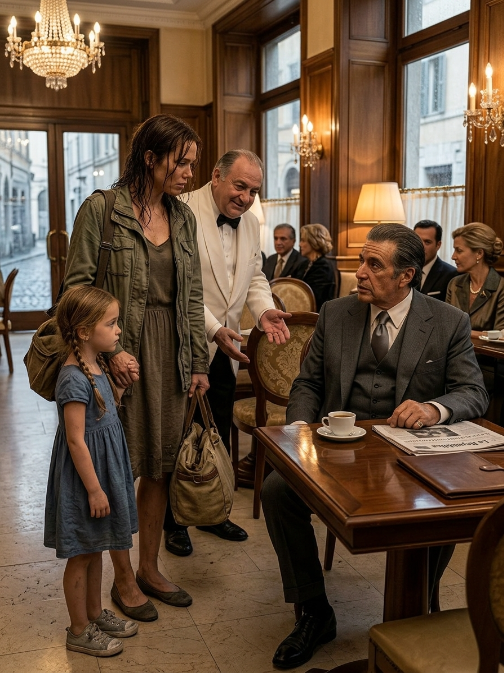
SHE SIGNED NOTHING FROM HER HOSPITAL BED — THEN HER HUSBAND DISCOVERED WHO REALLY OWNED HIS EMPIRE

## PART 1
The anesthesia hadn’t fully left my body when I heard heels clicking against the hospital linoleum, too confident for a place built for the broken.
I was twelve hours out of surgery, my throat still raw from the tube, when the door opened and a stranger walked in wearing white silk to visit a woman in a paper gown.
She smiled at me the way people smile at furniture they intend to replace.
That was the first thing I noticed. Not her face. Not her name, which I didn’t yet have. Just the smile — the kind reserved for someone you’ve already decided doesn’t matter.
My husband walked in behind her, holding a leather folder against his chest like a shield.
He looked rested. I looked like I’d been carved open by strangers, because I had.
“Adrienne,” he said, using my name the way he used to use it at dinner parties, smooth and performative. “This is Celine Rourke.”
I said nothing. I had learned, in nine years of marriage to Weston Marsh, that silence unsettled him more than questions did.
Celine set the folder on my meal tray, beside a half-eaten cup of orange gelatin, and opened it with fingers tipped in the exact shade of red I’d once worn on our honeymoon.
“We just need your signature on the Wynfield property,” she said, sliding a silver pen toward my hand. “It’s the cleanest way to move forward before this gets complicated.”
Complicated. As though theft required a softer word to feel civilized.
I looked at the deed to my house — the house my grandmother had left me, the house whose mortgage had never once carried Weston’s name — and then I looked at my husband’s hand, bare where a wedding band used to sit.
“Explain to me exactly what I’m signing,” I said. My voice came out flatter than I expected. Steadier.
Weston’s eyes flicked toward Celine. Only for a second. But a second is a long time when you’re watching for exactly that kind of glance.
“We’re trying to reduce your stress,” he said. “That’s all this is.”
“We.”
He didn’t correct himself.
Celine leaned in, resting one hand near the chair where my sister had slept the night before my surgery, still warm from her absence. “We never wanted to embarrass you, Adrienne. Truly.”
I studied the white of her dress. The missing ring on Weston’s finger. The documents arranged with the precision of something rehearsed in a car on the drive over.
“You’ve both done a remarkably poor job of not embarrassing me,” I said.
Her smile cracked, just slightly, before she smoothed it back into place.
Weston sighed the way he used to sigh at board members who asked inconvenient questions. “This is exactly why decisions shouldn’t be made emotionally.”
I nearly laughed. He had walked his mistress into my recovery room, announced the end of our marriage over a meal tray, and was now lecturing me about emotional decision-making.
“What does Sterling Cove have to do with my house?” I asked.
A hesitation passed between them — small, but visible, like static before a storm.
Celine answered before he could. “The bank is requiring additional collateral for the acquisition.”
There it was. Not love. Not even the decency of honesty. Just money, wearing a white dress and calling itself compassion.
They didn’t need my signature because the marriage was over. They needed it because they needed something of mine to survive.
I turned the page slowly.
“A lien,” I said. “Against my grandmother’s house.”
“It’s temporary,” Weston said, too quickly.
“And if the Marchwood acquisition falls through?”
“It won’t.”
The certainty in his voice sounded memorized, like something he’d said aloud in a mirror until it felt true. He genuinely believed I would sign. He believed the surgery and the sedatives had softened whatever part of me used to ask hard questions.
He never noticed my left hand resting beneath the blanket. Never wondered why I kept asking them to read each clause aloud instead of simply reading it myself. He mistook my quiet for surrender.
He never once considered that quiet could also mean someone was recording.
“Read me the second page,” I told Celine.
“You should rest, Adrienne—”
“Read it.”
She did. Every clause. Every carefully worded sentence meant to protect the two of them from a woman they assumed had already lost everything worth protecting.
Then I found something else tucked behind the deed. A medical power of attorney, my name already typed at the top, waiting only for ink.
My pulse didn’t spike. It slowed — the way it does right before you stop being afraid of something and start being ready for it.
“My surgeon said the procedure was a complete success,” I said, looking at Weston.
“We’re only being responsible.”
“By requesting control of my medical and financial decisions on the same afternoon?”
For the first time, something shifted behind his eyes.
Fear. Small, and poorly hidden, but unmistakably there.
I reached beneath the blanket without breaking his gaze, my fingers finding the phone I’d hidden against my hip an hour before they’d walked in — already connected, already listening, already sending everything to a woman twenty minutes away who had spent nine years waiting for me to finally ask for her help.
The room went silent except for the steady, unbothered rhythm of the heart monitor beside me.
And somewhere on the other end of that call, a voice they didn’t know I had was one breath away from unmaking everything they believed they’d already won.
—
## PART 2
Betrayal never begins the day you catch it. It begins in the quiet years before, when your kindness gets measured for weaknesses no one bothers to name aloud.
Weston never once asked where Sterling Cove’s first investment came from. He simply accepted that the world had recognized his genius. When the company survived the downturn, he called it instinct. When the Chicago deal nearly buried him and someone quietly bailed him out, he called it leadership.
Ashcroft House had become the backdrop for his magazine features and gala photographs. He called it *our home*. He’d built an empire on doors I had opened for him and convinced himself, somewhere along the way, that he’d never needed a key at all.
I didn’t regret helping him. I regretted making that help invisible.
Priya arrived twenty minutes after hospital security walked Weston and Celine out, and she didn’t hug me until the door was locked and my phone’s recording sat safely inside an evidence file with her name on it.
She sat on the edge of my bed and took my hand. “How much do you want to know tonight?”
“All of it.”
She warned me I was allowed to fall apart first.
“Later,” I said, and meant it.
Then she opened her laptop, and the real storm began.
—
## PART 3
The forensic report Priya pulled up that night was worse than a lien on a house. It was a map of a marriage that had been quietly hollowed out for years, one wire transfer at a time.
Weston had created three shell consulting firms and personally approved payments to all of them. One belonged to his college roommate. One belonged to Celine’s brother. The third traced back to a Delaware entity connected, three layers deep, to a deposit on a penthouse overlooking Central Park.
He had already paid that deposit. The paperwork listed Celine Rourke as the intended owner. While I sat beside him at fundraisers reading his texts about *running late at the office*, the two of them had been choosing marble finishes for a home built on money that was never his to spend.
Priya scrolled further. Hundreds of emails. In them, Celine referred to me as “the sleeping shareholder.” Weston reassured her, again and again, that I understood nothing about Sterling Cove’s ownership structure — that my family’s own trustees had once called me “too emotional” to be trusted with financial decisions.
One message stopped my breath entirely. It wasn’t romantic. It was practical, cold, efficient.
*Once Adrienne signs the house over, we announce after the gala. She’ll be too humiliated to fight it publicly.*
“What gala?” I asked.
Priya’s jaw tightened before she even answered. “The Marchwood announcement. The Wyndmoor Grand. Twelve days from now.”
Twelve days. Weston still intended to walk onto that stage in front of investors, city officials, and half of Manhattan’s business press as though nothing about his life had changed — as though the woman lying in a hospital bed three miles away didn’t exist, or worse, had simply agreed to disappear on cue.
Celine had already arranged a national business feature naming her *the strategic force behind Sterling Cove’s next era*. I appeared exactly once in the draft, described as “Weston’s wife, a private philanthropist recovering from an unexpected health matter.” Not a name. A footnote.
There was more. Celine had prepared a public statement claiming Weston and I had separated months earlier, that the decision had been mutual, that we remained close, and that I fully supported “his new chapter.” A fantasy dressed up as a press release, ready to be handed to any reporter who asked the wrong question at the wrong time.
I looked out the hospital window at the skyline glittering like it hadn’t just watched my marriage get itemized and appraised for parts.
“When’s the next board meeting?” I asked.
“Tomorrow morning.”
“Move it to the Ashcroft family office. I’ll join remotely.”
Priya studied me for a long moment, the way she used to study opposing counsel right before she dismantled them. “What do you want the board to do?”
“Nothing yet,” I said. “Complete the audit. Notify the lender privately. Lock down company accounts. Preserve every email.” I glanced at the evidence file glowing on her laptop screen. “Let him have his gala.”
—
For the next twelve days, I healed in a silence Weston mistook for defeat.
He sent white roses with no note attached, and I had the nurses redistribute them to other patients on the floor. He asked, through his attorney, to speak without lawyers present, and I didn’t answer. Celine emailed my assistant requesting access codes to Ashcroft House, and her car turned around at the gate when the system rejected her credentials without explanation.
On the fifth day, Weston released his separation statement to a friendly columnist. By noon, photographs of him and Celine leaving a restaurant on the Upper East Side were circulating online. She wore my late mother-in-law’s sapphire earrings, the ones passed down through three generations of Marsh women, the ones I had once been given as though they meant something. In the photos, they both looked radiant.
I looked, by comparison, like a woman who had already lost.
My silence made Weston bold. He told two board members that my “postoperative condition” had left me unstable, and quietly suggested that the Ashcroft Trust’s voting proxy be reassigned to him “for continuity.” Then he sent the trustees a forged physician’s letter claiming I required extended cognitive recovery before resuming any financial oversight.
Priya traced the document’s metadata back to a computer registered to Celine’s office within six hours.
That discovery burned away whatever mercy I still had left for either of them.
Two days before the gala, the board convened in secret at the Ashcroft family office. Daniel Ferris, our longtime CFO, presented the completed audit. Priya presented the hospital recording, the forged medical letter, and the paper trail behind the unauthorized transfers. I appeared by video from my own living room, a blanket over my knees, my voice steadier than it had been in years.
“I am exercising the Ashcroft Trust’s controlling vote,” I said. “Effective nine o’clock tomorrow evening, Weston Marsh is removed as Chief Executive Officer of Sterling Cove Holdings, for cause.”
One director, visibly startled, asked why nine in the evening specifically.
“Because the gala begins at seven-thirty,” I said. “I’d like him to finish his toast first.”
The resolution passed five votes to one. By sunset the following day, the lenders had frozen every unauthorized credit line Weston had opened, the penthouse deposit had been flagged and reversed, and the Marchwood sellers had agreed to negotiate directly with the Ashcroft Trust instead.
Weston knew none of it. He was too busy rehearsing his victory speech in a hotel mirror.
—
The Wyndmoor Grand’s ballroom glittered under twelve chandeliers the night of the announcement, filled with the kind of people who mistake proximity to money for a personality trait. Weston stood near the stage, shaking hands, accepting congratulations for an acquisition that no longer legally belonged to him — utterly unaware that the hotel hosting his triumph was itself owned, three subsidiaries deep, by the Ashcroft Trust.
Beside him, Celine wore a silver gown and my mother’s sapphire necklace, not earrings this time — the necklace I hadn’t seen since it went missing from Ashcroft House the week after my surgery.
I watched all of it from the hotel manager’s office on a private security feed, while Priya, Daniel, and my sister Charlotte finished the last preparations one floor below. Weston believed I was resting quietly at home while he replaced me in front of six hundred witnesses.
The truth, I decided, deserved to walk through the same door as the lie.
At eight forty-five, Weston stepped up to the podium and thanked the room for its patience “during a difficult personal chapter.” He explained that our separation had been mutual, and that I’d chosen not to attend tonight due to ongoing health concerns. Then he invited Celine onto the stage, called her “instrumental to everything ahead,” and raised his glass to new beginnings.
The champagne never reached his lips.
The ballroom doors opened, and I walked in wearing black silk, flanked by two hotel security officers who cleared a path through six hundred stunned guests. Weston’s glass froze midair. Celine’s face drained of every ounce of color it had spent the evening performing.
“You told this entire room I chose not to come,” I said, reaching the edge of the stage.
Weston forced his practiced smile back into place. “Adrienne, you should be resting—”
“I rested,” I said, “while your lawyers tried to mortgage my grandmother’s house from a hospital bed.”
Celine found her voice first, accusing me of making a scene in front of cameras. I looked at the necklace resting against her collarbone and said, loudly enough for the nearest microphones to catch it, “You’re wearing stolen jewelry under six television lights.”
The room went utterly silent as I climbed the short steps onto the stage. Weston reached for the microphone out of instinct, but the sound system cut dead beneath his hand — Daniel, standing at the control booth, had been waiting for exactly that moment.
Behind them, the massive screen that had been playing Sterling Cove’s promotional reel all evening flickered and changed.
**SPECIAL SHAREHOLDER DISCLOSURE.**
I took the microphone. It worked perfectly for me.
“My name is Adrienne Ashcroft Marsh,” I said, my voice carrying clean and even across the ballroom. “For nine years, most of you have known me only as Weston’s wife, because I chose privacy. Unfortunately, my husband mistook that privacy for powerlessness.”
The screen behind me changed again, and gasps rippled through the crowd as the numbers appeared. The Ashcroft Family Trust held sixty-one percent of Sterling Cove’s voting shares. It had provided the company’s founding capital. It had carried the firm through two recessions Weston had publicly credited entirely to his own instincts.
“One should generally confirm who owns a company,” I said, looking directly at him, “before attempting to steal from it.”
Then the forensic audit filled the screen — nine-point-eight million dollars in unauthorized transfers, three shell companies, and the signed deposit agreement for a Central Park penthouse with Celine Rourke’s name on the deed. Celine spun toward Weston, insisting, loud enough for the front rows to hear, that he’d told her the money came from his personal holdings.
He said nothing. His silence answered for him.
Then the recording played. My hospital room, twelve days earlier. Celine’s voice, asking me to sign away my house before things became *complicated*. Weston’s voice, pressing the pen toward my hand. And finally, Priya’s voice, ending the clip with the same three words she’d used to close it that night in the hospital: *”That was enough.”*
Hundreds of guests stood frozen, listening to a private betrayal become public record in real time.
Daniel and the board secretary walked onto the stage carrying the formal resolution. I announced that the board had voted, unanimously except for one dissent, to remove Weston Marsh as Chief Executive Officer for cause, effective at nine o’clock that evening. As the ballroom clock chimed nine, his company phone locked in his hand, his access badge deactivated at the door, and the Sterling Cove logo dissolved from the screen behind us.
In its place: **ASHCROFT URBAN GROUP.**
One person began clapping. Then another. Within moments, the entire ballroom rose — the same investors who had toasted Weston twenty minutes earlier now standing for me.
I didn’t smile. I had learned, somewhere in the last twelve days, that power was never the applause.
Power was simply no longer needing it.
—
Weston waited until the sound of clapping thinned, then crossed the stage close enough that only the front rows could hear him. “You can’t do this to me.”
“I already did,” I said.
“I built Sterling Cove.”
“Your talent designed the buildings,” I said. “My family’s money funded, protected, and rescued the company more times than you’ll ever admit. You never asked who saved you, Weston, because you preferred believing you’d saved yourself.”
He accused me of hiding the truth from him for nine years. I told him privacy was never a lie; it was simply something he’d never bothered to ask about, because he’d never imagined I was worth asking.
Beside him, Celine unclasped my mother’s necklace with trembling hands, insisting she hadn’t known it was mine. I reminded her she had stood beneath the portrait of my mother wearing that exact necklace at our wedding.
Weston snapped at her to be quiet. For the first time all night, Celine turned her fury on him instead of me. She said he’d told her our marriage had ended years ago. I asked, calmly, why then they’d needed my signature at all if it were already over. She looked away, finally understanding she hadn’t been competing with me for a man — she’d been auditioning for a life that had never once been his to give her.
Priya joined us onstage and handed Weston two envelopes. The first held his termination notice, an asset preservation order, and formal repayment demands. The second held the divorce petition I’d filed that morning, before the sun had even fully risen over the city.
“What do you want,” Weston asked, and for the first time in nine years, it wasn’t a rhetorical question.
“Stop contacting my doctors, my staff, and my family,” I said. “Surrender every company device tonight. Return what you took. Disclose everyone who helped forge that medical letter.” I paused. “And leave my grandmother’s house alone.”
“You’re trying to destroy me.”
“You destroyed yourself,” I said, “in rooms where you assumed I wasn’t listening.”
When he glanced toward the exits, already calculating an escape, I reminded him gently that the Wyndmoor belonged to Ashcroft Hospitality, and that Ashcroft House — the home he’d called *ours* for nine years in interviews — had never once carried his name on the deed. His permission to live there had been revoked the moment my signature went on the divorce filing that morning.
For the first time in our marriage, Weston Marsh begged. He said we could fix this. He said Celine had meant nothing to him, and beside him, she flinched as though she’d been struck. Twelve days earlier he had stood at my hospital bed demanding my house with her hand practically on his shoulder. Now that his power had evaporated, he was ready to discard her just as easily.
“What did I mean to you?” he asked quietly, the crowd’s noise a distant hum around us now.
“You were the man I loved,” I told him. “That should have been enough for both of us.”
Hotel security stopped Celine at the edge of the stage before she could leave still wearing the necklace. She rounded on Weston, demanding to know if he’d ever actually intended to put her name on that penthouse, or if she’d simply been useful until she wasn’t. His silence was, once again, the only answer either of us needed.
She admitted it then, quietly, to no one and everyone. She’d known he was married. She’d known I was in a hospital bed recovering from surgery when they walked in with that folder. She’d convinced herself that because I already had money, a house, a name — taking one more piece of my life couldn’t really be called cruelty.
“I hope,” I told her, “that you become someone who never again needs another woman’s ruin to feel chosen.”
Then I turned away, because that was the last piece of forgiveness I had left to give either of them that night.
—
Six months later, Ashcroft Urban Group broke ground on the Marchwood site under my own name for the first time in a decade — not as a silent trustee standing behind someone else’s ambition, but as the woman whose signature actually built things.
Weston’s disbarment from the board became permanent. The repayment agreement took eighteen months to fully unwind, most of it funneled quietly into a fund Priya and I built for women navigating financial abuse disguised as marriage — women who had learned, the way I had, that a hospital bed can be the safest place in the world to finally stop being quiet.
Celine disappeared from Manhattan’s society pages within a season, her name mentioned only in passing, in stories that were no longer about her.
I kept the house. I kept my name, restored to what it had always been before I folded it into someone else’s. I kept the sapphires, cleaned and reset, and gave them to Charlotte’s daughter on her eighteenth birthday, along with the only advice that mattered: *know exactly what belongs to you before anyone asks you to sign it away.*
On the anniversary of the surgery, I stood in the lobby of the building that used to bear Weston’s name and now bore mine, and I thought about the version of myself who lay in that hospital bed twelve hours out of surgery, listening to a stranger explain, in a soft and reasonable voice, exactly how I was going to lose everything.
She hadn’t lost anything.
She had simply waited until the room was ready to hear the truth — and then she had let it speak for itself.