EVERY BRIDE FLED THE DISFIGURED RANCHER WITHIN DAYS — THEN THE HEAVYSET WOMAN THE WHOLE TOWN MOCKED STAYED, AND FOUND OUT WHY THE OTHERS REALLY LEFT

PART 1
Three women had already run from that cabin, and Marguerite Doyle intended to be the one who didn’t.
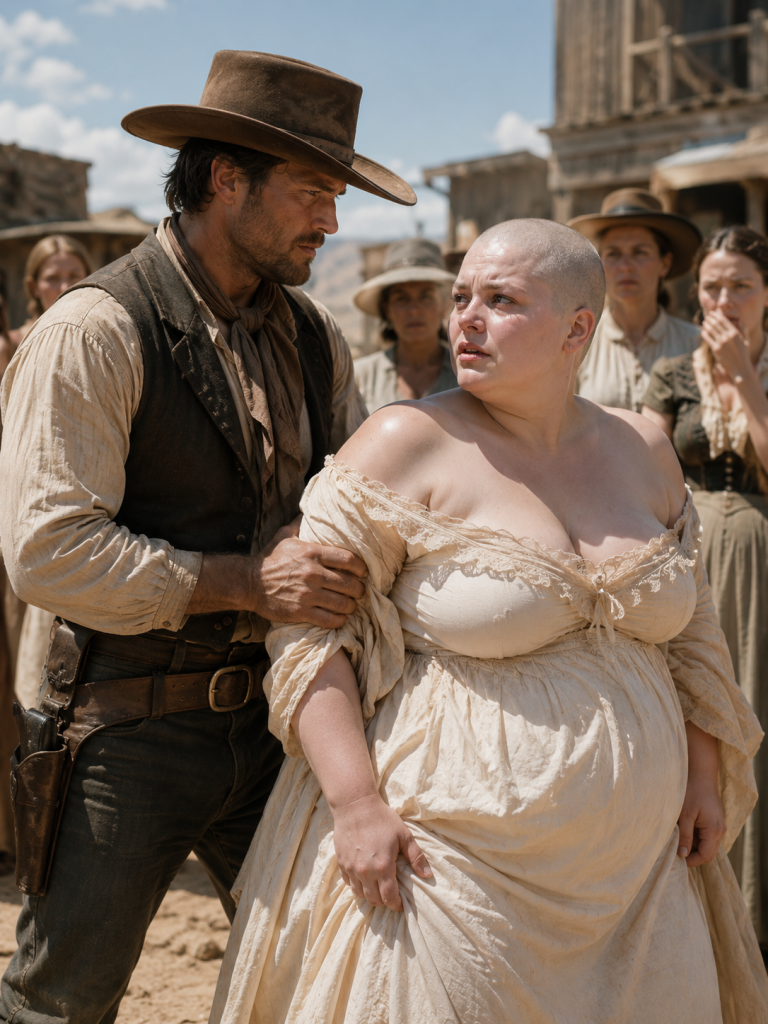
She learned that the moment she stepped off the stagecoach in Pine Hollow, Colorado, boots sinking into half-frozen mud while a cluster of townsfolk watched her the way people watch a wagon wreck — unable to look away, unwilling to help. Word of her arrival had beaten her into town by nearly a week. So had the nickname waiting for the man she’d come to marry. They didn’t call him a rancher. They called him the Ghost of Widow’s Peak, and they said it the way you’d warn a child off a well with no bottom.
Nobody in Pine Hollow said his real name much anymore. Somewhere along the way, Caleb Ashworth had simply stopped being a person to them and started being a story — the kind told low and quick on porches after dark, the kind meant to keep girls from wandering too far up the mountain road alone.
He hadn’t started that way. Ten years back, Caleb had been a quiet, capable rancher who came down from Widow’s Peak twice a season to trade cattle and buy supplies, polite enough, unremarkable enough, forgettable enough that nobody thought much of him at all. Then a rockslide during a summer storm crushed the left side of his skull and face, tore his jaw half loose, and left him with one clouded eye and a landscape of scar tissue climbing from his collar to his temple. He should have died on that mountainside. He didn’t, and the town never quite forgave him the inconvenience of surviving ugly.
After that, he stopped coming down as often. When he did, people stopped meeting his remaining good eye. Years of that treatment will curdle a man’s patience, and somewhere along the way Caleb Ashworth’s silence hardened into something the town mistook for menace instead of grief.
Lonely enough, eventually, to try something desperate, he’d taken to placing advertisements in newspapers back East. They read like a man who’d already stopped expecting kindness and had decided to ask for usefulness instead.
Wanted: sturdy, sensible woman for marriage. Ranch life. Real work, not romance. Weak stomachs need not write.
Three women had answered.
The first, a young widow named Ruth Calloway, arrived full of hope and left two days later during a hailstorm, half-hysterical, swearing to anyone who’d listen that something evil lived up on that mountain.
The second, a seamstress from Boston named Dovie Marsh, lasted six days and came back to town in torn clothes, refusing to say one word about what had happened in Caleb’s cabin.
The third, a quiet older woman named Opal Reinhardt, never came back down the mountain at all. Caleb claimed she’d stolen a horse in the night and ridden east alone. The sheriff rode up, found no sign of foul play, and rode back down with nothing but Caleb’s word — which, by then, was worth exactly nothing to Pine Hollow.
By the time Marguerite arrived that November, the town had long since stopped debating whether Caleb Ashworth was dangerous. They’d already decided.
Marguerite, for her part, had come from a very different kind of danger — the polished, smiling kind that Philadelphia high society specialized in. At twenty-nine, broad-shouldered and solidly built, with sharp brown eyes that missed very little, she’d spent years being treated as an embarrassment by people who considered cruelty a form of good manners. Her older brother Nathaniel, a banker with expensive tastes and a gift for spending money that wasn’t his, had kept her tucked away in their family home like a stain to be managed, working her like unpaid help while insisting he was protecting her from a world that would only laugh at her.
The world had laughed at her plenty already. Starvation diets forced on her by relatives. Suitors who treated courtship as a joke told at her expense. A brother who flinched when she stood beside him in public. She had survived all of it by building a wall of indifference so thick that other people’s opinions simply stopped reaching her.
So when she found Caleb Ashworth’s advertisement — blunt, plain, utterly without flattery — she hadn’t seen romance in it. She’d seen an exit. A place where nobody would ask her to apologize for the space she took up in a room.
She stepped down into Pine Hollow’s freezing mud, adjusted her shawl, and looked the town over like a woman taking inventory of a place she fully intended to outlast.
They were already whispering.
They always were.
PART 2
Two young women covered their mouths and giggled behind gloved hands as Marguerite passed. A cowhand nudged his friend hard enough to spill his drink. “Guess the Ghost finally found himself someone nobody else wanted.”
The laughter chased her all the way to the boarding house.
She let it. Laughter had never once paid a debt or filled a stomach, and she’d crossed half a continent on the strength of that fact alone.
Inside, the innkeeper, a sharp-eyed woman named Ida Ferris, slid a room key across the counter without being asked why she’d come.
“You’re the one marrying Ashworth.”
“I am.”
“There’s still time to turn around.”
Marguerite offered a polite, unbothered smile. “Everyone back East said the same thing before I left.”
Ida leaned in, lowering her voice like she was passing along something dangerous. “First one screamed the whole way down the mountain. Second one wouldn’t say a word about what she saw. Third one just — disappeared.”
“Did anyone actually witness him harming any of them?”
Silence.
“No,” Ida admitted.
“Then somebody’s been lying to this whole town,” Marguerite said, and went up to her room.
She rode out to Widow’s Peak alone the next morning on a borrowed mule. The cabin, when it finally appeared through the pines, looked nothing like the stories. It was large, well-built, meticulously kept — split firewood stacked in even rows, fences mended and taut, smoke rising steady from a clean-swept chimney. Nothing about it looked like the lair of a monster.
Before she could knock, the door opened, and Caleb Ashworth filled the frame.
He was massive — not quite the giant the legends promised, but broad enough to make the doorway look narrow around him. The ruined half of his face caught the light first: scars branching from temple to jaw, one eye permanently clouded shut beneath the damaged skin. The other side of his face remained unmarked, even striking. The contrast between the two halves was almost dizzying.
“You came,” he said. His voice was low, rusted from disuse.
“I did.”
“You’ve heard what they say about me.”
“I have.”
“And you’re still standing here.”
“Yes.”
He studied her a long moment, then stepped fully into the doorway’s light, hiding nothing. Offering her every scar at once, as if daring her to look away.
She didn’t look away. She looked carefully — not politely, not quickly — the way a person studies something they intend to understand rather than merely endure.
“Whoever stitched that up knew exactly what they were doing,” she finally said.
Caleb blinked. “What?”
“The scar tracks the muscle almost perfectly.” She gestured gently toward his jaw. “That’s skilled work. Somebody saved your life properly.”
In ten years, not one soul had ever looked at the wreckage of his face and noticed the surgeon’s craftsmanship instead of the damage. He didn’t have words ready for that, so he said nothing at all, and let her inside.
The following weeks unsettled them both in ways neither expected. Marguerite didn’t flinch, not once. She cooked, scrubbed the floors, argued with him over fence lines, complained loudly about his terrible coffee, and filled the quiet cabin with more noise and life than it had held in a decade. Caleb kept waiting, every single morning, for the moment she’d finally look at him the way the others had. It never arrived.
Instead, she found his carvings — tucked in a drawer, dozens of them. Tiny wooden birds. Foxes mid-stride. Delicate flowers. A carved child reaching for a carved bird overhead.
She held up a small bluebird, turning it in the light. “You made these?”
He nodded, looking almost embarrassed.
“You have a real gift in your hands.”
He glanced down at those same scarred hands like he was seeing them for the first time. “Nobody’s ever told me that.”
“Then everybody’s been wrong.”
One evening, once the dishes were cleared, she finally asked him outright.
“Tell me about Ruth.”
He went rigid. “You think I hurt her?”
“I don’t know yet. What about Dovie?”
“I don’t know.”
“And Opal?”
His jaw tightened. “I don’t know that either.”
“I deal in facts,” she said simply.
He rose without a word, crossed to a locked chest beneath the stairs, and pulled out three ribbon-tied bundles of letters.
“Read them.”
Ruth’s letters were written to a sister back East, every one of them. The last read: I’ve decided to go home. Caleb has been gentler than any man I’ve known, but I can’t survive another mountain winter. I haven’t told him — he’ll only blame himself.
Dovie’s bundle held factory pay stubs and a half-finished marriage proposal from a man in Boston. Her final note read: Forgive me. I love someone else. You deserved honesty, not silence.
Marguerite set both bundles down slowly. “And Opal?”
Caleb’s face went dark. “There’s no letter. There never was one.”
That night Marguerite lay awake turning it over. Two women had left for reasons that had nothing to do with cruelty — one from homesickness, one from love. Neither had come to harm.
So why had the whole town sworn otherwise?
Only one story remained unaccounted for. Opal. The bride who had simply vanished — and Marguerite intended to find out exactly what had happened to her.
PART 3
Three days later, Marguerite walked into the sheriff’s office and asked to see Opal Reinhardt’s file.
Sheriff Wade Hutchins laughed under his breath. “Ain’t much to see.”
“I’ll be the judge of that.”
He handed over a thin folder — six pages for a woman who had vanished without a trace. Marguerite frowned before she’d even finished the first line. The file listed exactly one witness interview.
One name.
Nathaniel Doyle.
Her own brother.
Her stomach dropped. Nathaniel had never set foot west of Pennsylvania in his life. Or so she’d believed.
She dug further — shipping ledgers, bank transfers, land filings — until she found what she hadn’t wanted to find. Nathaniel had quietly purchased mining shares in a claim just outside Pine Hollow two months before Opal disappeared.
Why would her brother invest in a Colorado mining claim he’d never mentioned to her?
The answer surfaced in a dusty ledger buried in the courthouse archive.
Widow’s Peak Mining Company.
President: Sheriff Wade Hutchins.
Treasurer: Nathaniel Doyle.
Silent Investor: Mayor Silas Crane.
Marguerite stopped breathing for a moment. Widow’s Peak. Caleb’s land. A survey buried in the same ledger confirmed it — the richest silver vein in three counties ran directly beneath his cabin.
If Caleb sold the land, three men in town would become wealthy overnight.
If he refused — as he clearly had — it was far cheaper to turn him into a monster the whole territory feared than to fight him honestly for land he’d never willingly give up.
Everything fit into place at once. One bride frightened off with rumors before she even arrived. One quietly encouraged to leave for a man back home. And one — Opal — who had refused to help spread the lie.
Marguerite found her alive. Not dead, not vanished by choice. Committed under a false name to a private asylum in Denver, kept sedated and silenced for over a year. Two deputies, paid by Nathaniel, had abducted her the night she threatened to tell the truth about Caleb to anyone who’d listen.
Cheaper than murder. Quieter than a shooting. Safer than trying to run an unmovable rancher off his own land through the courts.
Opal’s testimony, once she was found and weaned off the drugs holding her under, tore Pine Hollow apart at the seams.
The trial ran five days. Every fabricated charge against Caleb collapsed under its own weight. He was declared innocent, publicly and without qualification. Nathaniel Doyle was arrested for fraud and conspiracy to commit false imprisonment. Sheriff Hutchins lost his badge before the gavel even finished falling. Mayor Crane fled town in the night before sentencing and was never seen in the territory again.
Pine Hollow finally understood what it had actually built on that mountain for ten years.
Not a monster.
A convenient lie, dressed up in scar tissue because it was easier to fear a disfigured man’s face than to question three respectable men’s greed.
Months later, the little church in Pine Hollow filled past its walls — not for a funeral this time, but for a wedding. Caleb stood at the front, visibly nervous, while Marguerite walked the aisle in a simple blue dress. Half the town wept. Nearly all of them apologized, one by one, in the weeks that followed. Caleb accepted none of it. There was only one opinion in that whole valley he’d ever needed.
“Nervous?” Marguerite asked when she reached him.
“A little.”
“Good,” she said. “Now we’re even.”
He laughed — a full, startled, genuine laugh that rolled out across the church and echoed off the rafters. It was, several people would swear afterward, the first time in ten years anyone in Pine Hollow had ever heard that sound.
Years later, travelers passing through the Colorado high country still heard stories about the Ghost of Widow’s Peak. But the story had changed shape by then. They told it as the tale of a scarred rancher whose heart turned out finer than his face, and of the heavyset woman the whole town had mocked, who looked past the scars and found a surgeon’s skill instead of a monster — and who refused to believe a single rumor until she’d dug up the truth herself.
When strangers asked Marguerite whether his scars ever frightened her, she gave the same answer every time.
“No,” she’d say, slipping her hand into his. “They only tell me where he survived.”
Then she’d glance toward the mountain and add, quieter, “The truly ugly faces in this story never had a single scar on them.”
THE END