THE FAT BANKER’S DAUGHTER THREW GOLD AT A LYNCH MOB TO SAVE A DYING BOY — THEN THE BEAST OF THE ROCKIES REVEALED THE SECRET HE’D KEPT FOR THIRTY YEARS

—
PART 1
November 12th, 1881.
Leadville, Colorado. Altitude: ten thousand feet. Temperature: twelve degrees and falling.
Abigail Montgomery had been watching Harrison Avenue from her second-floor window for most of her life. She watched the mule teams and the mud. The drunk prospectors sleeping in doorways with ice forming on their beards. The saloon girls with their painted smiles and their tired eyes. She watched all of it through thick beveled glass that kept out the cold and kept in the silence, and she had told herself, in the quiet way a person tells themselves necessary lies, that this was enough.
It was not enough.
She was twenty-two years old. She was the sole heir to the Montgomery Savings and Exchange — the most secure bank west of the Mississippi, according to the placard above the front door. She owned a Paris-made silk dress in four colors, a complete set of Charles Dickens in burgundy leather, and a mind sharper than any man in the building below her. She also weighed well over two hundred pounds, which, in the winter of 1881, in a town that measured a person’s worth entirely in what they could carry and what they could endure, meant that none of the other things mattered at all.
They called her the Montgomery Mountain.
Not to her face. Never quite to her face. But the saloon girls said it behind their fans, and the silver barons’ sons said it loudly enough for her to hear through the glass, and after a while, a person stops pretending they didn’t hear.
She was at her window when the commotion started.
Men poured from the Silver Dollar Saloon — abandoning faro tables, abandoning whiskey, which told her everything about the gravity of what was happening outside. She pressed her palm to the cold glass and watched the crowd form, their breath rising in the gray air like smoke signals.
Then she saw what they were circling.
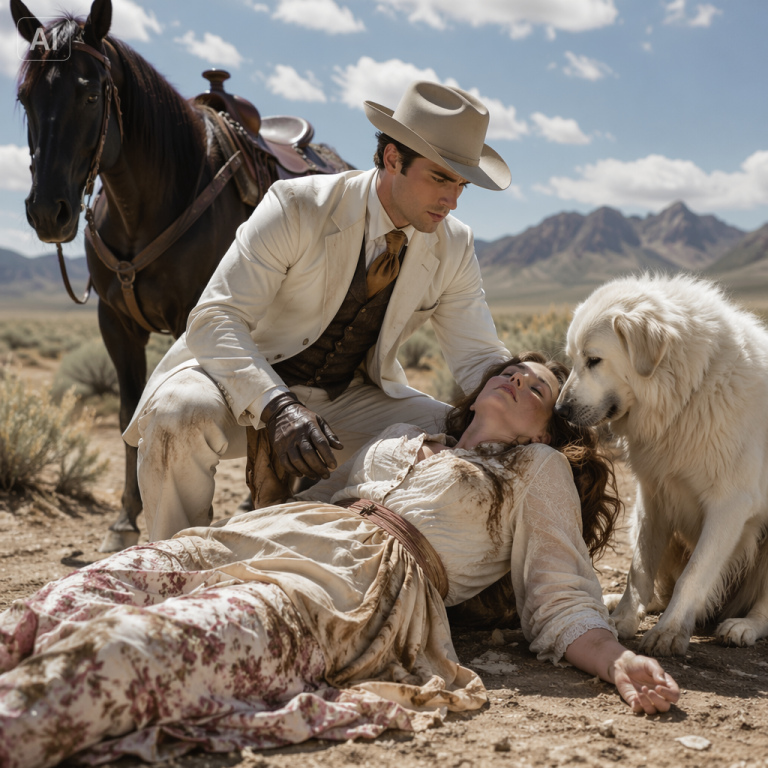
He came down the center of Harrison Avenue like something the wilderness had coughed up. Jeremiah Gallagher — called Ran by everyone who valued their teeth — was a mountain man of the old breed, the kind that existed now mostly in dime novels and frontier nightmares. Six and a half feet of weathered sinew and untanned grizzly hide. A face like a terrain map. A frost-bitten beard that swallowed the lower half of his features, leaving only those pale, colorless eyes visible — the eyes of an animal that had learned, long ago, that it was the apex predator in every room it entered.
He was dragging something behind his horse.
Abigail pressed closer to the glass.
Not something. Someone.
A boy. Sixteen at most. Rags for clothes. Boots worn through to bloodied skin. Wrists bound with hemp rope, raw and weeping, tied to the saddle of Ran’s massive draft horse. He stumbled with every step, fell, was dragged, found his feet again. His face was a ruin of bruising and cold. He was crying without sound, which is the kind of crying a person does when they’ve been at it so long they’ve simply run out of noise.
Waiting on the boardwalk outside the assay office stood Amos Blackwood.
Blackwood was the kind of man who wore tailored suits in a mining town not because he was naive, but because he wanted you to understand exactly how untouchable he believed himself to be. Silver-tipped cane. Chicago wool. The casual authority of a man who had never once, in his entire life, experienced a consequence.
*Well, I’ll be damned,* Blackwood called out, his voice carrying like a preacher’s. *The beast actually found him.*
Ran stopped his horse. He didn’t dismount. He gave the rope a single sharp tug, and the boy’s knees hit the frozen mud.
*Found him hiding near Half Moon Creek,* Ran rumbled. *He ain’t got the money.*
*Doesn’t matter.* Blackwood raised his cane and pointed it at the weeping boy like he was identifying livestock. He turned to the crowd, performing now, enjoying it. *This is Caleb. Was a stable boy at my ranch. Two days ago, he broke into my office, shot my foreman, and made off with three thousand dollars of investor payroll. I put a five-hundred-dollar bounty on him. Dead or alive.*
*I didn’t do it.* The boy’s voice cracked on every word. He looked around at the miners, at the men with their hard faces and harder hearts. *I swear to God. I didn’t steal nothing. I saw them —*
Blackwood hit him.
The silver handle of the cane connected with the side of Caleb’s face, and the sound it made — the wet crack of metal against bone — was the kind of sound that lives in the body afterward, that you feel before you’ve consciously heard it.
Caleb collapsed into the snow. He lay there, spitting something dark.
*Shut your lying mouth,* Blackwood said pleasantly.
Upstairs, behind the beveled glass, Abigail stopped breathing.
She watched Blackwood produce a thick stack of greenbacks and throw them up to the mountain man without ceremony — blood money, paid like a tab at the saloon. She watched eager men scramble to toss a knotted hemp rope over the livery stable’s oak beam. She watched the crowd brighten with that particular excitement that is the ugliest thing human faces are capable of producing.
She turned from the window.
Her father was at his desk. Ledgers open. Pen moving.
*Father.* Her voice came out smaller than she intended. *They are going to hang a child.*
Elias Montgomery did not look up. *It is Blackwood’s affair. The boy is a thief and an attempted murderer. Frontier justice is swift. Step away from the window.*
*He is a boy.* She pressed closer, and something in her voice shifted — cracked open, the way ice does when the weight on it finally exceeds its design. *Look at him. He couldn’t have shot a man. He’s starving. He is sixteen years old and they are putting a noose around his —*
*Abigail.* Her father’s pen stopped. He looked up then, and his face was perfectly calm in the way that a door is perfectly closed. *Sit down. We do not interfere with Amos Blackwood’s business.*
Below, she could see men dragging the semi-conscious boy toward a wooden crate. Could see the rope swinging in the wind above him.
Something in Abigail’s chest — something that had been quiet for twenty-two years, that had learned to be quiet, that had been trained into quietness by a thousand small cruelties and silences — ignited.
She turned away from her father.
She crossed to the open company safe.
She grabbed the canvas sack by its neck and ran.
—
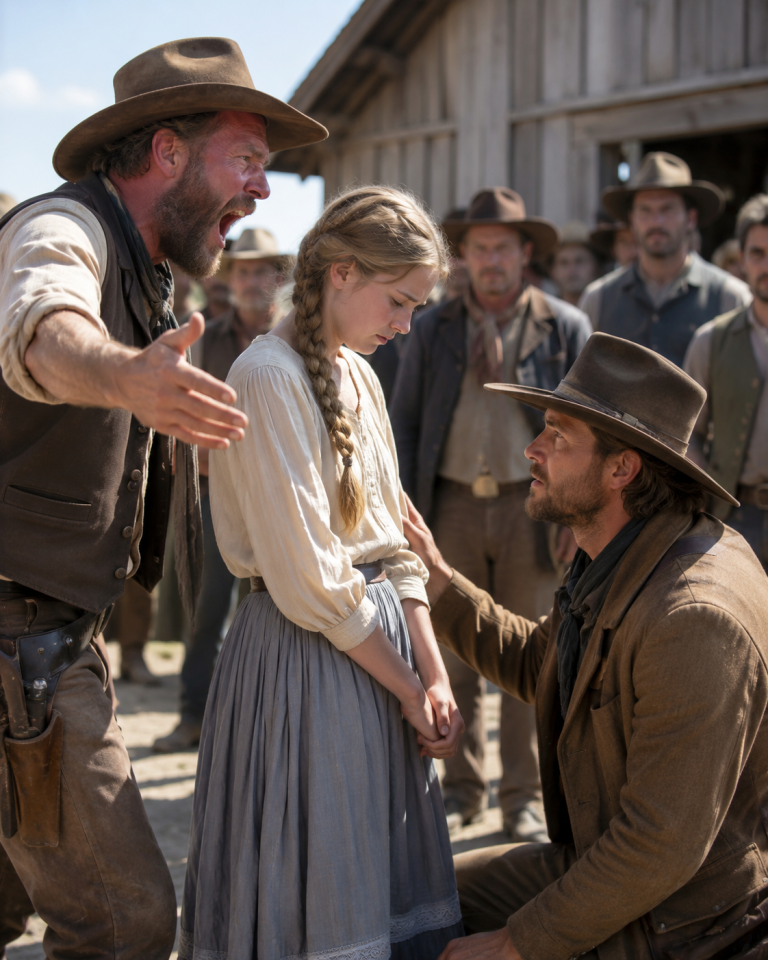
The cold hit her like a closed fist the moment she burst through the bank’s oak doors. She had no coat. The silk of her dress was instantly useless against the blizzard building off the Sawatch Range, and the frozen mud grabbed at her boots with every step. She was running — actually running, her heavy frame lurching forward with a momentum that surprised even her — directly into the densest part of the crowd.
*Make way. Stop this. Let him go.*
Men turned. The laughter died.
Not out of respect. Out of novelty. The banker’s daughter, in her fancy Parisian dress, shoving a two-hundred-pound path through their ranks. Someone elbowed her from behind. Someone else called out from the back of the crowd with the particular cruelty that only cowardly men manage — *Go back inside, fat Abby. The floorboards are groaning out here.*
She didn’t stop.
She shoved into the clearing just as two men were lifting Caleb onto the wooden crate. The rope hung above him, the noose swaying in the wind, and she could see his face clearly now — the broken, animal terror of a creature that has run out of places to run.
She turned to Blackwood. She put herself between him and the boy, her chest heaving, tears freezing on her cheeks before they’d finished falling.
*I’ll pay for him.*
She swung the sack and let it drop.
It hit the ground at Blackwood’s polished boots with a sound like a gunshot. The canvas split. Gold double eagles spilled into the white snow, catching the gray winter light, and the crowd went absolutely silent.
*Four thousand dollars in minted gold,* Abigail said. Her voice shook. Her chin did not. *More than the three thousand you claim he stole. Your five-hundred bounty. Extra for your foreman’s medical bills. The debt is paid. The bank guarantees it. Let the boy go.*
Blackwood looked at the gold. The greed moved across his face like weather — fast, unguarded, animal.
Then he looked at her.
And he smiled.
—
PART 2
She saw it in his eyes before she heard the words. That particular flicker — not greed, not rage, but something colder. The look of a man who has decided that making a point is worth more than four thousand dollars.
*That is very generous of you, Miss Montgomery,* Blackwood said, and his voice had gone smooth as river ice. He signaled his men toward the spilled coins. *The town accepts your donation to cover the damages this rat caused.*
He paused.
*But the law is the law.* He looked at Caleb, and his expression didn’t change at all. *The boy shot a man. He hangs anyway.*
*No —*
Abigail lunged. Two of Blackwood’s men caught her arms before she’d taken a step, holding her with an ease that was its own humiliation. She fought, her skirts twisting in the snow, the wind screaming off the mountains.
*You took the money. You gave your word.* Her voice broke over it. *You are a monster, Amos Blackwood.*
*Kick the crate,* Blackwood said, turning his back on her.
And then — a voice.
Not loud. Not the kind of voice that filled a room. The kind that emptied one.
*Wait.*
Every head turned.
Jeremiah Gallagher had not moved from his horse through any of this. He had sat there, counting his bounty money, his pale eyes moving over the proceedings with the total indifference of a man watching weather. He had done his job. He had collected his pay. Whatever happened next was not his affair.
Except.
He swung his massive leg over the saddle and dropped to the ground. The snow compressed under his weight like it was making room.
He walked toward the spilled gold.
The crowd assumed he was claiming his share. Even Blackwood watched with something like satisfaction — of course. Of course the savage would take the money. That was the thing about animals. You always knew what they’d do.
Ran knelt.
With enormous dirt-caked hands, he gathered every last gold coin from the snow, one by one, and placed them carefully back into the canvas sack.
He stood.
He walked to Abigail.
And he gave it back to her.
—
PART 3
She stood completely still as he placed the heavy sack into her palms.
Up close, Ran was something that defied the comfortable categories a person uses to organize the world. He smelled of pine smoke and old blood and wet fur, and the scar that ran down the left side of his face was the kind that told a long and violent story without requiring any words. His eyes, pale as February sky, moved over her face with a directness she had not experienced from any living person — not assessment, not cruelty, but something almost clinical in its honesty.
*Keep your gold, little bird.*
His voice, this close, was startlingly different from the rough public instrument he’d used in the square. Low. Resonant. Like something said in a church.
*A soul ain’t bought with yellow rocks. And bravery like yours ain’t for sale.*
Abigail looked at him.
She had no words. She had spent twenty-two years accumulating words — from Dickens, from ledgers, from the careful internal monologue of a person who is never asked to speak aloud — and none of them were available to her now.
Ran held her gaze for exactly one more second.
Then he turned around, and the gentleness was gone as completely as if a lamp had been extinguished.
—
What happened in the next three minutes would be recounted in the saloons of Leadville for a generation.
Ran walked toward Amos Blackwood with the rolling, deliberate gait of a man who had decided something and was simply executing the decision. There was no performance in it. No anger, visible at least. Just the terrible, focused certainty of a predator that has selected its target.
*Gallagher.* Blackwood’s voice snagged on something — not quite fear, not yet, but the awareness of the nearness of fear. He held his silver-tipped cane like a weapon, which it was. *Take your bounty and ride out. This isn’t your concern.*
*You made it my concern when you lied to me.*
The words landed flatly. Ran stopped six feet from the cattle baron, and something in his stillness made the men around Blackwood take a half-step backward without meaning to.
*I didn’t catch this boy running from your ranch.* Ran’s pale eyes swept the crowd, ensuring he was heard by all of it. *I caught your men dragging him into a frozen creek to drown him.*
The gasp moved through the crowd like wind through grass — spontaneous, collective, and immediately followed by the dangerous buzz of men recalculating everything they thought they knew about what they’d gathered to watch.
*Lies!* Blackwood’s face went florid. He looked around at the faces of his town — faces that had, until thirty seconds ago, been thoroughly on his side — and saw something shifting in them. *He is a savage. An uncivilized brute. Are you going to believe a beast over a civilized man?*
Ran reached under his grizzly coat.
Every man’s hand moved toward a weapon.
He pulled out a ledger book. Thick. Leather-bound. Water-stained at the edges from mountain exposure.
He tossed it into the snow at the feet of Mayor Harrison.
*I can read, Blackwood.* He said it loudly, ensuring the back of the crowd heard it too. *I read your foreman’s book. I read all about how you’ve been staging robberies on your own stagecoaches — stealing investor payroll and blaming it on drifters and on Indians — so you could collect the insurance money from back east. The boy was in the stables. He saw you hand the lockbox to your own rustlers. That is why you wanted him dead.* He let a beat pass. *You put a bounty on a child so some fool would kill him before he could talk.*
The silence that followed was a different kind of silence than the one the gold had created. The gold-silence had been shock and greed. This one was darker. Heavier. The silence of men realizing they had almost participated in a murder.
Blackwood’s composure broke.
*Kill the savage,* he screamed, and his hand dove inside his coat.
Ran was already moving.
He crossed the distance between them with an impossible speed for his size — four steps, maybe, but compressed into a single fluid acceleration — and his arm swung.
He didn’t shoot. He didn’t draw the Bowie knife riding at his hip.
He punched Amos Blackwood in the face with his bare fist.
The sound it made was the sound of ending. Bone gave. The cattle baron left the ground, described a brief, undignified arc through the freezing air, and crashed backward through the wooden railing of the assay office’s boardwalk, landing in a broken heap in the slush below.
Blackwood’s men drew weapons.
Ran’s Bowie knife was already in his hand — a foot of steel that caught what little light the gray sky offered. He grabbed the hanging noose with the other hand and slashed it in a single stroke, caught Caleb’s collapsing body with that same arm, and pivoted, raising his Sharps rifle with a fluid motion that should not have been possible for a man of his mass.
The metallic clack of the hammer cocking sounded like something structural giving way.
He swept the barrel across the square.
Nobody moved. Not the Pinkerton men. Not the mayor. Not the miners who had been cheering for a hanging twenty minutes ago.
*The boy walks,* Ran said. Not loudly. He didn’t need to. *And if a single one of you so much as looks at this woman sideways ever again —* the barrel paused, not pointing at anyone, pointing at everyone, *— I will come down from the mountain, and I will burn Leadville to the ground.*
He let that land.
*Am I understood?*
The wind answered him. The human silence was absolute.
—
It was into this silence that Elias Montgomery chose to arrive.
The heavy mahogany doors of the bank swung open, and her father descended onto the boardwalk with the bearing of a man who believed, with complete sincerity, that the chaos in the street below him was primarily an offense against his dignity.
He walked past the motionless form of Amos Blackwood in the slush. He walked past the shaking mayor and the frozen crowd and the terrified boy that Ran had set carefully on his feet. He looked at none of it.
He looked at his daughter. At the canvas sack of gold she was holding against her chest.
*Abigail.* His voice cut through the wind with the particular authority of a man who had never once, in her memory, needed to raise it to be obeyed. *You have humiliated this family enough. Bring that gold inside immediately. You are acting like a hysterical fool.*
She flinched.
It was involuntary — the flinch of a person whose body has learned, over years and years, to respond to that voice in a particular way before the mind can intervene. She took a half step backward. The sack trembled in her hands.
Ran stepped between them.
He didn’t raise the rifle. He simply placed himself — all six and a half feet, all grizzly fur and mountain silence — between Elias Montgomery and his daughter. He said nothing. He looked at the banker with pale eyes that held the particular expression of a predator deciding whether a thing is worth the energy of a response.
*She ain’t going anywhere, Elias.*
Elias’s nostrils flared. He straightened his lapels with the slow, deliberate gesture of a man reasserting his dignity. *You have overstepped, Gallagher. You caught your bounty. You punched a cattle baron.* A thin smile. *Do not think that brute strength gives you the right to speak to a man of my station. I run the finances of this territory.*
*You run a slaughterhouse,* Ran corrected softly.
And then, with the unhurried motion of a man who has been waiting for precisely this moment, he nudged the ledger in the snow with the toe of his boot.
*I told the town I read Blackwood’s foreman’s book. I told them about the staged robberies.* He looked at Elias. Really looked at him, with the focused attention of a man reading terrain. *What I didn’t mention was where the stolen payroll went.*
The color left Elias Montgomery’s face.
Not gradually. All at once, like a lamp blown out.
*Page forty-two,* Ran continued, his voice carrying easily over the now-absolute silence of the crowd, *shows the Montgomery Savings and Exchange taking twenty percent off every stolen lockbox before laundering the greenbacks through the Denver Mint. Blackwood was the muscle.* A pause. *You were the brain, Elias. You’ve been stealing from the very miners who deposit their silver in your vaults.*
For three full seconds, no one in Leadville made a sound.
Then the crowd erupted.
Not with the blood-drunk excitement of the lynch mob — with something rawer and more dangerous. The buzzing anger of men who have just understood that they have been bled, quietly and systematically, by the person they trusted most. The men of the Leadville matchless mine and the Carbonate and the Adelaide — men who had broken their bodies in lightless shafts for years, who had deposited their silver earnings in the Montgomery exchange because it was the most secure bank west of the Mississippi — turned and looked at Elias Montgomery with their collective fury reorienting toward a new target.
*It is a forgery,* Elias said. His voice had lost its authority. It was the voice of a man scrambling. *It is a lie. It is a savage’s fabrication.*
He lunged toward Abigail.
His hands extended, and she saw his face clearly in that moment — the man behind the stern financier, the calculating strategist behind the patrician bearing — and what she saw was nothing she recognized. He grabbed her shoulder, his fingers digging into her flesh.
*Give me the gold. We are leaving.*
Ran moved.
He dropped the rifle and clamped his hand around Elias Montgomery’s wrist.
The sound of grinding cartilage was very clear in the cold air.
Elias went to his knees in the snow, screaming.
*You don’t touch her,* Ran said, and his voice was low, almost private. *Not ever again.*
—
Deputy Marshal Thomas Fitzpatrick had been working the stagecoach robbery cases for four months.
He pushed through the outer ring of the crowd with his silver star catching the gray light, his heavy wool coat dusted with the same snow that covered everything else in Leadville. He was a methodical man — not dramatic, not given to speeches — and when he knelt and picked the ledger up from the snow and flipped through its water-stained pages, he did so with the focused attention of a man professionally trained to confirm what he already suspects.
He looked up at Elias Montgomery.
*Lord Almighty,* he said quietly. Not to the crowd. Not to Ran. Just to himself, because some things have to be said out loud before they become real. He stood. *Dates. Amounts. Signatures.* He closed the ledger. *Montgomery. You are under arrest for federal embezzlement and conspiracy to commit murder.*
The crowd’s anger found its shape. It became something organized and righteous as Fitzpatrick’s deputies materialized from the crowd and took Elias by his arms.
Abigail did not move.
She stood in the snow with the canvas sack against her chest and watched her father be led away. He did not look back at her. He walked with his chin up and his jaw set, the posture of a man who has not yet permitted himself to believe that the story is over. His lapels were immaculate even now. His shoes — fine Chicago leather — left perfect prints in the slush.
She watched until he was gone.
Around her, the crowd broke into fragments — some following Fitzpatrick’s men, some already moving toward the saloon, some standing in small knots, arguing in low, urgent voices about their deposits, their savings, the money they had trusted to the most secure bank west of the Mississippi.
Ran was beside her. He had retrieved his rifle and sheathed the knife without ceremony.
She looked up at him.
*Caleb,* she said.
*He’s all right.* Ran glanced back at the boy, who was sitting on the boardwalk steps with someone’s blanket around his shoulders. *He’ll need to warm up proper. But he’s all right.*
Abigail nodded.
She became aware, suddenly, of the cold. Her dress was soaked at the hem from the snow. Her hands were shaking in a way that had moved beyond cold into something that lived deeper in the body.
*Thank you,* she said.
It was not enough. It was entirely inadequate. It was what she had.
Ran looked at her for a moment.
*Don’t thank me yet,* he said. *The hard part’s coming.*
—
Two days later, the blizzard moved through and left Leadville under three feet of clean, glittering snow.
The town was unrecognizable in its silence. The mines had stopped. The saloons were open but muted. The noise that usually defined Harrison Avenue — the constant clamor of commerce and conflict and raw frontier ambition — had been replaced by something that sounded almost like grief.
Amos Blackwood and Elias Montgomery sat in the Leadville jail under heavy guard, awaiting the armored train that would carry them to the territorial prison in Canyon City. The charges were extensive. Federal prosecutors had arrived from Denver the morning after the arrest, and they brought with them a thoroughness that frontier justice had never quite mustered on its own.
Abigail sat behind her father’s mahogany desk.
She had chosen a plain dark dress. The silk was put away. She was in mourning, though nobody had died — she was mourning the coherent story of her own life, the story in which her father, for all his coldness, for all the ways he had diminished her, had at least built something real. Had at least been what he appeared to be.
The reality was different.
Outside, she could hear the miners gathering. A mob — less violent than the one that had assembled around Caleb’s gallows, but no less frightened, and frightened men are dangerous in their own particular way. She could hear their voices through the thick glass, the same kind of thick glass she had spent twenty-two years watching Harrison Avenue through. They were afraid their savings were gone. They were afraid that Elias’s arrest meant the bank was hollow, that the vault held nothing, that the most secure bank west of the Mississippi was a beautifully appointed coffin.
The knock on the doorframe, when it came, was somehow both enormous and tentative.
Ran filled the doorway the way mountains fill horizons — by making everything else look temporary by comparison. He’d removed his grizzly coat, though she couldn’t imagine where, and stood in heavy wool and canvas, his tangled beard slightly less frost-rimed than it had been in the square. He held his battered felt hat in both hands.
Beside him stood Caleb.
The boy was unrecognizable from the weeping, broken figure that had been dragged down Harrison Avenue two days ago. Someone — she suspected Ran, though she could not have said why — had found him new wool trousers, a flannel shirt, and a sturdy pair of boots that actually fit. He was washed. His face, freed from the bruising’s worst of it, was young and uncertain and rather sweet, the face of a boy who has been frightened too badly and for too long to yet understand that the fear is over.
*We came to pay our respects before we head out,* Ran said. He didn’t sit. He stood in the doorway like he needed to be sure of his exit, or like he was unwilling to fully enter the world the office represented.
Abigail looked at him.
*You’re leaving.*
*Towns ain’t for me, Miss Montgomery.* He turned the hat in his hands. *And Caleb needs to get back to his aunt in Missouri. I’m escorting him to the train in Denver.*
She had known this was coming. She had known it in the way one knows certain things before they arrive — with a resignation that isn’t quite sadness, but sits right next to it.
She opened her desk drawer.
She produced a thick envelope and held it out to Caleb. *This is a bank draft drawn from my late mother’s private trust — entirely separate from my father’s accounts, untouched by his crimes. It is enough to buy a farm in Missouri.* She paused. *Consider it an apology from Leadville.*
Caleb took the envelope with both hands. He looked at it, then at her, and his throat worked against something he was trying to control, and then lost.
*Thank you, ma’am.* His voice cracked on both words. *Thank you for standing up for me. You didn’t have to do that. Nobody else —* He stopped. Pressed his lips together. *Nobody else was going to.*
*I know,* Abigail said quietly.
Caleb stepped out into the hallway, giving them the privacy he was old enough to recognize was needed.
The silence between Ran and Abigail was not an uncomfortable one. It was the silence of two people who have witnessed each other in extremity and no longer require the usual social scaffolding.
*They’re going to run you out of town, little bird,* Ran said finally, his eyes moving to the window, to the gathering crowd outside. *They think you’re part of your father’s poison.*
*They can try.*
He looked back at her.
Her chin was up. There were no tears — she had not cried since the square, not in front of anyone, and she did not intend to begin now. But her eyes held something that the morning’s grief and the two days of silent reckoning had forged into something harder and more permanent. A resolve that didn’t announce itself because it didn’t need to.
*I am not leaving,* Abigail said. *I am liquidating my mother’s estate. I will guarantee every deposit in this bank with my own money.* She looked at her father’s ledgers, stacked on the shelves behind her, and then away from them. *I will rebuild this exchange. I will lend to the homesteaders and the prospectors that my father crushed. I will do it honestly, at rates a man can survive.* She met Ran’s pale eyes. *Let them call me the Montgomery Mountain.*
A beat.
*Mountains do not move.*
Something happened to Ran’s face. The scarred, weathered terrain of it shifted, and what emerged was a smile — not the performed kind, not the public kind, but the rare involuntary kind that arrives when a person sees something that is genuinely, unexpectedly good in the world and cannot help but respond to it.
It transformed him.
For a moment she could see, through the mountain man, through the grizzly coat and the frost-bitten beard and the legend and the scar, something that might have been what he looked like before the wilderness claimed him. Something younger. Something that had, once, known warmth.
He reached inside his coat.
He produced two things: a thick piece of folded parchment and a small, heavy leather pouch, both of which he set on the mahogany desk with a care that bordered on reverence.
Abigail looked at them. *What is this?*
*The short of it,* Ran said, sitting down for the first time, lowering himself into the chair across from her with the deliberateness of a large man who has learned to be careful with furniture, *is that I didn’t stumble across Caleb in those mountains.*
She waited.
*I hunted that boy specifically.* He said it plainly, without apology or performance. *For three weeks. I knew what he’d seen. I knew what was in that ledger. I went looking for both.* He looked at the desk. *I knew what your father was, Abigail.*
The sound of her given name, unadorned, in his voice, did something unexpected to the air in the room.
*Why?* She said it carefully. *You’re a trapper. A bounty hunter. Why would you involve yourself in bank fraud?*
Ran was quiet for a moment. Outside, she could hear the mob growing, the low urgent buzzing of frightened men.
*Thirty years ago,* he said finally, *I was half dead from cholera in the alley behind a trading post outside Saint Louis. Couldn’t move. Couldn’t speak. About two hours from being done.* He looked at his hands — enormous, scarred, the hands of a man who had used them for every conceivable purpose. *A young nurse came out of the back of that trading post. She was maybe eighteen years old. She sat down in that alley in the mud and the cold and she held my hand, and she talked to me like I was a man worth keeping alive until the fever broke.*
Abigail was very still.
*She didn’t care what I looked like.* Ran’s voice had gone quieter, moving into the register of things that are said only once. *I was filthy. I was feral. I’d been in the mountains for two years at that point. But she looked at me and she talked to me like a person.* He paused. *Her name was Martha Hughes.*
The name landed in Abigail’s chest like a stone into still water.
*Before she died,* Ran continued, *I made her a promise. I told her I would watch over her daughter.*
The silence that followed was the longest one they had shared.
Abigail’s hands were flat on the surface of the desk. Her breathing was controlled, measured, the breathing of a woman keeping a careful grip on something that very much wants to break loose.
*You kept her picture,* she said. It wasn’t a question — she knew, suddenly, with the bone-deep certainty of things understood rather than learned, that somewhere in that grizzly coat, in some inner pocket worn smooth from years of touching, there was a small photograph or a miniature painting, her mother at eighteen years old. *All this time.*
*All this time,* Ran confirmed.
He looked at her with his pale, clear eyes.
*Your father kept you locked away, Abigail. Kept you small. Kept you isolated, kept you ashamed of yourself so you’d never ask questions about the business and never have the confidence to leave.* He said it without heat, as a plain accounting of facts. *I couldn’t just shoot him. He had too many men, too much protection, and if I’d tried, you’d have inherited a dead father and a ruined estate with no power to do anything about either. He had to fall by his own greed.* A pause. *And you had to see it — really see it — to be free of him.*
She understood.
The two days of quiet she had been keeping suddenly made a different kind of sense — not the quiet of grief, but the quiet of a woman whose understanding of her entire life was being rebuilt from the foundation.
Her mother, who had died when Abigail was four. Whose private trust had been the only thing in the Montgomery estate that Elias couldn’t touch. Whose portrait hung in the upstairs hall, a young woman with kind eyes, a woman who had sat in alleys with mountain men because they were worth keeping alive.
*She would have stood in that square,* Abigail said softly. *In the snow. She would have thrown the gold.*
*Yes,* Ran said. *She would have.*
He stood.
He tapped the parchment on the desk. *That is the deed to an unregistered silver vein near the Roaring Fork. The pouch is the assay proof — I had it tested in Aspen before I came down. It’s rich, Abigail. Not Tabor-rich, but honest-rich. Enough to back your bank through the rebuilding. Enough to make the guarantees real.* He looked at her. *Make Martha proud.*
She rose from the desk.
She was going to say something — she had the words assembled, the gratitude that this moment required, everything she owed him for a thirty-year promise kept through avalanches and mountains and frontier winters and the precise, patient engineering of her own liberation. She opened her mouth.
He turned and walked out the door.
His heavy boots on the stairs. The creak of the landing. The sound of him collecting Caleb from the hallway, the boy’s lighter footsteps joining the mountain man’s, two sets descending together through the building.
She crossed to the window.
Down on Harrison Avenue, the crowd parted for them — not out of warmth, but out of the same instinctive deference that all wild things show a creature more wild than themselves. Ran walked without looking up, Caleb beside him, the boy’s new coat bright against the white of the snow.
At the edge of the thoroughfare, just before the avenue bent and took them out of her sightline, Ran stopped.
He turned.
He looked up at her window.
She didn’t know, afterward, whether he could actually see her through the thick beveled glass. She didn’t know whether he raised his hand in farewell or whether she imagined it. The distance was too great and the winter light was too flat and she was, after all, crying for the first time — properly, fully, without reservation — and vision through tears is not reliable.
But she raised her hand back.
She kept it there until the avenue bent and took him and the boy around the corner and the street was just a street again, and the crowd was just a crowd, and the most secure bank west of the Mississippi stood behind her, waiting to be remade.
—
She turned from the window.
She sat back down behind the mahogany desk.
She pulled her father’s ledgers from the shelf — all of them, every volume — and began to work.
Outside, the mob was still gathering. She could hear them. She could hear the fear in their voices, the anger underneath the fear, the way frightened men’s voices have a particular rising edge that means they are close to doing something they will later regret.
She stood. She crossed to the window and threw up the sash, letting the mountain cold flood into the warm office.
*Gentlemen,* she called down.
The crowd turned.
The banker’s daughter. The Montgomery Mountain. In the window above the exchange, without her silk dresses and her careful isolation, her dark mourning clothes and her red eyes and her chin held at the angle of a woman who has decided something irrevocable.
*Your deposits are safe,* she said. *Every dollar. I am guaranteeing them personally, from my mother’s estate, effective this morning. The Montgomery Savings and Exchange is open for business.* She looked out at their upturned faces — miners, homesteaders, the desperate and the frightened and the angry. *And starting next week, we are offering new lending terms. Fair rates. No usury. No coercion.* A pause. *I know what this bank has done to some of you. I know what my father was. I cannot undo that. But I can spend the rest of my life trying to balance the ledger.*
Silence.
Then, from somewhere in the middle of the crowd, a single miner — heavyset, bearded, his hands raw from underground work — removed his hat.
Others followed. Slowly. One by one, like a tide reversing.
Abigail closed the window.
She returned to the desk.
She opened the first ledger and picked up the pen.
Outside, Leadville began, haltingly, to find its way back to something that resembled itself. The mines would start again tomorrow. The saloons were already warming up. The snow on Harrison Avenue was beginning to pack into the dirty gray slush of a working town.
Inside the Montgomery Savings and Exchange, the heir to the largest banking fraud in Colorado’s frontier history sat at her father’s desk, in her father’s chair, beneath her mother’s portrait — a young woman with kind eyes, looking down with an expression that no one had ever noticed before, or perhaps they had never known to look for.
Pride.
She opened the parchment that a mountain man had carried for thirty years through avalanches and wolves and frontier winters, and she read the deed to her honest future.
And she began.
—
*THE END*