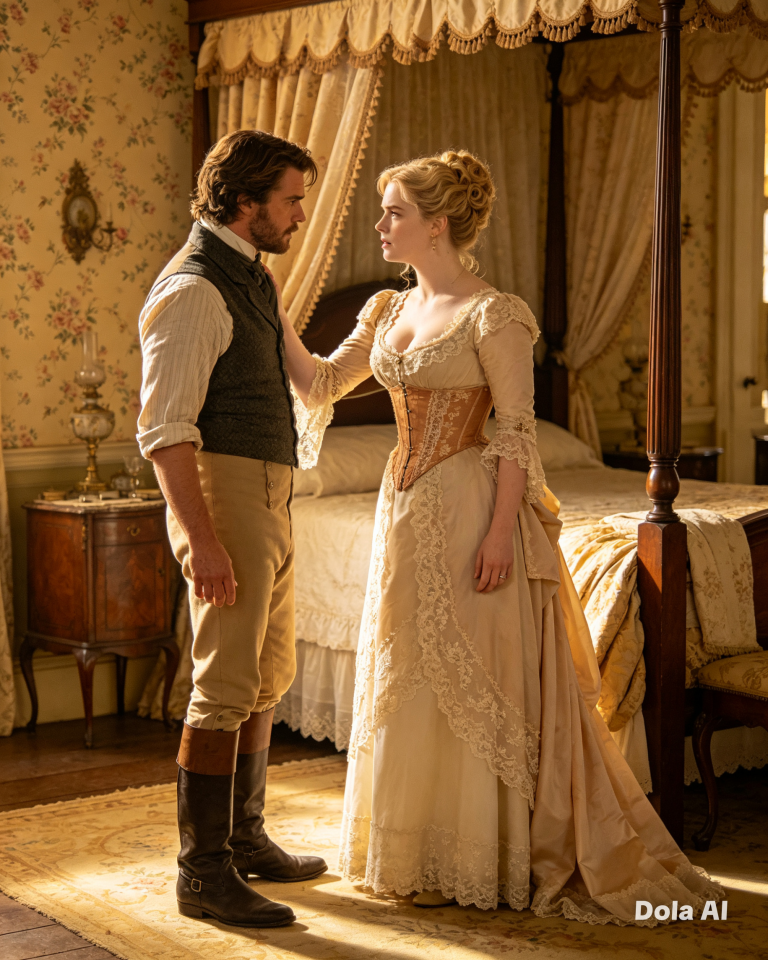
HIS MISTRESS ASKED THE BANKER ABOUT “OUR PORTFOLIO” WHILE SITTING IN MY CHAIR — SHE HAD NO IDEA WHOSE MONEY SHE WAS SPENDING

Part 1
His mistress sat beside my husband at the private bank dinner and asked the banker about “our portfolio.”
Foster Hale looked at me before he answered.
My husband set one calm hand over hers. “Genevieve,” he said, “we are all adults here.” Then, softer, like it was generous of him: “She deserves to understand the future.”
The room went quiet in that particular way expensive rooms go quiet — where even the ice in the crystal seems trained not to make noise.
Paige Larkin smiled at me from my chair. Twenty-eight, blonde, glossy, wearing the emerald earrings Desmond had once told me were stolen out of our safe.
I looked at the earrings. Then at my husband. Then I opened the black folder I’d carried in with me all evening.
“Start,” I said, “with the accounts he no longer has access to.”
—
The dinner was held in the private room above Continental Crest Bank on Madison Avenue — no logo on the door, no sign outside, just a brass elevator panel, a retinal scanner, and a receptionist who knew everyone’s net worth before they said their name. The room smelled like white roses and old money. Manhattan glittered below the windows like someone had spilled diamonds across black velvet, and a portrait of some dead railroad baron watched us from the head of the table with the cold approval of a man who’d never once apologized to a woman.
I arrived seven minutes late on purpose — not for drama, but so everyone would already be seated when I walked in.
Desmond Kingsley sat near the center of the table in a tailored navy suit, sun-touched and polished, the look of a man who played tennis badly but inherited the club anyway. His jaw tightened when he saw me. That was the first pleasure of the evening. The second was watching Paige freeze with my monogrammed napkin still in her lap — because my seat had always been to Desmond’s right, and everyone at that table knew it. Foster Hale knew it. The trust attorneys knew it. Desmond’s parents knew it. Even Paige knew it, which was exactly why she’d chosen that chair with the bright, hungry precision of a woman who didn’t want a man. She wanted placement.
“Genevieve,” Desmond said, standing halfway. He didn’t come around the table. He didn’t kiss my cheek. He didn’t even bother looking ashamed. “Traffic?”
“No,” I said, setting my folder beside an untouched glass of champagne. “Timing.”
Paige recovered her smile quickly — the kind of pageant smile women learn when they’ve spent a lifetime mistaking prettiness for strategy. “Genevieve,” she said, soft, rehearsed. “I hope this is okay.”
“Does it feel okay?” I asked.
Color rose to her cheeks. Desmond’s mother, Rosalind Kingsley, set down her fork hard enough to ring silver against porcelain. “Let’s not begin the evening with hostility,” she said, wearing Chanel tweed like armor and disappointment like perfume. For ten years she’d called me “dear” in the tone other women reserve for “temporary.” Beside her, Edwin Kingsley folded his large red hands over his stomach — the sort of man who still believed the world owed his last name a chair, a loan, and silence. The Kingsleys were old Greenwich money sitting on new debt: horse portraits, silver trophies, and nothing liquid. Desmond liked to say he’d married me for love. His family preferred to forget he’d married me the same month their flagship hotel group missed payroll.
Foster Hale rose from his place at the end of the table. “Mrs. Kingsley,” he said — not Genevieve, not Mrs. Desmond Kingsley, but Mrs. Kingsley, because banking is a language of knives wrapped in linen. “Your seat is prepared.” He gestured to the chair at the opposite head of the table — facing Desmond, the best view of his face in the room.
I walked to it slowly. Every eye followed. My heels made no sound against the hand-knotted rug, because true power doesn’t click across a room. It arrives quietly and makes everyone else hear themselves breathing.
I sat. A server poured water. No one moved. Paige glanced between Desmond and Foster, one hand drifting to the earrings — my earrings.
“This dinner was meant to be a mature conversation,” Desmond said.
“Was it?”
“Yes. There have been changes.”
“I noticed one in my chair.”
Paige’s smile sharpened. “Desmond asked me to come.”
“I assumed you didn’t take the service elevator.”
Rosalind inhaled sharply. Edwin muttered something under his breath. Desmond leaned back, letting the table see how patient he was being with his unreasonable wife — a performance he’d clearly rehearsed, which was how I always knew when he was lying.
“I won’t have you humiliate Paige,” he said.
I picked up my water. “That’s generous, considering she wore my jewelry to my bank.”
Paige’s hand flew from her ear. Desmond’s eyes flicked, just briefly, to the emeralds. A small mistake. I filed it away.
“Those were a gift,” he said.
“From whom?”
He didn’t answer.
Paige lifted her chin. “Desmond told me they were family pieces.”
“They are,” I said. “My family.”
The table went still. Foster looked down at the portfolio in front of him. The attorneys didn’t blink. That was how I knew they’d already read the first envelope.
Paige recovered first, reaching for Desmond’s hand, her nails pale and perfect. “Maybe we should focus on what matters,” she said, glancing toward Foster. “I know this is awkward, but Desmond and I have been discussing our future, and it would help me to understand our portfolio.”
*Our.* A small word. A cheap one. A word with blood already on it.
Desmond watched me carefully across the table — not with guilt, with expectation. He wanted a scene. He wanted tears, because tears could be dismissed. He wanted the banker to watch a woman come apart while he sat composed beside someone younger. He wanted, more than anything, a story he could tell afterward.
Poor Desmond. After ten years of marriage, he still didn’t know I’d been raised by women who never raised their voices, because they already owned the room.
Foster turned his head toward me and waited.
Desmond exhaled like a man forced to teach manners to peasants. “Genevieve, we are all adults here.”
Paige pressed his hand. He went on. “Paige deserves transparency.”
“She deserves a lot of things,” I said. “I’m not sure transparency will be kind to her.”
His jaw tightened. “I’m asking you not to make this ugly.”
I smiled, just a little. “Desmond, ugly arrived wearing my earrings.”
Edwin slammed his palm on the table. “That is enough.”
“No,” I said, and opened the black folder. The sound of paper against leather was soft. Somehow it carried the entire length of the table. “This is where we begin.”
Desmond laughed once, cold, performative. “Is this another one of your little documents?”
I slid the first page to Foster. He took it without surprise. Desmond noticed — for the first time all night, something shifted behind his eyes.
“You’ve already seen it?” he asked Foster.
“Yes, Mr. Kingsley,” Foster said, with professional sorrow.
“What is it?” Paige asked.
I folded my hands. “A notice of account restriction.”
“Restriction?”
“Removal,” I said. “Restriction was the polite word.” Foster adjusted his glasses. “As of five o’clock this afternoon, Desmond Kingsley’s discretionary access to the Wren-Kingsley family office accounts, the Continental Crest custodial accounts, and affiliated credit facilities has been suspended pending review.”
Paige blinked. “The what?”
I looked at her earrings again. “Our portfolio.”
Part 2
Foster’s words hadn’t finished settling before Desmond’s face lost its easy color.
“This is ridiculous,” he said. “You cannot suspend my access.”
“I didn’t,” I said. “The trust did.”
“I am your husband.”
“Not a banking credential.”
Edwin leaned in. “Genevieve, you are making a mistake.”
“Edwin,” I said, “you made the mistake in 2016 when you signed the conversion schedule without reading section nine.” His mouth opened. Rosalind went still. Desmond turned to his father. “What section nine?” Edwin didn’t answer. That silence was delicious — not because I hated him, but because it was honest.
Paige shifted in my chair, having owned it for exactly eight minutes. “Desmond,” she whispered. He ignored her, snapping instead at Foster. “Tell her this can be reversed.”
Foster rested both hands on the table, his gold cufflinks catching the light. “The bank is obligated to comply with instructions from the controlling trustee and authorized signatories.”
“I am an authorized signatory.”
“You *were*,” Foster said.
The word hit harder than a shout. Paige drew her hand back from Desmond’s, and for the first time that night, she looked at him not like a prize but like a stock that had just been downgraded. I almost admired her efficiency. Desmond noticed, too, and his face hardened.
“This is temporary,” he told her.
“No,” I said. “It’s documented.” I removed another page. “The discretionary line of credit is closed.” Another. “The family office cards are cancelled.” Another. “The Boston, Palm Beach, and Aspen expense accounts are frozen pending audit.” Another. “The jet account is restricted to medical and minor-child travel with trustee approval.”
At the word *jet*, Paige blinked again. Small. Enough.
Desmond laughed, but it cracked in the middle. “You think money is marriage?”
“No,” I said. “I think money is what you used to rent a replacement wife.”
The room breathed in. Rosalind’s eyes cut toward Paige’s earrings. Paige lifted her chin again, though the motion wasn’t as clean now. “You can insult me all you want,” she said. “I love Desmond.”
“Conveniently close to the wire transfer dates,” I said.
Desmond pushed back his chair. “Enough.” I didn’t move. He stood, which was a mistake — in rooms like that, standing can look powerful, or it can look desperate. “You have been cold for years,” he said. “You built walls around yourself. You cared more about contracts than connection. You made me feel like a tenant in my own life.”
One of the attorneys wrote that down. Desmond saw. “You are not recording this,” he snapped.
“No,” I said. “Continental Crest is.” Foster nodded once. “All private client meetings in this room are recorded for compliance, as disclosed on entry.” Paige went pale. She hadn’t read the disclosure either. It was becoming a theme.
Rosalind spoke quietly. “Subpoenaed for what?”
I turned a page. “The misuse of trust assets.” Edwin swore. Desmond’s anger snapped toward his father. “You knew?”
“Genevieve,” Edwin said, “families handle these matters privately.”
“Mine is.”
“Desmond is Marlowe’s father.” His strongest card, played early, because men like Edwin always assume women fold at the mention of a child.
Something in my chest moved — not pain, a door closing. “Yes,” I said. “That’s why I filed for emergency custodial protections this morning.”
Desmond went white. “What?”
“You said she would never use Marlowe,” Paige said to him.
I looked at her. “She just did.”
Part 3
Ten years earlier, Desmond Kingsley had proposed to me in a church courtyard in Newport, rain falling, no umbrella, his hair wet and his smile crooked, looking at me like I wasn’t a solution but a discovery. I believed him. That was the part I was most ashamed of later — not that he lied, because people lie every day, with flowers and forgiveness and Christmas cards, but that I’d thought he was different because he was broken beautifully. He told me his father was difficult. His mother was cold. Kingsley House Hotels had been mismanaged by men who cared more about golf than payroll. He wanted to build something honest. He wanted me beside him, not behind him. I was thirty-one, old enough to know better and young enough to mistake confession for character.
My grandmother, Margot Wren, was neither. Three weeks before the wedding, she sat in her library with a glass of water and a pen older than most bank charters — she’d built the Wren family office out of a chain of regional banks her father nearly lost in the eighties, and she could read a balance sheet the way some women read prayer cards. When I told her Desmond didn’t want a prenup because it would feel “transactional,” she laughed for a full forty seconds. Then she said, “Love is not weakened by paperwork, darling,” and slid a two-hundred-and-twelve-page agreement across the table. Desmond called it insulting. My grandmother called it merciful. In the end he signed, because Kingsley House needed bridge financing by Monday. That was the first document he never read.
The second was the rescue agreement. The Wren Family Trust didn’t lend the Kingsleys money — it acquired leverage. Edwin thought he’d negotiated a loan. My grandmother had structured a conversion right: missed performance markers converted the debt to equity; breach of fiduciary duty shifted voting control; fraud, diverted assets, or unauthorized encumbrance of marital trust property meant removal for cause. Desmond signed that too, smiling, believing papers were ceremony and names were power and women like me carried folders because men like him created value.
For eight years I let him believe it. Not because I was weak — because the hotels recovered, because employees kept their jobs, because our daughter Marlowe was born in the penthouse suite of the Boston flagship during a snowstorm and Desmond cried when he held her. For a while I thought paperwork was just paperwork. For a while I thought we were the exception.
Then came Paige. She started as an events consultant for the Kingsley Foundation gala — the official version. She wore winter white to the first planning meeting and laughed at Desmond’s jokes before he reached the punchline. Wives always notice. Not paranoia — betrayal changes the air before it changes the facts. His phone started facing down. His showers got longer. His shirts smelled like a perfume too expensive to be accidental. He said I was imagining things, then that I was tired, then that motherhood had made me suspicious, then that my grandmother’s death had made me controlling.
That was the moment I stopped feeling sad and started taking notes.
Margot died six months before Paige arrived, naming me controlling trustee of the Wren Family Trust. Desmond held my hand at the graveside in a black suit. That night, while I slept in my childhood bedroom, he texted someone named P. *Soon.* I didn’t confront him. I took a screenshot. That became page one.
Revenge doesn’t begin with anger. It begins with inventory. A receipt for two from a restaurant on the Upper East Side. A hotel charge in Palm Beach the week he told me he was in Chicago. A diamond bracelet invoiced to the Kingsley Foundation and delivered to an apartment in Tribeca. An email from Desmond to the family office requesting a liquidity transfer for “brand repositioning.” A wire from that transfer to Ivory Gate LLC. A Delaware filing search showing Ivory Gate LLC had exactly one managing member — Paige Larkin.
I didn’t cry when I found it, though I remember wanting to. I sat in the silent kitchen of our Greenwich house at 2:17 in the morning while the refrigerator hummed and the security lights glowed over the lawn, Marlowe’s drawing of our family taped to the door — stick figures with hands touching. I opened a new folder on my laptop and named it *Garden*, not *Affair*, not *Divorce*, because my grandmother used to say, if a man plants weeds in your house, don’t scream at the weeds. Find the roots.
The roots ran deeper than Paige. Desmond had been borrowing against company assets without board approval, pledging art owned by the Wren Trust as collateral for a personal line of credit, moving foundation money through consulting invoices, using my digital signature on internal approvals, taking Paige to tour a townhouse on East Seventy-Third Street and telling the broker it was “for after the transition.” The transition was me.
I learned this on a Tuesday. On Wednesday I helped Marlowe practice spelling words. On Thursday I sat beside Desmond at a luncheon at the Continental Club while Paige walked across the room in red like destiny had invited her instead of a man with a corporate card. Desmond kissed my cheek in front of everyone. His lips were dry. Paige watched, wanting me to flinch. I didn’t.
That afternoon I met with four lawyers — family, corporate, trusts and estates, white-collar litigation — in a room over Bryant Park. My lead attorney, Katherine Voss, sixty, silver-haired, terrifying in the way only women who bill in six-minute increments can be, read the first twenty pages and said nothing for a long time. Then: “How quiet can you be?”
“As quiet as necessary.”
“Good. Then he’ll confuse your silence with permission.”
That became the plan. Let Desmond perform. Let Paige reach. Let the Kingsleys pressure. Let every greedy hand find the wrong doorknob. Notices went to Continental Crest, to the trustees, to the Kingsley House board. The last one — the one meant for Desmond himself — waited. He earned a stage first. He chose the private bank dinner. He told Foster that Paige needed “an education in the family assets.” He invited his parents for unity, two attorneys so I’d feel outnumbered, and the room above Continental Crest because it was where powerful men were used to women smiling through pain.
He didn’t know my grandmother had once saved that bank from collapse in a credit crisis. He didn’t know the portrait of the railroad baron belonged to the Wren Foundation. He didn’t know the room had been renovated with my money. He didn’t know the dinner was never his trap.
It was mine.
—
Back at the table, Paige stood so fast her chair scraped the rug. “This is insane,” she said, silk gone from her voice. “Desmond, tell them.” Desmond didn’t look at her. He was staring at me like I’d turned into someone he should have studied years ago.
“Genevieve,” he said, lower now — the private voice, the midnight voice, the one that wanted forgiveness without confession. “Can we speak alone?”
“No.”
“Please.”
“No.”
“You owe me that.”
I closed the folder halfway. “Desmond, I paid your payroll, renovated your flagship, refinanced your debt, gave birth to your daughter, hosted your mother’s galas, buried my grandmother with you texting your mistress in the next room, and sat through two years of your lying without once embarrassing you in public. That was what I owed you.” No one spoke. Even Paige looked down. “Tonight is interest.”
Rosalind’s face crumpled slightly — not sad for me, sad the chandelier had fallen on her side of the table. “You could have come to me,” she said.
“No, Rosalind.”
“You always thought you were better than us.”
“No,” I said. “I thought you were kinder than this.”
That landed. She looked away, then recovered, because women like Rosalind don’t survive old money by letting truth leave bruises where guests can see. “Paige is pregnant,” she said.
The sentence hit the table like a thrown glass. Paige froze. Desmond’s head snapped up. So did Edwin’s. There it was — the jewel she’d been saving, the claim, the heir, the leash. Paige touched her stomach, theatrical, delicate, devastatingly effective. “At least someone in this family still believes in the future,” she said.
I looked at Desmond. “Did you know she was going to announce that here?” His face told me he hadn’t. Perfect. She’d overplayed.
I opened the second section of the folder. “Congratulations,” I said. “Your attorney should enjoy page forty-two.” I read from Paige’s email to Desmond’s estate lawyer, three weeks old: *Once Desmond’s divorce is final, will my child be entitled to Kingsley trust distributions, and can Genevieve’s daughter’s share be reduced if there is a male heir?*
The word *male* hung in the air like smoke. Marlowe’s name wasn’t in that sentence. Somehow that was worse.
“I was just asking about security,” Paige whispered.
“For whom?” I asked.
Then came the paternity issue — a draft demand her lawyer had sent requesting prenatal support and inheritance acknowledgment, which had triggered a noninvasive prenatal paternity test from Desmond’s counsel. Desmond stared at the lab report like it might burn him. “I didn’t approve that.”
“Your counsel did, after her demand named you as father for financial purposes.”
The result was not zero percent this time in genre convention — but here, once again, the math didn’t favor the fantasy. Desmond read it. His face simply emptied. Paige started crying — not for love, for math. “It was before we were serious,” she said.
He laughed, the worst sound of the night, not loud, not angry, just broken beyond asking for sympathy. “You’re pregnant,” he said slowly, “with someone else’s child?”
I handed Foster the next packet. “The audit covers all transactions involving Ivory Gate LLC, the Kingsley Foundation, the East Seventy-Third Street escrow, the Palm Beach marina account, and the unauthorized pledge of Wren Trust artwork.”
“You have been planning this for months,” Desmond said quietly.
“Yes.”
“You watched me.”
“Yes.”
“You let me walk in here.”
“No,” I said. “You walked in here.”
Traps aren’t cages built by enemies. Most are just mirrors placed in the right room.
The dinner ended at 9:38. No dessert was served. Paige tried to leave with the earrings; a security officer stopped her discreetly at the elevator. “They’re listed as trust property, ma’am.” She removed them with shaking fingers and set them in a velvet tray. I didn’t feel triumphant. I felt clean.
—
That night at the house in Greenwich, I sat on the edge of Marlowe’s bed and watched her sleep, *The Secret Garden* open on the pillow beside her. That was when the shaking finally started — not at the bank, not when Paige touched my husband, not when the paternity result broke him. In my daughter’s room, surrounded by stuffed rabbits and night-light stars, my hands trembled until I pressed them between my knees.
Desmond came home at 11:12. I met him in the library — my grandmother’s room, dark shelves, green leather chairs, a fireplace wide enough to make winter feel expensive. Three envelopes sat on the desk.
“Is she mine?” he asked. He meant Marlowe. That was the first sentence he chose after everything, and it told me more than an apology could have.
“How dare you,” I said.
“I didn’t mean—”
“Yes, you did.”
He looked down. Shame, finally, entered the room, late and underdressed. “After tonight, I don’t know what is real.”
“That’s the first honest thing you’ve said in a year.”
“I made mistakes.”
“No,” I said. “You made a strategy.” I picked up the first envelope. “The divorce petition.” He stared at it. “The custody filing.” Another. “The corporate complaint.” His face hardened — panic wearing anger, because anger feels less naked.
“You are destroying me.”
“You used my money to build a life without me,” I said. “I’m only taking back the materials.”
“I loved you,” he said. I believed that, in his way — which was almost worse. Some people love you the way children love toys. Entirely, sincerely, until they want another one.
“You loved being forgiven,” I said. The words landed. He sat in the green chair like his knees had failed.
“What happens now?”
“You leave tonight.”
“This is my home.”
“No.” I opened a drawer and set the deed in front of him. “This property belongs to the Wren Residential Trust. The Greenwich house. Nantucket. Aspen.” He pressed his fingers to his eyes. “Palm Beach was always mine.”
“I paid for renovations.”
“With a trust construction account.”
“I live here.”
“Not after tonight.” I handed him the temporary order. He read it, his face changing again. “You filed ex parte.”
“Your attorney can respond Monday.”
“It’s Friday night.”
“I know.” Timing isn’t cruelty. Timing is strategy.
By morning his parents were on the portico, the lock changed at dawn on Mrs. Duarte’s suggestion. Edwin still had a key that no longer worked. “Do you understand what you are doing to this family?” he demanded through the closed door. “Harrington— Kingsley House employs thousands of people.”
“That’s why Desmond is being removed instead of protected.”
Rosalind’s voice softened. “Think of Marlowe. She needs her father.”
“She has one, under a court schedule and supervised financial boundaries until a judge says otherwise.”
Rosalind flinched at *supervised*. Old-money women fear legal adjectives more than illness. They can hide illness. They can’t hide supervised.
The board vote took forty-two minutes. Desmond was removed as CEO pending investigation. The press called it a “governance review.” My name appeared in the final paragraph — Genevieve Wren Kingsley, interim chair. By afternoon, financial news outlets were calling me the woman stabilizing Kingsley House. By evening, Paige’s social media had gone dark, and Desmond’s card had been declined at the bar of the Aldwych Hotel.
—
The first hearing came on a rainy Tuesday in lower Manhattan, in a courtroom with no flowers and no flattering light, just wood benches and fluorescent truth. Desmond wore charcoal gray. Paige sat two rows back in beige — smart, the color women wear when they want to look like victims of weather. I wore black. Not mourning. Editing.
Judge Miriam Castellano was unimpressed by anyone’s last name, which helped. Desmond’s attorney spoke of marital strain and a father’s rights. Katherine Voss stood and opened her binders — the admissions-office application listing Paige as “prospective stepmother,” the unauthorized transfers, the forged approvals, the private bank transcript, the email about reducing Marlowe’s share. When the recording from Continental Crest played, my own voice filled the room: *Start with the accounts he no longer has access to.* Then Desmond’s: *Paige deserves transparency.* Then Paige’s: *Our portfolio.*
At the paternity exchange, Paige stood abruptly. “I need air.”
“Sit down, Ms. Larkin,” the judge said. She sat. That was the moment her fantasy ended — not at the bank, not when the earrings came off, but there, on a wooden bench, told to sit down like everyone else.
The judge upheld the temporary custody structure — visitation with no unilateral school changes, no unsupervised travel outside the tri-state area, no romantic partners introduced during custodial time. The financial restraining order stayed. The corporate proceedings moved forward separately.
Outside, under the courthouse awning, Desmond waited in the rain. “I am sorry,” he said. “I was stupid. I was lonely.”
“So was I.”
“I didn’t know about the email.”
“I believe you,” I said, and it surprised him.
“Then you know I would never hurt Marlowe.”
“Desmond, you hurt her mother every day in the house where she slept.”
His face broke. “I lost my mind.”
“No,” I said. “You lost access.”
“Is there any way back?” he asked.
I thought of the church courtyard in the rain, the first apartment, Marlowe’s first steps between us, the man he had been and the man he’d chosen not to remain.
“No,” I said.
A reporter caught me under the awning. “Mrs. Kingsley, any comment?”
“My daughter and the employees of Kingsley House are protected,” I said. “That is my only comment.”
—
Six months later, the Manhattan flagship reopened after renovation — not his renovation, mine. Black marble, brass railings, white orchids, a jazz trio under the mezzanine. The Kingsley name stayed on the awning because employees deserved continuity, but everything inside had changed. The foundation’s fake consulting contracts were terminated. Ivory Gate LLC remained under investigation. Two executives resigned. Edwin stepped down from the board “for health reasons.” Rosalind moved to Palm Beach and stopped returning calls I hadn’t made. Desmond settled — surrendering voting claims, repaying misused funds, accepting a custody framework and removal from leadership, keeping a modest income stream my grandmother would have called “enough rope to remember the fence.” Paige’s baby’s father turned out to be a venture capitalist from Miami; the last I heard, she’d rebranded herself as a wellness founder in Scottsdale.
I wore the emerald earrings to the gala that night, not to reclaim them, just because I liked how they looked with my hair up. Marlowe twirled under the chandelier in navy velvet before Mrs. Duarte took her home. “Is Daddy sad?” she asked me.
“Yes.”
“Are you sad?”
“Sometimes. But I am also okay.”
“Can I have another tiny cake?”
“Yes.” That was motherhood — a question about grief followed by frosting.
Desmond came anyway, in a tuxedo he didn’t wear as well as before, or maybe I simply saw him more clearly now. “The hotel looks beautiful,” he said.
“Thank you.”
“You did it.”
“No,” I said, looking at the staff moving through the restored lobby. “We did.”
“I thought I was the story,” he said quietly. “I thought you were the setting. I was wrong.”
“I know,” I said. It wasn’t a bridge. It was a receipt.
“Do you hate me?”
“No.” That hurt him more than hatred would have. Hatred would have tied us together. I’d already cut the rope.
He left without a scene, without a final grab at my hand — just a man walking out beneath a name he no longer controlled.
—
People ask when I knew the marriage was over. They expect me to say the dinner, or the earrings, or the email about Marlowe’s inheritance. The truth is quieter. It was a Sunday morning three months before any of it, Desmond in the kitchen making coffee, Marlowe wrapped around his leg asking for pancakes, and him kissing her head, saying he had a call, then smiling at his phone in the doorway — not a business smile, a secret one. Marlowe watched him go and asked me, “Does Daddy like his phone better than pancakes?”
That was when I knew. Not that he wanted another woman — that he’d started teaching our daughter what waiting looked like. I could survive humiliation, loneliness, whispers, legal bills, and waking at three in the morning with my heart against my ribs. I would not let my daughter grow up believing love meant sitting quietly at a table while someone else took your seat.
So I built a case instead of a wound. I learned every account number, read every deed, met auditors at dawn and lawyers after bedtime, hosted Thanksgiving, held Marlowe through a fever while Desmond texted from the guest house, let Paige post flowers from rooms already flagged, let Desmond talk about legacy at a foundation event while accountants copied invoices two buildings away. I let them all mistake restraint for surrender. A calm woman isn’t always forgiving you. Sometimes she’s simply waiting for the bank to open.
That Christmas, Marlowe and I went to Nantucket, baked gingerbread badly, walked the beach in coats too big for her, and on Christmas Eve she asked if families could change shape. I told her yes. She asked if changed families could still be happy. I told her yes again. Then she asked if I was happy.
“I am learning,” I said.
“Me too,” she said, leaning against me.
That was enough. A warm ending doesn’t always need a new man. Sometimes it’s a child asleep upstairs, a house without lies in it, a phone that doesn’t make your stomach drop when it lights up, a mirror that no longer asks why you stayed.
I still attend dinners at Continental Crest. Foster still seats me at the head of the table. The railroad baron still looks disappointed. I like to think my grandmother enjoys that. The black folder sits locked behind glass in my office now — not because I need to look at it, but because I want Marlowe to know, one day, that the women in our family don’t beg for chairs.
We own tables.
And if someone ever sits beside a man who betrayed her and asks about “our portfolio,” I hope she smiles. I hope she opens the folder. I hope she remembers that the most dangerous woman in any room is rarely the loudest one — she’s the one who knows where every account is buried, who lets the mistress count imaginary money while the banker waits for her permission, who never asks who will choose her.
She chooses herself.
And when the room finally turns to her for an answer, she says the only thing left to say.
“Start with the accounts he no longer has access to.”
THE END.