When the Storm Trapped a Young Rancher With Two Apache Sisters, He Thought the Worst Was Over—Until One of Them Pointed to the Fire and Whispered, “It Found Us.”

## PART 1
Thomas Garrett had been alone for five years, and he had told himself this was by choice.
It was October 1887, and the wind off the Wyoming high plains carried the smell of iron and snow, which meant a storm was coming. Thomas stood on the hill above the creek and looked down at his ranch: a weathered house, a barn patched more times than he could count, forty-three head of cattle browsing the dry grass near the water. The land was stubborn and the cattle were modest and the silence that settled over everything by evening had become, for Thomas, the most familiar sound he knew.
He was twenty-four years old. He had not kissed a woman. He had not had a true conversation since his parents died of fever five years earlier. He had buried them side by side in the northeast pasture, sold a portion of the herd to pay the debts, and retreated into the work and the silence with the determination of a man who had decided that needing people was the source of loss.
His father had taught him this. Stern and narrow, Thomas Garrett Sr. had built his lessons from grief and suspicion. *Keep your heart locked up tight, Tommy. This world isn’t kind to those who feel too much.* His mother had tried to soften the edges of this instruction from the gentler side of the same grief, but the lesson had taken in Thomas all the same.
The other ranchers called him the hermit. He knew it and didn’t mind. Loneliness, he had concluded, was a small price for peace.
The storm clouds that rolled in from the north in the early afternoon were not ordinary clouds. They had weight to them, a bruised darkness that ate the sky as it moved. Thomas recognized the signs too late: the birds vanishing, the cattle huddling near the creek, the specific stillness in the air before a killer blizzard released its full force.
He spurred his mare Belle toward the herd, thinking to push them into the eastern valley where the tree line would provide some protection. The storm moved faster than he did.
Within twenty minutes he could not see Belle’s ears.
The temperature had dropped so quickly his breath froze in his beard before it left his mouth. Snow drove sideways from all directions at once. The ranch house was three miles behind him. Three miles in a whiteout was effectively impossible. He had miscalculated badly, and in Wyoming Territory in October, bad calculations killed people.
He gave Belle her head. She was the steadier mind in a storm. She pushed forward, head low, fighting through drifts that rose from nowhere, while Thomas hunched into his coat and tried to keep sensation in his hands and feet.
He had nearly stopped hoping when Belle halted so suddenly he almost went over her neck.
Through the snow, a flicker of orange.
Fire.
He slid from the saddle and stumbled toward it, leading Belle by the reins, unable to trust his legs to carry him unaided. The light came from a structure tucked against a rocky outcrop, nearly invisible until he was almost on top of it.
A tipi.
He stopped.
His father’s voice came to him as clearly as if the old man stood in the snow beside him. *Can’t trust them, son. They smile at your face and put a knife in your back.*
But the cold was already a knife. It had worked through his coat, through his skin, all the way into the bone. Pride and inherited fear were luxuries a dying man could not afford.
He approached the entrance flap, remembered one of the gentler lessons his mother had managed to get through to him, and knocked on the wooden pole beside it.
“Hello,” he said. His voice came out rough and broken. “I’m caught in the storm. I’m sorry to bother you.”
The flap drew back.
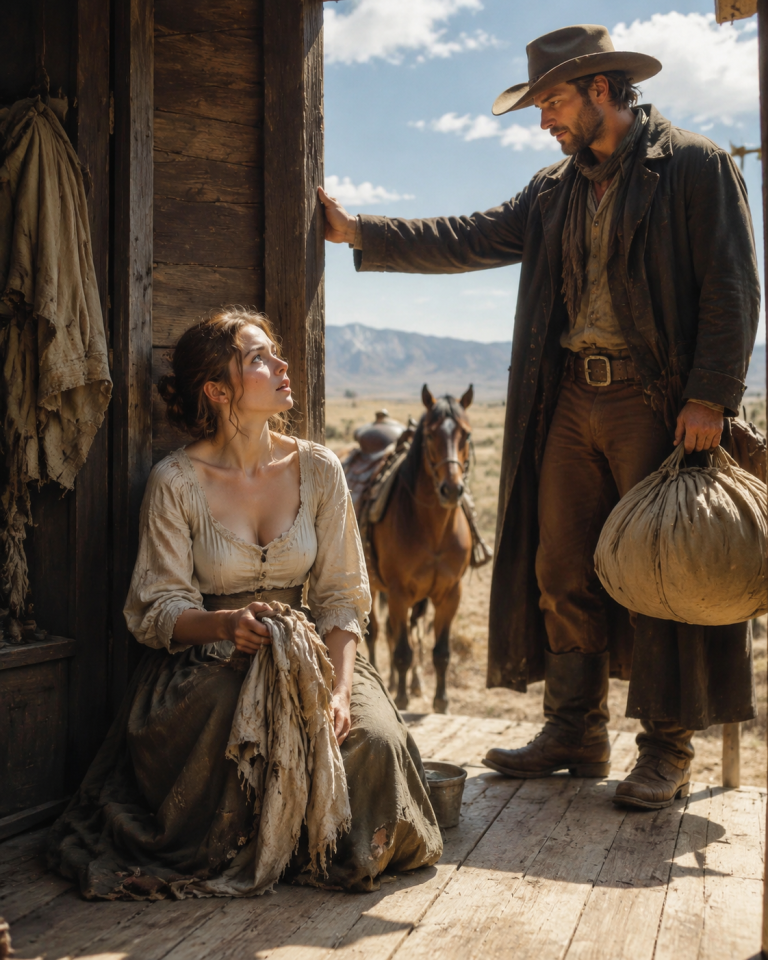
Two women stood inside. The younger one, perhaps twenty, had long black hair braided down her back and dark eyes filled with weariness and surprise. The older one, maybe twenty-five, rose from beside the fire, her face sharper, her hand moving to her belt. Sisters, Thomas thought immediately, from the resemblance between them.
He understood what they saw: a white man with a gun at their door, in a territory where that combination had never once been good news for Apache people.
“Please,” he said, his teeth rattling against each other. “My horse and I are lost. I mean no harm.”
The younger woman looked to the older. They exchanged quick words in their own language. Then the older nodded.
“Come,” the younger said in accented English. “Bring horse.”
—
They showed him where to tie Belle on the sheltered side of the tipi. His fingers were too numb to manage the knots, and without comment, the older sister took the reins from him and secured the mare with quick, efficient movements.
Inside, warmth struck Thomas like a physical blow. A small fire burned at the center, smoke rising through the opening above. Buffalo robes formed a circle around the flames. The space smelled of leather and smoke and something else — herbs, or pine tea simmering near the coals.
The younger woman gestured to a place beside the fire.
“Sit. You freeze standing there.”
He collapsed more than sat.
“Thomas Garrett,” he managed. “Ranch about three miles south. Or what I think is south.”
“I am Mary,” the younger said. “My sister Sarah.”
Mary. Sarah.
He must have shown his confusion because Mary smiled slightly.
“Mission school. They give us new names. Say our real names too hard for white tongues.”
She said it without bitterness, only fact, and that somehow made it worse.
Sarah handed him a clay cup of something hot that smelled of pine and earth. The first sip made him cough. The second began to warm him from the inside.
“Medicine tea,” Mary said. “Warm you first. Then pain comes. That is good sign.”
She was right. Feeling returned to his hands and feet as real pain, his body announcing it was still alive. He must have shown it on his face.
Sarah, who had not spoken yet, said simply: “Pain means no frostbite. Drink more.”
They moved around him with quiet efficiency — hanging his coat to dry, settling a blanket around his shoulders, checking on the tea. Their kindness confused Thomas at a level he was not able to articulate. Everything he had been taught about these people insisted on danger, on savagery, on distrust. Yet here were two young Apache women sharing their warmth, their food, their medicine, and their shelter with a white stranger who was part of the people who had taken so much from theirs.
“Why?” he asked, before he could stop himself.
They looked at each other. Then Mary sat across from him and was serious for a moment.
“Storm does not care if you are white or Apache,” she said. “Cold kills all the same. We know what it means to need shelter.”
The wind rattled the tipi walls. Inside, the fire held steady. Thomas felt something in him — tightly wound, carefully maintained, five years in the building — begin, tentatively, to loosen.
He found himself talking. Actually talking. About the ranch, about the cattle, about the silence that followed him from barn to house and back. They listened without judgment, asking questions that showed they understood land and animals and weather with a knowledge that surprised him, though it shouldn’t have.
“You have no one?” Sarah asked eventually. “No family?”
“No,” Thomas said. “I keep to myself.”
Mary tilted her head. Those dark eyes, steady and direct, saw more than he was comfortable with.
“Young man with land, cattle. Alone.”
“It’s—” He stopped. He could not explain it without explaining everything, and explaining everything would mean saying that the thought of letting anyone close had frightened him for five years in a way he had never named.
They seemed to understand anyway. They did not press. They added wood to the fire and poured more tea and accepted his silence with a grace he had not earned and could not account for.
As the night deepened and the storm showed no sign of releasing Wyoming from its fist, Thomas understood that something had shifted. For the first time in five years, he did not feel alone. These two women, who by every inherited lesson should have been threatening, had offered him more genuine warmth than he had known since his mother’s death.
“Thank you,” he said, quietly. “For the shelter. The tea. For—” He gestured helplessly.
Mary’s expression transformed then, a full smile replacing the wariness.
“A hermit rancher took shelter with two Apache sisters,” she said, mischief in her eyes. “This night will change him. Whether he wants or not.”
Thomas choked on his tea.
Sarah laughed, the sound light and startling in the firelight.
“We have eyes,” she said. “We see man who does not know women. Is nothing shameful.”
But he felt shame anyway, hotter than the fire, because he was supposed to be the one who knew the world and they were the ones who had been taken from theirs, and yet here they saw him entirely and did not use it against him.
The wind howled. The tipi walls shuddered. Inside, in the warmth and unexpected company, Thomas Garrett felt something he had believed was gone from him: the faint, dangerous possibility of being known.
—
## PART 2
He woke to silence.
The storm had passed. Gray morning light filtered through the smoke hole. Mary sat near the entrance working beadwork, her fingers precise and patient.
“Your horse is well,” she said when she saw he was awake.
Thomas ate the porridge she prepared — rabbit meat, sage, wild onion, hearty and good — and they talked with an ease that unsettled him, because ease was not something he had experienced in a long time.
He learned that their father had been killed by soldiers. Their mother had died of sickness after their brothers were taken to the reservation. They were, in the legal language of the territory, fugitives. Living free but off the books, hiding from the authorities who would force them back.
Thomas knew he should report them.
He knew with equal certainty that he would not.
Before he left, he asked — carefully, aware of what he was asking — if he could return. To bring supplies. To repay what they had given him.
Sarah looked at him with the direct assessment of a woman who had learned to read intentions accurately.
Mary said: “You know where to find us.”
The ride home was cold, but his heart was warm.
Three days later, he loaded his packhorse with flour, salt, coffee, venison, blankets. At the last moment, he added a small packet of sugar, a luxury even for himself, and a hand mirror with a wooden handle because he could not explain exactly why except that he wanted to give something without a practical reason.
When he returned to the rocky outcrop and Mary came out to meet him, her face going from surprise to something that might have been pleasure, Thomas felt the thing he had been carefully not-feeling since he woke in the tipi.
He stayed for supper.
Then he stayed to hear stories. Their real names were Ayana and Nashota; Mary and Sarah were the mission names that kept them safer in a world with a short patience for Apache sounds.
Then he came back three days later. And then again.
Weeks became a pattern that would have shocked the man he had been in October. He brought supplies and questions and stories about the ranch. They taught him to set snares, to read weather in the shape of clouds, to identify plants his mother had only known a fraction of. Sarah taught him words in their language: water, fire, friend. He stumbled over the sounds and they laughed and he laughed at himself, which was a new thing.
And beneath all of it, building so slowly he almost didn’t notice: the feeling that had no English word. Mary had tried to explain it to him once in their own language.
*When heart recognizes another heart.*
By February, three months after the storm, Thomas Garrett had fallen in love for the first time in his life, with an Apache woman the law did not recognize as having the right to exist freely in the territory where she had been born. He rode home one night under stars sharp as glass and looked at this fact from every angle he could find, and could not find an angle from which it was less true.
His father would have been appalled.
His neighbors would be scandalized.
It could cost him his reputation, his ranch, perhaps his life.
For the first time since his parents died, Thomas felt genuinely alive.
*Good teaching or bad?*
The question Mary had asked him once came back clearly.
Any teaching that had kept him from this warmth, this connection, this specific recognition of another person, was teaching worth abandoning. The question was not whether he felt it.
The question was what he was willing to do about it.
—
## PART 3
By March, he had moved them to a hidden valley two miles north of his property line.
Not on his land — Mary had refused that arrangement, explaining with patient clarity that hiding under a white man’s protection was not freedom, only a smaller cage. The valley had water, shelter from a natural cave formation nearly invisible unless you knew where to look, good hunting, and proximity to Thomas’s route without making them dependent on it.
*We bend like grass in wind,* Mary had told him. *Not break like trees. This is how Apache survive.*
Thomas was learning the difference, slowly.
He was also learning how much he did not know about the people who had always been his neighbors. He had inherited a map of the world from his father, a map that labeled everything beyond his fence line as either useful or threatening. The map had been wrong in ways that took daily revision.
Sarah taught him that the hidden valley had been a camp three generations of her mother’s family had used. The spring had been theirs. The cave’s angle relative to the wind was not accident. The tipi’s placement in the rocks during the blizzard had been precise, considered, the result of knowledge passed from grandmother to mother to daughter across decades.
“Apache women build homes,” Sarah had said, with a quiet pride that required no audience.
One afternoon in March, Thomas arrived at the valley to find Mary alone. Sarah had gone to check the trap lines. They sat by the fire closer than usual, and Thomas was aware of the distance between them as he had not been when the space was crowded with other things to pay attention to.
“You are different now,” Mary said.
“Less frightened?”
“More present.” She reached out and touched his hand — briefly, carefully, the way you touched something you were assessing the weight of. “Before, you were here but thinking about past. Or future. Now you are just here.”
He turned his hand over. She let him hold her fingers for a moment.
“I’ve been thinking,” he said, “about spring. When the snow melts.”
She waited.
“About whether—” He stopped. Started again. “I know what I’m asking is dangerous. I know it differently now than I did three months ago. I know what it costs you, every day, just to exist the way you choose to exist. I’m not asking you to let me solve that. I’m not asking to be your protector or your keeper.”
He looked at her.
“I’m asking if you’d let me be your partner. Whatever that means out here. Whatever we can make it.”
Mary was quiet for a long time.
From somewhere up the valley, they could hear Sarah returning, the particular rhythm of her footsteps in the snow.
“My white man,” Mary said, so softly it was almost not words. “My nervous deer who learns to be brave.” Then she withdrew her hand and met his eyes. “Yes. With conditions.”
“Name them.”
“We are not your property. We are not under your protection. We are people with our own home, our own choices. You are welcome here. You are part of what we build. But not because you own any part of it.”
“That’s not a condition,” Thomas said. “That’s just true.”
The ghost of a smile. “Then we understand each other.”
Sarah returned with two rabbits and an expression that suggested she had assessed the situation from the tree line and was choosing to find it acceptable.
“Finally,” she said, dropping the rabbits by the fire pit. “I thought I would be old and gray before you two stopped being polite at each other.”
—
The saloon in Cedar Falls had seen better days, but Thomas was there for supplies, not company. Old Sam’s store had been closed for a funeral.
At the bar, someone said, “Heard there are Apache women up near the north valley. Army’s sweeping through.”
Thomas’s hand tightened around his glass, but he kept his face the way it had always looked in town: empty, uninterested, the hermit rancher who was barely more interesting than furniture.
“Dobs says he saw smoke up near Garrett’s place,” Pete Henderson said.
Thomas sipped.
Rode out of town at a measured pace.
Spurred hard the moment he was out of sight.
He found them by the spring. Mary washing cloth. Sarah repairing a tear in the cave entrance’s windbreak. They looked up as he came around the curve of the valley, Mary’s expression going flat and careful when she saw his face.
“Trouble,” he said. “Army’s coming. Dobs has been talking in town.”
Sarah stood.
“We knew this would come.”
“You have to go. Tonight. West toward the mountains or north to—”
“No.”
Mary’s voice was quiet and final.
She rose from the stream, water still dripping from her hands.
“We run no more.”
“Mary. This is survival. This isn’t pride.”
“Is it?” Sarah asked. She came around from the cave entrance, and her eyes were not afraid. They were tired. “Run forever? Never have home? Never have chance at a life?”
“Alive is better than—”
“You lived five years dead inside your own house,” Mary said. “Was that better?”
The words hit him like cold water.
He had no answer that held.
Mary took his hands.
“We choose,” she said. “Stay and face it. Run and die slowly. We choose.”
“If you stay, they’ll find you. With soldiers, with men like Dobs—”
He could not finish it.
“Maybe,” Sarah said. “Maybe not. We have time. And we are not alone.”
Thomas looked at her. “What?”
Sarah sat down on a rock with the pragmatic calm of someone delivering a briefing.
“Ruth Miller found our tracks two weeks ago. Came alone. We talked. She has a son buried for one war and no patience for more.” She paused. “Mrs. Chen at the laundry. Jorge, the Mexican who sells horses near the southern creek. Samuel, the farrier. People who know what it means to be on the wrong side of someone else’s fear.”
Thomas stared.
“How many people know you exist?”
“Enough,” Sarah said. “Not many. Enough.”
He had believed their secret perfectly kept. He had been the only one who knew, the sole protection, the single point of failure.
Instead, a network had formed without him, built on exactly the kind of connection he had spent five years refusing.
“The question,” Mary said, “is whether you stand with us. Or tell us to run.”
He looked at Sarah, fierce and protective, armored in grief she had decided to carry as strength. He looked at Mary, gentle and clear-eyed, watching him with an expression that did not demand anything.
“You know I stand with you,” he said. “Always. But I need you to understand I’m scared. Losing you is—” He stopped. “I didn’t know it was possible to be this scared of losing something until I had something to lose.”
Mary knelt beside him, both hands on his face.
“Fear is wise. Fear that stops living is poison. You taught us that.”
“I think you taught me.”
“We taught each other.”
—
The following days built into preparation, which turned out to be less solitary than anything Thomas had done in five years. Ruth Miller arrived at his ranch with a basket of bread and a mind sharp as a skinning knife.
“Let’s not dance around it,” she said. “I know about your friends. Question is what we do about the army.”
What they did was this: misdirection. False reports of Apache sightings west toward the mountains, spread through cowboys who owed Ruth Miller favors and did not ask specific questions. The young cavalry sergeant who had processed too many violence reports against women and children to stomach more. Jorge, who knew trail routes and which patrols would go where if given reason. Mrs. Chen, who knew how to make quiet arrangements without gossip finding the thread.
Thomas had believed that standing for something meant standing alone. He was learning the real mechanics of it: a web of people who each paid some small price so no single person had to pay everything.
“Why?” Mary asked one evening, watching the sunset turn the canyon walls red. “Why do they help?”
“Because everyone is fighting their own version of this,” Thomas said. “Against fear. Against being told different means enemy. They recognize the shape of it.”
Mary leaned into him. The closeness that had once seemed impossible had become, over these months, something as natural as breathing.
“Strange army,” she said. “Broken people fixing each other.”
“The best kind,” Sarah said from behind them. “Fights for something, not just against.”
—
They came at dawn.
Not the army. Thomas woke to too many horses moving too fast through the valley.
He rolled from his bedroll and grabbed his rifle as Mary and Sarah came alert beside him. Through the pre-dawn dark, riders circled the valley entrance.
“Eight,” Sarah whispered. “Maybe ten. Not soldiers.”
She was right. The men wore no uniforms. They moved with the loose organization of a mob. Thomas recognized the yellow coat in front.
Dobs.
Pete Henderson beside him.
“Garrett!” Dobs shouted, voice bouncing off the canyon walls. “We know you’re in there. Come out now and maybe we let you live.”
Mary’s hand found Thomas’s arm. Sarah had already moved into the rocks, taking a defensive position they had chosen and rehearsed.
“Stay back,” Thomas said to Mary.
“No.”
She checked the load on her rifle with the same practical efficiency she applied to everything.
Thomas stepped into view, rifle at his side.
“This is private land. You’re trespassing.”
“Ain’t your land, breed-lover,” Pete called. “Open range. We’re here to clean out—”
A shot cracked from the rocks above, close enough to Dobs’s ear that his hat flew off.
Sarah’s voice came down clear and cold.
“One man and two Apache women who know these rocks better than you know your own names. Next shot won’t miss.”
The riders shifted nervously. The valley entrance was narrow, rock walls on both sides. What had looked like easy prey had the shape of a trap.
“You fire on us, it’s murder,” one man called.
“Self-defense isn’t murder,” Ruth Miller’s voice answered from behind them.
The riders spun.
Ruth sat her horse with the calm authority of a woman who had decided something. Beside her were her husband, Mrs. Chen’s son David, Samuel the farrier, and — Thomas felt something shift in his chest — Jim Henderson himself.
“What in the—” Pete started.
“Stopping you from being stupid,” Jim said. “Though it looks like I nearly didn’t make it in time.”
“They’re fugitives,” Dobs said.
“They’re people trying to live,” Jim said. “The only trouble in this valley is what you rode in with.”
“You’re taking their side?”
Jim’s face was the face of a man who had spent a long time being a certain kind of person and was making a different choice.
“My side is decent folks trying to live in peace. Always has been, even when I forgot it. Now go on home before someone else gets hurt.”
For a moment everything held still.
Then one of Dobs’s men reached for his pistol.
Several things happened at once.
Sarah’s rifle cracked. The man grabbed his shoulder, his pistol falling. Mary appeared beside Thomas, rifle aimed at Dobs. From the rocks, more figures emerged: the cavalry sergeant, two of Jorge’s riders, Mrs. Chen’s son, the Jewish merchant from town with an old shotgun, others Thomas only half-recognized.
“Enough,” Jim Henderson said, loud enough to reach everyone. “Dobs, take your man and get out. Pete, you’re coming with me. The rest of you leave before the sergeant here has cause to arrest you.”
The riders broke. Most wheeled and went. Dobs lingered, rage working through his face in the specific way of a man who has lost something he believed was his right to have.
“This isn’t over, Garrett. You chose your side.”
“I did,” Thomas said. “You chose yours a long time ago. Question is which of us will live easier with what we chose.”
Dobs rode off.
In the settling dust, Thomas’s hands were shaking. Not from fear exactly, but from the physical aftermath of courage, which turned out to be indistinguishable from the aftermath of fear until the moment had passed.
Mary slipped her hand into his.
“You see?” she said. “Not alone. Never alone.”
Sarah climbed down from her position with the easy grace of someone at home in rough country.
“They’ll come back eventually,” she said. “Men like Dobs need easy targets.”
“Maybe not,” Jim Henderson said, dismounting heavily. “Cowards look for easy. You showed him you’re not.”
He looked at Mary and Sarah directly, with the discomfort of a man doing something overdue.
“I owe you an apology. My son’s behavior — some of that is on how I raised him. I taught him pride, but somewhere it turned mean. I’ll handle Pete.”
“Your son makes his own choices,” Sarah said. “But thank you for coming.”
The allies dispersed. Ruth Miller pressed a basket of food into Mary’s hands before leaving. Samuel the farrier told Thomas to come by when he needed ironwork done by a man who believed in tending the business that mattered. The cavalry sergeant, who was clearly going to have to answer for his presence here, looked like he was at peace with the answer.
When the valley was quiet, Thomas, Mary, and Sarah stood in the morning light.
“The army will still come,” Thomas said.
“Yes,” Sarah agreed. “But we face it different now. Not as fugitives hiding alone. As people with friends.”
“We don’t have rights,” Mary said quietly. “Not in their law.”
“Then we change the law,” Thomas said. “Or we bend it until it fits better.”
They spent the day strengthening the camp and repairing what damage had been done, but the quality of the work was different from before. Something had been tested and had held. They had not broken, and more importantly, they had not been alone.
—
That evening, Sarah found a reason to be elsewhere.
Thomas sat with Mary by the spring as the last light left the canyon walls orange, then red, then the specific deep blue that came just before stars.
“I was proud of you today,” Mary said. “You stood tall. Said what was true.”
“I was frightened,” Thomas said. “When Dobs came, when I thought about what he might—” He could not finish it.
“Fear and courage are not enemies,” she said. “You cannot have one without the other. This I learned young.”
She leaned into him, and he wrapped his arm around her.
“Mary,” he said.
“Yes.”
“I want to marry you.”
She went very still.
“I know it may not be recognized. I know most people won’t care about the ceremony. But I want to say it. Before whoever will witness it. Before God or whatever you call the thing that hears us. I want to say that you are my wife. That we are family. That whatever comes—”
She silenced him.
It was deeper than their first kiss, full of everything that had been building since the night she pulled back a tipi flap in a blizzard and looked at a stranger with wary eyes.
When they parted, there were tears on her face.
“Yes,” she said. “Creator already knows what is in our hearts. But yes. Let us say it for the world to hear.”
Sarah returned as they sat in the dark, took one look at them, and sat down with the particular satisfaction of someone whose patience has been vindicated.
“Finally,” she said. “I was beginning to think I would have to say it for you.”
Mary laughed. “You would have.”
“Yes,” Sarah agreed. “I would have.” She looked at Thomas with an expression that had begun as assessment and had become, over these months, something close to affection. “Welcome to the family, nervous deer. Try not to trip during the vows.”
—
The ceremony happened two weeks later, beneath cottonwood trees just beginning to bud in the hidden valley.
There was no whitewashed respectability. There was no church. There were the people who had chosen to be there at some cost to themselves: Ruth and Harold Miller, Jorge and two of his riders, Mrs. Chen and her son, Samuel the farrier, the Jewish merchant with his wife, Jim Henderson standing slightly apart with his hat in his hands, and the traveling preacher who had agreed to speak vows before God even if the territory’s paperwork might not follow.
Mary wore deerskin softened and decorated with beadwork she and Sarah had worked on for a week. Around her neck hung the small mirror Thomas had given her months ago, tied with a strip of blue cloth. Sarah stood beside her with the expression of a woman who had decided this was acceptable and intended to make sure it remained so.
Thomas wore his best coat, hands trembling enough that Sarah leaned over and whispered: “Breathe, nervous deer.”
He breathed.
When the preacher asked if he took Mary as his wife, Thomas’s voice came out steady.
“I do. Before God, before these people, before this land, I do.”
Mary answered in English, then in Apache, her voice carrying across the canyon with the steadiness of someone speaking a long-held truth.
Sarah spoke a blessing in their own language. Thomas understood only fragments, but he understood the tone: protection, courage, love, home.
Jim Henderson approached afterward.
“I don’t know what town will make of this,” he said.
“Town can make what it likes,” Thomas said.
Jim nodded slowly.
“You’re braver than most thought.”
“I was afraid for five years,” Thomas said. “I learned fear doesn’t have to be the one making the decisions.”
—
The first months were hard in the ordinary ways of hard things.
Not everything changed because vows had been spoken in a canyon. Dobs spread what poison he could. Some businesses in Cedar Falls welcomed Thomas’s money; others turned him away. Men who had barely noticed him now watched him with a different kind of attention.
But the network held.
The young cavalry sergeant, discharged not long after, found work as a surveyor and helped them file proper land claims for the hidden valley. Ruth Miller brought seeds and advice. Jorge brought tools when others refused to sell. Samuel the farrier charged Thomas nothing for months and said payment could come when Thomas stopped looking surprised by generosity.
Quaker families moving through the territory heard of what had happened and decided to stop. Some Mexican families who had kept quiet for years began speaking. Others came because they wanted a place where different did not automatically mean dangerous.
A community formed around the creek and the hidden valley. Cabins. A road. Gardens. Shared fences. Gatherings where English, Spanish, Apache, and other languages passed across the same fire.
Thomas’s ranch was no longer a sealed box. It became part of something larger.
Sarah changed too. She remained sharp-eyed and protective, but laughter came more easily. One autumn evening on the porch, watching the mountains go gold, she said:
“I’ve been thinking about the school.”
“What school?” Thomas asked.
“The one we build. For children who don’t fit in town schools. Indian children. Mexican children. Children whose parents chose decency over fear.”
She looked at Thomas and Mary with a brightness he had not seen in her before.
“Mrs. Whitman, the Quaker woman, taught back east. Ruth Miller has money and opinions. I have knowledge. Between us we have everything except the walls.”
“Then build the walls,” Thomas said.
“You’d fund it?”
“I’d help build it. There’s a difference.”
Sarah almost smiled. “You’re learning.”
—
Two years after the blizzard, Thomas stood on the hill above his ranch on a morning when spring had arrived in full and the world smelled like wet earth and new grass.
The view had changed.
Where once there had been only the weathered house and barn, a small community had taken root. The school stood near the creek, its walls freshly painted. Children’s voices carried on the breeze: Apache, Mexican, Black, white, all under the same roof that Mrs. Whitman and Sarah had built from different kinds of knowledge, fitted together.
“You’re woolgathering again,” Mary said, appearing beside him.
She carried their son on her hip. Little James, named for Thomas’s father but with his mother’s dark eyes and his aunt Sarah’s way of assessing the world with complete attention.
“Just looking,” Thomas said.
“At what?”
He gestured at all of it.
James reached for him, and Thomas took the boy, marveling as he always did at the specific weight of a child who was entirely themselves.
“Real things need tending,” Mary said. “Like fire. Like cattle. Like love.”
“I know.”
She looked at him. “You learned.”
“I had good teachers.”
Below, Sarah called children into order with an authority that made grown men pay attention. Ruth Miller walked with a basket. Jorge stood by the corral with Samuel. Jim Henderson sat near the fence with an old neighbor, arguing about cattle prices with the comfortable heat of men who disagreed about things they both actually cared about.
The town remained divided. Dobs still caused trouble where he could. The law still moved slowly and sometimes wrong. Some businesses remained closed to them. Pete Henderson had left for another county, unable to live in the shadow of his own choices. The army had come through once, but by then the valley had land claims and public records and enough witnesses that force had become inconvenient.
Law, bent by conscience and paperwork, had made room where none had existed before.
Thomas looked down at James, then at Mary.
“Do you ever regret staying?”
Mary’s expression was the expression of someone who had considered a question many times and arrived at a settled answer.
“Sometimes I miss moving with seasons. I miss some things that cannot come back.” She touched his face. “But regret? No. We did not stop being Apache because we built home. We made a place where Apache can live.”
“And you?” she asked. “Regret opening the locked heart?”
Thomas looked at the school, the cabins, the children, the creek, the wife beside him, the son in his arms.
“No,” he said. “Though I still get scared.”
She smiled. “Nervous deer.”
“Brave deer, maybe. Sometimes.”
She leaned against him.
Below them, the morning opened across the land. Children’s voices rose and tangled and separated in the way of children who had not been taught yet to be suspicious of each other.
Years before, Thomas had believed loneliness was peace. He had mistaken numbness for strength, isolation for safety. He had thought his mother’s warning was wisdom: that a locked heart would survive what an open one could not.
But two Apache sisters in a blizzard had shown him the real lesson.
A heart locked too tightly does not break.
It starves.
He had nearly frozen to death before he learned how to live.
The wind moved over the Wyoming plains, softer now than it had been that October, carrying the sound of children rather than only the sound of winter warning of itself.
Thomas held his son close and looked out over the life that had grown from one night of mercy.
Mary was right.
That night had changed him.
It had changed everything.
*THE END*