THE LEDGER SHE SIGNED WITH SOMEONE ELSE’S PEN

## PART 1: THE GUEST WHO WASN’T INVITED
The first sign that the evening would end badly was the pen.
Not the speech. Not the champagne. The pen, sitting in its narrow velvet case at the center of the gift table like something on display in a museum — my father’s 1958 Fontaine fountain pen, the one he’d used to sign every single wine label design that ever left our family’s vineyard, the one that had been sitting in my desk drawer that morning and was, by that evening, somehow sitting on a table three hundred miles from where I’d left it.
I noticed it the moment I walked into the courtyard of the old Vasquez estate outside Lafayette, where my younger sister Camille was hosting her engagement party under strings of warm bulb lights and a canopy of live oaks dripping Spanish moss. I noticed it the way you notice a wrong note in a song you know by heart — before you can explain why, you already feel the floor tilt.
“Simone.” My husband, Julian Ashford, appeared at my elbow with two glasses of wine, smiling the smile he’d perfected over eleven years of marriage — warm enough to disarm a room, practiced enough that I’d stopped being able to tell, most days, whether it meant anything at all. “You made it.”
“I told you I would.” I didn’t take the glass. “Julian, why is my father’s pen on the gift table?”
He blinked, and for half a second something flickered behind his eyes — not guilt exactly, something closer to a man recalculating. “I thought it would be a nice touch. For the guest book.”
“It’s not a guest book pen. It’s the pen he signed the deed with. The one that’s been in my family for three generations.”
“It’s just a pen, Simone.”
I had heard those exact words before, in a different tone, about a different object, from a different mouth that had also once promised to love me carefully. I did not know yet how true that echo would turn out to be.
Camille found me a few minutes later, radiant in blush silk, her fiancé Andre trailing behind her with the slightly dazed happiness of a man still getting used to being chosen. She was twenty-six to my thirty-four, the baby of the family, the one our father used to say had inherited all his stubbornness and none of his patience.
“You okay?” she asked, catching my expression.
“I’m at my baby sister’s engagement party,” I said, forcing my face into something warmer. “Of course I’m okay.”
“That’s not an answer.”
“It’s the one I’m giving you tonight.”
She studied me a beat longer than I liked, then let it go, because that was the deal we’d made without ever saying it out loud — tonight belonged to her, and whatever I was carrying could wait until Monday.
It could not, as it turned out, wait even until dessert.
I had known, in the vague, unprovable way you know things before you’re allowed to say them out loud, that something in my marriage had gone quietly rotten. Six months of Julian taking calls in the wine cellar with the door shut. Six months of a perfume on his jacket that wasn’t mine — something floral and expensive, nothing like the vetiver soap I’d used since college. Six months of his mother, Corinne Ashford, no longer inviting me to Sunday lunch, only him.
Noticing is not the same as proof. And in families like the Ashfords — old Louisiana money, older manners, a talent for making cruelty sound like concern — proof mattered more than pain ever would.
Julian had inherited his family’s charm the way some men inherit a chin. When we married, people told me I was lucky. Not because he adored me — though for a while, in the ordinary unglamorous way of early marriage, I believed he did — but because the Ashfords had a plantation-style house on St. Charles, a camp in the Atchafalaya Basin, and a name that made bankers pick up on the first ring.
No one mentioned that my own father, Etienne Fontaine, had built Fontaine Vineyards out of eleven acres of scrubland and a stubborn refusal to sell to the corporate buyers circling South Louisiana in the eighties. No one mentioned that I held a degree in viticulture and enology, that I had run the estate’s finances since I was twenty-five, that men twice my age cleared their throats in board meetings when I corrected their numbers.
To Corinne Ashford, I was always “sweet Simone.” Sweet Simone, who should smile more at fundraisers. Sweet Simone, who should understand that a man under pressure needed patience, not questions.
The first time I met Delphine Roux, she was standing beside Julian at a hospital gala, one hand resting lightly on his forearm as though checking that his pulse still belonged to her. Julian introduced her as a marketing consultant hired to “modernize the Ashford brand.” Corinne introduced her as “a breath of fresh air.” I introduced myself as Julian’s wife.
Delphine’s smile had flickered. Only for a second. Long enough.
Tonight, she arrived twenty minutes after Julian and me, stepping out of a car under the oaks in a column of deep burgundy silk that matched, with a precision I doubted was accidental, the label color of our family’s flagship red.
The courtyard seemed to inhale as one.
Camille’s future mother-in-law leaned toward me. “Is that—”
“A colleague of my husband’s,” I said, and heard how thin the lie sounded even as I offered it.
Andre’s mother, Renata Vasquez, did not look convinced, but she was too well-mannered to press. My own Aunt Josephine, seated three tables over, went very still, the way she used to before she said something she couldn’t take back.
Delphine crossed the courtyard directly to the gift table.
She picked up my father’s pen.
She turned it over in her fingers as though admiring the craftsmanship, then set it down again, angled just so, near a small card that read *Please sign our guest book.*
I watched her do it and said nothing, because there is a particular kind of humiliation that steals your voice before it steals anything else, and I was, in that moment, still deciding which version of myself I intended to be for the rest of the night.
I did not yet know that Camille had noticed too. That she had, in fact, been noticing for weeks — quietly, carefully, the way our father had taught both of us to notice things before we ever said a word out loud about them.
I did not know that in her clutch bag, folded twice and slightly creased from being read too many times, Camille was carrying six printed messages that would end my marriage before the cake was cut.
—
## PART 2: THE TOAST NO ONE ASKED HER TO GIVE
Dinner passed in the particular discomfort of people pretending not to notice what everyone had already noticed. Delphine sat two seats down from Julian, close enough to lean in whenever she wanted, far enough that no one could accuse anyone of anything directly.
Corinne watched me the way a woman watches weather she’s hoping will ruin someone else’s parade.
The toasts began. Andre’s father spoke about work ethic and second chances. Camille’s college roommate made everyone cry laughing about a spring break gone wrong. I gave mine last, short and steady, about the sandwich Camille used to leave me half of when we were kids and she thought I was too sad to eat, the year our mother left.
Then Delphine stood, without being asked, and picked up a champagne flute instead of the microphone she clearly wished someone had handed her.
“I know I’m not on the program,” she said, smiling around the courtyard like she owned the moss overhead, “but love doesn’t always follow programs, does it?”
Julian laughed. Not nervously. Fondly.
Corinne clapped once, sharp and delighted, a starter’s pistol disguised as applause.
“I’ve had the privilege,” Delphine went on, “of getting close to this family in a really transitional season. And transitions are hard. People cling to what they know, even after it’s clearly over.” Her eyes found mine across the courtyard, deliberate as a dropped stitch. “I’m grateful to Corinne, honestly, for making me feel already family.”
*Already family.*
The pen sat gleaming on the gift table behind her, my father’s initials — E.F., 1958 — catching the string lights, waiting for her to reach for it again like a woman signing herself into a ledger she had never earned a page in.
I did not cry. I did not stand and remind that courtyard that I was still Mrs. Julian Ashford, that the ring on my finger had not yet come off, that eleven years did not dissolve because a woman in the color of my family’s wine decided to toast to a future she’d already decided was hers.
I folded my hands in my lap.
Because sometimes the coldest thing a woman can do is nothing — and sometimes, if she waits long enough, the truth walks in wearing someone else’s confidence.
Camille rose from her seat before Delphine could finish, and reached into her clutch.
—
## PART 3: THE PAPERWORK THAT CAUGHT UP
Camille did not hurry. That was what made it devastating.
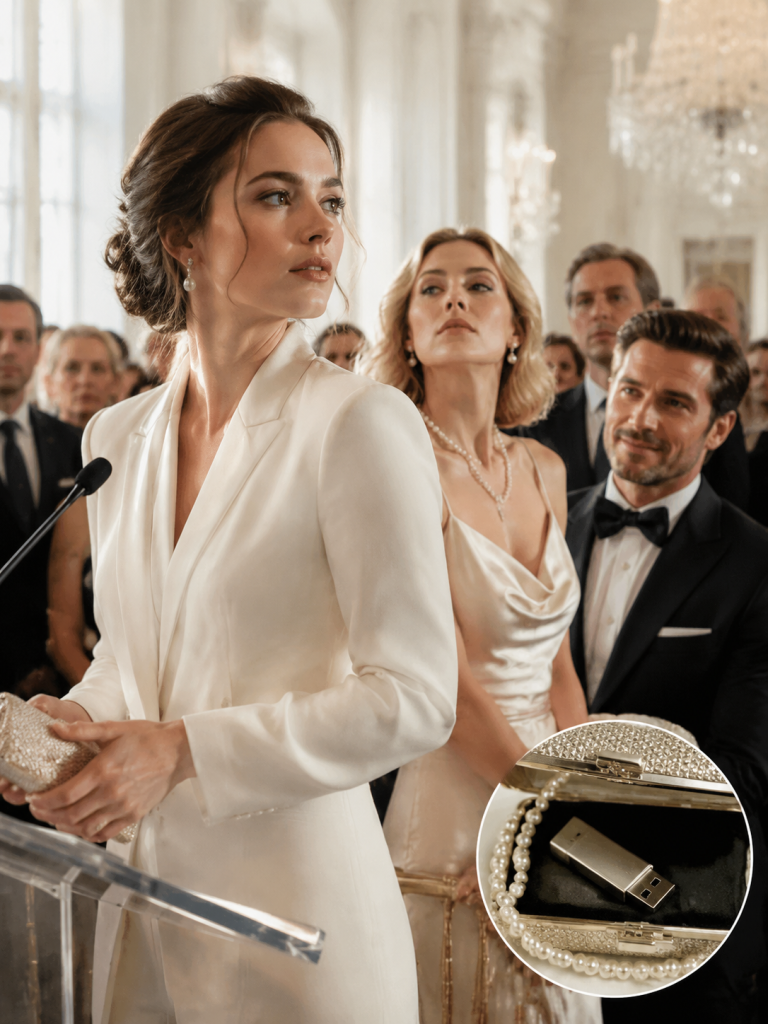
She crossed the courtyard in blush silk, unhooked the small clasp of her clutch, and pulled out six folded pages, creased soft from handling.
“Thank you for that speech,” she said to Delphine, in a voice pitched for the whole table. “Since we’re talking about family, I think it’s only fair everyone understands why you’re actually here tonight.”
Julian went still in the particular way of a man watching a wave arrive that he’d convinced himself would never reach shore.
“Camille,” he said. “Don’t.”
“I’m not doing anything,” she said. “I’m reading.”
The first message, sent to Camille three weeks earlier from an account with Delphine’s name on it, asked whether the guest list could “reflect the family’s next chapter” and suggested Simone might prefer to sit “somewhere less central” so as not to seem “encouraged to attend.” The second floated the idea of telling me the party was “immediate family only,” despite the fact that Delphine herself had not been immediate family, or family at all, or, as far as anyone in that courtyard had understood until ninety seconds earlier, anything but a marketing consultant.
The third message mentioned Corinne by name.
*Corinne says Simone is fragile and might embarrass herself. Corinne says Julian deserves a night where he can breathe. Corinne says once the divorce is finalized, everyone will understand.*
The word *divorce* dropped into the courtyard like a glass shattering somewhere out of sight.
My Aunt Josephine turned toward Julian. “Divorce?”
He did not look at me. That told the table enough.
“I did not respond to any of this,” Camille said, folding the pages closed, “because I told myself it was a misunderstanding. Then she sent me a revised seating chart with Simone’s name moved to a table by the kitchen door. The note underneath it said, and I’m quoting: *Less visible. Better for photos.*”
Andre took the paper from Camille’s hand and stared at it like it had personally insulted him.
Julian pushed back his chair. “This is a private matter.”
I finally spoke — the first thing I’d said aloud since Delphine had picked up my father’s pen and set it down like a claim staked.
“A private matter is a conversation between spouses,” I said. “This became public when you let her put her hand on that pen.”
Corinne stood so fast her chair nearly went over. “I will not be insulted at my son’s engagement — ”
“It’s my engagement,” Camille said, quiet and final. “Mine and Andre’s. Not yours. Not hers.”
That was when a man in a gray linen suit stepped out from beneath the oaks near the bar, where he’d been standing, unremarked, for the better part of twenty minutes. Older, silver at the temples, carrying the particular calm of a lawyer who bills by the hour and considers panic a client’s problem, not his.
Julian saw him and went pale before the man even reached the table.
“Mrs. Ashford,” the lawyer said to me. “Apologies for the timing.”
“You’re right on schedule, Mr. Broussard,” I said.
Etienne Fontaine had trusted Marcel Broussard with the vineyard’s affairs for over twenty years. After my father died two years earlier, Marcel had handled the estate, the trust, the ownership transfers — and, as it turned out, the postnuptial agreement Julian had signed the year after our wedding, back when the vineyard needed a line of credit and Corinne had insisted on “protecting the family investment” in language everyone at the time had assumed only applied to me.
Marcel opened a leather folder.
“Effective tonight,” he said, “Mrs. Ashford is initiating separation proceedings under the infidelity and financial misconduct clauses of the postnuptial agreement, executed four years ago this March.”
Delphine’s mouth opened. “Postnuptial?”
Julian said nothing. He was already reading, his face draining of color line by line.
Marcel continued, unhurried. “Joint accounts linked to Fontaine Vineyards’ credit have been frozen as of five o’clock this evening. Expenditures connected to a leased apartment on Prytania Street, a leased vehicle, and several jewelry purchases will be reviewed for misuse of marital and estate funds.”
*Apartment. Vehicle. Jewelry.* Each word landed like a dropped glass in a silent room.
Corinne’s hand gripped the back of her chair. “That’s absurd. Julian would never — ”
Marcel handed her a single page. “Mrs. Ashford, your signature appears on two of the authorization forms.”
For the first time in my eleven years of knowing her, Corinne Ashford had nothing to say.
Julian folded the document too slowly. “Simone. We can talk about this.”
I almost laughed. For six months I had begged him to talk — in our kitchen, in the car, standing in the vineyard rows at dusk while he told me I was imagining things, that grief over my father was making me paranoid, that I needed to stop counting nights that weren’t mine to count. He had called me difficult. Fragile. Cold.
Now he wanted to talk because the room had receipts.
“No,” I said. “We already did all the talking you deserved.”
Delphine found her voice again, brittle now, stripped of its earlier polish. “You can’t punish him for loving someone else.”
Every woman at every table seemed to straighten at once.
“I’m not punishing him for loving someone else,” I said. “I’m holding him accountable for funding it with my father’s vineyard.”
She had no answer for that.
Marcel reached into the folder once more. “There is also an audio file.”
Julian’s head snapped up. “No.”
Not angry. Afraid. The courtyard seemed to register the difference immediately, the way a room does when it realizes the story it’s been half-believing has more buried in it than anyone wanted to dig up.
Marcel looked to me. My choice.
“Not tonight,” I said. “Send it to my attorney.”
“Already done,” Marcel said.
Delphine looked between Julian and me, and something in her expression shifted — not remorse yet, but the beginning of arithmetic, the recognition that a man who betrays his wife rarely stays loyal to whoever he betrayed her with.
—
The party dismantled itself in the quiet, awkward way parties do after something breaks too loudly for anyone to pretend otherwise. Guests drifted toward their cars in murmuring clusters. Aunt Josephine held my face in both hands on her way out and said, “Your father would be so proud of you tonight,” and I nearly came undone right there under the oaks, not because of Julian, but because of him.
He had died two years earlier at his desk in the tasting room, beneath a photograph of Camille and me as girls, sunburned and grinning after a day spent stomping grapes in wooden barrels because he thought every Fontaine child should know what the work actually felt like under bare feet.
After the funeral, I had moved through the following months wrapped in a kind of gauze grief that Julian, I understood now, had used against me — every doubt I raised about Delphine folded neatly back into my mourning, as though sorrow had made me an unreliable narrator of my own marriage.
But my father had not believed that. Marcel found me on the veranda after most of the guests had gone, the Atchafalaya night thick with cicadas and the smell of crushed grass, and handed me a sealed cream envelope.
My name was written across the front in my father’s hand. *Simone Bear* — the nickname he’d used since I was six, after I’d tried to wrestle a stray dog for the last biscuit at a church picnic and won.
“He asked me to give you this,” Marcel said, “when you were ready. He was very specific about the timing.”
“How would you know when that was?”
Marcel glanced toward the courtyard, where Julian stood alone under the string lights, phone in hand, calling someone who clearly wasn’t picking up.
“He said you’d stop asking permission to believe what you already knew.”
Camille found me a moment later, barefoot, her heels dangling from one hand, hem of her dress smudged with grass. Andre trailed behind her, still holding the printed pages like he wasn’t sure what else to do with them.
“I’m sorry,” Camille said. “I should have shown you those messages the moment they came in.”
“You saved the whole night,” I said.
“No,” she said. “You were already saving yourself. I just brought the proof.”
I opened my father’s letter with hands that weren’t quite steady.
*Simone Bear —*
*If Marcel is handing you this, it means the day I hoped would never come has arrived, and I prepared for it anyway, because I have watched Julian enter rooms before you and let people believe he brought the light in with him. I have watched his mother correct your posture while spending your patience like it belonged to her.*
*You do not owe loyalty to anyone who treats loyalty as a leash.*
*The vineyard is structured so no husband, banker, or charming fool can take what your grandfather planted and I protected. Camille knows enough to stand beside you. Marcel knows enough to stand in front of you. You, Simone Bear, know enough to stand on your own two feet in soil that has always belonged to you.*
*When the day comes, don’t explain too much. People committed to misunderstanding you will turn every explanation into rope.*
*Keep the pen. It signed every good year this family ever had. Let it sign the next chapter too — the one where you finally write it yourself.*
*Come home to yourself.*
*— Dad*
I was crying by the time I finished, though not the tears Corinne had wanted from me all evening. These were cleaner. Camille cried with me. Andre studied the sky as though it had personally wronged him.
That was when Delphine appeared at the edge of the veranda, alone, Julian nowhere in sight. The glow was gone from her; without an audience, she looked smaller, still beautiful, but beauty without power is only arrangement.
“I didn’t know about the accounts,” she said.
I believed her. It didn’t make her innocent.
“He told me you two were basically separated,” she went on. “That it was for appearances. That his mother was the only one who understood how unhappy he’d been.”
I felt something distant and strange — not warmth, but a kind of pity that surprised me.
“Did he tell you,” I asked, “that he said almost the exact same thing about the woman before me? That she didn’t understand ambition?”
Delphine flinched.
“That’s what men like Julian do,” I said. “They don’t change the story. They just change the woman standing in it.”
She didn’t answer. There was nothing left to say that wouldn’t have made things worse for both of us.
—
The separation took eight months to finalize — long enough for the vineyard to move through an entire growing season without him ever setting foot in the rows again.
Those eight months did not pass quietly. They passed in the slow, unglamorous grind of depositions and disclosure requests, of Marcel’s office calling with updates that always started the same way — *nothing dramatic, just paperwork* — and always managed to be dramatic anyway. I learned things in that stretch of time that I wished I hadn’t had to learn, the way you sometimes wish a wound had simply healed crooked instead of being reset.
I learned that Julian had been paying Delphine’s Prytania Street rent for fourteen months, not the six I’d assumed, going back to well before the hospital gala where I’d first shaken her hand and thought nothing of the way her fingers lingered a beat too long against mine.
I learned that Corinne had arranged the lease herself, under a shell entity connected to Ashford Hospitality’s marketing budget, the same budget that had, on paper, justified hiring Delphine as a consultant in the first place. It was, Marcel told me over the phone one gray Tuesday morning, an almost elegant piece of fraud — elegant the way a well-set trap is elegant, admirable only if you forget what it’s for.
I learned that my own signature, or something close enough to fool a junior associate, had appeared on one of the authorization documents. It took three weeks and a forensic handwriting analyst to prove it wasn’t mine. I remember sitting in Marcel’s office the day the report came back, staring at two versions of my own name side by side, one real and one forged, and feeling a strange, unmoored horror — not just that Julian had stolen from the vineyard, but that he had been willing to steal my identity to do it more cleanly.
“He’s going to face charges for that one,” Marcel said, not unkindly, watching my face for the reaction he clearly expected and didn’t quite get.
I didn’t feel triumphant. I felt tired, in the particular way that comes after you’ve spent months being right about something you desperately wished you were wrong about.
—
Camille came by the vineyard most Sunday afternoons that year, ostensibly to help with the harvest planning, mostly to make sure I was eating something other than crackers and the last of whatever bottle I’d opened the night before out of habit rather than pleasure. She had a talent, my sister, for sitting with a person’s grief without trying to fix it, a talent I suspected she’d learned from watching me do the same for her after our mother left, all those years ago, back when I was the older sister who left half a sandwich on her plate because I thought she was too sad to eat.
“You don’t have to be strong every Sunday,” she told me once, feet propped on my porch railing, a glass of unopened wine sweating in her hand because neither of us actually wanted to drink it — we just liked having something to hold.
“I’m not being strong,” I said. “I’m being busy. There’s a difference.”
“Is there?”
I didn’t have an answer for that. Some weeks, busy was the closest thing to strong I could manage, and I’d decided, somewhere around month four, that pretending otherwise wasn’t worth the energy.
Aunt Josephine started coming too, uninvited and always with food — gumbo one week, a pecan pie the next, casseroles that could have fed a wedding reception dropped off “just in case company stops by,” though we both knew no company was stopping by, and that the food was really just her way of making sure I remembered someone was thinking of me even on the weeks she couldn’t say it out loud.
It was Josephine, actually, who found the second letter.
She’d been helping me clear out my father’s old office in the tasting room — a task I’d been putting off for two years, unable to bring myself to touch the stacks of invoices and yellowed ledgers he’d kept in his own particular chaos of order — when she pulled a slim folder from behind a filing cabinet that had clearly been wedged there on purpose, tucked out of sight of anyone doing a casual search.
Inside was a copy of the postnuptial agreement, annotated in my father’s handwriting in the margins, along with a note dated the same week Julian had signed it.
*Simone doesn’t know I asked Marcel to draft this the way I did. She thinks it’s standard. It isn’t. I’ve seen men like Julian before — not bad men, exactly, just men who mistake access for ownership the moment no one reminds them of the difference. I’m not protecting the vineyard from him. I’m protecting her from ever having to prove, in a room full of strangers, that she deserves what’s already hers.*
I sat on the floor of that office for a long time after reading it, Josephine’s hand resting quietly on my shoulder, neither of us saying anything, because some grief doesn’t need commentary. It just needs company.
Julian lost his seat on the Ashford Hospitality board within the first three months, once the frozen accounts triggered an internal review the family could no longer contain quietly. Two properties were sold that summer to cover what Marcel’s audit eventually uncovered — a number large enough that even Corinne stopped pretending the word “misunderstanding” still applied. She resigned from three charity boards “to focus on family,” which in New Orleans means, politely and permanently, that she was asked to leave.
I read it twice, then wrote back: *Be someone your daughter never has to apologize for.* I had heard, by then, that there was a daughter. I hoped, in the distant, unbothered way you hope for weather in a city you no longer visit, that she’d grow up somewhere honest.
Camille and Andre married the following spring on the vineyard itself, under the same oaks where the trouble had started, because Camille said she refused to let one ugly night own that land. I stood beside her in blush linen, front and center in every photograph, not tucked near a kitchen door, not less visible for anyone’s comfort.
At the reception, Andre took the microphone and looked straight at me.
“My future sister-in-law taught me something this year,” he said. “Love isn’t proven by how much someone can endure. It’s proven by how safe they’re allowed to be.”
I cried, and this time, no one used it against me.
—
A year after that first, terrible party, I signed the paperwork making Fontaine Vineyards fully mine — not half mine, not mine-in-trust, not mine-until-a-husband-decided-otherwise. I used my father’s pen to do it, the same one that had sat, once, on a gift table three hundred miles from where it belonged, waiting for a woman with no right to it to claim it as her own.
It didn’t happen. She’d set it down again that night without signing anything, and I had picked it up myself an hour later, once the courtyard had emptied and the string lights had gone dark one bulb at a time.
I keep it in the tasting room now, in a glass case near the door, where every visitor sees the engraving before they see anything else. *E.F., 1958.* Some of them ask about it. I tell them it belonged to the man who planted the first eleven acres, and that it has signed every good vintage since, and that this year, for the first time, it signed one entirely on its own terms.
Some things aren’t damage.
Some things are proof you survived, and kept your own name on the label while you did it.
On the second anniversary of that engagement dinner under the oaks, Camille and Andre drove out for Sunday supper, the way they did most weekends by then, bringing their new baby, Etienne — named, without a moment’s hesitation on either of their parts, after the man who’d built the ground they were standing on. We ate on the porch, shrimp and rice and a bottle from the first vintage I’d bottled entirely under my own label, no Ashford name anywhere near it, nothing borrowed, nothing on loan.
Camille raised her glass before dessert, the way she always did now, half tradition and half stubborn refusal to let one bad night at Vasquez estate keep owning the idea of a toast.
“To Simone,” she said. “Who didn’t disappear.”
I looked at my sister, at her husband, at the baby drowsing against Andre’s shoulder in the last of the evening light, at the rows of vines stretching dark and orderly toward the tree line, planted by a man who had understood, better than I did at twenty-eight in a borrowed last name, that love should never require a woman to shrink to fit inside it.
For years I had believed being chosen meant someone staying, no matter what it cost me to keep them.
I know better now.
Sometimes being chosen means your own hand reaching for the door — and finding, on the other side of it, a whole vineyard that was always yours to begin with, waiting patiently for you to come home to it.
People still ask about that party sometimes, when they hear the story secondhand, the way stories travel through parish gossip and old family friends and, eventually, the internet, where strangers turn a woman’s worst night into a caption with dramatic music behind it. I don’t mind anymore. Some woman somewhere might need to hear it — might be sitting at a table right now while someone smiles too sweetly across from her, might be told she’s difficult, or fragile, or imagining things, might be tempted to explain herself until her voice disappears entirely into other people’s version of events.
I hope she remembers this: you do not have to fight for a seat at a table where someone else is planning your erasure. Stand up. Let them speak. Let them clap for whoever they’ve already chosen. Let the truth walk in whenever it’s ready — and when it does, make sure you’re the one still holding the pen.