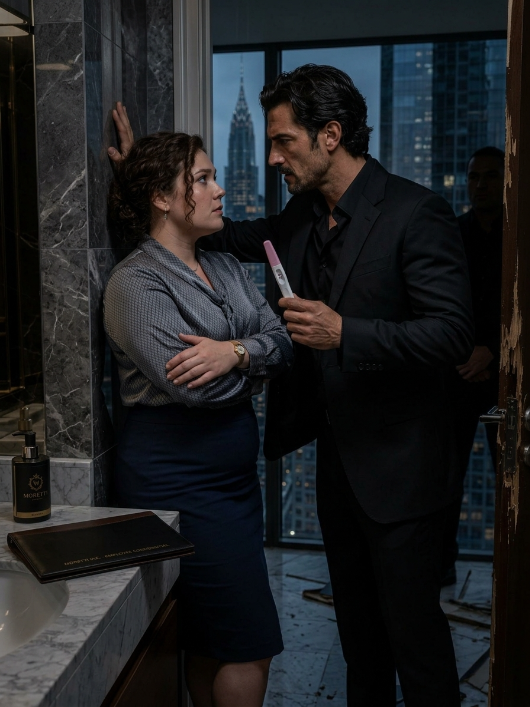
“Can You Come Get Me?” She Whispered to the Mafia Boss After Her Ex Shattered Her Arm

## PART 1
The door splintered under his fist the same way your hope had been splintering for five years.
Sophie’s arm screamed when she hit the bathtub tile, the angle wrong enough that she knew before the pain arrived. Her mind went abstract with shock, turning the agony into something theoretical, something happening to someone else. That’s how she survived these moments—by becoming an audience to her own disaster.
BAM. BAM. BAM.
Thomas Reed was hitting the bathroom door like it owed him blood.
“Sophie. Open this door. Right now.”
His voice carried the particular rage of a man who believed ownership gave him rights. Five years of apologies and promises had taught Sophie that his rage came in cycles, but tonight he had skipped the warm-up. Tonight he had simply seen her flinch and decided that flinching was permission.
Sophie’s chest was too tight to fill with air.
She was locked in the bathroom of the apartment that still, somehow, belonged to both of them. The world outside the door was his. The world inside the door was just her and a business card she had carried like a secret prayer for six months.
The card was black, edges gold, lettering clean and expensive.
Sebastian Russo.
The name that made rooms go quiet.
The kind of quiet that came from fear, not respect.
Sophie stared at the card with her good hand while her broken arm hung at an angle that made her stomach turn. She had acquired this card the way you acquire a bullet you never intend to fire—by accident, by grace, by the accident of being in the right place when someone decided you were worth remembering.
Six months ago, Sebastian Russo had been sitting at a table in her restaurant, and Sophie had spilled wine on his expensive suit. She had waited for the anger. Instead, he had looked up at her like she was a person, not a failure in black and white. At the end of the meal, he had placed the card on her tray and said, “If you ever need something,” like it was an ordinary thing, not a grenade.
She had almost thrown it away in the alley. Almost. But some part of her that refused to die completely had sewn it into her purse lining with shaky stitches at three in the morning while Thomas slept off his rage.
The door groaned under another impact.
CRACK.
Sophie’s fingers trembled as she pulled her phone toward her with her good hand. The screen blurred through tears. She could barely see the numbers, but her body knew them anyway. She had rehearsed this moment a thousand times in her head, rejected it a thousand times as insane, impossible, a fantasy that would only make things worse.
This time, her body called anyway.
One ring.
Two.
A voice answered, deep and smooth, the kind of calm that doesn’t come from kindness.
It comes from never having to ask twice for anything.
“Yes.”
Not hello. Not who is this.
Just yes, like he was expecting her.
Sophie’s breath caught. “I… I…” The door splintered further and her courage nearly snapped with it. “You said… six months ago. You said if I ever needed anything.”
Silence stretched so heavy she thought he had hung up.
Then: “The restaurant.”
Not a question. A recognition.
He remembered her.
“Sophie,” she whispered, almost ashamed that her name sounded so small.
“Where are you,” Sebastian asked, and the question was already becoming a plan. She heard a car door open. Footsteps. The kind of movement that came with purpose.
“Two-fourteen Morrison Street, apartment 7F,” Sophie said, and the words felt like they were breaking some law. “My arm. He broke my… please.”
CRACK.
The bathroom door gave way.
Thomas’s fist punched through the wood, reaching for the lock, reaching for her, his face red and wild. Sophie dropped the phone and scrambled into the bathtub because her body only knew one response to his rage.
Disappear.
Thomas ripped the door open, and his eyes locked onto her with that familiar mixture of satisfaction and fury. He loved this part. The part where she was small and he was big. The part where there was nowhere to run.
“Who were you calling,” he snarled, grabbing for the phone.
The phone skidded into the corner, still connected.
And a voice emerged from the speaker, calm as a prayer before an execution.
“Sophie. Stay exactly where you are. I’m seven minutes away.”
Thomas froze, his entire body going rigid.
He stared at the phone like it was a poisonous snake.
When he picked it up, his voice cracked with a fear Sophie had never heard from him. “Who the hell is this?”
A pause.
The kind that makes blood run cold.
“Sebastian Russo,” the voice said, and every ounce of authority was contained in those two words. “And you just made a mistake that’s going to cost you everything.”
The color drained from Thomas’s face so fast it was almost merciful.
In this city, everyone knew that name.
The Russo family didn’t make threats.
They made examples.
Thomas tried to recover, tried to inflate himself back to dangerous. “Look,” he said, forcing roughness into his voice, “she’s my wife. You don’t have a right to—”
“Six minutes,” Sebastian interrupted, boredom masking something lethal. “I suggest you use them to pray.”
The call ended.
Thomas stood motionless, holding the dead phone, looking like a man who had just realized the water he was standing in was deep enough to drown him.
Sophie watched from the bathtub, her broken arm cradled against her body, and for the first time in five years, she allowed herself to believe that rescue might actually be possible.
## PART 2
Thomas jerked her up by the broken arm, and the pain that exploded through her body was almost a relief because it confirmed that something had finally ruptured beyond his ability to glue back together with apologies.
Sophie screamed—raw, animal, unfamiliar—and Thomas dragged her into the living room like she was furniture he was rearranging. He threw her onto the couch and paced, running his hands through his hair, muttering to himself like a man trying to negotiate with a god he’d just insulted.
“Russo,” he spat. “Sebastian fucking Russo.”
He stared at the door like it was a weapon pointed at his chest.
Sophie curled around her arm, tears streaming hot, her body braced for the next escalation. But Thomas’s fear had shifted his violence into something new and unstable. When fear takes over from rage, a man becomes unpredictable in ways that are worse than the original anger.
The doorbell rang.
The sound was polite. Almost gentle. That’s what made it terrifying.
Thomas’s whole body went rigid. He looked at the door like he was staring down a firing squad. The doorbell rang again, patient and steady, as if whoever was outside had all the time in the world.
Thomas swallowed hard and forced his voice into something approximating authority. “Stay here,” he hissed at Sophie, as if she were the problem. He walked to the door and looked through the peephole, and whatever he saw made him go pale.
He opened the door with the chain still engaged.
“Look,” he said, loud enough for Sophie to hear him trying to sound like a man in charge, “this is a domestic situation. You can’t just—”
“Move,” a new voice said, and the single word was absolute.
Thomas started to speak again, and there was a quick, dull sound. The impact of a fist meeting face. Silence followed, the kind that lands heavy and final.
Footsteps approached, deliberate and calm, like whoever was walking had never had to hurry in his life.
Sebastian Russo stepped into Sophie’s living room like he owned it.
He was tall, dressed in black that looked custom-made, the kind of suit that made men straighten their spines without knowing why. His face was sharp, controlled, but when his eyes found Sophie, something softened for half a second. Not sympathy. Not pity.
Attention. Recognition. The weight of being actually seen.
“Sophie,” he said, and hearing her name from him felt impossible, like a door opening in a place she thought was sealed.
He knelt beside her, hands hovering near her broken arm without touching, reading the injury with the calm of someone who had witnessed worse. Two men in dark suits appeared behind him, and in the hallway, Sophie caught a glimpse of Thomas crumpled on the floor, unconscious.
“We’re taking you to a proper doctor,” Sebastian said, like it was already decided. “Now.”
Sophie tried to speak, but the only thing that emerged was a shaky breath.
The men lifted Thomas like he weighed nothing, carrying him out without ceremony. Sebastian’s focus stayed entirely on Sophie. “Can you walk,” he asked. She tried, her knees wobbled, and she shook her head. He lifted her with a gentleness that nearly broke her because kindness felt like a trap after so long.
He wrapped his coat around her shoulders, warm and expensive, and her body wanted to collapse into it completely.
“Your things will be collected,” he said. “You’re leaving now.”
Outside, a black Mercedes waited with the engine running, and the night air hit Sophie’s face like freedom finally had a temperature.
## PART 3
The car rode smooth and insulated, a private planet separated from the ordinary world. Sophie cradled her broken arm and stared at the city lights sliding past, trying to understand what kind of man offers protection without demanding ownership in return.
Dante sat near her, not too close, but close enough that she could feel his presence like gravity. “What will you do to him?” she asked, because her brain needed a question to keep from dissolving entirely.
“Nothing permanent,” he said, then paused. “Yet.”
The word hung in the air like a judge’s verdict.
Sophie should have been terrified of him, she told herself. People like Sebastian didn’t offer mercy for altruistic reasons. But fear is complicated when the person you feared most is the one you left bleeding on your floor. “He’ll come after me,” she whispered, because Thomas always came after what he believed belonged to him.
Sebastian turned his head and looked at her fully, and the certainty in his eyes made something tight inside her finally release. “No,” he said. “He won’t.”
They passed through iron gates that opened like they had been expecting her. A mansion rose ahead, lit clean and bright, guarded by cameras and men who watched the darkness with professional eyes. The house looked like it was built to survive wars.
Sebastian carried her inside, past a woman named Catherine with kind eyes and professional calm. A doctor waited in a guest suite that looked like a five-star hotel, not a sickroom. He moved fast, efficient, setting her arm, taking images, speaking in a tone that never once blamed her for being hurt. The painkillers took the edge off the physical pain, though nothing touched the shock still moving through her nervous system.
Before Sebastian left, Sophie managed to whisper the question that had been building since he first answered her call. “Why?”
He paused at the door, and his jaw tightened like he was holding back something older than tonight. “Rest,” he said. “Tomorrow we talk.”
Then he was gone, and Sophie fell asleep in sheets that felt like clouds and safety.
—
Morning arrived with real sunlight, warm and impossible. Sophie woke disoriented and reached for Thomas before remembering. Her heart stuttered, but the apartment was quiet. The room was quiet. The world outside the windows was quiet in a way that felt like a choice instead of a threat.
Breakfast appeared on a tray—fruit, pastries, coffee that smelled like a life she never had. Catherine introduced herself, and her voice was gentle but firm, like she had seen panic before and knew exactly how to handle it. “You are safe here,” she said, like a fact. Sophie laughed once, bitter, because she hadn’t felt safe in years.
Catherine didn’t flinch at her laugh. She just nodded, understanding that safety was something you had to relearn with your whole body.
Hours crawled past. Sophie walked slowly through the guest wing, touching the edges of luxury like they might disappear if she looked too hard. Soft carpets. Quiet art. Clean air that didn’t smell like stale beer and rage.
Then she heard a familiar shout from somewhere down by the front gates. Distant but unmistakable.
Thomas.
His voice carried through the morning air, loud and furious, calling her name like it was a curse. Her knees went weak. Her brain tried to shove her back into the bathtub, back into hiding. Catherine appeared again, calm as ever. “He cannot enter,” she said. “Mr. Russo is handling it.”
Sophie wanted to believe her, but five years of Thomas had taught her that men find a way in.
The shouting stopped after a while, cut off like someone turned a switch.
That night, Sebastian appeared in her suite looking composed, suit perfect, face controlled. But his eyes held something cold and contained—the kind of anger that doesn’t explode.
“He’s gone,” Sebastian said.
Sophie’s mouth went dry. “Gone where?”
“Away from you.”
Sophie tried to ask if Thomas was dead, but the word stuck in her throat. Sebastian answered anyway, like he heard the question she couldn’t voice. “Not dead,” he said. “Not tonight.”
He walked to the window and looked out like he was checking the perimeter of her new world. “He came to my gate and he threatened,” Sebastian continued, almost casually. “Then he begged. Then he threatened again.” Sophie knew that rhythm—the cycle of sorry and rage, rage and sorry.
Sebastian turned back to her. “He signed papers. He leaves the state tomorrow. He doesn’t contact you again. If he does, I’ll know.”
Sophie’s chest tightened with something unfamiliar.
Relief that felt illegal.
—
Weeks passed, and Sophie started to understand that safety has a sound. It sounds like quiet hallways and doors that don’t slam. It sounds like a cup placed on a saucer without anger. It sounds like your own breathing when you aren’t holding it hostage.
Sebastian arranged therapy with a trauma specialist, and the first session felt like ripping open an old wound just to prove it existed. Sophie hated it. She needed it. She learned words for what had happened—coercive control, financial abuse, isolation. She learned her fear had been strategy, not weakness.
Sebastian checked in after sessions without prying, without demanding details, and that restraint confused her. Thomas had used questions like traps. Sebastian’s questions felt like doors she could choose to walk through or not.
Catherine became a steady presence, the kind of kindness that didn’t ask for anything back.
Slowly, Sophie’s body began to believe what her mind kept repeating. She was not in that apartment anymore. She was not trapped in the bathroom. She was not alone.
Then she noticed the small things that made her chest tight for reasons beyond pain.
Sebastian remembered how she took her tea. Sebastian noticed when she went quiet and gave her space. Sebastian asked permission before moving too close, like her “no” was a law, not a challenge.
It terrified her, because tenderness felt like the opening page of a story that always ended in bruises.
One afternoon she caught him watching her from across the garden, and the look on his face wasn’t hunger or entitlement. It was something softer, something careful, like he was protecting a flame from wind.
She told herself it was impossible. Men like him didn’t fall for women like her. But she had also told herself she could survive Thomas by staying small, and she was wrong about that too.
—
Sophie moved into her own apartment after a few months because her therapist said independence wasn’t rejection, it was repair. Sebastian supported it without sulking or bargaining. His people helped her move, but he made sure every decision was hers—from the neighborhood to the color of the walls.
He didn’t hand her a gilded cage.
He handed her keys.
That difference hit so hard she had to sit down on the floor of her new living room and breathe through tears.
She got a job at a small bookstore because she wanted quiet and stories and a place where nobody yelled. She started saving money and felt pride in her own numbers. She joined a support group and then, later, helped run one, because the best revenge is refusing to let the cycle recruit another woman.
Sebastian visited only when invited, and every time he left, he left her with more space instead of less.
—
Thomas tried once, months later, through a burner number with a pathetic message that started with “I’m sorry.” The words hit her screen like poison. Her stomach turned, her hands went cold, and the old Sophie wanted to delete it and pretend it never happened.
But the new Sophie was learning that silence is where abuse grows roots.
She screenshot it.
She forwarded it to the legal contact Sebastian had provided.
She breathed, and she did not answer.
The next morning she heard Thomas was pulled over across state lines for violating the order. She didn’t feel joy. She felt closure. There’s a difference.
—
On the anniversary of the night she called Sebastian, Sophie found the old business card in a drawer. It looked smaller now, almost harmless, like it shouldn’t have been able to change her entire life.
She remembered the bathroom tile, the blood, the crack of her bone, Marcus’s smile afterward.
She remembered the ring, ring, ring and the moment Sebastian said “The restaurant” like she mattered enough to be remembered.
She realized the bravest thing she did wasn’t when Sebastian arrived.
It was when she decided she was allowed to ask for help.
—
When she met Sebastian for dinner a year later, she chose a small place downtown with warm lighting and normal people. She chose it because she needed to prove to herself that she could share space with him without losing her own.
Sebastian arrived understated, and when he looked at her, his expression softened and steadied.
“I’m not asking for a fairytale,” Sophie said, her voice steady because she had learned how. “I’m not promising anything fast. My fear still visits sometimes.”
“Slow is fine,” Sebastian said. “Slow is smart.”
“Rules,” Sophie said, half-joking, half-serious. “Therapy continues. My apartment stays mine. My no stays no.”
“Your no is law,” Sebastian said, and for the first time, she believed a man when he said it.
—
The relationship, if you could call it that at first, looked nothing like her old life.
It was coffee and conversations, not commands and apologies.
It was Sebastian asking, not Sebastian taking.
It was Sophie learning how to say “I don’t like that” without bracing for impact.
Sometimes she flinched anyway, and Sebastian noticed, and he paused like a man who respected invisible bruises too.
Healthy love is boring in the best way. It doesn’t spike your adrenaline. It doesn’t keep you guessing. It doesn’t punish you for existing.
—
A year after the bathroom, Sophie stood in front of a mirror in her own apartment, adjusting her jacket before a support group meeting she now led for survivors.
She looked different. Not in the way magazines meant. In the way her eyes held the room. In the way her shoulders sat where they were supposed to, not curled inward like parentheses.
She still had scars—inside and out—but they no longer defined her future.
She told the women in her group the truth without sugarcoating it.
Leaving is dangerous. Staying is deadly in slow motion. Documentation is power. Community is oxygen. Forgive yourself for the time it took.
After the meeting, she stepped outside into the night air.
Her phone buzzed.
Sebastian: Want me to pick you up?
She smiled and texted back: No. I’m driving. See you soon.
As she walked to her car, she realized the most satisfying ending isn’t the abuser suffering.
It’s you living.
—
Sophie never forgot the night she dialed the one person she thought was dangerous.
But she stopped calling him that.
Because the truth is, the devil was the man she hid from in the bathroom.
The man with the beer and the grin after the crack.
Sebastian wasn’t a saint. She didn’t pretend he was. He was dangerous, and he did dangerous work in a dangerous world.
But he did one thing that changed hers: he treated her like she was worth saving without making her pay with her freedom.
That didn’t erase her trauma.
It didn’t rewrite the past.
It just gave the future a different shape.
She didn’t need to be rescued anymore.
That was the point.
She needed a bridge out, and she built the rest with her own hands.
The city still whispered the name Russo, but when she heard it now, she didn’t feel fear.
She felt quiet, steady gratitude for the night she finally chose her life.
—