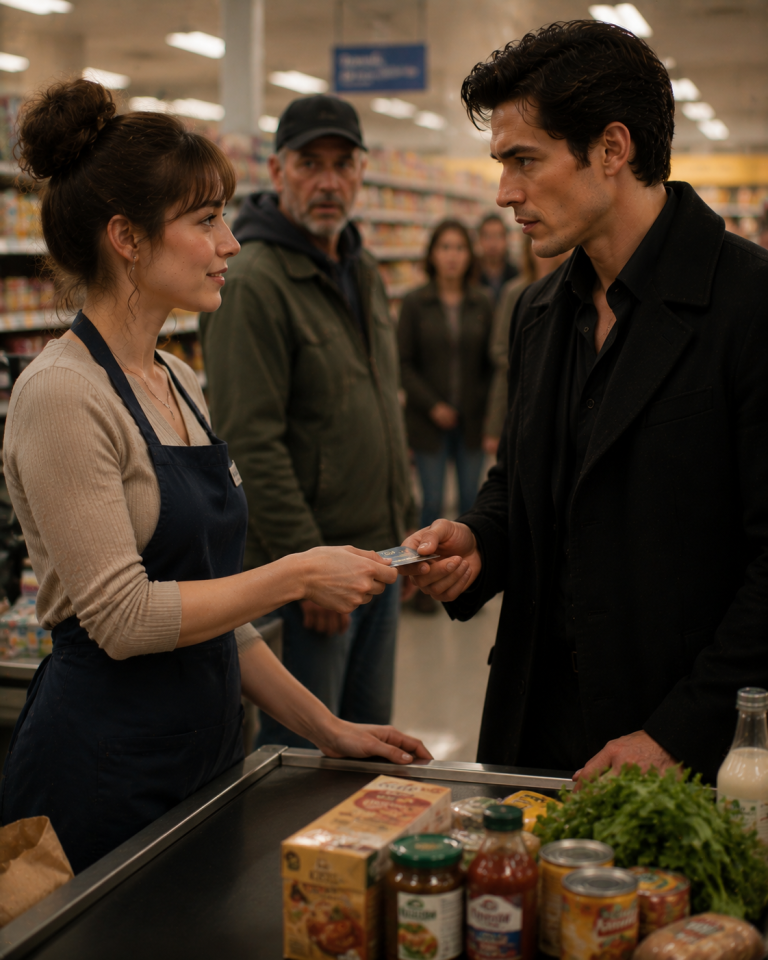
“Like It or Not, You’re Staying—That Baby Is Mine,” Declared the Mafia Boss

## PART 1
She had known, for exactly seven minutes before the door came off its hinges, that her life was over as she understood it.
Not because of the test.
Because of what the test meant about her.
Nadia Brynn had spent four years being the most capable person in a room that never noticed she was in it. She was thirty, practical-faced, auburn-haired, always in charcoal or navy, always with reading glasses she didn’t technically need but which helped her think. She was the executive secretary to Marco Ferretti — which meant, in practice, that she was the operational core of everything the name Ferretti implied. She knew which judges could be reached by money and which required something more personal. She knew which shipping manifests were legally defensible lies. She knew the names of men who sat at that boardroom table and believed themselves essential while Nadia quietly made the machinery work around their blindspots.
Men called her Brynn. Occasionally sweetheart when they wanted coffee. They moved through the office like she was furniture and left important conversations half-finished in her earshot because she had successfully made herself appear to not be listening for four consecutive years.
She had been listening.
That was always the point.
Standing in the executive bathroom on the fortieth floor with a pregnancy test still warm in her palm and rain sliding in gray sheets down the glass outside, Nadia understood that the most dangerous thing she had ever done was not the four years of quiet documentation or the flash drive taped beneath her kitchen sink or even the night six weeks ago in the safe room. The most dangerous thing she had ever done was feel something for a man who thought of her as infrastructure.
The safe room.
Red emergency light. Blood dark through white shirt. Her hands pressing hard against his side while Marco Ferretti looked at her with an expression she had never seen him use on anyone. The gunfire had stopped. The world had reduced itself to a steel box and two people who had been standing close to each other for four years without ever standing close. Fear had done what proximity alone hadn’t. Something broke between them and something else came through the break.
By morning he was in a clean shirt calling her Brynn and asking about his nine o’clock.
By January she was pregnant.
The bathroom door did not knock.
It came in.
She heard the splintering before she registered the motion — the handle still in Marco Ferretti’s hand, his face in the doorway, his eyes going from her face to the white stick to the curve of her stomach she had been hiding under the cut of her blazer for three weeks with mixed success.
The silence had a specific quality. Not empty. Full of things not yet decided.
“I’ll resign today,” Nadia said. “I’ll leave the city. I won’t ask for anything and I won’t tell anyone.” Her voice cracked once in the middle and she hated it. “I know how to disappear.”
Marco shut the door behind him.
That sound was worse than anything he could have said.
He looked at her with an expression she had classified, over four years of study, as his pre-decision face. The moment before a verdict. The held breath before the sentence.
“Do you really think,” he said quietly, “that you disappear from me?”
“I don’t belong in your world.”
She meant it as a statement of fact. It landed in the room as something else — something older and more particular than a professional boundary.
Marco’s world was built for women with diamonds at their throats and the polished confidence of people who had never been laughed at for their size, never been mistaken for support staff while holding documents that could bury half the city, never eaten lunch at their desk for four years because the executive dining room was technically available to her and practically designed to make her feel like she should leave.
She was the useful one.
The forgettable one.
The one men stopped seeing the moment something more decorative walked through the door.
And yet here was Marco Ferretti, standing in the ruins of a bathroom door, looking at her like she was the only thing in the room that mattered.
“I need to think,” she said.
“There’s a car downstairs.”
“I just said I need to think.”
“You can think in the car.”
“That’s not—” She stopped. He was already reaching for his phone. She watched him issue three instructions in the flat efficient Italian that meant something had been decided and the deciding was done. “Marco.”
He looked up.
It was the first time she had used his name without the title in four years.
Something changed in his face.
But not the right something. Not enough of the right something.
“This is my choice too,” she said.
He studied her. “Yes.”
“You don’t actually believe that.”
“The car is waiting.”
That was the truth under the words. He was not asking what she wanted. He was reorganizing the world around the fact of the baby and expecting that to be enough, because it had always been enough before — the certainty of his power, the efficiency of his resources, the assumption that being claimed was close enough to being cherished for practical purposes.
Nadia’s fingers closed around the pregnancy test.
She let him lead her to the elevator.
She sat in the armored car beside him and watched the city go gray through tinted glass, and she pressed one hand over her stomach and understood, with the particular clarity that comes to women who have spent years observing powerful men, that the man sitting six inches away from her had no idea what was actually in the car with him.
Not the pregnancy.
Not even the woman.
The knowledge.
Four years of it. Names, accounts, private communications, shipping irregularities, the specific anatomy of arrangements between Marco Ferretti’s empire and the people who were supposed to be its enemies. Evidence. Copied carefully. Stored somewhere he had never thought to look.
Marco Ferretti believed the most dangerous thing about the pregnancy was the leverage it gave others.
He had not yet considered what leverage she was already holding.
—
## PART 2
The Ferretti estate was what she had always imagined it to be from the invoices and security reports that passed across her desk: a fortress wearing the vocabulary of a home.
Iron gates. Cameras inside the flower arrangements. Guards who moved with the specific quiet of men paid well for silence. Hallways that swallowed sound.
The bedroom he had assigned her was the size of her entire apartment, and it felt smaller.
“This is temporary,” she said.
Marco set his phone on the dresser. “No. Temporary was pretending none of it happened.”
“None of what happened. Be specific.”
His eyes moved to her.
“The safe room,” he said.
“We were scared. People do things when they’re scared.”
“You kept your hand on the wound for forty minutes. You talked to me the entire time. You said—” He stopped.
She remembered what she had said. She had not meant for it to count. She had meant for it to be what you said to a man you were afraid was dying, the kind of words that had permission to exist only inside a locked steel room where no one could hear them.
“You went back to your desk in the morning,” she said.
“So did you.”
“I work for you.”
“You saved my life.”
“That’s part of the job description.”
He looked at her with the expression she had never been able to classify — not the pre-decision face, not the management face, not the dangerous quiet he used with people who had done something that required consequence. Something without a name in her four-year catalog.
“I kept your desk,” he said. “After the safe room. Three board members suggested replacing you. Two of them were worried you’d seen too much. I told them you were irreplaceable.”
“Because I am irreplaceable.”
“Yes.”
“Professionally.”
“Nadia.”
She went still.
Her name. Not Brynn. Not the executive surname that kept her at a functional distance. The name her mother had used. The name she heard in her own head.
“Don’t,” she said.
“Don’t what?”
“Don’t use my name like it means something if you’re going to send me to a room at the end of this corridor and assume that solves it.”
Marco opened his mouth.
A knock interrupted him.
The guard’s expression when he entered said the news was bad before the news was delivered.
“Boss. There were federal agents at Miss Brynn’s building.”
The temperature in the room dropped.
“Which agency?”
“FBI.”
“What were they looking for?”
The guard glanced at Nadia.
She kept her face exactly as it had been.
Four years of practice.
Marco looked at her with the stillness she knew better than any expression he owned.
“You’re hiding something,” he said.
“Everyone in your world is hiding something.”
“Not from me.”
The words were quiet. That was when they were most dangerous.
She felt the heat of his attention the way you feel weather changing — the pressure shifting, the air going still before something loud and irreversible.
She had built an insurance policy because she was afraid of being discarded.
She had been afraid of being discarded because she knew exactly what he was capable of.
She had known what he was capable of because she had spent four years running the machinery of it.
And now he was looking at her with the face that preceded verdicts, and there was a flash drive beneath her kitchen sink that the FBI was two days from finding, and there was a baby that made her more visible than she had ever allowed herself to be, and the most dangerous man she had ever known was waiting for her to lie to him.
“Yes,” Nadia said.
He waited.
“I have been hiding something,” she said. “From the beginning.”
—
## PART 3
**What She Had Actually Built**
For three seconds, Marco Ferretti did not move.
Nadia had seen him absorb information that would have broken most people — the night the east warehouse burned, the morning the Ricci family sent a message carved into one of his men, the afternoon a senator called in a favor that cost eight figures and left Marco staring at his desk for twenty-seven minutes.
She had timed the twenty-seven minutes.
He absorbed all of those with the same face: neutral, interior, already calculating.
This was different.
She could see the difference in the precise way his jaw shifted.
“Tell me,” he said.
So she did.
Four years ago, when she had first understood the shape of what she had walked into — not the official version, not the sanitized LLC filings and the charity board memberships, but the actual machinery — Nadia had made a decision. She was not naive. She was not heroic. She was a woman without family money, without connections, without a safety net, who had taken a job she was desperately qualified for and then discovered the job required her to know things that made her a liability the moment she became inconvenient.
She had prepared accordingly.
Copies. Not of everything — she wasn’t stupid, she was careful. Selected documents, communications, financial threads. The things that would be most useful to someone who needed to protect themselves, or most useful to a federal prosecution if she ever had reason to want that. She had organized it the way she organized everything: methodically, without sentiment.
“It’s not meant for them,” she said. “The FBI. I didn’t contact them. I haven’t used any of it.”
“Then what was it for?”
“Me.” She looked at him directly. “So that if you ever decided I was more useful gone than present, someone would care that I was gone.”
The room was very quiet.
Marco’s guard, still near the door, was making himself as invisible as possible.
“You think I would have you—”
“I think you run an organization that has made people disappear for less reason than inconvenience. I think I spent four years watching how that worked. I think I was very good at my job and I made sure I stayed indispensable and I also made sure that if indispensable wasn’t enough, I had something else.”
He looked at her for a long moment.
“Four years,” he said.
“Yes.”
“You’ve been prepared to burn me for four years.”
“I’ve been prepared to survive for four years.” She held his gaze. “There’s a difference.”
Something moved in his expression. She could not identify it immediately. She filed it and kept speaking.
“The FBI isn’t there because of me. They found a thread through Conte’s operation — I recognized the name in a brief last month. They’ll be at the building for two more days before they realize there’s nothing public-facing to find. The drive is behind a panel, not under the sink — I moved it six months ago when the building’s maintenance schedule changed.”
Marco blinked. “You said beneath the kitchen sink.”
“I said the FBI was at the building. I didn’t say where the drive was.”
He stared at her.
“I wanted to see if you’d send someone for it before asking me,” she said.
The silence had a different texture now.
The guard near the door, admirably, remained invisible.
Marco walked to the window. The grounds were dark except for the security lights. He stood with his back to her, hands in his pockets, and she watched the shape of him process information in the way she had watched it for four years — the slight shift of weight, the still of the shoulders, the particular quality of a mind working at speed without sound.
“The baby,” he said, without turning.
“What about it?”
“Is that part of the calculation? The drive?”
“The drive has been there since year one. The baby has been—” She stopped. “The baby is eleven weeks old. It is not a strategy. I am aware that it complicates things.”
“For which of us?”
She almost laughed.
“For both of us,” she said. “For me it complicates everything. For you it mostly complicates liability and succession, which I realize sounds cold but I’m trying to be accurate.”
Marco turned.
He looked at her with the expression she hadn’t been able to name.
“What did you want?” he asked. “Not what you were protecting yourself from. What did you actually want when you took this job?”
Nadia considered the question.
It was the first time in four years he had asked her what she wanted rather than what she could do.
“I wanted to be good at something,” she said. “Not invisible. Genuinely useful. The kind of useful that has a name on it.” She paused. “I’m good at this work. I’m probably better at it than anyone you’ve ever employed. I know that sounds arrogant.”
“It doesn’t sound arrogant. It sounds true.”
The simplicity of it disarmed her more than argument would have.
“And then I stopped being just good at it,” she said, more quietly. “I started—”
She stopped.
“Say it,” he said.
“Caring about the outcome.” She looked at her hands. “About whether certain things didn’t happen. About whether the parts of this organization that protected people were strong enough to outlast the parts that—didn’t. I started caring about whether it mattered.”
“And then the safe room.”
“And then the safe room.”
He crossed back toward her. Not quickly. The way he moved through the office when something had been decided — not the predatory velocity of a threat, but the deliberate gravity of a man moving toward something he intended to keep.
“The drive,” he said. “I want to know what’s on it.”
“Some of it implicates you,” she said.
“I assumed.”
“Some of it implicates people who have been working against you from inside the organization for two years.”
He went very still.
“Which people.”
“Ricci. And the man you call your logistics director.”
Marco’s jaw tightened. “Casale.”
“Yes.”
“How long have you known?”
“Fourteen months.” She met his eyes. “I was waiting to understand the full shape of it before I—before I made a decision about what to do with it.”
“You were going to tell me.”
“I was deciding whether to tell you. There’s a difference.”
“And now?”
Nadia looked at the room around her. The fortress walls. The guards at the edges. The life she had not chosen, rearranging itself around a fact she had also not chosen.
“Now I’m telling you,” she said. “Because you came through a door without knocking. Because you said it mattered. Because—” She stopped. “Because I’m tired of preparing to survive and never getting to the part that comes after surviving.”
The room was very quiet.
Marco stood in front of her, close enough that she could see the slight imperfection in the line of his jaw, the exhaustion he carried in the way expensive suits could not entirely conceal.
“I called you Brynn,” he said.
“Yes.”
“For four years.”
“Yes.”
“I need you to understand that I—” He stopped. This was the rarest thing she had ever witnessed from him: not having the next sentence ready. “I didn’t call you Brynn because I didn’t see you.”
“Then why?”
“Because I was afraid of what it meant if I used the other one.”
Nadia stared at him.
Marco Ferretti, who had stared down rivals and prosecutors and armed men in darkened corridors, looked briefly like someone who had arrived at the edge of something and was still deciding whether to step off it.
“I know about the accounting trick on the Genova contracts,” he said. “I know you restructured the Bellini settlement documentation four months ago before I realized it needed restructuring. I know you’ve been quietly rerouting the community fund allocations away from the three line items that were laundering rather than giving.”
“Those were—”
“Brilliant,” he said. “Those were brilliant, and quiet, and they fixed things I had looked at for weeks without seeing the solution.”
She was quiet.
“I have been aware of what you are for longer than you think,” he said. “I have been afraid of it for longer than that.”
“Afraid of a secretary.”
“Afraid of a woman who knew everything about me and hadn’t decided yet whether I deserved to survive it.”
The honesty of it opened something in her chest that she was not entirely prepared for.
“The baby,” she said, after a moment.
“Yes.”
“I need to be able to leave,” she said. “If I decide to leave. I need that to be a real option.”
“I know.”
“Not a theoretical option. An actual one. With resources and safety and no one following me.”
“I understand.”
“Do you?”
He looked at her. “You just told me that you’ve spent four years ensuring your own survival. You did that because you weren’t certain I would protect your right to leave.” A pause. “I can’t undo four years of being the reason you felt you needed insurance. But I can tell you — and I need you to know I mean this the way I say it — you are not trapped here.”
Nadia felt her breath change.
“Then what am I?” she asked.
The question was smaller and more honest than she had intended.
Marco looked at her with the expression she had finally placed, somewhere in the last few minutes — not pre-decision, not management, not dangerous quiet.
The face from the safe room.
The one she had seen only once, in red emergency light, with his blood on her hands.
“You are the person who kept me alive,” he said. “Who has been running my organization better than I have run half of it. Who is apparently better at protecting herself than I have been at protecting her.” He paused. “Who is having my child. Who I have been—” The word seemed to cost him something. “—afraid to look at directly for four years in case it changed something I couldn’t change back.”
“And now it’s changed.”
“It changed six weeks ago in a safe room.”
“Marco.”
“Nadia.”
The name. Again. Still startling in his mouth.
She looked at the drive in her hand — she had retrieved it from the dresser where she’d placed it when they entered. She held it out.
“Ricci and Casale,” she said. “They’ve been skimming the eastern corridor. They have a contact in the federal building who’s been signaling them about investigations. That’s how they knew to set up the Conte operation as a decoy.”
He took it.
His fingers touched hers as he did, and neither of them moved for a moment.
“And the rest?” he said.
“The rest is still insurance,” she said. “I’m keeping that.”
He looked at the drive. Then at her.
“Reasonable,” he said.
That was not the word she expected.
“You’re not angry.”
“I’m many things,” he said. “Angry is not the most interesting one.” He turned the drive over in his hand. “I built an organization that gave you reason to prepare for your own disappearance. I called you by your surname for four years to avoid having a feeling I didn’t know how to manage. I left you alone in a safe room by morning because I was a coward.” He looked at her. “Being angry at you for being smarter than me seems like misplaced energy.”
Nadia sat down slowly on the edge of the bed.
The weight of the day arrived all at once.
“I don’t know how to do this,” she said.
“No.” He remained standing. “Neither do I.”
“That’s not reassuring.”
“No,” he agreed. “But it’s true. And I’ve been told you prefer true.”
She looked up at him. “Who told you that?”
“You. Indirectly. For four years.”
She was quiet for a moment.
“I need food,” she said finally. “I’ve been nauseous since Tuesday and apparently the only thing that helps is plain rice and company that doesn’t lie to me.”
Something happened to his expression.
Not the safe room face. Something new.
Something she didn’t have a name for yet but would learn, she thought, if she was patient.
“The kitchen is on the second floor,” he said.
“I know. I approved the renovation contract.”
He made a sound that was almost, almost a laugh.
“Of course you did,” he said.
—
**Six Months Later**
Nadia’s desk was not in a different location.
She had considered that — a dramatic new beginning, a new title, an office with a door and a nameplate and a window of her own. She had thought about it and then thought about the actual work, which required proximity to where decisions were made, and had decided that the geography wasn’t the problem.
The problem had been being invisible in a visible room.
She was not invisible anymore.
The nameplate read *N. Brynn — Director of Operations*, which was accurate. The door to Marco’s office was always open when she was working, which was also accurate. The men who had once asked her where the coffee was now came to her with questions they were afraid to ask him, which was both useful and quietly satisfying.
The baby was due in eleven weeks.
Ricci and Casale had been removed from the organization three months ago with the specific thoroughness that Marco Ferretti applied to threats once he had confirmed their shape. The federal contact in their operation had been neutralized through channels that Nadia had organized and that she did not have to know the details of, which was the arrangement they had reached about several things.
She knew the parts she needed to know.
He told her the parts he thought she needed to know.
They were still negotiating the gap.
She sat in the afternoon light reading through a shipping authorization when Marco came in from the boardroom with a tired look that meant the meeting had been difficult and unproductive.
“The Bellini proxy?” she asked.
“Stalling again.”
“Second quarter or third?”
“He said third.”
“He means second. He has a conference in Milan in March and he wants the deal settled before he goes so he can announce it there.” She circled a date on the document. “Offer the fifteenth of February. He’ll take it.”
Marco looked at her.
“How do you know he has a conference in Milan?”
“His assistant mentioned it to our assistant in October. I filed it.”
“You filed a piece of conversation.”
“I file everything.”
He stood in the doorway for a moment.
“You’re keeping the drive,” he said.
“Yes.”
“Even now.”
“Especially now.” She looked up at him. “Not because I don’t trust you.”
“Then why?”
“Because I spent four years teaching myself that the most important thing was to be able to leave.” She set the document down. “I don’t want to leave. But I want the choice to exist. Do you understand the difference?”
He looked at her across the office — across the distance she had been managing for years and was no longer required to manage.
“Yes,” he said.
“You don’t like it.”
“I don’t like that I gave you reason to need it.” He crossed to his desk and sat down, which was as close as he got to rest in the middle of a workday. “But I understand the difference.”
Nadia picked up the authorization again.
“Marco.”
“Yes.”
“The name.”
“What about it?”
“You can use it.” She did not look up from the document. “Brynn. Or Nadia. Either one.” A pause. “I’m not invisible anymore. I don’t need the armor.”
When she finally looked up, he was watching her with the expression she had been learning to read over six months of proximity and shared meals and difficult conversations and, occasionally, easy ones.
The safe room face.
She had a name for it now.
She had been working on it for six months.
It meant: *I see you.*
Not the invisible useful function. Not the organizational machinery. Not the liability or the leverage or the mother of his child.
Her.
“Nadia,” he said.
She nodded once.
The window let in afternoon light that made the office look temporary and golden, the way things look when you’re finally present in them instead of managing them from a distance.
The baby moved. A small, particular motion she had just started to feel, like a question being asked.
Nadia put her hand over it.
She thought about four years of filing.
About the safe room.
About a flash drive she still kept.
About a man who had been afraid to say her name.
About the fact that she had built an exit and instead was staying — not because she had no choice, but because she had every choice, and this was the one she was making.
That, she thought, was the only kind of staying that meant anything.
**THE END**
—
—