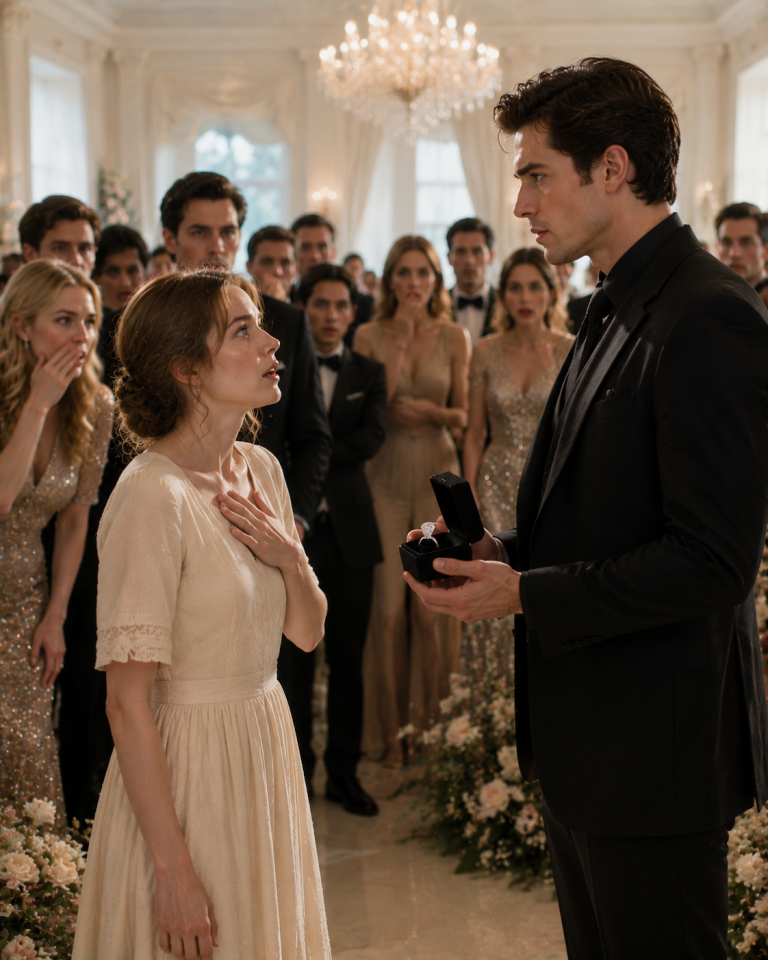
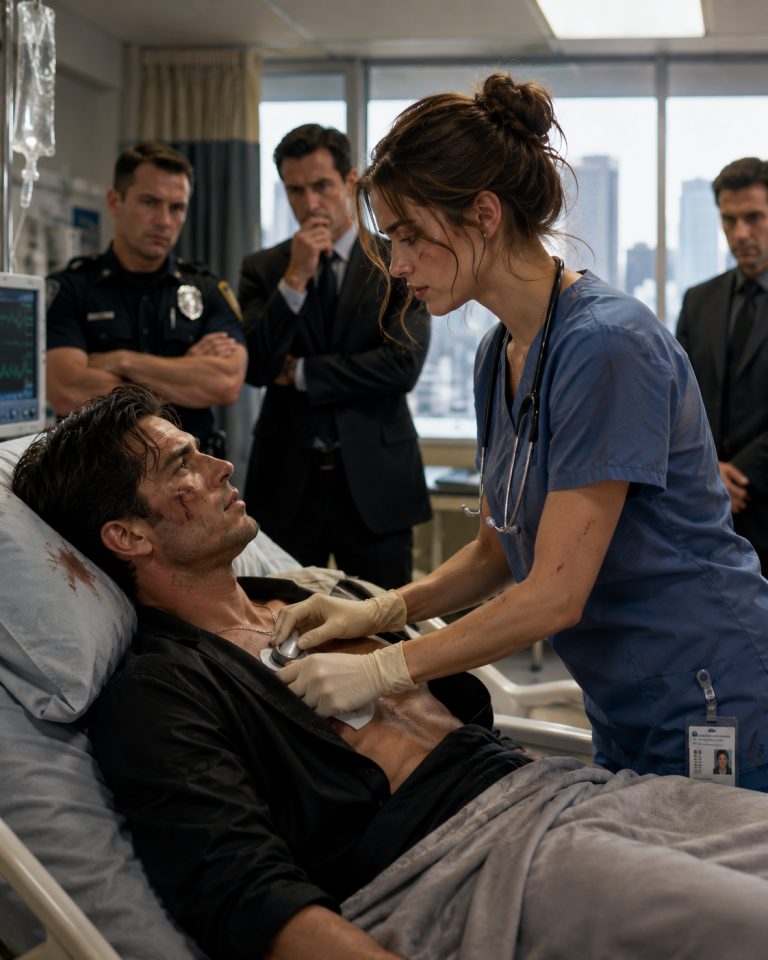
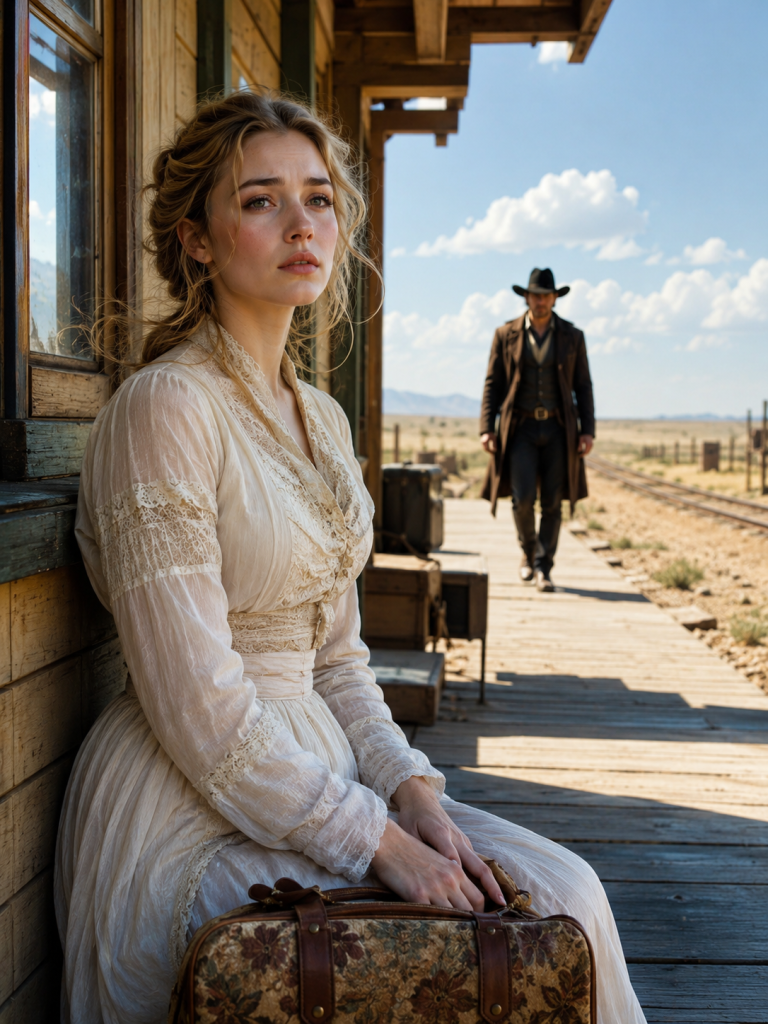
She Dropped the Ultrasound—The Mafia Boss’s World Changed in an Instant

## PART 1
I kept the scan folded in the inside pocket of my coat for eleven days before I dropped it.
Not figuratively. Literally dropped it — watched it slide out of my fingers in a hospital parking garage at nine in the evening, skid across wet concrete, and come to rest against the shoe of the man I had spent eleven weeks trying to forget.
That’s how Matteo Ferrara found out he was going to be a father.
Not over coffee. Not with a carefully prepared conversation. Not in any version of the moment I had rehearsed in the hospital break room while pretending to eat lunch.
He found out the same way he found out most things, I would later understand: by watching something arrive at his feet and deciding what it meant before anyone else had the chance to explain it.
Let me go back.
My name is Sera Park, and three months before that parking garage I was assigned to a private medical suite at the Ferrara Foundation gala as part of the hospital’s donor outreach program. The reasoning, according to my supervisor, was that I had the sort of face that reassured people. What she meant was I did not look like I judged anyone, which was true, and which has been both my greatest professional strength and the source of most of my personal disasters.
I had heard the name Ferrara the way everyone in this city had heard it — attached to shipping companies, construction projects, political donations, and the occasional rumor that moved faster than the truth and always arrived without a return address. I knew what the name meant the same way I knew what bad weather meant: something to be aware of, not something to stand directly in front of.
I was standing directly in front of it within forty minutes of arriving.
He came into the suite with a laceration on his left hand and two men behind him who looked like they had been assembled from the concept of consequences. The cut was real, not deep, the kind of thing that bled more than it deserved to.
“It’s nothing,” he said.
“Then why are you here?” I said, and pulled on my gloves.
One of the men behind him shifted. He himself looked at me with what I would later identify as genuine surprise — the brief, involuntary kind that happens when someone responds to you in a way you did not anticipate.
He sat.
I worked.
He watched me with the particular quality of attention that powerful men sometimes had, the kind that was not flirtation but felt like being read in a language you didn’t know you’d been written in.
“You’re not nervous,” he said.
“You’re bleeding on my equipment,” I said. “Hold still.”
He held still.
After the hand was cleaned and bandaged, he did not leave immediately. A conversation began, the way conversations between two people with no business talking sometimes did — gradually, then all at once, finding its own momentum before either person had consented to it.
There was a second conversation near the service entrance. A third on a narrow balcony above the river where rain had started and he put his jacket over my shoulders without asking, and I did not give it back, and by the time the city blurred gold and black below us there was a warmth between us that had no business existing.
I had not made a mistake like that since I was twenty-three.
I left before dawn. I changed my work schedule. I told myself that men with that kind of name and that kind of silence forgot women like me before the coffee cooled.
I was wrong about all of it.
Eleven weeks later I was sitting in the hospital break room at the end of a shift that had included one traumatic injury, two long-term patients declining in ways that kept the ward quiet with a specific kind of grief, and a prenatal confirmation from Radiology that I had been carrying in my pocket since I picked it up that morning.
Twelve weeks.
I sat with the image in my hands and looked at the thing that was no longer a secret just because I hadn’t told anyone.
Then I put on my coat and went downstairs.
—
The parking garage at St. Agatha’s smelled like exhaust and damp concrete. My shift bag was over one shoulder. My hands were shaking slightly, which I attributed to not eating since noon and refused to examine further.
I was halfway to my car when the black vehicle rolled alongside me.
The window came down.
The man inside was not Matteo Ferrara. He was someone I’d never seen before — careful face, dark coat, the particular stillness of a person whose job required absolute reliability.
“Ms. Park.”
My stomach dropped.
“Mr. Ferrara would like to speak with you.”
“I don’t think so,” I said.
He was already opening the rear door.
And Matteo Ferrara was already stepping out of it.
He looked exactly as I remembered. Dark coat, quiet face, eyes that moved over me with the swift and thorough assessment of someone who had learned early that the information you gathered in the first three seconds of a situation was usually the most honest.
I stepped back.
The scan slipped.
I watched it fall as though time had decided to take a break — watched it slide across the concrete and stop against the toe of his shoe. Watched him look down. Watched him go completely still.
He bent slowly and picked it up.
His eyes moved across the page.
Name. Date. Measurements.
Gestational age: twelve weeks.
When he looked up, Matteo Ferrara — the man I had heard described in the same breath as flooding, pestilence, and federal investigations — looked like something inside him had split cleanly along an old fault line.
“The gala,” he said.
I could not speak.
“Sera.” My name, the way he said it, landed differently than I expected. Not a command. Something almost careful. “Is it mine?”
I should have said something composed.
Instead I said: “You think I make a habit of this?”
He absorbed that.
“No,” he said quietly. “That is not what I meant.”
A long second.
“Yes,” I said. “It’s yours.”
And in the overhead fluorescence of a hospital parking garage, the city moving obliviously outside, Matteo Ferrara looked at the scan in his hand with an expression I could not have named then but would understand completely later: the face of a man realizing that the life he had organized entirely around surviving was going to have to make room for something else.
His driver spoke low and urgent beside him.
Matteo’s eyes lifted.
His body changed — the way weather changed, all at once.
“Get in the car,” he said to me.
“No—”
“Sera.” His voice dropped. “Please.”
Headlights swept the garage entrance.
Wrong kind. Moving too fast.
Then the first shot shattered the night.
—
## PART 2
Everything happened in a sequence that my trauma training processed before my fear did.
Shot. Concrete chip near my left foot. Matteo’s arm across my chest driving me sideways behind the vehicle’s bulk. His driver drawing a weapon so fast the motion seemed edited out. A second shot, then a third, ricocheting off the pillar behind us with a sound like a struck bell.
I was against the rear panel of the car with Matteo’s body between me and the direction of fire.
“Move,” he said.
We moved.
The driver held position, returning fire with terrifying precision, and in the forty seconds it took to reach the far stairwell exit I understood viscerally the difference between the man I had stitched up at a charity gala and the man crouching beside me now.
The gala version had been controlled, curious, unexpectedly warm.
This version was someone who had survived violence often enough that his body did not need instructions.
We took three turns through the structure’s lower level, emerged into an alley, and were inside a second vehicle — one that had not been there before and which I had not seen arrive — within ninety seconds.
I sat in the backseat in my damp coat with the scan still folded in Matteo’s coat pocket and tried to assess my condition the way I assessed patients.
Elevated heart rate. Shaking hands. No pain. No blood.
The baby was fine.
I pressed my palm flat against my coat.
The baby was fine.
“Who was that?” I asked.
Matteo looked at his phone. “I don’t know yet.”
“You don’t know?”
His eyes met mine. “That’s what ‘I don’t know yet’ means.”
I wanted to be furious. The fury was right there, entirely justified, ready to go.
But he was also still holding the scan.
And he had put himself between me and the gunfire without hesitating.
“Someone found out,” he said.
“Found out what?”
He looked at me directly.
“About the pregnancy.”
Ice moved through me. “That’s not possible. I haven’t told anyone.”
“Someone has been watching you for longer than tonight.”
The car was moving fast through side streets, rain coming harder now against the windows.
“For how long?” I whispered.
“Weeks, we think.”
Weeks.
While I slept. While I worked. While I bought the test and sat in the bathroom of the break room and looked at the result for so long the timer on my phone went off.
“Why?” I asked. Though part of me already understood.
Matteo folded the scan carefully — not crumpling, not carelessly, the way you fold something you intend to keep — and looked out the window.
“Because in my world,” he said, “a child is not just a child.”
He paused.
“A child is leverage. Or a target. Depending on who’s watching.”
And in the front seat, his driver received a call, spoke three words in Italian, and went silent.
Matteo turned.
“They have your mother,” he said.
—
## PART 3
The drive north took three hours.
I spent the first one in silence, which I needed, and the second one asking questions, which I also needed, and the third looking out the window at snow that had started somewhere past the city limits and was now falling in the particular thick and indifferent way of weather that did not know or care what it was covering.
Matteo answered most of the questions. Not all of them. The ones he didn’t answer he indicated with a particular stillness — not evasion exactly, more like the pause of a man who understood that some information, shared too early, did more harm than it prevented.
I was not sure I believed that.
But I noted it.
What I understood by the time we reached the cabin, which sat on the edge of a frozen lake behind a treeline so dense it felt like another country, was this:
A man named Rykov — not Italian, not connected to Matteo’s world by blood but by competing territory — had been building a case for months that Matteo was responsible for the disappearance of Rykov’s associate. The case was wrong. The evidence was manufactured. But manufactured evidence in that world, Matteo explained with the flat tone of someone describing weather, was often as effective as real evidence in terms of what it produced.
What it had produced was a decision to use me.
“He found out about the baby,” Matteo said. “Before I did.”
“That’s—” I stopped. “Someone told him.”
“Yes.”
“Someone from your side.”
The word *side* felt wrong in my mouth, like wearing someone else’s coat.
Matteo’s jaw tightened. “Yes.”
I filed that away for later.
The cabin itself surprised me.
I had expected something fortress-like, all angles and surveillance. Instead it was large and unexpectedly livable — dark wood, deep chairs, a fireplace that the driver, whose name I learned was Marco, had running within ten minutes of our arrival. A kitchen stocked with actual food. Books on a shelf that someone had clearly read, judging by the state of the spines.
A place where someone had once tried, with varying success, to do something other than plan.
Marco checked the structure and the perimeter and disappeared to a separate outbuilding without being told.
Matteo and I were alone.
I stood near the window watching snow accumulate on the dock and thought about my mother, who was sixty-one years old and grew herbs in small pots on her kitchen windowsill and did the crossword in pen because she said pencil was for people who expected to be wrong.
She had absolutely no business being anywhere near this.
“Tell me what you know,” I said.
Matteo poured two glasses of water — not whiskey, which surprised me — and placed one on the table beside me.
“Marco’s team found the vehicle that took her. She was not harmed when they last confirmed her location.”
“When was that?”
“Forty minutes ago.”
“That is not reassuring.”
“No,” he said. “It isn’t.” He sat, which he had not done since the garage. “But Rykov is not interested in harming her. She is only valuable to him in the condition in which he took her.”
“You don’t know that.”
“I know Rykov. He is methodical. He uses leverage carefully because he understands it depreciates the moment it’s damaged.”
I stared at him.
“You’re telling me my mother is safe because the man who took her is too strategic to hurt her.”
“Yes.”
“That’s the least comforting sentence in the English language.”
His mouth moved slightly. “I know.”
We sat with the fire and the snow and the particular quiet that forms around terrible things when they’ve been acknowledged and haven’t yet been resolved.
Then I asked the question I had been holding since the parking garage.
“Who told him about the baby?”
Matteo looked at the fire.
“My cousin Nico.”
I waited.
“He has been with my organization since we were teenagers. He is—” A pause, the kind that carried weight. “He has wanted control of the operation since my uncle died and I was given it instead.”
“And the baby.”
“Made me, in his calculation, vulnerable.”
“He was trying to get you killed.”
“He was trying to get both of us killed,” Matteo said, “and inherit what was left.”
I looked at my hands.
“He didn’t know about my mother.”
“No. That was Rykov’s addition. Rykov found out through Nico and then decided to expand the leverage.” His voice was careful, controlled. “That was not something Nico planned.”
“Does that matter?”
Matteo looked at me.
“No,” he said. “Not particularly.”
—
I did not sleep that night.
Around two in the morning I found Matteo standing at the back window looking out at the frozen lake. He had his jacket off, which made him look simultaneously more and less dangerous. His hands were in his pockets.
I made tea, because it was the only thing I knew how to do in an unfamiliar kitchen that would produce something useful, and I brought two cups to the window.
He took one without comment.
We stood side by side and watched the snow.
“Tell me something true,” I said.
He looked at me.
“About yourself,” I said. “Not strategy. Not information. Something real.”
A long pause.
“My father died when I was seventeen,” he said. “He built everything I inherited and he died protecting it, which I understood as a child to mean that some things were worth dying for. It took me until about four years ago to understand that what he actually proved was that some things were not worth building.”
I turned my cup in my hands.
“Then why are you still in it?”
“Because leaving a structure like this, if it’s done carelessly, doesn’t end it. It fractures it. And fractured power in my world is more dangerous than consolidated power.” He looked out at the lake. “I’ve been trying to do it carefully.”
“How long?”
“Three years.”
I looked at him.
“And now?”
Something moved through his face.
“Now there’s a reason to move faster.”
The fire popped behind us.
I thought about twelve weeks. About the scan folded in his pocket. About a baby who had not asked to arrive inside a situation like this and whose arrival had, somehow, reoriented the entire landscape.
“I need you to get my mother out,” I said.
“Yes.”
“Before anything else happens. Before whatever you’re planning. Before—”
“Sera.” Quiet. Absolute. “I know.”
He turned to look at me, and in the low lamp light with snow moving outside and the fire behind us, he looked like a man standing at the edge of a decision he had been approaching for years.
“I found you,” he said, “because I needed to know you were safe. That was three weeks ago. I did not approach immediately because—” He stopped. “Because I was trying to figure out what I could offer that was worth your risk.”
I stared at him.
“You’ve been watching over me for three weeks.”
“Yes.”
“Without telling me.”
“I was trying to end the threat before it required involving you.”
“That is—” I started to say *insane* and stopped, because something about the way he said it landed differently than it should have. Not controlling. Not possessive. Careful, in the particular way of someone who understood exactly how little they had the right to ask for.
“You should have told me,” I said instead.
“Yes,” he said. “I should have.”
No defense. No explanation of why he hadn’t. Just the admission, clean and unadorned.
I was not prepared for how much that mattered.
—
At dawn, Marco came back with three other men I didn’t recognize. Matteo met them in the main room and the conversation was in Italian, quick and low, and I did not understand most of it except for my mother’s name, which appeared twice, and the word *domani*, which I understood from one year of college Italian to mean *tomorrow.*
Afterward Matteo found me in the kitchen.
“Her location is confirmed,” he said.
“Is she okay?”
“She has been treated respectfully. She has food and heat and has apparently been arguing with the men guarding her about the correct way to brew coffee, which Marco says is going extremely poorly for the guards.”
I laughed before I could stop myself.
Then I pressed the heel of my hand to my mouth.
“That is exactly what she would do,” I said.
Something in Matteo’s expression shifted — a brief, involuntary warmth that came and went so quickly I almost missed it.
“The exchange happens tomorrow evening at the harbor,” he said. “Rykov releases your mother in exchange for my appearance at a meeting he’s arranged.”
“And what happens at that meeting?”
“That depends on what we bring to it.”
He explained the rest of it over the next hour, and what he explained was this: Nico had made a deal with a federal prosecutor — not because he believed in anything except his own survival, but because the combination of federal immunity and Rykov’s backing had seemed, to him, like a more stable foundation than continued loyalty.
He was wrong.
The evidence he had offered the prosecutor was real, but incomplete. And the pieces he had kept back — believing they gave him leverage over both sides simultaneously — had a location. A physical location. A set of files in a property that Matteo’s organization controlled but that Nico had accessed three weeks ago without authorization.
“You knew he’d been in there,” I said.
“I suspected. Now I know.”
“You’ve been waiting for him to commit fully.”
Matteo looked at me with the expression of someone who was not accustomed to being followed that quickly.
“Yes,” he said.
“So tomorrow night at the harbor, Rykov brings my mother and expects you to walk into a situation where you’re either arrested or killed.”
“Yes.”
“And instead.”
“And instead we bring the files Nico sold us out to protect. We present them to the prosecutor — who is, it turns out, operating without full knowledge of what Nico withheld. We make it clear that Nico’s deal was built on incomplete information and that his value to the federal case is significantly lower than represented.”
“That unravels his immunity.”
“Enough of it.”
“And Rykov?”
Matteo’s voice went very even. “Rykov loses his inside source. His leverage over me disappears. And the associate he believes I eliminated—” A pause. “—will be confirmed alive through a third party tomorrow morning. Which is something I could not do until now without revealing where he’d been hidden.”
I processed this.
“He’s been alive the whole time.”
“Yes.”
“And you’ve been protecting him from Rykov by letting Rykov believe you killed him.”
“It was the fastest way to remove him from danger.”
I looked at the man across from me — the dangerous one, the one in the headlines, the one everyone in this city had an opinion about — and thought about what it meant to protect someone by making yourself look worse than you were.
“Your cousin thought you were capable of killing your own associate,” I said.
“Most people do.”
“Are you?”
He met my eyes.
“I have been,” he said. “I am trying, with varying success, not to be anymore.”
The honesty was so unguarded it felt almost reckless.
I put my cup down.
“Okay,” I said.
He waited.
“Tell me what you need me to do tomorrow.”
—
The harbor smelled like salt and iron and the particular cold of water that had stopped moving.
Snow had stopped falling but the ground held it, piled against the cargo containers and the dock equipment, reflecting the weak light from the overhead floods in streaks of gray and white. I stood inside a heated vehicle two hundred meters from the exchange point with Marco and a woman named Giulia who had appeared at the cabin at four in the afternoon and whose precise role I had not asked about and did not need to.
Matteo was somewhere in the dark ahead.
Nico was also somewhere ahead.
I watched through the windshield and tried to breathe slowly.
My mother.
I needed to see her and then I needed everything after that to become someone else’s problem for at least forty-eight hours.
The exchange point was a cleared area near the water, lit by portable floods that Rykov’s people had set up, which Marco said was a mistake because it meant their own eyes had adjusted to the light and the dark around them would be full of things they couldn’t see.
At seven-fifteen, two vehicles arrived from the east.
Rykov’s.
A third arrived from the north.
Matteo emerged from the shadow line and walked toward the center of the lit area with two men flanking him and the specific deliberate calm of someone who had chosen the pace of this approach very carefully.
Rykov stepped forward from his vehicles.
He was older than I’d expected. Silver-haired. The kind of composed that came from having survived long enough that surprise had become merely interesting.
They spoke. I could not hear it.
Then a rear door opened.
My mother stepped out.
She looked, from two hundred meters and through fogged glass, entirely unharmed and specifically irritated, which meant she was fine.
I pressed my hand against the window.
Then the third vehicle opened.
Nico Ferrara stepped out.
He was younger than Matteo. Same dark coloring, different quality — where Matteo moved with precision, Nico moved with the restless energy of someone who had always believed the world owed him a faster answer.
He looked toward Matteo and something crossed his face that I was too far away to read.
A federal vehicle appeared at the harbor entrance.
Nico froze.
A woman in a dark coat stepped out and walked toward the lit area with three agents behind her.
The prosecutor.
Marco spoke quietly. “She received the files forty minutes ago.”
Which meant the immunity deal Nico had been operating under was currently experiencing a structural problem.
What happened next happened quickly.
Nico understood before Rykov did. He turned, and I saw in the movement of his body the specific calculation of a man who has just realized that the exit he planned is no longer there.
He ran for the dock edge.
Matteo moved at the same time, not toward Nico but toward my mother, putting himself between her and Rykov’s men, his hand going to her arm and directing her toward Marco who had already emerged from our vehicle.
My door opened.
I was running before I made the decision to.
My mother turned at the sound of my footsteps and her face — the face I had been seeing in every unguarded moment for three weeks, imagining harm coming to it — crumpled into the most overwhelming relief I have ever witnessed.
I reached her and held on.
She held back.
Behind us, Rykov’s men lowered their weapons one by one as the federal agents spread out across the dock. Rykov himself stood with the expression of a man doing rapid cost-benefit analysis and arriving at an unpleasant conclusion.
At the dock edge, Nico had run out of dock.
He stood at the end of it with the water behind him and Matteo in front of him and a choice that had already been made by the events of the last three hours.
Matteo stopped ten feet away.
They looked at each other.
I could not hear what was said.
But I saw Nico’s face, and what was on it was not calculation anymore.
It was grief.
The particular grief of someone who has just understood that the thing they destroyed in reaching for something else was the only thing that had actually mattered.
He lowered his hands.
The agents came forward.
—
Matteo found me and my mother near Marco’s vehicle.
My mother looked at him with the expression of a woman who had spent three days being guarded by men she had systematically demoralized and was now assessing the source of her situation.
“You’re him,” she said.
Matteo’s eyes moved briefly to me. “Yes.”
“My daughter has been alone for a long time,” she said.
“Mom—”
“I’m speaking.” She looked at Matteo. “Whatever you are and whatever this is, that’s the one fact that matters.”
Matteo was quiet for a moment.
“I’m aware of that,” he said.
My mother studied him the way she studied crossword clues she wasn’t sure of.
Then she said: “The baby is healthy?”
“As far as we know,” I said. “Yes.”
She looked at Matteo again.
“You have a lot to account for,” she said.
“Yes,” he said. “I do.”
She seemed to decide something.
“Then start accounting,” she said, and got into Marco’s vehicle.
I stood beside Matteo on the harbor dock with the federal activity behind us and snow resuming in thin, tired sheets from a sky that had run out of energy for drama.
“She’s terrifying,” he said.
“Yes.”
“I like her.”
“Don’t tell her that. She’ll find a way to use it.”
A brief, real laugh from him, the kind that caught you off guard the same way his had at the gala.
I looked out at the dark water.
“What happens now?” I asked.
He stood beside me without touching, which I noticed, and which felt like a question being asked very carefully.
“That depends on what you want to happen,” he said.
I turned to look at him.
He looked back.
Not demanding. Not managing. Just honest, in the way I was beginning to understand he was capable of when he chose to be — which was not always, and not easily, but when it came it was completely real.
“I need you to tell me what you actually want,” I said. “Not what’s strategic. Not what protects the organization. What you want.”
He held my gaze for a long moment.
“To be present for this,” he said. “For the baby. For whatever comes with it. Honestly and without conditions.”
“You’d be giving up a great deal.”
“I’ve been trying to give it up for three years. I was looking for a reason that was sufficient.” He paused. “I have one now.”
“A baby is not a reason to rebuild a life.”
“No,” he said. “You are.”
The harbor was cold and noisy and nothing about any of this was simple or clean or the kind of story that people told when they described how things were supposed to go.
But I thought about the gala and a man who held still while I worked and asked my name and laughed at something I said like he’d forgotten laughter was a thing available to him.
I thought about eleven weeks of carrying a secret that had been getting heavier every day.
I thought about my mother arguing with guards about coffee, which was, I recognized, her form of refusing to be afraid.
I thought about the way Matteo had put himself between me and the gunfire without calculating whether it was worth it.
“Okay,” I said.
He waited.
“Start from the beginning,” I said. “Tell me everything I don’t know. All of it.”
“That will take a long time.”
“I’m not going anywhere tonight.”
The snow came down between us, and the harbor lights caught it, and somewhere behind us a federal agent called out an instruction in a voice that meant things were being processed and accounted for, and the machinery of consequence was doing its slow and necessary work.
Matteo turned toward me and began to talk.
—
Six months later, spring arrived in the usual way it arrived in this city — reluctantly, then all at once, the lake suddenly blue instead of gray, the trees deciding overnight to be serious about it.
I was sitting on the porch of a house in a neighborhood I would not have predicted six months ago, reading something I could no longer fully concentrate on because concentration required a baseline level of sleep that a three-week-old daughter had decided was optional.
Inside, Matteo was attempting to assemble furniture.
I could hear him because he was not attempting it quietly.
“The instructions are wrong,” he said, appearing in the doorway.
“The instructions are in four languages. One of them is correct.”
“None of them describe the component currently in my hand.”
I put my book down. “Show me.”
He showed me. I looked at the component. I looked at the diagram.
“That goes on the other side first,” I said.
“That is physically impossible given the—”
“Matteo.”
He looked at me.
“It goes on the other side first.”
He looked at the component for a long moment.
Then he went back inside.
From the interior came the sounds of successful assembly, followed by a silence that meant it had worked, and Matteo was not going to comment on it.
The baby had his coloring — dark hair in the soft, impractical abundance of newborns, which I had already been informed by my mother would require management. She had his hands too, which were small and complete and which curled around my finger with a grip that seemed disproportionate to her size.
She had, it turned out, both our stubbornness, which meant the future was going to be interesting.
The organization was in its third year of a transition that was, as Matteo had said, neither clean nor fast, but was ongoing and real. The harbor deal had accelerated certain things. The federal cooperation — which was extensive, and which Matteo had pursued with the systematic thoroughness he brought to everything — had changed certain balances in ways that took time to settle.
Nico was in federal custody.
Rykov had retreated to a position of cautious non-engagement, which was, apparently, a diplomatic outcome.
Marco had been given expanded responsibilities that he accepted with the same complete absence of visible enthusiasm that he brought to everything, which Matteo said meant he was satisfied.
My mother visited every Sunday and spent approximately forty percent of each visit arguing good-naturedly with Matteo about things that did not require argument and the other sixty percent holding her granddaughter with an expression that made me understand, in a new way, what it meant to her that I had not been alone for a long time and was no longer.
Matteo came back onto the porch.
He had flour on his sleeve, which was from the previous evening’s experiment, and the furniture dust, and the general evidence of a person learning, with varying success, how to occupy a domestic space.
He sat beside me.
We watched the street.
“The scan is framed,” he said.
I turned. “You had it framed?”
“It’s on the wall in the hallway.” A pause. “Was that wrong?”
I thought about a scan falling in a hospital parking garage and coming to rest against a stranger’s shoe. About eleven weeks of carrying something alone that was not meant to be carried alone. About the specific quality of being seen by someone who chose to look carefully instead of quickly.
“No,” I said. “That wasn’t wrong.”
He put his arm around me.
Inside, our daughter made a sound that was not quite crying — the exploratory kind, testing whether the world would respond, discovering that it would.
Matteo was already standing.
I watched him disappear inside to answer her, and thought about how sometimes the most dangerous men were not the ones the newspapers wrote about.
Sometimes the most dangerous thing was watching someone become something you hadn’t expected.
Something worth staying for.
—