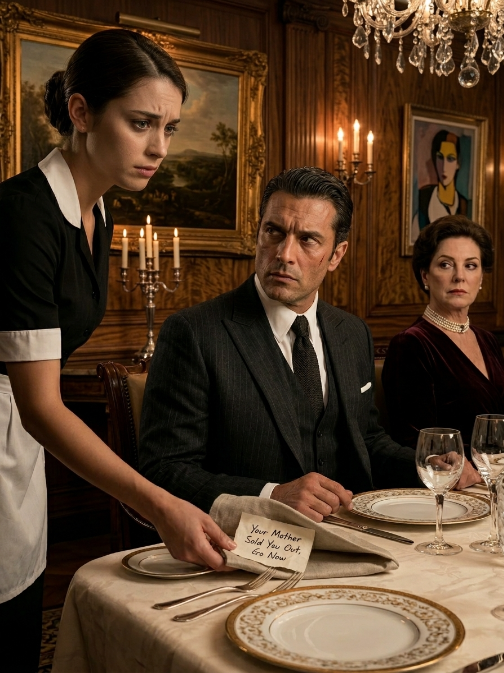
The Mafia Boss’s Dog Dragged Home a Dead Puppy—What the Maid Did Next Stunned Everyone in Chicago

PART 1
There is a particular kind of grief that lives in your hands.
Not metaphorically. Literally — in the muscle memory, in the way your fingers move when they remember something they were trained for and no longer do. Sloane Adeyemi had known that grief for six years. She felt it most in quiet moments: folding linen, scrubbing tile, pressing flat against polished marble the kind of work that requires nothing of a person except their presence and their willingness to disappear.
She had been many things before she became a night-shift housekeeper.
She had been a second-year veterinary resident at the University of Washington. She had been her father’s daughter, which had felt like the most permanent fact about her until the morning it stopped being true. She had been someone with a future that had a specific shape — white coat, exam table, the particular satisfaction of a living thing leaving your hands in better condition than it arrived.
Then her father, Detective Joseph Adeyemi, didn’t come home from a Thursday night shift.
Then the hospital bills for her mother’s grief-turned-illness began arriving with the regularity of bad weather.
Then the residency had to pause, and then the pause extended, and then six years passed without her quite deciding to give up — it had happened too gradually for a decision, more like a tide going out while she was looking somewhere else.
Now she cleaned a Seattle waterfront estate between midnight and five, moving through rooms that cost more than her father’s entire pension, and the grief in her hands had nowhere to go.
She was on her knees wiping the kitchen floor when the door to the service corridor swung open.
Atlas came through it at a pace that told her something was wrong before she saw what he was carrying.
He was enormous. A Cane Corso with a chest like a barrel and a face that had broken its nose at least once in a life that had clearly involved serious incident. The guards on the eastern perimeter gave him a ten-foot margin when they could manage it. The morning cook had once dropped an entire pan of roasted potatoes simply because Atlas appeared in the doorway and made eye contact.
He was carrying something gently between his teeth.
Sloane’s cleaning rag went still.
Atlas crossed the kitchen and lowered himself to the tiles with the deliberate care of something enormous trying not to break what it holds. He set the thing at her feet.
A puppy.
Newborn. Dark, nearly black, impossibly small. Its eyes were sealed. Its chest was not moving.
Atlas looked at her.
She had never been the person he looked at. She had been furniture — useful, present, peripheral to his actual concerns. The kitchen staff, the guards, the man who occupied the locked upper wing of this house: those were the things Atlas oriented around.
But he was looking at her now with an expression she recognized, had seen it in animals her whole shortened career — the specific desperation of a creature who understands that what needs to happen is beyond what it can do, and has chosen to bring the problem to hands it believes in.
*He chose me.*
She was on the floor before the thought finished forming.
“Okay,” she said, to the puppy, to Atlas, to the kitchen, to the six years of silence in her hands. “Okay. Let’s go.”
She grabbed a clean dish towel from the second drawer. Cleared the puppy’s airway first — there was fluid, she moved it. The puppy’s color was wrong, too pale, the gums bluing at the edges.
Compressions. Two fingers on a chest smaller than her palm. Breath. Careful, barely a breath, just enough to lift that tiny chest.
Atlas pressed against her side.
He was warm against her shoulder, enormous and utterly still, and she could feel him breathing as she worked — in, out, in, out — like he was trying to match her rhythm, like he understood that what she needed was for something else in the room to keep going.
“Come on,” she whispered. “You already made it this far.”
Compressions. Breath. Compressions. Breath.
Her wrists ached. The tile was cold through her uniform trousers. The kitchen clock read 2:14.
Then, at 2:18, beneath her fingertips: a flicker.
She stopped pressing and waited.
There.
A heartbeat. Threadbare, unsteady, real.
The puppy made a sound — not a cry exactly, more like a question, the thin uncertain sound of something testing whether the world was worth entering — and then it inhaled on its own, chest rising without her help for the first time.
Sloane pressed the back of her hand against her eye socket and made herself keep breathing.
Atlas lowered his head and touched the puppy with his nose. Then he turned and pressed his forehead very gently against Sloane’s hand, not demanding anything, not commanding — just making contact.
She named the puppy Ember. Because on the kitchen floor at 2:18 in the morning, something that had nearly gone dark had found its way back to heat.
She did not know anyone had seen her until she heard the footsteps.
Cael Farrow stood in the kitchen doorway.
She had worked in his house for four months. She had seen him twice, both times at distances that kept him safely abstract — a tall, dark-suited figure moving through a corridor, the quality of stillness that surrounded him less like calm and more like the surface of deep water.
Now he was ten feet away, looking at her kneeling on his kitchen floor with a newborn puppy wrapped in a dish towel against her chest and his dog’s head pressed against her hand.
His face was the controlled kind. The kind that took years and reasons to build.
But she watched something move through it when he looked at Ember.
“She was still,” Sloane said, before he could speak. “She’s breathing now, but she needs warmth and monitoring. The colostrum window is narrow — she needs to nurse within the next few hours or we supplement.”
Cael looked at her hands.
Then at Atlas.
Atlas’s tail moved once — not the energetic wag of a dog performing happiness, but the slow, deliberate acknowledgment of a dog communicating something true.
Cael crossed the kitchen, opened the coat he was wearing, and placed it over Sloane’s shoulders.
She flinched at the warmth.
Only then did she realize she was shaking.
He walked out without a word.
Sloane sat on the kitchen floor until Ember’s breathing steadied into something like confidence, Atlas beside her, the borrowed coat around her shoulders smelling of cedar and expensive restraint.
She did not know that upstairs, Cael Farrow had opened his staff directory for the first time in his tenure as owner of this house and looked up her name.
She did not know that by morning, his lieutenant Nolan would have a file on her.
She did not know what that file would find.
What she knew was that her hands had remembered something. That the muscle memory had returned, as her old professor used to say it always would, not like a door reopening but like a light coming back on — instant, complete, as though it had never really been off at all.
She held the puppy and felt, for the first time in six years, like herself.
—
PART 2
He tripled her pay before she finished her shift.
Nolan told her at seven in the morning, standing in the corridor outside the utility room with the expression of a man relaying information he found surprising but not unwelcome.
“The dog quarters,” he said. “Your own room. The litter and Sable need daily monitoring, and the vet visits need someone who can hold a conversation with the doctor afterward rather than just pass along notes.”
Sloane looked at him.
“What’s the catch?”
Nolan’s expression didn’t change. “There isn’t one.”
“There’s always one.”
“Not this time.” He paused. “He said to tell you the gate stays open. That if you’d rather leave, the car can take you anywhere.”
She thought about her apartment, the debt, the monthly payment on the loan she’d taken out two years ago when her mother’s care escalated. She thought about the residency application she’d been putting off starting for three years because starting meant believing it might work.
She thought about Ember’s heartbeat under her fingers.
“I’ll stay,” she said.
The house learned to include her.
Sable and the pups thrived. Ember was the smallest and needed the most work, but she was also the most insistent about surviving, which Sloane found, privately, inspiring. Atlas began waiting outside Sloane’s door each morning. He would not let the new veterinary assistant — a kind, competent young man named Patrick who came Tuesdays and Thursdays — examine Ember without Sloane present.
Cael started appearing in the evenings.
Not dramatically. Just in the doorway, asking specific questions in the tone of a man who wanted the truth rather than reassurance.
*How much did Ember take?*
*Is Sable rested?*
*Atlas favored his left side this morning.*
Sloane gave him straight answers. The house was full of people who adjusted their responses based on his expression; she had decided early that this was something she could not afford to do, because her value here was in being accurate, and accuracy required not caring about the shape of his face when she delivered bad news.
He seemed to understand this. Perhaps to prefer it.
She noticed he stood differently when he came to the dog quarters than he did anywhere else in the house — slightly less held together, shoulders an inch lower, the controlled posture relaxed into something that looked, not warm exactly, but less sealed.
Then Declan arrived.
He came on a Tuesday in a car he drove himself, which no one in this house did unless they wanted to make a point. He had Cael’s bone structure but wore it differently — lighter, sharper, the face of a man who had chosen to be charming as a strategy rather than as a condition.
Sloane saw him from the window.
She had learned the language of this house well enough to read what the guards’ body language was saying: present, acknowledged, not entirely welcome.
That evening, behind a closed door two floors up, he asked about succession.
Cael told him it would be Nolan.
Declan left the next morning.
On his way out, he stopped at the dog quarters.
Atlas rose.
Sloane did not move from where she was standing.
Declan looked at her with the particular attention of someone cataloguing usefulness.
“Sable’s litter?” he said.
“Yes.”
“Which one’s the runt?”
Sloane said nothing.
He smiled and left.
She watched him go and felt something cold settle into the base of her spine — not fear exactly, more like recognition. She had worked at the bottom of enough hierarchies to know the look of someone deciding what they could use.
That night, she checked Ember’s weight twice.
Three nights later, at 3 a.m., Atlas began scratching at Sloane’s door.
She smelled it before she crossed the kennel threshold.
Something sharp beneath the ordinary scent of the room. Chemical. Wrong.
Atlas was collapsed against the far wall. Not sleeping — collapsed. His legs were rigid, his jaw working against nothing, drool at the corners of his mouth. His eyes were open and clouded, tracking nothing correctly.
Ember was pressed against him, crying.
Sloane moved without deciding to.
She cleared his airway, positioned him so he wouldn’t aspirate, got what she had into him while calling through the intercom for Nolan — three words, flat and fast: *dog quarters, now* — and then stayed with her hands on Atlas and refused to consider any outcome except the one where he was alive in an hour.
Nolan arrived and understood in four seconds.
He made two calls.
The second one brought Cael.
He came down the service stairs and walked into the room and saw Atlas on the floor, and something happened to his face that he couldn’t entirely control. It was only a moment. One crack in the architecture before it sealed again.
He knelt beside the dog.
Atlas’s tail tapped the floor twice.
It was very quiet in that room.
Cael stayed on his knees.
Sloane had never seen him do that before. She had never seen him at anything below standing. Watching it — watching him press his hand against the thick fur of Atlas’s neck and stay there — she understood something about the house, about the controlled silences and the locked corridors and the particular exhaustion of a man who had spent years believing that everything worth protecting had to be protected alone.
When the veterinarian confirmed what Sloane already knew — poisoned, survived because she’d moved fast — Cael stood, looked at Nolan, and said two words.
*Find out.*
Then his phone rang.
While he was on it, Sloane looked at the food bowl. Smelled it. Found the faint off-note beneath the gravy.
She looked at the window.
She looked at the clock.
Atlas had been the first warning. Which meant someone had removed the warning.
Which meant the next thing on the list was already in motion.
She was out of the dog quarters and up the back stairs before she had time to think it through.
—
PART 3
The east corridor on the second floor was lit only by the emergency strips along the floor — a dim, cold light that made everything look like the inside of a ship. Sloane moved in her socks because the floor was marble and her boots would have announced her from forty feet.
She stopped at the turn.
A figure crouched at the far end of the hallway. Not moving, bent over the door to Cael’s private wing, doing something quiet and sustained to the lock.
Every sensible thought she had said: go back, find Nolan, make noise.
The lock made a sound.
Sloane looked left.
There was a fire extinguisher bracketed to the wall three feet from her.
She thought: *this is a terrible idea.*
She lifted it anyway, pulled the pin, and walked forward as quietly as she could manage.
The intruder pushed the door open.
Sloane aimed and discharged the extinguisher full into his face.
The noise was enormous. White powder exploded across the corridor. The man made a choked, furious sound and went sideways into the wall, hands flying to his face. Sloane kept the nozzle aimed, kept the pressure on until he slid down the wall coughing into the cloud.
Behind her, Cael’s door flew open from the inside.
He looked at the intruder. At the extinguisher. At Sloane, standing in the corridor in her socks and uniform, powder-white from the wrist down, breathing hard.
“Are you hurt?” he said.
“No.”
He looked at the intruder again.
“Go back to the dog quarters,” he said. “Lock it.”
Sloane lowered the extinguisher.
“Sloane,” he said, and it was the first time he had used her name, and the sound of it in his voice was different from the sound of her name in anyone else’s mouth — precise, like he had been holding it carefully for a while and had just now decided to put it down. “Lock the door. Don’t open it for anyone until I knock. Not for anyone.”
She left.
She understood the instruction completely.
A man trying to impersonate Cael would issue an order. He would say *open it* or *it’s safe* or construct some sentence designed to produce the outcome he wanted.
Cael Farrow, she had learned, did not construct sentences. He stated facts.
So she locked the dog quarters, sat beside Atlas, and held Ember against her palm, and listened to the house rearrange itself around what had happened.
By dawn, Nolan had it all.
The intruder worked for Declan. Three people inside the estate had taken money — one drugged Atlas’s food, two disabled cameras and released the side gate. The plan had been simple in the way that simple plans are: remove the dog, enter the room, let Declan walk in at breakfast as the grieving brother who had arrived too late.
The elegance of it was the worst part. It would have worked.
When Nolan finished, Cael said: “I’ll handle Declan myself.”
What happened in that room, Sloane did not witness.
She heard one impact — not repeated, just one — and then silence, and then voices at a low register for a long time, and then the sound of a car leaving the property through the side gate.
Declan did not come back.
Near five in the morning, three slow knocks at the dog quarters door.
Sloane remembered: *not for anyone.*
She stayed still.
The knocks came again. Patient. Not demanding.
She thought about this for a moment. A man who wanted to force the door would not knock at all. A man trying to deceive would knock louder, or add urgency, or call her name in a way designed to produce movement.
These knocks were the knocks of a man who understood she might not open it, and was giving her the choice.
She opened it.
Cael looked like the night had cost him something. His collar was open, his jacket gone. His right hand, at his side, was split across two knuckles.
He looked past her at Atlas.
The dog’s tail moved against the floor.
“It’s done,” Cael said.
Sloane stepped back to let him in.
He crossed to the sink and ran water over his hand, not washing it exactly, just standing with the water moving over his knuckles, the way people do when they need a moment to be somewhere ordinary before they can speak.
Sloane took a cloth from the shelf, ran it under warm water, and brought it to him.
He flinched slightly when she touched his hand.
She cleaned the cut anyway, finger by finger, methodical and gentle.
“Declan,” she said.
“Yes.”
“Your brother.”
“Yes.”
She said nothing else. She folded the cloth and set it on the edge of the sink.
Cael was quiet for a long time.
“He felt passed over,” he said finally. “Fourteen years standing next to me and I never looked at him the way I looked at the work. He thought it was dismissal. I thought I was just—” He stopped. “I thought I was busy.”
“Were you?”
“Yes. That’s not the same as being right.”
She looked at him.
He looked at Ember, asleep in the small woven basket near Atlas’s head.
“She’s stable,” Sloane said.
“I know.”
“You should sleep.”
“I know that too.”
She sat down on the floor beside Atlas. After a moment, Cael sat on the supply bench along the wall, and they were quiet together in the pre-dawn dark, surrounded by the even breathing of Sable and her pups and Atlas and Ember, and the sound of the harbor moving outside.
At some point, Sloane’s hand found Atlas’s neck, and Cael’s hand was already there, and she didn’t move hers, and neither did he.
—
Three weeks later, Nolan placed an unlabeled file on Cael’s desk.
Cael opened it and read it twice.
Then he closed it and sat with it for three days.
The file contained a name: Joseph Adeyemi.
Detective. Homicide. Deceased six years ago.
He had been investigating an operation tied to the Farrow organization. He had been offered a substantial sum to look elsewhere and had declined, filed a supplementary report instead, sent copies to three oversight bodies.
The order to remove him had not come from Cael’s father.
It had come from Declan. Twenty-two years old at the time, trying to prove he belonged in rooms he hadn’t earned. Trying to show the organization that he could handle problems his older brother trusted to other people.
The second document in the file was equally significant.
Cael’s father had found out. Six months before his death, the old man had been building an internal case against Declan — removing him from operational roles, building the paper trail that would eventually justify cutting him out entirely. He had not wanted it to become public, which had slowed him. Then he had died before finishing it.
The half-finished case was in the file too.
Cael sat with this for three days.
He understood the pull toward holding it back — telling Sloane the first part, the part that implicated Declan and was already resolved, and sparing her the secondary pain of knowing her father’s death had been avenged for the wrong reasons, by the wrong people, in the wrong order.
It would have been easy to show her a version that hurt less.
But buried truth, he had lived long enough to know, became something else. It became the thing that grew in the dark between two people until there was no more room for anything else.
He called her to his study on a Thursday evening.
She sat across from him.
He placed the file on the desk between them and told her what it contained before she opened it. Not to soften it — there was no soft version — but because she deserved to hear it from him before she read it in a document.
Sloane read it anyway.
All of it.
When she was done, she pressed both palms flat on the desk and held them there until they stopped trembling.
“How long,” she said.
“Three days.”
“Why three days?”
Cael looked at her steadily.
“Because if I had shown it to you the morning Nolan found it, it would have looked like I was using it to buy something. Like the second document — my father’s attempt to correct what Declan had done — was leverage. A way of saying the Farrow name wasn’t entirely rotten.” He paused. “I needed to sit with it long enough to understand why I was telling you. And the only reason I could find that didn’t involve getting something back was that you deserved to know everything. Including the parts that make my family look worst.”
Sloane was quiet for a long time.
Then she stood, pushed the chair back in with the precise care of someone managing something large inside a small container, and walked to the door.
She paused.
“I’m not ready to talk about what this means,” she said.
“I know.”
“I may not be for a while.”
“I know that too.”
She left.
She packed in ten minutes. One bag. The notebook where she’d tracked each puppy’s weight, she left on the table for whoever came next.
In the dog quarters, she knelt before Atlas and held his face in both hands and pressed her forehead to his.
“Be good,” she told him.
Atlas stayed very still.
She picked up Ember — just for a moment, just to feel the weight of her, solid and warm and breathing on her own — and set her back down.
Then she walked out.
Nolan was at the gate. He said nothing. He nodded to her the way soldiers acknowledge each other, and she nodded back, and got in the car.
The driver asked where she wanted to go.
She gave him an address she had been carrying in her head for six years.
The veterinary school.
—
Two weeks after she left, Atlas stopped eating.
He lay outside the door to her old room at night. He allowed the new caretaker — competent, careful, following Sloane’s notes precisely — to feed the pups, but he would not let her near Ember.
Ghost howled twice in the night on the fifth day, which he had never done before.
Nolan told Cael.
Cael sat on the floor beside Atlas that evening and felt the dog’s head settle against his thigh, and thought about Sloane telling him once that animals grieved as specifically and as uselessly as people did, missing the exact shape of the person who was gone rather than the general category of comfort.
He took out his phone.
He found her because she had not hidden — she had gone back to the place she had always been heading, and her name was already appearing in the reinstatement system of the veterinary school, a name on a list of returning students with an application submitted two weeks ago.
He drove there alone.
No car service. No Nolan.
A small community clinic on the south end of the city, the kind of place with hand-lettered signage and a donation jar on the counter and animals in the back that had been given up on by everyone except the people who worked there.
The bell above the door rang when he came in.
Sloane was at the exam table, suturing the leg of a gray cat with calm economy of movement. She didn’t look up immediately.
“With you in a second,” she said.
Then she looked up and saw him.
She finished the suture before she spoke.
“Atlas,” she said.
“He hasn’t eaten in two weeks.”
She stripped her gloves.
“How much weight?”
“Two and a half kilos.”
She looked at him.
He stood inside the door with his hands at his sides, not approaching, giving her the room to decide.
“I can’t come back to the estate,” she said.
“I’m not asking.”
She studied him.
“Bring him here on Saturday,” she said. “I’ll check him.”
Cael nodded.
He turned to leave.
“Cael.”
He stopped.
“My father stood against what he stood against because it was right,” she said. “Not because of who was watching and not because of who he thought his choices might protect or hurt later. He just did the right thing and went home and thought about it as little as possible afterward.” She paused. “I’ve been thinking about why you waited three days, and I think the honest answer is the one you gave me. That’s not nothing.”
He stood with that.
“Saturday,” she said.
He left.
—
On Saturday, the bell rang at nine in the morning.
Cael came in with Atlas on a lead, and the mastiff crossed the clinic in two strides and pressed his entire head against Sloane’s chest, tail swinging his whole body.
She held him.
Her eyes were closed.
Behind them, Cael let go of the lead and let her have the reunion for as long as she needed it.
Then she helped Atlas onto the table and checked him — gums, eyes, heart, abdomen — her hands moving with the quiet certainty that had never really left them.
And in the strip of morning light at the bottom of the clinic door, Ember lay curled in a patch of sun.
Sloane noticed and looked at Cael.
He offered the smallest shrug. “She wouldn’t stay home.”
The corner of Sloane’s mouth lifted.
—
Months became seasons.
Sloane finished her reinstatement application and began the final year of her residency. She did not return to the Farrow estate. Cael did not ask her to. Instead, every Saturday morning, he brought Atlas and Ember to the clinic. He sat in the waiting room beside people with sick cats and old dogs and ferrets with mysterious rashes, and no one knew who he was, and he did not seem to mind.
Nolan began donating supplies without being asked to. Then Cael — through a foundation with no name on the letterhead — covered the clinic’s roof repair and a new exam table and, eventually, a second exam room.
Sloane found out.
She walked out to the parking lot one Tuesday evening and found him leaning against his car.
“You bought us an exam room,” she said.
“The second one had a drainage problem.”
“Cael.”
He looked at her.
“I said don’t buy me.”
“I didn’t,” he said. “I paid a debt to the animals who had no one else.”
She held his gaze for a moment.
“Next time ask what we need first.”
“Yes,” he said. “I will.”
Spring came to Seattle late, the way it always did — grudgingly, the rain continuing past what seemed fair before finally giving way to actual sun. Caesar’s magnolia in the estate garden bloomed white and excessive.
Atlas grew slower. He slept more. His eyes stayed clear and warm, and he moved through the world with the specific unhurried grace of a creature that had decided to spend its remaining time precisely as it wanted.
On a pale morning in April, he lay down on a thick blanket in the clinic garden and did not try to get up.
Sloane had known it was coming. Animals told you, if you were paying attention.
Cael sat on the grass beside him, one hand in Atlas’s fur.
Sloane knelt across from him.
There was no distress in Atlas. He was tired. He had done his work — had carried something dying to the one person in the house who could fix it, had chosen correctly, had stayed to see what his choosing built — and now he was finished.
Cael said his name once, quietly.
Atlas’s tail moved.
Then it stopped.
Afterward, they sat in the garden while the clinic moved around them, its morning sounds — the front bell, a dog barking twice in a back room, Sloane’s colleague asking someone a question about a medication dose — carrying on with the ordinary business of keeping things alive.
“He brought you to me,” Cael said.
Sloane was quiet for a moment.
“He brought Ember to me,” she said. “In a kitchen, in the middle of the night, because he’d run out of other options and something needed saving.” She looked at the blanket. “I think the rest of us were always going to find our way to each other. He just accelerated it.”
Cael looked at her.
Sloane slipped her hand into his.
Not a declaration. Not a conclusion. A beginning, made quietly, in a garden in April, with a dog’s blanket between them and Ember asleep in the doorway behind them and the whole necessary future waiting at a respectful distance.
—
Years later, the sign above the clinic read *Adeyemi Veterinary — Community Care.* Sloane’s colleague handled mornings. Sloane handled afternoons and the cases that required the most patience. A framed photograph of Detective Joseph Adeyemi hung inside the entrance — a steady-faced man in uniform, dignified, someone who had done the right thing and gone home and thought about it as little as possible, which was its own kind of faith.
Ember slept across the clinic doorway every morning. She was large now, gray and enormous and convinced that the threshold between inside and outside was her personal responsibility to guard. New patients stepped over her and she permitted it.
Cael came most Saturdays.
He had rebuilt the parts of his business that could be made clean, and was still in the process with the parts that required more time, and was honest about the pace of that process in a way he had not been capable of before a mastiff walked into his kitchen at two in the morning and chose a night-shift housekeeper who was going to save everything she could reach.
He brought coffee when he came. He sat in the waiting room.
He did not need to be useful here.
He was just a man in a waiting room, watching Sloane move through her work with the steady precision of someone whose hands had finally returned to what they were built for — saving things, keeping things, bringing things back from the edge of being lost.
Not every story begins with a dramatic entrance.
Some begin with a dog carrying something small and broken to the only person left in the building.
Some begin with a woman dropping to her knees on a cold floor and deciding that whatever she once was, she still was, and the world still needed it.
Some begin in the dark, with two people who had both lost too much learning, slowly and without announcement, that the losses had not been the end.
Only the beginning of the story they were actually living.