The Diner Froze When Brooklyn’s Mafia Boss Walked In—Then a Waitress Spoke Sicilian and Chaos Erupted

## PART 1
Nobody warned her about his eyes.
That was the thing Cora Delaney would think about later, in the strange quiet that followed those seventy-two hours — not the guns, not the fire, not the old man with his black umbrella in the middle of a warehouse war. Just the eyes. The way they landed on her face and stayed there, as if they had been looking for something and finally, after a very long time, found it.
But that was later.
At 1:14 on a Thursday morning, Cora was doing what she always did: wiping down the espresso machine at the back of the Blue Anchor, a twenty-four-hour diner on the Greenpoint waterfront that smelled permanently of bacon fat and burnt coffee, and thinking about rent.
She was twenty-three. She owed the hospital system sixty-two thousand dollars from the last year of her mother’s illness. She had a landlord who charged a late fee if the check arrived after noon on the first. She had a father she loved and mostly didn’t trust, and she had the graveyard shift six nights a week, and none of this was interesting to anyone including herself.
Then the door opened.
Later she would not be able to explain why she looked up. The diner got all kinds at this hour — paramedics, night-shift nurses, insomniacs, cabbies, the specific species of sad man who orders only coffee and stares at his phone. She was not in the habit of looking up for any of them.
But something changed in the room before the door finished swinging.
The cook at the grill went still. The couple in the corner booth stopped talking mid-sentence. Pete, the shift manager, actually took one step backward without appearing to notice he had done it.
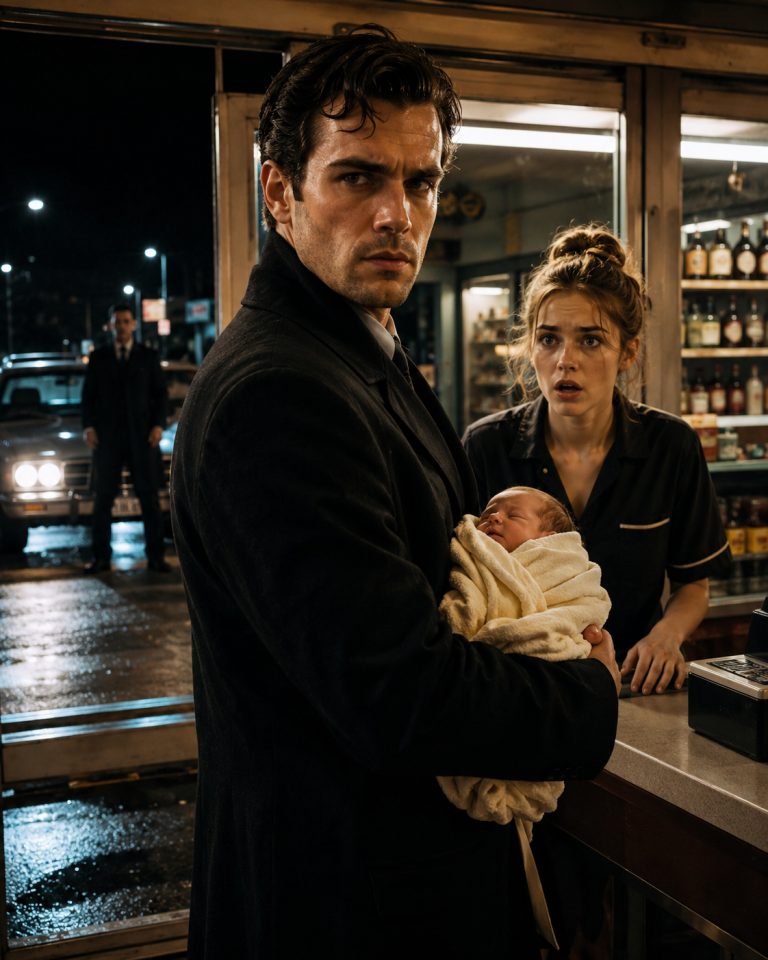
Three men stood in the entrance.
The two flanking ones were built for function — broad, flat-faced, scanning the diner with the trained efficiency of people who thought in angles and exits. The one in the middle was something else.
He wasn’t the largest man in the room. He wasn’t the loudest. He wasn’t doing anything except standing there in a dark overcoat still shining with rain, one hand loose at his side, his gaze moving through the diner with the unhurried calm of someone who had never once doubted that the room belonged to him.
Luca Ferrante. Cora knew the name the way everyone in this part of Brooklyn knew it — the way you know the weather and the subway schedule, as a fact of the city rather than a choice. Three generations of Ferrantes running the waterfront. His father shot outside a butcher shop in Carroll Gardens two years back. Luca inheriting everything: the contracts, the obligations, the soldiers, the silence that filled a room whenever he entered one.
She grabbed the coffee pot.
Pete materialized at her shoulder instantly. “Don’t.”
“We’re open.”
“Cora, I am asking you—”
“My landlord doesn’t accept asking.” She pushed through the half-door.
Up close, he smelled like rain and cedar and something underneath — metal, maybe, or the remnant of a night gone sideways. He had taken a stool at the counter without looking at the menu, one hand flat on the surface, saying nothing.
Cora set down a mug.
“Coffee?”
His eyes moved to her name tag. Then to her face. The quality of his attention was unusual — not the idle assessment of men who catalogued women, but something more focused. More careful.
“Black,” he said.
The man behind his left shoulder leaned forward with a thin, wet smile. “The boss prefers his brought by someone who knows what they’re doing.”
Cora poured the coffee.
Then, in Sicilian, she said: “Then perhaps he should hire better staff, because the mess walked in with yours.”
The room became a different kind of quiet.
The smiling man’s expression curdled. His hand moved toward his coat.
Luca raised two fingers. The hand stopped.
He looked at Cora with an entirely new quality of attention.
“Where did you learn that?”
“My grandmother.”
“From where?”
Cora set the pot down. “Agrigento, originally. She moved around.”
Something shifted behind his eyes — brief and controlled, almost invisible.
“What else did she teach you?”
Cora slid the coffee toward him. “That cold men still need warming up.”
Three seconds of silence.
Then Luca Ferrante — the man Brooklyn’s criminal press called the Architect, the man whose name made police captains lower their voices — smiled.
It was not a reassuring smile. It was the smile of a man encountering something he had not anticipated and finding the experience, against his better judgment, interesting.
He lifted the mug and drank.
The man behind him looked personally offended.
Luca reached inside his coat. Half the diner flinched. He produced a folded hundred and placed it beneath the mug.
“For the coffee,” he said.
“Coffee is two-fifty.”
“For the Sicilian lesson.”
“I’m not selling lessons.”
His gaze sharpened. “Everyone sells something, Miss—”
“Delaney.”
“Irish name.”
“Brooklyn education.”
He studied her for a moment longer than was comfortable. Then the diner’s landline rang.
The sound was ordinary. It rang every night. But something about the timing made Cora’s spine tighten before she even crossed the room to answer it.
Pete picked it up first. His face went the color of old paper.
He held it toward her without speaking.
“Who is it?” she asked.
“Your father.”
The room seemed to compress.
She took the phone.
“Dad?”
Heavy breathing. The sound of somewhere industrial — echoing concrete, distant machinery.
“Cora.” His voice was wet and small. “I need you to listen.”
“What happened.”
“I owe money. To people I shouldn’t owe money to.”
Her stomach dropped cold.
“How much?”
Silence.
“Dad. How much?”
A different voice came on the line. Male. Unhurried. Amused in the specific way of someone who has planned a long time for this conversation.
“Sixty-two thousand,” it said. “Isn’t that a number you know well, Miss Delaney?”
Her mother’s medical debt. The exact figure. Down to the dollar.
“And the good news,” the voice continued, “is that someone in a position to help is sitting right in front of you.”
Cora turned around slowly.
Luca Ferrante had not moved. But his expression had changed completely.
Not surprise. Not calculation.
Recognition.
Like a man watching a door open that he had been standing outside for a very long time.
“Give me the phone,” he said quietly.
Cora did not move.
The voice on the line spoke again, warmer now, almost fond.
“Tell Luca that his uncle sends his regards.”
—
## PART 2
She gave him the phone.
He listened for eleven seconds. She counted.
Then he said, in flat, cold Sicilian: *Touch him again and I will make sure you don’t see daylight for the rest of your life.*
He hung up.
Pete made a sound like a man swallowing glass.
Luca was already buttoning his coat.
“Where is my father?” Cora said.
“Somewhere near the Red Hook docks.”
“I’m coming with you.”
“No.”
“Yes.”
He turned to look at her with the particular expression of a man confronting something inconvenient that refuses to cooperate. “Miss Delaney. This is not a situation for—”
“That’s my father.”
“That is leverage. There’s a difference.”
“Then congratulations,” Cora said. “It worked.”
He looked at her for a long moment. Not the casual male assessment she was used to. Something more careful. Like he was reading something he hadn’t expected to find written there.
“Your grandmother,” he said. “Her name.”
Cora frowned. “Why?”
“Her name.”
“Lucia Carrano.” A pause. “She went by Carrano after she immigrated. Her birth name was different.”
“What was it?”
Her pulse ticked upward for no reason she could immediately name. “Ferrara. Lucia Ferrara.”
The smiling man behind Luca made a sound she had never heard from a grown man — barely a breath, barely audible, but full of something that sounded like dread.
Luca went very still.
“Say that again,” he said softly.
“Lucia Ferrara. She — what? Why are you looking at me like that?”
He said nothing.
“What does that name mean to you?”
Still nothing.
Then his phone rang. He checked it. His jaw tightened fractionally.
“We need to go,” he said. “Now.”
Cora removed her apron.
Pete grabbed her arm. “Emma, please—”
“It’s Cora,” she said, “and let go.”
Outside, two black cars waited in the rain. Luca held the door open. Cora climbed in without letting herself think too long about it.
As the door closed, she looked at the profile of the man beside her — controlled, silent, looking straight ahead — and understood that the name she had just said had changed something.
She just didn’t know what.
“What is Lucia Ferrara to you?” she asked.
The city moved past them in wet reflections.
“Tell me what she told you,” Luca said quietly. “About your family. About where you come from.”
“She told me she was from a small town near Agrigento. That she left at twenty and never went back. That Sicily was beautiful and dangerous and she never missed it.”
A pause.
“She told me,” Cora added, “to never trust men who smiled too quickly.”
“She was correct.”
“She also told me to learn the language. Said someday I’d need it.”
Luca looked at her then. Really looked. And in the close dark of the car, Cora saw something in his expression that she would spend a long time afterward trying to name.
It was not pity. It was not calculation. It was the look of a man standing at the edge of something enormous, deciding whether to jump.
“Your grandmother,” he said, “did not come from a small town near Agrigento.”
Cora waited.
“She came from a family that my family spent twenty years trying to find.”
Rain hammered the windows.
“Why?” Cora asked.
He was quiet for three full seconds.
“Because she took something with her when she left,” he said. “Something that three crime families, two government agencies, and at least one dead man have been hunting ever since.”
—
## PART 3
The warehouse near Red Hook smelled like seawater and old machinery and fear.
Floodlights threw hard shadows across concrete floors. Her father sat zip-tied to a folding chair at the center of the space, his face bruised in two places, trembling with the specific shaking of a man who has been terrified for hours and is now beyond feeling it.
The moment he saw Cora, he started crying. Not quietly.
She moved toward him instinctively. Luca’s hand caught her shoulder without force — just presence.
“Wait,” he said.
From the far end of the warehouse stepped a man she recognized from photographs in old newspaper archives. Silver hair, tailored coat, the careful walk of someone accustomed to being the most powerful person in any room.
Dante Russo. The head of the Russo family. Older than Luca by twenty years and apparently not interested in the territorial truce that had held the last two years together.
“Ferrante,” Russo said pleasantly. “I was hoping you’d come personally.”
“Release the civilian.”
“When we’re done talking.” Russo’s gaze moved to Cora with undisguised interest. “She has her grandmother’s face.”
The floor seemed to tilt.
“You knew her,” Cora said.
Russo smiled. “Everyone knew Lucia Ferrara. Before she stole from all of us and disappeared.”
He reached into his coat and produced a photograph — old, slightly water-damaged. He held it out.
Cora crossed the distance and took it.
Her grandmother. Decades younger, unsmiling, standing between two men she didn’t recognize in front of a building that looked nothing like anything she’d ever seen in Brooklyn. Italian architecture. Warm stone. One of the men had his hand on her grandmother’s shoulder in the proprietary way of someone who considers another person a possession.
“What did she take?” Cora asked.
“Not what,” Russo said. “Who.”
Before she could process that—
The warehouse doors blew inward.
Gunfire. Shouting. Men pouring in from the loading dock side, not in Russo’s colors and not Luca’s either — different. Harder.
Luca grabbed her arm and they dropped behind a concrete pillar as the room erupted into chaos.
“Who are these people?” she shouted.
“Friends of your grandmother,” he said, and drew his gun with the tired efficiency of a man for whom this was, unfortunately, not the worst Thursday of his life.
The firefight lasted four minutes.
It felt like forty.
When the shooting stopped, three men were down and Russo’s remaining soldiers had their weapons raised at a group of strangers who were not quite pointing back — a standoff made stranger by the elderly man who walked through the smoke in the center of it all, unhurried, carrying a black umbrella he hadn’t bothered to close.
White hair. Narrow face. Eyes that looked like they had outlasted several sets of enemies.
He looked at Cora.
He said, in Sicilian: *Buonasera, nipotina.*
Good evening, granddaughter.
—
His name was Enzo Ferrara. Her grandmother’s older brother. The patriarch of a Sicilian family that had, for three generations, existed somewhere in the space between organized crime, political intelligence, and something that didn’t have a clean name in either English or Italian.
They relocated to a disused social club in Carroll Gardens while her father was taken to a doctor Luca apparently kept on informal retainer. Cora sat at a table that held three crime bosses, a great-uncle she’d never known existed, and the accumulated wreckage of a family secret her grandmother had carried to her grave.
Enzo spoke slowly, in a mix of Sicilian and careful English, as if he had rehearsed this explanation and was not certain the words existed to do it justice.
Lucia Ferrara had left Sicily at twenty-two — not fleeing poverty, as she’d told her American granddaughter, but fleeing an arranged marriage that would have merged two criminal dynasties and made the combined family powerful enough to operate with near-complete political impunity. She had refused. Her family had tried to compel her. She had left in the night, taking one thing with her: a set of documents her father had kept locked in a private safe. Financial records. Names. Transactions spanning four decades. The paper evidence of what the Ferrara family’s political connections actually looked like from the inside.
“A ledger,” Luca said.
Enzo nodded. “The original is somewhere. We have never found it.”
Russo, from the far end of the table, looked like a man sitting on a large and uncomfortable secret.
“Three months ago,” Luca said, his voice cooling slightly, “someone accessed a dormant account registered to a Lucia Carrano. The access triggered an alert in a system I maintain.”
Everyone looked at Cora.
She felt the weight of it before she spoke.
“After she died,” Cora said slowly, “I found a key. Inside an old recipe box. A safety deposit key — the box had a bank name and a number written on the inside of the lid in my grandmother’s handwriting.”
Silence.
“I thought it was her emergency savings. She always talked about having a safety net.” Cora pressed her hands flat on the table to keep them still. “There was money. Not much — about fourteen thousand dollars. And a letter.”
The letter was in her apartment. She hadn’t brought it. She hadn’t known to bring it, forty-eight hours ago, before any of this.
“What did it say?” Enzo asked quietly.
Cora looked at her great-uncle — a stranger with her grandmother’s cheekbones — and tried to decide how much of her mother’s handwriting she was willing to share in a room full of armed men she’d known for less than a day.
Luca was watching her.
Not with the calculating attention of someone who wanted something from her.
With the particular careful stillness of someone who already knew part of the answer and was waiting to see if she had the rest.
“She told me,” Cora said, “that if anyone ever came asking about the family name, I should find the other box.”
“What other box?” Russo asked sharply.
“She didn’t say.”
That was not entirely true.
The letter had named a storage facility. Pier 17. A locker number written in her grandmother’s hand, the ink faded but legible.
She had not told anyone this. She did not know why she was protecting it. Only that something — instinct, or her grandmother’s training, or the memory of being told as a child that information held close was information that kept you alive — made her go still and careful before speaking.
She looked at Luca again.
He looked back.
In the letter, there had been one other line. Written at the bottom, below the locker number, as if added later or as an afterthought:
*If Luca Ferrante is with you, show him this. He is not his father.*
She didn’t know what that meant.
She didn’t know if she trusted it.
But her grandmother had known his name. Had written it down years ago, or decades ago, before Cora was old enough to know that Brooklyn had a map underneath its map.
“There’s more,” Cora said finally. “But I need to get something first.”
—
Pier 17 was wrapped in fog.
The East River was invisible beyond it, just a sound and a cold smell. Cora’s footsteps and Luca’s were the only ones — he had left his men at the perimeter, which was either trust or a tactical decision she wasn’t equipped to evaluate.
The storage room was in a locked outbuilding that smelled like salt and old rope. Locker 31. The key from her apartment fit.
Inside: a fireproof case. Heavy enough to take two hands.
She set it on a nearby table. Luca stood back and let her open it.
Inside: hard drives, wrapped carefully. A bundle of passports — three, with different names, all photographs of her grandmother at different ages. Bank documents. A sealed envelope labeled, in handwriting she didn’t recognize: *FOR LUCA*.
He went still.
She handed it to him.
He opened it carefully, the way you open something you’ve been afraid to want.
She didn’t read it over his shoulder. She looked out the narrow window at the fog and the river she couldn’t see and thought about her grandmother at her kitchen table, clipping coupons and watching cooking shows, speaking Sicilian to no one in a language she claimed was just memory.
Hiding everything.
Carrying everything.
Not telling Cora the truth because the truth was the most dangerous thing she owned.
“She knew,” Luca said behind her.
He sounded like a man who had just set down something very heavy.
“Knew what?” Cora turned.
His face had changed. The controlled surface of it — the armor she’d watched him maintain through a gunfight and a table of enemies — had cracked just slightly.
“My father killed her.”
The fog pressed against the window.
“Your grandmother,” he said. “She had evidence of what he did. This—” He held up the letter. “She gathered it over years. Everything needed to build a case. She gave it to your mother to hide and your mother hid it here.”
“Why didn’t she use it?”
“Because using it would have brought everything she was protecting you from directly to your door.” He looked at her steadily. “She made a choice. She chose you over the evidence.”
Cora’s throat tightened.
Her grandmother, dying in a hospital bed, had known all of this. Had chosen not to say it. Had clipped coupons and watched cooking shows and taught her granddaughter to swear in Sicilian, and had taken this entire world with her to a grave in Queens that Cora visited on birthdays because there was no one else left.
A sound outside.
Then headlights flooded the outbuilding’s windows.
Multiple vehicles.
Luca moved instantly, positioning himself between Cora and the door. She heard car doors, voices, at least two languages.
The door opened.
Russo. Enzo. Behind them, three cars’ worth of men who were not entirely certain they weren’t about to shoot each other.
And stepping out of the fourth car: a woman in a federal jacket, FBI credentials at her belt, who looked at the assembled scene with the expression of someone who has been chasing a case for eleven years and has arrived at the ending in a location that does not match her paperwork.
“Miss Delaney,” she said, ignoring everyone else. “My name is Agent Reyes. I’ve been waiting a long time to talk to someone from your family.”
—
Her name was Sandra Reyes and she had been assigned to the Ferrara file for the better part of a decade.
She did not explain everything at once. She explained it in pieces, in the back of her SUV while radio chatter murmured through the partition and Cora sat with the fireproof case in her lap and tried to build a coherent picture from the wreckage of everything she’d believed.
Lucia Ferrara had been, in the last years of her life, in intermittent contact with a federal investigator — not the Bureau, but a Treasury Department analyst who had been building a financial crimes case against three separate organized crime families with New York and Sicilian connections. Lucia had not been an informant in the formal sense. She had been a source. Sending documents. Confirming names. Providing the particular kind of institutional knowledge that only comes from having grown up inside a thing you spent your adult life trying to dismantle.
She had stopped communicating fourteen months before her death.
“We thought we’d lost her,” Reyes said. “It took us this long to understand why she went quiet.”
“She was sick,” Cora said.
“She was scared. Someone found out she was talking.” Reyes paused. “We believe she was poisoned. The illness was real — but it was accelerated by something administered over several months in small doses.”
Cora pressed her hands flat against the case.
“Who?”
Reyes glanced toward the window, where the fog and the assembled criminals waited with varying degrees of patience.
“The evidence in that case points toward someone in the Ferrante organization. Someone who found out she was cooperating and made a decision.”
Cora looked at Luca, standing outside. The man her grandmother had named in a letter. *He is not his father.*
“His father,” Cora said.
“Yes.”
“Luca didn’t know.”
Reyes was quiet for a moment.
“We don’t believe he did.”
“But you’re not certain.”
“We’re more certain than we were yesterday.” She looked at Cora directly. “The contents of that case will answer what we haven’t been able to prove for eleven years.”
Cora looked at the hard drives in the fireproof box. Her grandmother’s decades of careful collection. Everything Lucia Ferrara had chosen not to use, choosing instead to leave it behind for someone who would know what to do with it when the time came.
When the door opened.
Cora stepped out into the fog.
Russo stood ten feet away. Enzo beyond him, watching. The assorted soldiers. Reyes behind her.
Luca looked at her face and understood something from it before she spoke.
She crossed to Reyes and held out the case.
“Everything’s on the drives,” she said. “My grandmother documented all of it.”
Reyes took it.
Russo moved. Two of his men started forward. Enzo’s people tensed.
Then a single gunshot cut through the fog.
Not from Reyes’s agents. Not from Luca’s men.
From Enzo Ferrara, who had produced a pistol from his overcoat with the calmness of a much younger man and shot Dante Russo once through the shoulder, stopping him where he stood.
“Enough,” the old man said. “This family has spent forty years making enemies. It ends here.”
Russo went down.
His men looked at each other.
Then, one by one, they lowered their weapons.
—
Six months later, Brooklyn looked different.
Not peaceful — it was never going to be entirely peaceful, and Cora had enough sense by now to stop expecting it. But different. The Russo organization had collapsed under the weight of four federal indictments and the particular kind of document that, once released, makes politicians resign before breakfast. Two city commissioners. A state senator. A contract arrangement with the dockworkers’ union that had been running quietly for eleven years.
Her grandmother’s evidence. Finally used.
Cora worked a different shift now — afternoons instead of graveyard, at a place in Williamsburg that had good light and a decent espresso machine and a manager who didn’t take personal offense when she pushed through the half-door.
She was still paying down the medical debt. Slowly. But the math was changing.
She was still thinking about the letter when the bell above the door rang on a Tuesday afternoon.
Luca walked in wearing ordinary clothes — dark jacket, no entourage, rain on his shoulders — and sat at the counter like a man who had thought about doing this for a while and finally decided to stop thinking.
Cora set a mug in front of him.
“Black?” she said.
“Black.”
She poured the coffee.
He turned the mug once in his hands without drinking. The gesture was uncharacteristic — she had not seen him hold anything uncertainly before.
“The organization is largely dissolved,” he said. “I’ve been cooperating with Agent Reyes for three months. The remaining obligations are being transferred to legitimate holding structures.”
“I know,” Cora said. “I saw the press coverage.”
“You knew before the press coverage.”
“I did.”
“I didn’t call,” he said. “I should have.”
“You were busy dismantling a three-generation criminal empire.”
“That’s not an excuse.”
“No,” she agreed. “It’s not.”
He reached into his jacket pocket and set something on the counter.
Her grandmother’s ring — old Sicilian gold, a crest she now recognized.
Cora had last seen it in the fireproof case.
“I kept it out before handing everything to Reyes,” he said. “I thought—”
He stopped.
“I thought it should come back to you from a person rather than an evidence log.”
Cora looked at the ring.
Then at him.
The man who had walked into a diner at one in the morning and found a thread that unraveled everything. Who had stood in a fog-soaked storage room and learned something about his father that he couldn’t undo. Who had, apparently, spent the months since then choosing to do something with it rather than bury it.
Outside, Williamsburg went about its business — trucks on the bridge approach, a food cart closing up early because of the rain, someone’s music from an apartment above.
“My grandmother wrote that you were not your father,” Cora said.
“She was generous.”
“She was accurate,” Cora said. “She was almost always accurate.”
Something in his face shifted. Not dramatically — he was not a dramatic person. But enough.
She picked up the ring and turned it in her fingers.
“She spent her whole life carrying something she couldn’t put down,” Cora said. “And she passed it to me without telling me what it was.” She paused. “I think she was trying to give me the choice she never got.”
“What choice?”
Cora set the ring on her finger. It fit, which shouldn’t have surprised her and did.
“Whether to use what you know to run,” she said, “or use it to finish something.”
She looked at him.
“She chose to finish it. From a distance, quietly, over decades.” Cora leaned on the counter. “I’m not going to do it that way.”
Luca studied her face with the same careful attention he’d turned on her the first night — the look of a man reading something he hadn’t expected.
“What are you going to do?” he asked.
“Reyes offered me a position. Consulting, mostly. Helping identify financial structures they don’t have the contextual knowledge to interpret.” She paused. “Turns out growing up with a grandmother who was secretly a Sicilian crime family defector gives you a specific skill set.”
“I see.”
“I accepted.”
The corner of his mouth moved. Not quite a smile. The precursor to one.
“And is there anything else you’re going to do?” he said.
Cora refilled his coffee without being asked.
“One condition,” she said.
“Name it.”
“No more gunfights.”
He was quiet for a moment — the particular quiet of a man taking something seriously.
“I can commit to significantly fewer gunfights,” he said.
“That’s a lower bar than I asked for.”
“It’s an honest one.”
She considered this.
Outside, the rain had stopped. The light through the windows was the pale gold of a winter afternoon burning off the last of the clouds — the kind of light Brooklyn produced occasionally, unexpectedly, as if to remind you that the city was capable of beauty in between everything else.
“Okay,” Cora said.
She came around the counter and sat on the stool beside him.
He did not look surprised. He looked like a man for whom a great deal of things were, for the first time in a long time, arriving in the right order.
She picked up her coffee.
He picked up his.
Outside, the city hummed and clattered and went on being itself.
And in a diner in Williamsburg, two people who had arrived at each other through fire and fog and the careful long work of a woman who had known, decades ago, exactly what she was leaving behind — they sat together, and drank their coffee, and started over.
—
**THE END**