She Ran From Her Abusive Cop Ex—Then the Mafia Boss Made Her His the Woman He’d Burn Boston to Protect

## PART 1
There are things you learn about yourself in the moment you decide to run.
You learn how fast your body moves when it finally has permission. You learn that streets you have walked every day of your adult life become completely unrecognizable when the person chasing you is someone who used to kiss you. You learn that your instincts, suppressed for months under the weight of apology and accommodation, are still there — still intact — waiting for the moment you’re desperate enough to let them work.
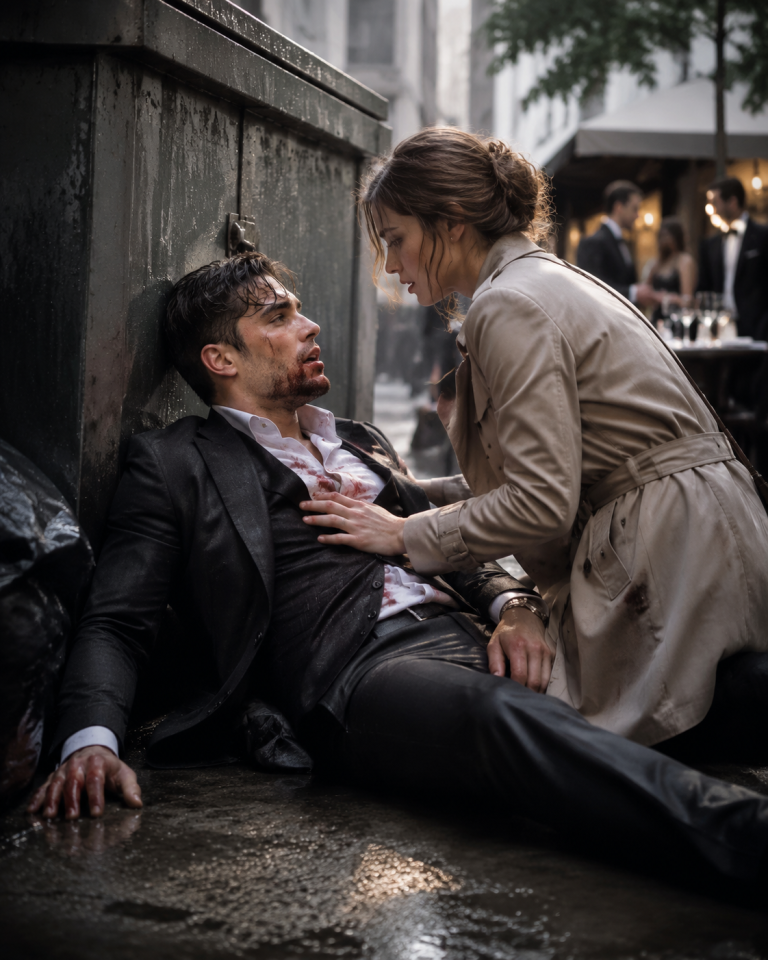
I ran out of the parking garage behind St. Catherine’s on a Tuesday night in November with the rain coming down sideways and Marcus Holt’s voice behind me like something I couldn’t outpace no matter how fast my feet moved.
My name is Cass Ferrara. I am twenty-nine years old. I work pediatric oncology, which requires a specific kind of person — someone who can hold a terrified child and mean it, who can tell exhausted parents the truth without flinching, who can see the worst things happen and return the next morning because the work still matters. I had thought this made me strong.
It had made me very good at withstanding things I should have walked away from.
Marcus Holt had been a detective with the Boston PD for eleven years. He was charming in the specific way of people who know exactly how to position charm, and I had believed it for seven months before I understood that what I had taken for protectiveness was something entirely different. By the time I understood, leaving had become its own engineering problem — he knew where I lived, where I worked, where my father spent his days in a memory care facility in Brookline, and he had made certain I understood that each of those places could become contingent on my behavior.
I had spent three weeks making quiet plans. Small movements. A bag at a friend’s house. My father’s care contract in writing, paid through a trust rather than directly. My own documents copied and stored.
And then Marcus had appeared in the parking garage before I was ready, smelling like whiskey and something colder underneath, and the plan had collapsed into simple animal motion.
Run.
I ran down Haverhill Street without a destination. The rain plastered my scrubs to my back and made the pavement slick and the streetlights blur. Behind me I heard footsteps, then voices that were not Marcus’s — multiple voices, disciplined, spread out. He had said once that he owed money to people who did not have the patience of the parole system, and I understood, running, that those people were here.
Not hunting Marcus.
Hunting me.
I cut down an alley. Hit a wet patch and caught myself on a dumpster with both hands, then kept moving. A cross street opened up. Ahead, warm light came through the windows of a restaurant — amber glass and white tablecloths, the kind of place that existed in its own contained world regardless of the weather outside.
A man came out the front door.
He stopped under the overhang to adjust his cuff and looked up when I ran past him.
I grabbed his hand.
I did not plan to. My body made the decision before I did, some primitive calculation that said *this person is solid and the solidity is what you need right now,* and I grabbed him and said the only word I had left.
“Please.”
He was tall enough that I had to tilt my head to read his face. Dark hair, with some gray at the edges. A suit that cost more than my car. Eyes that were a particular shade of gray-green, and the expression behind them was not what I expected — not the startled defensiveness of a stranger being grabbed, not irritation, not the polite concern of someone who would help me and then get back to their evening.
He was reading me.
Quickly and thoroughly, the way certain people read situations — not cataloguing what was visible but calculating what the visible signs indicated.
My scrubs. The rain. My hands. My face.
“What are you running from?” he said.
I heard Marcus’s voice at the end of the block.
“Cass.”
The man’s gaze moved past me. He saw Marcus. He saw the two figures behind Marcus who were not moving like bystanders. And something shifted in the set of his jaw — not alarm, not even concern exactly, more like a decision being confirmed.
“Niccolo,” he said.
A man stepped from the shadow of the restaurant entrance to my left.
“Two behind her,” the man said, very quietly. “One in front, police identification visible.”
Then, to me, the man whose hand I was still holding: “How badly does he want you back?”
“Badly enough to be drunk in the rain,” I said.
He looked at me a moment longer.
Then his fingers closed around mine.
“Walk with me,” he said.
Not run. Walk.
Marcus reached us.
He was in plainclothes, his badge on his belt catching the streetlight, and I felt the particular nausea of recognizing that the badge had once made me feel safe and now made me feel exactly the opposite. He stopped when he saw the man beside me.
Whatever he’d expected, it was not this.
“That’s private property,” the man said. He had a slight accent — Italian, I thought, submerged beneath years in this city. “If you follow her inside, you’ll need cause.”
Marcus’s jaw worked. “She’s—”
“What?”
A long pause.
“Nothing,” Marcus said finally. The word cost him.
He stepped back.
I felt the release of his attention like a physical thing.
The man walked me inside the restaurant through a side entrance, down a short corridor, and up a private staircase that opened into a penthouse apartment above the dining room. He released my hand when we were inside, not quickly, just with the specific care of someone who understood that how you let go mattered as much as how you held.
“Sit down,” he said.
I sat on the edge of a cream-colored sofa and looked at my own hands, which had finally started shaking.
“My name is Giacomo Serrano,” he said.
The name landed on me like a stone dropped into still water.
Serrano.
I was not someone who followed organized crime coverage. I was a nurse. I spent my attention on dosages and treatment protocols and parents who needed honest information delivered with care. But you could not live in Boston for six years without absorbing certain things. Serrano was one of those things — a name you heard connected to buildings and shipping and charitable foundations and also, in certain contexts, to the kind of quiet authority that did not require explanation.
He watched recognition move through my face.
“Good,” he said. “That saves time.”
“I grabbed the wrong hand,” I said.
“You grabbed the only useful one in reach,” he said. “Tell me about Marcus Holt.”
“Why would you want to know about my ex-boyfriend?”
He looked at me steadily.
“Because Marcus Holt is the reason my brother is dead,” he said. “And I’d like to understand the full picture before I decide what to do about it.”
The rain outside continued.
I didn’t say anything.
Giacomo sat down in the chair across from me and waited.
—
## PART 2
I told him what I knew.
Not because I trusted him — I had no reasonable basis for trust, standing in a strange apartment in the middle of the night having accidentally inserted myself into someone else’s vendetta. I told him because the alternative was the parking garage and Marcus and the voices that were not Marcus’s, and I had already done the math on which danger was more immediate.
Marcus had been part of an operation that was never named to me but whose contours I had absorbed over seven months the way you absorb anything you live adjacent to — through small inconsistencies, through phone calls that ended when I entered rooms, through money that appeared without explanation and vanished without accounting. He had mentioned a man named Rukov. He had mentioned the word territory. He had told me once, in the specific intimacy of someone who believed apology dissolved what they had done, that he had done bad things for people who expected continued loyalty.
Giacomo listened.
When I mentioned Rukov, something changed in his expression — not movement exactly, but a settling, like a room finding its shape.
“Aleksei Rukov,” he said.
“He didn’t say first names.”
“He wouldn’t.” Giacomo was quiet for a moment. “Rukov has been trying to take Boston’s harbor operations for eight years. My father resisted him. When my brother Marco took over — ” He stopped.
I waited.
“Three years ago, Marco died in a car accident outside this restaurant. The investigation found nothing. A gas leak. Faulty maintenance. Everyone accepted it.” He looked at his hands. “I didn’t accept it.”
“And you think Marcus—”
“I know Marcus,” he said. “He has been running interference for Rukov for six years. He helps make things disappear. He identifies threats and neutralizes them cleanly enough to look accidental.” A pause. “You were a threat.”
“I’m a nurse.”
“You were sleeping beside someone who knew too much. Rukov’s people consider that sufficient.”
The rain hit the windows.
“He offered me to them,” I said. Not a question. I had understood it the moment Marcus mentioned the debt in the parking garage — the particular way he had said *people who don’t care that I’m a cop*, which was not desperation but calculation, and the way his eyes had moved over me in the specific assessing way that I had always misread as desire.
“Yes,” Giacomo said.
“And you’ve been watching.”
He held my gaze.
“Watching me,” I said.
“Watching Holt. You were part of what I was watching.”
“For how long?”
A pause.
“Fourteen months.”
The silence that followed had a specific quality.
“You should have warned me,” I said.
“Yes,” he said.
“Why didn’t you?”
“Because anything I told you would have gone back to Holt, or Holt would have seen you change your behavior and known you’d received information. Either outcome put you at greater risk.” He looked at me with the even delivery of a man who has rehearsed this explanation because he understood he would have to give it. “I watched you handle a dangerous situation without knowing it was dangerous. I made sure he couldn’t hurt you without knowing I was doing it.”
“That’s manipulation.”
“Yes.”
“And surveillance.”
“Yes.”
“You don’t look sorry.”
“I’m not sorry I kept you alive,” he said. “I’m sorry the method required deceiving you. Those are different things.”
I looked at him.
He looked back, and the gray-green of his eyes in the lamp light was the specific color of a person who has thought about this conversation more than once and arrived at this version of honesty.
His phone rang before I could answer.
He listened for ten seconds.
“What?” I said.
“My man followed Holt,” he said. He was already standing. “Rukov’s people grabbed someone outside St. Catherine’s. Woman, early thirties, dark hair, scrubs.”
My stomach dropped.
“That’s my coworker Priya,” I said. “She does the same shift I do. She would have left when I left.”
“They think she’s you,” he said.
“How long ago?”
“Twenty minutes.”
“If they realize she’s not—”
“I know.”
“Giacomo.”
He was already moving.
“Come with me or stay here,” he said. “If you come, you do exactly what I say.”
I stood up.
“Tell me where we’re going,” I said.
He told me. And I came.
—
## PART 3
The warehouse was on the harbor, near the old shipyard, in the specific part of the city that had been waiting to be developed for thirty years and had developed instead into the kind of place where things happened without witnesses.
Giacomo’s car held four people: himself, me, Niccolo, and a man named Sandro who had the quiet competence of someone whose professional history did not bear examination. They spoke in Italian that moved too quickly for me to follow, but I picked out Rukov’s name, Priya’s, and the address twice repeated.
“What’s the building layout?” Giacomo asked.
I thought about Priya. Cherry blossom tattoo on her left forearm. Two daughters, four and six. Brought empanadas to overnight shifts. Laughed at my terrible coffee order. She was in that building because she looked like me and had the misfortune of leaving at the same time.
“I don’t know the building,” I said. “But I know Priya. She’s resourceful. If she’s conscious, she’ll be looking for any opportunity to signal where she is.”
Giacomo looked at me.
“Her tattoo,” I said. “Left forearm. If you can see that, you have a positive ID.”
He nodded.
“What does Rukov want?” I asked.
“Leverage over me,” Giacomo said. “He believes that if he takes someone I’m protecting, I become negotiable.”
“Are you?”
He was quiet for a moment.
“No,” he said. “But he doesn’t know that yet.”
The plan was not simple.
What I understood of it was this: Niccolo and Sandro would enter through the loading dock. Giacomo would take the river-facing entrance. The confusion created by two simultaneous entry points would give them approximately ninety seconds to locate Priya before the people inside understood which direction to direct attention.
“And me?” I said.
“You’re not going in,” Giacomo said.
“If Priya sees you first, she’ll react the wrong way. She doesn’t know you. She knows me.”
“No.”
“You said I know her habits. Her signals. You need me to translate.”
He looked at me.
“I need you alive more than I need your expertise,” he said.
“Those aren’t mutually exclusive.”
We were parked in the shadow of a container yard a hundred meters from the building’s north side. Rain still fell, lighter now, making the harbor lights streak downward in the black water.
“You are not coming inside,” Giacomo said.
I understood why, and the understanding did not remove the wrongness of staying in the car.
“The roof,” I said. “There’s a line of high windows along the second floor. If you put me above the north side with a sight line, I can confirm the location and communicate via the earpiece when you’re in position.”
Niccolo said something in Italian.
Giacomo looked at him, then at me.
“That is specifically not what I agreed to,” he said.
“It is also the most useful configuration,” I said.
Another pause.
“Sandro goes with you,” he said. “You do not move independently. You do exactly what he says.”
“Yes.”
“If I say pull back, you pull back.”
“Yes.”
He looked at me for a moment longer than the logistics required.
“I would prefer it if you didn’t get shot,” he said.
“The feeling is mutual,” I said.
Sandro and I reached the roof access while Niccolo took the dock. The rooftop was wet concrete and ventilation ducts, the city spread in every direction, the harbor dark and silver below. I found the windows and looked down through the condensation-hazed glass.
The room below was large, lit by industrial fixtures, stacked with equipment that looked like it hadn’t been used in a decade. Five men visible. And in the far corner, tied to a metal chair, a woman with dark hair and a jacket I recognized.
“Left forearm,” I murmured into the earpiece. “Cherry blossom. That’s Priya.”
Giacomo’s voice came back immediately. “Copy.”
A man stood over her with his back to me. Silver-haired, immaculate clothing that was wrong for this building in the way of someone who dressed to project authority regardless of context. He was talking. I could not hear the words.
Then Priya’s head lifted.
She saw me.
Not clearly — I was above her, through dirty glass, barely visible. But Priya had spent years reading ICU monitors in bad light and she was the most observant person I knew. She looked directly at me and held the eye contact for three seconds and then looked away.
“She’s okay,” I said. “She sees me. She’s tracking.”
“We’re thirty seconds from entry,” Giacomo said.
The silver-haired man turned away from Priya and I saw his face in profile.
“The man standing,” I said. “I don’t know his name but I’ve seen that face in Marcus’s apartment. A photograph. He was at something official — maybe a function—”
“Aleksei Rukov,” Giacomo said.
“He’s here himself?”
“He doesn’t trust delegation for things that matter.” A pause. “Cass.”
“Yes.”
“When I go in, you count thirty seconds and then you move to the roof exit. You do not wait for me. You do not look for me. You take Sandro and you get off this roof.”
“Giacomo—”
“Thirty seconds,” he said. “Promise me.”
The quality of his voice — not commanding, not managing, just asking — made something in my chest respond to it differently than all the other instructions I had received that night.
“Thirty seconds,” I said.
The entry happened without warning. One moment the building was still. Then glass broke somewhere below, motion in the peripheral edges of my sight line, and the room I was watching through the dirty window became a different room entirely — organized chaos, professional and fast, four of the five visible men going down in the span of thirty seconds in ways I could not fully see from above.
Rukov moved toward Priya.
He had a gun.
I did not count to thirty.
I found the roof access and went down.
Sandro was behind me saying things I did not register.
The internal stairwell was wet concrete and bad lighting. I heard voices below — Italian, a command, a response — and followed them until I came through a doorway and into the main room.
Giacomo had his gun on Rukov.
Rukov had his gun on Priya.
Niccolo and two others held the remaining men at the far wall.
“Set it down, Aleksei,” Giacomo said. His voice was exactly level.
“You move on me and she dies,” Rukov said.
“You shoot her and you gain nothing.”
“I gain the satisfaction of costing you something.”
I walked across the room.
Not fast. Not slow. I walked the way I walked toward frightened patients — with the deliberate presence of someone who was choosing to be visible, giving the room time to register me before anything happened.
Rukov saw me.
His gun hand moved slightly.
Giacomo’s did not.
“She’s not who you took her for,” I said. “My name is Cass Ferrara. Your arrangement was with Marcus Holt, not with me. Priya Nair is a pediatric nurse. She has two daughters. She was in the wrong place because she looked like me.”
“You should care more about yourself than about her,” Rukov said.
“I care about both of us,” I said. “That’s how it works.”
I kept walking.
“Stop—”
“I’m going to untie her,” I said. “Because she has nothing to do with any of this, and she’s going to need her hands.”
I reached Priya.
She looked at me with the exact expression I would have given her if our situations were reversed — the specific mix of relief and fury of someone who was very glad to see you and very unhappy about the method.
I worked the knot.
Rukov’s gun was on me now.
Giacomo’s gun was on Rukov.
“Aleksei,” Giacomo said. His voice had not changed. “You came here yourself tonight. That is a significant choice. It tells me what this is actually about.”
“This is about territory,” Rukov said.
“No,” Giacomo said. “This is about my brother. And I think you came tonight because you needed to be present when it ended. To see it close.”
The rope came loose in my hands.
Priya’s arms dropped forward.
I pulled her to her feet.
“Marco Benedetti died three years ago,” Giacomo said. “You paid Marcus Holt to arrange it, and it worked, and yet here you are. Why?”
Rukov’s jaw tightened.
“Because it did not work as intended,” Giacomo said. “You needed the territory to capitulate. Instead it consolidated. So you tried Holt again, through a different lever.” His eyes moved to me briefly. “And that also did not work. Which means you are running out of angles. So you came to close this yourself.”
“You can’t prosecute me,” Rukov said. “You have no standing in any court—”
“I’m not interested in courts,” Giacomo said.
Priya’s hand found mine.
I squeezed it once.
“There’s a way out of this room that doesn’t end in additional deaths,” Giacomo said. “You surrender what you have — the documentation of the arrangement with Holt, the payment trails, the operational records. All of it. In exchange, the people who came here tonight go back to where they came from.”
“And me?”
“You leave Boston,” Giacomo said. “Tonight. Permanently.”
Rukov looked at him.
Giacomo waited.
The gun lowered.
Slowly.
Then further.
Then to the floor.
—
The next four hours were the kind of hours that defied chronological measurement.
Statements and documentation and the quiet, efficient work of men who handled aftermath the way I handled post-operative care — systematically, without drama, with attention to every step. Marcus Holt was found two hours later at a bar in Southie, arrested by the only members of Boston PD internal affairs who had been waiting for exactly this to become prosecutable. The documentation Rukov surrendered connected dates and payments to Marco Benedetti’s death in a way that the original investigation had been designed not to find.
Priya was taken to a private clinic, evaluated, treated for a dislocated shoulder and cuts from the rope, and eventually reunited with her daughters via a car that Giacomo arranged without being asked. She called me from the clinic at four in the morning to say she was okay and that she had questions and that those questions could wait until she had slept.
“Thank you,” she said.
“I’m so sorry,” I said.
“It’s not your fault,” she said. “I know the difference.”
I sat in Giacomo’s kitchen after that and held a cup of coffee that had gone cold and looked at the harbor from the window.
He came in and refilled the cup without asking.
“Sit down,” I said.
He sat.
We were quiet for a moment.
“You knew about Marco,” I said. “Before tonight — you knew Holt was connected.”
“Yes.”
“And you’ve been building toward this.”
“For three years.”
“Then I was—” I stopped.
“What?”
“I was incidental,” I said. “Holt offered me to Rukov, which gave you a way in. If I hadn’t grabbed your hand tonight—”
“You would have been in more immediate danger and I would have had a harder problem,” he said. “But yes. The larger situation was already in motion.”
I held the coffee cup.
“The difference between you and Marcus,” I said, “is not that you don’t manipulate circumstances.”
“No,” he said. “It isn’t.”
“The difference is what the manipulation is for.”
He looked at me steadily.
“And that,” I said, “is a more complicated thing to weigh than I have resources for at four in the morning.”
“You should sleep,” he said.
“Yes.”
“There’s a guest room.”
“I know.”
I stood up. Took the cup to the sink. Stood there looking at the harbor lights.
“Giacomo.”
“Yes.”
“Thank you. Not for the situation you put me in. For the part where it ended differently than it could have.”
“You’re the one who walked across the room,” he said.
“You’re the one who didn’t shoot Rukov when you had every reason to.”
A pause.
“I wanted to,” he said.
“I know.” I turned. “The fact that you didn’t tells me something about you that your reputation doesn’t.”
He looked at me with the gray-green eyes and the expression of a man who was not used to being read clearly by someone who wasn’t afraid of what they saw.
“Get some sleep,” I said.
“You too,” he said.
I went to the guest room, which had a window looking out over the same harbor, and I lay down in borrowed clothes and listened to the rain finally stop, and thought about the fact that the last time I had felt safe in a space that wasn’t my own had been before Marcus, before I had learned to measure safety by what absence looked like rather than by what presence offered.
This felt like presence.
That was worth paying attention to.
—
I did not disappear after that.
I thought I might. The rational version of events suggested I should take my documented safety, my father’s care arrangement, my professional life, and the address of a shelter I knew in Cambridge, and I should put distance between myself and anything with the name Serrano attached to it.
I thought about it seriously for two days.
Then Priya called me from home, with her daughters making noise in the background, and said: “He sent flowers. To the clinic. Card just says *on behalf of everyone who shouldn’t have needed saving.*”
“That’s his style,” I said, which was an interesting thing to say about someone I had known for thirty-six hours.
“Are you going to see him again?”
I thought about it.
“Yes,” I said. “I think so.”
“Good,” Priya said. “He looked at you the way men look at things they’re afraid they’ll lose.”
“He’s not afraid of much.”
“Everyone is afraid of something,” she said. “The ones who know what it is are just harder to manipulate.”
—
Six months later:
I still worked pediatric oncology.
This had been Giacomo’s initial assumption — that I would eventually step away from the work, or move into the foundation oversight, or redirect toward something that required less of a person each shift. I had explained, carefully and more than once, that the work was the point. That I had not rebuilt my capacity to stand in difficult rooms only to avoid them.
He had listened.
He had been listening, it turned out, in the specific way of someone who had spent years in a world where listening was intelligence-gathering and was now learning that it could be something else — something that was just about the other person, their words, what mattered to them.
This took time. It remained imperfect. He was accustomed to making decisions unilaterally and explaining them afterward, and I was accustomed to people making decisions about my life without explaining them at all, and those two habits abraded against each other in ways that required regular honest conversation.
We had those conversations.
Not always easily. But honestly.
The Isabella Serrano Foundation — which I had named something else for professional reasons but which Giacomo’s people called by that name regardless — funded a new oncology wing at St. Catherine’s with family housing and three positions for social workers who specialized in families managing pediatric illness and financial crisis simultaneously. The money came from Giacomo’s redirected holdings, which were in the process of becoming legitimate in the grinding, complicated, multi-year way that such processes actually worked.
My father, in his clearer moments, had asked me once what Giacomo did.
“He’s in business,” I said.
My father, who had spent forty years as a man who noticed the difference between what people said and what they meant, had looked at me for a long moment and then said: “Is he good to you?”
“He tries to be,” I said. “And when he isn’t, he understands why it matters.”
“Then that’s enough,” my father said. “That’s more than most.”
I had not told him everything. I did not know if I ever would. There were parts of the year that had passed that did not require narration — that existed as the specific weight of things survived, things chosen, things paid for and still worth the cost.
I told him what mattered: that I was safe. That I had built something. That I had stopped waiting for safety to arrive and had started making it myself.
That felt true.
—
On a Sunday afternoon in spring, sitting across from Giacomo in the kitchen of the apartment above the restaurant — which had become, by gradual accumulation of mornings and evenings, as much mine as his — I watched him try to explain to his brother Lucas why the pasta required more time before the sauce went in.
Lucas, who was the kind of person who believed conviction could substitute for technique, was not persuaded.
“You’re doing it wrong,” I said.
Lucas turned.
“Again,” Giacomo said, with a expression that I had come to understand was what he looked like when something made him genuinely happy and he hadn’t decided yet whether to show it.
“The pasta needs to finish in the sauce,” I said. “It absorbs the flavor. If you just put the sauce on top, it’s two separate things.”
“You’re a nurse,” Lucas said.
“My grandmother was from Naples,” I said.
Lucas looked at Giacomo.
Giacomo was smiling.
“She’s usually right,” he said.
Lucas conceded with the specific grace of someone who knew when they were outvoted and transferred the pasta to the sauce to finish.
The kitchen filled with the smell of garlic and herbs and the sound of rain beginning again outside — lighter than November, the kind of rain that belonged to March and meant something different, that meant the city was transitioning rather than enduring.
Giacomo came to stand beside me.
“Are you all right?” he asked.
I thought about the question, which he asked me with the consistency of someone who had decided that asking it regularly was more useful than assuming.
“Yes,” I said. “I am.”
“You’re sure?”
I turned to look at him.
“Seven months ago I ran out of a parking garage in the rain and grabbed the hand of the most dangerous man in Boston,” I said. “And here I am, teaching his brother to make pasta.”
“That’s not an answer.”
“I’m exactly where I chose to be,” I said. “That’s the answer.”
He looked at me with the gray-green eyes and the expression that Priya had correctly identified months ago.
“I grabbed the wrong hand,” I had said that first night.
I had been wrong about that.
I had grabbed the only hand that was both available and worth holding. The distinction between those two things had taken time to understand, and the understanding had cost something. But the thing you build on the other side of cost, when you have paid it willingly and with full knowledge, is sturdier than anything handed to you at the start.
Lucas announced that the pasta was ready.
Giacomo’s hand found mine under the counter — briefly, without announcement.
I held it.
Outside, the spring rain continued, making the city look like it was beginning again.
We ate dinner.
We stayed.
**THE END.**