“You’re Carrying My Child,” the Mafia Boss Declared at Her Wedding—Then Gunfire Shattered Everything

## PART 1
The morning of my wedding, I stood at the window of the bridal suite and pressed one hand flat against the glass and thought: *I am about to marry a man I respect enormously and feel almost nothing for.*
Not nothing. That wasn’t fair. I felt warmth toward Connor. Gratitude. A kind of deep, clean fondness that I suspected most marriages were built on and that most people dressed up as something more because the truth was too complicated to say at a shower or rehearsal dinner. But love the way poems described it, the kind that rearranged your architecture, the kind that made you afraid—no. Not that.
I had made my peace with that.
I was thirty-one. A large animal veterinarian who spent her days with creatures that could kill her and had never once broken her nerve. I had spent years in the kind of work that required absolute steadiness—setting bones in animals that weighed more than cars, administering anesthesia to leopards, making the decision to end suffering without flinching. I was not the kind of person who waited for lightning.
Connor was kind. Careful. He made excellent decisions and kept his commitments and genuinely believed in building things that lasted. He had never once made me feel small.
My mother had wept happy tears when I said yes.
I had told myself that was enough.
There was one secret, though.
It sat in the bottom of my overnight bag inside a small zippered pocket—a plastic test wrapped in tissue that I’d been unable to throw away since the morning I’d taken it three weeks ago. Two lines. Eleven weeks along now. Conceived not in any romantic sense but in a clinic room that smelled of antiseptic and careful protocol, via donor insemination that Connor and I had planned as methodically as we planned everything else. His choice not to use his own genetic material—his family carried conditions he wasn’t willing to pass on, and I had respected that—had led us here, to a clinic in Beacon Hill, to a procedure I’d undergone alone because Connor had a conference call he couldn’t reschedule.
I had been planning to tell him on the honeymoon. I had a whole scene arranged in my mind: sunset, the sound of water, the careful architecture of a good surprise.
Instead I watched a black car pull past the hotel’s entrance and idle at the curb below, and I felt the small particular chill of something wrong before my brain had named what it was.
The ceremony was in the rooftop garden. White chairs, white roses, one hundred and twenty people who had known Connor and me long enough to confuse our efficiency for romance. I walked myself down the aisle—my one insistence in the planning—under a sky that was cloudlessly blue and wastefully beautiful.
Connor was waiting at the altar, composed in the way of someone who had prepared for this and found his preparation adequate. He took my hand. His palm was dry and steady. The officiant began.
I heard almost none of it.
The sound arrived before the vehicles—a low mechanical rumble that seemed wrong for a rooftop until it became impossible to ignore. Three black SUVs had somehow breached the service entrance. They crossed the terrace at speed, and the guests nearest the edge scrambled back, and someone knocked over a floral arrangement, and then the vehicles stopped and the doors opened and men in dark suits came out with the practiced economy of people who had done far worse than crash a wedding.
Eight of them. Maybe ten. They arranged themselves with no apparent hurry and all the actual effect of a perimeter being closed.
And then one more man stepped from the center vehicle.
Everything I could say about him sounds inadequate now.
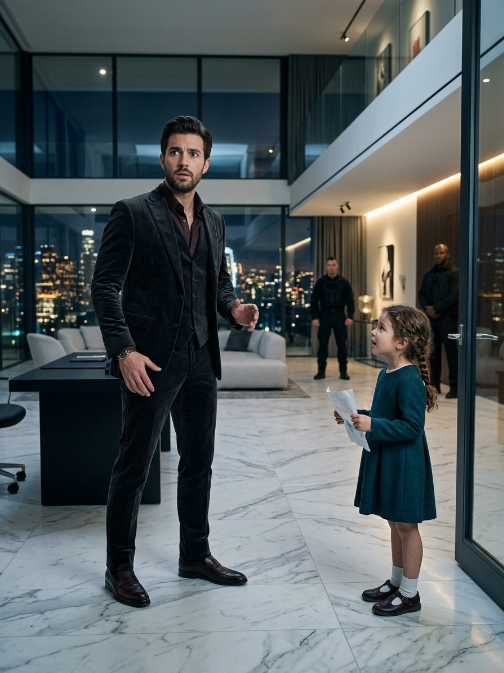
He was tall, broad across the shoulder, wearing a suit the color of charcoal that fit the way expensive things fit when they are made for a specific body. Dark hair. A scar through one eyebrow that caught the light. And eyes—I’m being precise here, because I’ve tried to understand it since—eyes so dark they seemed to function differently from other eyes, absorbing the scene rather than reflecting it.
He did not look at the guests. He did not look at Connor.
He looked directly at me.
My body reacted before my mind caught up. Every muscle registered him before I had a conscious thought to organize around. My pulse spiked once, hard. I had never seen this man. I was absolutely certain I had never seen him in my life.
He walked forward. His men stayed put. No one intercepted him—not the hotel security, not Connor’s partners, no one. That told me everything about the kind of person he was before he said a single word.
He stopped several feet from the altar.
“Nora Callahan,” he said. His voice was even. Almost quiet. Worse, somehow, than if he’d shouted. “Step away from him.”
Connor straightened like a man who has decided that a threat requires a visible spine. “Who the hell are you.”
The man ignored him completely. His eyes stayed on mine.
“You don’t know me,” he said. “But you’re carrying my child.”
The rooftop went completely silent.
I heard my mother somewhere behind me. I heard the officiant take a step back. I heard Connor’s hand tighten around mine until the bones shifted.
“That’s insane,” I said. “I’ve never met you.”
He reached inside his jacket. Two of his men shifted, visible now at the edges of the garden, hands open, demonstrating the gesture wasn’t a weapon. He produced an envelope and held it toward me.
“Beacon Hill Fertility Center,” he said. “Eleven weeks ago. Your procedure used my genetic material.”
Something cold moved through me.
Not because I believed him. Because he had said *Beacon Hill*. Because he had said *eleven weeks*. Because those were the exact words from my own private file, and I had never told anyone, and there was no way—
Connor let go of my hand.
“This is harassment,” he said. “You’re threatening her.”
“I’m protecting her.” The man’s gaze moved to Connor for the first time, and there was something in it—not contempt exactly, but a kind of tired certainty. “There’s a vehicle on the street below that has been watching this building for three weeks. They were planning to take her during your honeymoon.”
He looked back at me.
“The clinic director switched your donor sample deliberately. My genetic material was selected because I’m the leverage they wanted. They intended to wait until the pregnancy was established, then disappear you. Your fiancé would spend years looking for a body he’d never find.”
“I don’t believe you,” I said.
But my skin had gone cold.
Because three weeks ago I’d had the strange conviction, outside the grocery store in the early morning, that someone was watching me from a parked car. I’d told myself it was prenatal paranoia. Too much caffeine, not enough sleep.
His phone buzzed. He glanced at it once. His jaw tightened.
“We’re out of time.”
The gunfire started from the street below. Not the rooftop—the vehicle he’d pointed toward, firing up at the garden terrace.
What happened after that is something I can still reconstruct beat by beat when I need to, and cannot stop reconstructing when I don’t.
Guests hitting the ground. A server spinning backward. The sound of bullets tearing through flowers and stone. Connor dropping flat. The man from the SUV reaching me in two strides and putting himself between my body and the direction of fire, one arm across my chest like a bar.
I fought him. Of course I did. I dug in, I twisted, I tried to wrench away.
He bent close, his mouth near my ear, his arm not releasing.
“Come with me and live,” he said. Not a threat. A calculation, delivered with brutal precision. “Or stay and watch everyone you love die in the crossfire.”
I looked over his shoulder. My mother had her hands over her head behind a planter. The officiant was gone. A white chair had blood on it.
I stopped fighting.
He carried me to the SUV. Not dragging—carried, with a carefulness that felt almost obscene in the middle of the carnage. Placed me inside. Climbed in beside me. Barked orders in Italian as the vehicle accelerated through a service gate.
Through the window I watched my wedding disappear. My veil was caught on the arm of an overturned chair and fluttered there as we pulled away, white against smoke.
“Your seat belt,” he said.
My hands were shaking so badly I couldn’t manage it. He reached over and fastened it himself, efficient and close, and I smelled leather and gunpowder and something else, clean and expensive. When he leaned back, I could see blood soaking through his sleeve at the forearm. He didn’t appear to notice.
“Who are you,” I said.
“Marco Serrano.”
The name meant nothing to me. Nothing at all.
“The next few months,” he said, “you stay close to me.”
Then he turned to look at me—fully, without apology—and I saw in his face something that was not possession and not pity but felt, in its complete seriousness, like both.
I had no idea yet what the clinic had actually done with my body.
And I had no idea that the file he was carrying would be worse than anything he’d said.
—
## PART 2
The house was the kind of beautiful that didn’t care whether you were comfortable.
High stone walls. Cameras at every corner. Men pacing the grounds in the careful patterns of people trained to create the impression of fewer of them than there were. Inside: high ceilings, art that cost more than my apartment building, the deep silence of rooms that had never tolerated noise.
I woke in a bed with linen sheets and a view of a walled garden and spent the first ten minutes checking my body with the methodical focus of someone who needed to know exactly what had and hadn’t been taken. My clothes had been changed—silk slip, nothing else—but everything that mattered was intact. I felt the way a patient feels coming out of anesthesia: grateful first, furious immediately after.
The door was locked.
A woman named Mrs. Carra came eventually with a tray. Steel hair. Eyes that did not pry. She told me there were clothes in the closet and that Mr. Serrano would receive me when I was ready.
I was not ready for two hours. Then hunger and the baby made me practical.
Marco was waiting in a library behind a desk covered in files. Dark jeans, black shirt, sleeves rolled. The bandaged forearm the only proof that yesterday had been real.
He told me to sit.
I stood.
“I want to go home.”
“Your home isn’t safe.”
He opened a folder. Surveillance photographs: me leaving my apartment, me crossing the Common, me at the side entrance of my clinic. In every image, circled in red, the same face. Light eyes, sharp features, different clothes each time. Always watching.
“His name is Petru Vasile,” Marco said. “Albanian organized crime. He’s been tracking you for three weeks.”
I picked up one photograph. I remembered the day—early November, coffee before rounds. That prickling at the back of my neck I’d dismissed.
He opened a second folder: Beacon Hill Fertility letterhead. My patient forms. Lab records. A paternity test I had not requested.
Three years earlier, before what he described as high-exposure operations, Marco had banked genetic material as a precaution. The clinic director was the brother-in-law of the men who wanted to use that material against him. When I’d arrived months ago for donor insemination—a single woman, professional, unlikely to ask too many questions—they had made their substitution deliberately.
A baby as leverage. A body as hostage. A human being as collateral.
The probability of paternity, according to the test: ninety-nine point eight percent.
“You’re lying,” I said.
He turned the laptop toward me. Security footage from a side entrance at the clinic. A timestamp from two weeks before my procedure. A man in scrubs carrying a sealed container out of the facility at 2 a.m. The face, when it sharpened, matched the circled photographs.
I sat down then, without deciding to.
He gave me time. That was the first thing I noticed about him—he gave me time to process instead of pushing. Not kindness, necessarily. Strategy, perhaps. But it looked the same from the inside.
“So I’m bait,” I said.
“You were intended to be. They planned to take you once the pregnancy was confirmed and established.”
“You took me first.”
“Yes.”
I looked at him across the desk, this man who had stolen me from my own wedding with what I was beginning to understand was a calculated kindness, and asked the only question that mattered in that moment.
“What was supposed to happen to me after they took me?”
Something moved through his expression. Carefully controlled, but there.
“They would hold you,” he said. “Until the child was born.”
The clinical flatness of it hit harder than rage would have.
He stood, and in the same motion—precise, controlled—he placed one more sheet on the desk. A list. Women’s names. Different dates. Same clinic. Same pattern.
I was not the first.
I was simply the one carrying the wrong man’s child.
He was watching me with that unreadable attention when I turned the last page and found a photograph I shouldn’t have been in.
I had never stood at that location. Never been photographed in that context. But there I was—unmistakably, impossibly—in an image that predated my first clinic appointment by six months.
The trap had been set before I ever walked through their door.
—
## PART 3
The first week was fury and logistics in equal measure.
I mapped the room. I tested the windows. I learned the guard shifts by the sound of footsteps in the corridor and the particular rhythm of radios checking in. Mrs. Carra brought meals and never asked questions. Marco maintained a distance that was disciplined enough to feel deliberate.
He was not what I had prepared to hate.
He was controlling—absolutely, openly, without apology. Dangerous in the way that men who have spent years making lethal decisions become dangerous, where the capacity for violence sits in them like weather, present even when quiet. He gave orders with the expectation of a man who had never needed to repeat himself.
But he did not shout. He did not threaten me for sport. When he gave me rules—a guard whenever I left the room, no traceable communications, no contact with people from my previous life without clearance—he stated them plainly and then waited for my response. As if my response mattered. As if, within the circumstances, he was preserving something.
I hated how much harder that made the hating.
On the eighth day, morning sickness broke through whatever adrenaline had been holding it at bay. I spent three hours in the marble bathroom while Mrs. Carra brought ginger tea and crackers without comment, without pity, with a practical efficiency that I found, inexplicably, almost tender.
By the second week I had begun hearing the house differently. Italian in clipped phone calls. Movement at irregular hours. The scrape of a chair in the library past midnight where Marco worked through files and maps with the focused attention of a man managing multiple urgent things at once. I understood gradually that I had not been brought to a prison. I had been brought to a command center.
The attack came on a Wednesday night.
Glass breaking somewhere below. Then voices shouting in Italian, the kind of urgent shorthand that doesn’t require translation. I pulled a chair into my hands—as if that would help—and the door opened and Marco came in with a gun and someone else’s blood on his shirt collar and eyes that, when they found me, did something I hadn’t expected: they relaxed.
“They found the location,” he said. “Move.”
Two guards met us in the corridor. He took me through a door I’d assumed was a closet and down concrete stairs into a reinforced basement—monitors covering every exterior angle, the garden alive with muzzle flashes and running figures. He settled me with Bastian, his most senior guard, and went back upstairs.
I watched him on the monitors.
I had known he was capable of violence. Watching a person move through it is different from knowing. He was economical. Precise. He did not waste motion or ammunition or whatever it was he kept in reserve behind that controlled exterior. He moved through his house under fire with a steadiness that was its own education.
The fight lasted forty minutes. Eight of theirs. Two of his wounded, none killed.
Afterward he found me on the terrace where I’d gone for air, sitting with my back against the stone wall and the dawn coming up pink and oblivious over Boston Harbor.
He sat beside me. Not touching.
“This is your life,” I said.
“Yes.”
“Every day. Death and blood and never knowing which night they come back.”
“Not every day.” A pause. “Most of them.”
I looked at the sky. “And you brought a child into it.”
He flinched. Not the controlled microexpression I’d learned to watch for but an actual flinch, the kind that gets through armor.
“This was done to both of us,” he said. “I didn’t choose this.”
Then, after a silence that had real weight in it: “I never wanted this for an innocent. Especially not a child.”
The sentence sounded like something pulled loose against his will. I believed it not because he’d earned my trust but because the night had stripped both of us down to a layer where performance cost too much.
“If you hadn’t taken me,” I said slowly. “They really would have.”
“Yes.”
“A body they never would have found.”
“Yes.”
He stood when the sun was fully up and held out his hand. I looked at it. Taking it felt like too many things at once—surrender, survival, the admission that my old life was already gone. But the light was coming in off the water and I was eleven weeks pregnant and the garden below was full of evidence that people had tried to kill me in my wedding dress, and my body made the decision before my pride could intervene.
I took his hand.
He pulled me up with careful steadiness and told me we were moving to his property in the Seaport District that afternoon.
“Another cage,” I said.
He looked at me for a moment. “You deserved better than this.”
He said it the way people say true things they’re angry about—not at the person they’re saying it to, but at the fact itself.
—
The Seaport penthouse was all steel and glass and harbor light. Different from the stone house—colder at first, but with a view that made the size of the sky impossible to ignore. I stopped testing doors there. Not acceptance. Just the recognition that rage can’t sustain fever pitch indefinitely. Mine burned down into something quieter and considerably more useful.
Observation.
I learned that Marco read physical books—always two or three going at once, left face-down on various surfaces in a way that suggested he thought about continuing them even when he wasn’t. That he ate with the focused efficiency of someone treating food as fuel and seemed genuinely surprised when something was exceptional. That he spoke to his people with a spare authority that expected competence without requiring performance.
At breakfast we observed each other across the table in a silence that was neither comfortable nor hostile but slowly became, over days, something with its own texture.
He asked how I felt, every morning. I answered with the minimum honest information. He never pretended any of it was ordinary. That helped more than I expected.
On the eleventh day he slid a medical file across the table.
“Dr. Elaine Park. Private obstetrician, former Mass General maternal-fetal medicine. I’ve had her thoroughly checked.”
I skimmed it. Credentials beyond reproach. Private practice. The kind of discretion that came from years of handling cases that required it.
“You hired an OB.”
“I hired the right one.” Then, with a precision I was beginning to understand was his version of emotional honesty: “A legitimate thing I could actually do.”
The appointment happened in a converted room off the main corridor—private, equipped, nothing missing. Dr. Park had warm eyes and the brisk competence of someone who did not confuse gentleness with imprecision. She took my blood pressure—elevated, unsurprisingly—asked questions without making them feel like interrogation, and then smeared cool gel across my abdomen and angled the screen toward us.
At first just movement I couldn’t interpret. Static resolving.
Then sound filled the room.
Fast. Wild. Absolutely certain of itself.
My throat closed so suddenly it hurt. I had imagined this moment—in the clinic, alone, the first time—but I hadn’t imagined this. The specific physical reality of a heartbeat that wasn’t mine. Evidence of a life that had started without any of its own say in the matter and was busy becoming itself regardless.
I turned toward Marco because something in me needed witness.
He was standing very still.
Not his usual controlled stillness. Something different—the kind of stillness that happens when a person is hit by something they had no framework for and is trying to build one in real time. His face was doing something I hadn’t seen it do before. Not soft. Something more structural than soft—open, in the way that a door is open.
“That’s your baby,” Dr. Park said quietly.
Neither of us corrected her.
—
After the appointment, the air between us changed in ways I couldn’t undo and eventually stopped wanting to.
It wasn’t trust. Trust implies a clean slate and we were nowhere near a clean slate. It was something more like mutual damage becoming visible enough to generate its own gravity.
I told him two weeks later that I needed to work.
I said it the way I say most things that matter to me: directly, without softening the edges. My career had vanished the moment he took me. I was a veterinarian. I had cases in progress. Animals whose treatment I had been managing. The person I was outside of pregnancy and captivity was dissolving faster than the morning sickness.
He considered it—I watched him actually weigh it, danger against usefulness, which was the most honest form of respect I’d seen him show—and said yes. Controlled access. No location data. His tech team would build the system.
Within three days I was reviewing imaging from a wildlife rehabilitation center in Vermont, advising on treatment for a red wolf with a fractured radius. It was not freedom. It was a controlled simulation of the thing I’d had. But it reminded me that I still existed beyond my own body and other people’s plans for it.
The same week, he asked for something in return.
He was planning an operation at Beacon Hill Fertility. His team needed someone who knew the building’s internal layout—service corridors, records rooms, the gaps in the security system that clinics acquire through years of never expecting anyone capable. He needed me to guide them remotely.
“You want me to help you rob a fertility clinic,” I said.
“I want you to help me dismantle the network that made you a target.”
That was harder to dismiss.
I agreed on one condition: no harm to anyone not directly responsible. Staff, security guards, cleaners, anyone who came in to do an ordinary job—they walked away.
He listened to this without interrupting. Then extended his hand.
“Agreed.”
The handshake felt strange and too formal and far more intimate than it had any right to be.
The night of the operation I sat in his office in a headset watching camera feeds bloom across six monitors. Marco and four men moved through the clinic in darkness with an efficiency that explained why no one had ever been able to produce usable evidence against him. Dmitri, his technical specialist, handled the digital breach from a station beside me, muttering in a mixture of English and Russian I didn’t try to follow.
A guard deviated from his scheduled route. My heart stopped.
“South corridor,” I said into the headset. “Maintenance door on your left. Twenty seconds.”
They moved. The guard passed.
The download completed clean. They were out in twelve minutes.
When Marco returned to the penthouse hours later, he still carried the cold of the November night on his jacket. He told me I had saved them fifteen minutes and two potentially serious complications. He said it plainly, with the directness I’d come to recognize as his version of praise.
Then he stepped closer—and I had started measuring safety in the distance between us, I realized, so I noticed when it changed.
“The guard,” I said.
“You could have had them take him down.”
“You asked me not to.”
The fact that he had kept his word made my breath catch for reasons I was not yet ready to examine.
He reached up and touched my face. Just his fingertips. Just for a moment. His hand was warm and his touch was so careful it almost hurt.
“You’re stronger than you’ve been given credit for,” he said.
Footsteps in the hallway broke the moment apart like it had never been.
—
Dmitri spent two days untangling the stolen files.
What came out was a blackmail architecture hidden inside the mechanisms of reproductive medicine. Judges. A state senator. Three corporate executives. Women paired not with anonymous genetic material but with samples selected for maximum coercive leverage—material belonging to men who would need to be managed, controlled, made vulnerable at the right moment. Leverage in gestation. The most patient kind of trap.
My case was not unique. It was an entry in a database.
I sat with that for a long time.
Afterward, Marco took the evidence to an FBI contact named Agent Dana Reyes—official where the law allowed, off-record where it didn’t. He spent three nights building the case file. I sat nearby, ostensibly working, watching instead.
The angle of his face in lamplight. The way he pressed the back of his hand to his mouth when something stalled. The particular Italian phrase he repeated under his breath when he was frustrated, always the same one, always quiet.
That was the night I understood the most dangerous shift of all.
I had stopped being afraid of him.
I had started being afraid of something else entirely.
—
At fourteen weeks I told him I needed to be present when they picked up the clinic director.
He refused immediately. I refused his refusal. This particular argument was different from the ones before it because I understood exactly why I needed to be there and he understood it too, and the reason was the kind that makes people stubborn past comfort.
I had spent months being the person things happened to. I needed to look at the man who had treated my body as a pressure point and say that to his face.
Marco compromised the way dangerous men compromise when they understand they’ve already lost: I could come, I stayed in the vehicle, Bastian and Tomas stayed with me, any sign of trouble and we left immediately.
The interrogation site was a stripped industrial space—concrete, portable lighting, no furniture except a chair in the center. Dr. Viktor Laszlo sat in it with his hands behind his back and the expression of a man who has recently discovered that credentials do not insulate against consequences.
His eyes widened when I walked in.
I stepped close enough to see the sweat at his temples.
He tried the standard defenses first. Business logic. Acceptable risk. I fit a profile—single, professional, motivated by wanting a child, unlikely to scrutinize. He said the word *profile* with the blandness of an actuary discussing statistical categories.
The cruelty of that was specific and precise. He had used longing as a key code. Found the ordinary human hope of wanting a family and turned it into a door.
Marco stood behind me like a wall while Laszlo gave up names, routines, locations, everything he knew. He broke when Marco showed him the intercepted communications from his associates indicating he was already expendable after earlier operational failures.
Fear does what loyalty cannot.
Before they finished I asked the one question nobody else could ask for me.
“What was supposed to happen after they took me?”
He wouldn’t look at me.
“Hold you until delivery,” he said.
He delivered the sentence the way someone describes a storage protocol.
I left the warehouse shaking—not with fear but with the effort of not becoming as cold as the men who’d built this.
—
Weeks accumulated. The penthouse became routine. Breakfast across from each other. My remote consultations, which had expanded to two different wildlife rehabilitation programs. Security briefings I wasn’t supposed to notice but had started following by sound. The first anatomy scan, which revealed a healthy boy, which sent Marco into a silence that lasted until he admitted he was thinking about inheritance—what sons learned from their fathers, what they absorbed without being taught.
I touched his face when he said that. It was the first time I had touched him voluntarily.
“Our son will learn what we choose to teach him,” I said. “Not what other men built into you.”
He looked at me as if that sentence had moved something he’d believed was fixed.
Three weeks later I felt the baby move for the first time.
I called for Marco without thinking. He crossed the room immediately. I placed his hand where I guided it and waited. When the kick came—small, unmistakable, the communication of something that existed and was making itself known—his expression did what his expression rarely did. It let me see through it.
Not soft. Open. The look of a man meeting consequence and miracle simultaneously and finding himself entirely unprepared.
“That’s our son,” I said.
He pressed his lips to my stomach with a reverence that seemed to arrive against his will.
We argued about names that afternoon with the low-grade seriousness of people who were trying to have a normal conversation and discovering they were capable of it.
Then the building exploded.
The first blast threw books from a shelf. The second shattered glass in the floor below. By the time Marco reached me he was already armed and everything that had softened over the previous weeks had burned away in an instant—he was all edge and motion, back to the version of himself that existed before I’d started being able to read the one beneath it.
“Car bomb,” he said. “Garage level. We go now.”
The service elevator. Guards packed in with us. The baby kicked against my hand twice in the descent, as if the panic were something he could register. The second explosion hit as we reached the vehicles, tearing through part of the garage wall in a roar that I still hear sometimes at the edge of sleep.
Marco shoved me into the SUV and braced himself over me until Bastian had the vehicle moving. Through the rear window I watched smoke uncoil from the building that had, against every intention, started feeling like somewhere I lived.
“They really wanted us dead,” I said.
“They wanted me dead,” Marco corrected. “You were collateral damage they were comfortable accepting.”
The flatness of that answer made me colder than anything else he’d said.
—
At the rebuilt Brooklyn house—stone and high walls and cameras positioned where I’d stopped noticing them weeks ago—I told Mrs. Carra I was staying with Marco.
Not in the guest room.
With him.
He looked at me the way people look when they’ve prepared themselves for every possible outcome except the one that’s actually happening. I almost took it back. Didn’t.
When we were finally alone, the control he’d worn through the evacuation cracked.
He apologized—not for kidnapping me, not for that directly, but for the bombs. For the danger. For coming too close to the edge of something irreversible.
He said he had considered, in the immediate aftermath, whether surrendering the harbor territory might buy a temporary peace. That he had actually considered it.
I told him you cannot negotiate with men who blow up residential buildings to prove they can.
Then I held him while he shook.
He said he couldn’t lose us. Either of us.
I told him I loved him before I understood I was going to say it. The truth had been growing for longer than either of us wanted to acknowledge. The bombs had simply burned through the last of the material I’d been using to avoid it.
He kissed me with the particular desperation of people who have come too close to absence.
—
Our operation against Agran Vasile—Petru’s older brother, the one who had engineered everything from the beginning—came together over three weeks of planning that I was part of from the start.
Marco tried to sideline me. I refused.
“I’m his mother,” I said. “Before he’s born, I’m already his mother. Use me.”
He looked at me for a long moment. Then he laid the entire structure out—his intelligence network, the options available, the risks he could quantify and the ones he couldn’t.
I listened. Asked questions. Took notes. Whatever version of me had believed danger belonged exclusively to other people had burned away months ago in a Brooklyn garden under gunfire, and I didn’t mourn her the way I’d expected to.
The opportunity arrived through an email that Dmitri had been monitoring: an invitation to the New England Aquarium’s conservation gala, forwarded from an account I’d used before everything happened. I had been scheduled to speak at it—sea turtle rehabilitation, habitat preservation—months before my wedding.
Public venue. Prestige crowd. Limited access points. An event where my presence would be completely expected.
I told Marco we could use it.
He hated the plan immediately, which told me it was right.
Dr. Park expressed her professional displeasure with considerable precision. My blood pressure was elevated. The stress was not ideal. The baby was healthy.
“For his future,” I said. “So he grows up without men trying to kill his father.”
She looked at me the way doctors look at patients making dangerous choices for comprehensible reasons. In the end she said only: “Come back alive.”
The aquarium glowed blue that evening. Guests in formal wear moved past tanks full of sharks and rays, talking about marine conservation and philanthropy, oblivious to the armed network woven around them. I wore an emerald gown designed to accommodate my stomach and hide the bulletproof vest Marco had commissioned from a specialist he trusted. Jewelry at my throat. Composure over the fatigue. A woman glowing from the outside, carrying something specific underneath.
I gave my speech. Sea turtle nesting success rates. Rehabilitation protocols. The way ocean temperature changes affected migratory patterns. I stood under glass filled with living ocean and talked about healing things, and the absurdity of it nearly cracked me.
Then Bastian made the subtle hand signal from the third row.
Three new arrivals. One matching the photographs.
Agran Vasile was older than his brother and harder in a foundational way—Petru Laszlo had been a petty architect; this man had designed the whole system. He moved through the crowd with the controlled hunger of someone who has spent years taking what he wanted without consequence.
I moved to the deep ocean exhibit as planned. Darkness. Fewer guests. The massive central tank glowing blue-black, sharks moving through it in slow ellipses.
His two men followed me through the doors.
Marco’s people took them into a service corridor without sound.
Then Agran himself stepped into my path.
“Nora Callahan,” he said.
He smiled the way people smile when they have never yet encountered the thing that would stop them. “You’re either very brave or you’ve miscalculated badly.”
“Neither,” I said. “I’m tired. Tired of running. Tired of watching innocent people absorb the cost of your greed.”
He took a step forward. “Your child is worth more as leverage than you understand.”
I thought about the hotel residents running from smoke. About a waiter in a white jacket going down at my wedding. About the specific arrogance of people who treat human continuity as a line item.
“You said that about every woman in that database,” I said. “There were forty-three of us. Did you say that to all of them?”
Something shifted in his expression—not quite surprise, but recognition. That I knew that number. That I had read the files.
He reached for his weapon.
And Marco’s voice came from the darkness behind him, even and quiet, like a door closing on something that had no more room.
“I wouldn’t.”
Six of Marco’s men stepped from the shadows at once. Agran turned, counting angles that no longer worked in his favor. The sharks behind the glass continued their indifferent circuits.
For a moment pride fought with calculation in his face.
Calculation won.
His gun hit the floor. His wrists disappeared behind restraints.
As they moved him toward the exit, he looked at my stomach with the particular contempt of a man who has nothing left to use except words.
“That child will grow up knowing what his father is,” he said.
I answered before Marco could move.
“Better that than growing up belonging to you.”
Marco stepped between us. He didn’t touch Agran. He just stood there, which was enough.
—
They took Agran to a federal contact first, with the full file from Beacon Hill and the evidence from three months of surveillance and the testimony of his own lieutenant, who had agreed to cooperate after concluding that loyalty to a man growing erratic was less valuable than a plea arrangement.
Marco came home that night to find me sitting on the terrace with a cup of tea I’d made myself, watching the harbor lights.
He sat beside me. The war that had shaped my pregnancy had lost its center.
Our son kicked against his father’s hand while we sat there in the quiet.
“What happens now,” I said.
It was the same question I’d asked him in the Brooklyn library months ago, with clinic files on the desk between us and no concept yet of who he actually was.
This time his answer felt like something he’d earned the right to mean.
“Now we live.”
—
Two weeks later I met Connor for coffee in Cambridge.
He looked older. The public version of what had happened was enough for him to understand the shape of it. He asked if I was safe.
“Yes,” I said. “Alive, and safe, and—” I paused. “Getting married. To the baby’s father.”
He sat with that carefully. Then: “I assumed it was coercion. All of it.”
“It started as captivity,” I said. “It became something real.” I looked at him across the table—this kind, careful man I had been about to marry in a garden that now felt like someone else’s life. “I won’t pretend it was clean. It wasn’t. But I love him.”
He asked me that directly and I answered yes without hesitation. That was the most honest thing I’d managed to do for him in our entire acquaintance.
When he rose to leave, I felt sadness without grief. We had never built something capable of surviving contact with reality—not because of him and not because of me, but because the thing we’d had between us required a world without gunfire or fertility clinic fraud or the particular kind of love that rearranges your architecture.
I watched him disappear into the street.
Marco stepped out from where he’d been waiting—he had told me he was giving me space; he had absolutely been watching the perimeter—and settled his hand on my shoulder. Warm. Certain.
Then he reached into his jacket pocket and produced a small velvet box in the middle of a Cambridge café on a Tuesday morning, with absolutely no ceremony and complete seriousness.
“Marry me,” he said. “Properly this time. Just us and the people who matter.”
Inside was a simple platinum band with a single stone, dark green, the color of everything alive.
I laughed. I cried. I said yes in the middle of both.
He kissed me in front of strangers, and being seen felt like the most ordinary, extraordinary thing.
—
The second wedding happened in a small garden outside the city.
Eight months pregnant, unwilling to pretend I could move gracefully, I walked toward Marco under late afternoon light with my hand resting on the curve of my stomach.
He spoke his vows with the same precision he brought to everything—no performance, no embellishment, only truth. He said he had taken me as an asset, as a biological fact he hadn’t asked for, as a problem he intended to manage. He said I had refused to be managed. He said that was the most important thing about me.
When it was my turn I said the truth was ugly and specific: I had hated him first. Then I had started seeing him. Then somewhere between a safe house under gunfire and the first time our son kicked against his palm and a hundred quiet acts of unexpected care, I had fallen in love with the man who kept choosing tenderness when cruelty was available. Who gave me truth when lies would have served him better. Who listened when I demanded to be a partner instead of a protected object.
Not because the violence didn’t matter.
Because he kept choosing against it, with me, every time there was a choice.
We exchanged rings. Everyone applauded.
For once I felt no gap between the ceremony and the thing it was supposed to represent.
—
Our son arrived on a Thursday morning in February, after fourteen hours of labor that Marco endured with the same steady presence he brought to everything, and one moment near the end when I squeezed his hand hard enough to feel the bones shift and he didn’t make a sound.
They placed the baby on my chest—dark hair, warm weight, a tiny fist already searching—and Marco touched his son’s head with two fingers, very carefully, as if reverence had a specific pressure.
“Liam,” I said.
He had started as a weapon in someone else’s system. He became the axis of ours.
—
Six months passed in sleepless fragments and specific miracles. Liam grew stubborn and communicative in equal measure. I reopened my case files, part-time at first, then more, establishing a private practice focused on exotic animal rehabilitation. Marco shifted the architecture of his business toward legitimate operations—not because morality appeared to him in a vision but because fatherhood had changed what risks felt acceptable, and the ones that didn’t involve Liam had started to seem less important.
Some things didn’t change. Security remained. Certain relationships and debts and structures did not dissolve because a child had been born. Some scars don’t retire.
But the constant war had ended.
One evening in November I stood in my new clinic office with Liam on my hip, reviewing radiographs of a red-tailed hawk with a healing wing fracture, while he reached for the images with the confidence of a child who had opinions about everything and had not yet learned to doubt them.
Marco came to pick us up and Liam lunged for his father’s collar the moment he appeared, with the absolute certainty of someone who has never once doubted being caught.
We drove home through city light. Talked about a snake case. About a contract Marco was adamant was legitimate and boring. About whether Liam’s first word was going to be in Italian because he was hearing more of it.
That night, after Liam was asleep, Marco and I sat on the terrace with the harbor spread below us like a lit circuit board.
I asked him if he ever regretted walking into that wedding.
He was quiet for a moment—not the performing kind of quiet but the genuine kind, the kind where a person is actually assembling an honest answer.
“I regret the fear I caused you,” he said. “The loss of choice. The violence you witnessed that you should never have had to see.” A pause. “But not the life after it. Not you. Not him.”
I kissed him because my answer was the same.
All of it had been terrible, in ways that would never become clean. Some of it fell into categories that the word *forgiven* doesn’t quite fit, because forgiven implies a ledger and what had happened between us didn’t reduce to arithmetic.
What it reduced to was this: we were an impossible combination built from stolen medical records and gun smoke and captivity and choice and defiance and a hundred acts of unexpected care from a man who had every reason to be purely what his history had made him.
Truth doesn’t care whether it sounds respectable.
The truth was that love arrived in the ugliest possible circumstances and insisted on becoming love anyway.
The truth was that family wasn’t handed to us intact. We assembled it ourselves, piece by damaged piece, out of exactly what we had.
The truth was that a stranger walked into my wedding and took everything I thought I was supposed to want.
And in the rubble he left behind, I found everything I was actually meant to live.