A Rancher Found a Dying Stranger on a Frozen Platform — She Turned Out to Be the Last Voss Standing Between a Land Syndicate and Everything He Owned

PART 1
The train had already gone. That was the first thing anyone noticed at Black Hollow Station — not the girl slumped against the iron bench, but the silence where the locomotive should have been, and the snow that kept falling like the world had no interest in the emergency at its feet.
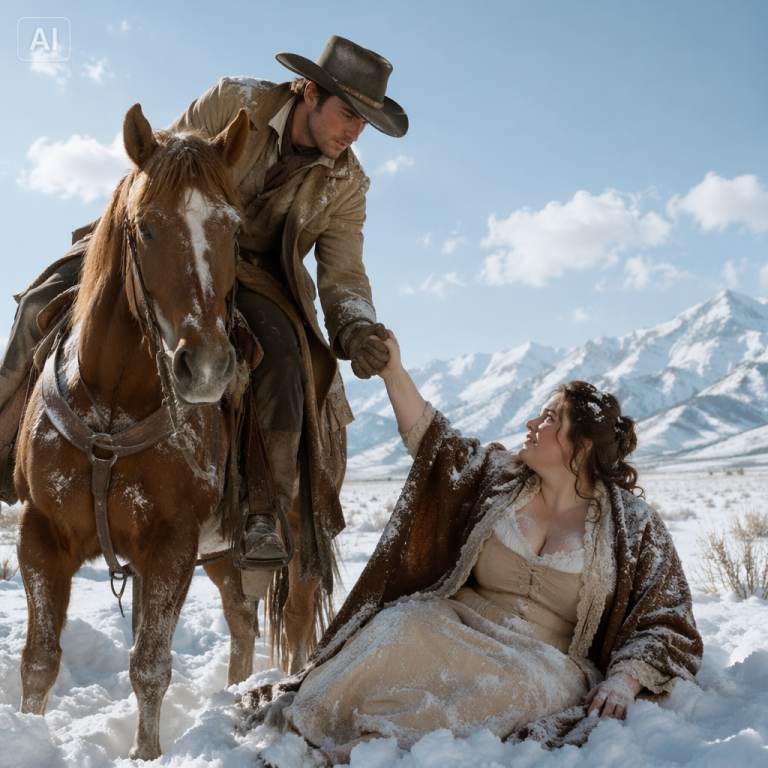
Rhett Mercer almost didn’t stop. He’d been riding since before dawn, pushing his horse through a storm no sensible man would have ridden into, because the supply run to Caldwell Creek couldn’t wait, and because Rhett Mercer had never once in his life been accused of being sensible.
He knew this platform. He didn’t know the woman buried in four inches of fresh powder, her boots wrong for the weather, her lips gone the color of a bruise. She might have been sleeping. She might have been dead.
He pressed two fingers to her throat. A pulse. Faint. Too faint.
“All right,” he muttered to no one. “Come on, then.”
He got her draped across his saddle and led his horse the whole frozen way back to Iron Hollow Ridge, the ranch his father had built to outlast him — which it had, twice over now, with the old man buried behind the east pasture and Rhett’s wife Margaret beside him four years back, a wound that had never quite closed right.
She slept two full days. On the third morning, Rhett found her sitting up, a blanket around her shoulders, looking at the window like she was working through a long, difficult calculation.
“Elena Voss,” she said, before he’d asked. Her voice was rough. “That’s my name, in case you were going to ask.”
“Rhett Mercer. This is my land.”
“I know. Your cook told me.”
He set a cup of coffee on the table beside her. She held it in both palms without drinking — warming her hands first — and something about the private economy of that gesture made him look away.
“Where were you going? Before Black Hollow.”
“South,” she said. “South is a direction. It’s not a destination. It was what I had.”
He didn’t push. He’d learned, from years on this land, that there were things people told you when they were ready, and things they carried to the grave, and no amount of asking changed which was which.
“You can stay until you’re on your feet,” he said. “After that, we’ll figure out the rest.”
She was on her feet in five days. Riding fence in two weeks — quiet hands, good seat, a woman who’d clearly grown up on horses even if she wouldn’t say where. Shooting tin cans off posts by the third week, flinching on every shot until, one cold morning, she didn’t anymore.
“Better,” Rhett said.
She reloaded and went back to work.
It was a Tuesday in the third week when the truth finally pushed its way out of her, the way certain truths have to — not because you decide to tell them, but because the pressure finally wins.
“My father’s name was Cole Voss,” she said, facing the fire. “Ran the family ranch east of Mil Haven Creek. Three generations. Good land. Not large — but ours.” A pause. “There are men called the Graves Syndicate. You’ve heard of them?”
The name hit Rhett like a cold hand.
“They wanted our land,” Elena said. “My father told them no. Twice. Then one night in September, four men came. They burned the barn first, to drive us out. My father went to see.” Her voice went very steady — the steadiness of someone who has told herself she will not break. “He never came back inside. They shot him in the yard. I hid in the root cellar under the kitchen floor. I stayed there two days before I came out.”
The house was gone by then. The cattle scattered. A notice nailed to the front gate claimed the land had been seized for a debt her father had never owed.
“They fabricated a debt,” Rhett said.
“After they murdered him,” Elena said. She looked at him directly, dry-eyed in a way that was somehow worse than tears. “And then I am going to get it back.”
She said it the way a person states the temperature outside. Not a wish. Not a threat. A plain fact about the future.
Rhett Mercer, a man who had buried a wife and built a life on the principle that isolation was safer than attachment, looked at this five-foot-four, twelve-pounds-underweight stranger with frostbitten fingers and a story that would earn most people sympathy and nothing else — and felt something in his careful, sealed-off life start to give way.
“All right,” he said finally, and picked up his pen. “We’ll talk about what that looks like.”
He had no idea yet what the Graves Syndicate would send to his door once they learned she was alive. He had no idea a county clerk’s conscience would end up mattering more than any court in the territory. And he had no idea that the woman his horse had found frozen on a bench in the snow was about to become the reason he remembered what it felt like to have something worth defending.
—
PART 2
The Graves Syndicate wasn’t like the other outfits that had come through the territory chasing land. They had lawyers. They had money. And they had the particular kind of ambition that didn’t stop at the edges of the law, because they’d already bought the edges of the law.
Elena had gone to the marshal in Mil Haven. Told her there were no jurisdiction. Gone to the county sheriff. Same answer, different words. By the time she reached the judge who might have listened, the case had already been reviewed and closed before she arrived.
They’d bought half the territory, Rhett said quietly.
“Not a question,” Elena answered. “More.”
She’d sold her horse for a train ticket to nowhere in particular, run out of money, and ended up on a bench in the snow — following, as it turned out, the trail of the one horse in the territory that happened to belong to a man too stubborn to leave a stranger to freeze.
Rhett recognized the cattle brand she described the moment she named it — a V with a line through the bottom. He’d seen it two months back, on stock sold through the Caldwell auction, paperwork claiming a “liquidated estate.”
“They took everything,” he said. “And then they sold it.”
“Yes,” Elena said. “And then I am going to get it back.”
What followed was months of quiet, methodical work that had nothing dramatic about it and everything dangerous underneath — Elena learning the land the way she’d learned her father’s, riding fence with no one beside her, shooting every morning before the workday started, building a hand-drawn map from memory that laid out syndicate holdings with the precision of someone who’d watched a cancer spread and refused to look away.
“They’ll come here eventually,” she told Rhett one evening, finger on Iron Hollow Ridge. “Not because of me. Because you’re in the way of what they want.”
They started digging in. Trench lines along the north approach. Wire strung to funnel riders into predictable ground. Allies gathered from neighboring ranches who’d been quietly waiting for someone willing to stand instead of hope the trouble passed them by.
And underneath all of it, folded and carried close against her body since winter, Elena kept a list. Four names. Men connected to the night her father died. One name sat apart from the others — not an enforcer, not a hired gun, but the man who actually gave the orders. The operational son of the syndicate’s patriarch. A man named Doyle Graves.
She hadn’t told Rhett that name yet. Not because she didn’t trust him. Because telling him would make it a shared plan, and she didn’t know yet what she intended to do with it.
Then the first Graves man rode onto Mercer land with a letter offering to buy the ranch. Then a second, watching from the road, counting workers. Then bounty notices went up in Caldwell — first for her arrest on fabricated fraud charges, then, two days later, a second notice. Not for her arrest.
For her return.
Rhett read both in the kitchen, sitting very still in the particular way he went still when he was angry.
“They’re drawing in outside help,” Elena said. “Bounty hunters. People who won’t lose sleep over the details.”
Fourteen people stood between Iron Hollow Ridge and whatever the Graves Syndicate was about to send down that north approach. It was not, by any honest count, enough.
And nineteen riders were already coming.
—
PART 3
They came at dawn.
Elena had taken her position on the ridge crest before first light, cold enough that her breath hung in front of her like something solid, because she’d identified this ground as the strongest observation point weeks earlier and had been quietly preparing herself for this exact morning ever since. Nineteen riders came down the north approach in a loose formation that fanned out and slowed the moment it hit the first line of wire — wire that did exactly what Doss Garrett had built it to do.
“Hold until they cross the second wire,” Rhett’s voice carried up from below. Controlled. A man who’d decided not to shout.
She had the rifle. She had forty rounds. She was not going to use forty rounds on nineteen men — you didn’t shoot nineteen men and walk away from it, even on the right side of the law. But forty rounds meant choices, and choices were what the morning needed.
A big man on a black horse pulled up at the wire and called out toward the house. “Merc — send the girl out and we’ll talk terms.”
“There are no terms,” Rhett said.
The big man’s eyes found the ridge. He’d clearly been told exactly where to look. He held his gaze there a moment, and Elena held her rifle steady, and did not fire, because she needed him to move first.
He did. The shot came before she’d consciously processed that he’d drawn — the sound arriving the way gunfire always did at dawn, after the body had already clenched in anticipation. He was off by the length of a man. A warning, not a beginning.
She found his center mass in her sights. Then, deliberately, moved to his horse instead, because the horse hadn’t done anything to deserve today, and because a fallen horse and a thrown rider at the front of a formation did more damage to nineteen men’s nerve than a dead man who might make the other eighteen angry enough to charge.
The horse went down. The big man hit the ground hard enough that even from the ridge she could see he wasn’t getting up fast.
Then it broke open.
What followed was not clean — she’d known it wouldn’t be, and she’d prepared for the specific ugliness of it anyway. The wire did its work. The trenches did their work. Two riders’ horses pitched into the shallow cut on the east approach. Frank Cullen, dug in at the east fence with his brother and a quiet young man named Gil Maro, put down a rider who came up shooting blind, with a precision Elena watched and would not forget. A Mercer field hand named Tomas Reyes took a shot through the upper arm and went down cursing behind the barn wall. Fay, who’d refused to leave the property, sat in the root cellar under the kitchen with a shotgun she knew how to use and never had to.
By the time the smoke settled into the morning air, five of the nineteen riders were down. None of the Mercer people were dead — a margin so thin that when Elena climbed down off the ridge, her legs weren’t entirely steady, and she didn’t pretend otherwise.
Rhett had a cut across his face from wire or flying debris. He was looking at the retreating riders with the expression of a man accounting for things.
“The man on the black horse,” Elena said. “The one who gave the order to fire.”
“Doyle Graves,” Rhett said quietly. “He came himself.”
Elena looked out at the empty rise where the riders had disappeared over the horizon, and thought about being called *the girl*, like she was a thing to be handed over — like her father’s death had been a line item in a transaction.
“He’ll come back,” she said.
“Yes.”
“Good,” said Elena Voss, and meant it — not with the dark heat she’d carried out of the root cellar, but with something colder and clearer. The purpose of someone who has decided the thing ends here, on this ground, and that she will be the one to end it.
—
Rhett spent the two days after the siege writing — not letters this time, documentation. A detailed, careful account written in the register of a man who understood that what gets recorded before memory has time to soften is the most credible version of events. He had Doss sign a witness statement. Frank Cullen signed one. Gil Maro signed one in his quiet, neat hand. Elena signed one. He sent the full package to a Caldwell lawyer named Henry Castle, to a newspaper editor named Bess Whitmore who had a reputation for printing things powerful people preferred stay unprinted, and to a territorial Attorney General’s office that had already opened a thin file after a circuit judge dismissed a fraudulent boundary claim with a pointed note about “irregularities.”
“This alone doesn’t finish it,” Rhett said, sealing the last envelope.
“No,” Elena said. “But it makes finishing it harder to undo.”
Word came days later, through a land surveyor named Harlon Puit, that Doyle Graves hadn’t gone back east. He was eleven miles away, at a property the syndicate had seized two years before, nursing whatever the failed siege had cost him in the currency men like him valued most — the impression of inevitability.
He would come again. Different tactics this time. Patient, when he had to be. That was what made him dangerous.
“What if we don’t let him choose the next move?” Elena said.
She’d been thinking about it since before the attack, turning it over in the evenings when Rhett assumed she was just reading survey documents. A man named Kratic — the county official who’d signed off on every fabricated transfer, every forged debt, including her father’s — was nine miles the other direction. He had records. Men like him always kept records; it was how they maintained leverage over each other. If they had those records, the Attorney General’s thin file would have enough to move.
“You’re talking about going to the county seat,” Rhett said.
“I’m talking about going to Kratic directly,” Elena said. “Not to threaten him. To give him a reason to shift his own calculations.” She met his eyes. “A ladder down from a building that’s starting to burn. His choice whether to use it.”
They rode out before dawn the next morning, taking a back road into Harrow’s Fork. Kratic answered his own front door — a sloped-shouldered man of fifty with the eyes of someone who’d spent a long time looking at things he couldn’t fully look away from — and went very still when he saw who was standing there.
“You should leave,” he said.
“If anyone sees,” Elena said. “Then let’s go inside. So no one sees.”
Inside, in a parlor too neat to be comfortable, Kratic told them what he already knew — that the Attorney General had a file, that the Gazette had run two stories, that the syndicate would not survive this intact. The only question was whether he went down with it.
“You were part of it,” Elena said — not with cruelty, just directly, because he knew it as well as she did. “I’m not here to absolve you of that. I’m here to tell you there’s a difference between being part of something and being willing to keep being part of it.”
He gave her a name — a federal land investigator who’d left a card three months back — and told them the records weren’t in his office anymore. He’d moved them six weeks earlier, the moment the Gazette ran its first piece, into a locked box held by a notary in Caldwell who had no idea what she was storing.
“He’ll hold,” Rhett said, once they were back outside.
“He’s not a brave man,” Elena said. “But he’s a tired one. They do the same thing sometimes.”
The box, when Castle opened it that evening, was heavy — which was a good sign. Heavy meant thorough. Correspondence between Kratic and the Graves holding companies describing the fabricated-debt scheme explicitly. Names. And, near the bottom, the Voss transfer — her father’s forged debt, the syndicate’s authorization to transfer the land, and the name of the man who’d approved the enforcement action against a ranch east of Mil Haven Creek.
Doyle Graves.
Rhett reached across and put his hand over hers on the arm of the chair. Just a moment. Not a gesture meant to be noticed. She felt the weight of it anyway.
—
Three days later, Doyle Graves came back to Iron Hollow — not with nineteen men, but with four, and a white cloth tied to a saddle.
“I’d like to talk,” he called from the south fence.
“You sent nineteen men through my wire,” Rhett called back. “Civil is a stretch.”
Graves’s eyes found Elena and held there. Up close he looked older than the eastern-businessman image she’d built of him in her mind — something more frontier than she’d given him credit for, and something visibly recalculating behind his eyes.
“The Attorney General’s office contacted my lawyers yesterday,” he said. “A federal investigator arrives next week.” A pause. “I want to understand what kind of resolution you’re looking for.”
Nine months. A root cellar, a frozen platform, borrowed boots, a hundred-and-thirty-yard rifle shot, a folded list of names carried against her chest since winter. Elena had imagined this moment a hundred ways.
“Give back the land,” she said. “Every property acquired through the debt scheme. Every ranch taken through a fabricated transfer, back to the people it was stolen from, or their families.” A beat. “The Voss land first.”
“That’s not a negotiation,” Graves said. “That’s a demand.”
“Yes.”
He was quiet a long time. Not a moral recognition — she knew that much about men like him. Arithmetic. The cost of fighting this against the cost of settling it, weighed against internal correspondence with his own name on every page.
“I’ll need thirty days,” he said finally.
“You have three weeks. Castle’s office will supervise.”
He turned his horse and rode away with his four men, the white cloth moving against the summer air. He believed, Elena understood, that returning the land would make the federal file go quiet. It wouldn’t. But the land came back first, and that mattered more to her than watching him understand his mistake.
“Your father would have liked you,” Rhett said, once the road was empty again.
It wasn’t a complicated statement. That was exactly why it landed the way it did.
“He did like me,” Elena said quietly. “I’m still figuring out how to be the person he thought I was.”
—
The three weeks passed with the particular tension of time being measured. Castle’s office became a small, relentless machine — transfer documents, boundary confirmations, the slow and unglamorous reversal of two years of fabricated legal architecture. Elena read every update at the kitchen table with the same careful attention she’d given the survey documents in winter, looking for the gaps, the false stones a good lawyer might try to leave standing.
The Voss transfer completed first, on the seventeenth day. Rhett had the papers waiting at the table when she came in from the barn with hay still in her hair. She read through them slowly, the way she read everything now — looking for what was wrong.
There was nothing wrong. The land her grandfather had first broken, that her father had worked for thirty years, that had burned on a September night while she lay in a root cellar listening to strangers walk over her head — it was hers.
She didn’t cry. What she felt instead was quieter than that. A door that had been held shut by pressure, finally swinging free.
“It’s done,” she said.
“First part,” Rhett said.
The second part ran on its own slower track. A federal investigator named Judith Crane spent six weeks in the territory conducting interviews that left a great many men in Harrow’s Fork reassessing their life choices. Kratic testified — carefully, on negotiated terms, but thoroughly — and his cooperation reduced, without erasing, the consequences that eventually found him. Doyle Graves, who had believed a land transfer would make a federal file disappear, learned otherwise in October, arrested by marshals whose jurisdiction the county’s purchased lawmen didn’t reach. The syndicate, built entirely around one man’s authority, collapsed the way overbuilt things collapse — all at once, and then completely.
Not every family got their land back. Some properties had passed through too many hands to untangle. Those losses stayed in the ledger of things that could be acknowledged but never fully undone. But most did. Clara Maro’s ranch, never formally seized, stood as it always had. The Cullen brothers went home to their cattle. Frank sent a note to Iron Hollow that read, in full: *Good result. — F. Cullen.* Three words that, from Frank, carried considerable warmth.
—
Elena rode to the Voss ranch alone in September, three weeks after the transfer completed, without quite deciding to make the trip until she was an hour out and realized she hadn’t told anyone where she was going.
The land came up familiar the way places do after long absence — the creek crossing, the willows going yellow-green, fence lines her father had built and rebuilt over thirty years, sagging now but still there, still defining the shape of the thing.
The house was gone. She’d known it would be. What remained was a stone foundation standing in tall grass, and near where the kitchen had been, a weathered wooden hatch with a rusted iron handle. She did not open it.
She stood in the foundation a long time, in the September light, and understood something true rather than something large. That her father had loved this ground the way you love something you built rather than something you were given, and that the love had passed to her the way the deepest things pass between parents and children — not through instruction, but through years of watching someone treat a piece of earth like it mattered.
She understood, too, that she was not the person who had hidden in the root cellar anymore. Not because she’d stopped being afraid, but because she’d learned, through months of ground and people and work, that the only thing worse than the fight was the cellar. That the darkness you choose is still darkness. That choosing it only separates you from the people who might help you carry it.
That, she thought, was what Iron Hollow had given her. Not safety exactly. A picture of what it looked like when people stayed.
She rode back at dusk. Rhett was on the porch when she came in, and he read her face the way he’d learned to read her without needing an explanation.
“I don’t think I can go back there to live,” she said. “The land is mine. I’ll keep it. Lease it to someone who’ll work it well.” She looked at the house behind him — the stone and timber, the wraparound porch, the warm window light. “But it’s not home anymore. I didn’t know that until I went back.”
Rhett was quiet a moment. “Iron Hollow could use a second opinion on most of its major decisions,” he said finally. “Doss agrees with me about seventy percent of the time. That’s not enough disagreement for good outcomes.”
“That’s not a particularly romantic argument.”
“No,” he agreed. “I’m not a particularly romantic man. You’ve had enough time to know that.”
She had. She also knew he’d sat with her through a winter of her worst grief without once trying to hurry it along. That he’d handed her a rifle and taught her to use it and never made it mean anything except that she needed to know how. That he’d put his hand over hers for one unremarkable moment in a lawyer’s office and made no performance of it. That he’d told her, at a fence line in the summer morning, that her father would have liked her — and meant it like a fact, not a comfort.
“All right,” she said.
“All right,” he said.
—
The years did what years do.
She leased the Voss land to a careful young couple who asked about soil and water rights and said nothing about the burned house or the root cellar, which she appreciated more than she could have explained. She watched the ground become something new without ever pretending the new erased what had been there before.
A seventeen-year-old named Mara Quinn walked up the road to Iron Hollow on an ordinary Tuesday two springs later, thin in the way that comes from not eating enough, eyes steady in the way that comes from learning to look unafraid when you aren’t. She asked at the gate if there was work. Elena looked at her and felt something shift in her chest that had everything to do with a train station bench and a particular quality of snow.
“Have you eaten today?” Elena asked.
“No.”
“Then come inside.”
Mara stayed. She was stubborn in the way people who’ve survived alone are stubborn — armor first, habit second — and it took months before she stopped expecting every kindness to be taken back. Elena taught her to really ride, the way Doss and Frank Cullen had once corrected Elena herself, passing the lesson forward the way lessons like that travel. She taught her to read a fence line, a survey map, the specific weight of ground worth defending. She did not teach her to shoot, because Mara didn’t need it yet, and you didn’t hand people tools for problems that weren’t in front of them.
What she gave Mara that had no name was the thing Rhett had given her that first winter — the experience of being somewhere the people around you were not going anywhere.
Doss’s knees went, then his back, and he retired to the small house behind the barn, carving wooden figures he gave away to no one in particular and teaching Mara card games on slow afternoons. Rhett aged the way strong men age — slowly, then suddenly — and after a fall at sixty-two never fully recovered the easy movement in his right shoulder, and ran the ranch from closer quarters after that, which annoyed him less than Elena expected. Not resignation. A gradual willingness to trust that what he’d built was solid enough to stand without his hands on every part of it.
They were not a fairy-tale match. They argued about money and timing and how much rope to give Mara. They had seasons of distance the way any long partnership does. But they chose each other continuously, in the daily decisions of a shared life, in a way that had a depth the first, desperate choosing never could have had on its own.
Rhett died on a November morning in his sixty-ninth year, in the house he’d been born in, built, lost, and defended, looking out the east window at the ridge he’d walked every day of his life. It was not dramatic. Two weeks of illness the Caldwell doctor couldn’t fully name, then a few tired days, then he was gone. Elena sat with him after, the way she’d learned to sit with things without rushing herself past them.
She had buried her father at twenty-three and believed, then, that loss worked on a scale — that the size of a grief defined some kind of limit. What she understood now was that loss didn’t work on a scale at all. Each one had its own shape. What you got better at wasn’t feeling less. It was carrying it differently — not buried, but integrated, the way you carry a scar. Present. Real. Never the only thing about you.
—
Mara took over the ranch’s management in the years after, ready for it the way people are ready for things they’ve been quietly preparing for without knowing it. Elena didn’t retire — she wasn’t built for it — but she changed the proportion of things. Less of the work that needed strength she was conserving. More of the long evening conversations at the kitchen table about what the ranch was and where it was going. She planted, at last, the garden along the south wall that Rhett had always meant to plant and never had, and was terrible at it for two years, and better after that, and found it accurate to her own life that she could still be a beginner at something, even now.
A territorial official came in the spring of her fifty-sixth year to tell her, formally, that the bounties fabricated against her by the Graves Syndicate had been cleared from the record for good. A dry, procedural piece of paper, more than a decade late. What moved her wasn’t the paper. It was a conversation with Mara that same evening, on the porch in the spring dark, when Mara finally asked, bluntly, what that first winter had actually been like — the platform, the frozen bench, the root cellar before all of it.
“I had nothing,” Elena said. “I had a name and a story that made people uncomfortable, and the anger was the only thing that still felt like mine. I kept it like a lantern. It was the only light I had.” She looked at the dark ridge. “What I didn’t understand then was that you can see by anger. You can’t navigate by it.”
“What do you navigate by?” Mara asked.
“People,” Elena said. “The ones who stay.” She looked at her. “And what you’re willing to build.”
She gave Mara the full title to Iron Hollow in her sixty-third year — not a departure, but a deliberate redistribution of weight, so the land could keep moving forward without her having to carry all of it alone. She kept the second bedroom. The garden. The long evenings watching the ridge go dark.
She kept the list, too — moved years earlier from her coat pocket to a small box on her bedside table, alongside her father’s watch and a pressed wildflower Mara had once put wordlessly into her hand. The names on it had met imperfect, unsatisfying ends, the way real consequences so often do — one dead before the law ever reached him, others serving time and disappearing into whatever remained of their own lives, Doyle Graves dying two years after a conditional release from federal confinement, in an eastern city whose address she never learned. She had stopped expecting the feelings about any of it to resolve into something clean. She had come to believe that was the honest condition of the worst things that happen to a person — they don’t resolve. They just become the ongoing fact of having survived them, and built something anyway.
—
She was seventy-one when she died, on an early spring morning, the garden along the south wall just beginning to show its first pale green, the ridge clear against a blue sky. Mara found her in the porch chair with a cup of coffee gone cold beside her. She didn’t look like someone whose story had ended. She looked like someone who had set down something heavy, at last, and rested.
People came from the valley, from Caldwell, from the county seat — Clara Maro’s granddaughter, an old man who turned out to be Tomas Reyes, sixty years of weather on his face, standing at the grave with his hat in his hands. Bess Whitmore’s paper, changed hands twice by then but still running, printed a short piece that said very little in a lot of words, and then one true thing: that Elena Voss had made a decision in a root cellar in September of 1887 not to stay where it was dark, and that the decision had consequences that outlived her.
Mara buried her beside Rhett, where she belonged, though neither of them had ever needed to say so out loud.
Iron Hollow went on. The cattle moved through the seasons. The fences needed work every spring, the way fences always do. Mara ran the place with the same stubborn, careful attention she’d arrived with — a saddle bag, no plan, and a question at a gate — and made her own mistakes, and found her own way to the same true things Elena had found, not as repetition, but as continuation.
The pasture lines Cole Voss first walked were long since rebuilt, and rebuilt again, but they were still the same lines. The creek at the lower Voss property still ran the same water. The ridge at Iron Hollow still caught the same light every morning over the east pasture, and whoever stood watching it — Mara, or the people after her — stood on ground that had been fought for not out of pride, but out of the plain belief that what you build with your hands, and your choices, and your willingness to stay, deserves to last.
It was not a perfect story. It was a true one, which is a different thing, and sometimes harder to tell.
But it is worth telling for the same reason any of them are: because somewhere, on some ordinary Tuesday, there is a person at the bottom of a very dark place, holding the only light they have — anger, or grief, or the bare stubborn fact of still being there. And what they need is not a miracle. What they need is the knowledge that someone else stood in that same dark once, and found their way to something worth standing in the light for.
Elena Voss found it.
Iron Hollow endured.
That is enough.
**THE END**