“You Broke Me Enough…”—The Humiliated Wife Walked Away, While the Mafia Boss Watched It All

## PART 1
The bruise was four days old, which meant it had moved from purple to the particular yellow-green that makeup could still cover, which meant no one at the Whitfield Gala would know it was there.
Adriana Reyes had become very good at this kind of math.
She stood at the vanity mirror in the master suite of the penthouse her husband had purchased specifically because it was higher than every building in their neighborhood, and she applied concealer with the practiced patience of someone who had stopped being angry about needing it.
The necklace rested on the dressing table.
Eighteen-carat gold. Colombian emeralds. A gift from Caldwell’s “business trip” to Bogotá that she had learned, six months after the fact, was not a business trip.
She clasped it anyway.
Because that was also the math.
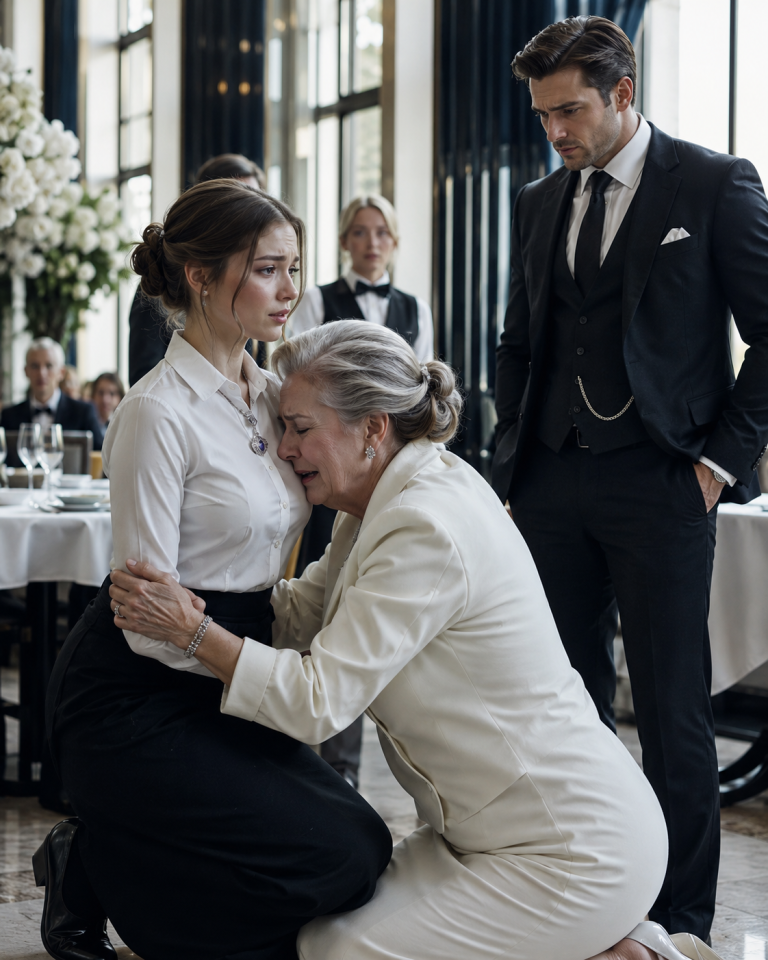
Forty minutes later, she was standing in the Whitfield Hotel ballroom with a glass of champagne she had not touched, wearing a dress Caldwell had selected, smiling at people Caldwell needed, while Caldwell himself stood twenty feet away with his hand resting on the lower back of a woman whose name Adriana had never been told and did not need to be.
She had been here before.
Not this exact room. This exact dynamic.
The champagne glass was cold in her fingers. The band played something meaningless. Around her, Chicago’s version of royalty — the developers, the aldermen, the people who owned buildings that contained people — talked loudly about things that mattered enormously to them and nothing at all to her.
Caldwell looked across the room at her.
Not a loving look.
A calibrating one. Checking the dial. Making sure the reading was still in the acceptable range.
Adriana looked back.
For eleven years, three months, and some number of days, that look had made her lower her eyes.
She did not lower them.
Caldwell’s mouth thinned slightly. He leaned toward the woman beside him and said something that made her laugh.
Adriana set her glass down.
She crossed the ballroom floor.
Not toward the exit. Toward him.
The space between them closed in a way that made the nearest conversations pause. Something in her posture communicated itself before she arrived — a change in pressure, a shift in the air. Caldwell turned, registering her approach with the too-smooth composure of a man who had controlled rooms for twenty years.
“Adriana,” he said pleasantly. “I was just telling Simone about the Lisbon project.”
Simone’s smile was professional and empty.
Adriana looked at her husband.
“Tell me again,” she said, “what you told me in the car on the way here.”
Caldwell’s eyes sharpened. “This isn’t the moment.”
“You said I was an asset that had depreciated.” Her voice was conversational, almost light. “You said you had been patient but patience had a cost-benefit analysis. You said you were already in the process of upgrading.”
Someone nearby had stopped talking.
Then someone else.
Caldwell’s jaw was perfectly controlled, but his eyes had gone cold. “You’ve had too much to drink.”
“I haven’t touched it.”
“Adriana—”
“I want everyone in this room to understand something.” She was not raising her voice. She did not need to. The ballroom’s acoustics were doing it for her. “This man told me, forty minutes ago, that I was a depreciated asset being upgraded. He told me in those words. He has been telling me versions of this for several years, in private, where no one could hear it except me.”
Total silence.
Caldwell stepped toward her, smile returning, hand extending. The concerned husband. The steady one. “She’s been under significant stress—”
“Don’t touch me.”
He stopped.
Adriana reached up.
She unclasped the necklace.
It came free from her throat and she set it, carefully and deliberately, on the tray of a passing waiter.
“Give that to Simone,” she said. “It came from a trip he told me was business.”
Simone’s professional smile flickered.
The ballroom was absolutely still.
Caldwell Reyes looked at his wife with the particular fury of a man who has been publicly removed from a narrative he believed he controlled.
“We are leaving,” he said quietly, “right now.”
“You’re leaving,” Adriana said. “I’m not.”
She turned and walked toward the doors.
—
The hotel lobby was cool and enormous after the ballroom’s heat. She crossed it without stopping. Through the revolving doors. Down the steps. Into the November wind off the lake.
She had no coat.
No phone.
No plan.
Her sister Gabriela had not been returning calls for three weeks, which Adriana now understood was because Caldwell had spent three weeks making it extremely inconvenient to know her. Her friends had thinned the way they always thinned around powerful men — not all at once, not dramatically, just gradually, like water leaving a glass that no one refilled.
She walked for six blocks before she acknowledged that her feet were beginning to hurt and she did not know where she was going.
The café appeared at the corner of a narrow street that smelled of bread and coffee and the first real warmth she had encountered in hours. A young woman was wiping down the window from inside. She looked out, saw Adriana, and opened the door.
“Come in, come in, you’re freezing.”
Her name was Pilar. She brought tea without asking.
Adriana sat in a back booth and held the mug and thought about the specific mathematics of her life — what she had given, what had been taken, what remained, and whether anything remained could be called a foundation.
She did not hear the man approach until he was standing beside the booth.
“Adriana Reyes,” he said.
She looked up.
Dark coat. Dark eyes. The particular stillness of a person who had learned that stillness communicated more than movement.
“I don’t know you,” she said.
“No.”
“Then how do you know me?”
He looked at her in a way that most people did not — not at the dress, or the carefully composed face, or the woman who had walked out of a ballroom without a coat. At her.
“Because I was at the Whitfield tonight,” he said, “and I have been watching Caldwell Reyes for two years.”
—
## PART 2
He sat across from her without asking.
She noted this — that he asked for nothing, including permission — and filed it somewhere complicated.
“My name is Sebastián Varela,” he said.
Adriana heard the name land somewhere in the back of her mind with the particular weight of something she had been told not to notice. Varela. The kind of name that appeared in federal court documents and real estate filings and sometimes in the back pages of Tribune crime coverage, never in the headline, always implying a structure whose surface was not the whole story.
“And if I told you to leave?” she said.
“I would leave.” A pause. “But I would have someone follow from a distance until you were somewhere safe.”
Pilar set a second tea on the table without being asked.
Sebastián glanced at the cup, then at her. He placed two bills beside it without looking at the denomination.
Adriana watched him.
“What is it you want?” she said.
He was quiet for a moment, and in that quiet she observed something she had not expected from a man with that name: he appeared to be considering carefully how much honesty she could use and how much she could not.
“Caldwell has been buying distressed properties through shell companies for four years,” he said. “I have documentation on seven cases. In three of them, the displacement of tenants was accelerated through targeted harassment. In two, the properties were fire-damaged shortly before acquisition.”
Adriana’s hands went still around the mug.
Sebastián watched her face.
“Do you know about any of this?” he asked. Not accusatory. Genuinely asking.
“I know about a fire in Bridgeport three years ago,” she said. “I know because Caldwell came home that night and told me he’d been handling a problem. I know because I asked and he looked at me the way he looks when I’ve asked something I am not supposed to ask.”
“And then?”
“And then I stopped asking.”
She said it without shame. That was the most honest part of it. She had stopped asking not because she was complicit but because she had learned, incrementally and completely, that asking had a price.
“A woman named Yolanda Restrepo died in the Bridgeport building,” Sebastián said. “She went back inside for a neighbor. The neighbor survived. Yolanda did not.”
The words fell into the booth like stones into water.
Adriana knew what was coming before she asked. “Who was she to you?”
Sebastián looked at the table for exactly two seconds.
Then: “She was my cousin.”
The café was very quiet.
“I have spent two years building the documentation to end Caldwell’s operation,” Sebastián said. “What I do not have is access to his physical records. His internal ledgers. The original signed documents before they were cleaned for outside review.”
He looked at her directly.
“You lived in that house for eleven years,” he said. “You know where things are.”
And Adriana thought about a small room at the back of the house that Caldwell called the archive. That she had never been told to stay out of, because she had been trained not to go in.
She looked at Sebastián Varela.
“If I help you,” she said, “what happens to me?”
“That depends entirely on what you want to happen.”
Pilar appeared at the edge of the booth, her expression apologetic.
“I’m sorry,” she said quietly. “There’s a car outside. Dark windows. It’s been sitting there since you came in.”
Adriana and Sebastián both turned toward the window.
The car was black.
The plates were private.
And someone inside it was holding a phone.
—
## PART 3
Sebastián moved without dramatics.
He spoke two words into his phone — quiet, in Spanish — and then said to Adriana, “Is there a back exit?”
Pilar pointed.
They went through the kitchen, past a cook who pretended not to see them, and out through a delivery door into an alley that smelled of rain and restaurant waste. A different car was already at the alley’s far end. Not black. Dark gray. Engine running.
Inside was a driver whose name Adriana was not given and who drove with the careful focus of a person who had done this before and understood that the goal was inconspicuous, not fast.
Sebastián sat beside her. The space between them was deliberate.
“He found you quickly,” Sebastián said.
“He has a tracker on my phone.” She paused. “I don’t have my phone.”
“He may have tracked it to the café and sent someone to wait.”
“He does this when he thinks I’ve done something that requires correction.” She said it the way she said most things about Caldwell now — with the flat affect of someone describing a weather pattern. “He would call it collecting me.”
Sebastián’s jaw moved once.
“Where does he believe he is taking you?”
“Home. Where he will tell me I humiliated him in front of people who matter. Where he will be extremely controlled about it. Where I will understand without being told explicitly that what happened tonight cannot happen again.”
“Has he hurt you physically?”
She considered how to answer this for a moment. Not because she was uncertain, but because the word *physically* did it a disservice, made it smaller than it was, implied that the other kind was not also injury.
“Yes,” she said. “In ways he always had a reasonable explanation for.”
Sebastián was quiet.
Then he said: “Where would his records be?”
“There’s a room at the back of the house that he calls the archive. I was never told to stay out of it because I was trained not to go in without being told to. There’s a secondary filing system behind the built-in shelves — original copies of everything that gets cleaned before it goes to his lawyers.”
“How do you know about it?”
“Because I cleaned that room for three years before he had staff to do it. Because I have been invisible in that house long enough to see its architecture.” She looked at the passing city. “The combination on the concealed drawer is his mother’s birth year and the year he acquired his first property. He told me once. He thought I wasn’t paying attention.”
Sebastián looked at her with an expression that was not surprise, exactly, but something adjacent — a recalibration.
“You’ve been watching him,” he said.
“I’ve been surviving,” she said. “They look similar from the outside.”
—
The house they arrived at was not a fortress. That was the first thing Adriana noticed. It was a brownstone on a street with old trees, warm light in the front windows, and a door opened by a woman in her sixties named Consuelo who looked at Adriana’s bare arms, her missing coat, the composure she was wearing like armor, and said: “Come inside. I’ll find you something warm.”
Consuelo ran the house with the cheerful efficiency of someone who had seen situations like this before and chosen, each time, the side of the person who needed a coat.
She brought clothes, then food. She showed Adriana a bathroom and pointed to a brass bell on the shelf.
“You ring if you need anything,” she said. “Not him. Me.”
“Is that a standing instruction?”
Consuelo smiled. “For eleven years.”
Adriana found herself alone in a bathroom with hot water and the first real privacy she’d had in longer than she could name. She ran the bath. Stepped in. Looked at the fading bruise on her ribs where Caldwell’s elbow had connected with “accidental” precision four days ago.
She had stopped counting them years back.
Not the bruises — those she tracked with clinical accuracy, the way she tracked everything. She had stopped counting the number of times she had translated his cruelty into her inadequacy. The times she had decided she must have misremembered. The times she had chosen the explanation that let her stay.
The water went gray around her feet from the evening’s rain.
She sat in it and did not cry, which frightened her in a different way than crying would have.
—
Sebastián was in the library when she came downstairs.
He stood near the fireplace, not reading, just standing in the way of someone who was thinking and preferred to do it on their feet. He turned when she entered. She was wearing soft dark clothes that belonged to no one she knew, and she felt, in them, like someone whose shape had changed slightly.
On the mantel was a photograph: a woman with expressive eyes and a laugh caught mid-motion, standing in a garden somewhere that was not Chicago. Beside her, a younger Sebastián with his arm around her shoulders, looking at something outside the frame.
“Yolanda?” Adriana asked.
“Yes.”
“She looked like someone who laughed easily.”
“She was.” He turned back to the fire. “She could find something funny in nearly anything. I used to tell her it was going to get her in trouble. She said trouble that came from finding joy was the best kind.” A pause. “She was twenty-nine.”
Adriana looked at the photograph.
“Caldwell doesn’t think about people like her,” she said. “I want you to know I understand that now. I think I understood it for years and built a wall between understanding it and having to act on it. Because acting on it meant dismantling the only life I had.”
“You don’t have to justify that to me.”
“I know. I’m justifying it to myself.”
He looked at her.
“I know what it costs,” he said. “To stay when you know. I don’t think I would have made it out of that knowledge any faster.”
Adriana sat near the fire and held the silence for a moment.
“Tell me what you need from inside the house,” she said.
“The archive room. Original records, not copies. Particularly anything connected to the Bridgeport property acquisition and the two before it in Humboldt Park and Englewood. Any correspondence with city inspectors. Any records of payments that would explain how a fire report becomes a clean report.”
“He’ll have security on the property. He always does when he believes I’ve behaved badly.”
“I have people who can manage the external security.”
“He won’t have covered the greenhouse,” she said.
Sebastián looked at her.
“I built it in the third year. He has never used it, never shown any interest in it. He considers it something I did to fill time.” She looked at her hands. “The back wall of the greenhouse connects to the east corridor through a service door. The lock requires the key I still have because it never occurred to Caldwell that I would need a new one. From the east corridor, the archive room is forty feet.”
“You planned this,” Sebastián said.
“No,” she said. “I noticed this. Years ago. I filed it away the way I filed everything away, in case there was a future where I needed it.” She paused. “Tonight turned out to be that future.”
—
They went in at midnight.
Two of Sebastián’s people managed the outer security with the quiet efficiency of people running a long-rehearsed plan. Adriana and Sebastián entered through the greenhouse, which smelled of damp earth and the gardenias she had planted because she loved their smell and Caldwell could not enter without sneezing.
She had always found that privately satisfying.
The east corridor was dark. They moved through it the way she had moved through this house for years — quietly, with full awareness of which floorboards made noise.
Behind her, she could hear Sebastián moving and found herself surprised again by how quiet he was.
Forty feet.
The archive room.
She pressed the panels in sequence. The built-in shelves released.
Behind them: four drawers of the filing system she had dusted for three years before staff had been hired.
The combination turned without resistance.
Inside: original documents. The real ledgers. Signed inspection reports with both a clean copy and, beneath it, the original. Correspondence routed through a server address she did not recognize. A separate drawer of property deeds with acquisition dates and purchase prices that told, plainly to anyone who knew how to read them, the story of how Caldwell had acquired distressed properties at catastrophically low prices in the weeks following fires that officials had signed off as accidents.
Sebastián was photographing each page with quiet methodical focus.
Then Adriana opened the last drawer.
And found her own name.
A folder. Cream-colored. Thick.
She stood with it in her hands for a moment before she opened it.
Medical records she had not requested.
A psychiatric evaluation she had not attended, signed by a doctor she had never seen.
A declaration from Caldwell’s legal team certifying that she had a documented history of emotional instability.
Draft divorce filings assigning all marital assets to Caldwell Reyes.
And beneath that, a life insurance policy.
Eight million dollars.
Beneficiary: Caldwell Reyes.
Policy opened: four months ago.
Adriana stood very still.
Sebastián had stopped photographing.
He was looking at her.
“He was planning this before tonight,” she said.
“Yes.”
“The gala was not a mistake. It was a trigger. He wanted me to leave publicly. He wanted witnesses who would describe me as unstable. He wanted the evening to go exactly the way it went.”
“Yes.”
She closed the folder.
“He knew I would walk out,” she said. “He engineered it.”
“He needed a public incident to support what the documents say.”
Her hands were steady. She found this remarkable.
“If he had taken me home tonight instead of having me collected at the café—”
“You would have had an incident of some kind,” Sebastián said. “Something that could be described as a crisis. Something that required medical intervention. Something that supported the narrative already prepared.”
The archive room was very cold.
Or perhaps it was her.
“How long have you known this?” she asked.
“That the documentation existed? Three days. That he was planning something that required your removal? Since the insurance policy was flagged by a contact six weeks ago.”
“You came to the gala tonight specifically for me.”
“Yes.”
She looked at him.
“You could have told me sooner,” she said.
“I could have,” he said. “I wasn’t sure I had the right. You were not a case to me. You were a woman living inside a danger I could describe but could not make you believe without showing you. I was watching for the moment you could see it clearly.”
“The car on the way here,” she said. “He told me I was a depreciated asset.”
“Yes.”
“You heard it.”
“I was two tables away.”
She breathed in.
Then out.
“Document everything,” she said. “All of it.”
From above them, the sound of the front door.
Then Caldwell’s voice, carrying through the house with the particular resonance of a man who had never needed to raise it to make rooms obey.
“Adriana.”
Sebastián moved instantly.
He pulled the shelves shut. She reset the combination. They pressed themselves against the far wall of the archive room in the dark.
Caldwell’s footsteps in the corridor.
Closer.
“I know you’re here,” he said. “The greenhouse door sensors, Adriana. I had them installed last year.”
He stopped outside the archive room.
“This is disappointing,” he said, through the door. “I thought better of you, honestly. The scene at the Whitfield was embarrassing enough. This is just sad.”
Neither of them moved.
“Come out,” Caldwell said. “We can end this quietly. The alternative is that I call the police and report that my wife has broken into our family home with an associate, and then the story writes itself.”
Sebastián’s phone vibrated once.
He read the screen.
He looked at Adriana.
*Federal agents arrived at front gate. Tip received from anonymous source. Warrant for property records.*
Adriana stared at the screen.
Sebastián almost smiled.
He typed back: *Go ahead.*
Outside the archive room, Caldwell heard something. A different sound. Something from the front of the house that was not what he had expected.
He moved away from the door.
They heard his footsteps accelerating.
Then his voice — and this was new, this was the first time in eleven years she had heard it with this quality — afraid.
“Who authorized— this is private property— I have a lawyer—”
The federal agents, it emerged, had arrived with a warrant specific enough that Caldwell’s lawyer was going to have an extremely busy morning.
Sebastián had submitted the digital copies of the archive room documents to a federal contact thirty seconds after photographing the last one.
The tip had been sent six minutes before they entered the house.
Adriana looked at him.
“You had this planned,” she said.
“I had contingencies,” he said. “I did not know what we would find in the archive room. I knew what I had from two years of building the case. Tonight was the final piece.”
“The insurance policy.”
“The insurance policy confirmed what the pattern suggested. I needed it documented.” He paused. “I’m sorry you had to see it.”
“I’m not,” she said. “I needed to see it. I needed to see his handwriting on the reason I was supposed to disappear.”
—
Adriana sat in a federal building for four hours.
She answered questions with the precision she had developed over years of being someone whose words were always potentially used against her, which meant she had learned to say exactly what she meant and nothing that could be reasonably misinterpreted.
The agent across from her looked at her twice with an expression she recognized from other women: the look of someone who understood the specific exhaustion of having survived a long and careful unraveling.
Sebastián waited in the corridor outside.
Not pressuring. Not pacing.
Just present.
At two in the morning, when she emerged, he was sitting in a chair reading something on his phone with the deep focus of a man who had learned to use waiting productively.
He looked up.
“Okay?” he asked.
It was a small word.
A real one.
“Not yet,” she said. “But I will be.”
He nodded as though that were a complete answer, which it was.
—
Caldwell Reyes was arrested at the front gate of their home before he could reach the private car he had called.
The agents found, in the archive room, enough documentation to open investigations into fourteen properties and initiate charges on six. The inspector who had signed the Bridgeport clean report had his own records examined and found to contain twenty-two similar signatures over eight years.
The city council member who had approved three expedited permits was placed on administrative leave.
The woman named Simone from the Whitfield gala gave a statement to federal investigators two days later.
Caldwell’s lawyer issued a statement describing his client as the victim of a coordinated smear campaign by criminal elements.
The statement was the lead item on the evening news for approximately six hours, after which the documentation became the lead item, and the statement was not mentioned again.
—
Three months later, spring was arriving in the stubborn and sideways manner it always arrived in Chicago — too cold in the morning, too warm by afternoon, the trees not quite ready to commit.
Adriana stood outside a building on a street in Bridgeport.
The building was new.
Not new-new — it had been built in the 1920s and had bones that would outlast everyone present — but newly renovated, newly occupied, newly returned to the function buildings were supposed to serve. The displacement that had preceded the fire had been partly reversed through a foundation that Sebastián had operated, carefully and quietly, for three years. Not all of the families had returned. Some had built lives elsewhere. But the ones who wanted to come back had a place to come back to.
On the wall beside the entrance, someone had painted a mural.
A woman with expressive eyes and a laugh caught mid-motion.
Yolanda.
Adriana stood in front of it for a long time.
Sebastián stood beside her.
He had been doing that more frequently — standing beside her, at whatever distance she needed, without requiring her to name what the distance meant. She was learning, slowly, how to be in a space where proximity was not a form of ownership.
It was taking practice.
She was willing to practice.
“Consuelo wants to know if you’re coming to dinner,” he said.
“Is she making the soup?”
“She’s always making the soup. The soup is a permanent condition of being associated with Consuelo.”
“Then yes.” Adriana paused. “Tell her yes.”
She looked at the mural one more time.
“She would have laughed at all of this,” she said. “Found something funny in it.”
“Trouble that came from finding joy,” Sebastián said, “is the best kind.”
He had told her that story a month ago, and she had told it back to him now, and he received it without comment, which was its own kind of answer.
They walked.
The street was moving around them — the particular alive movement of a neighborhood that had chosen to remain — and Adriana found herself thinking about the necklace she had set on a waiter’s tray in a ballroom three months ago.
She had not missed it once.
She had, gradually, stopped calculating the price of things.
Not the financial kind — those calculations remained, were practical, would probably remain for years as the legal process took its time and her life was rebuilt from the material that remained after everything borrowed was returned.
The other price. The one she had paid daily for eleven years without accounting for it.
That calculation, she was learning, had been a con.
The math that told her smallness was safety.
The math that said enduring was the same as surviving.
The math that made three seconds — the time it took to unclasp a necklace — feel like the bravest thing anyone had ever done.
She had done braver things since.
She would do braver things still.
Behind her, the mural of Yolanda watched the street with painted eyes that somehow looked like they were still looking for something funny.
In the building, on the second floor, someone had hung wind chimes in a window.
The spring wind moved them.
They rang.
—