They Sent Away the Daughter No One Wanted — Then She Became the Only Woman a Lonely Mountain Man Would Ever Treasure

PART 1
The Blackwood house woke early that Tuesday, but no one expected the letter that reached the front gate before the coffee had even finished boiling. The messenger’s smile wasn’t a friendly one — it was the kind people wear when they know something the household doesn’t yet. When Samuel Blackwood broke the seal and read the first lines, his expression sharpened into something eager. This wasn’t ordinary news. It was opportunity.
Ezra Stone, the most prosperous mountain man in the neighboring valley, was asking for the hand of one of Samuel’s daughters. Everyone in three counties knew his name — wide land, strong cattle, a reputation nobody had a bad word for. Samuel didn’t smile often. That morning, he did.
He called Martha and their two older daughters into the sitting room. Rebecca entered like she was stepping onto a stage — perfect posture, perfect hair. Clara followed, graceful in the practiced way of a woman who had spent her whole life being looked at and had learned to enjoy it. Both were the pride of the family, prepared for marriage the way other families prepared land for planting. In their minds, any sensible man would choose one of them without a second thought.
Samuel handed Martha the letter. She read it aloud, voice climbing with excitement — until she reached the name of the daughter Ezra had actually asked for, and paused just long enough for something strange to cross her face.
“He wants Sarah.”
The room went silent for one full breath. Then Rebecca laughed, sharp and cutting, and Clara joined her — not warm laughter, not joyful, the kind only people who enjoy someone else’s humiliation know how to produce. Martha tried to hide her own delight and failed. Samuel leaned back in his chair, eyes lit with something closer to satisfaction than surprise.
“He asked for Sarah,” Martha repeated, as if saying it twice would make it funnier.
“He must not know anything,” Rebecca said, shaking her head.
“Not a single thing,” Clara agreed.
Not one person in that room felt worry. Only triumph.
While her family celebrated what they believed was a perfect trick, Sarah was behind the house pressing a cool cloth to her sick grandmother’s forehead — up before sunrise as she was every day, feeding the old woman, cleaning her room, carrying her through the worst of her illness without complaint and without expecting thanks. When laughter rose from the sitting room, something in its pitch made her go still. She knew that tone. It was the sound her family made when they were planning something unkind.
Sarah Blackwood had never belonged to the world her parents valued. At twenty-four, she was the strong one, calloused hands, plain speech, the one who stood up the moment she saw someone being mistreated — and in that house, that made her the worst kind of flaw. She had exposed a merchant raising prices during a drought. She had revealed a magistrate’s corruption, at real cost to her family’s standing. She had defended neighbors who couldn’t defend themselves and never once apologized for it. For Samuel and Martha, that made her a problem. For her sisters, an embarrassment. Rebecca and Clara had beauty and charm. Sarah had honesty and courage — and in that particular house, those were treated as defects instead of gifts.
What none of them knew was that five years earlier, at a crowded market in Timber Ridge, Sarah had stood between a lying merchant and an innocent old man, bought the chicken he’d been falsely accused of stealing, and handed it back to him without a second thought. One stranger had watched the entire exchange from a few feet away. His name was Ezra Stone. The Blackwoods knew nothing of that day. They only knew they had, they believed, the perfect way to be rid of the daughter who kept causing them trouble.
“This is perfect,” Samuel said, rubbing his hands together. “We accept quickly and send her off. Let him deal with her stubbornness. Let him find out too late what she is.”
“He’ll expect a soft wife,” Clara said, chin lifted.
“And he’ll get Sarah,” Rebecca finished.
What none of them knew was that Sarah was standing in the hallway, and had heard every word.
*A problem not ours. Send her quickly. A blessing to be rid of her.*
The words hit her hard, but they didn’t break her — not anymore. She pressed her hand flat against the wooden wall and let the truth settle where she could finally look at it. Tears filled her eyes, but they weren’t tears of sadness. They were tears of something closer to waking up. She had given this family years of loyalty, the hardest work in the house, the honest choices no one else would make — and none of it had ever mattered. She was, and always would be, the wrong daughter. Too bold. Too honest. Too real.
If they wanted her gone this badly, she decided, then she would leave with her head up. If Ezra Stone truly wanted to know her, he would know the real Sarah. And if he rejected her, at least it would be for the truth, not for a lie her family had dressed her in.
She lifted the laundry basket and walked out into the yard, wind moving through her hair, and looked toward the mountains in the distance. In five days, her life would change completely. She didn’t know it yet, but somewhere in those mountains waited a man who had remembered her for five years — and the cruel joke her family thought they were sending him was about to become the best thing that had ever happened to her.
The morning of her departure came in under a sky the color of old iron. She’d barely slept, her mind replaying every word she’d overheard — the plan, the relief in their voices at finally being rid of her. Still, she rose before dawn, folded her few dresses into her grandmother’s old trunk, and packed a small Bible, one hair ribbon, and a stack of yellowed letters the old woman had written her over the years. No jewelry. No gifts. Her parents had never given her anything meant to matter.
Breakfast was silent, her parents wearing a performance of pride and concern that didn’t reach their eyes. Only her grandmother looked at her with anything real, her trembling hand closing around Sarah’s arm. “You will be happy, child,” she whispered. “A good heart always finds its path.” Leaving her behind hurt more than anything her parents had said.
A wagon arrived at eight, driven by a middle-aged man with kind eyes who helped load her trunk like she was someone who mattered — small enough a gesture that it made her chest tighten anyway. Samuel offered his goodbyes in the same false, important-guest voice he used for company. Martha added something similar that didn’t reach her voice at all. Rebecca and Clara waved from the porch with smiles too bright to be sincere.
Sarah climbed into the wagon without looking back, and the house that had never once felt like home disappeared slowly behind her.
The journey took most of a day — rolling hills, dusty roads, tall grass bending in the wind — and somewhere in the middle of it, Sarah stopped rehearsing her family’s cruelty and started wondering, honestly, what kind of man was waiting at the end of the road. She’d heard he was hardworking, fair, a man who’d built everything with his own hands. She’d also heard he lived alone, had never married, kept mostly to himself. Some called him too serious. Others said he had a temper — but only for lying, or disrespect.
None of it answered the one question sitting heaviest in her chest. Why had he asked for her, specifically, by name?
As the wagon crested the last hill, a stone homestead came into view — wide porches, straight fences, healthy livestock, the unmistakable shape of careful, honest work. And then she saw him standing on the porch, already stepping down to meet the wagon before it had fully stopped.
PART 2
He was taller than she remembered from the market — broad-shouldered, sun-darkened, hands rough with labor, but the eyes were the same steady, quiet ones she’d noticed five years ago without knowing why they’d stayed with her.
“Miss Sarah,” he said, his voice deep and unhurried. “Welcome to Stone Homestead.”
She lifted her chin and offered a light curtsy. “Thank you, Mr. Ezra.”
He helped her down, carried her trunk like it weighed nothing, and led her inside to a simple, sturdy sitting room where a fire glowed low in the hearth. Over coffee, the silence between them had a different quality than the ones she was used to at home — necessary, serious, the kind that comes right before an important question.
“Mr. Ezra,” she said finally, holding her cup with both hands. “I believe we should talk honestly.”
“I agree.” He set his own cup down and leaned forward.
“Why did you choose me specifically?”
He didn’t look surprised by the question, only ready for it. “Because I saw you five years ago, in Timber Ridge. I watched you defend an old man no one else cared about. I watched you stand up to a dishonest merchant when it would have been easier to look away. I never forgot the kind of heart that takes.”
Sarah’s breath caught. “You were there.”
“I was. And I never forgot what I saw. A woman who does what’s right, even when it costs her something.”
No one had ever described her that way — not kindly, at least. “My family considers those qualities a problem,” she said quietly.
“I suspected they might.” His voice stayed even, no shock, no anger, just the calm of a man confirming something he’d already guessed. “Sarah, I did not ask for a quiet wife. I asked for a brave one. A true one. Someone who cannot ignore injustice, someone who thinks with her own mind.”
“You don’t know everything about me,” she said. “I might disappoint you.”
“Or,” he said gently, “you might be exactly what my life needs.” He stood, walked to the window, and turned back to her. “I built this place with my own hands, but a home is more than wood and land. I want a partner, not a decoration. So — I have a proposal. We spend a few weeks getting to know each other honestly, without pressure. If we suit one another, we marry. If not, I’ll see you settled somewhere safe and respected, and there will be no shame in either outcome.”
No man had ever offered her a choice like that. “And if I accept,” she asked, “do you promise I can be myself?”
“Especially then.”
Her voice shook when she answered. “Then I accept.”
He smiled, and something warm opened in her chest for the first time in longer than she could remember. But as the weeks that followed unfolded — mornings with two saddled horses on the porch, evenings on the steps watching the sky turn colors neither of them had words for — Sarah began to understand that the real question wasn’t whether Ezra Stone could love the woman her family had thrown away.
It was whether she still knew how to let herself be loved at all.
PART 3
The weeks that followed felt like stepping into a life Sarah had never let herself imagine. Each morning began with sunlight through her window, the smell of fresh coffee, and Ezra already waiting with two horses saddled. He kept his promise from that first afternoon — he asked her opinion on the health of the cattle, the management of the fields, the placement of a new fence line, and then he did something Sarah’s own father had never once managed. He listened. Genuinely, all the way through, without waiting for his turn to talk.
She learned quickly that Ezra wasn’t simply hardworking. He was thoughtful in ways that showed up in small, unannounced moments — paying for a sick worker’s medicine before anyone asked him to, working a broken fence line beside his men instead of standing over them barking orders, treating every person on the property with the same plain respect he gave her. It unsettled her, at first, how much of it she wanted to believe. She had spent twenty-four years learning that kindness from her family always came with a hidden cost attached, and some nights she lay awake waiting to find Ezra’s.
She didn’t find one. That, more than anything he said, was what finally started to loosen something tight in her chest.
The long conversations at the end of each day surprised her more than the shared work did. They’d sit on the porch and watch the sky slide from pink to purple, crickets filling in the quiet, and one evening Ezra asked her, “Tell me something no one in your family cared to know.”
Sarah hesitated. No one had ever asked her that before. “I always wanted to teach children,” she said finally. “Not just reading and letters. I wanted to teach them how to think. How to tell right from wrong, even when it’s hard, even when it isn’t popular.”
Ezra smiled slowly. “I knew there was a reason you impressed me.”
He wasn’t only kind — he was honest in a way that made her recalibrate what honesty was supposed to cost a person. When something bothered him, he said it plainly instead of letting it curdle into silence. When he was unsure of something, he admitted it instead of pretending certainty he didn’t have. Sarah began to understand, slowly and then all at once, what a life could look like beside a man who valued truth instead of managing it.
There was one evening, about three weeks in, when a neighboring rancher visited for supper and spent most of the meal talking over her, correcting her opinions on cattle prices she happened to know better than he did. Sarah bit her tongue longer than she wanted to, old habits from a house where speaking up had always cost her something. It was Ezra who finally set his fork down and said, evenly, “My wife-to-be knows this market better than either of us. I’d like to hear the rest of what she was saying.” The rancher reddened and let her finish. Later, alone, Sarah told Ezra she hadn’t needed defending.
“I know,” he said. “I wasn’t defending you. I was correcting him. There’s a difference, and I think you already know which one I meant.”
She thought about that for days. It was the first time in her life a man’s protectiveness hadn’t felt like a cage disguised as care.
Feelings between them didn’t stay quiet for long after that. One night, under a sky heavy with stars, Ezra stopped mid-step during their walk through the garden, his expression serious enough to make her heart pick up its pace.
“Sarah,” he said. “I did not expect this to happen so quickly.”
“What?” she asked, barely breathing.
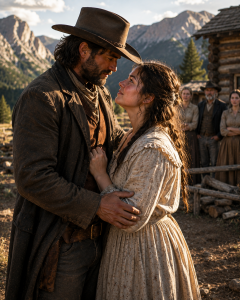
He stepped closer, close enough she could feel the warmth off him. “I am falling in love with you.”
She froze, her chest suddenly too full to hold steady.
“I need to say it plainly,” he went on. “I’m not in love with the idea of you I carried for five years. I’m in love with the real woman standing in front of me.”
Tears rose in her eyes, but they didn’t hurt this time. “I feel the same,” she whispered. “I tried to fight it. I don’t know how to stop.”
“You make me feel like I can be exactly who I am,” she added, and it was, she realized, the first time she had ever said that sentence about anyone.
He lifted a hand to her cheek. “May I kiss you?”
She nodded, and the kiss was soft at first, then deeper, warmth moving through her chest in a way she’d never once let herself expect from a marriage arranged as someone else’s cruelty.
“Marry me,” he whispered when they finally pulled apart. “Not because of a letter. Not because of an arrangement. Because I cannot imagine a future that doesn’t have you in it.”
“Yes,” Sarah said, without a heartbeat of hesitation. “I want to marry you.”
Their wedding took place a week later in the small church at Pine Valley — nothing grand, no fancy fabric or overflowing flowers, but full, entirely, of people who actually cared. Workers from the homestead. Families from the valley. The old man from the Timber Ridge market, brought by Ezra himself, sitting near the front in a coat that had clearly been pressed for the occasion. People whose lives Sarah had quietly touched over the years without ever expecting anything back, all in the same room at once, for her.
She walked down the aisle in a simple blue dress Ezra had ordered for her — soft, unfussy, beautiful in the plainest sense of the word. She had never once in twenty-four years been called beautiful. When Ezra looked at her that morning, she believed it for the first time.
The vows were simple and, somehow, more powerful for it. When Sarah promised to stand by him with the same courage she’d always carried, Ezra’s eyes filled in a way he didn’t try to hide. When he promised to love and respect her completely, Sarah felt something in her chest finally settle into the shape it had always been meant to hold. Afterward they danced under lantern light while music carried out across the valley, and Sarah laughed more in that single evening than she had in years of Blackwood suppers combined.
The peace didn’t last uninterrupted. Three months into the marriage, a familiar carriage struggled up the dirt road toward the homestead, and Sarah’s stomach tightened the second she recognized it. Ezra came to stand beside her, one steady arm settling around her shoulders before either of them had said a word.
Samuel Blackwood climbed out looking smaller than she remembered, his hat in his hands, his confidence visibly cracked. “Sarah,” he said. “Our family is in trouble.”
She didn’t invite him inside. She simply waited.
“The magistrate’s been arrested,” Samuel said. “Corruption charges. Half the families who did business with him are under investigation. We could lose everything.”
Ezra’s expression stayed calm, unreadable. “And why come to us?”
Samuel’s eyes flicked to Sarah. “We thought — perhaps Sarah could speak to you. Perhaps you could help us financially, until things settle.”
Something dark and painful moved through her, looking at the man who had called her a burden, a mistake, a problem to be handed off like unwanted baggage. “Father,” she said quietly, “all my life you mocked my conscience. You punished me for speaking the truth. And now the truth has caught up with you.”
Samuel stiffened. “Sarah, you cannot turn your back on your family.”
“You turned your back on me first,” she said. “Every day, for twenty-four years.”
Ezra stepped closer and placed his hand over hers. “Mr. Blackwood,” he said, firm and without heat. “My wife speaks with courage. I support every word she says.”
Samuel’s face twisted, some last piece of the old confidence trying and failing to hold its shape. “You two will regret this,” he said, and climbed back into his carriage, dust rising behind him like an old grievance finally given somewhere to go.
When he was gone, Sarah let out a long breath she felt like she’d been holding for years, not minutes. “Did I do right?” she asked softly.
Ezra kissed her forehead. “You did what was right for your own heart. And I love you more for it.”
That evening, in the warm quiet of their kitchen, Sarah understood something with a clarity she hadn’t had before. Her family had tried to send her away as a joke — a way to shame her, to be rid of the daughter they’d never once valued. Instead, without meaning to, they had given her everything she’d ever quietly hoped for and never let herself ask for out loud. A home. A partner who listened. A future built on the truth instead of despite it.
“You know the strange thing,” Ezra said, reaching across the table for her hand. “Your family thought they were punishing me — sending me the daughter they didn’t want.”
Sarah smiled, eyes warm. “They had no idea,” she said.
“That they were sending me the one thing I’d been waiting five years for,” he finished.
She lifted his hand and pressed a kiss to it. “Sometimes life gives us blessings disguised as cruelty.”
“And sometimes,” Ezra said quietly, “those blessings lead us exactly where we were always meant to be.”
Word of the Blackwood scandal spread through the valley faster than Samuel could contain it — the magistrate’s arrest, the families pulled into the investigation, the slow public unraveling of a household that had spent years priding itself on appearances. Sarah heard pieces of it secondhand, from neighbors, from the same workers who’d once watched her arrive as a stranger and now treated her as simply theirs. She felt, to her own quiet surprise, very little satisfaction in any of it. Mostly she felt the particular relief of a door closing on a version of her life she no longer had to carry.
Her grandmother came to live with them the following spring, once travel was safe enough for the old woman to make the trip. Ezra built her a small room off the kitchen with a window that caught the morning sun, and in the evenings she would sit with Sarah on the porch, the same porch where Ezra had once told her he wasn’t in love with an idea, and say, more than once, “I told you a good heart always finds its path. I just didn’t know it would find one this good.”
Rebecca and Clara never wrote. Sarah found, in time, that she didn’t wait for it the way she once might have.
By the following autumn, the homestead had a small schoolhouse standing at its edge — one room, plain, built with the same careful hands that had built everything else on the property — and Sarah stood at the front of it most mornings, teaching a handful of valley children not just their letters, but the thing she’d told Ezra she’d always wanted to teach: how to tell right from wrong, and how to hold to it even when it cost them something. Ezra would sometimes stand in the doorway at the end of the day, watching her explain some point of fairness to a roomful of restless children with the same plain conviction she’d once used to defend a stranger’s chicken in a crowded market, and think, every time, that he had waited exactly the right number of years.
On quiet evenings, the two of them still sat on that same porch, watching the sky change color over land Ezra had built with his own hands and Sarah had, without either of them planning it, made into something neither of them had to pretend about. The cruel joke her family thought they’d sent up into the mountains had become, in the end, the truest thing either of them had ever been given — and neither one of them ever called it anything less.
THE END