THEY LEFT THE BEATEN MAIL-ORDER BRIDE FACE-DOWN IN THE MUD — THEN A MOUNTAIN TRAPPER SAID “COME WITH ME”

**PART 1**
Blood mixed with cold Colorado mud as Adelaide Fenwick fought for breath in the middle of Ashford Gulch’s main street.
The rain had turned the packed earth to black sludge, and she lay half-curled in it, ribs burning with every ragged pull of air, her torn dress soaked through with filth and horse runoff and the blood rising in her mouth. Heavy boots passed nearby. Some slowed. None stopped. Men looked, then looked away. Women watched from behind curtains and did nothing. Deputy Dobbs, the town’s lawman in title only, stood beneath an awning across the street with a cigar in one hand and every ounce of the territory’s courage tucked safely in his pocket — which was to say, none at all.
Garrett Colby stood over her, broad-shouldered and red with fury, chest heaving from exertion and drink. He still held a crumpled fistful of papers — the last official traces of the life Adelaide had once imagined would save her. He spat near her shoulder and barked to the gathering crowd, “She’s a thief and a liar. Leave her in the muck. Anybody touches her answers to me.”
No one answered. No one moved.
Adelaide closed her eyes against the sleet and the humiliation of being watched while she might be dying. The kick he’d driven into her ribs outside the Copper Kettle had landed with a crack she’d felt through her whole body. Breath came now in torn, shallow strips, as if her lungs had been broken into pieces that each needed coaxing separately. Copper coated her tongue. Rain stung the cuts on her face. What remained of her dreams seemed to be running off into the mud around her.
She had traveled two thousand miles for this.
Back in Boston, before ruin hollowed out her family’s standing, Adelaide had grown up in rooms where voices stayed low and emotion got folded neatly into manners. Her father had owned a shipping business that once made the Fenwick name respectable, if never grand. Then the business collapsed. Debts surfaced. Gentle acquaintances turned cool. Her father died soon after, sudden and humiliatingly mortal, leaving behind little besides shame, scattered paperwork, and a daughter whose prospects had narrowed overnight.
For a woman in her position, the matrimonial advertisements hadn’t seemed romantic — just possible. Garrett Colby’s letters arrived from Colorado full of lyrical promise: wide skies, good horses, clean air, a prosperous cattle ranch, a house large enough to need a woman’s care. He wrote of respect, partnership, a future far from Boston’s whispering parlors. He wrote beautifully. That should have warned her. Adelaide had simply been desperate enough to mistake performance for sincerity.
Ashford Gulch was not a cattle ranch town.
It was a silver camp squatting in the mountains like an infected wound — a raw place built from greed, mud, whiskey, and the suffering of men who went underground each morning for the chance to die slowly in the dark. Garrett Colby was no rancher. He owned the Copper Kettle Saloon, feeding on the camp from above while the miners bled it from below. No broad house had waited for her — only private rooms over the saloon, thick with smoke and spilled liquor and the stale smell of a man who treated ownership as an appetite.
Their wedding had happened hurriedly in the back room of the assayer’s office, with no warmth in it, no tenderness in his gaze, and no real choice left open to her once she’d arrived alone in a place where every road out cost money she didn’t yet know she’d need to hide.
The truth of him revealed itself fast. By the second week, the kind words were gone, replaced by contempt sharp as broken glass. A cold meal earned her a slap. A poorly timed question earned a bruising grip on the arm. If she looked at him with too much intelligence in her face — as if she hadn’t forgotten she’d once been treated like a thinking person — his temper caught fire outright. He hadn’t wanted a wife. He’d wanted a respectable front for his business, a pleasant-looking possession to display, a servant to keep his rooms clean above the saloon he ruled like a petty king.
Adelaide endured what she could and prepared for the moment she might have to run. She’d done one thing quietly right before leaving Boston — from the wreckage of her father’s affairs, she’d withheld a small amount of money and stitched it into the lining of her trunk. Not enough to restore a life, but enough, maybe, for stagecoach fare. She’d also kept letters from her father’s lawyer describing a small parcel of land in Massachusetts still legally hers — little by itself, but something of her own, a final thread to a self not entirely swallowed by desperation.
Garrett found both.
The discovery came on a blistering Tuesday. He’d gone through her belongings while she was downstairs, and when she climbed back up he was waiting, her hidden money in one hand and the lawyer’s letters in the other, demanding she sign the land over to him at once. When she refused — terrified, but clinging to the last shred of independence she had — something in him loosened into open violence.
He dragged her by the hair down the saloon stairs while the piano went silent note by note. Men turned in their chairs. Cards stopped midair. Someone laughed once, uncertainly, and then no one made another sound. He hauled her through the Copper Kettle and out into the street like a lesson in public order.
“You think you’re better than this dirt?” he shouted, and threw her through the swinging doors.
She hit hard. Mud, rock, stagnant rainwater, manure, cold. Her palms skidded open. Before she could rise, the heavy toe of his boot caught her ribs. The crack rang across the street, and the world went white for a moment before sharpening back into pain.
Now she lay in that same street, waiting for the dark to come.
Instead, she heard the saloon doors swing open again.
At first she thought Garrett had come back for one more kick. But the footsteps that approached were different — heavier, slower, steady in a way that suggested not drunken rage but absolute intent. Even through the blur of her vision, Adelaide sensed the crowd rearranging itself around something.
Ezekiel Thorne didn’t belong to Ashford Gulch. He belonged to the high country above it — the cold basins and timberline lakes and trap lines that lay beyond where ordinary men bothered to go. He came down from the mountains only a handful of times a year, trading pelts for salt, coffee, ammunition, whatever the wilderness couldn’t provide. The townspeople spoke of him in the half-invented language frontier settlements reserved for solitary men they could neither classify nor control. Some said he’d been a sniper in the war and never came back right in the head. Others said he’d once killed a man bare-handed in Cheyenne. Children whispered about him like he was some creature of the peaks rather than a man walking among them.
In truth, Ezekiel simply found the world of towns more unbearable than the world of storms. He’d married young in St. Louis. His wife, Rebecca, had died ten years earlier during a cholera outbreak, when the physicians and wealthy men of the city decided their district wasn’t worth the medicine required to save it. He’d buried her, left civilization behind, and built himself a hard, quiet life in the mountains, where at least indifference didn’t bother pretending to be virtue.
He’d been outside the general store loading his pack mules when the shouting started. He saw Garrett hurl a woman into the street. Heard the boot connect. Watched a whole town witness the beating and choose cowardice instead. That was what moved him — more than the violence itself, the crowd’s total surrender to it.
He tied off his lead mule and walked.
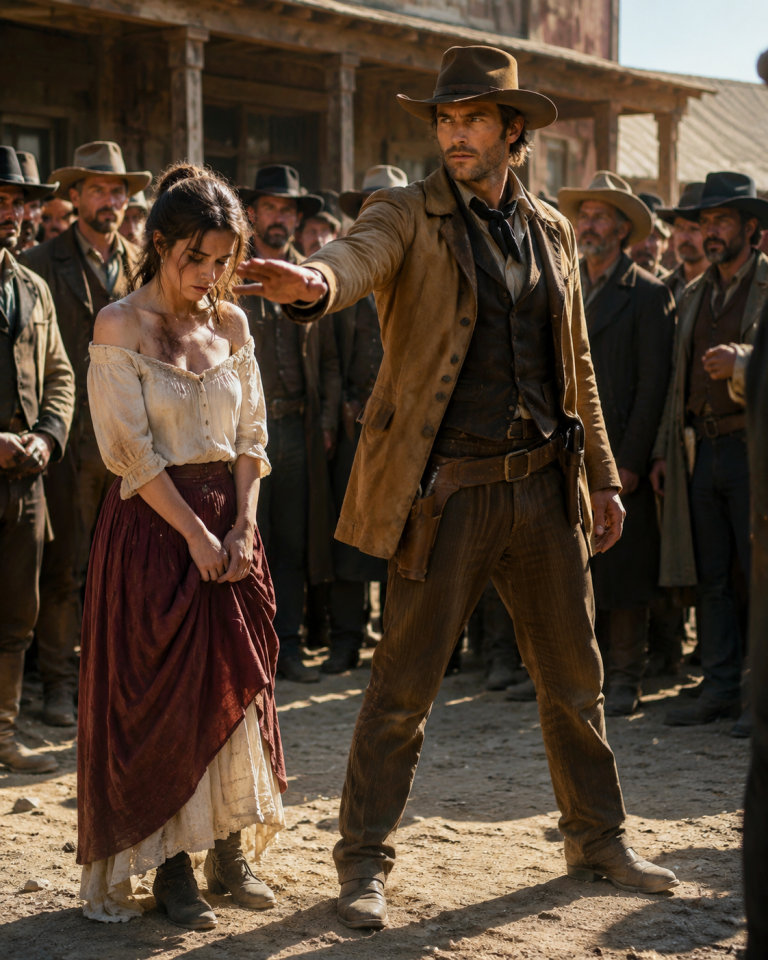
The crowd parted before him, something in his pace telling people instinctively this wasn’t a man performing outrage for effect. Ezekiel wore no badge, held no office, asked permission from no one. He crossed the boardwalk, stepped into the mud, and put his own body between Garrett and his next kick. The blow landed against his shin instead. He didn’t flinch.
“What the hell do you think you’re doing, Thorne?” Garrett snapped. “Step aside. This is my wife. My property.”
“A woman ain’t property,” Ezekiel said. “And a man who hits one is less than dirt.”
Garrett’s hand twitched toward the pearl-handled revolver at his hip. Deputy Dobbs finally stirred, coming a few paces forward, trying to sound official without risking anything. “Now hold on, Ezekiel. Garrett’s just disciplining his wife. Best you mount up and head back to the high country.”
Ezekiel didn’t even look at him. He took one step toward Garrett, closing the distance until he stood over the saloon owner like something carved from granite.
“You pull that iron, Colby,” he said, calm enough to be worse than a shout, “and I’ll make you eat it before you hit the ground.”
Garrett’s bravado faltered. His fingers eased off the gun. Ezekiel turned his back on him — insult, contempt, and judgment all at once — then crouched beside Adelaide in the mud.
When his hand reached toward her, she flinched violently, arms flying up to protect her face. For a month, every male hand raised near her had meant pain. But this one stopped short and stayed open. Huge. Scarred. Heavy with the calluses of frost and traps and rope and hard labor. Steady, too.
Through swollen eyes she looked up into a face shadowed by a broad hat and thick beard. Roughened by weather, but not cruel. That, more than anything, startled her.
“Come with me,” he said, low enough that only she could hear it.
She hesitated. A stranger. A mountain ghost out of every whisper she’d overheard since arriving in Ashford Gulch. But past him she saw Garrett glaring with naked, murderous hatred. Saw Deputy Dobbs already retreating from responsibility. Saw the town that had let her be beaten into the road. The stranger wasn’t safety, exactly. But he was the only direction that wasn’t certain death.
Adelaide put her hand in his.
He pulled her up gently. When her knees buckled and a cry tore out of her at the shock in her ribs, he caught her without hesitation, lifting her like she weighed nothing, and turned toward the tethered horses.
Behind them, Garrett found his voice again. “I’ll have a posse on you by morning, Thorne! You’re stealing from me!”
Ezekiel paused only long enough to glance back over one shoulder.
“I’ll be waiting, Colby,” he said. “Bring your own shovels.”
Adelaide drifted in and out as they climbed. Ezekiel settled her on his big Appaloosa and walked beside it on foot, one hand on the reins, the other steadying her whenever she swayed in the saddle. Snow began falling as they rose. The town vanished below the tree line, and with it the last evidence that other human beings existed. In its place: pines, granite, air cold enough to scrape the lungs, and the immense silence of the high country.
By dusk they reached his cabin, low and tight against winter wind, hidden in a basin near a frozen lake. Inside, it smelled of pine smoke, old leather, herbs, and cleanliness — a stone fireplace, books stacked on rough shelves, cleaned rifles, snowshoes hanging beside a row of traps. Not merely a shelter. A home carved out of solitude and discipline.
He laid her on a bed covered in wolf pelts, built up the fire, brought warm water and a clean flannel shirt.
“I need to look at your ribs, ma’am,” he said, eyes on her face. “And get you out of those wet clothes before you freeze. You can do it yourself, or I can help. I promise you no harm.”
The plainness of the promise nearly undid her. “I can’t lift my arms,” she whispered.
He nodded and helped with the practiced restraint of a man who understood dignity wasn’t decoration but necessity — got her out of the ruined dress, into the oversized shirt, bound her ribs with clean linen torn from a sheet. Hands large enough to crush, and instead they anticipated every flinch. When he finished, he settled blankets over her and handed her a tin cup of hot sweet tea cut with a splash of whiskey.
“Drink it slow.”
She obeyed. Warmth spread down into the places that still remembered terror.
When she finally found breath enough to speak, she asked the only question that made sense. “Why did you help me?”
Ezekiel sat by the fire, stirring the pine with an iron rod, watching the flames settle before answering. “A man who hurts a creature smaller than himself is a coward. I don’t much care for cowards.”
It would have been enough if the trouble ended there. It didn’t.
Garrett’s rage wasn’t merely that of a violent husband denied his audience — it was sharpened by something far more dangerous, and Adelaide understood that the moment her breathing eased enough for thought to connect back to fear.
“He’s going to come after you,” she said, tears returning. “You don’t understand. It’s not only his pride. It’s what I have.”
Ezekiel set down the poker and looked at her closely.
Adelaide reached into the pocket of her muddy skirt, where by pure accident one object remained — a small leather-bound ledger. In the chaos of Garrett’s attack, she’d snatched it off his desk meaning only to throw it at him. It had ended up in her pocket instead.
“I looked at it while he was downstairs shouting at the bartender,” she said. “It’s his real accounting book.”
Then she told him what she’d found. The Gravedigger claim outside town — supposed to be drying up — Garrett had been buying out old prospectors and adjacent claims for almost nothing, insisting the mountain was giving out. The ledger told a different story entirely: faked collapses, blocked productive veins, high-grade ore smuggled out at night while legitimate owners were starved into selling, so he could swallow the whole mountain. The profits listed were staggering.
Ezekiel listened without interrupting. The cabin grew even quieter.
When she finished, he stood and crossed to the gun rack, took down a heavy scoped Sharps buffalo rifle, and checked the action with a metallic clack that seemed to split the room in two.
“Well,” he said softly, a dangerous light coming into his winter-storm eyes, “looks like we just got a lot more interesting to Mr. Colby.”
He chambered a brass cartridge and looked toward the door.
“Rest now, Miss Adelaide. The storm will hold them off tonight. Tomorrow, the real trouble starts.”
**PART 2**
Morning came hard and bright over the Sangre de Cristo range, new snow throwing back the sun with a merciless brilliance that made the whole basin look built from broken glass.
Inside the cabin, the fire still held, and the silence was thick with waiting. Adelaide had barely slept, pain jerking her back to consciousness every time she drifted, each waking bringing the certainty that she’d traded one danger for another. When she finally sat up, wrapped in wool and stifling a gasp as her ribs shifted, she found Ezekiel already dressed, already armed, moving through the room with the focused efficiency of a man preparing for weather, not fear.
He sat at the oak table cleaning a Winchester 1873 with slow precision, a leather bandolier heavy with cartridges hung over the back of his chair. “Coffee’s hot. Biscuits in the Dutch oven. Eat. Today’s going to be hard on the body.”
No excess comfort in it, but no coldness either — practical care, which steadied her more than gentleness might have.
She hobbled to the stove, one hand pressed to her wrapped ribs, and forced down a biscuit and a few swallows of chicory coffee. Outside, the basin looked deceptively peaceful — pine boughs bent under snow, the frozen lake holding a flat sheen of pale light, the mountains so vast it seemed impossible one angry man from Ashford Gulch could reach this place.
“Are they coming today?”
“Colby isn’t patient.” Ezekiel checked the cylinder of a small silver-plated Schofield revolver and stood. “He won’t wait for spring thaw to get that ledger back. Not when it’s worth millions and a noose besides.” He held the revolver out to her, grip first.
She stared at it. “I don’t know how to shoot. My father despised firearms.”
“Your father isn’t here. And right now, polite society won’t keep you breathing. I can shoot the wings off a fly at two hundred yards, but I’m one man. If they flank the cabin, I need to know you can defend yourself.”
There was no room in it for delicate refusal — not cruelty, just a mountain with no patience for illusions, and a man who’d lived inside it long enough to lose patience for them too.
So for the next hour he taught her — how to open the cylinder, check the load, thumb back the hammer, align the sights, brace for recoil — until the weapon felt less like a symbol of terror and more like a weight with purpose. She learned quickly. Under the fear and pain sat an intelligence sharpened by necessity, and Ezekiel saw it and said nothing, because she already knew she was changing.
At one point, aiming the unloaded Schofield at the door as instructed, she asked quietly, “Why are you doing this? Truly? You could’ve taken the ledger and left me at a stage stop. Claimed the reward yourself once Colby was exposed.”
Ezekiel went still, then turned to the window and looked out over the white basin.
“Ten years ago in St. Louis, cholera took my wife, Rebecca,” he said. “Doctors wouldn’t come to our district — said we couldn’t pay. I went to men with money, men with standing, begged for help. They shut their doors in my face.” He looked back at her. “I learned then the law protects those who can afford it. Watching Colby throw you into the dirt while a whole town stood and watched, it put me right back there. I promised myself I’d never again stand by and let the strong crush the weak.”
Before she could answer, a sound cracked the stillness outside — a branch breaking, then the frightened whinny of a pack mule.
Ezekiel transformed instantly. The grieving widower vanished, replaced by the thing rumor had always hinted at — a hunter, absolute in his focus. He moved to the window with the Sharps and peered through a small brass spyglass.
“Four riders. Coming up the main switchback. Not local drunks.” He lowered the glass. “Military saddles. Repeaters. Looks like the Cassidy brothers — Otis and Reuben. Nasty work out of Missouri. Colby paid a fortune to get them up here this fast.”
He knocked a wooden block from the window frame, opening a firing slit. “What do we do?”
“We make them bleed for every inch of snow.”
The first shot shattered the morning and buried itself in the stone fireplace. Ezekiel didn’t flinch — rested the Sharps on the sill, drew one breath, fired. The roar of the .45-70 hit like thunder inside the small room. Outside, a horse screamed. A rider hit the snow.
“One down,” he said, reloading with terrifying calm. “Three to go.”
But the men below were professionals. Once they understood they faced a buffalo rifle and the skill to use it, they scattered into the trees and rocks. A storm of lead ripped toward the cabin — glass bursting, wood splintering, pine shards flying. Ezekiel switched to the Winchester, working the lever fast enough that the metallic rhythm merged with the gunfire.
“They’re flanking east!”
Then something landed on the roof with a heavy thud and a wicked hiss.
“Dynamite,” he said, and crossed the room in two strides, caught Adelaide by the arm, and pulled her off her feet. “Trap door. Now.”
He kicked aside a woven rug, yanked open a hatch in the floor, and half-threw her down the root-cellar steps as the roof erupted above them, the explosion caving in the top of the cabin, burning beams and smoke and splintered shingles crashing through the room they’d occupied seconds before.
“Keep moving!” he shouted through choking debris.
At the back of the cellar, a narrow reinforced tunnel. He shoved her toward it. “Leads behind the ridge, to the old mining shafts. Go!”
A second explosion rocked the foundation. A cellar beam fell, catching Ezekiel across the shoulder — his buckskin coat tore, blood blooming dark through the leather.
“Ezekiel!”
“I’m fine. Move!”
He wasn’t fine, but there was no time to argue. Adelaide crawled into the tunnel, dragging breath through smoke-thick lungs, while behind her the home he’d built over ten years of solitude collapsed into flame.
The tunnel opened into a jagged ravine, shielded from the burning cabin by a granite wall. The wind there cut colder, sharpened by stone. Ezekiel emerged behind her, one hand pressed to his shoulder, blood dark on his coat and beard.
“Can’t stay exposed,” he said. “They’ll track us in the snow. We need to go underground.”
He led her deeper into the ravine, picking his way over ice and broken rock with surprising speed for a wounded man. A quarter mile on, hidden behind dead blue spruce and frozen briars, yawned the entrance to an old mine framed by rotting timbers, a weathered sign hanging askew: *THE GRAVEDIGGER CLAIM — PROPERTY OF E. WHITFIELD — KEEP OUT.*
“Old man Whitfield’s silver mine,” Ezekiel said. “Richest vein in Ashford Gulch, before it supposedly dried up. It didn’t. Colby bought the surrounding claims. This place is a labyrinth — miles of tunnels, shafts, blind drops. If they follow us in, we’ve got the advantage.”
The mine swallowed them at once, the air turning colder and staler, smelling of wet stone and metal and old rot. Ezekiel found a hidden cache just past the entrance and lit a brass kerosene lantern, yellow light throwing monstrous shadows over the supports. The world outside ceased to exist. Only darkness, echo, and the weight of mountain overhead.
“Sit down,” Adelaide said suddenly.
He blinked, surprised. She’d seen the blood dripping from his fingertips. Without waiting for permission, she tore a strip from the hem of the flannel shirt he’d given her, took the whiskey flask from his coat, and guided him onto an overturned ore cart. The wound was ugly — a deep gash where the beam had caught him. Not fatal yet. Dangerous enough.
“This will hurt.” She poured whiskey into it. His jaw flexed; he made no sound. She wrapped the shoulder tight, hands shaking once before settling into steadiness.
“Thank you,” he said when she tied it off.
“You’re welcome.” She picked up her revolver. “Now how do we get out of here without walking straight into Colby’s men?”
“Ventilation shaft, east face. Comes out above the treeline. From there we circle down to Silver Cliff, hit the telegraph office. Wire the federal marshals in Denver. Hand over the ledger. Colby hangs.”
They moved. For more than an hour they navigated twisting tunnels, unstable bridges over flooded shafts, passages where the lantern light seemed too weak against the pressing dark. Then they heard footsteps. Not their own.
Ezekiel killed the lantern instantly. Darkness crushed in so completely Adelaide lost all sense of her own body’s edges. He pressed her back into a shallow alcove, his good arm across her chest.
“They found the entrance,” he breathed against her ear. “Breathe through your mouth. Not a sound.”
Lantern light appeared down the tunnel. Two men advanced, revolvers drawn — Otis and Reuben Cassidy.
“Tracks stop here,” one muttered.
“They’re in here,” the other said. “Colby wants the girl alive if he can get her. Ledger’s the prize. Mountain man on sight.”
Ezekiel eased a curved hunting knife from his belt — gunfire down here could bring the ceiling down, so this had to happen in silence. He gave Adelaide a barely visible push deeper into the alcove, and then he was gone from beside her.
The attack was more predation than combat. He came out of the dark, seized Otis by the throat, drove the knife hilt into his temple. The man dropped with a grunt and a shattering lantern. Reuben shouted and fired blindly — the shot blasted through the tunnel like a cannon, dust raining from above. The two men collided, hit the rock wall hard. Adelaide could hear bodies slamming stone, boots scraping, fists finding flesh, but couldn’t tell where Ezekiel ended and the other man began. She raised the Schofield and couldn’t shoot.
Then a heavy body fell and lay still.
A match flared. Ezekiel lit a fresh lantern one-handed. Blood ran from a cut over his eye, but he stood. Reuben lay unconscious at his feet. “I’m here,” he panted. “But the shot carried. Now everyone in this mountain knows where we are. We run.”
They plunged into a side passage. The air changed — colder, older. After several sharp turns, the tunnel widened abruptly into a vast hidden chamber, and both of them stopped.
The cavern was not abandoned. It was a secret staging area — wooden crates stamped *G.C.* stacked floor to ceiling, pickaxes and shovels and blasting powder lining the walls. Ezekiel pried one crate open with his knife, held the lantern over the contents.
Dull gleams answered back. Silver — high-grade, unrefined ore, in quantities that reshaped everything Adelaide thought she understood.
“The Gravedigger didn’t dry up,” Ezekiel said. “It hit the motherlode. Colby faked cave-ins, bought the claims cheap, mined the backside of the mountain the whole time.”
“Millions,” Adelaide whispered.
“Well, well, well. Looks like the little bird found the nest.”
The voice came from the shadows.
**PART 3**
Silas Kruger stepped into the lantern light with a double-barreled shotgun leveled at Ezekiel’s chest. Larger than Garrett, rougher, a man built for enforcement, scarred and utterly without hesitation. Three armed miners spread out behind him.
“Drop the rifle, Thorne,” Kruger said. “And hand over the book, Mrs. Colby. Garrett’ll be mighty pleased to see you both.”
Adelaide felt the ledger in her pocket like a physical weight dragging her toward death.
Kruger’s shotgun never wavered — not the size of the barrels but the total confidence in how he held them, the confidence of a man who’d threatened plenty and rarely met resistance. The miners behind him were no town drunks either, guns loose and ready, faces dust-dark, eyes flat with the hired patience of men who’d already decided whatever happened next wouldn’t trouble their sleep.
Ezekiel took it all in — Kruger, the men, the powder crates stacked near the tunnel wall, the rotted timbers overhead, the distance to cover, the way the lantern light bent across the stone — and lowered his Winchester slowly to the floor, because he understood before Adelaide did that there was no clean way out of this if it stayed a standoff.
“Long way from home, Kruger.”
“Colby pays well.”
“Enough to die in a hole?”
“Enough to bury a mountain man and a runaway wife.” Kruger’s grin widened. “Judge Pruitt down in Denver’s already in Colby’s pocket. Once you’re dead, the mine gets declared dry and forgotten. Give me the ledger, Mrs. Colby, and I’ll make it quick.”
Adelaide’s hand slid into the oversized pocket of Ezekiel’s flannel shirt. For a moment she touched the leather edge of the ledger. Then her fingers closed around the grip of the Schofield instead.
Ezekiel gave her the smallest nod.
“I don’t have it,” she said, the lie steadier than she expected. “I dropped it in the snow when the Cassidys hit the cabin.”
Kruger’s face blackened. “You lying Boston—”
He never finished. Ezekiel moved with terrifying precision — not lunging at Kruger or the miners, but kicking the kerosene lantern flat across the ground. It shattered, burning oil leaping outward across the dusty floor, igniting debris in a sheet of sudden orange fire. Kruger stumbled back shouting. The miners fired instinctively, muzzle flashes tearing through the smoke. Adelaide dropped low, drew the Schofield, and forced herself to think not like prey but like the quick study Ezekiel had made of her.
Not the men. The powder.
Twenty yards off, stacked near the entrance, several smaller crates bore the unmistakable mark of blasting powder. She aligned the sights the way he’d shown her, thumbed back the hammer, and squeezed.
The recoil slammed through her bruised ribs like a hammer blow, but the shot flew true — struck iron banding, threw a spark into the black powder spilling from a seam.
“Down!” Ezekiel bellowed, hitting her at the waist as the crates ignited.
The explosion wasn’t sound so much as force. It lifted the ore cart they’d dived behind and dropped it back onto stone with a crash that seemed to come from inside the mountain itself. Heat rolled over them. Dust and smoke devoured the chamber. Above, rotted timbers gave out with a snapping roar.
The mine began to collapse.
Through the ringing in her ears, Adelaide heard the screams first — Kruger, the miners, men buried under the greed they’d come to protect. Silver crates toppled, stone slabs plunged, beams splintered, the chamber folding in on itself under the concussion, sealing treasure and evidence and killers together in the dark.
“Adelaide! The shaft!”
Ezekiel pulled her up and half-dragged her through the blinding dust toward the far wall, left arm nearly useless now, blood soaking through the bandage and down his coat, right hand never once loosening its grip on her. They found the shaft just before a section of ceiling crashed where they’d stood seconds before — a narrow vertical chimney lined with ancient ladders barely worthy of the name, moonlight showing far above as a pale, impossibly distant square.
“You have to climb.”
The shaft ran perhaps a hundred and fifty feet up. Old wood sweating cold. Dust and falling debris heaving below. Her ribs felt broken all over again with every breath. But the mountain was coming down behind them, and hesitation belonged to dead people.
She climbed. The first rungs groaned under her weight, twice flexing enough to make her think they’d shear away. She gritted her teeth and climbed anyway. Below her, Ezekiel came one-handed, using his legs and good arm with grim efficiency, blood loss roughening his breath more with every foot gained.
“Keep moving,” he urged. “Don’t look down.”
A rung snapped under her boot. She cried out, slipped, scraped her hands raw, hung against the shaft wall one horrible instant with an arm screaming and a foot searching air. Ezekiel’s hand struck her boot and drove it upward to the next rung.
“You’re stronger than you know,” he said through clenched teeth.
She climbed again.
By the time her hands reached the lip of the opening, she was shaking violently, aware of nothing but the need not to fall. She hauled herself into the snow and lay there one breathless second before turning back. Ezekiel emerged moments later, rolling onto his back, chest heaving, face pale beneath blood and beard. Below them, deep in the mountain, the last of the collapse boomed and settled — the Gravedigger sealing itself shut, entombing Kruger, the stolen silver, and the whole secret chamber forever.
They were alive. High on an exposed ridge, miles from safety, in subzero wind, and Ezekiel was fading fast.
Adelaide crawled to him. “Ezekiel.”
“I’m all right,” he lied.
He pointed downslope. “Kruger’s men had to get up here somehow. There’ll be a staging camp. Horses.”
She got beneath his good arm, hauled him upright, and together they began the long descent through waist-deep snow and black pines. The camp lay exactly where he’d predicted — a small hidden spread tucked into a grove, tethered horses, a tent, meager provisions. She helped him onto a rangy chestnut and mounted another herself, the effort nearly making her faint.
“We can’t stay,” he said, swaying in the saddle. “Colby will see the smoke from the cabin. Feel that blast in the valley. He’ll send every gun in Ashford Gulch.”
“Where do we go?”
“Silver Cliff. Twenty miles east. Telegraph office. Wire Denver. Hand over the ledger. End this.”
So they rode — a frozen ordeal of wind, exhaustion, pain, and stubbornness, Ezekiel drifting in and out, kept upright by sheer refusal to fall, Adelaide leading both mounts through blowing snow and treacherous ice because there was no one else left to do it.
Silver Cliff appeared near noon the next day — brick and rail line and smoke rising from proper chimneys instead of lawless saloon roofs. Not clean, exactly, but structured. Incorporated. A narrow-gauge spur of the railroad, proper storefronts, and the one thing Ashford Gulch had never possessed: a meaningful federal connection.
Adelaide rode straight past the saloons to the depot, dragged Ezekiel’s horse to the hitching post, and hauled him through the doors of the telegraph office. The operator, a nervous man named Wendell, nearly spilled his ink bottle at the sight of them.
“Lord Almighty — do you need the doctor?”
“We need the U.S. Marshals,” Adelaide said, drawing out the leather-bound ledger and slamming it on the counter. “Open a line to Denver immediately. Tell them Adelaide Fenwick has the accounting ledger for the Gravedigger claim proving Garrett Colby of Ashford Gulch is orchestrating multi-million-dollar silver fraud, murder, and claim jumping.”
Wendell stared from the ledger to the blood-soaked giant on the bench to the wild-eyed woman standing in his office like she’d crossed hell and kept walking. Then he sat and began tapping the key.
Adelaide got Ezekiel onto a bench, peeled back his coat, and checked the wound — bleeding slowed but the flesh around it hot, swollen, angry. Infection had taken hold.
“You did good, Boston,” he murmured.
“We aren’t safe yet,” she said, taking his cold hand in both of hers.
An hour passed. Then another. She brought back coffee and stew, forced him to eat. A local doctor came, stitched the wound properly, stared at Ezekiel’s constitution like it offended medical probability. At last the telegraph clattered again, and Wendell tore off the strip with shaking fingers.
“Marshals are building a case against Colby already — been at it a year. They’re boarding a special locomotive now. Three hours out.”
For the first time since the Copper Kettle, Adelaide let herself breathe.
Then a shout rose from outside. She wiped the frosted window clear with her sleeve.
Garrett Colby rode at the head of a posse of twelve down Silver Cliff’s main street, buffalo-hide coat, Winchester across his saddle. Even here, even now, the sight of him made her stomach drop. Shutters closed up and down the street. Doors barred. The town emptied in seconds.
Garrett drew up before the depot, calling out in a syrupy voice made worse by its false softness. “Adelaide. Come on out, darling. Bring me my property and I’ll see to it you only get a mild disciplining.”
Wendell vanished under his desk.
Ezekiel checked his Schofield and stood despite the pain draining the color from his face. “Stay here. I’ll buy you the three hours.”
“No.” She stepped in front of him. “You’re in no condition to fight twelve men.”
“I only need to kill one. Colby’s a coward. Cut the head off the snake, the rest run.”
Before she could stop him, he shoved open the depot doors and stepped onto the boardwalk. The street went still. He looked like a ghost risen out of the high country — blood still on his beard, one arm in a sling, coat stiff with cold and dried blood — but standing straight enough to shame healthier men.
“Well, look what the cat dragged in,” Garrett sneered, though something behind it twitched. “You’re bleeding out, Thorne. Where’s my wife?”
“She ain’t your wife,” Ezekiel said. “And she ain’t your property. She’s standing inside holding a ledger that’ll hang you higher than a Georgia pine.” Louder now, so the whole posse heard it: “Federal marshals are on a train right now.”
A murmur passed through the posse. These men were paid to bully and enforce local fear — not to war openly with the United States government.
“Lies,” Garrett snapped. “Boys, gun him down.”
No one moved. One hired gun, scarred, missing an ear, shifted in his saddle. “You heard him, Colby. If the feds are coming, I ain’t catching a noose for your silver. Want the mountain man dead, shoot him yourself.”
The rest hesitated. That hesitation was enough.
Garrett’s face went purple, watching authority slip through his fingers. In panic, he dropped the reins and went for his revolver. Ezekiel drew too, but wounded, slowed just enough by blood loss and the drag of heavy clothes. Garrett fired first — the shot cracked the freezing air, and Ezekiel grunted and staggered as the bullet tore a graze through his thigh, one knee dipping.
Then another shot rang out.
Garrett screamed. His revolver fell into the snow. He clutched his right hand, staring in disbelief at the blood and ruined flesh where his trigger finger had been.
Every head on the street turned toward the depot.
Adelaide stood in the doorway holding a heavy Colt Single Action Army Wendell kept in his desk, smoke curling from the barrel, wind whipping her hair, her arms steady.
“You don’t own me, Garrett,” she said, voice carrying clear and hard through the dead silence. “And you will never lay a hand on me again.”
For one suspended moment the whole street seemed to reorganize itself around the fact of her standing there. Garrett — tyrant of Ashford Gulch — lay whimpering in the snow, clutching his shattered hand. The posse looked from him to Adelaide, then to Ezekiel, then back. Without a word, they turned their horses and rode out of town, scattering into the foothills before the law could arrive.
In the distance, the long whistle of a locomotive. The train from Denver, pulling in.
Ezekiel holstered his weapon and limped back toward the depot, strain plain in every line of him. But when he looked at her, what she saw wasn’t pity, wasn’t surprise. Respect.
“Nice shot, Boston,” he said, and a genuine smile cracked through the blood and beard.
Adelaide lowered the gun. Only then did her hands start to shake.
“I had a good teacher.”
Marshal Neagle’s arrival finished what Garrett Colby’s money and violence couldn’t survive. The ledger proved more than sufficient — every false collapse, every nighttime shipment, every payoff, every prospector starved off his own claim, all of it documented. Coupled with what remained visible in the Gravedigger and Adelaide’s testimony, the book destroyed him. Garrett was taken to Denver, tried, stripped of his ill-gotten wealth, sentenced to life in the territorial prison. Judge Pruitt, whose name had surfaced in the muttered bribes, found his own dealings unraveling in the spillover. Ashford Gulch, severed at last from Garrett’s grip, began the slow, painful climb from lawless boomtown toward something closer to a real community.
Adelaide Fenwick did not go back to Boston. The parlors of her old life held no power over her anymore. The woman who’d left them believing security lay in a husband’s promise was gone. In her place stood someone forged by mud, snow, gunpowder, grief, and the hard schooling of survival.
With help from the federal courts, she laid legal claim to the Gravedigger mine through the Whitfield interest and the evidence the ledger had preserved, and used a portion of the legitimately recovered silver to pay back the prospectors Garrett had cheated. She could easily have stayed in the valley after that, built a respectable new life in Silver Cliff or further east. But peace didn’t live there for her.
It lived higher up. Beneath the timberline. Near the frozen lake. In a cabin once burned, and rebuilt with stubborn hands.
She and Ezekiel didn’t become a savior and a rescued maiden, because life in the high country had no use for such sentimental arrangements. They became something truer and harder-won — partners, two people who’d each learned what civilization often withheld, and what wilderness, for all its danger, never once pretended to give. Together they rebuilt the cabin, beam by beam, under a sky wide enough to hold both grief and beginning, a bond forged not in fantasy but in blood, trust, labor, and the unforgiving beauty of the Colorado mountains.
And if, in later years, travelers passing through those high elevations sometimes saw chimney smoke rising from a hidden basin, and heard stories down in the valley of the Boston woman who could outshoot most men and the mountain trapper who’d once carried her out of the mud, they never knew the half of it.
They didn’t know how close either of them had come to being buried.
They didn’t know how much of a life can begin at the exact place another one was meant to end.
But Adelaide and Ezekiel knew.
And that was enough.