SHE SEWED HER OWN WEDDING DRESS AND TRAVELED 2,000 MILES TO MARRY A MAN WHO NEVER EXISTED — THEN A NINE-YEAR-OLD GIRL OFFERED HER A DIFFERENT ONE

—
PART 1
The letter had been read so many times the creases had gone soft as cloth.
*My dearest Lenora, the ranch awaits you. I have prepared everything for our union. The mountains here touch the sky, and I promise you a life of dignity unlike anything the crowded streets of Philadelphia could offer.*
Lenora Whitmore held that letter the way some women held rosaries — not because she still believed in it, but because letting go felt like admitting the last three months hadn’t mattered.
The train shrieked to a stop. Through the window: Red Hollow, Montana Territory. Wooden buildings squatting in the dirt like they’d given up halfway through being built. A sky the color of an old bruise, already promising snow.
Inside her single suitcase, wrapped in tissue paper that had cost more than she could afford, lay the wedding dress. White silk, pearl buttons down the back. Sewn by candlelight over three months of sixteen-hour factory days, each stitch a small, stupid prayer that Marcus Holloway’s letters hadn’t been lies.
She stepped onto the platform. Waited.
An hour. Then two.
The sun dropped behind the mountains. The platform emptied. Her hands went numb around the suitcase handle, and still no one came.
The station master locked up around her like she was furniture he’d have to work.
“You waiting on someone, miss?”
“Marcus Holloway.” Her voice came out steadier than she felt. “We’re to be married.”
Something shifted in the man’s face. Not quite pity. Recognition.
“Miss, I don’t know how to tell you this gently, so I’ll just say it plain.” He turned his cap over in his hands. “There ain’t no Marcus Holloway. Never was. Fellow who writes them letters doesn’t even live in Montana, probably.”
“That’s not possible. I have twelve letters. He described the ranch. He told me—”
“I know what he told you.” The station master’s eyes wouldn’t hold hers. “I’m real sorry.”
Her knees went loose. She locked them. Refused to sit down on that platform and give the town the satisfaction of watching her come apart.
*No Marcus Holloway. No ranch. No wedding.*
$7.35 to her name, and Philadelphia two thousand miles behind her with nothing left to go back to.
—
Granger’s Inn smelled like boiled cabbage and slow defeat. Four nights, if she didn’t eat. Three days of walking into every business in Red Hollow — general store, restaurant, seamstress — and hearing the same word in a dozen different shapes.
*No.*
One saloon owner offered her work that had nothing to do with pouring drinks. She left before he finished the sentence.
By the fourth night, she had three dollars and a return ticket that would leave her in Philadelphia with exactly nothing. She packed the wedding dress first, wrapped in its tissue like something already dead, and sat on the suitcase until the latches caught.
Tomorrow the train would take her home to a city that would swallow her whole.
Tonight, her feet carried her back to the platform anyway. Some sick pilgrimage to the scene of her own ruin.
She sat on the bench, back to the tracks, and watched the mountains bruise purple in the dying light.
She didn’t hear the child approach until a voice said, flat and unafraid:
“Are you the lady who got left?”
Lenora turned. A girl, maybe eight — wild dark braids coming undone, a dress patched so many times the original fabric was a rumor, and eyes far too old for the face they sat in.
“Who’s asking?”
“Maisie Boone.” The girl looked her up and down like she was appraising livestock. “You really came all this way to marry some man you never met?”
“I did.”
“That’s stupid.”
Despite everything, Lenora felt a laugh try to climb out of her. She swallowed it before it could turn into something worse.
“It was,” she agreed.
“But you’re still here.”
“Not for long. I leave tomorrow.”
Maisie crossed her arms, studying her the way a person studies a fence line before deciding where to put the gate.
“My pa needs a wife.”
The words landed so plainly that for a moment Lenora couldn’t respond at all.
“Excuse me?”
“My pa. Gideon Boone. He’s a widower. Our ranch is dying and he won’t admit it, but I ain’t stupid — I see the bills, I hear him pacing at night when he thinks I’m asleep.” Maisie’s chin lifted. “We need help. You need somewhere to go.”
Lenora stood, slow, the suitcase suddenly heavy as guilt.
“Sweetheart, I appreciate the offer, but I cannot marry a man I’ve never met based on a conversation with his nine-year-old daughter.”
“I’m nine and a half.” A beat. “And yeah, you can. You were about to marry a man who don’t exist. My pa exists. He’s solid. He’s honest. He’s just—”
She stopped, searching for the word like it was buried somewhere under the dirt on her knees.
“He’s stuck.”
Something in Lenora’s chest went very still.
“I know desperation when I see it,” Maisie said quietly, “because I’m drowning in it, too.”
Behind them, Red Hollow’s lights were flickering on one by one — a town Lenora was leaving before she’d ever really arrived. Ahead of her, the mountains waited, holding a ranch she’d never seen and a man who had no idea his daughter was standing on a train platform at dusk, offering a stranger’s future in trade for his own.
“If I come meet your father,” Lenora heard herself say, “and he wants nothing to do with this — I leave. No harm done.”
Maisie’s whole face changed. Not quite hope. Something fiercer.
“That’s all I’m asking.”
She grabbed Lenora’s hand and pulled her toward the dark.
—
PART 2
The supply wagon rattled through two hours of foothill dark. Old Mr. Chen asked no questions about why a grown woman in a ruined traveling dress was riding into the wilderness with a nine-year-old he clearly already knew.
“You’re awful quiet,” Maisie said, cross-legged on a flour sack.
“I’m thinking.”
“About running?”
“About what I’m going to say when your father realizes what you’ve done.”
“Pa don’t say much these days anyway.” A shrug. “Probably won’t even yell.”
“That’s not reassuring.”
“Didn’t say it was.”
The Boone Ranch appeared out of the dark like shadows trying to hold the shape of buildings — a sagging two-story house, shutters that needed paint. The front door opened, spilling lamplight across a porch.
A man stepped into it. Tall. Broad-shouldered. Moving with the careful economy of someone who’d learned there was never enough energy to spare.
“Maisie?” His voice was rough, unused. “Where the hell have you been?”
“I brought someone.”
Gideon Boone’s eyes found Lenora and stopped there — confusion, then the weary blankness of a man whose life had stopped making sense a long time ago.
“Who’s this?”
“Her name’s Lenora Whitmore. She came all the way from Philadelphia to marry a man who don’t exist. I asked if she’d marry you instead.”
The silence that followed had weight.
“You did *what*?”
“We can’t keep going like this, Pa. You know we can’t.”
“What we need,” Gideon said, each word dropped like a stone, “is for you to stop dragging strangers home like stray dogs.”
Maisie flinched. Didn’t back down.
“She ain’t a stranger. I know we’re going to lose the ranch if something don’t change. I know the bank man came by last week and you wouldn’t let me hear what he said, but I heard it anyway. I know you sold Ma’s jewelry to pay the feed bill. I know—”
“*Enough.*”
The word cracked like a whip. Lenora watched something in the girl’s spine refuse to bend anyway.
“She’s staying tonight,” Maisie said. “You said it yourself — too dark to send her back.”
Gideon turned those exhausted gray eyes on Lenora fully for the first time.
“You ever worked on a ranch before?”
“No.”
“Livestock? Crops? Fencing?”
“No to all of it.” Lenora kept her voice level, because it was the only thing she had left to keep steady. “But I know how to work until my hands bleed, and I know how to keep going when everything looks hopeless. If that’s not useful here, I’ll leave tomorrow with no hard feelings.”
Something flickered across his face. Not quite interest. Recognition — a man seeing his own stubbornness reflected back at him from a stranger’s eyes.
“One week,” he said finally. “Room and board. You work, you stay. You don’t pull your weight, you go.” A pause, harder. “And if Maisie mentions marriage one more time, I’m dragging you back to town myself. Clear?”
“Clear.”
He turned toward the house without another word.
Maisie grinned up at her, triumphant. “Told you he’d say yes.”
“That wasn’t yes. That was grudging tolerance.”
“It’s a start.”
Inside, the house looked like someone had given up on civilization the day his wife stopped breathing — dishes stacked in the sink, a cold fireplace, and on the kitchen table, a stack of papers covered in numbers. Bills. Debt calculations. The arithmetic of slow failure, laid bare for anyone to see.
Lenora looked at it and felt something she hadn’t expected to feel again after four days of humiliation and closed doors.
Not hope, exactly.
Curiosity about whether hope was still stupid.
She lay in a narrow guest bed that night — Martha Boone’s old sewing room, Maisie told her, before trailing off — and through the thin walls heard Gideon’s heavy footsteps below, the scrape of a chair, then silence. A man sitting alone with numbers he couldn’t make add up.
She pulled out Marcus Holloway’s letters. All those promises. All those lies. She should burn them.
She was too tired for symbolism.
She tucked them away and closed her eyes instead, and outside the Montana wind rattled the window frame and carried the smell of sage into a house that didn’t yet know it was about to be fought for.
Morning would come whether either of them was ready for it or not — bringing with it the full, impossible arithmetic of survival, and the first small, dangerous possibility of something more.
—
PART 3
Dawn came cold and gray, the kind of morning that felt less like a beginning than a warning. A rooster screamed somewhere outside. Lenora’s body ached from the thin mattress and a night spent bracing for a decision she’d already made.
A note waited in the kitchen, handwriting blocky enough to look carved rather than written.
*Work starts at sunrise. You’re late. Find Maisie if you want to be useful. Don’t touch anything expensive.*
No signature. No pleasantries. Fine. She hadn’t come here expecting easy.
She found Maisie behind the barn losing an argument with a rotted fence post.
“You ever mucked out a stall?” Maisie asked, without looking up.
“No.”
“Fed chickens? Hauled water?”
“No. But I can sew. And I’m good with numbers. I once kept a textile factory floor from falling apart when three machines broke and the foreman was too drunk to notice.”
Maisie considered this with the gravity of a foreman conducting an interview. “We ain’t got textile machines. We got plenty of broken things, though. Start with the chickens.”
The chickens regarded Lenora with the malevolent suspicion chickens perfect over a thousand generations of domestication. The first nesting box exploded a bird directly into her face. She landed hard in old straw, filthy, furious, and — for reasons she couldn’t fully name — not defeated.
*That’s how it’s going to be,* she thought, and went back for the eggs anyway.
By midmorning her dress was ruined, her hands bleeding from a dozen small pecks, and she’d learned two things: she hated chickens with a passion she hadn’t known she possessed, and she’d rather bleed here than go back east and slowly stop existing.
“You’re doing it wrong,” Maisie said, watching her wrestle a fifty-pound feed sack. “Get underneath. Use your legs, not your back.”
The third attempt worked.
“Better,” Maisie allowed, and it was as close to a compliment as the girl seemed to give out.
They worked through the morning in the rhythm of two people who’d both decided, separately, that stopping wasn’t an option. Around noon, Lenora straightened up from a coil of rope and asked the question that had been sitting under her ribs since last night.
“Does your father know how much work you’re doing here?”
“He knows.” Maisie kept her eyes on a bridle she was mending. “He ain’t fine with it. But there’s only two of us and twice as much work as we can carry, so being fine with it don’t really matter.”
“That’s not a childhood.”
“Neither is starving.”
Lenora crouched beside her without another word, and together they worked the leather until it held.
Gideon didn’t return until dark, riding a horse as exhausted as its rider. He led it toward the barn without acknowledging either of them.
“Pa,” Maisie called. “We need to talk. It’s about the accounts.”
He stopped. His shoulders went rigid.
“Miss Whitmore looked at Ma’s book,” Maisie said. “She says—”
“She had no business looking at anything.” Gideon’s voice was dangerously quiet. “That book is private.”
“That book is falling apart and the numbers in it are killing us.”
“We’re losing everything,” Maisie said, voice cracking, “and you know it, and you’re too damn stubborn to admit we need help.”
The silence that followed could have suffocated a room.
“Inside,” Gideon said at last. “Both of you. Now.”
The kitchen table became a battlefield inside five minutes.
“You want to see the numbers?” Gideon slammed the account book down. “Fine. Tell me something I don’t already know.”
Lenora went through it page by page. How much did feed cost. What had the last cattle sale actually brought. When had they last turned a profit. The answers painted a picture of a man compensating for grief the only way he knew how — by working harder, longer, alone — which was strategy without arithmetic. Exhaustion with extra steps.
“You’re paying twice what you should for feed,” she said. “And you’re selling cattle at exactly the wrong time of year. Every sale you’ve made in eighteen months has been at a loss.”
“I sell when I need cash.”
“Which is exactly when buyers know they can lowball you.”
“So what’s your brilliant solution?”
“Diversify. Your wife was doing it before she died — I can see it in the early entries. Preserves. Medicinal herbs. Small goods that brought in steady cash between cattle sales. Why did that stop?”
“Because I’m one man running a ranch that needs three.” His voice cracked open, just slightly. “I don’t have time to do the things she did. I’m not her. I’m not good at the things she was good at.”
The admission hung in the room, painful and true.
“Then let someone else do them,” Lenora said, quiet now. “I can’t help with the cattle. That’s your expertise. But I can handle accounts. I can run a trading operation. I think I can figure out how to sell preserves at a profit.”
“You’ve been here one day.”
“And in one day I’ve seen exactly how bad things are.” She leaned forward. “You’re not failing because you’re lazy. You’re failing because you’re trying to do everything alone, and there’s no human being alive who can sustain that.”
Gideon looked at her — really looked, gray eyes searching for the catch.
“One month,” he said finally. “You make a real, measurable difference in the accounts, you can stay longer. You don’t, you go. No arguments.”
“Deal.”
He walked out to check the stock before dark, and didn’t say another word. Maisie let out a breath she’d clearly been holding.
“He’s testing you. He does that — tests people to see if they’ll quit. Most people quit.”
“I’m not most people.”
“Yeah.” Maisie smiled, slow. “I’m starting to figure that out.”
—
**THE PRESERVES**
That night, Lenora worked by lamplight until her eyes burned, building a plan out of Martha Boone’s account book — recipes, supply lists, market prices two years stale but a place to start. The preserve operation had never been much. Thirty dollars a month, maybe. Not enough to save a ranch.
Enough to keep one breathing.
The next morning, she and Maisie rode into Red Hollow with borrowed money and negotiated supplies out of a shopkeeper who clearly didn’t trust women doing business without a man present.
“That’s robbery,” he said, when she refused his first price.
“That’s economics. I can go to Silver Creek. Or you can sell to me fair and guarantee regular orders all winter.”
He sold fair.
Mrs. Chen, the seamstress, studied Lenora with sharp, assessing eyes.
“Martha Boone was a good woman. Smart. Practical. Saw problems and fixed them instead of complaining.” A pause. “You remind me of her.”
“I didn’t know her.”
“No. But you’ve got her account book and her daughter’s loyalty. That counts for something.”
Two days of picking berries in the hills left their fingers stained purple. Lenora burned the first batch of preserves, botched the second, and on the third, sealed twenty-four jars of something that finally, actually worked.
Gideon came in after dark and stopped in the kitchen doorway, staring at rows of Mason jars catching lamplight like something holy.
“This looks like what Martha used to make.”
“I’m using her recipes.”
He picked one up, turned it in the light, set it down with a care that told her more than words would have.
“My wife worked herself half to death making these.”
“I’m not your wife.”
“No.” He looked at her directly. “You’re not. So why are you working yourself half to death instead?”
“Because I made a deal. I intend to prove it.”
Something shifted in his face. Not quite approval. Acknowledgment, maybe, that she was serious.
“Don’t burn down my kitchen,” he said, and almost smiled. Almost.
—
The preserves sold out in four days. Forty-two dollars, more than double the cost of supplies, plus a standing order for twenty-five more jars.
“One sale,” Lenora warned Maisie, who was practically vibrating in the wagon seat.
“One sale is more than we had last week.”
Gideon said only, “Good. Do it again,” when she set the coins on the table — then went back outside to fight a fence losing its argument with gravity.
“That’s Pa for *I’m impressed but I’ll die before I say it out loud*,” Maisie translated.
The weeks that followed fell into a rhythm neither of them named out loud. Coffee waiting each morning before Lenora came downstairs. A stuck window fixed without comment. Evenings where Gideon came into the kitchen with cold dinner and his account books and simply existed in the same room, filling silence with presence instead of words.
It should have been uncomfortable.
It felt, instead, like something Lenora had been missing without knowing its name.
—
**THE DEBT**
Three weeks in, Gideon broke the silence over dinner with words that landed like a dropped weight.
“Bank man’s coming tomorrow. We’re three months behind. Two hundred and forty dollars, plus interest.”
“How much have we brought in?”
“Ninety. Maybe. Nowhere near enough.”
He stood, paced, stopped facing her directly.
“I let you try because Maisie needed to believe we still had a chance.” His voice roughened. “Maybe I needed to believe it, too, for a while.”
“So you’re giving up.”
“I’m facing reality.”
“You’re deciding reality’s too hard, so you’d rather surrender.” Lenora grabbed the account book, flipped it open. “You’re trying to save this ranch by doing everything the way you’ve always done it. Harder. Longer. But you can’t outwork a losing business model.”
“Then what’s your solution?”
“Leverage what we’ve built. You’ve got forty acres producing nothing — grazing land you can’t use because you don’t have the herd for it. Sell or lease a portion. Raise capital. Keep the core ranch.”
“That land’s been in my family thirty years.”
“And it’ll be in someone else’s family next month if you don’t find two hundred and forty dollars.”
The truth of it sat between them like smoke. Gideon sank into his chair.
“One week,” he said finally. “If you can find a buyer before the bank man comes back, we try it.” A pause, his voice going rough at the edges. “If you can’t — take Maisie when they foreclose. Somewhere she doesn’t have to watch them take it.”
—
Red Hollow’s land office produced a pattern Lenora hadn’t expected — someone had been buying parcels around the Boone property for eight months, coordinated, systematic. A land agent named Silas Crow, staying at Granger’s Inn.
She found him at breakfast, expensive suit, sharp eyes that priced her the moment she sat down.
“I represent the Boone Ranch,” she said. “Forty acres northwest of town. We’re interested in discussing a sale.”
“Not a strong negotiating position,” Crow said, sipping his coffee. “Overextended, behind on the mortgage. I’m familiar.”
“We’re not negotiating from desperation. You’ve spent eight months assembling parcels around ours. You want it. The question is whether you’d rather buy it from us today, or wait for the bank to auction it off for less.”
Something flickered behind his eyes. Interest.
“Three hundred,” she opened, “for fifteen acres, northeast section. Water access included.”
“That’s robbery.”
“That’s market value for land you clearly want.”
They settled at two hundred fifty. Cash, three-day transfer. His handshake was firm, calibrated to project confidence without threatening anything at all — the handshake of a man who’d spent his life buying things from people who couldn’t afford to keep them.
“You’re wasted out on that ranch,” Crow said as he left. “Boone’s a broken man. You’re just delaying the inevitable.”
She rode home with the agreement in her pocket and victory sitting strange and heavy in her chest, like she’d won something and lost something in the same handshake.
Gideon stared at the two hundred fifty dollar figure like the words might not be real.
“You got us a deal anyway,” he said, and something shifted in the space between them — his eyes finding hers and staying there, tired but no longer dead. “That’s what was missing. What Martha used to handle. The business side.”
“You’re not failing,” Lenora said. “You’re just doing it alone when you shouldn’t have to.”
“You’re staying,” he said quietly. “Past the month. If you’ll have me.”
“Yeah. I’ll have you.”
—
**THE TRAP**
The bank man arrived the next day with company. Silas Crow climbed down beside him, his expression rearranged into professional sympathy.
“There’s been a complication,” the bank man said. “Mr. Crow’s discovered irregularities in the boundary survey. Until they’re resolved, the bank can’t accept a land sale as payment.”
Cold understanding dropped through Lenora like a stone through ice.
“How convenient,” she said, “that you discover this right after agreeing to buy.”
“I don’t back out of deals, Miss Whitmore. I simply refuse to complete transactions with unclear title. Good business practice.”
“It’s extortion.”
“It’s due diligence.” Crow turned to the bank man. “I’d recommend foreclosure proceedings begin immediately.”
“One day?” Gideon’s voice went dangerous. “You’re giving me one day to disprove a claim that’s been valid for thirty years?”
They left dust and disaster behind them.
“This is why you didn’t trust him,” Gideon said, staring after the wagon.
“He was never going to buy the land. He was gathering weaknesses. Setting us up to fail.”
“Then we find the original claim,” Lenora said. “Tonight. If your grandfather filed it properly, there’s documentation somewhere.”
They tore the house apart past midnight and found nothing but old receipts and a photograph of Gideon’s parents, young and hopeful in a way that hurt to look at.
“The church,” Gideon said suddenly. “Before the territory was stable, people didn’t trust keeping papers at home. My father would’ve left it with Reverend Michaels.”
“The church burned down eight years ago,” Maisie said quietly. “Lightning.”
“They rebuilt,” Lenora said. “If anything survived —”
They rode into Red Hollow through darkness thick enough to feel solid and woke Reverend Patterson from actual sleep.
“Middle of the night,” he said, blinking, nightshirt and wild gray hair.
“I know. I’m sorry. I need to see old records. Before the fire.”
“What’s left is a mess. Water damage. Smoke. We’ve meant to organize it for years.”
“Can we look tonight?”
He studied them — Gideon desperate, Lenora defiant, Maisie half-asleep on her feet — and reached for his coat.
The basement smelled of mildew and old smoke. Crates of salvaged paper, stuck together, half-burned at the edges. They worked in silence broken only by the careful sound of separating pages and Maisie’s sniffles from the dust.
Two hours passed. Then three.
“Got something.” Gideon held up a half-burned registry. “Thomas Boone, filed April fifteenth, eighteen forty-three. Quarter section, foothills northwest.” He looked up. “That’s my father. But it doesn’t prove the boundaries.”
They kept searching until Lenora’s hands found a folded paper tucked inside an old Bible, brown with age, a territorial stamp pressed into the corner.
“Gideon.”
He was at her side instantly. Thomas Boone’s signature at the bottom. Survey coordinates in careful mathematical detail. *Approved. Territorial Land Office. Helena. 1843.*
“That’s it,” Gideon breathed. “That’s the actual claim.”
Patterson examined the stamp. “This is legitimate. I recognize Michaels’ witness signature.”
They rode back as dawn broke gray and cold, none of them having slept, and arrived at the land office at nine sharp.
“I need this registered today,” Lenora told the clerk. “Now. A family is about to lose everything based on false accusations.”
He processed it in two hours instead of the usual days.
At 10:45, Silas Crow walked in and found them waiting.
“How fortunate,” he said, “that you found thirty-year-old papers right when you needed them. Almost convenient enough to seem suspicious.”
“Almost as suspicious as a land agent discovering boundary discrepancies right after agreeing to purchase,” Lenora said. “Your boundary concerns are resolved. Complete the purchase, or admit you were never negotiating in good faith.”
His jaw tightened. For one long moment, she thought he might walk away just to spite them.
“Today,” he said finally. “Papers by two.”
—
They struck the sale that afternoon — Lenora reading every clause twice, striking out two that would have given Crow access to the remaining property — and left with two hundred fifty dollars in cash and a debt that no longer had teeth.
“Pleasure doing business with you,” Crow said, cold-eyed. “Though I imagine we’ll be seeing each other again. This territory is small.”
The bank man counted the money twice that evening, examined the registered documentation, and handed over a receipt.
“I’ll be honest, Boone. I didn’t think you’d pull this off.”
“Neither did I,” Gideon admitted.
That night, three people who should have been destroyed stood in a kitchen laughing until it hurt — the exhausted, disbelieving laughter of people who’d survived something that should have killed them.
—
**THE MAN FROM PHILADELPHIA**
Two weeks later, walking Red Hollow’s main street after a cattle-price meeting Lenora had steered away from a bad deal, she felt someone watching. Turned. Stopped breathing.
Across the street: well-dressed, handsome in a calculated way, a smile built for women who didn’t know better.
Edgar Vale. Marcus Holloway. Whatever name he was wearing this week.
“Lenora.” He crossed toward them like finding something he’d misplaced. “What a coincidence.”
“You don’t do coincidences,” she said. “What do you want?”
“I feel terrible about the ranch. The miscommunication—”
“There was no miscommunication. You’re a con man who sends fake letters to desperate women. You never had a ranch.” She kept her voice level, though her hands weren’t. “I still don’t know what you actually wanted.”
“Money, usually. Travel funds, wedding costs.” His eyes flicked to Gideon, assessing. “You’re the first one who stayed.”
“Because I had nowhere else to go.”
“And now?” He studied Gideon with open curiosity. “It seems you’ve landed quite comfortably.”
“I work with investors,” Edgar said, when Gideon’s silence made clear no introduction was coming. “Land acquisition. I’ve reformed.”
“You don’t reform. You just find new ways to steal.”
“I could tell you some things about Silas Crow you’d find interesting,” Edgar said, tipping his hat as he walked away, “since I gather you’ve been doing business together. Small territories breed strange partnerships.”
Thunder cracked overhead. Rain came down in sheets, and Gideon grabbed her hand, and they ran laughing despite everything toward the wagon.
Looking back through the downpour, Lenora saw Edgar Vale standing under an awning.
Beside him: Silas Crow.
They were talking. Planning something. She could see it in the shape of their shoulders.
“We have a problem,” she said quietly, as they pulled away.
“Bigger than the foreclosure we just survived?”
“Maybe.”
—
**THE FIRE**
It came three nights later.
Lenora woke to smoke and Maisie screaming. The barn doors were engulfed, boards nailed across from outside — she saw it clearly even through the smoke, the deliberate cruelty of it — and the horses were screaming, too, trapped inside.
Gideon kicked open the side entrance and disappeared into smoke thick enough to blind. Lenora followed. Fire roared through the hay storage. She fought a warped latch open, and a horse exploded past her, catching her shoulder, sending her into the dirt.
They pulled horse after horse from collapsing stalls while the roof groaned overhead. On the last one, Gideon climbed into the debris with his bare hands, oblivious to the burns already blistering his skin, and dragged the final terrified animal free just as the roof came down behind them with a sound like the end of the world.
They fell into the yard, coughing, alive.
The barn burned like a funeral pyre. Everything it held — tools, feed, Martha’s saddle, seed for spring — turning to ash while they watched.
“This wasn’t an accident,” Lenora said, hoarse. “The doors were barred from outside.”
Gideon’s face, lit orange by the flames, went very still.
“Crow.”
“Or Edgar. Or both.”
By dawn, neighbors had come with buckets that arrived too late to matter. Old Mr. Chen studied the wreckage.
“Heard you beat Crow on that land deal. Heard he didn’t like it.”
“Can we prove it?”
“In a territorial court, with his money?” Chen shook his head. “You’d need witnesses. Things that don’t exist when rich men commit crimes in the dark.”
Lenora cleaned Gideon’s burned hands by lamplight, second-degree across both palms, wrapping the cloth as gently as her own shaking would allow.
“This is my fault,” she said. “I humiliated him publicly. He’s retaliating.”
“Crow’s retaliating because he’s a bastard who can’t stand losing.” Gideon winced as she tied off the bandage. “That’s on him.”
“They can take the barn,” he said, when she couldn’t answer. “The equipment. Everything physical. They can’t take what we built together unless we let them. Unless we quit.”
“I don’t know how to not quit when there’s nothing left to fight with.”
“Then we figure it out together. Same as everything else.”
—
**THE RECKONING**
Red Hollow’s main street was crowded the next morning, the whole town buzzing with barely contained anger. Mrs. Chen stepped forward before anyone else could speak.
“We heard about your barn. Heard it was set deliberately.” She held up a list. “We’re helping you rebuild. Lumber from the mill. Tools. Labor. We could have walls up by next week.”
“I don’t know what to say.”
“Say yes,” a voice called. Others echoed it.
Before Gideon could answer, the crowd parted for Silas Crow, striding through like he owned the street. Edgar walked a step behind, sympathy arranged carefully on his face.
“Terrible tragedy,” Crow announced. “Old buildings, dry hay. These things happen.”
“It wasn’t careless,” Lenora said, cutting through the crowd’s murmur. “The doors were barred from outside. This was arson.”
“Strong accusation. Do you have evidence?”
“I have timing. A man loses a land deal two weeks ago, and suddenly experiences a catastrophic fire.”
“Slander is actionable in territorial court.”
“So is arson.” She turned to the sheriff standing at the crowd’s edge. “Sheriff Willis, you heard that. Are you going to do anything about it?”
The sheriff’s discomfort was visible. Crow had money and connections. The crowd had numbers and a growing fury that outweighed both.
“Given recent stress,” Edgar offered smoothly, into the pause, “perhaps now would be the time to consider selling. The whole ranch. Fair price. You could relocate somewhere less challenging.”
“We’re not selling.”
“You should reconsider. Without a barn, without equipment, how exactly do you plan to survive winter? Charity from neighbors won’t last. People get tired of supporting lost causes.”
“Strange,” Crow added quietly, “how bad luck follows those who refuse reasonable offers.”
The threat sat in the open air, plain enough that no one in the crowd could pretend not to have heard it.
“Everyone hear that?” Lenora said. “Mr. Crow just threatened continued violence against anyone who refuses to sell, in broad daylight, in front of witnesses.” She looked back to Willis. “That’s conspiracy. That’s extortion. If you don’t act on it now, you’re complicit in whatever happens next.”
The sheriff’s hand drifted toward his gun belt — not a threat, just a presence.
“Mr. Crow. I’ll need you to come to my office.”
—
The barn rose from ash in a week, a whole town driving nails into new wood as an act of defiance disguised as neighborliness. Gideon worked despite his bandaged hands. Lenora ran logistics. Maisie ran herself ragged with messages and undiluted joy.
The night the roof finished, someone threw a party. A fiddle player showed up uninvited. Gideon pulled Lenora into a dance neither of them knew how to do.
“You should be celebrating,” he said. “This is your victory as much as anyone’s.”
“Keeping us from losing isn’t the same as winning.”
“It’s winning when you’re fighting people like Crow.”
A rider came fast through the firelight before she could answer — the land office clerk, breathless.
“Edgar Vale filed papers. Claims Lenora Whitmore is his legal wife. Says she signed a contract back east, abandoned the marriage. He’s demanding she be turned over to him.” A pause, apologetic. “He’s got documents. Signatures. A whole case built on you belonging to him.”
—
**THE PROPOSAL**
The kitchen went silent after the clerk left.
“We fight it,” Gideon said. “I go to court, prove he’s lying.”
“With what proof? Signatures from years ago. Who’s going to believe me over a man with money and a good attorney?”
“I believe you.”
“That won’t be enough.”
“Then what do we do?”
“I leave.” The words tasted like defeat even as she said them. “Tonight. Without me here, his case falls apart.”
“No.”
“It’s the only option that—”
“*No.*” He stood. “You’re not running. Not from him. Not from this.”
“If I stay and he wins, I’m his legal property. He can take me anywhere. You can’t fight that.”
“Watch me.” He stepped closer, something raw breaking through the exhaustion in his face. “Marry me.”
The room went completely still.
“What?”
“Marry me. Tonight. Legal marriage. If you’re my wife, his claim is void. Territorial law’s clear — can’t enforce a marriage contract against someone already married to somebody else.”
“That’s insane.”
“It’s strategy. Same as everything else we’ve done.” He held her eyes. “I’m not asking because I love you — though maybe I’m starting to. I’m not asking because Maisie wants a mother, though she does. I’m asking because it’s the smartest move we’ve got. Partnership. Protection. Everything we’ve built, formalized in a way Edgar can’t touch.”
“Marriage isn’t a business contract.”
“Out here, half of them are. We’ve already got the survival part figured out.” A pause, quieter. “The rest we figure out together. If you’re willing.”
Lenora looked at this man — broken by grief, hands scarred from a fire he’d walked into for horses that weren’t even his by blood, still standing anyway.
“Yes,” she said. “I’ll marry you.”
—
They rode to Reverend Patterson’s house at midnight. He answered the door in his nightshirt for the second time in a month.
“Miss Whitmore,” he said, before agreeing to anything, “do you want this marriage? Not because it’s strategic. Because you actually want to marry this man?”
Lenora looked at Gideon.
“Yes,” she said. “I want this marriage.”
Patterson married them in his living room with no flowers, no music, just legal words spoken over two people who’d found each other through disaster and were choosing, now, to keep choosing.
When he pronounced them married, Gideon kissed her — brief, not romantic, confirmation of something already decided.
“You’re my wife now.”
“And you’re my husband. We’ll figure out what that means as we go.”
—
**THE COURTROOM**
Edgar’s attorney was already presenting the forged marriage contract when Lenora stood in the courthouse the next morning.
“Your honor, I can’t be held to a marriage contract with Edgar Vale, because I’m already married to Gideon Boone.” She held out the certificate. “As of last night.”
The room erupted. Edgar went pale.
“This is fraud,” he shouted. “She married him to avoid legal obligations.”
“She married him because he asked and she said yes,” Gideon said, standing. “That’s how marriage works. Territorial law says a legitimate marriage voids prior claims. Argue with the territorial government.”
The judge examined the certificate. “Properly witnessed. Registered with the land office. Unless you’re claiming the marriage itself is fraudulent, Mr. Vale?”
“I’m claiming she married him specifically to avoid my claim.”
“So she married someone she wanted to marry, instead of being forced into a marriage with someone she didn’t.” The judge’s expression didn’t shift. “That’s not fraud. That’s using available legal options.”
He handed the certificate back.
“Your claim is denied.”
Outside, Lenora felt dizzy with something that wasn’t quite disbelief.
“We did it,” Gideon said. “I’m actually married to you.”
“Yeah. That’s—” She stopped. “I don’t know what that is.”
“Weird. Definitely weird.” He almost smiled. “Also, maybe the smartest decision we’ve made.”
Maisie threw her arms around both of them. “I got a Ma again. A real one. This is the best day ever.”
“I’m not replacing your mother,” Lenora said gently.
“I know. You’re different. But you’re still mine.”
—
**AFTER**
Crow and Edgar disappeared from Red Hollow within weeks. Word spread that the territorial investigation into Crow’s forged land deals had expanded into fraud charges. Edgar apparently moved on to another territory, another list of desperate women to write letters to.
The preserve business grew steady through winter — enough hired help that the kitchen became a small factory, enough money to breathe past next week for the first time in years. Marriage hadn’t changed much practically; they’d already been surviving together. But small things shifted anyway. The way Gideon started asking her opinion instead of just accepting her help. The way Maisie began calling her *Ma* without asking permission, and no one corrected her.
On a night in late November, with snow falling quiet outside, Gideon found her at the kitchen table with the account books.
“I care about you,” he said, without preamble, the words costing him something visible. “More than partnership. More than gratitude. If you don’t feel the same, that’s fine. We keep going like we have been. But if you do—”
“Then maybe we stop pretending this was just strategy,” Lenora finished.
She reached across the table and took his scarred hand.
“I’m terrified of this,” she admitted. “Every time I’ve let myself want something, it’s been taken away.”
“Same.” His grip tightened, gentle. “But you showed up and refused to let me stay destroyed. Somewhere between fighting foreclosure and surviving arson and marrying you out of spite for Edgar, I started wanting things again. Specifically, I started wanting you.”
“This could still fail.”
“Probably. We’re both stubborn and terrible at talking about feelings.” A small, real smile. “But we’re good at fighting together. Maybe that’s enough to build on.”
—
Spring came with new grass and calves born healthy, and a barn that stood solid through every storm that tried it. On an April morning that smelled like possibility, Lenora told Gideon she was pregnant.
He sat down heavily, like the news had weight he needed to hold with his whole body.
“I don’t know how to do this again,” he said. “Last time, Martha handled everything. I just tried not to panic.”
“Then I guess we panic together.”
The baby came in October, during the season’s first snow — a boy who screamed with the same stubborn determination his parents had shown in everything else. They named him Thomas, after Gideon’s father, and he fit into the ranch like he’d always been part of the plan.
Years later, Lenora would stand on the porch and watch Maisie teach Thomas to feed the chickens, and think about the impossible road that had brought her here. From a factory floor in Philadelphia to an abandoned train platform to a dying ranch that had somehow, against every reasonable expectation, become home.
The ranch was never perfect. Some winters still bit hard. But they fought them together now, and that had turned out to be the whole difference.
“What are you thinking about?” Gideon asked one evening, catching her expression from across the porch.
“About how I got left on a train platform, and it turned out to be the best thing that ever happened to me.”
“Strange thing to be grateful for.”
“I’m a strange woman. You married me anyway.”
“Best decision I ever made.” A pause, warm. “Even if we did it partly to spite Edgar.”
“*Especially* because we did it to spite Edgar.”
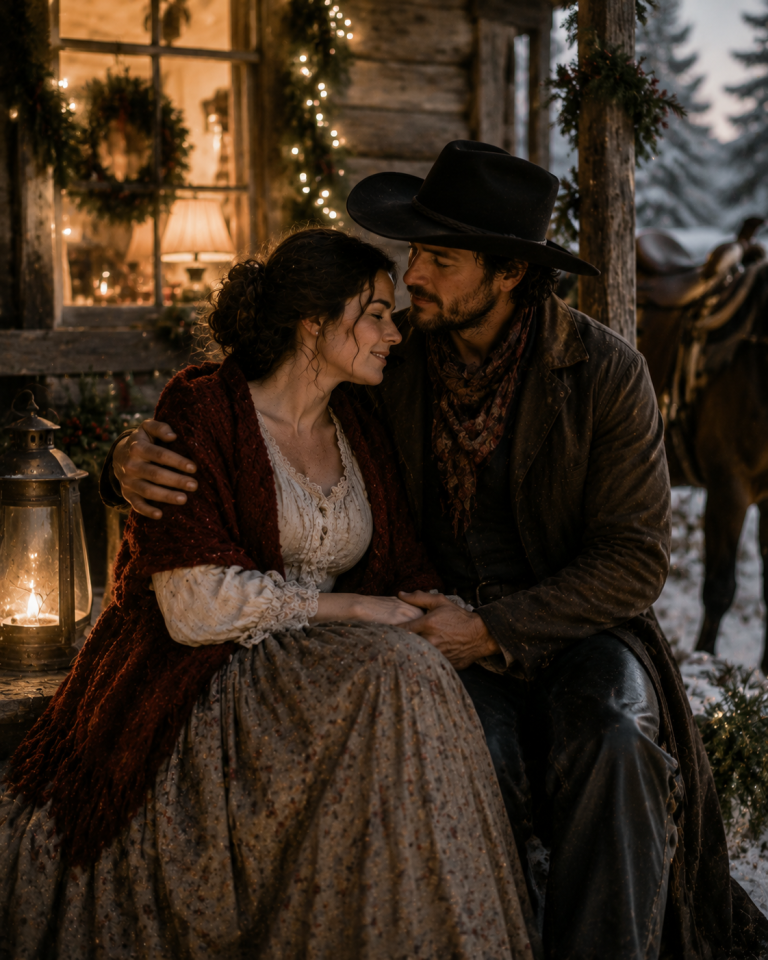
She leaned into his shoulder. Snow fell soft across the ranch they’d saved together, first by fighting for it and then, slowly, by choosing it, and then, without either of them quite noticing the moment it happened, by loving it and each other in equal, stubborn measure.
She’d come west expecting one kind of marriage.
She’d found something harder, messier, and infinitely more real.
Rescue, she understood now, was never someone riding in to save you.
It was finding the strength to save yourself — and discovering, against every hard-earned instinct to expect otherwise, that you didn’t have to do it alone.
THE END