They Left Her to Die Alone in the Snow—Then a Lonely Mountain Man Claimed Her as His Wife

PART 1
The storm came in the way the worst ones always did in the high country — not gradually, but as a hard turn in the wind and a sky that went from pale to iron in the space of twenty minutes. Evelyn Hart felt it before she saw it. She’d been working the treeline for the better part of an hour, breaking dead branches from low Douglas fir boughs and stuffing them into the canvas sling over her shoulder, while the cold worked its familiar path into the left side of her body — the hip that had never healed right after the wagon accident two summers back, the one her stepmother Margaret called *her bad side*, the way you’d talk about a tool that had gone wrong and couldn’t be trusted with real work.
She’d been sent for wood with explicit instructions. *Fill it completely. Don’t come back with less than a full load. We can’t afford to waste a stop.* Margaret didn’t repeat herself twice on things like that, and Evelyn had learned a long time ago not to make her.
The sling was only half full when the light told her to stop arguing with the sky and get back. She moved as fast as the hip allowed, which was not fast, using a stick as a staff, jabbing it into frozen ground with every fourth step to keep herself upright. She came out of the treeline into the clearing where the wagon had been sitting since morning.
The wagon wasn’t there.
For a long moment she simply stood and looked at the space where it should have been — the flattened grass, the wheel ruts, the shallow print where the mule had stood for hours, and one other set of tracks, smaller, leading into the trees. Her own, from that morning.
“Papa?” Her voice came out smaller than she meant it to. She tried again, louder, and got nothing back but wind moving through the pass.
She walked to the center of the clearing and made herself read the tracks the way her father had taught her to read weather — honestly, without flinching. The wagon had been turned. Not spooked, not bolted — turned, deliberately, and driven east at a measured, controlled pace. Not the gait of an animal in a panic. The gait of people who had made a decision and didn’t want to be talked out of it.
She sat down in the snow, dry-eyed, and thought about her father, Caleb Hart, a man she had always told herself was weak rather than cruel — the man who’d held her hand when her mother died, who’d told her more than once, in his quiet way, that she was the image of her mother and that he was grateful she was his. And then she thought about three weeks ago, half-asleep in the back of the wagon, hearing her stepmother’s voice carry across the fire. *The girl can’t make it through the pass, Caleb. Not with that leg. She’ll slow us down, and we’ll all die trying to carry her. She’s a liability.* And her father’s answer, low and tired. *I’ll think about it.*
She had told herself, for three weeks, that she’d misunderstood. Sitting in that clearing with the first fat flakes of snow beginning to fall, she understood that she had not.
She spent the first night under a deadfall spruce with a fire the size of her two fists, a folding knife she’d carried since fourteen, a flint striker, and no food beyond half a hard biscuit and a sliver of dried venison she made last as long as she possibly could. In the morning she followed the wagon tracks east — not because she believed anyone was coming back for her, she’d already stopped believing that, but because east was the only direction that wasn’t simply *up into the mountains and stay there.*
By the second afternoon she had discarded the firewood because her hands could no longer manage the weight. By the second evening, soaked through and shivering steadily — which an old mountain man had once told her father was the sign your body was still fighting — she knew, with a strange and total clarity, that she was not going to make it out.
She found a hollow between two boulders, sat down against the cold stone, and understood she wasn’t going to light a fire because her fingers no longer had the fine motor control to try. She thought, with mild surprise, the way you note an interesting fact: *I don’t want to die.*
The snow fell straight down now, thick and silent, settling on her coat and her hair, and she understood that if she stayed sitting here, by morning she would simply be a white shape that looked like a small boulder.
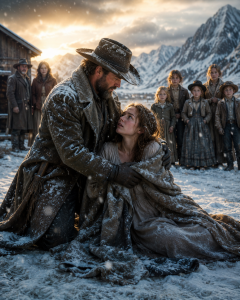
That was when she heard it. Not a sound exactly — a change in the shape of the silence. She opened her eyes and there was a shadow above her, enormous, blocking out the snow-heavy sky. A man crouched down slowly, the way you’d approach something that might bolt, though she was far too frozen to bolt anywhere at all.
“You alive?” His voice was low, rough as gravel underfoot.
“Yes,” she said. The word came out strange in her own mouth.
He looked at her for a long moment — at the angle of her leg, at her face — and then, without another word, set down the frozen fox he’d been carrying and the rifle slung across his back.
“This will hurt,” he said. It was the most honest thing anyone had told her in a very long time.
PART 2
It did hurt. The white flare that went up through her hip when he lifted her sent her vision dark at the edges, and she made a sound she hated making — but he kept moving, steady and matter-of-fact, settling her weight against his chest with the ease of a man who’d carried plenty of things that didn’t want to cooperate.
“Where are you taking me?”
“Cabin.”
“How far?”
“Far enough.”
She wanted more than that — a name, a reason, some sense of whether this was better or worse than the alternative — but the cold had taken most of her words, and the motion of being carried was already jostling the hip into a steady, brutal ache that used up whatever attention she had left. She watched snow fall past the brim of his hat. She listened to his breathing, controlled, unhurried, the breathing of a man who did hard things for a living and didn’t make a production of them.
She woke by degrees, hours or a day later — she couldn’t tell which — to warmth first, deep in her bones before she felt it on her skin, then woodsmoke, then the particular close sound of a fire in a hearth. Her hip had settled into a deep, volcanic throb. When she opened her eyes, she was on a cot inside a small, rough-timbered cabin, covered in furs, and three feet away an enormous gray dog sat watching her with an unblinking, unreadable calm.
“He won’t bother you unless I tell him to,” the man said, without turning from the fire.
His hair was dark, threaded with gray, pulled back roughly. Scarring ran down the side of his neck and disappeared into his collar — old scarring, the kind that had healed a long time ago and stayed anyway.
“What’s his name?” she asked.
“Rack.”
“What’s yours?”
A pause long enough that she thought he wouldn’t answer.
“Creed. Ronan Creed.”
She learned, over the following days, that he was a trapper who had come into these mountains eleven years earlier and had not gone east of them since — not from anything he told her outright, but from the small, careful arithmetic of things he let slip and didn’t repeat. He’d built the cabin himself. There had been another dog before Rack, mentioned once, in a voice that made it clear the loss of it had never gotten smaller. The scar at his collar, the old damage in his right knee that he’d adapted past rather than let show — none of it he explained, and she’d learned fast that pushing only made him go quieter.
What she couldn’t stop wondering, lying awake with the fire down to coals and the dog’s breathing steady near the door, was what a man had to walk away from to choose eleven winters of silence over anything a town could offer him. And whether, when spring finally came and she had to walk out of these mountains the way she’d walked in — alone — she would ever find out.
PART 3
The bargain, when it came, was struck on the fourth day, over a bowl of beans at a table built for one man eating alone.
“I need to understand what this is,” Evelyn said, sitting down across from him in the chair he’d glanced at once — the look a person gives furniture that had been in the same place so long its position had become a fact of the room. “Me being here. What you expect. What the terms are.”
Ronan set down his spoon. “Terms.”
“You found me. You brought me here. You’ve been feeding me. I assume that doesn’t come without expectations.”
Something crossed his face — not offense, she didn’t think he was a man who took easy offense, but something closer to recognition.
“What kind of expectations are you worried about?”
“The obvious kind.”
“No,” he said. “You’re in no shape, and you can’t get out of these mountains until spring. I’m not going to add to your trouble.”
She studied him. He’d gone back to eating, which she was beginning to understand meant he’d said what he intended to say and didn’t feel obligated to decorate it. “All right,” she said. “Then what do you need from me? I can’t just sit here and eat your food and give nothing back. I won’t do that.”
“Can you cook?”
“Yes.”
“Can you mend?”
“Yes.”
“Can you stay out of my way when I’m working?”
“That depends how much space you need.”
The corner of his mouth moved — not quite a smile, more the facial equivalent of a man making a note. “That’s the deal, then. You cook, mend, keep the fire. I hunt, run the lines, keep the cabin standing.” He paused. “And in spring, you leave.”
She nodded. And then, because it had been sitting in her chest for four days with nowhere to go, she said it — flat, without asking for anything back. “My family left me. They sent me for firewood and they left while I was gone. My father, my stepmother, my two stepbrothers. They just left.”
He didn’t say anything. He also didn’t look away, which she found she was grateful for, because most people looked away.
“I’m telling you because I need you to know I’m not going to do anything stupid — go after them, or—” She stopped. “I just needed to say it out loud to someone. I haven’t yet.”
Ronan was quiet for a long moment. Then: “Eat something. There’s more in the pot.”
It wasn’t sympathy, not exactly. It was something more basic than sympathy — an insistence that whatever had happened, she was alive, and that had to keep going. It was, to her mild surprise, enough.
The first week nearly broke her in a different way than the cold had — not physical survival, which had its own plain logic, but the difficulty of sharing six hundred square feet with a man who explained nothing, expected her to work out the rest on her own, and moved through his own cabin like someone who’d long since stopped imagining he’d need to make room for anyone else. He woke before light and was gone before the gray came through the oilcloth window, returned by mid-afternoon to work the remaining daylight on pelts and equipment, ate twice a day in near total silence, and seemed to be recalculating, every hour, how much of the place he was willing to share.
Evelyn made herself useful in the only currency she had. She could take cornmeal, rendered fat, and dried apples and turn them into more than the sum of their parts, a skill learned in a trading-post kitchen where money was always tight. The first morning she was steady enough to stand at the stove, she made hoecakes on a griddle that had clearly sat unused for years. Ronan stopped in the doorway at the smell of something that wasn’t broth, sat when she told him to, and ate three of them without a word — didn’t thank her, but didn’t tell her not to bother either, which she decided, that first week, to count as the same thing.
The stores told a harder story: dried meat, beans, cornmeal, a little flour, coffee rationed thin. She did the arithmetic of two mouths instead of one and kept it to herself, stretching every meal further than it wanted to go. Ronan noticed — she could see it in the calculating look he gave the pot before eating everything in it anyway. With Ronan Creed, she was learning, eating what you made *was* the compliment.
The cabin itself argued with both of them. There was one cot — his, though he gave it up the first night without discussion for a pallet by the fire, claiming he slept better there, which she knew wasn’t true and knew there was no arguing with. One table, two chairs where there’d only ever needed to be one, and a layout built for a man’s rehearsed routine that made almost no sense for two people trying not to collide. They walked into each other three times that first week. The worst was a door catching wind, swinging hard, Evelyn spinning in surprise and the bad hip folding beneath her — Ronan’s hand closing on her arm before she’d finished going down, then letting go the instant she’d steadied, as if the touch had been instinct he wasn’t sure he’d meant to have.
“I’m fine,” she said quickly, before he could look at her leg the way he was already starting to look at it.
“You twisted it.”
“I stumbled. It’s different.”
“Didn’t sound different.”
“I have a bad hip,” she said, meeting his eyes. “It’s not going to get better. It’s just the way it is. I’d appreciate it if you’d stop watching it like it’s suddenly going to become your problem.”
“It’s already my problem if you fall and can’t work,” he said, so flatly practical that she nearly laughed. Almost.
“Fair point. I’ll be more careful.”
She was. And without announcing it, Ronan started adjusting things too — a pot moved to a lower shelf, a water bucket relocated somewhere she wouldn’t have to stretch for. She noticed. She decided not to say anything, in case acknowledging it made him stop.
The conversations, when they came, arrived sideways, the way conversation does with guarded people. She told him about her mother’s seamstress shop in Kansas, about her father’s earnest, impractical love for a trading post he never ran well. He rarely asked questions, but days later he’d reference something she’d said, which told her he’d been sitting with it the whole time.
“You said your mother taught you to sew,” he said one evening, unprompted, working a piece of rawhide into a trap trigger.
“Five, I think. Maybe four. First useful thing she ever taught me. She used to say the difference between a woman who sews and a woman who just makes stitches is whether she understands what the cloth wants to do — the grain of it. You work with it instead of fighting it.”
Ronan was quiet a moment. “That’s how trapping works,” he said. “You learn what the animal wants to do, where it wants to walk. Then you put the trap there.”
“I never thought of it that way.”
“Most things are the same, when you get down to it.”
She never got his equivalent story — the eleven years, the scar, whatever sat behind whatever wall he maintained — and she kept her promise to herself not to grab for it. But he listened to hers with a steadiness she’d started, cautiously, to trust, and some evenings that was more than she’d had anywhere else in her life.
The morning he didn’t come back on time, she didn’t worry immediately; the trap lines were variable, some days early, some days late. But the sky had been wrong since noon — the low iron gray she’d learned to mistrust — and by the time full dark came down with the wind screaming out of the northwest, Rack had been sitting at the door for an hour, which he only did when he was waiting for Ronan.
Two hours after dark, the dog’s head came up. Evelyn was at the door before she’d consciously decided to move, pulling on one of Ronan’s spare coats, enormous on her but warm. The cold hit like a wall when she opened it. In the horizontal snow she saw a shape at the edge of the porch steps, upright but wrong — listing to one side, a leg not tracking properly, his face tight with something past cold.
“Ronan—”
“Get inside.” His voice was rough but controlled.
“Can you walk?”
“I’m walking.” Technically.
She got his arm over her shoulders and took as much of his weight as her hip would allow, which was not enough, and they made the steps together. Inside, in the light, she saw it properly for the first time — his right leg below the knee dark with frozen blood, not from snowmelt.
“Sit down,” she said, and something in her own voice — some register she hadn’t used before — made him actually sit.
A broken limb, brought down by a heavy snow load, had torn a jagged four-inch gash into the lateral side of his leg, five inches above the ankle. It had bled long enough, in cold enough air, that the blood had frozen in layers instead of clotting clean.
“When did this happen?”
“Two hours ago. Maybe more.”
“You walked on this for two hours.”
“Didn’t have another option.”
She cleaned it with whiskey — he made a sound that was almost nothing, almost entirely suppressed, and she pressed harder rather than lighter because stopping partway was worse than finishing fast. “Talk,” he said through his teeth. “Say something. Anything.” So she talked — about cornmeal rationing, about nothing, keeping her voice level while her hands did what they needed to do.
She had sutured exactly twice before in her life — a dog at sixteen, her own hand two years ago. “I have to stitch it,” she said. “I’ve done it before. Not on anything this size. But I know what I’m doing.”
He looked at her, his face more open than she’d seen it, pain having taken down whatever he usually kept standing. “I believe you,” he said.
Twelve stitches, pulled as clean as the wound’s ragged shape allowed. He didn’t make a sound the whole time; she felt him breathe, felt the chair creak under the grip of his hands, and kept going. Rack pressed himself against Ronan’s good leg and stayed there, the way a dog does when it has decided something is wrong and made a decision about what to do with that fact.
“Thank you,” Ronan said, when it was done, his voice different — not softer exactly, but a layer closer to the surface than she’d heard before.
She got him to the cot over his protest, banked the fire to hold through the night, and pulled the second chair to his side. “I’ll stay up a while,” she said. “If the fever starts—”
“You don’t need to, Evelyn.” He said her name the way most people said *stop*.
“Let me.”
His jaw tightened — the particular difficulty, she understood, of a self-sufficient man accepting that tonight he wasn’t. “All right,” he said finally.
Outside, the blizzard threw itself against the walls. Inside, the fire held, and so, through the long night, did the wound. In the morning she checked it and let herself believe, carefully, without celebration, that he might be all right.
The fever found him anyway, on the second day, the way infection sometimes does regardless of how clean the stitching was — dry, hot skin, sweat-soaked furs, breathing gone shallow. She kept cold compresses moving through the worst of it, checked the wound obsessively for the red line that would mean real trouble, and found none. He surfaced occasionally into fragments that weren’t quite coherent — a name once, maybe two, something about a river she never caught the rest of — and she didn’t try to answer any of it, only kept the cloth cold and the fire steady.
By the third day the fever broke, messily, the way they do, and left him pale and clear-eyed and immediately arguing about the trap lines.
“I need to check the North Line.”
“You have a hole in your leg I stitched closed forty hours ago. You’re not going anywhere.”
“The traps will keep.”
“The animals won’t. If something’s caught and it sits too long in this cold, then it sits.” She held out a cup of water. “Drink this.”
He drank it with the particular energy of a man doing something under protest and wanting that fact noted. “You’re stubborn,” he said.
“Learned it from someone.”
He almost smiled.
The food arithmetic, when they finally faced it together, was not generous — ten days, maybe, if she was careful, less if the cold held hard. Ronan gave her the location of a snare from the cot, describing landmarks with the precision of a man who could see the terrain perfectly in his head even flat on his back. She reset it herself, checked it daily on a bad hip through deep, treacherous snow, and came back empty three mornings running, revising the numbers in her head each time and keeping the worry to herself because nothing useful came of sharing it.
By the sixth day post-fever he was upright and moving despite everything she said about it, the leg holding his weight with visible, controlled pain. When she insisted on checking the reset snare herself, he insisted on coming, using the staff she’d cut and smoothed for him.
They found the draw empty again, but Ronan crouched carefully, read the snow the way she’d watched him read every part of this place, and pointed ten feet north. “Move it. There’s a run here.” She saw nothing until he showed her — the faintest disturbance along a blowdown, rabbits moving at night when it was coldest. She reset the snare where he told her, and he said nothing, which she understood by now to mean she’d done it right.
They were heading back when Rack went rigid — not curious, but fixed, a low sound starting in his chest she’d never heard before. Evelyn followed his stare to the treeline and saw them a half-second before she understood what she was looking at: five shapes, gaunt with a bad winter’s hunger, watching from the trees with a patience that had nothing casual in it. The lead animal drifted sideways, testing, angling toward Ronan’s compromised leg like it had already worked out which of them couldn’t run. Evelyn shouted, loud and sharp, and it checked, dropped back — but only ten yards, only long enough for her to reach the rifle on the porch and get them both through the door. She threw the bolt. Her heart was going hard enough that she could feel it in her ears, and for a long moment neither of them moved, listening to the wind and, underneath it, something circling.
“They’ll come back,” she said, at the window that night, watching gray shapes drift at the edge of the clearing and vanish and reappear.
“Tonight, probably. Or they’ll wait and watch.”
“We have to solve two problems,” she said. “The wolves and the food.”
“If we solve one,” Ronan said quietly, “we solve both.”
Neither of them slept much. She heard him get up twice in the dark to check the door bar, and once, near dawn, the low click of the rifle being loaded by feel. When the first gray light came, the lead wolf was already in the clearing, alone out front, the others fanned back into the trees, watching the cabin with the same unhurried, deciding patience it had worn the day before. Ronan eased the window open two inches. Cold poured in. Somewhere outside, a bird went silent. He braced the rifle against the frame, his weight thrown hard onto his good leg to spare the wound, and went still in a way that seemed to cost him everything he had left to give it. Evelyn didn’t breathe. The wolf’s head came up, ears forward, reading something in the stillness of the cabin it didn’t like.
The shot cracked the morning apart. The lead wolf dropped where it stood, and the rest broke and scattered into the timber in a single flash of gray, gone before the echo had finished coming back off the mountain. “Good shot,” she said, into the ringing quiet. “It was a close shot,” he answered, and she understood the complication in his face, because she felt the same weight — the specific, uncomfortable arithmetic of having killed something because you needed to eat.
That night, standing at the window together with two feet of cold cabin air between them, he said, unprompted, “I’m sorry.”
“For what? For getting hit by a tree limb you didn’t plan on?”
“I should have been watching better.”
“You carried me out of a blizzard,” she said, turning to face him fully. “You fed me and kept me alive and didn’t ask for anything in return. You don’t get to apologize for getting hurt.”
He looked at her for a long moment. “You stitched me back together,” he said. “Sat up three nights. Why?”
The question was genuine, which made it the strangest one she’d been asked in a long time. She thought about it with the seriousness it deserved.
“Because you’re still alive,” she said. “And I’d like you to stay that way.”
He didn’t answer. She went back to the stove and pretended to be very focused on the water.
Winter loosened its grip the way it always does in high country — not in a single soft morning, but in arguments: a warm afternoon undone by two days of hard freeze, slush turned overnight to lethal ice on the porch steps, water moving under the snowpack before it was visible anywhere. Rack felt it first, restless at the door in a way that pointed outward instead of in. The leg had healed as well as a wound in the back of nowhere ever heals — a scar that pulled with the weather, a stiffness he walked out each morning without comment.
What filled the late winter was longer-horizon work — pelts prepared for sale, a ledger reorganized without being asked, a mental list of repairs Evelyn kept in the margins of a scrap of paper and didn’t show him. She told herself it was habit. She didn’t examine that too closely.
The conversation she’d been avoiding all winter caught up with her in March, the morning she sat at the table with real coffee — produced from a tin he’d apparently been hiding, with an expression as close to conspiratorial as his face got — and Ronan stood at the stove with his back to her for an unusually long time before he spoke.
“There’s going to be a wagon train through the lower pass. A month, maybe two.” He didn’t turn around. “I go down every year, trade the season’s pelts. There’s a trading post at the junction.”
“All right.”
“You could join them.” A pause. “I’ve got gold set aside from good years. Enough to get yourself set up somewhere real. Portland’s grown a good deal. Sacramento.” He finally turned. “You deserve a better situation than this.”
She looked down at her coffee and thought about Portland, about Sacramento, about buildings and shops and people who talked in complete sentences. The picture didn’t take hold the way she expected it to.
“You want me to go?” she said.
“I want—” He stopped, started again. “What I want isn’t the relevant question.”
“It’s one of them.” She set her cup down and looked at him the way she’d learned he could tolerate — directly. “Ronan. Do you want me to go?”
The silence that followed wasn’t the working silence, or the eating silence. It was the third kind, the one that felt like presence instead of absence, the one she’d started, quietly, to recognize.
“No,” he said finally. “I don’t want you to go. But what I want doesn’t get to be the only thing that matters, and saying that doesn’t stop being true just because I don’t like it.”
She stood up from the table, not dramatically — she simply needed to be standing for this. “I’ve spent my whole life around people who decided what they needed mattered more than what I could offer, and who I was. My stepmother told my father I was a liability. My father, who I believed loved me, decided that was an arithmetic he could live with.” Her voice stayed even; she’d made peace with the fact of it, if not the feeling. “I’m not doing that again. I’m not letting someone else decide what I’m worth and where I belong.”
He watched her.
“So I’m asking you directly,” she said. “Do you want me to stay?”
A shorter silence this time. “Yes.”
“Then say so. Don’t pack my bag and hand me gold and make the decision for me because you’ve already decided you’re not worth staying for.”
That landed visibly — a small tightening around his eyes, a fractional shift in how he stood. She hadn’t meant it as a weapon, exactly, but she’d meant it as true, and she wasn’t going to take it back.
“It’s not a small thing,” he said. “Staying here. It’s a hard life. It doesn’t get easier.”
“I know that. I’ve been living it four months.”
“A hard life gets harder—” He stopped.
“When what?”
He looked at her the way he had a handful of times before — as close to the surface of himself as he usually let anyone see, and then stopping, because further was territory he didn’t have easy access to. The scar. The eleven years. Everything she’d never asked about.
“When you care whether someone’s all right,” he said. “It gets harder when that’s involved.”
She understood what that sentence had cost him, and she didn’t treat it lightly. She let it sit in the air a moment. “I know,” she said, more quietly. “I know it does.”
He looked at the window, where morning light was coming through the oilcloth, real and pale gold. Then at his hands. Then back at her.
“The chinking on the north wall needs redoing,” he said.
She blinked. “I know. It’s on a list.”
“And the step, second from the top.”
“I’ve known about that since February.”
“I was thinking,” he said slowly, like a man feeling his way along unfamiliar ground, “we could add another room. Not large. Back wall’s sound, and there’s timber if I start cutting in April.” A pause. “More space would help.”
She looked at this man — scarred neck, rebuilt knee, eleven years of deliberate solitude, and a complete inability to say directly anything he actually meant — and felt something warm move through her chest that she didn’t try to name or manage. She just let it be there.
“It would help,” she agreed. “We should think about a proper root cellar too, before next fall.”
“I’ll add it to the list.”
They drank their coffee in a quiet that had ease in it now — the kind of quiet that belongs to people who survived something together that neither of them would have survived alone, and had stopped pretending otherwise.
Six weeks later the wagon train came through the lower pass, twenty canvas-topped wagons trailing dust that meant dry ground, meant spring had finally arrived to stay. Evelyn stood on the porch and watched them move through the valley, Rack leaning against her leg the way he’d started doing sometime in February, still an honor she felt obscurely proud of.
She thought about herself four and a half months ago, in a different wagon, believing the people on the seat ahead of her were the fixed point her whole life was organized around. She thought about her father — she did this less now, not because it hurt less but because she’d gotten honest about the shape of it. He had loved her. She still believed that. Love and choice, she’d come to understand, were separate things, and he’d made his choice, and she had spent the winter building her own life in the wreckage of it, the way you rebuild a house after a flood — with whatever materials were still sound, arranged differently than before.
She wasn’t the woman who’d gone out for firewood in November. That woman had been waiting — for someone to tell her where she belonged and who she was supposed to be to them. Evelyn had stopped waiting sometime between the wolf and the thaw. She couldn’t say exactly when. Only that she’d looked up one morning and found she wasn’t doing it anymore.
Ronan came out of the treeline carrying timber across one shoulder, set it down beside her, and followed her gaze to the valley. “You should go down,” she said. “Trade the pelts, get the roofing.”
“We’ll both go,” he said. “You need boots. Those won’t last another winter.”
She looked down at boots resoled twice and held together with rawhide and stubbornness. “I’ve been meaning to mention those.”
“I know you didn’t want to add to the list.”
The corner of his mouth moved.
At the trading post two days later — noise and unwashed wool and fresh-cut lumber, more human density than she’d stood in since November — she negotiated the price of the season’s pelts herself, better than the trader’s first offer, and bought real coffee, cornmeal, flour, dried fruit, roofing material, and, on an instinct she didn’t second-guess, a small pane of actual glass to replace the oilcloth in the cabin window.
A woman from the wagon train approached her while she loaded the sled. “You’re not with the train,” she said. It wasn’t quite a question.
“No. I live up the mountain.”
The woman glanced at Ronan, loading timber with the same systematic efficiency he brought to everything. “Been here long? Through the whole winter?” A pause. “Alone?”
“Not alone,” Evelyn said.
“It’s a hard country,” the woman said.
“It is,” Evelyn agreed. “It’s also mine.” She hadn’t planned to say it. It came out with the simple certainty of something she’d known for a while without knowing she knew it, and she stood with it a moment after, testing it. It was true. The mountain, the timber, the cold, the creek, the cabin, the morning light through what would soon be glass instead of oilcloth — it was hers in a way that had nothing to do with ownership and everything to do with what she’d paid for it, in the particular currency of a person who nearly dies somewhere and chooses, afterward, to stay.
The ride back up was long, the light doing something extraordinary to the high peaks — pink sliding toward gold, the twenty minutes of color that only happened this time of year.
“The light on those peaks,” she said.
Ronan looked, held on it. “March is better. Sometimes the clouds go a certain way and it turns real red.” A pause. “You’ll see it. Next March.”
He said it naturally, without making a point of it — the way you mention a seasonal thing to someone you expect will still be there for the season. The way you hand someone the calendar of a place they belong to.
“I want a garden,” she said. “South side of the cabin. Sun’s good there. We could have vegetables by midsummer.”
“Ground’s hard to break up there.”
“I know. I’ll start now, work it in pieces.”
A pause. “I’ll help.”
“You can help.”
The cabin came into view through the trees as the light went — stone chimney first, then the walls, the framed addition standing open to the sky, waiting on its roof. Rack was already on the porch, watching their approach with his yellow eyes and his permanent, unreadable calm.
Evelyn climbed down, her new boots hitting the ground solidly, her hip offering its usual mild complaint about a long day, and stood a moment looking at a cabin that was rough, small, and in need of more work than any list could hold — the cabin of someone who’d never had quite enough help or time, only determination. Her family had done the arithmetic on a November morning and decided she was a cost they couldn’t carry. What they hadn’t calculated was what she’d become without them.
That, she thought, was the thing nobody told you about being thrown away by the people who were supposed to keep you — that sometimes, in the specific and unlikely conditions of the right hardship with the right person standing nearby, being discarded is the thing that finally shows you what you’re made of. You find out you can stitch a wound in a man’s leg with your hands shaking and get it right, that you can shoot fear back at a wolf with borrowed courage and make it land. You find out you can build a life out of the raw material of being unwanted, if you’re willing to put in the work.
She wasn’t grateful for what her family had done. She wasn’t going to perform gratitude for pain that had been real and had cost her real things. But she was standing on a mountain in new boots, with a list of repairs for a cabin that was hers in every way that mattered, beside a man who had said yes when it counted — and she was going to break ground on a garden in the morning.
Ronan paused in the doorway, arms full of the first load, and looked back at her, still standing in the clearing. “You coming in?”
“In a minute.”
He looked at her the way he sometimes looked at things he was working to understand — not impatient, just fully present — and then went inside and left her to her minute, because that was what he did, and she had long since understood it was one of the most important things about him.
She stood in the last of the light and let it be everything it was — cold still pooled in the shade of the trees, the creek running clean and constant somewhere below, the mountains holding their final hour of color above the timberline.
Then she turned, walked inside, and pulled the door shut behind her. The fire was going. The coffee was on. She sat down, took off her new boots, and picked up the list of what came next.
There was a great deal on it.
She was already looking forward to all of it.
THE END