The widow asked if he would stay after saving her from the river — then the cowboy’s answer changed everything


—
## PART 1
The scream did not belong to the mountains. Eli Walker had lived long enough beside the Wind River to know every sound it made — the groan of pines in winter, the low rumble of spring melt, the cry of hawks, the distant howl of wolves. This cut through the roar of the swollen river like a blade. It was human. It was fear.
Eli dropped the horseshoe file from his hand and lifted his head. For a heartbeat he thought it was memory playing tricks on him — the war had left him with echoes that came at the worst times. Then it came again, desperate, thin, breaking. He ran without deciding to.
It was early June of 1874, and the snow off the Wyoming peaks had turned the Wind River into a raging beast, brown water clawing at the banks, whole branches spinning like broken bones in the current. Then he saw her — a flash of dark fabric caught in a fallen cottonwood, pale skin, a limp arm. She was trapped mid-torrent, one arm hooked around a branch, the rest of her half under, her head slipping lower with every second that passed.
Eli didn’t stop to think. He tore off his boots, flung aside his gun belt, and plunged into water cold enough to hit him like a fist to the chest. The current dragged at his legs, debris slammed his shoulder, water filled his mouth — but he’d dragged men off battlefields before, pulled brothers out of mud soaked through with blood. This was just another fight. He reached the cottonwood, anchored himself on a thick limb, and saw up close the bruise already blooming on her cheek, her torn dress, a leather satchel tied to her wrist like she’d sooner drown than let it go.
“Hold on,” he shouted, though her eyes stayed closed. Her leg was wedged between branches below the surface. He took a breath and went under, working blind with his hands until her leg came free. When he surfaced she was limp. He dragged her from the tree and fought the current back to shore, every step feeling like war all over again, until he stumbled onto the muddy bank with her weight still in his arms.
For a long moment he lay there, chest heaving, the river roaring in his ears. Then she coughed. Water spilled from her mouth. Her eyes fluttered open — green, confused, afraid.
“You’re safe,” he said, voice rough.
She tried to sit up, shivering hard, her torn dress clinging to her, and crossed her arms over her chest the moment awareness caught up with fear. “Where am I?”
“My land. Near the Wind River.” He stood dripping and cold. “You’ll freeze out here. My cabin’s close.”
She flinched away when he reached for her. “Not town,” she said quickly. “Please don’t take me to town.” The fear in her voice ran deeper than the river had.
“I’m not taking you to town,” he said. “But you can’t stay here.” Her eyes searched his face a long moment before she gave a small nod. When she tried to stand, her legs failed her, and Eli lifted her into his arms — lighter than he expected, fragile. She went stiff but didn’t fight him.
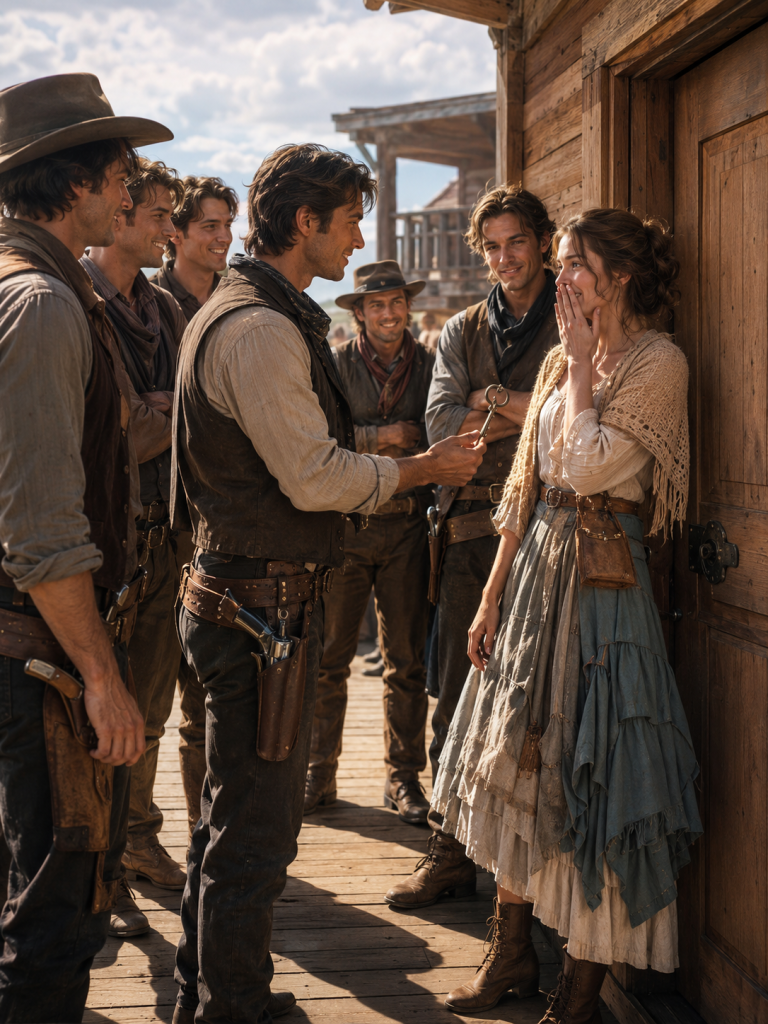
He carried her to the small log cabin tucked against the pines — a stone fireplace, a narrow cot, a rough table, the smell of woodsmoke and long solitude. He set her near the fire. “Get those wet clothes off,” he said, already turning his back and adding wood to the flames, his tone firm and practical, his eyes elsewhere. He poured coffee and added whiskey to both cups. When he finally glanced over, she’d wrapped herself in his spare blanket, her dress hung to dry, the bruise on her cheek stark against pale skin.
“My name is Eli Walker,” he said.
“Clara Jensen,” she answered softly.
His eyes went to the satchel, still clutched even now against her chest under the blanket. “What’s in that you’d rather drown than lose?”
Her whole body went guarded at once. “Nothing that concerns you yet, Mr. Walker.”
He let it sit. A man learned, in his line of work and hers apparently both, when pushing only closed a door harder. They drank in silence, and as warmth returned to her hands, her voice began to shake for a different reason. “My husband died,” she said. “He left debts. His family came for the land. I had to leave.” She didn’t finish the sentence, and Eli understood enough without her finishing it — the West was full of stories shaped like hers. Widows with nothing. Families who collected what they believed was owed them with fists instead of paper.
“You’ll stay until the river drops,” he said. “You’re not crossing it.”
That night he gave her the cot and lay on the floor by the fire, the cabin feeling smaller than it ever had before. Before he banked the fire low, he’d walked the tree line once more out of old habit, and found a single set of hoofprints crossing the upstream ford that weren’t his own and looked no more than a day old. He said nothing about it to Clara. No sense frightening a woman half-drowned and shaking before he knew what the tracks actually meant.
In the dark, her voice came quiet. “Mr. Walker.” A long pause. “Will you stay if I undress?”
The words struck him harder than the river had. He understood exactly what she meant by it — payment, a trade, a woman who’d learned shelter always came with a price attached. Slowly, he turned his back further, though he was already facing away. “Get some sleep, Mrs. Jensen,” he said. “No one’s going to bother you here.”
In the dark he heard her try and fail to hide a sob, and as the river roared on outside, Eli Walker felt the first crack form in the walls he’d spent years building around whatever was left of his heart.
—
## PART 2
The next morning the river still roared. Eli was already awake when pale light pushed through the small window, having barely slept, Clara’s question from the night before still hanging in the cabin like smoke. He kept his back to her until her breathing settled into real sleep, then stood by the fire listening to the river’s dull thunder.
Clara rose slow from the cot, favoring one leg, the bruise on her cheek darker now. “The river’s still too high,” Eli said without turning.
“I can see that,” she replied, and dressed behind the blanket he’d hung for her.
The days that followed trapped them together, and Eli found more sign along the tree line twice more that week — a boot print by the springhouse that matched neither his stride nor Clara’s, a broken branch at the property’s edge that looked snapped by a hand rather than weather. He mentioned it to her plainly the second time.
“Someone’s been on my land who isn’t welcome,” he said. “I’d sooner know who, than guess.”
Clara’s jaw tightened. “My husband’s family isn’t the kind to send one man asking one question,” she admitted finally. “Silas’s father, Cyrus, still holds the family spread outright. In his eyes a widow with no filed marriage papers has no claim on anything Silas left behind — but if he can prove I stole from the estate besides, it settles any question clean, and quiet, without a court ever needing to hear my side of it. Amos does the riding. Cyrus does the deciding. There’s cousins besides, and hired men who don’t ask why before they’re paid.” She looked at him, something like an apology in her face. “I didn’t want to bring that kind of trouble onto your land. I still don’t.”
“It found its way here regardless,” Eli said. “Better I know the shape of it.”
She didn’t sit idle those days despite it all. On the second morning Eli found her kneeling in his garden patch, pulling weeds from damp soil with steady hands despite an unsteady body. “You don’t have to do that,” he said.
“It’s better than sitting,” she answered. “I’m earning my keep.” He didn’t argue. He watched her over the following days hauling water despite her limp, mending his shirts with neat, careful stitches, baking bread that filled the cabin with a scent he hadn’t realized he’d missed. In return he left fresh water by her door each morning, split extra wood, kept the fire from dying low at night.
One evening, cleaning his rifle by the fire out of the same old habit that had him walking the tree line most nights now, he glanced up to find her watching the motion of his hands with a familiarity that surprised him. “You know your way around a gun,” he said.
“My father raised me on a Nebraska homestead with no sons,” Clara said. “Taught me to bring down a deer at sixty yards before he taught me to sew a hem straight. Silas didn’t care for it once we married. Said it wasn’t fitting.” Something flickered in her face. “I haven’t held one since.”
“Would you want to again?”
She thought about it a long moment, then nodded, and over the following evenings he set bottles along the corral fence and taught her the particular rhythm of his own rifle rather than her long-unused memory of her father’s, until her hands stopped shaking around the stock the way they had the first evening.
One afternoon, reaching up to hang a washed shirt on the line, her dress shifted, and Eli looked away a half-second too late. He’d seen faint silver scars across her back — not accident scars. Deliberate ones. Cold anger settled deep in his chest. Clara felt his gaze and stiffened, pulling the fabric back into place fast, saying nothing, though the air between them changed.
That night she sat at the table turning a small silver locket in her hands, shoulders shaking though she tried to hide it. Eli made noise with his boots so she’d know he was there before he got close. She wiped her eyes and snapped the locket shut. “He had his father’s eyes,” she whispered, before she could stop herself. Eli didn’t ask who. He didn’t need to.
On the fourth day, a rider appeared in the distance — Jed, a hand from the main spread down the valley, a man Eli had traded work with for years and trusted about as far as he trusted anyone left breathing. Clara saw him too, and fear flashed plain across her face.
Jed dismounted near the corral, glancing toward the cabin, and lowered his voice like the words themselves might carry too far in the open air. “Town’s talking,” he said. “About the widow Jensen. Amos and old Cyrus both been through the mercantile twice this week, asking after her, offering coin for word of where she’d got to. Sheriff Boone’s been drinking free at the Jensen table most Sundays for longer than I care to think about, so I wouldn’t count on him hearing your side of anything fair.” He hesitated. “Judge Miller rides the circuit through Lander first week of next month, though. Man’s got no love for the Jensens — fined Cyrus for grazing trespass two years back and never once let it go easy. If this has to land in front of anybody, better it’s him than Boone.”
After Jed rode off, Clara stood by the cold hearth, arms wrapped around herself. “It’s true he died in a fight,” she said softly, before Eli could even ask. “Silas drank too much, owed too much, and we were never properly married — no papers filed. In the eyes of the law I was nothing to him at all, and Cyrus knows it, and means to use it.”
Eli leaned against the wall. “I went to war at nineteen,” he said quietly. “Promised I’d come home in a year. Came back four years later. My brother dead. The woman I was to marry already wed to another man.” He met her eyes. “Promises break easy out here. I’ve stopped expecting most of them to hold. But I don’t intend to hand you over to a family that already broke every promise it owed you first.”
The silence between them wasn’t empty after that. It was shared, and somewhere past the tree line, Eli knew without needing to check again, at least one more set of boots was still watching the cabin, waiting on Cyrus Jensen’s word before it moved any closer.
—
## PART 3
That night Clara developed a fever, fast and fierce, burning by midnight, her body shaking on the narrow cot. Eli stayed beside her with a basin of water, pressing cool cloths to her forehead, feeding the fire, watching her through the long dark hours. In her fever she spoke without guard. “You’re the only one,” she murmured, gripping his hand. “The only one who touched me without wanting something.”
By dawn the fever broke and she slept peaceful at last. Eli stepped outside and noticed the river had dropped, its roar gone softer. When he turned back she stood barefoot in the grass behind him, wearing his old faded army shirt loose around her small frame. “Eli,” she said, using his name for the first time. “Can I stay a little longer?”
It wasn’t about the river, and he knew it. He gave a short nod. “You can work for your keep,” he said, and something shifted between them that neither of them yet understood the cost of.
Weeks passed. The cabin began to feel less like a hiding place and more like something neither of them had a ready word for. One afternoon, riding his horse along the flat land near the river with his hand steady at her waist, the ground gave way beneath the horse near a shallow ravine and she slid down with the crumbling dirt. He reached her in seconds, hands searching her arms and shoulders. “I’m all right,” she whispered, and relief hit him hard enough that he pulled her against him without thinking. For a moment he almost kissed her, before he caught the same look in her eyes he’d seen that first night — gratitude, quiet surrender rather than want — and stepped back instead.
That night Clara finally unbuttoned the old army shirt herself, one button at a time, and told him plain it wasn’t payment this time. It was a plea. Eli crossed the space between them and cupped her face instead of taking what was offered. “I want you,” he said honestly. “But not because you feel you owe me anything at all.” Her control broke, and she told him the rest of it that night — Kansas, hunger, a husband who struck her, a child she’d lost after a blow that had nothing to do with any accident. He listened, rage burning quiet in his chest, and held her after without a single word of pity attached to it.
The next morning they kissed, soft and uncertain, two wounded people finding something steadier in each other than the land alone had ever offered either of them.
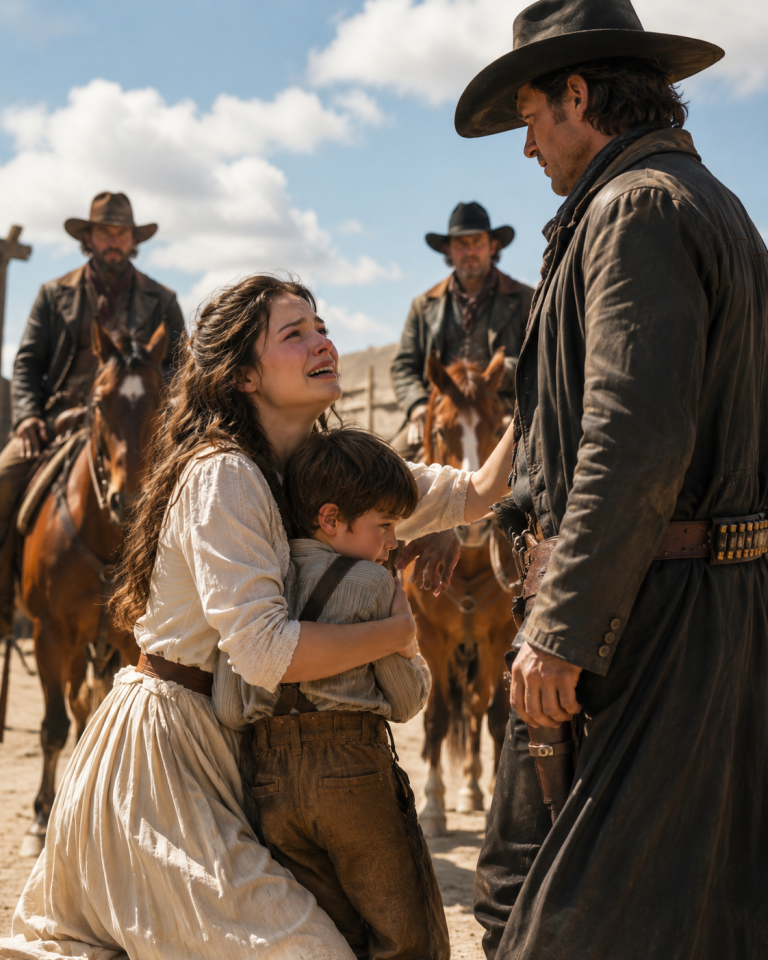
It didn’t last undisturbed. Four days later, Jed rode up at a dead gallop, no dust cloud warning them this time, his horse lathered white. “They’re coming,” he said, barely getting the words out. “Amos filed a petition with Justice Coyle in town yesterday — Coyle’s Cyrus’s man through and through, ruled in an hour that Clara owed the estate for theft and ordered her held pending the circuit judge’s arrival. Amos didn’t wait on the paper to catch up with him. He’s riding with four men, and last I saw them they were headed for the ford upstream, meaning to come at the cabin from the river side where the trees give them cover.”
“How long?” Eli asked, already moving for his rifle.
“An hour. Maybe less.”
Eli looked at Clara, steady now around a rifle stock in a way she hadn’t been a month before. “The ford,” he said. “That’s where this started. Seems it means to finish there too.”
They didn’t wait to be surrounded in a cabin with one door. Eli knew the ground along that river better than any man alive, every deadfall and bend of it memorized across years of solitary walking, and he chose it deliberately over four stone walls that could be fired into or burned. They took position in the rocks above the ford itself — the same stretch of water where he’d pulled her out of the current weeks before — Clara steady on his left with the rifle he’d spent evenings teaching her to trust again, Jed riding hard for the main spread to raise what help he could.
Amos came first through the trees, four hired men behind him, confidence in every line of his posture until he found himself looking up at two rifles instead of one frightened widow.
“Justice Coyle’s ordered her held,” Amos called out. “You’re harboring a thief, Walker. Hand her over and this ends peaceable.”
“Coyle’s not the judge riding this circuit,” Eli called back. “And even if he were, a ruling made in an hour without the accused ever standing in the room isn’t worth the paper it’s written on, and you know it as well as I do.”
“Don’t much care what it’s worth,” Amos said. “Care what it lets me do.” He nodded to his men, and the four of them fanned out along the bank, boots splashing into the shallows where the current still ran fast enough to drag a careless man off his feet.
The first shot came from one of the hired men, wide and rushed. Eli answered it with a round that took the man’s hat clean off and sent him scrambling back for the tree line, no longer quite so certain the day’s wages were worth the risk attached to them. Clara held her position exactly as he’d taught her, breathing slow, and when a second man came up the rocks too close on Eli’s blind side, she fired without hesitation, catching him in the shoulder before he’d closed half the distance — the same steady hands that had once shaken around a coffee cup now holding dead level under fire.
Amos, seeing his hired men falter, drew his own knife rather than a gun — cheaper to claim self-defense with a blade than a bullet, Eli would think later — and came up the rocks himself at a dead run while Eli’s rifle was already spent and swinging for a reload. The knife caught Eli in the side before he could bring the stock around, white pain blinding him for half a second, but he’d taken worse in worse places and didn’t go down. He drove the rifle stock hard into Amos’s jaw instead, staggering him back toward the loose scree at the water’s edge, and it was the same unstable ground that had nearly taken Clara weeks before that finally took Amos — his boots sliding out from under him on the wet rock, arms wheeling, the current catching him before he’d fully understood he’d lost his footing at all.
Eli, bleeding freely now, didn’t go in after him. Two of the remaining hired men did, more out of self-preservation than loyalty, and between the three of them they hauled a half-drowned, thoroughly beaten Amos back onto the bank rather than let the river finish what his own knife had started. The fight went out of what remained of his men within the same minute, watching their employer’s son coughing up river water at their feet instead of standing tall over a captured widow the way the day’s wages had promised.
Jed returned within the hour with four riders from the main spread and, unexpectedly, Judge Miller himself, arrived early into Lander and drawn out to the disturbance by a rider Jed had flagged down on the road. The judge took one look at the scene — a stabbed rancher, a half-drowned Jensen son, a woman still holding a rifle steady despite her hands finally starting to shake now that the danger had passed — and didn’t need much explaining to understand which account of the morning was going to hold up.
Clara’s satchel, opened fully now without hesitation, gave him the rest of it inside the hour: a small ledger of her own egg and quilt money kept separate from Silas for four careful years, corroborated on the spot by a receipt book Jed rode back for from Mrs. Halloway’s mercantile in town. It wasn’t the whole of what convicted Amos — the four hired men, facing charges of their own, had considerably less loyalty to the Jensen name once Judge Miller made clear which of them might avoid prison by speaking plain about who’d ordered the ambush and why. But it was enough, alongside a stabbed man and a river-soaked one, that Justice Coyle’s hasty ruling didn’t survive the judge’s first real look at it.
Cyrus Jensen, informed by wire of his son’s arrest and the collapse of the theft claim both, did not ride out himself to contest it further. Word came back through Jed weeks later that the old man had settled instead for tightening his grip on what remained of the family spread and letting his son’s name go unmentioned at his own table from then on — not remorse, most folks agreed, so much as a rancher cutting his losses the same cold way he did everything else.
Clara nursed Eli back to strength over the slow weeks that followed the knife wound — fed him broth, held his hand through nightmares of war, and when he cried out for his brother in his sleep, whispered him back to the present, over and over, until the words became a kind of prayer between them. “You’re here,” she’d say softly. “The war is over.” In turn, when her own sleep broke sudden and gasping some nights, dreaming of hands that weren’t Eli’s ever reaching for her, he learned to simply lie still and let her find her own way back to the room without startling her further, the way she’d learned to do for him.
By the first frost, the nightmares had thinned for both of them, not vanished entirely, but spaced further apart, softer when they came. One night in late October, Clara slept clean through until morning for what she told him, counting back, was the first time in over three years, and woke disoriented by how ordinary it felt rather than grateful for it in the exhausted, bracing way she’d grown used to. Eli, for his part, stopped flinching at the sound of a dropped pan sometime around the same week, and neither of them made much fuss over either small mercy beyond a held hand across the table the morning each one happened.
Weeks later, once the last of his wound had knit closed, Eli stood by the window, still weak but steady. “I want to wake beside you every morning,” he said simply. “If you’ll have a cowboy with too many scars.”
Clara smiled through tears. “Only if you’ll have a widow with too many ghosts.”
They married under a cottonwood tree by the Wind River — the same stretch of water that had once tried to claim her, and later tried to claim Amos, running calm and clear the day they stood beside it in front of a small circle of witnesses that included, at Eli’s quiet insistence, Judge Miller himself. They built a new house on a rise overlooking the water, small but strong, raised by their own hands over the following year. People in town still whispered sometimes about a widow and a war-scarred rancher who’d built a life out of a flood and a knife wound and a family that had wanted her erased. The whispers had no real power over either of them anymore.
One late summer afternoon, they rode side by side along the riverbank, Clara reaching for his hand the way she’d learned to over the past year without hesitation or apology attached to the gesture. Eli smiled, a real smile that reached all the way to his storm-gray eyes. The ghosts were still there, for both of them. The scars remained, hers and his both, silver and pink and old. But the river ran quiet beneath them now, the same water that had once nearly taken everything from both of them settled back into its banks like it, too, had finally been given permission to rest.
**THE END**