The Mafia Boss Said “I Don’t Want You as My Wife”—So She Walked Into His Enemy’s Party in Red, and Chaos Followed

## PART 1
The dress was where I had left it.
Wrapped in black tissue at the back of the closet, behind the cream coats and the gray dresses that Luca had approved of, behind every quiet and respectable thing I had worn while disappearing by degrees. I had hidden it there nine months ago the same week he saw it on me and said, without cruelty or particular emphasis, that I should get rid of it. As if color were a character flaw. As if wanting to be seen were a liability he couldn’t afford.
I had not gotten rid of it.
I had kept it the way you keep a door that has been nailed shut. Just in case.
Now I pulled it on.
Short, sharp, unapologetic. The neckline didn’t ask for permission. The color was exactly what it looked like — a warning.
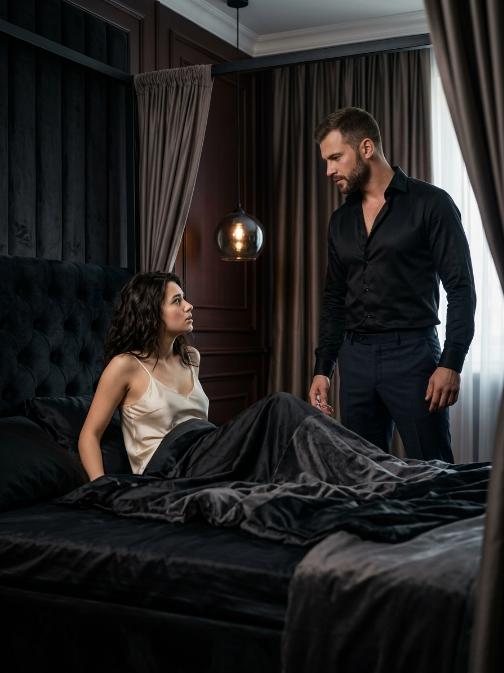
Forty minutes earlier, Luca Marini had stood behind the desk in his study, the Boston night pressed black against the windows, and told me the thing he had been swallowing since the afternoon we married.
He did not shout. He did not pace. He had simply looked at me with those gray winter eyes and said: “I don’t want you as my wife, Sera. I never did.”
He said it with the same inflection he used when reviewing quarterly reports.
I had almost cried. One second, maybe two.
Then I remembered who had taught me that tears were the most expensive thing a woman could spend.
My father had taught me that the night he sold me to settle a debt. My mother had taught me that when she died and left me alone with a thirteen-year-old brother to raise. And Luca Marini had taught me every morning for nine months when I came down to find only his coffee cup on the counter, still warm, him already gone.
I called Gianna.
“Tell me you know where Stefan Vane is throwing his party tonight,” I said.
Silence.
Then: “Sera. Please tell me you are not asking for the address of your husband’s worst enemy.”
“That’s exactly what I’m asking.”
She laughed so hard the sound hurt my ear.
“The red one?” she said. “Tell me it’s the red one.”
“Get the car.”
She was outside in eighteen minutes.
—
I should explain the marriage, because it will not make sense without it.
There had been no courtship. There was never going to be. My father had owed money to men who collected with their hands and their patience ran short in early spring. Luca’s people had bought that debt from them — absorbed it the way large water absorbs small stones — and the arrangement that followed was simple: my father walked away intact, my brother Marco stayed untouched, and I married Luca Marini.
I was twenty-eight. Luca was thirty-six. He ran the Marini family from a stone estate in Weston, forty minutes outside the city, where the birches were old and the neighbors kept careful ignorance about the vehicles that came and went.
At the wedding, he had been polite. Not warm. Polite. He said his vows in the level voice of someone reciting a legal instrument and kissed my cheek instead of my mouth.
Nine months followed. The quietest nine months of my life and the loneliest.
Luca slept in the study or elsewhere. I had the east bedroom at the end of the hall, which he never entered. We passed in corridors and sometimes nodded. I learned his routines because they were the only geography available: coffee black, tie loosened at the threshold, lamps low after eight. His head of security, Rafe — tall, former military, face like a shut door — appeared wherever the household’s shape required him. Mrs. Ferretti, the housekeeper, called me “Mrs. Marini” with a warmth that made the title feel like a wound.
Three days before the night he told me the truth, I did something I should never have attempted.
I set the long dining table for two.
No candles, because candles would have looked like hope. No flowers. Just the good china, the wine he preferred, and a risotto I’d made with Mrs. Ferretti’s guidance before she went home.
He arrived an hour late, saw the table from the doorway, understood everything — I watched understanding move across his face like weather — and turned toward the stairs.
“I have work.”
I should have let him go.
Instead, I followed him to the study and opened the door without permission.
He was at the desk, jacket off, a cut of whiskey in hand. The light made shadows in the hollows of his face, made him look assembled from something colder than bone.
“I said I have work,” he said.
“Your wife set a table for you,” I said. “The papers can wait.”
Something sharpened in his expression.
“Go to bed, Sera.”
“No. Tell me why you married me.”
“You know why.”
“I know what I was told. What I don’t know is why you brought me into this house if you planned to treat me like a guest who never checked out.”
He put the glass down.
“Stop,” he said, quietly.
“Tell me why.”
One breath. Two.
“I don’t want you as my wife,” he said. “I never did.”
—
Now: Gianna’s car, north on Beacon Street, her hands tight on the wheel with barely contained delight.
“Stefan Vane,” she said. “Back Bay. You understand what walking in there means?”
“Yes.”
“He hates Luca.”
“I know.”
“He’d use you in a second.”
I watched the city lights streak past.
“Then at least someone will.”
Gianna was quiet for four seconds.
“That isn’t funny,” she said.
“I know that too.”
Stefan Vane occupied a restored brownstone on Commonwealth Avenue — the kind of address old Boston treated as a credential and new Boston bought to acquire one. Music carried through the closed windows. Two men with the posture of people who were paid to stand still flanked the entrance.
Gianna got us inside. I did not ask how. She had cousins in every zip code and information in every room she’d ever been in.
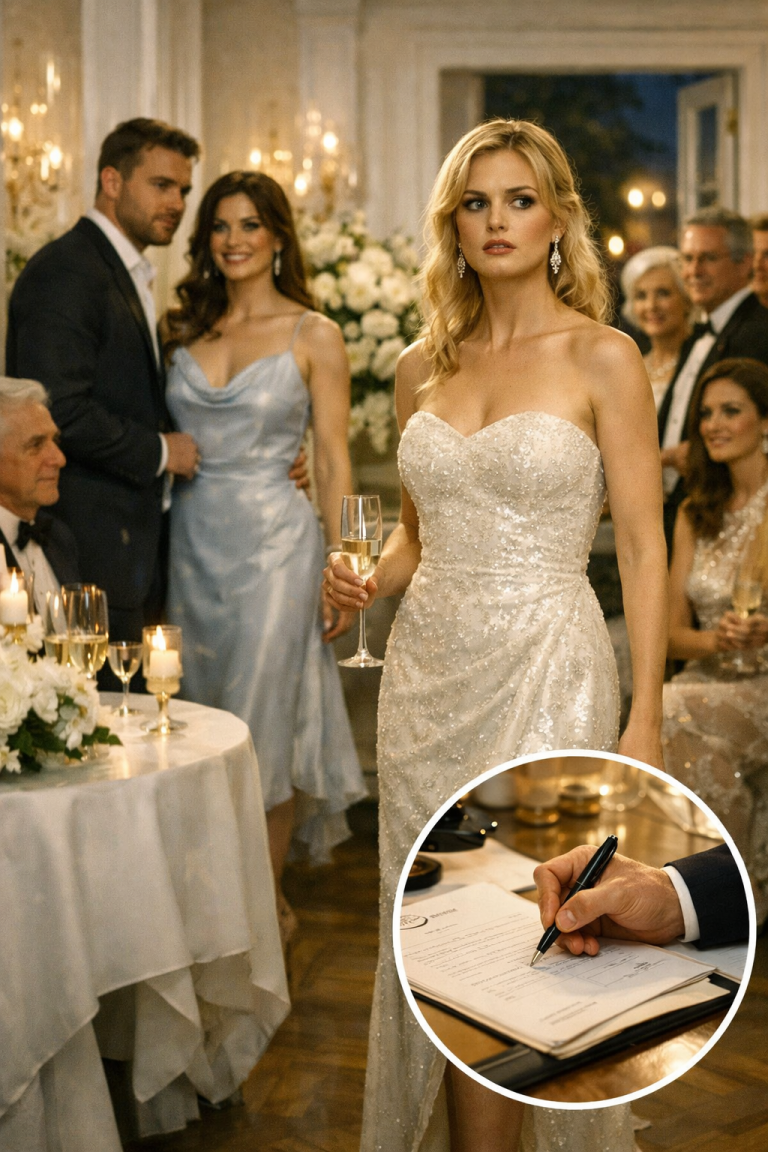
The party was gold-lit and crowded and dangerous in a way I felt in the back of my teeth. Conversations dropped when I entered. A woman in green silk looked at my dress as if it had arrived without an invitation.
Stefan Vane appeared before I had crossed the room.
He was handsome in the way of things designed to be: silver at the temples, a charcoal suit, a smile that had been practiced until it looked effortless.
“Sera Marini,” he said, taking my hand.
“Sera Connell,” I said. “Marini is paperwork.”
His smile widened. Something lit in his eyes that I should have recognized earlier.
“Dance with me,” he said.
Gianna’s elbow found my ribs.
Every person nearby went still.
I knew what it meant to say yes. I knew the city’s underworld would have the story before midnight. I knew Luca would have it faster, because Rafe had been at the front of the house when I left and had said only, “Be careful, Mrs. Marini,” in a voice that made the words sound like something more.
I placed my hand in Stefan Vane’s.
“One,” I said.
He led me onto the floor.
His hand at my waist was careful. Not respectful — calculating. He was taking inventory.
“Did your husband send you?” he asked.
I laughed. The sound didn’t belong to me.
“If Luca had sent me, I’d be wearing beige and looking miserable.”
“You look angry.”
“I am.”
“At him?”
“At myself. For forgetting I existed before him.”
His eyes brightened.
“That,” he said, “is the most interesting thing a Marini wife has ever said to me.”
We turned.
The room turned with us.
Then the quality of the air changed.
Not dramatically — just a subtle pulling back, like a tide. Gianna caught it before I did.
“Sera,” she said from the edge of the floor. “He’s here.”
I turned.
Luca stood in the entrance.
Dark suit, no tie. Rafe two steps back. He didn’t scan the room the way a man searching does. He found me immediately, the way you find something you’ve been tracking without admitting it.
His eyes moved from my face to the dress, to Stefan’s hand at my waist, then back. To my mouth. To the red.
He had looked at me for nine months with the controlled distance of a man who had decided what he was allowed to feel.
He was not looking at me that way now.
Stefan leaned close.
“This,” he murmured, “will be remembered.”
I pulled back from his hand, looked straight across the ballroom at my husband, and blew him a slow kiss.
Red as a warning.
Red as blood.
The room held its breath.
Luca crossed toward me. Not hurrying — men like him never hurried — but moving, and the crowd rearranged itself without being asked.
He stopped in front of me.
“Outside,” he said.
“No.”
His jaw tightened.
“You told me you didn’t want me as your wife,” I said. Out loud. In front of everyone.
Stefan’s smile deepened.
Luca didn’t look at him. Only at me.
“I said outside, Sera.”
Then his hand closed around my wrist.
Not to hurt. Not tightly enough to bruise. But firmly enough that everyone in earshot understood I had two options — leave with him and keep my dignity, or stay and lose it in a different way.
I chose my dignity. I followed him toward the side exit.
As we reached the door, Stefan called after us. “Careful, Marini. Women are most dangerous once they understand they’ve been undervalued.”
Luca stopped.
The temperature changed.
Rafe stepped forward.
Luca turned his head very slightly.
“If you speak to my wife again,” he said, voice almost gentle, “you will need last rites before the week ends.”
Stefan’s smile thinned to a line.
Luca opened the door.
The cold air of the Boston night came through it like a hand.
—
## PART 2
The drive back to Weston was twenty-three minutes of silence so complete it had texture.
Finally I said, “Are you going to say anything?”
He looked out the window.
“What would you like me to say?”
“Something that sounds like a person.”
His head turned. Slowly.
“Do you understand what Stefan Vane does with weaknesses?”
“I walked into his party, not his confidence.”
“You announced yourself as mine.”
I laughed, and the sound was wrong.
“You did that the day you put your ring on my finger. Then you spent nine months pretending I was no one.”
He had no answer.
That silence was more information than any denial.
Back at the estate, he went to the library. I followed, because the anger had changed shape but hadn’t left. He stood near the fireplace with one hand braced on the mantel, no fire lit, the room cold.
“You could have been hurt tonight,” he said.
“Would that have inconvenienced you?”
He turned.
And what I saw stopped me.
Not anger.
Not the controlled winter-gray distance.
Pain. Unguarded, uncalculated, the kind men like him spent decades learning to eliminate.
“Don’t say that,” he said.
“Why? You don’t want me.”
“I should not have said it the way I did.”
“But you meant it.”
He said nothing.
Which was worse.
I turned for the door.
His hand caught my wrist.
Different this time. Not possessive. Something else — almost desperate. His thumb moved once against my pulse, and I felt it move through me like a key turning.
He released me as if the contact had burned him.
“Lock your door tonight,” he said.
“Why?”
“Because Stefan Vane looked at you tonight the way men look at things they intend to acquire.”
I stared at him.
That was all he would give me. But that night, I did lock the door.
Not from fear of Luca.
Because for the first time in nine months, I wondered if what I had been calling cruelty had another name.
In the morning, he was in the kitchen.
Sleeves rolled. Coffee. The morning light making him look human in a way the night refused.
He looked tired. Not powerful tired. Just tired.
I poured my own coffee and sat across from him.
We were quiet for a while.
“Did you sleep?” he said.
It was such an ordinary question that I almost hated him for it.
“A little. You?”
“No.”
“Because of me?”
His eyes found mine.
“Yes.”
I didn’t know what to do with that, so I drank my coffee.
For three days, the house changed.
He didn’t become warm. This was not that kind of story, and men who built walls for that many years didn’t become open fields overnight. But he appeared. Breakfast. Dinner at the kitchen island instead of the long formal table. He asked Mrs. Ferretti what I liked and pretended he hadn’t.
Then, a week later, there was a dinner.
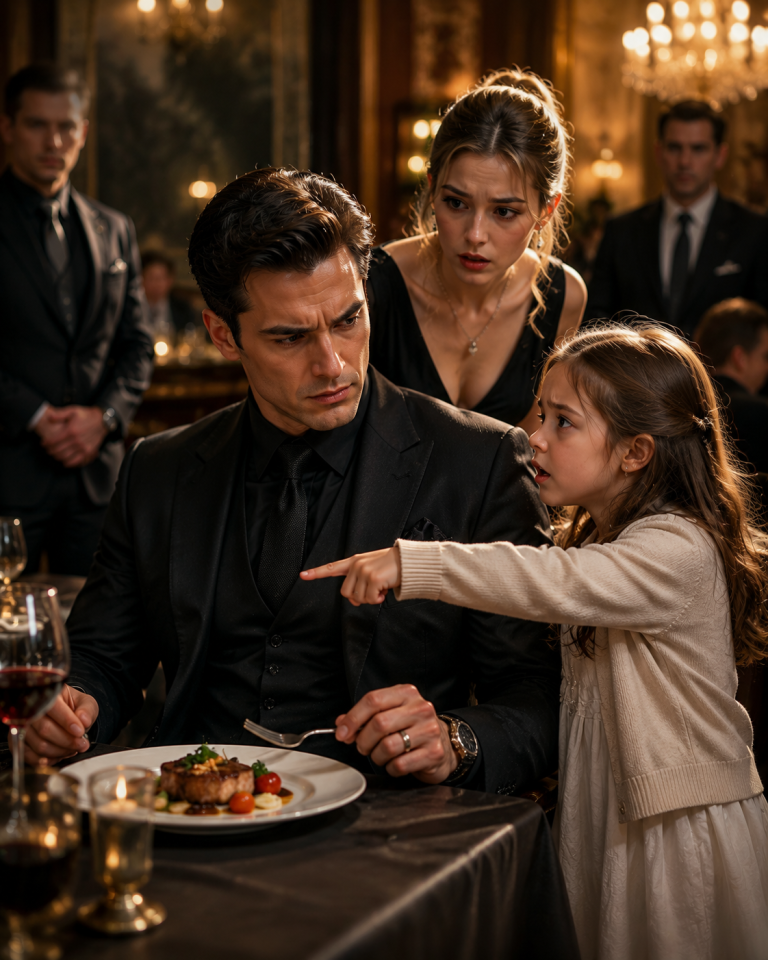
A private room in a restaurant downtown. The men around the table had been looking through me for nine months. They stopped when Luca pulled out the chair at his right and seated me beside him.
I played the part expected of me. Smiled. Listened. Kept my real opinions behind my teeth.
Then a captain named Carmine Soto raised his glass.
“Eight months married,” he said, “and the boss’s wife still shines. Most of them fade by summer.”
A few men laughed.
Luca picked up his wineglass.
He squeezed.
It shattered in his palm.
Red wine spread across the white linen like something the room would have to reckon with.
No one spoke.
Luca opened his hand. Blood ran thin across his palm.
“Her name,” he said, looking at Carmine, “is Sera. And she is seated closer to me than you are for a reason.”
Carmine drained of color.
“My apologies. Sera.”
Luca looked at his bleeding hand and reached for a napkin with the deliberateness of a man who had made a decision and intended to follow through with it.
I sat beside him and hated that my chest tightened.
Because one act of defense did not erase nine months of absence.
But it made the absence harder to understand.
That night, on the drive home, I asked, “Why?”
“Because he was disrespectful.”
“He’s always been disrespectful.”
Luca looked at me. “Yes.”
Not an excuse. An admission with weight in it.
At the estate, I started up the stairs. He stopped me from the bottom.
“Sera.”
I waited.
“I was wrong,” he said. A pause. “Not just tonight.”
It wasn’t enough.
But it was the first thing removed from a wall I had stopped believing had anything behind it.
A week later, a storm.
Rain against the North Shore windows, the sky turning the specific green-gray of bad news. Luca left after dinner with Rafe and three men without telling me where. He never told me where. But I had learned to read his posture, and what I read that night was readiness — the particular kind that came before blood.
At 11:40, the garage door.
I was already in the hallway. I told myself I’d come down for water. The glass in my hand was empty.
Rafe came in first, wet from the rain.
Luca leaned on him.
Dark stain on the left side of his shirt.
“What happened?”
“Graze,” Rafe said. “Shoulder. He’s fine.”
“He’s bleeding on the floor,” I said. “He can be fine upstairs.”
Luca looked at me.
Even pale, even in pain — surprised.
As if he had not expected me to come toward him instead of away.
That landed somewhere I hadn’t been prepared to feel.
I took his weight and we went up.
In the bathroom, I removed his shirt carefully, pulling fabric from the wound. The bullet had skimmed the shoulder — ugly, painful, not deep.
“This will sting,” I said.
“I’ve been shot before.”
“I know. It’ll still sting.”
His mouth moved. Not quite a smile. Close enough to confuse me.
I cleaned the wound. He didn’t flinch. I found myself hating that, because pain should have somewhere to go, and in Luca it seemed to simply disappear into locked rooms where everything else lived.
When I finished, my hands started shaking.
He noticed.
“Sera—”
“Don’t.”
“I was going to say thank you.”
I looked away. Picked up his jacket from the floor.
A folded note fell from the inside pocket.
I should not have read it.
Caruso. Pier 11. Midnight. Vane knows.
My blood cooled.
Caruso.
I had heard that name three nights earlier, walking past Luca’s study. *Find Caruso before Vane uses him again*, he’d said into the phone.
Someone inside Luca’s circle had betrayed him tonight.
Someone had sent him into an ambush.
I looked up.
Luca was watching me.
I crossed to him and held out the note.
“It fell from your jacket.”
His eyes dropped to it.
“You read it.”
“Yes.”
“And?”
“Enzo Caruso,” I said. “You said his name three nights ago in your study.”
The room changed.
“Enzo Caruso,” Luca said. “One of my captains. He has been providing Stefan Vane with routes and timing.”
“He sent you there tonight?”
“Yes.”
“Then why is he still breathing?”
Luca studied me for a moment that lasted longer than it should.
“Because killing a traitor is fast,” he said. “Finding out who purchased him takes longer.”
“Stefan Vane.”
“Stefan is the buyer. Not the only interested party.”
The rain outside intensified.
I sat on the edge of the tub.
“Tonight wasn’t random,” Luca said. “Stefan wanted me hurt. Not dead.”
“Why not dead?”
His eyes found mine.
“To see who came toward me.”
The understanding moved through me slowly. Then all at once.
“He wanted to know if I mattered,” I said.
Luca said nothing. He didn’t have to.
“That’s why you ignored me for nine months,” I said. “You thought distance would protect me.”
He still said nothing. His silence was so complete it finally answered.
“No,” I said. “Don’t you dare make your cruelty sound like care.”
He flinched.
Small. Real.
“You don’t get to tell me you were protecting me by treating me like furniture,” I said. “If I was in danger, you owed me a partner. Not a performance.”
He rose from where he’d been sitting.
“I know.”
Quiet.
Too quiet.
I stared at him. “What does that mean?”
“My mother died because my father loved her and let it show,” he said. “I was seventeen. I came home and she was in the driveway.”
The anger in me stumbled. Didn’t fall.
“So you decided to protect me by making sure no one could tell,” I said.
“Yes.”
“And then I walked into Stefan Vane’s party in red.”
His jaw tightened.
“He looked at you like he had found the one thing I’d failed to conceal.”
I sat with that.
“You should have told me,” I said.
“Yes.”
No defense. No command. Just yes, worn smooth from being held too long.
He stepped toward me and stopped himself.
“Sera. I did not want a wife because I had buried one woman I loved as a consequence. That is not the same thing as not wanting you.”
The room went very still.
My heart beat once. Hard.
“Don’t say things you can’t mean,” I said.
“I won’t.”
We stood there in the bathroom with rain breaking against the windows and his blood on my sleeve.
Then the lights went out.
Complete darkness.
Before I could move, Luca’s hand found mine.
Warm. Steadier than anything had a right to be in that moment.
“I can find the switch,” I said.
“I know you can.” A pause. “I’d rather you didn’t.”
“Are you afraid of the dark?”
A silence that was somehow also an answer.
“I found my mother in the dark,” he said. “I’ve never managed to leave it there.”
I did not let go of his hand.
In the dark, with rain pressing against every surface and his fingers closed around mine, he was not the man who had told me he never wanted me, not a contract husband, not a fortress of controlled silences. He was someone who had learned early that loving people created targets, and had spent twenty years trying to solve that problem by pretending he didn’t.
I understood that.
I had learned something similar from different teachers.
When the power came back, neither of us moved for a moment.
Then he said, quietly: “There is something I need to tell you. About why Stefan Vane wants you specifically.”
The bathroom was very bright after the dark.
“Tell me,” I said.
“Not tonight,” he said. “Tonight you need to sleep. Tomorrow.”
“That is not a reassuring sentence.”
“No,” he agreed. “It isn’t.”
I looked at him. At the bandaged shoulder. At the exhaustion beneath the control.
“Tomorrow,” I said.
I left the bathroom. Walked to my room. Locked the door.
Not because I feared him.
Because I had the feeling that whatever he needed to say would change the shape of everything I thought I understood.
And I wanted one more night before that happened.
—
## PART 3
In the morning, Luca was already in the kitchen.
He looked like a man who had spent the night losing an argument with himself.
I poured coffee. Sat.
“Tell me,” I said.
He put his cup down.
“Your mother’s name was Margot Connell,” he said.
“I know my mother’s name.”
“You knew her as a school administrator who died in a car accident when you were twenty-two.”
I looked at him.
“That’s what she was,” I said.
“That’s what she became, after she ran.” He kept his voice level, careful. “Before that, she worked for Stefan Vane. Not as an employee. As family.”
The kitchen went very quiet.
“What does that mean?”
“Stefan Vane’s father had a daughter from a relationship before his marriage. That daughter was your mother.”
I stopped breathing.
“Margot Vane,” Luca said. “That was her name. She took her mother’s name when she ran. She rebuilt herself as Margot Connell and raised two children in Brookline and never told either of them where she’d come from.”
“Why would she run from her own family?”
“Because she found out what the family business actually was. Not just the legitimate side — the other side. Children moved through placement systems. Judges paid to look elsewhere. State contracts funneled to facilities that didn’t exist.” He paused. “She copied records. Enough to dismantle everything Stefan’s father had built. She encoded them and hid them before she ran.”
“She hid them where?”
He looked at my throat.
I became aware of the weight there before I reached for it — the small gold locket I had worn for ten years, the one my mother had pressed into my palm two weeks before the accident, telling me to keep it close, keep it always.
Inside: a photograph of her on one side. Me and Marco as children on the other.
My hand closed around it.
“She left them with you,” Luca said. “She encoded them behind the photograph. A memory card so small you wouldn’t have found it unless you looked for it.”
“She knew something was going to happen to her,” I said.
“Yes.”
“Stefan had her killed.”
A silence.
“Yes.”
“And the accident—”
“Was not an accident.”
I sat with that.
Ten years of grief and I had been carrying the proof the whole time. Against my skin. Every single day.
“He wants the locket,” I said.
“He wants it destroyed. What’s on it doesn’t just expose his criminal network. It documents what his father’s organization did to his own half-sister. It shows that when she tried to leave, Stefan was the one who authorized the order.”
“He had his own family killed.”
“To protect the enterprise. Yes.”
I looked down at my coffee cup.
My mother had not left me grief. She had left me a case file.
“When did you find out?” I said.
“After the wedding. Not before.”
“You swear that.”
“Yes.”
“Why didn’t you tell me when you found out?”
“Because I needed to be certain. And because telling you meant telling you your mother was murdered, that the man responsible was circling your family, and that you were carrying evidence he’d been hunting for ten years.” His jaw tightened. “I thought I could resolve it before you needed to carry any of that.”
“That was a decision you made for me.”
“Yes.”
“Without my consent.”
“Yes.”
I looked at him.
“You kept Marco under protection the whole time,” I said. “Not just from debt collection. From Vane.”
“Yes.”
“Because the locket made Marco a target too.”
“Yes.”
I set my coffee down.
“I am very angry with you,” I said.
“I know.”
“You protected me with one hand and removed my right to understand my own life with the other.”
“Yes.” He looked at me with the expression of a man who had run out of defenses and was discovering that surrender felt different than he’d expected. “That was wrong. Not cautious. Wrong.”
We sat with that.
Then my phone rang.
Marco. His voice strained. Someone had come to his apartment in Cambridge. A man who said I was in trouble. Said Luca was planning to hand him over to Stefan Vane as a concession unless I signed something over first.
I held the phone very still.
“Where are you?” I asked.
“South Station. I thought I’d come to you—”
“Stay there. Don’t move. I’m coming.”
I hung up.
Luca was already standing.
“Stefan has Marco,” I said.
“Not yet. He’s trying to get him there.”
“If I don’t go—”
“Stefan uses Marco to draw you out.” He crossed to the door. “Rafe!”
Rafe appeared from the hall.
Luca turned back to me.
“I need you to stay—”
“No.”
His eyes went hard.
“If you’re in the open—”
“If I stay here, Marco pays for my obedience. And we both know I won’t stay here.”
A full second.
He looked at me — really looked, the way he hadn’t in nine months.
Then he nodded once.
“Then we go together,” he said.
South Station was bright and loud and full of ordinary people who had no idea what was happening inside the noise.
Marco was near the north entrance, twenty years old and still more boy than man despite the stubble and the set of his jaw. When he saw me, his whole face came apart with relief.
I held him hard.
“You idiot,” I said.
“The man said you were in trouble—”
“I am always in some kind of trouble. That does not mean you come running.”
He almost smiled.
Then he saw Luca behind me, and the smile didn’t finish.
Luca kept his distance. Hands visible.
“Marco,” he said. “I’m Luca.”
“I know who you are.”
The bitterness in it cut.
Luca absorbed it without comment.
Before anyone could say more, my phone rang. Unknown number.
Stefan Vane’s voice — smooth, practiced, genuinely pleased with itself.
“Family is such a gift,” he said.
I put it on speaker.
Luca’s eyes sharpened.
“What do you want?” I said.
“The locket, Sera. Not forever. Just whatever is inside it. Come to the car on Summer Street, and your brother has a clean night.”
Luca said, “Vane.”
A pause.
“Russo. I wondered when you’d stop pretending she was leverage.”
“She is not part of this.”
“She was always part of this. You just didn’t understand what you’d married into.”
The line ended.
Marco looked between us.
“What does that mean?” he said.
I looked at Luca.
He looked back, and I could see him deciding — one final thing still unspoken.
“My mother,” I said. “Tell me the rest.”
“Margot didn’t just work for Stefan’s father,” Luca said. “She loved him. She trusted him. When she found the records and tried to take them to someone who could act on them, she went to my father first. He sheltered her for eight months. Then Stefan found out.”
“Your father protected my mother.”
“Yes.”
“And then stopped.”
A silence.
“He became someone who stopped protecting anyone,” Luca said. “That is the truest thing I can tell you about who he was.”
Marco sat down on a bench.
I touched the locket at my throat.
Stefan’s car was on Summer Street.
I took the locket off.
Opened it.
Behind my mother’s photograph — behind her face, which I had looked at every day for ten years — was a memory card no larger than a thumbnail. She had pressed it there with the care of someone who knew she might not have another chance to place it.
I looked at Luca.
“Gianna,” I said.
He understood immediately.
“Rafe, get Gianna here.”
Gianna arrived in fourteen minutes, cursing at the traffic the entire way. She took the memory card, looked at me, looked at Luca, and said, “I’m going to need a very good lawyer.”
“I have one waiting,” Luca said.
“Of course you do.”
She left with Marco through a service exit — Marco furious and frightened and ultimately trusting his sister enough to go — while I put the open locket back around my neck.
The chain was lighter without the card inside it.
I walked out onto Summer Street alone.
Stefan’s car was a black sedan, tinted windows. The driver got out and opened the rear door without speaking.
I got in.
Stefan was in the back seat with the air of a man who had been waiting without impatience because he never doubted he would get what he came for.
“You look like your mother,” he said.
I hated him for it.
“I know,” I said.
“She was extraordinary. Truly. A shame she chose principle over survival.”
“She chose me over you,” I said. “That’s different.”
Something shifted behind his eyes. Not guilt — he was past guilt — but recognition. The acknowledgment of a calculation he had made and could not uncalculate.
“Give me the locket,” he said.
“The locket is empty.”
His expression didn’t change, but his stillness did.
“What?”
“The card isn’t there. It’s already with a federal prosecutor. And with two journalists. And with a lawyer who has instructions to release everything to every outlet in Massachusetts if I or my brother or anyone connected to me fails to be reachable by eight tomorrow morning.”
Stefan studied me.
“You’re bluffing.”
“My mother hid evidence for ten years,” I said. “She raised me and my brother on a teacher’s salary with a secret against her chest every single day. She built a life out of what she’d managed to save and she died rather than give it up.” I looked at him. “Do you think she raised a daughter who doesn’t know how to plan an exit?”
He was quiet for a long moment.
The car door opened.
Luca stood in the street.
He was alone. No Rafe, no men. Just him, in a dark coat, standing between a federal building and where Stefan’s driver was standing.
But he looked at me.
“Special Agent Dolan has been waiting for documentation strong enough to move,” Luca said. “She’s been waiting for eight months.”
The sedan’s other door opened.
A woman in a navy coat entered from the other side and showed Stefan Vane her credentials.
Stefan looked at the credentials. Then at me.
“You brought the government into my car?” he said.
Luca’s voice came in through the open door.
“You brought my wife into this.”
That was when Stefan Vane understood he had miscalculated the one variable he’d underestimated for thirty years: what happened to women who were underestimated long enough to finish planning.
He was arrested in the back seat of his own car, efficiently and without drama, while the September evening moved around them as if this were the most ordinary thing in the world.
Which, in a way, it was.
Powerful men fell all the time.
They just rarely saw it coming from the direction it arrived.
—
What happened after was not clean. Nothing real is.
Stefan Vane’s network unraveled over several months in the particular messy way of things built on secrecy: partial confessions, deals made in rooms with no windows, men who vanished before warrants could catch them, men who talked because loyalty only holds up to a certain kind of pressure and that kind came in early.
The placement fraud alone filled five federal indictments. The sealed family court records were vacated. Former foster children who had aged out of the system without answers began receiving calls from advocates with, finally, some of those answers.
My father was found in Florida, still borrowing money from people who did not lend it lightly, and arrested on charges that had nothing to do with me and everything to do with his own accounting.
Luca surrendered parts of the Marini network that had sustained the criminal side for two generations. Not all at once. Not cleanly. The legitimate businesses remained, cleaned and restructured under federal monitoring. The rest he allowed to contract until only what could be defended legally remained. It cost him. He did it anyway, not because he had been transformed by love into someone uncomplicated, but because he had made a different calculation and intended to honor it.
Marco moved to Boston, finished his certification, opened a shop with the trust money my mother’s hidden records had ultimately freed from legal dispute. He did not forgive Luca quickly. I respected him for that. Forgiveness was his to give on his own schedule.
Gianna started seeing Rafe, claiming for four months that she found “emotionally unavailable men exhausting.” Rafe proposed by leaving a ring box next to her favorite pastries with a note that said: “This seemed efficient.” She cried anyway, which she denied until we had the photographs.
—
Six months after Stefan Vane’s arrest, Luca and I went back to the church.
Not the one where we had married — a different one, smaller, near the water. No captains. No contract. Just Marco, Gianna, Rafe, Mrs. Ferretti, and a priest who asked no questions about the men outside with good posture.
Luca stood across from me.
His eyes were open in the way they almost never were. Not performing anything. Not calculating. Just there.
“I married you the first time because your father and mine left us nothing clean to choose from,” he said. “I kept you at distance because I had already learned once what happened to women I let myself need, and I was not willing to repeat the lesson at your expense.” His throat moved. “I told you I didn’t want you because I had run out of ways to tell you I was afraid of how much I did.”
“That,” I said, “was a very complicated way to handle something.”
“Yes.”
“You could have just told me.”
“I know that now.”
“You could have told me about my mother.”
“Yes.”
“You could have given me the choice.”
“Yes.” He looked at me. “I should have. That is the most honest thing I can say. I should have trusted you with all of it from the beginning, and I didn’t, and I am sorry.”
I looked at him for a long moment.
“I choose you,” I said. “But I choose myself first. And that means I will not spend the rest of this marriage being managed.”
“No,” he said. “You won’t.”
“I mean that as a condition.”
“I understand it as one.”
“Good.”
The priest asked if we wished to renew our vows.
We did.
The ring, this time, fit.
—
That evening, back at the estate, the long formal dining table was gone. I had removed it three months earlier. In its place was a smaller one near the bay windows, the kind that held people rather than performed for them.
Luca cooked badly. Marco criticized him with great enthusiasm. Gianna drank too much and told Mrs. Ferretti she was the only competent person in the house. Rafe quietly fixed a squeaking cabinet hinge. Mrs. Ferretti said grace with tears she attributed to onions.
Later, when the house had settled into its night sounds, Luca and I stood on the back terrace. The North Shore spread below us, dark and patient, the water picking up what light there was and running it sideways.
“I never answered you properly,” he said.
“Answered what?”
“The question in the study. Why I married you.”
I waited.
“At first,” he said, “because there was no other way to keep both of us out of a worse situation. Then because keeping you at a distance felt like the only protection I understood how to offer.” He looked at me. “Then because you went to Stefan Vane’s party in red and blew me a kiss in front of every person in that room, and I realized I had spent nine months protecting something I had never admitted I had.”
“What was that?”
“A reason,” he said, “to try.”
I leaned against him.
For a while we said nothing.
Once, silence in that house had meant punishment. Distance. Loneliness wearing dignity’s borrowed clothes. Now it meant Marco’s car in the driveway, and Gianna’s voice carrying from inside, and Luca’s arm around me on a terrace where the water went on without ending.
Eight months into our marriage, Luca Marini had told me he never wanted me.
He had been wrong.
But more than that — I had spent nine months waiting for his wanting to be the thing that made me real.
It wasn’t.
What made me real was the moment I put on the red dress and walked out the door.
What made me real was my mother encoding her life’s work behind her own photograph and pressing it into my hands so I could carry it until I was old enough to know what to do with it.
What made me real was choosing myself before I chose anything else.
And only after that could choosing him become something other than resignation.
It became a life.
And the life was mine.