The Billionaire Ignored His Wife for Years—Until She Revealed a Secret That Made the Mafia Boss Beg for Her Return

**PART 1**
She had rehearsed exactly one sentence on the way up.
Not because she was nervous. She had moved past nervous into something quieter and more permanent, the particular composure of a woman who has spent three years arriving at a decision and is finally done arriving.
The sentence was: *I need you to sign these.*
That was all. Six words. The rest would take care of itself.
Elena Ashford Rowe had not cried when she signed the papers. She had not cried when she packed the two boxes that represented everything she had accumulated during three years of being invisible in a marriage she still technically occupied. She had not cried on the drive across Manhattan to Rowe Capital’s tower on the west side, and she had not cried in the elevator on the way up, though the elevator’s mirrored walls offered several opportunities for the kind of private dissolution she had been refusing for years.
She did not cry because she had already done that. In private, in the specific hours of the early morning when the apartment was too large and too quiet and the sound of the city below felt like evidence of everyone else’s ongoing life. She had finished crying somewhere around month eighteen and discovered that what came after it was not numbness, as everyone implied, but clarity. Clean and cold and final as a diagnosis.
The reception desk on the forty-first floor was staffed by a woman named Priya who had been there since before Elena married into this building and who looked up from her monitor with the specific expression of someone who has been waiting for something to happen and has just seen it arrive.
“Mrs. Rowe—”
“Elena is fine.”
Priya sat down without finishing her sentence.
Elena knew what the folder in her hands looked like to the people in this office. It had that shape — the shape of a document that ends something — and people recognized it the way they recognized grief: not by seeing it directly but by the way it moved through a room and changed the atmosphere.
She walked past the desk toward the private corridor without asking anyone’s permission, because her name was still in the building’s access system, and that was the last useful thing it did for her now.
—
Marcus Rowe’s assistant was a man named Owen Chu, twenty-eight years old, meticulous, and possessed of the kind of loyalty that was quietly devoted rather than performed. He was standing when she came around the corner and sat down again immediately, which told her everything about how prepared he was for this.
“Elena,” he said carefully.
“Hi, Owen.”
His eyes went to the folder.
He had the grace to look genuinely pained.
“He’s in,” Elena said before Owen could formulate a question.
“He’s always—” Owen stopped.
“I know.” She kept walking. “I know he’s always in.”
She opened the door to Marcus’s office without knocking.
—
He was at the window.
That was the first thing she noticed — not that he was at his desk managing something, not that he was on a call, but that he was standing at the floor-to-ceiling glass looking out at the Hudson and the silver November sky above it with the posture of a man who was thinking rather than working. She had a sudden, unwelcome flash of recognition: he used to stand at windows like that in the early years. She hadn’t seen it in a long time.
He turned when she entered.
The room did what rooms did when she and Marcus occupied the same space now — it became aware of itself.
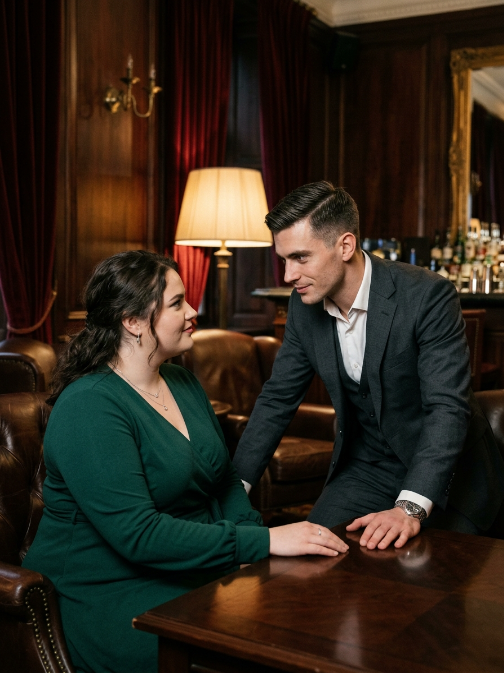
He was still the person she had married. That was the complicated, persistent fact at the center of everything: he had not become unrecognizable. He was forty, dark-haired, with the kind of face that had been shaped by decades of controlled expression and had not softened with age so much as deepened. His eyes were dark and still and had always been able to do things with attention that most people needed words for.
They moved from her face to the folder in her hand.
“Elena,” he said.
Her name in his voice still had the same effect it had always had. She had catalogued this as one of the indignities of the situation — that after three years of his absence from her actual life, the physical reality of him could still do that.
She walked to the desk and set the folder down.
“You need to sign these.”
He didn’t touch it.
“What is this?”
“Divorce papers.”
He said nothing for a full five seconds, which was long enough for Elena to understand he had not been entirely prepared for this, despite everything.
Then: “No.”
“Marcus.”
“No.” His voice was still controlled, but she heard the word land differently than his other words. Like it came from somewhere below the composure.
“I’ve been drafting them for two months,” she said. “The terms are reasonable. I’m not asking for anything that was mine before the marriage.”
“I don’t care about the terms.”
“You should read them.”
“I’m not signing.”
Elena had prepared for this.
“Then I’ll file without your signature. It takes longer but the outcome is the same.”
He came around the desk then — one movement, unhurried but decisive — and stopped several feet from her, close enough that she could smell the faint familiar traces of his presence and far enough to demonstrate that he understood he didn’t have the right to close the distance.
“You don’t want a divorce,” he said.
“What I want,” Elena said, “and what I’m doing are the same thing for the first time in three years. Don’t confuse the two.”
Something moved in his face.
“Tell me what happened.”
She almost laughed. “You know what happened. You were there.”
“Elena—”
“When did you last have dinner with me?” She kept her voice level. Not accusing — stating. “When did you last ask me a question and then stay in the room for the answer? When did you last—” She stopped. “When did you last look at me like you were glad I existed?”
He closed his eyes for one second.
When he opened them, they carried something she had not expected to see.
Not anger. Not the cold distance she had come to associate with the last three years.
Something that looked like a specific, directed pain.
“You think I stopped caring,” he said.
“I think the evidence is fairly—”
“Ask me a different question.”
“I’m not here to play—”
“Ask me,” he said, very quietly, “who told you you were alone.”
Elena went still.
It was such a strange question that for a moment she couldn’t arrange a response.
*Who told you?*
As if being alone in her own marriage had required narration. As if the evidence — the cold beds, the unanswered calls, the empty seat at every table — could have been constructed rather than simply experienced.
But the question sat in the room and would not leave.
She thought, against her will, of the night she had packed a bag.
Eighteen months into the silence. She had packed two bags, actually, and called a car service, and the car had never come. And then her phone had rung from a number she didn’t recognize, and the voice on the other end had been calm and pleasant and had said: *Leaving him won’t make things better for you. It might make things considerably worse.*
She had unpacked the bags.
She had told herself she had imagined the threat.
She had not imagined it.
Marcus was watching her face with the attention of someone reading something they have been trying to read for a long time.
“Ava,” he said — then stopped, corrected himself: “Elena. What did that question do to your face just now?”
“Nothing.”
“It did something.”
“Marcus—”
His phone lit up on the desk.
The name on the screen was *D. Crane*.
Not a contact she recognized.
She looked at it. She was close enough to see it clearly, and she saw Marcus see her see it.
His jaw tightened in a specific way — not toward her.
“Don’t move,” he said.
He picked up the phone. Put it on speaker.
“Crane.”
The voice that answered was smooth and unhurried, the voice of a man who had never once been surprised by a room.
“Marcus. I heard your wife paid you a visit.”
Elena’s pulse dropped.
Marcus’s eyes stayed on hers.
“How did you hear that?”
“I stay informed.”
“About my wife.”
“About relevant variables.”
Marcus said: “You’ll be here in fifteen minutes.”
“I’m not sure that’s—”
“It’s not a request.”
He ended the call.
The room was quiet.
Elena looked at her husband.
“Who is D. Crane?”
“Daniel Crane,” Marcus said. His voice had changed — not colder exactly, but directed now, pointed at something that was not her. “Head of private security for Rowe Capital. He has been with the company since before my father died.”
“Why does he know I’m here?”
“That,” Marcus said, “is the question I should have asked three years ago.”
—
**PART 2**
Daniel Crane arrived in fourteen minutes.
He looked exactly like what he was: a man who had spent decades making himself indispensable by making himself necessary. Late fifties, silver at the temples, a navy suit that had been chosen to communicate trustworthy rather than powerful. Calm eyes that took in every variable in a room before they settled on any one thing.
They settled on Elena first.
“Mrs. Rowe,” he said.
“Elena.”
His smile adjusted by a fraction.
Marcus did not offer him a seat.
“How did you know she was here?”
Crane spread his hands slightly — a gesture of openness that was itself a form of control. “Your wife arrives with divorce papers and you expect discretion? People notice. I manage what people notice.”
“Her presence in my office,” Marcus said, “is not your department.”
“Everything around you is my department. That’s what you pay me for.”
Elena looked at him carefully.
Something about the phrasing was wrong.
Not what he said but what he didn’t say, the specific quality of the non-answer, the way he moved to defend the category rather than address the act.
“Did you manage my messages?” she asked.
The pause was small.
It was enough.
Marcus turned to look at Crane with the focused attention of someone arriving at a conclusion they have been approaching for a very long time.
“What messages?”
Elena’s voice was level. “For two years, I sent messages to Marcus. Texts, emails, voicemails. Things I needed to say. Some were angry. Some were just asking if he was coming home.” She looked at Marcus. “You never answered. I decided you had chosen not to.”
Marcus’s face did something that had not happened in three years.
It became genuinely confused.
“I didn’t receive them.”
“Technical issues happen,” Crane said, easily.
“That wasn’t what I asked.” Marcus’s voice had gone quiet in the specific way it did when he was most dangerous. “Did you interfere with communications between my wife and me.”
Crane held very still.
“I managed threats.”
Elena felt the blood leave her face.
Not because of what he admitted — because she had already begun to understand. But hearing it stated, even obliquely, was different from inferring it.
“I wasn’t a threat,” she said.
“You were a vulnerability.”
Marcus stepped forward. “Say that again.”
“Your marriage became a liability. Proximity to her—”
“Was my choice,” Marcus said. “My life. My wife.”
Crane’s composure frayed at one edge. “She was getting too close to the foundation accounts before I—”
He stopped.
The room crystallized.
Elena heard her own heartbeat.
Three years ago, she had been working quietly — not officially, but with Marcus’s tacit permission — on the Rowe Foundation’s vendor records. She had been a forensic accountant before the marriage. Marcus had once said he loved the way her mind worked through numbers, loved that she could find the single thread that unraveled an entire structure. She had found irregularities. Small ones at first. Then patterns. Then something that didn’t have an innocent explanation.
Then Marcus had turned cold.
Then her access to the records had quietly disappeared.
Then she had stopped asking.
She looked at Crane.
“You framed the leak,” she said. “Whatever you told Marcus three years ago — whatever made him pull away — you told him I was the source.”
Crane said nothing.
Marcus said, very softly: “What did you tell me?”
“I showed you evidence,” Crane said. “A message trail. A financial connection. Someone was feeding information to your competitors. The evidence pointed—”
“To my wife.”
“It was credible.”
“Did you construct it?”
Crane held his gaze for a moment.
Then: “I protected the structure.”
Elena felt something leave her — not hope, exactly. The last of the uncertainty. The question she had been unable to answer for three years, the question that had made the silence so much worse than simple indifference would have been.
*Why did you stop wanting me here?*
The answer was: he hadn’t.
She had been removed.
Marcus’s phone buzzed on the desk.
Owen. Marcus answered on speaker.
“Talk.”
Owen sounded like he had been running. “I found something in the old message routing system. Crane had admin access to both your personal accounts through the private security infrastructure. Calls redirected, texts filtered, emails flagged and quarantined. Three years of it.” A pause. “And there’s more. Foundation vendor records. Several of the shell accounts trace back to entities with his fingerprints on the formation documents. The authorization codes on the suspicious transfers — some of them are under Elena’s old credentials.”
Elena’s breath caught.
“Her credentials that were deactivated,” Owen added, carefully, “and then reactivated from inside the security department.”
Marcus was looking at her.
She was looking at Marcus.
Between them, the folder of divorce papers sat on the desk like a document written about the wrong problem.
“Send everything to the forensic team,” Marcus said. “And to legal. Now.”
“Already sent.” Owen paused again. “Also, Crane’s car pulled out of the parking structure fourteen minutes ago. He might have—”
“He’s in the room,” Marcus said.
A sharp silence from Owen’s end.
Then: “I’m going to go be somewhere very small and very quiet.”
Marcus ended the call.
Elena looked at Crane.
He was still calm. That was the most frightening thing about him — not that he had done what he had done, but that being discovered had not broken the surface of his composure.
“She was going to find it all,” he said. “She already had most of it. I gave you six months before she put the full picture together.”
“So you gave me nothing instead,” Marcus said.
“I gave you a reason to distance yourself.”
“You gave me a lie and let me use it on my wife for three years.”
Crane looked at Elena with something that was not quite contempt but was adjacent to it — the look of a man who has always categorized people by their utility and is confused when they don’t accept the categorization.
“You were collateral,” he said. “The audit was the threat.”
Elena said: “I was doing my job.”
“Your job was being his wife.”
“My job,” she said quietly, “was being myself. You decided that was dangerous.”
Crane smiled. It did not look like a smile.
“It was.”
—
**PART 3**
Elena made the decision in the car on the way to her apartment, Marcus in the seat beside her maintaining a careful distance, Owen already three calls deep into coordinating what came next.
She made it without consulting anyone.
“I’m not filing tonight,” she said.
Marcus turned to look at her.
“The divorce papers.” She looked out the window at the city moving past, dark and lit and ongoing. “I’m not filing. Not because anything is resolved. But because I walked into that building today with six facts and I now have six hundred, and I want to know what the full picture looks like before I make permanent decisions based on the incomplete one.”
Marcus said nothing.
She looked at him. “That is not forgiveness. I want to be clear about what it is and what it isn’t.”
“Tell me what it is.”
“It’s an extension,” she said. “It’s the same thing I would give any other investigation. More time before the conclusion.”
He held her gaze. “Okay.”
“That’s all you’re going to say?”
“It’s your extension to give.” He looked back at the window. “I don’t get to negotiate the terms.”
That answer did something.
Not enough. Not yet.
But something.
—
Her apartment was the sublet she had signed three weeks ago, on the thirty-seventh floor of a building in Tribeca with good light and no memories. She had moved her boxes in on a Saturday. She had stood in the empty living room and felt, for the first time in years, like the space around her was something she had chosen rather than inherited.
Marcus walked her up.
He stood at the door like a man who understood exactly where the line was and had decided to honor it.
“Tomorrow,” she said, “we go through everything Owen found.”
“Yes.”
“Together. I’m not receiving a summary. I’m sitting at the table.”
“Yes.”
She looked at him. “The last time I tried to work on those records, three years ago, something made you pull away within a week.”
His jaw tightened. “I know.”
“What exactly did he tell you?”
Marcus was quiet for a moment. “He came to me with what looked like a conversation log. Your phone number on one end. A contact at Meridian Capital on the other. The leak had cost us real money. A man I trusted had died.”
“You thought I had done it.”
“I didn’t want to believe it.”
“That is different from not believing it.”
He accepted that without arguing. “Yes. It is.”
“And you decided that distance would protect me.”
“I thought if I kept you close, you’d be targeted. If I pushed you away—”
“I was targeted anyway,” Elena said. “Just from inside.”
He looked down.
“What did you need from me,” he asked, “that I didn’t give you.”
The question was genuine. That was what made it difficult.
“I needed you to ask me,” she said. “Directly. To my face. ‘Did you do this?’ And then to listen to the answer.”
Marcus closed his eyes briefly.
“I didn’t ask because I was afraid of the answer.”
“Which answer?”
“Both of them,” he said. “If you had said yes, I would have had to destroy something I’d spent years building. If you said no—” He stopped. “If you said no and I believed you, I would have had no explanation for why I was in pain.”
Elena stared at him.
“So you chose not to ask.”
“I chose not to know.”
“And I spent three years being punished for a question you couldn’t bring yourself to ask.”
“Yes.” His voice was stripped. “I know. I know that.”
She looked at the door behind her. Then at him.
“I’m going inside,” she said.
“Yes.”
“And you’re staying out here.”
“Yes.”
“When is the earliest you can get Owen on a call tomorrow?”
“Seven.”
“Make it eight. I need to sleep.”
Something shifted in his expression — something small and careful, something that understood it was not permission to feel hopeful but was going to exist anyway.
“Eight,” he said.
She opened the door.
Then stopped.
“Crane booked a flight,” she said. “Owen said he left the garage.”
“I know.”
“He’s not running to get away from you. He needs to destroy the physical archive before we get to it.”
Marcus’s eyes sharpened.
She had been thinking about this on the drive over, turning it the way she used to turn numbers — looking for the load-bearing piece, the thing that, if removed, collapsed the rest.
“The original vendor formation documents,” she said. “If they’re physical copies, they’re in the original company archive. Where?”
Marcus said: “Rowe Capital’s storage facility in Long Island City.”
“Can Owen get there before Crane?”
Marcus already had his phone out.
“Owen,” he said when the call connected. “Long Island City storage. Priority access. Lock out all secondary credentials except mine and Elena’s, effective immediately.” A pause. “Yes. Her credentials specifically. Tonight.”
He ended the call.
“The authorization went through,” he said.
Elena looked at him. “My credentials.”
“Your credentials.” He held her gaze. “You found it first. Three years ago. That’s why he burned the marriage. You deserve to be the one who finishes it.”
She stood in the doorway for a moment, holding that.
Then she said: “Go home, Marcus. Sleep for three hours. Be at my apartment at eight.”
He nodded.
“And Marcus.”
He looked at her.
“If there is one thing in those records that turns out differently than you’re telling me — one thing—”
“I sign the papers,” he said immediately, without hesitation. “Without war. Whatever you need.”
She believed him.
She was not sure she should believe him. But she did.
She went inside.
—
The meeting the next morning was not held in Marcus’s tower.
Elena had chosen a conference room at the firm she retained for personal legal work — a room with windows that belonged to no one she was investigating, with a lawyer who reported to her and only to her, with a forensic consultant Owen had sourced overnight who had no prior relationship with Rowe Capital.
Marcus arrived at 7:58 and sat where Elena indicated, which was not at the head of the table.
She sat at the head of the table.
He sat beside her.
The difference was small. It was the only difference that mattered.
The documents took six hours.
Crane had been careful. That was the thing about careful people — they were careful in ways that left evidence of their carefulness. The routing architecture for the filtered messages had required specific admin actions that logged. The reactivation of Elena’s credentials in the security system had been backdated but imperfectly. The vendor shell companies had been formed through three layers of intermediary entities, but the formation attorneys had used the same notary public across all of them, which was the kind of efficiency that looked invisible until someone who thought in patterns looked for it.
Elena looked for it.
The forensic consultant, a woman named Dr. Yates who worked with the pace and expression of someone accustomed to finding things people did not want found, looked over Elena’s shoulder twice and said, on the second time: “You do this professionally.”
“I used to,” Elena said.
Marcus was quiet for most of the morning. He asked questions when she asked him to verify specific dates or decisions. He did not explain himself when the timeline made him look bad. He did not soften the evidence by contextualizing it.
At noon, when they broke for coffee, he said: “You knew three years ago.”
“I was close,” she said. “I had seventeen million dollars of irregular transfers and a vendor pattern that didn’t make sense. I needed two more weeks.”
“He told me about a leak on a Thursday.”
“I found the notary connection on the previous Monday.”
Marcus put his coffee down.
“Three days,” he said.
“Three days,” she agreed.
He looked at her. “If I had just—”
“Don’t.”
“Elena—”
“You can’t undo it,” she said. “What you can do is make sure this is the last time you choose not to ask a question you’re afraid of the answer to.”
He was quiet.
“Can you do that?” she asked.
“I don’t know,” he said. “I think I’ve been afraid of that specific question my entire life.”
It was the most honest thing she had ever heard him say.
She picked up her coffee.
“Then you should probably start practicing.”
—
Crane was intercepted at the storage facility at 11:14 p.m. that night.
He had arrived to find that his access had been revoked and that the two individuals authorized to enter the facility were Elena Ashford Rowe and Marcus Rowe, and that a forensic team had already spent three hours inside.
He had been efficient about understanding the situation and had retained his own legal counsel within forty minutes.
The federal referral was filed the following afternoon.
Elena had given the formal statement herself — not a summary, not a brief, but a full account delivered from the position of someone who understood the documents and was prepared to explain every number in them to anyone who needed to understand it. The federal investigator had looked at her across the table and said, at the end of the second hour: “You’re going to be very useful to us.”
Elena had said: “I know.”
—
The next six months were not simple.
She had never expected them to be.
She stayed in her apartment. She and Marcus had dinner twice a week, on her terms, in restaurants she chose. She kept her own counsel and her own lawyer and her own access to the investigation’s progress. She was not available to be managed.
Marcus learned not to manage her.
He was not good at it at first. He asked too many questions in the first month — not intrusive ones, but questions that were really statements, the kind that communicated anxiety by way of inquiry. She told him that. He acknowledged it. He adjusted.
They went to a counselor. Not a couples counselor, specifically — a mediator who worked with people in situations where trust had been structurally compromised. He had worked with corporate whistleblowers and estranged business partners and two people who had been set against each other by a third party for financial gain.
He told them their situation was not unusual.
Marcus had looked at him and said, quietly, that it had felt very unusual from the inside.
The mediator had said: “That’s because it was personal. The betrayal is structural, but you experienced it in your body.”
Elena had looked at Marcus and seen him hear that in a way she recognized — the way she had heard things in the first month when she was beginning to understand what had actually happened versus what she had believed had happened.
She had been there already.
She waited for him.
In February, Owen sent her a message with seventeen question marks followed by a single news alert: *Rowe Foundation Donates $40M to Forensic Accounting Initiative Following Internal Audit.*
She replied: *Get back to work.*
He sent: *Ma’am.*
That evening, Marcus arrived at her apartment with food from the Italian place they had discovered three weeks earlier, where nobody knew them and the lighting was honest.
He put the bags on her kitchen counter.
She looked at him.
“You made a public statement without telling me,” she said.
“I made a donation,” he said. “You have foundation experience. I thought you might want to be involved.”
“You could have asked.”
He looked at her. “Do you want to be involved?”
“Yes,” she said. “But you ask first. Every time.”
“Yes,” he said. “I know.”
She looked at the food on the counter.
She looked at him.
“Do you understand,” she said, “that I am not back? That I am present, and that I am trying, and that those are different things from being back?”
“Yes.”
“And you understand what happens if I find one more thing that wasn’t told to me.”
“I sign whatever you put in front of me,” he said, “and I don’t argue.”
She nodded.
Then she moved to get plates from the cabinet.
“Owen’s going to keep sending me things with seventeen question marks,” she said.
“He really will,” Marcus agreed. “It’s become his primary communication style.”
“He sends me crying emojis when something is emotional.”
“He sends me spreadsheets when something is emotional,” Marcus said. “I think he has different registers for different people.”
Elena set two plates on the counter.
“That’s very perceptive for someone who learned his emotional vocabulary from a security infrastructure.”
Marcus looked at her.
His face did something she had not seen in a long time — something unguarded, unperformed, the expression of a person who has been allowed to be a person again and has not quite stopped being surprised by it.
“Are you staying?” he asked.
Not as a question about the apartment.
She understood the question.
She thought about three years. About silence that had been constructed rather than chosen. About the bags she had packed and the car that hadn’t come and the voice on the phone that had known exactly what fear to use. About the forensic records she had been three days away from completing.
About a man who stood at windows when he was thinking, and who had learned, in the past six months, to say the sentences he was afraid of rather than disappearing into their absence.
“I’m present,” she said.
He nodded once. Accepting.
She put food on the plates.
“Marcus.”
“Yes.”
“Ask me something real.”
He looked at her. Thought for a moment with the specific attention of someone who understood they were being given something important and wanted to honor it correctly.
“What are you afraid of?” he asked.
Elena looked at the food in front of her.
“That I’ll trust you,” she said, “and find out that what feels different is just the same thing handled more carefully.”
He was quiet.
“That’s a fair fear,” he said.
“Yes.”
“What would it take,” he asked carefully, “to make it less so?”
She looked at him.
“Time,” she said. “Truth when it’s inconvenient. You asking before deciding. You choosing the room I’m standing in rather than the one you’re more comfortable managing.”
He nodded.
“I can do those things.”
“You’re going to fail at some of them.”
“Yes.”
“And when you do, you come back and you say so.”
“Yes.”
She picked up her fork.
“Then we’ll see,” she said.
It was not a declaration. It was not forgiveness and it was not a beginning and it was not the story anyone would have written about a marriage that had been worth saving.
It was, precisely, what it was: two people who had been placed in opposition by a man who profited from their distance, sitting in an apartment that belonged to one of them, in a city that moved outside the window without caring what they decided, choosing to continue rather than conclude.
There was a difference between being held and being trapped.
She had learned it the hard way.
She intended to remember it.
Marcus set down his fork.
“His phone,” he said.
She looked at him.
“When his phone lit up in my office.” He met her eyes. “That was the moment I saw something was wrong. Not with you. With everything I’d believed for three years.”
“I saw your face change,” she said.
“I saw yours change first.” He held her gaze. “When I asked who told you you were alone. Something in your face changed before you answered. Like you remembered something that didn’t fit the explanation you’d been carrying.”
She had remembered the phone call. The night with the packed bags.
“I almost left eighteen months in,” she said.
“I know. Owen found the cancelled car.”
“Was that Crane?”
“Yes.”
She looked at the window.
“He was everywhere,” she said.
“Yes.” Marcus’s voice was very quiet. “He was. And I let him be, because I thought that was what competence looked like.”
“It looked like control.”
“Yes.”
She turned back to her plate.
“You learn to tell the difference,” she said, “by watching what someone does when they can’t control something. A competent person adapts. A controlling person escalates.”
Marcus was quiet for a moment.
“Is that what I did?” he asked. “Escalate?”
“You withdrew,” she said. “Which is a different form of the same response. When you couldn’t control the situation, you removed yourself from it.”
He accepted this.
“I’m trying not to do that.”
“I know.” She looked at him. “I can see you trying. That’s why I’m here.”
He held her gaze.
And she let him hold it.
Not as capitulation. Not as promise. Not as the restoration of something broken.
As what it was: two people in a room, both present, both choosing to be.
Outside, November had deepened into the city’s specific version of winter — not brutal, but honest, stripping the last pretenses from the trees along the avenue below.
She had walked into his office three months ago with a folder and a sentence.
The folder was still on his desk. Neither of them had touched it.
She would not file tonight.
She would not promise about other nights.
But tonight she was here, and the food was warm, and the window showed the city rather than hiding from it, and Marcus Rowe was sitting at her table asking real questions and waiting for real answers.
It was not the marriage she had arrived at this year expecting to save.
It was something else: smaller, more specific, and built — for the first time — from what was actually true.
That was a beginning worth having.
She was not going to waste it.