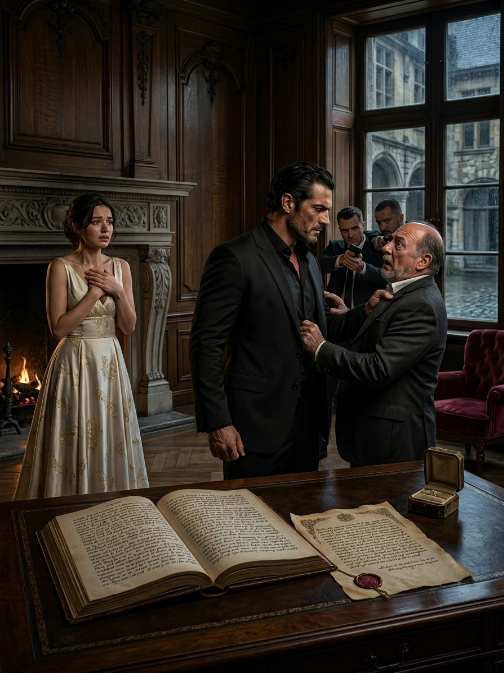
She Tried to Escape With Her Unborn Baby—Then the Ruthless Mafia Boss Claimed the Child Was His


—
## PART 1
The plastic stick sat on the edge of the porcelain sink, mocking her. Two pink lines. Clara Hayes stared at it until her vision blurred. She didn’t cry — crying was a luxury for women who had safety nets, for women who didn’t spend their days managing the schedules, the lies, and the bloody aftermaths of the Rossy crime family. She gripped the ice-cold porcelain, her stomach lurching, empty but still protesting the cheap coffee she’d forced down an hour ago. She buried the test in the trash beneath a wad of damp paper towels.
She took the subway to the office, packed and smelling of wet wool, her hands shoved deep in her trench coat pockets, fingers wrapped around a crisp white envelope. Rossy Logistics sat on the edge of the harbor — from the outside, a mid-level import-export firm; inside, the nerve center of Damian Rossy’s empire.
Clara walked through the glass doors at exactly 8:50, bypassed the main floor, and took the private elevator to the top. Her heart beat an irregular rhythm against her ribs. *Just slide it across the desk. Say it’s a family emergency.*
The top floor was silent, the air heavier, laced with sandalwood and old leather. Damian’s office door stood open a fraction. She could hear the low, even cadence of his voice — he rarely yelled; it was the quietness that usually preceded someone ending up in the back of an unmarked van. She pushed the door open.
Damian stood at the floor-to-ceiling window, looking over the gray, choppy harbor. “I don’t care about the port authority,” he said into the phone, voice gravel and ice. “Tell the harbor master the shipment clears tonight, or I start making decisions about his pension.” He ended the call, tossing the phone onto his desk without turning. “You’re late, Clara. It’s 8:55. You usually arrive at 8:45.”
He turned — a man carved from harsh angles, a jaw sharp enough to cut, eyes the color of bruised storm clouds. He looked tired. He’d looked tired since the hit on his father six months ago, since the mantle of the family had fallen squarely onto his shoulders. It was the grief that had broken them, just for one night — eight weeks ago, a bottle of bourbon, a locked office door, a momentary lapse in three years of ironclad boundaries. They had never spoken of it since.
Clara walked to the desk and placed the envelope squarely on the leather blotter. Damian looked at it. He didn’t touch it. “What is this?”
“My resignation.”
Silence stretched. A tugboat’s horn sounded outside, a low mournful wail against the glass. “I need to leave, Damian,” she said, reverting to his first name — usually in the office, it was Mr. Rossy. “Effective immediately.”
He stepped away from the window, silent and deliberate, until he stood opposite her. He picked up the envelope, didn’t open it, simply folded it in half, then quarters, until it was a small compressed square, and dropped it into the brass trash can.
“No.”
“It’s not a request. I’m giving my notice.”
“You don’t give notice to me, Clara. You know how this works. You know my accounts. You know the shipping schedules. You know the names of the men on my payroll at the docks, in the precinct, in the mayor’s office.”
“I would never say a word. You know me.”
“I do know you,” Damian said softly, eyes narrowing, scanning her face for a tell — he was a man who survived by reading liars. “You look pale. You’re shaking. What kind of trouble are you in?”
“None. I just want a normal life.”
A harsh, humorless laugh scraped from his throat. “A normal life? You’ve worked for a syndicate for three years and suddenly you want a picket fence.” He straightened. “Did someone approach you? Did the feds offer you a deal?”
“No. My God, Damian, no.” She stepped back, chest heaving. “I just want out.”
“You’re my secretary. You are my right hand.” He walked around the desk, closing the distance. Clara froze, sandalwood overwhelming her. “You don’t leave until I say you leave. Sit down. We have a meeting with the union reps in twenty minutes.”
He turned his back on her, dismissing the conversation entirely. Clara’s nails dug into her palms until they broke skin. She couldn’t fight him today — the nausea was rising again, a bitter tide. She grabbed the folder from his desk and walked to her adjoining office. She had failed. The trap had well and truly snapped shut.
—
The secret lasted exactly three more weeks. Clara became an expert at breathing through her mouth, hiding saltines in her blazer pockets, masking sudden aversions to printer ink and the heavy roasted espresso Damian drank by the gallon. She was losing weight everywhere except her lower belly, hidden beneath oversized sweaters. She told him she had a recurring stomach bug. He told her to see his private physician. She refused, claiming she was handling it.
It fell apart on a Tuesday afternoon. A shipment of untraceable firearms had been seized at the border. Damian had been pacing for two hours, barking into a burner phone, the air thick with the acidic tang of his stress and an abandoned cigar. Clara stood at the filing cabinets sorting customs manifests, trying to find the discrepancy that had tipped off the border patrol.
Damian slammed the phone down, cracking the plastic. “They had the route. Someone gave them the secondary route.”
“I’m checking the digital logs,” Clara said, tight.
He sighed, picking up his half-smoked cigar, and struck a match. The flare of sulfur hit her like a physical blow. Her stomach flipped entirely. She dropped the manifests, papers scattering, clamped a hand over her mouth, and bolted — not to her own office, but through the door of Damian’s private executive washroom, collapsing to her knees in front of the toilet, retching violently.
She hadn’t closed the door. She heard slow, heavy footsteps.
“A stomach bug,” Damian said, deadly quiet. “For three weeks.”
Clara wiped her mouth with a trembling hand, tried to stand, legs weak, bracing herself against the sink. “I ate something bad.”
“You didn’t eat lunch. I watched you push a salad around your plate for twenty minutes.” He stepped fully into the bathroom; the space felt suddenly small. He wet a hand towel and handed it to her. She pressed it to her neck. “I need to go home.”
“Look at me, Clara.” She kept her eyes on the drain. “Please, Damian.”
He reached out, gripping her chin — not hurting her, but absolute — and tilted her face up. His dark eyes searched hers, reading the terror, the exhaustion, the undeniable truth hiding underneath. His gaze flicked down, tracing her throat, settling on the slight bulk beneath her sweater before snapping back to her face. The realization hit him in real time. The cold calculation melted into something terrifyingly possessive.
“How long?” His voice had lost all its gravel — a smooth, lethal whisper. “Clara. How long?”
There was no point lying. “Eleven weeks.”
Damian didn’t flinch. He did the math. Eleven weeks ago was the week of his father’s funeral — the week the world burned down around them, and they’d sought refuge in each other on the leather couch in his office.
He let go of her chin, stepped back, ran a hand through his hair, exhaled long and ragged.
“You were going to run,” he stated. Not a question. “You are going to take my child and disappear.”
“It’s my child,” Clara fired back, adrenaline overriding her fear. She pushed off the sink, standing tall. “And yes, I was going to leave. Look at this life, Damian. You think I want a baby brought into a world where people are murdered over shipping routes?”
“You think I want to raise a child who has to look over their shoulder every day of their life?” His jaw tightened.
“I was trying to protect it. From all of this.” She gestured wildly toward his office, the guns, the ledgers.
Damian took a slow step toward her, stopping inches away, hovering his hand over her stomach before flattening his palm against her sweater. She gasped at the contact — warm, heavy, undeniably protective.
“You are carrying Rossy blood,” he said, low, rumbling through her. “My blood.”
“Damian, please just let me go. I won’t ask you for anything. I won’t tell anyone who the father is. I swear to God—”
“Stop talking.” He withdrew his hand, though his eyes never left hers. “You are done working. You are done living in that shoebox apartment in Brooklyn.”
“You can’t do that. I’m a person, not a piece of property.”
“You are the mother of my child.” He turned his back, picking up his suit jacket. “Like it or not, you’re staying. That baby is mine.”
—
## PART 2
The extraction was brutally efficient. Clara never went back to her apartment. Four hours later she stood in the foyer of the Rossy estate on Long Island — a fortress disguised as architectural brilliance, high walls, wrought iron gates, armed guards patrolling in pairs.
Damian led her up the sweeping staircase without more than ten words, opening double doors at the end of the east wing. “These are your rooms,” he said, stepping aside.
The bedroom was the size of her apartment. Her cardboard boxes sat stacked absurdly in the corner. “My men brought everything,” he said from the doorway, not crossing the threshold. “If anything’s missing, tell Paul at the front door.”
Clara wrapped her arms around herself. “Am I a prisoner here?”
“You’re safe here.”
“That’s not what I asked.”
“You have the run of the house. The gardens. But you do not leave the gates without me, and you do not speak to anyone outside this property.” He tossed a sleek phone onto the bed. “The only numbers in it are mine, the house staff, and the doctor.”
“Dr. Aris comes tomorrow at nine,” Damian continued, purely transactional. “He’ll examine you, set up a diet plan. You will follow his instructions to the letter.”
“I have my own doctor.”
“Not anymore.” He stepped fully into the room, swallowing the space. “You hate me right now.” Not an accusation — an observation. “You think I’m a monster keeping you in a cage.”
“Aren’t you?” she challenged.
His eyes darkened. “My father was shot in the head eating dinner in a restaurant he owned for twenty years. My enemies are constantly looking for a lever to pull. If anyone found out you were carrying my child while living alone in a third-floor walk-up in Brooklyn—” he stopped, swallowed hard, the cold mask slipping for a millimeter, revealing something terrified and exhausted underneath. “They wouldn’t just kill you, Clara. They would make it hurt, and they would make sure I watched.” He brushed his thumb against her cheek, painfully tender. “I am not keeping you here to punish you. I am keeping you here so you stay breathing.”
He turned and walked out. The lock didn’t turn. He didn’t need it — the fear he’d just instilled was a better cage than any bolt.
—
The next morning, Dr. Aris arrived with a portable ultrasound, treating Clara with a deferential, terrifying politeness while Damian stood in the corner, arms crossed, watching the small monitor. When the rapid thump-thump-thump of the heartbeat filled the room, his posture stiffened, his eyes widened slightly. For one fleeting second, he wasn’t the dawn of the Rossy family. He was just a man hearing his child’s heart for the first time.
“Eat the breakfast the chef prepared,” he said, not looking at her. “You need to put on weight.” He picked up the ultrasound printout — a blurry gray peanut — and stared at it for a long time. “We will have dinner together at 7. Don’t be late.” It wasn’t an invitation. It was a summons.
Dinner became an exercise in psychological endurance, night after night, Clara seated to his right so he could monitor how much she ate, could ensure the cage still held. By week five, her waistline had vanished, replaced by a firm, rounded curve. His tailor, a quiet man named Arthur, measured her expanding belly while she stood frozen with humiliation.
One night the silence at the table snapped. “Do you ever get tired of giving orders,” Clara said, dropping her fork, “or does it just bleed into your personal life so much you don’t know the difference anymore?”
Damian set his knife down. “My personal life and my business are the same thing.”
“I know that I am sitting in a prison. I know I haven’t spoken to another human being who isn’t on your payroll in over a month. I know I am carrying a baby whose only father solves his problems with a gun.”
He picked up his wine glass instead of yelling, swirling the dark red liquid. “Carter tells me you tried to walk out the front gates today.”
“I wanted air that didn’t belong to you.”
“Do you know what happened to the men who intercepted my shipment at the border last month?” He leaned toward her, sandalwood and gun oil drifting over the table. “They thought I was soft because I wear a suit and sit behind a desk. I found out who tipped them off. I went myself. In my world, respect is born from fear, and fear requires proof.” He wrapped his fingers loosely around her wrist. “I am a violent man, Clara. I do not deny it. It is the only reason I am alive. And it is the only reason you and that baby are currently breathing. Out there, you are leverage. In here, you are untouchable. So you will eat your dinner, and you will stop trying to walk out the gates.”
She picked up her fork, chewing through hot tears, hating him with an intensity that terrified her — mostly because she understood exactly why he was doing it.
—
The illusion of absolute safety shattered on a Tuesday at two in the morning. Clara sat in the bay window wrapped in a cashmere blanket, watching rain lash the security glass, when she heard the roaring, misfiring scream of an SUV pushed past its limits. A black Escalade, front bumper crumpled, one headlight gone, skidded to a halt below. Carter and another guard dragged a man from the back seat — dead weight, arms slung over their shoulders.
Even through the rain, she recognized the dark charcoal suit. *Damian.* Her breath left her lungs. She ran down the grand staircase, hitting the marble foyer just as the heavy oak doors burst open, the smell of copper and ozone hitting her first. Damian’s white shirt was soaked through, the entire left side stained a brilliant, terrifying crimson.
“Don’t put him on the floor. Get him to the study,” Vincent barked, gun in hand, kicking the door shut behind them.
What happened in that study over the following minutes — Clara’s hands pressed into a stranger’s version of the man she’d been running from, the desperate weight of his grip on her wrists shifting from a struggle into an anchor — would become the hinge on which everything after it turned.
—
## PART 3
“Pour the alcohol on my hands,” Clara ordered Vincent, her voice cutting through the chaos, shockingly loud. He didn’t argue. She folded a towel into a thick square, unbuttoned the ruined bottom of Damian’s shirt, exposing a jagged tear just below his lower left rib — not a clean bullet hole, but a graze that had ripped the flesh open, pulsing dark blood in a steady, terrifying rhythm.
She pressed the towel directly into the wound. Damian roared, his back arching off the sofa, hands flying up to tear her away, grip bone-crushing.
“Hold him down!” she yelled at Carter, who pinned Damian’s shoulders to the leather. “Look at me, Damian. Look at me.” His eyes locked onto hers, gray dilated almost black with shock. “Breathe. You are going to breathe. I have to hold this. If I let go, you bleed out before Aris gets here.”
The violent struggle slowly drained from his limbs. His grip on her wrists changed from a desperate attempt to stop the pain into a grounding anchor — holding on to her to stay conscious. They stayed like that for an eternity, the study silent but for his ragged breathing and rain against the windows, Clara’s arms burning, watching blood bloom through the white towel like a dark, macabre flower.
He wasn’t a monster right now. He wasn’t a kingpin. He was just a man bleeding on a couch, holding on to the mother of his child as if she were his only tether to the earth.
“I’ve got you,” she whispered, the words slipping out before she could stop them. Damian didn’t speak. He just watched her face until his eyes rolled back and he passed out.
—
Dr. Aris stitched a glancing wound that had miraculously missed his organs. Damian refused the hospital, refused even to be moved to his bedroom, staying on the study sofa, conducting a vicious internal investigation from a supine position. Clara didn’t see him for forty-eight hours.
When the doors finally unlocked Thursday evening, she walked down slowly. The house felt different — the tension wire that always hummed in the air had snapped, replaced by a heavy, exhausted quiet. She pushed open the study doors. Damian sat up on the couch, skin sallow, dark trenches under his eyes, wearing loose sweatpants and a t-shirt, the dangerous tailored don of the Rossy family entirely absent.
“Aris said you were the one who stopped the bleeding,” he said, not turning his head.
“You were ruining the leather.” A faint ghost of a smile touched his mouth and vanished. “Thank you.” The word sounded foreign on his tongue.
“Who did it?”
“A crew from the Bronx. They thought the border seizure meant I was weak. They ambushed my car at a red light.” He winced, taking a slow breath. “They are no longer a problem.”
Clara shuddered — the clinical way he spoke of death always terrified her, but looking at the pale, injured man on the couch, the terror was eclipsed by exhaustion. She sat in the armchair opposite and looked at him. Really looked.
“You almost died,” she said. Not an accusation. A fact.
“I did,” he admitted quietly, the mask completely gone.
“And what happens to us if you do?” She uncrossed her arms, resting her hands on her stomach. The baby shifted, a slow rolling movement. “What happens to me and your child if someone puts a bullet an inch to the right?”
Damian’s eyes fell to her hands and stayed there for a long, agonizing minute. “Vincent has orders,” he finally said, voice dropping to a gravelly whisper. “If I fall, you are taken to a private airstrip. I have a house in Switzerland. Untraceable accounts in your name, new passports. You will vanish, and the Rossy name dies with me.”
“You planned all that the day after I found out I was pregnant?”
He pushed himself forward, groaning, elbows on his knees, staring at the floor between his bare feet. “When my father was killed, I was standing right next to him. The blood sprayed across my face. I had been in this life since I was born — I knew the risks. But in that moment I realized the ultimate cruelty of this world isn’t the violence, Clara. It’s that you cannot love anything without painting a target on its back.” He looked up, eyes bright, rimmed with unspoken grief. “I locked you in this house because I thought I could control the variables. Enough guns, enough walls, and you’d be safe. But lying on that asphalt, bleeding out in the rain, the only thing I could think about was that I was leaving my child to be hunted.”
He stood, crossed to her chair with a calculated, stiff effort against the pain, and lowered himself painfully onto one knee. Clara gasped, reaching out to stop him; he waved her off. He laid both hands gently, reverently against her stomach.
Underneath his right palm, the baby kicked — a sharp, distinct thump. Damian gasped, looking up at her with absolute, shattered wonder.
“He’s been active all day,” Clara said softly, a small genuine smile pulling at her lips. “I think the stress woke him up.”
Damian didn’t move his hands, just stayed there, kneeling, feeling the life beneath his palms. “I will not let them touch you,” he vowed, voice thick. Not an order this time. A promise sworn on the blood he’d bled. “I will burn this entire city to the bedrock before I let anyone near you.”
Clara looked down at the man who had imprisoned her, who killed without remorse, who was now resting his cheek against her knee, listening to the heartbeat of their child, and understood with terrifying clarity: the cage hadn’t just locked her in. It had locked them both together. And she was no longer sure she wanted the door to open.
—
The transition from prisoner to partner happened in increments — shared meals, silences that stopped being hostile, a mutual understanding that the world outside the gates was waiting for them to fail. By her second trimester, Clara’s mental restlessness had sharpened into a razor edge. She was done pacing gardens, done waiting for Damian to come home smelling of cordite, refusing to tell her how close the wolves were getting.
One November evening, she walked into the study where Damian sat bathed in laptop glow, a tumbler of untouched amber liquid at his elbow.
“You should be in bed,” he said.
She walked around the desk instead of stopping at the guest chairs. “Move over.”
“Clara, I’m working.”
“I know. The Sullivan crew from Hell’s Kitchen is absorbing the territory the Bronx Syndicate left exposed.” She stated it as fact, hand on her hip. “You’ve been bleeding cash through the shipping ports for three weeks because Sullivan’s men are paying off the dock workers you neglected to give holiday bonuses to.”
Damian’s eyes narrowed, the predatory stillness settling over him. “How do you know about Sullivan?”
“Vincent left the quarterly projections on the dining table yesterday. He’s a good underboss, Damian. He’s a terrible accountant. He missed the pattern completely.” She tapped a few keys, pulling up a blank spreadsheet. “If I am going to live in this house, and if I am going to raise this child in this life, I am not doing it blindfolded. I am not going to be the fragile bird you keep locked in a tower while you get yourself killed managing logistics you clearly don’t have time for.”
The silence stretched, electric. She half expected him to call Carter. Instead, he let out a short, rough exhale, closed the laptop halfway, and gestured to the chair beside his desk.
“Sit.”
For the next four hours, they spoke the cold, hard language of survival. Clara systematically dismantled Sullivan’s financial infrastructure using nothing but public tax records, property deeds, and street-scraped data, laying out a tactical matrix: outbid the union reps at Pier 47 to paralyze incoming freight, tip off the state liquor authority to sever the laundering running through Sullivan’s Chelsea nightclubs, double the pay of his Hell’s Kitchen enforcers to flip their loyalty overnight.
“You want me to buy a union strike?” Damian asked, leaning over her shoulder.
“It costs fifty thousand in bribes,” Clara replied, not looking up. “A turf war with Sullivan costs a million in lost revenue and puts a target on your back. Starve them out. Don’t shoot them.”
He was silent, looking from the screen to her profile, the stubborn set of her jaw, the dark circles under her eyes. “You are ruthless,” he murmured, profound respect in his tone.
“I am pregnant,” she corrected, turning to meet his gaze, their faces inches apart. “I am making sure the man who protects my child doesn’t take a bullet because he was too arrogant to do the math.”
Damian traced his thumb along her cheekbone. “They wouldn’t just kill me, Clara. If Sullivan realizes who gave me this strategy—”
“They don’t know I exist. Keep it that way.” She turned back to the screen. The wall between captor and captive had dissolved, replaced by something far more dangerous. They weren’t just sharing a house anymore. They were building an empire, brick by bloody brick, with Clara firmly at the mortar.
—
Winter arrived on Long Island with a vicious, howling gale. By mid-January, the estate lay under two feet of snow, and Clara was thirty-eight weeks pregnant, her body a lead weight, Dr. Aris essentially moved into the guest wing.
It happened on a Friday. A storm had knocked out the county’s main power lines; the estate’s backup generators had kicked in flawlessly. Damian was in the city finalizing the strike Clara had orchestrated, due back by noon. It was four p.m. Clara sat in the library, watching the frost-covered window, wrapped in a wool shawl, when the lights died. The generator sputtered, choked, went entirely silent. It didn’t fail unless someone made it fail.
*Security protocol alpha one.* Vincent’s drilled instructions flashed behind her eyes. She turned from the window into a house swallowed in early winter dusk.
A sharp, deafening crack shattered the silence — gunfire, from the front gates. Panic tasted like blood at the back of her throat. She gripped the bookshelves, navigating the dark library by touch. “Carter!” Nothing. Another burst, closer. Automatic weapons. The heavy thud of a breaching charge through the floorboards. They were at the front doors.
A sharp tearing pain ripped across her abdomen, dropping her to her knees against the staircase banister. *Not now. Please God, not now.* The contraction held her for forty excruciating seconds before receding, leaving her trembling and slick with cold sweat. She forced herself up — the panic room lay three hallways away, beneath the kitchen.
The front door splintered and gave way. Boots hit the marble. “Sweep the ground floor. Find the woman. Sullivan wants her alive.”
Clara’s blood ran cold. Sullivan. The strike had worked too well — he was cornered, desperate, and somehow he’d found out about her. Someone had sold them out.
She kicked off her slippers, moving down the servants’ corridor in bare feet, trusting the dark, knowing this house intimately now — which floorboards creaked, the exact distance to the kitchen. A tactical flashlight beam swept an intersecting hallway; she held her breath, a hand over her mouth, the baby kicking violently as if sensing the adrenaline flooding her system. The footsteps passed.
She reached the hidden panel behind the false pantry wall, punched the six-digit code into the keypad with shaking fingers, pulled the heavy steel door open, slipped inside, hauled it shut, spun the internal locking wheel. Sealed in.
The safe room was small, lit by emergency LEDs, smelling of stale air and bottled water. Clara slid down against the steel door as another contraction hit, worse than the last, like her spine being ripped in two. She bit down on her shawl to muffle a scream, curling onto her side, panting, hands clutching her stomach, while above her the muffled concussion of a war zone vibrated through the ceiling.
*Damian.* She didn’t know if he was dead. She didn’t know if he’d walked into an ambush in the city. She only knew she was alone in a concrete box, entirely at the mercy of her own failing body.
Time lost meaning. Contractions rolled into each other like a rising tide. She lost track of the gunfire, the hours, drowning in pain, anchored only by the primal need to push.
Then the heavy steel wheel on the door groaned. Clara scrambled backward, grabbed a steel flashlight from the emergency kit, gripping it like a club. If it was Sullivan’s men, she would make them kill her before they took the child.
The door swung open. Damian stood in the doorway, unrecognizable — his coat soaked in blood and snow, face smeared with soot and crimson, eyes wild and hollow, an assault rifle in his right hand, barrel smoking. He looked at her curled on the floor, gripping the flashlight like a weapon, and the rifle dropped from his hand, clattering against the concrete.
“Clara,” he breathed, voice breaking entirely. He crossed the room in two strides, dropped to his knees, threw off his ruined coat, and pulled her into his chest. He was freezing cold; to her, he felt like the sun.
“You’re alive,” she sobbed into his neck.
“I’ve got you,” Damian whispered fiercely, hands shaking as they checked her for injuries. “They’re dead. All of them. I’ve got you.”
A brutal contraction tore through her, cutting off her reply. She screamed, nails digging into his shoulders. His eyes widened in terror. “Aris! Get Aris down here now!” he roared up the stairs.
—
The safe room became a delivery ward. Dr. Aris arrived minutes later, medical bag in white-knuckled hands. The estate above was a graveyard; in the concrete bunker below, life fought its way through. There were no soothing words, no warm blankets, no epidurals — only harsh emergency lighting, cold concrete, and Damian, who refused to leave. When Aris told him to wait outside, Damian drew a sidearm, set it on the metal supply table, and told the doctor to do his damn job.
He sat behind her, holding her upright against his chest, letting her break the skin on his arms as she gripped him through the final stages, whispering low, urgent Italian prayers and promises that anchored her when the pain threatened to pull her under.
“One more, Clara,” Aris urged. “The head is clear. Give me one more.”
She had nothing left, her vision spotting with black stars. She felt Damian’s chest heave behind her, his mouth pressed hard against her temple.
“Breathe with me,” he commanded, softly grounding her. “You are the strongest thing in this world. Finish it.”
With a final guttural scream that tore her throat raw, Clara pushed. The room went silent for two agonizing seconds. Then a sharp, angry wail echoed off the concrete walls.
She collapsed back against him, lungs burning, body entirely spent. She felt his chest hitch behind her.
“A boy,” Aris said, clearing the infant’s airways, clamping the cord, wrapping the screaming, bloody bundle in a thermal blanket before placing it on Clara’s chest.
He was tiny. His face red and furious, a thick shock of dark hair plastered to his head. He was perfect — heavy, real, breathing. The magnitude of it broke her completely, tears cutting tracks through sweat and grime. Damian leaned his chin heavily on her shoulder, his blood-stained hand reaching out to trace a trembling finger over the baby’s cheek. The infant stopped crying, turning blindly toward the warmth of his father’s touch.
Damian closed his eyes, a ragged breath escaping his lungs. A single tear slipped down his bruised face, hiding itself in Clara’s hair. He had an heir. The Rossy bloodline had survived the night.
—
Three days later, the estate was quiet again. The bodies had been removed, the blood scrubbed from the marble, the generators repaired. The world outside believed it was business as usual, utterly unaware of the slaughter that had taken place behind the iron gates.
Clara sat in the bay window, the winter sun pale through the glass, Leo asleep in a heavy oak bassinet by the bed. The doors opened. Damian walked in, fresh charcoal suit, bruises fading to dull yellow, the cold calculating mask of the don returned. He was going back to work — territories to secure, loose ends to bury.
He looked down at the sleeping child for a long moment before turning to her. “The perimeter is reinforced. I brought in a crew from Chicago to run the outer security. No one gets within five miles of this house without my approval.”
Clara looked at him. She didn’t see a monster anymore. She saw a man trapped in a cycle of violence — a man who had bled for her, who had held her together when she was breaking apart. She stood, sore, moving with slow, deliberate caution, and walked over to him.
“Sullivan?” she asked quietly.
“Buried,” Damian replied. The word held a terrible finality.
She nodded, reaching out to adjust his lapel — an intimate, domestic gesture that felt utterly surreal against the backdrop of their reality. “You told me once that the cruelty of this world is that you cannot love anything without painting a target on its back.”
His jaw tightened. “I haven’t changed my mind.”
“Neither have I.” She smoothed her hand flat against his chest, feeling the heavy, rhythmic beat of his heart. “Which means we don’t hide, Damian. We make sure the target is too dangerous for anyone to ever shoot at.”
Damian’s eyes darkened, a flash of dangerous pride flaring in the gray depths. He reached up, wrapping his hand around the back of her neck, pulling her in. He kissed her — not the desperate, hollow kiss from the night they’d created their son, nor the forceful claim of a captor. Heavy, deliberate, entirely mutual. A pact sealed in survival.
He pulled back just enough to look into her eyes. “You are staying,” he whispered — the echo of his order from months ago, the context now fundamentally shifted.
Clara looked at the man who commanded a violent empire, then at the son sleeping peacefully in the shadows of that very same empire. The cage doors had been blown wide open during the raid, and she hadn’t run. She had no intention of ever running again.
“Like it or not, Damian,” she murmured, a small, cynical smile playing on her lips, “you couldn’t get rid of me if you tried.”
**THE END**