She Slipped a Warning Under His Coffee Cup — Then the Mafia Boss Found Out What She Killed to Get There

—
PART 1
Blood under fingernails doesn’t wash out with soap. You need a stiff brush and scalding water. Vincent Corbo knew this the way other men knew their own birthdays — a fact absorbed so early in life it no longer felt like knowledge, just weather. He stared at his knuckles under the sick fluorescent hum of a diner on 9th Avenue, 3 a.m., wanting nothing more complicated than black coffee and ten minutes where nobody needed anything from him.
The neon sign in the window buzzed like a trapped insect, throwing a bruised pink glow over the rain-slicked asphalt outside. Vincent sat in a corner booth, the split red vinyl seat patched with duct tape that snagged his wool trousers. He was tired in a way sleep didn’t touch anymore — a marrow-deep exhaustion that tasted like copper and old coffee. The high-end steakhouses and private clubs had felt suffocating tonight. He’d wanted the anonymity of cheap linoleum and bad food instead.
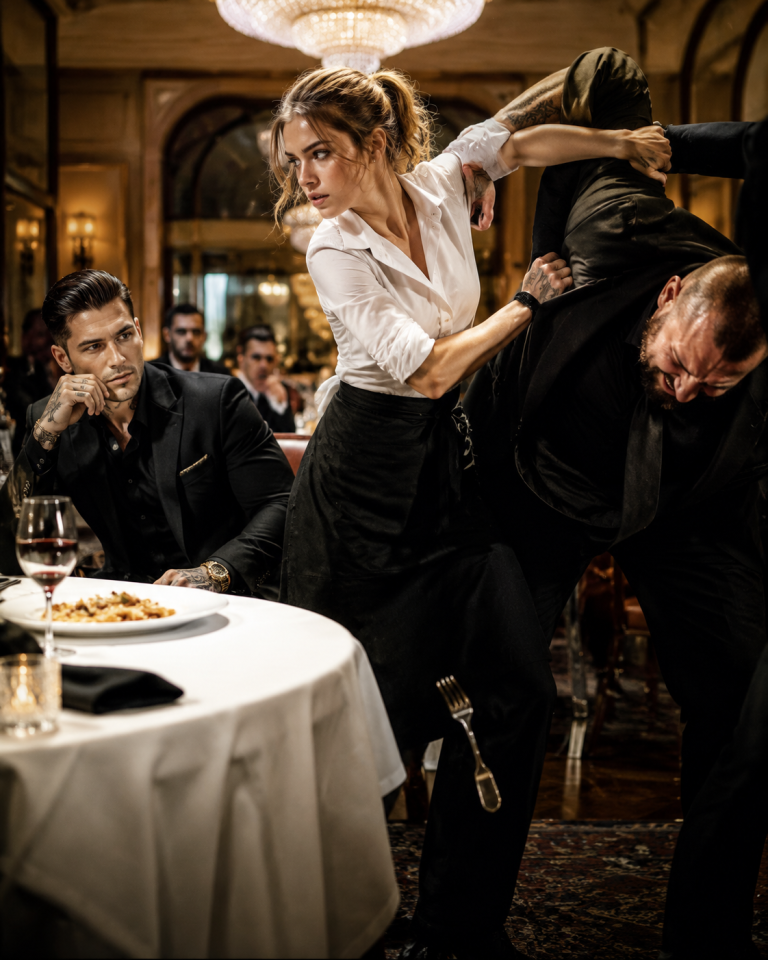
A waitress approached. She didn’t have the practiced brightness of the uptown staff — she walked with a slight limp, a ceramic mug in one hand, a pot of decaf that looked like motor oil in the other. Her name tag, crooked on a faded yellow uniform, read *Tessa.* Vincent noticed her hands before her face — cuticles chewed raw, a smear of faded blue ink on one finger. She set the mug down hard enough that the ceramic clanked against the formica.
“Want anything else, or just the sludge?”
Her voice was flat, gravel-worn, the voice of someone running on fumes. Vincent finally looked up. She was young — late twenties, maybe — though the city had sanded the youth off her edges early. Her left eye was swollen, a blooming map of purple and yellow spreading toward her cheekbone. She caught him looking and didn’t flinch away. Most people looked away from Vincent. She didn’t.
“Just the coffee,” he said.
“Suit yourself.”
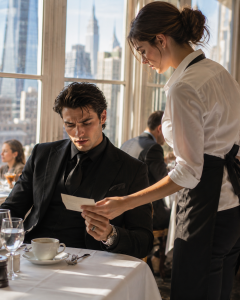
She reached into her apron, slid a folded green receipt under the edge of his saucer without breaking stride, and walked back behind the counter to scrub furiously at a coffee stain that had probably already surrendered.
Vincent frowned. He hadn’t asked for a check. He hadn’t even sipped the coffee. He pulled the damp paper toward him and unfolded it.
*The man in booth four is going to shoot.*
His pulse didn’t spike. What settled into his stomach instead was something colder and clearer — a stone of pure, hyper-focused calm. He didn’t turn his head. He lifted the mug, let the bitter coffee burn his tongue, and over the rim of the cup, angled his eyes toward the chrome napkin dispenser on his table. Its curved surface offered a warped, funhouse reflection of the room behind him.
Booth four. A man in a dark windbreaker, alone, no food, just a glass of water untouched in front of him. His right hand was under the table. His shoulders were angled, tense, aimed at Vincent’s back.
Vincent mapped the room without moving his head — the front door with its useless little bell, the swinging kitchen doors, the hallway toward the restrooms that probably led to a back exit. He glanced once at Tessa. She was still scrubbing, knuckles white, eyes flicking toward the pie case’s reflective surface — toward booth four. She wasn’t afraid of him. She was afraid *for* him.
He set the mug down. The click sounded enormous. He dropped a crumpled fifty on the table, stood, and instead of walking toward the front door, turned and closed the distance to booth four in three long, silent strides.
It broke the hitman’s rhythm completely. The man in the windbreaker froze, his hand snagging on the table edge as he tried to clear a suppressed pistol from beneath the fabric. That fraction of a second was all Vincent needed.
He didn’t draw his weapon — too loud, even in an empty diner. He slammed his palm down on the man’s wrist, pinning it to the table hard enough to crack bone. The hitman hissed, swung a wild left hook that Vincent ducked under, and took an elbow to the jaw with a wet, heavy crack that put him out cold across the table, the pistol clattering to the floor.
Silence rushed back in, broken only by the buzzing neon and a drunk snoring obliviously at the counter.
“Come on, pal, you’ve had too much,” Vincent said loudly, for the benefit of the cook peering out from the kitchen window, and dragged the man’s dead weight through the fire door into the alley behind the diner.
The rain was a fine, freezing mist. Vincent let the man drop, patted him down — no ID, a burner phone, a spare magazine. Professional, but cheap. A local ghost, not a syndicate crew.
The door behind him squeaked. He spun, hand flying to his coat.
Tessa stood in the doorway, shivering in her thin yellow uniform, a lit cigarette trembling between two fingers. She looked at the unconscious man, then at Vincent’s hand still inside his jacket. Her eyes didn’t widen.
“You didn’t kill him,” she said.
“Not yet.” Vincent stepped closer, close enough to cast a shadow that swallowed her small frame entirely. “How did you know?”
“I heard the safety click. I know what a gun sounds like.” She took a slow drag, exhaled into the rain. “That bruise on your knuckles — that’s fresh too. Recent hit. You stuck your neck out for a stranger. People don’t do that unless they want to die, or they want a payout.”
She flicked ash into a puddle. It hissed.
“I don’t want your money,” she said. “I want out.”
“Out of what?”
“Queens. The city. My shift.” She looked up at him, something feral simmering under the exhaustion. “I know who you are, Mr. Corbo. I saw you at the Velvet Room. I know you run the ports. I know you can make people disappear.”
Vincent went very still.
“If you know who I am,” he said, quiet enough that the rain nearly swallowed it, “then you know you shouldn’t be saying that name out loud.”
“You want me to kill whoever gave you that black eye?” It wasn’t a question meant kindly. It came out flat, almost bored.
Tessa’s laugh was harsh and bitter. “He’s already dead. I did that myself, two hours ago. He’s bleeding out on my kitchen floor right now.”
Vincent stopped breathing for one full second. He looked at this scrawny, bruised woman in a stained yellow dress — the chewed cuticles, the tremor she couldn’t quite hide — and understood, with total clarity, that his night had just gotten enormously more complicated.
“I gave you a warning,” Tessa said, dropping her cigarette butt into the alley. “I gave you an edge. Now you owe me a ride.”
—
PART 2
The inside of Vincent’s sedan was a sensory shock after the alley — rich leather, cedarwood cologne, the faint metallic ghost of gun oil, and blessed, total silence once the heavy doors thudded shut. Tessa sat rigid in the passenger seat, hands clamped between her knees, dripping onto upholstery that had probably cost more than her yearly rent.
“Tommy,” Vincent said, eyes on the road. “Tommy Rossi.”
“I just knew him as Tommy.” Her voice was hollow. “Kept his money in a shoe box. Kept his temper in a bottle.”
“How did it happen?”
“Why does it matter?” she snapped, turning toward him, wet hair plastered to her cheek. “I defended myself. He had a heavy hand. Tonight I had a heavier frying pan.”
“It matters,” Vincent said, tone utterly without judgment, like a man discussing shipping logistics, “because if it was an accident, they’ll just kill you. If it was a hit, they’ll torture you first to find out who paid you. The Vitiellos aren’t known for nuance.”
She went quiet after that, the adrenaline draining out of her, leaving something hollow and cold in its place. “I went to work because I didn’t know what else to do,” she admitted. “A public place felt safer than sitting with a body. Then you walked in. It felt like a slot machine paying out.”
Vincent’s eyes flicked to the rearview mirror. A dark SUV had turned onto the street two blocks back, matching their speed.
“Is that—”
“Maybe.” He pressed the accelerator. The sedan surged, took a corner too fast, tires shrieking against the wet asphalt. Ten seconds later, the SUV made the same turn.
“They found him,” Tessa breathed. “They found Tommy.”
“Or they followed the guy from booth four and realized he didn’t die.” Vincent reached across her, popped the glove box. The interior light caught a compact pistol and two spare magazines. “Take it.”
“I don’t know how to shoot that.”
“You know what a gun sounds like.” He quoted her own words back at her, eyes never leaving the road. “Point the heavy end at whoever’s trying to kill us and pull the trigger. It’s a frying pan. Just faster.”
She wrapped her fingers around the cold grip as Vincent threw the car into an abandoned industrial park by the waterfront, killed the headlights, and vanished them both into a gap between two shipping containers with a handbrake turn that left her knuckles white on the door handle. The SUV roared past their hiding spot and lost them in the storm.
What happened outside the car in the next ninety seconds, Tessa only heard — two suppressed shots like a nail gun striking wet wood, a wet gurgling scream cut short, a body slamming against the trunk, and then Vincent’s bare hands finishing what the gun hadn’t needed to. He came back soaked, smelling of rain and blood, and told her flatly: “Two down. One got away in the SUV. We have twenty minutes before he comes back with half the Vitiello payroll.”
They abandoned the car. They walked three freezing blocks to a rusted warehouse stamped *CORBO MARINE FREIGHT* in faded paint, and there, under a caged work light, Vincent forced whiskey into her shaking hands, cleaned a cut on her hairline with the precision of a watchmaker, and asked her the question that changed everything.
“What else was in the apartment, Tessa? What aren’t you telling me?”
She reached into her cardigan pocket and pulled out a small black notebook, its leather stained dark with something that wasn’t ink.
“You asked what else was in the shoe box,” she said quietly. “Tommy wasn’t smart. But he was greedy. And he liked to keep records.”
Vincent’s eyes went hard and bright at once, the look of a man who has just been handed, by pure accident, the keys to an empire that wasn’t his.
“You didn’t just kill a man tonight,” he said slowly. “You robbed the Vitiello family of their entire structural integrity.”
And when he reached out and took the notebook from her hand, closing his fingers over hers for one deliberate second too long, he said five words that would end her old life completely.
“You belong to me now.”
—
PART 3
The declaration hung in the stagnant warehouse air, heavy as wet concrete.
Tessa didn’t flinch. The shock of the night had burned itself out somewhere between the alley and the rail yard, leaving behind a crust of pure, hard pragmatism she hadn’t known she possessed until she needed it. She looked at his hand wrapped around her notebook — the only leverage she had, her one ticket out of a shallow grave in the Pine Barrens — and understood exactly how smoothly it had just been taken from her.
“I belong to myself,” she said. Her voice had lost its tremor completely, flattened into the exhausted resignation of a woman who’d worked double shifts her whole life and learned that nobody handed you anything you didn’t take back yourself. “The book is yours. The war is yours. I want a flight out of JFK. Seattle.”
Something dark and almost amused moved behind Vincent’s eyes — a terrifying thing to witness on a man who dealt in death for a living. He stepped back into the pool of yellow light, opened the notebook, and paged through Tommy Rossi’s jagged, meticulous handwriting.
“Seattle,” he murmured. “It rains a lot in Seattle.”
“I like the rain.”
“You say that soaked to the bone and shivering.” He snapped the book shut, sharp as a gunshot. “You don’t understand what you’re holding, Tessa. If Carmine Vitiello realizes Tommy is dead and this book is missing, he won’t look for you. He’ll tear this city down to the bedrock to find you. You’re not going anywhere. Not yet. Not until every name in here is verified.”
“Then hide me,” she said. “Just not in a body bag.”
He didn’t answer that directly. He picked up a burner phone, called a man named Darian, and by the time the sun came up, Tessa had a new set of clothes that fit like they belonged to nobody in particular, a ride in an untraceable car, and a private elevator opening onto a glass-walled penthouse forty-two floors above a city she no longer recognized as hers.
It was, she thought, standing at the floor-to-ceiling windows with the skyline glittering and indifferent below her, a beautiful cage. Vincent told her not to touch the windows — wired, he said, without elaborating — and disappeared into a study, leaving her alone with the kind of silence that rang in her ears louder than the chaos it replaced.
She showered until the water ran cold, scrubbing at skin that no longer smelled like Tommy’s blood but felt like it always would. She cried once, hard and silent, forehead against wet slate, mourning the small, miserable, ordinary life she’d lost the moment a cast-iron skillet connected with a man’s skull. Then she put on the oversized shirt Vincent had left on the bed — his smell, cedar and gun oil, worn into the fabric — and slept twelve hours straight, the kind of sleep that comes only after a body has finally run out of adrenaline to burn.
—
She woke to the smell of coffee and roasting garlic, and for one disorienting second thought she was back in Queens, waiting for a fist to hit her door. Then the skyline outside the window reminded her otherwise.
Vincent was at the kitchen island when she came out, sleeves rolled to his elbows over a forearm inked with old, dark tattoos, a map of the Bronx spread across the marble in front of him. Darian stood beside him, tracing a route with a thick finger. Two more men flanked the front door, expressions carefully blank. The room went silent the moment she walked in.
“You’re awake,” Vincent said. “Sit. Eat.”
She didn’t wait for permission. She ate the plate of pasta in front of her like a woman who hadn’t eaten in a day, because she hadn’t, and ignored the two men watching her from the door the way you ignore weather you can’t do anything about.
“Sal’s meatpacking plant, Hunts Point,” Vincent was saying to Darian. “Ledger says the drop happens Thursdays at six. His lieutenant, Paulie, runs the collection. You walk in the front door at five forty-five. No weapons drawn unless they draw first. Tell Paulie his boss has been skimming from Carmine for two years, and we have the ledger to prove it.”
“Is that true?” Darian asked.
“It’s true enough if you hold the numbers in the right light,” Vincent said, without a flicker of guilt. “Tell Paulie he has a choice. Keep collecting for a dead man walking, or hand the envelopes to you and keep breathing.”
Tessa stopped chewing. She understood, watching him lay it out with the calm of a man closing a real estate deal, that Vincent Corbo wasn’t just using Tommy’s ledger to hunt targets. He was weaponizing paranoia itself — using a dead bagman’s records to manufacture a lie precise enough to tear the Vitiello family apart from the inside, without a single shot fired by his own men.
Darian left with two others to run the play. When the elevator sealed shut behind them, the penthouse’s silence returned, thick and total. Vincent came around the island and stopped beside her stool, reaching out to brush a strand of hair from her bruised cheek with a gentleness that had nothing to do with the war he’d just declared.
“You’re shaking,” he said.
“You’re starting one.”
“I’m ending one.” His voice didn’t rise. “Carmine’s been pushing into my territory for six months. He thought I was weak. You handed me the knife to cut his throat.”
“And what happens to me when he bleeds out?” Tessa looked up at him, searching for an exit that wasn’t there. “When the book’s useless and you’ve taken the Bronx — do I get my flight to Seattle?”
The silence stretched, tight as piano wire.
“No,” Vincent said finally. “You don’t.”
That should have terrified her more than it did. Instead, something colder and more useful took root — the understanding that fear alone wasn’t going to get her out of this building. She would have to become something Vincent Corbo couldn’t afford to lose, and then make him choose to let her go anyway.
—
Three weeks folded into each other in the strange, suspended rhythm of captivity dressed up as protection. The play against Paulie worked exactly as Vincent predicted — by the following morning, Carmine Vitiello was tearing his own organization apart looking for a traitor who didn’t exist, too consumed by internal suspicion to notice a missing waitress from Queens. Sal the Butcher, cut off from his revenue stream and accused of a theft he hadn’t committed, made the fatal mistake of trying to prove his loyalty by launching a reckless strike against one of Vincent’s shipping routes — a strike that cost him four men, a warehouse, and, three days later, Carmine’s confidence entirely.
Tessa watched all of it happen from a marble kitchen island and a guest bedroom with wired windows, feeding Vincent details from memory whenever he asked — the layout of Tommy’s apartment, names he’d mentioned in passing, the particular paranoid habits of men who’d trusted Tommy with envelopes of cash. She wasn’t just leverage anymore. She’d become, without either of them naming it directly, a source. An asset with a memory Vincent’s own network couldn’t replicate.
It didn’t make the penthouse feel any less like a cage. But the bars had started to feel, unnervingly, like something closer to walls she was choosing to stay inside of.
“You could have handed me over to Carmine’s people the second you had the book verified,” she said one night, three weeks in, watching him clean a fresh cut across his own knuckles at the kitchen sink — a habit she’d learned was less about injury and more about needing his hands to be doing something. “Prove good faith. End the whole thing faster.”
“I could have,” Vincent agreed.
“Why didn’t you?”
He turned off the water, dried his hands on a dish towel, and looked at her for a long moment — the same look he’d given her in the warehouse, weighing something he clearly still hadn’t finished weighing.
“Because handing you over would have solved the Vitiello problem,” he said, “and created a worse one.”
“Which is?”
“You wouldn’t be here anymore.”
It was the closest he’d come to admitting anything, and it landed harder than any threat he’d made in that first freezing warehouse. Tessa didn’t answer. She didn’t trust herself to.
—
The end came faster than either of them expected, and it came from Carmine Vitiello himself, cornered and humiliated, doing the one thing a desperate man with nothing left to lose always eventually does — going for broke.
Darian’s call came at 2 a.m., waking Vincent from the study chair where he rarely actually slept. Carmine had pulled every remaining loyal soldier off the street and was moving on the penthouse directly, no subtlety left in him at all, just a dying man trying to take the thing that had ruined him down with him. Twenty minutes out. Maybe less.
Vincent didn’t panic. He moved through the penthouse with the same coiled, efficient calm Tessa remembered from the diner, pulling weapons from a locked cabinet she hadn’t known existed, briefing the two men at the door in short, clipped sentences that assumed no argument.
“You,” he said to Tessa, pressing the same compact pistol from the sedan’s glove box into her hands, “stay behind the island. Whatever comes through that door that isn’t me or Darian, you point the heavy end at it.”
“Vincent—”
“I need you alive,” he said, and for the first time since the alley, his voice cracked slightly around the edges of something that wasn’t strategy. “That’s not a request.”
The elevator’s soft mechanical whisper announcing an unauthorized car climbing the shaft was the worst sound Tessa had ever heard, worse even than the wet crack of Tommy’s skull against the radiator. She crouched behind the marble island exactly where she’d been told, pistol gripped in both hands, listening to her own heartbeat hammer louder than the rain had ever hammered against that motel-adjacent warehouse roof.
The doors opened onto gunfire.
It was fast, ugly, and mercifully brief. Vincent’s men had positioned themselves in the stairwells days ago, a contingency Tessa hadn’t known about until the moment it mattered, and Carmine’s remaining soldiers — desperate, undermanned, running on the fumes of a crumbling empire — walked into a kill box they never saw coming. The exchange lasted less than ninety seconds. When it ended, the silence that followed was the loudest thing Tessa had ever experienced, ringing in her ears louder than the shots themselves.
Carmine Vitiello did not die in that elevator. He was dragged out of it, bleeding from a shoulder wound, disarmed, and deposited on his knees in the middle of the penthouse’s pristine living room floor by two of Vincent’s men, while the city glittered on, indifferent, through the floor-to-ceiling windows behind him.
Vincent crouched in front of him, unhurried, the way he did everything.
“You had six months to leave my territory alone,” Vincent said. “You had three weeks to walk away after Tommy’s ledger surfaced. Instead you sent soldiers into my home at two in the morning.”
“You started this,” Carmine spat, blood on his teeth. “That whore killed my runner—”
He didn’t finish the sentence. Vincent’s hand closed around his collar before the word had fully left his mouth, and whatever happened in the next quiet, brutal thirty seconds, Tessa didn’t watch. She looked instead at the city outside the window, at the ordinary, oblivious lights of a million people who would never know how close their skyline had just come to changing hands entirely.
When it was over, Darian’s men removed what remained of Carmine’s presence from the building with the same efficient discretion they applied to everything. By dawn, word had already begun moving through the right channels that the Vitiello family no longer had a head, and that the docks, the drop points, and the shipping routes Tommy Rossi’s ledger had once mapped out in such careful, greedy handwriting now belonged, without contest, to Vincent Corbo.
—
The penthouse, in the grey hush of that first morning after, felt different. Not safer, exactly — Tessa didn’t think a life built next to Vincent Corbo would ever be something as simple as *safe* — but quieter, in the way a held breath finally released feels quiet.
She found him on the balcony, the one room in the apartment whose windows weren’t wired, watching the sun come up gray and reluctant over a skyline that was now, in some functional if unofficial sense, his. He hadn’t slept. Neither had she.
“It’s done,” he said, not turning around. “Carmine’s gone. Sal’s men have already scattered or switched sides. Paulie’s running the Bronx drops for me now instead.”
“And the ledger?”
“Burned it an hour ago.” He finally turned to look at her. “It did its job. I don’t need Tommy Rossi’s handwriting hanging over anyone’s head anymore, including yours.”
Tessa stepped out onto the cold concrete, wrapping her arms around herself against the early morning air. “So that’s it, then. The book’s gone. The war’s over. I don’t have anything left you need.”
“That’s not true.”
“Isn’t it?”
Vincent was quiet for a long moment, the kind of quiet she’d learned, over three strange weeks, meant he was choosing his next words with unusual care.
“You could still get on a flight to Seattle,” he said finally. “I’d get you the papers. Clean name, clean money, a life nobody in this city could ever trace back to Tommy Rossi or me. I meant that, the first night. I still mean it.”
“But?”
“But I’d rather you didn’t.”
It wasn’t a command this time. She heard the difference immediately — the absence of the flat, possessive certainty he’d used in the warehouse, in the kitchen, in every version of *you belong to me* he’d handed her since that first folded receipt under a coffee mug. This was something else. Something that, for the first time since she’d slid that warning across a formica table, actually left room for her to say no.
She thought about Queens — the cramped apartment, the shoebox of stolen twenties she’d never get to spend, the version of herself that used to flinch at a raised hand and clean up other people’s messes for tips that barely covered rent. That woman was gone. Whatever had walked out of that diner with Vincent Corbo wasn’t her anymore, and it never would be again, no matter which coast she landed on.
“I didn’t survive all of this,” Tessa said slowly, “just to hand you the only thing I have left to bargain with for free.”
Something that might have been the beginning of a smile moved at the corner of Vincent’s mouth — rare, and entirely unguarded, the way she imagined it must have looked before this city and this life had carved most of the softness out of him.
“Then name your price.”
Tessa looked out at the skyline — his skyline now, in every way that mattered — and felt, for the first time since a cast-iron skillet had ended one life and started another, something that wasn’t fear at all.
“A seat at the table,” she said. “Not a room down the hall. Not an asset behind a marble counter with a gun and instructions. If I’m staying in this world, I’m not staying in it as something you keep.”
Vincent studied her for a long moment, the sunrise turning the glass towers around them gold, and extended his hand — not to take anything from her this time, but to shake on it, the way men in his world sealed the deals that actually mattered.
“Welcome to the table, then,” he said.
Tessa took his hand. Below them, the city kept turning, unaware that somewhere forty-two floors above 9th Avenue, a waitress who used to scrub coffee stains for tips had just become something the entire underworld would learn, in time, not to underestimate.
THE END