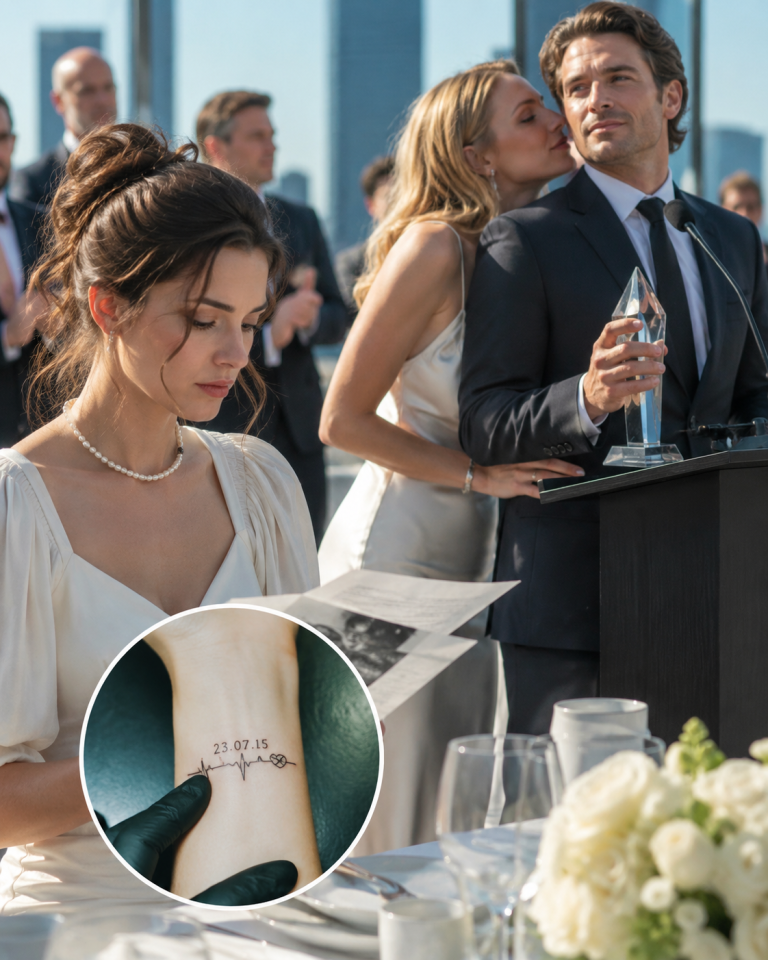
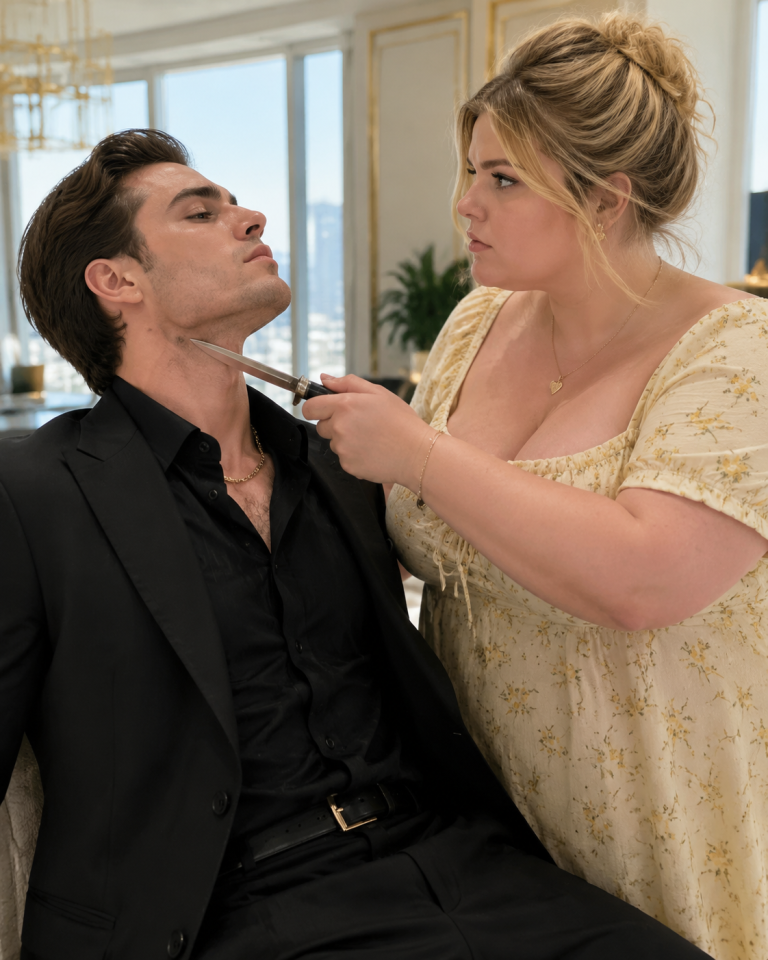
She Only Meant to Alter His Suit—Then the Mafia Boss’s Scar Revealed a Secret

## PART 1
I have sewn seams into the clothes of men who have done terrible things, and I have never asked questions.
That is the first rule of bespoke tailoring. You measure the body in front of you. You note the breadth of shoulders, the drop of a hem, the way a man carries his weight. You do not comment on the bruises. You do not wonder about the money. You record what the cloth requires and you make something that fits.
I had kept that rule for eight years without difficulty.
I kept it until the morning a commission arrived through a firm called Greystone & Associates, requesting urgent alterations to three formal jackets for a client known only as Larsson. The paperwork was meticulous, the rate extraordinary, and tucked inside the envelope — almost as an afterthought — was a single spool of black thread.
*Client requires all basting work use enclosed thread. Material compatibility essential.*
I turned the spool between my fingers. It felt slightly wrong. Not wrong the way cheap thread feels wrong. Wrong the way something designed to do two jobs simultaneously feels wrong when you only know about one of them.
I put it back. I took the commission. I needed the money.
My name is Clara Novak. I run a small atelier in Greenpoint called Novak & Thread, and the sign above the door is painted in the same shade of cobalt blue my father once described as *the color the sky turns right before it decides to do something remarkable.* He was like that. He turned everything poetic, even truck engines, even weather systems, even the moon on the nights it looked like someone had knocked a piece out of it.
Marcus Novak died when I was eleven. A hit-and-run, the police said. A drunk driver, the report said. The case went cold in six months.
I had spent twenty years knowing the report was wrong.
—
The client did not come himself.
Instead, a man arrived at my shop at seven in the evening, an hour after I had closed, which told me something about the kind of appointment this was. He was built like architecture, like someone had decided a person should also be a wall. His name was Sandro. He did not offer a last name. He stood in my doorway with two garment bags and the unhurried patience of someone who understood that most people would not tell him to leave.
“Mr. Larsson’s alterations,” he said.
I let him in because the invoice had already been paid.
The work was technical and intricate: a charcoal wool that required careful handling, a navy double-breast with a sleeve that needed resetting, a white dinner jacket with a lining that had pulled at the shoulder seam. Whoever this Larsson was, he wore his clothes hard. There were small burns on the lining of the charcoal jacket. Not from cigarettes. From something hotter and more specific.
I worked until midnight. I basted the second jacket’s seams with the black thread from the spool because the commission had specified it and I was professional even when I was uneasy.
Sandro returned at midnight precisely. He checked the work with the focus of someone who had been instructed to verify details.
“Excellent,” he said. “Mr. Larsson would like to thank you personally.”
“That isn’t necessary.”
“He insists.”
And that was how I ended up in the back of a car I had not called, heading toward an address I did not know, with a garment bag in my lap and the particular feeling of a person who has just understood that she made a wrong turn three intersections ago.
—
The building was a converted warehouse in the Navy Yard district, which had no lobby in the tourist sense but did have a private elevator that required biometrics. I noticed the cameras. I noticed the men who were not quite in sight. I noticed the way the elevator operator stood slightly in front of the panel rather than beside it.
The penthouse was modern and cold, the kind of beautiful that does not try to be comfortable.
The man standing at the window when I arrived was not what I expected.
His name, I would learn, was Damien Larsson. He was perhaps forty, with the kind of face that had earned its angles over time rather than being born with them. Dark clothing. No tie. A glass of something amber that he held rather than drank.
He turned when he heard me, and his expression moved through something so fast I almost missed it.
Almost.
“Miss Novak,” he said.
“Mr. Larsson.” I set the garment bag on the credenza nearest the door. “The alterations are complete. The white jacket—”
“You use the thread,” he said.
Not a question.
“You specified it in the commission.”
“I did.” He turned back toward the window. Something in his posture had changed. “Tell me something about yourself, Miss Novak.”
“I’m a tailor. I make clothes. I don’t tell clients about myself.”
“Your father.”
My hands went still on the garment bag.
“What?”
“Marcus Novak.” He set down his glass. “Driver. Former army logistics. Worked out of the Brooklyn Navy Yard from 2001 to 2011. Died in a hit-and-run that was not a hit-and-run.”
I turned to look at him fully.
The room was very quiet.
“How do you know my father’s name?” I said.
Damien Larsson reached for the buttons of his shirt.
“Because of what I carry,” he said.
He turned to face me.
And I saw the scar.
A crescent moon, raised and deliberate, burned into the skin above his ribs.
The same mark my father had carried since birth.
—
## PART 2
“From everyone,” he said. “I hid it from everyone.”
Clara pressed the words back down her throat where grief and anger were fighting for the same space.
“How do you have my father’s birthmark?” she said. “That’s not possible.”
Damien set down his glass. Then he turned fully and she saw it clearly for the first time: not a birthmark. The edges were too regular. Too intentional. Not something he had been born carrying.
Something he had chosen to carry.
“A specialist burned it in,” he said. “When I took over the organization, after Marcus died because of choices made inside it. I wanted a reminder that my position was bought with someone else’s life. That I owed a debt I could not pay backward.” He paused. “I also wanted to find you.”
Clara stood.
She was moving toward him before she had decided to. Her fingers stopped an inch from the scar.
He inhaled.
“You’ve been looking for me,” she said.
“Yes.”
“For how long?”
“Twelve years.”
She touched the mark. He was very still. The moment was not tender exactly — it was recognition, which is sometimes more devastating than tenderness. Two strangers standing at the same grave from different angles.
“You have been alone a long time,” he said quietly.
“I’ve managed,” Clara said.
His hand moved carefully toward her face. He brushed a tear from her cheek with his thumb, a gesture so controlled and so gentle it told her more about his character than anything he’d said.
“You should not have had to.”
Before she could answer, a radio erupted somewhere in the apartment.
“Boss.” A voice, urgent. “The east perimeter is down. Castellano’s people are in the service shafts.”
Damien moved before the sentence finished.
He pulled Clara behind the marble island as the windows at the far end of the apartment imploded inward. Glass filled the air. Wood splintered. Something tore through the far wall at speed and she pressed her face to the tile and understood with complete clarity that the thread commission, the carefully specified black thread, had brought her here.
She had not been hired as a tailor.
She had been placed as a signal. The thread was a tracker. Someone had used her to find Damien.
She had been bait she had never consented to be.
Damien shielded her with his body and returned fire with a precision that was terrible to witness.
“Stay down,” he said, into her hair, because she was that close. “Stay exactly here.”
There was a wall of noise and then a wall of silence and then the service elevator and then the car, and by the time they were on the highway north with rain erasing the city behind them, Clara was pressing a folded cloth to Damien’s arm and beginning to understand that the night her father died had never really ended.
She had only just arrived at it.
—
## PART 3
### What the Thread Was
They drove north for two hours.
Damien made calls in fragments she assembled into meaning: *lock the waterfront, freeze Kessler’s access, find every man who touched the commission.* The rain on the windows made the highway sound like something breathing.
Clara pressed the cloth harder against his arm. The bleeding had mostly stopped, but the wound was deeper than a graze regardless of what he called it.
“You need stitches,” she said.
“It can wait.”
“It is waiting. It’s currently waiting into my spare cloth. Tell me when it needs to wait into something more absorbent.”
He looked at her sideways.
“You’re very calm.”
“I’m not calm. I’m managing tasks because if I stop managing tasks I will begin crying and I would prefer to do that in a stationary location.”
Sandro drove without comment, which Clara had begun to understand was his primary professional skill.
The Hartwell estate arrived out of pine forest and darkness, a concrete and glass structure built into a hillside above the Hudson Valley in the way of people who understand that a building can be simultaneously beautiful and a warning. Inside, everything ran on silent efficiency. Men moved through rooms with laptops and weapons and the specific posture of people who had been in situations like this many times before.
Clara sat on the edge of a bathtub in a bathroom that was larger than her shop and cleaned Damien’s arm from a trauma kit, because she had learned trauma care during six years of her mother’s illness, and because it was the most useful thing she could do while her mind was trying to process everything that had happened since seven o’clock.
“My mother’s name was Elena,” she said, cutting away the ruined sleeve.
Damien was very still.
“I know,” he said. “Marcus talked about her constantly. Elena and Clara. He said you were the whole of it.”
Her hands stopped.
“She died four years ago.” She resumed cutting. “Cancer. The slow kind.”
“I’m sorry.”
“Don’t say that like you knew her.”
He accepted the correction without defense.
“You’re right.”
A silence that felt like weather.
“Tell me one true thing about him,” Clara said, and hated how much she needed the answer.
Damien looked at his hands.
“He drove with the windows down even in winter because he said heated air made him sleepy. He kept a photograph of you in his visor and showed it to everyone who got in the car. He could name the model of a car engine in three seconds by sound, and he told anyone who would listen that you could do it faster.”
Clara did not try to stop the tear. It was not worth the energy.
“I still can,” she said.
“I know,” he said. “That was the first thing I confirmed when I found you.”
She wrapped his arm.
Outside, through the bathroom’s small window, the Hudson Valley was dark and wet and entirely indifferent to what was happening inside.
Damien reached for her hand, not grabbing, just asking. She let him take it.
“Your father would be proud of what you built,” he said.
“You couldn’t know that.”
“Marcus described the life he wanted for you in enough detail that I believe I could recognize it. And what you built is more than he imagined.”
Clara looked at the wrapped arm.
“I should tell you something about the thread,” she said.
He waited.
“I knew something was wrong with it the moment it arrived. I should have refused the commission. I told myself it was odd client behavior, because odd client behavior pays my apprentices’ salaries.” She paused. “I should have refused it.”
“You had no reason to suspect what was in play.”
“I had a feeling.”
“Feelings are not intelligence.”
“No,” she said. “But now we’re here.”
He looked at her.
“Yes,” he said. “We are.”
The moment held something that was not tenderness and not quite danger — it was the specific electricity of two people who had arrived at the same point from completely different directions and were now standing in it together.
Then footsteps in the hall, and a silver-haired man in a navy suit pushed through the doorway with two guards behind him and the expression of someone performing concern.
“Damien,” he said. “Thank God. I heard about the penthouse. I came as soon as I could.”
Damien’s expression became completely still.
“Henrik,” he said.
“Cole has declared open war. I came the moment—”
“How did you know we were here?”
The silver-haired man — Henrik Kessler, she would learn — blinked with the slightly-too-delayed quality of a lie being assembled in real time.
“I traced Sandro’s vehicle. Standard protocol.”
Sandro appeared in the doorway behind him.
“My car has no GPS,” Sandro said. “No digital plates. I removed the radio module last March.”
The bathroom became a different temperature.
Damien took one step toward Kessler.
Clara remembered the spool.
“The thread,” she said.
Everyone looked at her.
“Greystone sent a spool of black thread with the commission. They said the client required it for material compatibility. It felt slightly metallic.” She looked at Damien. “I used it on the navy jacket. Every seam.”
Damien’s eyes went deadly cold.
Kessler’s composure slipped a fraction before he reached for his jacket.
Damien’s gun appeared before she saw him draw it. Sandro’s came up simultaneously, aimed at the guards.
“Lower them,” Sandro said.
The guards lowered.
Kessler raised his hands.
“Be reasonable, Damien.”
“Tell me,” Damien said. “All of it.”
Kessler’s expression moved through calculation and landed on something uglier: pride in his own cleverness, which is always the most dangerous kind.
“Castellano offered a merger. His maritime network combined with the Italian infrastructure — we would have controlled the entire eastern corridor. But you were consumed with a dead driver and his daughter.”
“My father was not just a driver,” Clara said.
Kessler looked at her with thin contempt.
“No. He was a problem.”
She felt Damien go rigid beside her.
“Marcus discovered I was diverting funds from the port shipments to finance Castellano’s expansion,” Kessler said. “He was going to bring it to the old man. So I told Castellano where Marcus would be that night.”
The floor disappeared.
Clara heard it from very far away.
“You killed him,” she said.
“Castellano’s people ran him down. I simply ensured the responding officer’s report was clean.” Kessler shrugged. “He was dying anyway.”
Clara crossed the distance before she knew she was moving.
Damien caught her around the waist. She fought against his arm, which did not give.
“He had a daughter,” she said, and her voice sounded like something else, someone younger, standing in a kitchen getting the news. “He had a wife. He had twenty more years minimum and you took them.”
Kessler looked away.
Damien’s voice dropped below the threshold of emotion into something colder.
“Take him downstairs.”
Sandro nodded.
Kessler went pale.
“Damien—”
“You are going to live long enough to provide complete testimony,” Damien said. “Every diverted account. Every bribed official. Every piece of evidence that makes a court case so airtight that not one of your lawyers can breathe in its direction.” He paused. “If you withhold anything, I will make sure every financial record you have ever touched becomes government exhibit A through Z. Do you understand me?”
Kessler stared.
“You’re not going to—”
“No,” Damien said. “Marcus died because men like him assumed power was the only law. I will not honor him by proving them right.”
—
### The Pier
By morning, the Hartwell estate had become a command center.
Clara spent an hour with the black thread spool under a magnifying glass, confirming what she had already understood. The filament was a hair-thin GPS polymer, the kind used in secure textile applications. She had found it in the nap of the fabric, invisible at working distance.
She knew thread. She understood, now, that she had been chosen for exactly this reason: that a skilled tailor was the perfect carrier because she would use the thread without understanding its secondary function.
She told Damien this in the dining room while maps of the Brooklyn waterfront covered the table.
“Castellano controls Pier 17 and the surrounding warehouse complex,” she said. “The polymer in that thread came from a textile operation in the same district. I recognize the formulation — there are only three suppliers in the city who produce fire-retardant material in this specific composition.”
She pointed to the map.
“He thought he was being clever. He thought I was just the bait.”
Damien watched her with the specific expression of a man re-evaluating something at speed.
“You want to come in,” he said.
“I want the pier to know it made a mistake,” Clara said. “I want every piece of evidence wrapped in testimony so clean that no one can unravel it in a courtroom.”
“This is not your war,” Damien said. Carefully.
She looked at him.
“My father died driving a car for men who were using him for things he didn’t fully understand. He died because someone decided his life was less important than a merger.” She held up the spool. “They used thread to set this up. Let the thread end it.”
—
### Pier 17
Rain fell all night.
The pier ran east into the river in stacked rust and sodium light, the kind of waterfront infrastructure that existed to move things without questions. For fifteen years, it had moved very particular things, and the questions had been answered with money and silence.
Clara sat in an armored van beneath an overpass with Sandro, watching thermal feeds on a monitor. The drone images were precise. She had spent an hour learning to read them, which had surprised Sandro enough that he stopped pretending to be politely skeptical.
“Two guards by the south door,” she said. “One near the row-D containers. Someone smoking — see the heat bloom? Three signatures on the upper floor, clustered around something warm. Server banks, probably.”
“Copy,” Damien said in her earpiece.
His voice was steady. Underneath the steadiness she could hear the thing that lived in the same room as grief.
Before he had left the van, he had kissed her.
Not soft. Not tender in the usual way. It was the press of something being promised in the dark, something that said: *I am coming back because you need me to.*
“Come back,” she had said.
“Because you told me to,” he said. And went.
Now she guided him through the building like someone who had learned to read spaces the way she read fabric grain. Blind spots were like dropped stitches — predictable once you knew what to look for.
“Stop. Two men around the corner, east side. One behind the pallet stack on your right, one near the loader.”
He stopped.
“Confirm?”
“Twelve and three o’clock. The three is closer.”
A white flash on the monitor. Then two signals went still.
Sandro let out a breath.
“You’re good at this,” he said.
“No,” Clara said, watching the screen. “I’m just my father’s daughter.”
Castellano was not who Clara had imagined in the childhood nightmares when the name had no face. He was heavy and sweating through a good shirt, a man whose gold cufflinks looked like an apology for everything else about him. He had been preparing to run. Two passports. A duffel bag with the specific bulk of packed currency.
Damien entered at 12:47 with the controlled violence of a man who had been waiting fifteen years and was finally choosing how to spend it.
Castellano grabbed the revolver from his desk.
Damien shot it out of his hand with one shot.
Castellano collapsed against the wall, clutching the bleeding hand with an expression of someone encountering a consequence they had genuinely not anticipated.
“It’s over,” Damien said.
“You hand me to the feds,” Castellano said, through pain and calculation, “I bring you down too. You think you’re clean? You’re a Larsson. They’ll bury you in my grave.”
Clara watched through the monitor as Damien went still.
She saw the moment. She knew it — she had watched enough people stand at the edge of a decision that could not be undone. His hand moved toward the scar beneath his shirt. Marcus’s mark.
She pressed the comm.
“Damien.”
He closed his eyes.
Her voice softened.
“My father saved your life. Don’t spend it becoming what took his.”
The room held its breath.
Castellano laughed, shakily.
Damien hit him once — hard, clean, necessary. Not lethal.
Then he cuffed him to the radiator with a zip tie and tossed a burner phone onto the desk.
“Henrik Kessler has already given testimony,” he said. “Your servers have been copied. Every financial record from the last twenty years is going to the FBI, the state attorney, and three news organizations whose lawyers you cannot afford.” He crouched to Castellano’s level. “You used a tailor to place a tracker on me. You should have verified what kind of thread she works with.”
—
### Sunrise
Federal vehicles arrived at Pier 17 as the rain stopped.
The operation did not proceed cleanly — nothing in that world did. Lawyers erupted. Fires were started. Men who had spent decades inside a system that answered to no one encountered, for the first time, the specific shock of something stronger than their network.
But the evidence held.
Kessler’s testimony held.
Castellano’s paperwork, his servers, his financial architecture — it held.
Three days later, Clara stood at a grave in Greenwood Cemetery under a sky that could not decide between gray and clearing.
*Marcus Novak. Husband and Father. 1969–2011.*
She had brought flowers every year because she had nothing else to bring. This year she brought something else.
She set a small piece of charcoal wool against the stone. The exact cloth from the first jacket she had ever made on her own, at fourteen, from a remnant he had given her. She had kept it in a drawer for twenty-two years.
“I know now,” she said. “Everything. I know you were brave and I know you were honest and I know the report was wrong. I know you didn’t drive away.”
Her voice cracked.
“I’m sorry I ever stopped being angry about it. I’m sorry I made peace with the wrong version.”
The wind moved through the cemetery with a particular quality of October.
Damien stood a few feet back. Not intruding. Just present.
He came forward and set down a white rose.
Clara looked at it.
“He hated flowers,” she said.
“Yes,” Damien said. “He told me flowers were overpriced guilt with petals. He bought them anyway. Every time he was late home.”
Clara laughed through the tears.
“That is exactly—”
“I know.”
They stood together at the grave.
“What happens now?” Clara said.
Damien kept his eyes on the stone.
“Kessler and Castellano go to trial. The organization will fracture in several places. What’s clean stays. What’s dirty gets surrendered or dissolved.”
“And you?”
“I make a decision I should have made ten years ago.”
She looked at him.
His expression was not peaceful exactly. It was honest, which is sometimes more uncomfortable than peace.
“Your father saved my life when I had forfeited it,” he said. “You may have saved what I was doing with it.”
“Pretty language,” Clara said.
“It’s yours,” he said. “If you want it.”
“What does that mean?”
“It means I am getting out of the parts of the business that killed him. The clean operations stay. Shipping, logistics, real estate, the legal work. Anything that built itself on what happened to Marcus goes.”
Clara studied him.
She found no lie. She found something harder: genuine fear. Fear of becoming no one without the architecture that had defined his adult life. Fear of enemies who would see the withdrawal as an invitation. Fear of offering too late.
“You think men like you get clean because they decide to,” she said.
“No.”
“Then why should I believe you?”
He stepped close, but not too close.
“Because I’ll prove it without asking you to wait for it.”
That answer was better than any promise.
—
### What Came After
The newspapers named it the Pier 17 Investigation. They printed Marcus Novak’s name.
Not as a casualty. Not as an unidentified victim in a traffic report. As a witness killed before he could testify to a criminal enterprise. As a man whose death had been covered up and whose name had been reclaimed.
Clara bought six copies. One for herself. One for her mother’s memory box. One for the shop. One for Damien. One for the grave. One she kept folded in the drawer beneath her grandmother’s thimble.
The atelier in Greenpoint changed after that.
Reporters came first, because they always do. Then clients came because they had read the story and the story was real, and real craft in a real atelier made by a real person was something people had started to miss without knowing they were missing it. Then serious clients came because the work had always been excellent and now more people knew it.
She moved to a sunlit space in Dumbo — tall windows, warm oak floors, a brass plate on the door.
*Novak & Thread. Bespoke Tailoring.*
She hired three apprentices. She established a scholarship in her mother’s name for women entering fashion and design. She established a vocational fund in her father’s name for young people who wanted to learn trades with their hands.
Damien came by sometimes.
Never with guards inside the building. Never with demands.
He would stand near the cutting table and watch her work the way you watch something that makes the world make sense.
“You’re staring,” she said one evening, pinning a sleeve.
“I’m paying attention,” he said. “There’s a difference.”
“You’re in the way of the light.”
He moved. Then moved back slightly, which was not the same as moving.
She fought a smile.
The honesty between them had been built in pieces, the way real things are built. An argument about a decision he had made without consulting her. An apology that was specific and not performative. A conversation about her father that went on past midnight and left them both more tired and more whole than before.
He had kept his word in the ways that could be verified. Shell companies dissolved. Properties transferred. The quiet testimony that had cost him relationships, leverage, and the respect of men who still operated on the old terms.
He was not innocent.
Clara was not naive.
But he was working to become someone who could stand beside her in daylight, and she was choosing, each morning, to see it.
One winter evening he arrived at the atelier after closing with snow in his coat and a small object in his coat pocket that he set on her cutting table.
Clara froze.
“That is not a ring,” she said.
“It isn’t.”
She opened it.
A small metal thimble, worn smooth with use, the kind that had been used daily for years.
Clara picked it up.
Something behind her sternum moved.
“This was mine,” she said. “From when I was small. I tried to help my mother sew curtains and I stabbed myself three times. My father wrapped my fingers in bandaging tape and told me I needed smaller tools.”
“He kept it in the glovebox,” Damien said. “With your photograph. I found it in a box of his things after Kessler’s accounts were unsealed.”
Clara closed her hand around it.
The thimble was too small for her fingers now. It fit her ring finger.
She stood there for a while.
Damien came around the table carefully.
“I don’t want to use your father as a bridge,” he said. “I don’t want grief to be the whole road between us. I just wanted to return what was yours.”
Clara touched his chest — above his ribs, where the crescent scar rested.
“You don’t get to lock doors around me,” she said.
“I know.”
“You don’t get to make decisions about my safety without asking me first.”
“I know. I’m working on that.”
“And you don’t get to disappear into guilt every time Marcus comes up in conversation.”
His jaw moved.
“I’m working on that too.”
“Work faster.”
“Yes,” he said, and she could tell he meant it.
“You can take me to dinner,” she said. “Somewhere public.”
“Of course.”
“No armed men at the table.”
He paused.
“Across the street?”
“Damien.”
“On the corner.”
“This is not the answer I asked for.”
“It is the answer that keeps you breathing.”
She looked at him for a moment.
Then she kissed him, because it was late and the snow was still falling and her father’s thimble was warm in her palm and some things do not wait for the perfectly negotiated terms.
—
### Pier 17, Rebuilt
One year later, Clara stood in front of the renovated Pier 17 complex on a morning bright enough to sting.
The warehouses no longer moved things without manifests. The trucks no longer arrived unmarked.
The buildings had been converted into a training center: logistics and freight management, automotive repair and engine diagnostics, tailoring and pattern-making and small business development. Young people from four boroughs filled the orientation room that morning. Behind them, their parents stood with the expression of people watching something go differently than they had feared.
On the front wall, in clean bronze letters:
*The Marcus Novak Center.*
Clara stood at the microphone with the specific feeling of something finally being in the right place.
She saw her father in the gathered faces. Not as absence. Not as wound. As a forward-leaning presence, a hand on a shoulder in a noisy room.
“My father spent his life fixing things that other people had broken or left to break,” she said. “For a long time I thought that story ended with the worst kind of broken. The kind that doesn’t have a repair.”
She looked at Damien, who stood at the edge of the crowd in a coat that she had altered to fit him better, the shoulder seam reset, the back vent let out by a quarter inch.
He nodded.
“What I have learned,” she said, “is that truth matters even when it arrives late. And what we build after the truth matters most of all.”
She looked at the young people in the front rows.
“This center is for every person who has been told that surviving is the ceiling. It isn’t. You can build. You can learn. You can carry your name forward and inherit something better than what was given to you. That is not optimism. That is craft. And craft is the belief that the thing you’re making deserves to be made well.”
The applause filled the pier.
Marcus Novak had come home.
—
That evening, after the crowd had left, Clara and Damien walked through the empty training floor.
Tool chests gleamed in the automotive room. Sewing machines lined one classroom. Pattern paper was pinned above the cutting table in the tailoring space, ready for tomorrow.
Damien stopped near the window overlooking the river.
“I used to think debt was settled in blood,” he said.
Clara stood beside him.
“And now?”
“Now I think the real payment is changing what the blood built into something that doesn’t need blood to sustain it.”
She slipped her hand into his.
Under his coat, the crescent scar was where it had always been. It would always be there. But it no longer felt like a wound he was carrying as punishment.
It felt like a seam.
A place where two pieces of cloth had been joined at a point of stress. Not invisibly. Not perfectly. But with enough care and the right thread that the seam would hold whatever pressure the world brought to it.
Clara leaned against his shoulder and looked at the water.
“My father used to say the broken moon was still beautiful,” she said.
Damien kissed her temple.
“Smart man.”
“He said the broken part was never the end.”
“No,” Damien said. “It was just where the light got interesting.”
She smiled.
She had entered this story as a tailor hired in the dark, and she had discovered a murder and faced an empire and reclaimed her father’s name from a false police report.
She was not bait. She was not a victim. She was not a secret someone could bury.
She was Clara Novak.
Daughter of Marcus Novak.
Founder of Novak & Thread.
And the woman who had taught a crime lord that legacy was not what you burned into your skin to remember.
It was what you chose to build after the scars.
**THE END.**
—
—