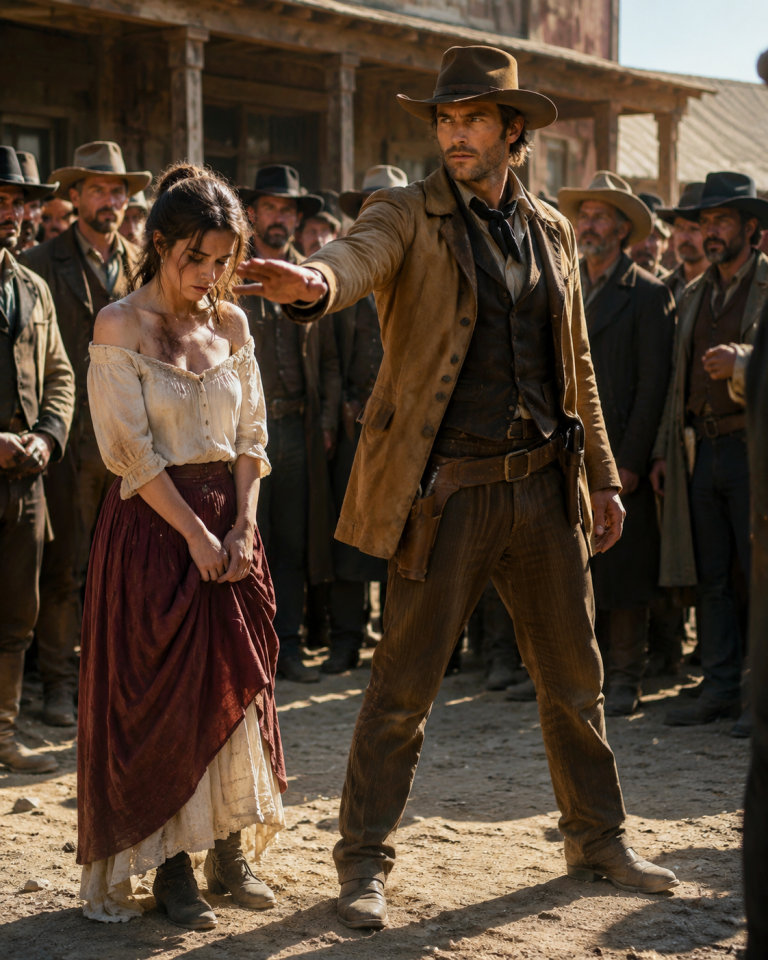
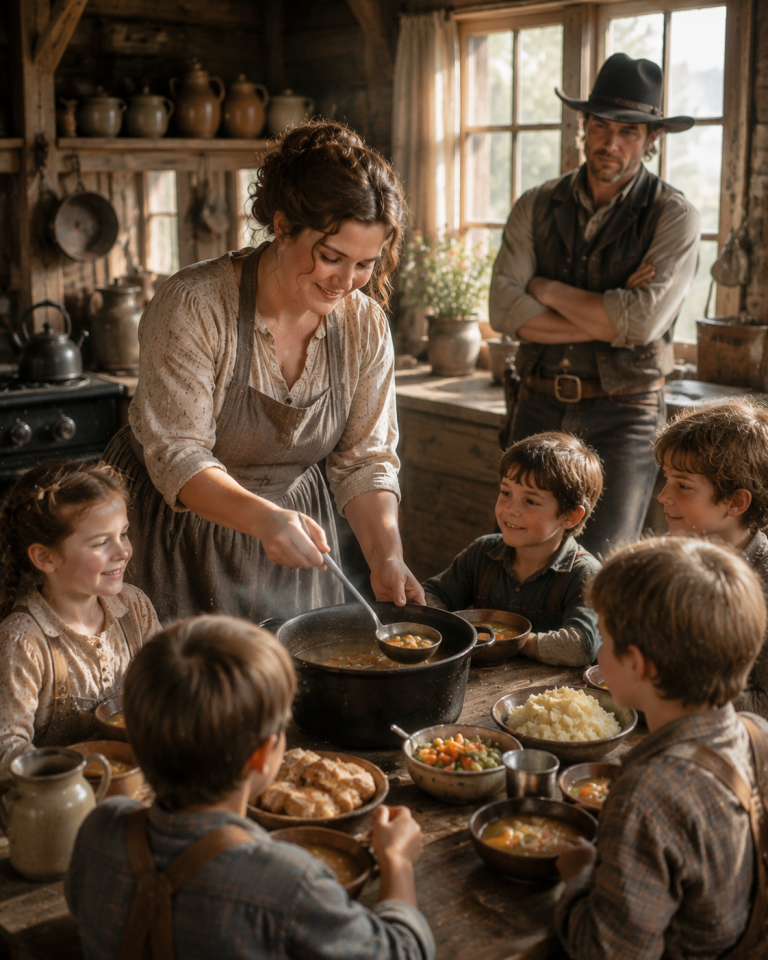
She Married the Cowboy Everyone Rejected—But on Her Worst Night, She Found Him Hiding a Cradle He’d Built for a Child That Wasn’t Yet Born.

His kiss was careful at first, almost reverent, as if he feared she might disappear like the others. Catherine did not. She leaned into him, holding not to the scar or the silence, but to the man she had learned piece by piece.
Three months later, Stone Creek Ranch looked like a different world. The new barn stood strong. The garden bloomed. Rugs warmed the floors. Curtains moved in the windows. The parlor held books and flowers. The dining room hosted ranch hands on Sundays when Catherine insisted a full table did more for morale than solitude.
Pictures returned to the walls. Not only family portraits, but also one small framed sketch of the ranch before the storm, and later, a photograph taken in Denver: James seated stiffly, Catherine beside him, one hand resting lightly on his shoulder, both of them looking far too serious until one noticed the softness in their eyes.
One evening, as sunset poured gold over the valley, James stood behind Catherine on the wraparound porch and wrapped one arm around her waist. Below them, cattle grazed. Horses moved along the fence line. The house behind them glowed warm in the windows.
“Do you regret it?” he asked.
“Answering the advertisement?”
“Yes.”
She looked over the land, over the home that had once seemed hollow and now hummed with life.
“James Stone, it was the best decision I ever made.”
His hand tightened gently at her waist.
“You were the miracle I did not expect.”
She smiled.
“I was practical, remember?”
“A practical miracle, then.”
She laughed, and the sound moved through the porch, through the open door, through the house that had once held only silence.
Years later, people still told versions of the story.
Some said Catherine had been brave. Others said desperate. Some said James had finally found a wife strong enough to survive him.
Catherine would roll her eyes whenever she heard it.
The truth was quieter.
She had not survived him. She had met him.
Not as savior and rescued woman. Not as master and housekeeper. Not as cold husband and practical wife.
But as two people shaped by loss who found, in each other, not a cure for the past but a reason to stop living inside it.
The other brides had run from a house filled with silence.
Catherine walked into that same silence and opened the windows.
She did not fix James by loving him. Love is not a doctor, and grief is not an illness a woman can wash from the walls with enough soap and patience. But love can make room for truth. It can sit at the table long enough for shame to speak. It can say, I am not leaving today, and then prove it again tomorrow.
What began as an advertisement for a practical wife became a partnership neither of them had dared to imagine.
A ranch saved from the bank. A house saved from emptiness. A man saved from becoming nothing but his wounds. A woman saved from believing survival was the same as living.
And every spring, when the garden bloomed and the impossible tomatoes ripened red, Catherine would stand beside James beneath the Montana sky and remember the question that had followed her from Cedar Falls.
What kind of woman walks toward a marriage every other bride ran away from?
The answer was simple: the kind who has already lost everything except courage. The kind who knows fear is not always a warning to turn back. Sometimes fear is only the gate you pass through on the way home.