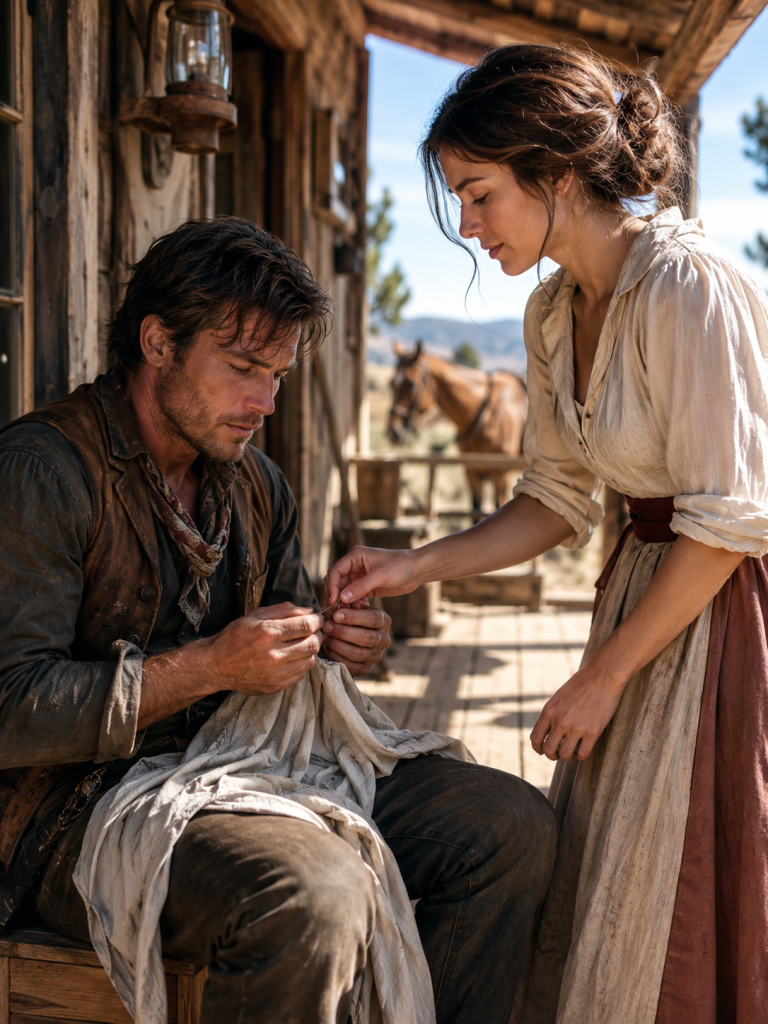
AT 43, SHE WAS “TOO OLD” FOR EVERY FRONTIER PLACEMENT — THEN THEY SENT HER TO THE RANCH THREE WOMEN HAD ALREADY REFUSED

—
PART 1
The coffee burned before dawn, and Nola Vance took it as a warning she should have listened to.
She stood in the staging house kitchen watching the blackened pot while younger, prettier women packed for their own journeys west — the kind men actually sent for. Nola was forty-three, with hands that looked like they’d fought every year twice, and a face that had forgotten how to arrange itself into anything soft.
Mrs. Talbott appeared in the doorway holding a telegram, not quite meeting her eyes.
“You’re going to Hollow Creek. Cattleman named Hale. Three children. Wife died in February.”
“What’s he paying?”
“Room, board, and thirty dollars monthly, if you last through harvest.”
Nola folded the telegram without reading it. She’d heard that tone before — the one that meant she was going somewhere other women had already refused.
“What aren’t you telling me?”
Mrs. Talbott finally looked at her.
“One woman quit after four days. Said the place was cursed. Two others heard the same stories on the road and turned back before they even reached it.”
“Why?”
“Because it’s dying, Miss Vance. The ranch, the man, all of it. His wife wasted away over six months while he watched. Now he’s trying to hold three babies and a falling-down spread together with nothing left in the tank. Most folks think he should just sell.”
Nola picked up her bag. Forty-three years of living, and it all fit in one carpet bag with room to spare.
“When’s the stage?”
Behind her, as she walked into the pre-dawn dark, she heard Mrs. Talbott’s voice carry to another woman.
“Thank the Lord that one’s finally off our hands. Nobody wants a woman that old unless they’re desperate.”
She kept walking.
—
The stage rattled across country that looked like creation had given up halfway through. At a relay station, an old man with one eye and tobacco stains in his beard studied her over cornbread that tasted like flour and broken promises.
“You heading to Hollow Creek? You’re either brave or stupid. Hale’s a hard man, always was, but since his wife died he’s gone somewhere else entirely. Doesn’t talk. Barely eats. The kids are half wild.” He shook his head. “Vernon Crow’s been circling like a buzzard, waiting to buy the land for nothing once Hale finally breaks.”
“Sounds like he needs help.”
The old man laughed, sharp and bitter.
“What he needs is a miracle.”
—
They reached Hollow Creek just before sunset on the third day. The house sat alone against the horizon, two stories, a porch sagging on one side, dust settled over everything the way dust settles when people have stopped caring.
Garrick Hale stepped onto the porch. Younger than she expected — maybe thirty-five, lean in the way men get when they forget to eat, dark hair needing a cut, a face like carved stone. His eyes were the worst part. Not sad. Not angry.
Empty.
“You’re the woman from the agency?”
“Nola Vance.”
“How old are you?”
“Old enough to know that’s a rude question.”
His jaw tightened. “I requested someone young. Someone who could keep up with three children and ranch work.”
“I can keep up.”
“You look like you’ve been keeping up with hard luck and not much else.”
Nola set her bag down, deliberate.
“Mr. Hale, I’ve traveled three days to get here. I’m tired, I’m hungry, and I don’t particularly care what you think I look like. You need help. I need work. We can stand here insulting each other, or you can show me where the kitchen is.”
For a moment, she thought he might tell her to get back on the stage.
Then a child’s cry came from inside — thin, weak, desperate.
Garrick’s face cracked, like the sound physically hurt him.
“That’s Weston. The baby. Sick a week now.”
“Have you called a doctor?”
“Doctor won’t come out here anymore. Says I owe him too much already.”
Nola picked up her bag and walked past him into the house.
—
The inside smelled like old grief and older dust. A little girl stood in the hallway, maybe five, blonde hair tangled, dress too small.
“Who are you?” she whispered.
“My name’s Nola. What’s yours?”
“Clara.”
Upstairs, the baby lay in a cradle, face flushed with fever, crying gone hoarse. A boy — maybe ten — sat on the floor beside the cradle, staring at nothing.
“You must be Eli.”
He looked up. His father’s eyes. Empty in the same way.
“Are you the new woman?”
“I am.”
“The last one left because Papa yelled at her.”
“Did she deserve it?”
Eli shrugged. “She kept trying to throw away Mama’s things.”
Nola knelt and touched the baby’s forehead. Burning.
“When did he eat last?”
“This morning. Won’t take milk anymore. Just cries.”
She turned to find Garrick in the doorway, watching.
“He needs water, not milk. His fever’s too high. When did you last change him?”
Garrick’s face went tight. “I’ve been managing the cattle.”
“Eli’s a child. This baby needs an adult.”
“I know that.”
“Then act like it.”
Real anger flashed across his face. Then it died, leaving only exhaustion.
“I don’t know what I’m doing,” he said quietly. “I’ve been trying, but I don’t know what I’m doing anymore.”
Nola looked at him — really looked. A man trying to outrun grief by working himself into the ground. Someone who’d forgotten how to ask for help because asking meant admitting he was drowning.
She’d seen that face in the mirror plenty of times.
“Go take care of your cattle,” she said, not unkindly. “I’ll take care of your children.”
—
PART 2
She worked through the night.
Boiled water, cooled it, got sips into the baby with a clean rag, changed him, wrapped him fresh. His fever broke near midnight. Then Clara — thin stew coaxed into a girl who’d been living on bread and water for days.
Eli was harder. He sat in the corner watching her with those empty eyes.
“You should eat something.”
“I’m not hungry.”
“You look hungry.”
“I said I’m not.”
She filled a bowl and set it in front of him anyway. “Suit yourself. It’s there if you change your mind.”
Twenty minutes later, the bowl was empty. He didn’t say anything, just took it to the sink and went upstairs.
Near dawn, Garrick came back inside and stopped in the doorway. Clean kitchen. Lit stove. Coffee brewing. Nola kneading bread dough, hands moving in a rhythm they knew by heart.
“How’s Weston?”
“Fever broke. He’s sleeping.”
Garrick pulled out a chair and sat down heavily, a man who’d been carrying a mountain and finally realized he could set it down.
“I’m sorry,” he said. “For what I said when you arrived. That wasn’t fair.”
“No, it wasn’t.”
“The agency told me they were sending someone younger.”
“The agency sends whoever’s willing to come. I was willing. Nobody else was.”
“Why?”
Nola shaped the dough into a loaf.
“Because I’ve been where your children are. I know what it’s like when the adults stop fighting. When you’re little and you realize nobody’s coming to save you.”
“You think I’ve stopped fighting?”
“Haven’t you?”
Garrick looked at her across the kitchen. Something almost alive moved behind his eyes.
“My wife died in this house. In the bedroom upstairs. I watched her fade a little more every day. By the end she didn’t even know who I was.” He stopped, jaw working. “After she died, I kept thinking if I just worked hard enough, I could make everything normal again. But it doesn’t work that way, does it?”
“No, it doesn’t.”
“So what do I do?”
She poured two cups of coffee and set one in front of him.
“You get up tomorrow and try again.”
“And the day after that?”
“And the day after that. You keep trying until one morning you wake up and realize you’re not trying anymore. You’re just living.”
“And if I can’t?”
“Then you let me help you.”
—
Word spread fast. In town, Nola felt every conversation stop when she walked into Porter’s General Store.
“That’s her?”
“She’s older than I thought.”
“Maybe she’s cheaper than a wife.”
Nola didn’t turn around. She’d heard worse. But when Porter set the supplies on the counter, she made sure her voice carried.
“Mr. Hale hired me because I know how to work. If that bothers people, they’re welcome to mind their own business.”
On the ride home, Eli sat beside her.
“People talk about us,” he said quietly.
“Let them.”
“They think Papa’s going to lose the ranch.”
“What do you think?”
He looked at the reins in his hands. “I think Mama dying broke something in him. And I don’t know if it can get fixed.”
“Maybe it can’t. That doesn’t mean he’s finished.”
“How do you know?”
“Because he got up this morning. And he’ll get up tomorrow. As long as he keeps doing that, there’s still a chance.”
But getting up wasn’t enough. By the second week, Nola found the ledger — feed deliveries charged for three tons but only two delivered, three times running, always signed off by the same hand.
“Someone’s cheating you,” she told Garrick that night, “and I’m saying you’re too tired to notice.”
His face went hard.
“Get out.”
She left before he could see her flinch. That night, lying awake, she heard footsteps on the stairs before dawn.
“You’re right,” Garrick said, standing in the kitchen doorway, looking like he hadn’t slept. “Someone’s been stealing from me. I need help figuring out who.”
—
PART 3
They worked through the records together until a pattern emerged. Dale Riggins — Garrick’s foreman, five years trusted, every shorted delivery bearing his countersignature.
“He was at my wife’s funeral,” Garrick said quietly. “Stood there with his hat in his hands and told me if I needed anything, all I had to do was ask.”
The confrontation happened three days later in the barn. Nola watched from the house, Clara’s hand in hers, the little girl pressing her face to the window. Voices rose. Something crashed. Dale stormed out, face twisted, Garrick’s knuckles bleeding behind him.
“You’re finished, Hale,” Dale spat. “Vernon Crow’s been paying me two years to make sure of it. Feed short, fences weak, whatever it took. Now he won’t even need me anymore.”
He rode off before Garrick could process what he’d just admitted. Garrick stood breathing hard.
“Crow’s been inside my own house this whole time,” he said. “Through Dale.”
“Then we remember that name,” Nola said. “Because it’s the first real thread back to him.”
—
That night, lightning split the sky. Rain hammered the roof, and somewhere in the darkness, cattle screamed.
Fire — lightning strike in the northern fields, spreading fast through drought-brittle grass, racing toward the barn.
“Get your brother and sister into the cellar,” Nola told Eli, then ran out into the storm.
Ranch hands beat flames with wet blankets. Not enough. The fire was jumping fences, moving toward the open pasture that stood between it and the barn. Nola grabbed a ranch hand.
“Where’s the blasting powder? The stump powder.”
“Tool shed, but—”
She was already running. Not toward the fire — ahead of it, to the strip of open pasture the flames hadn’t reached yet. Hands shaking, she set the charges along a line in the dry grass and lit the fuses, then ran clear.
The blast tore a raw brown scar through the pasture — grass, roots, topsoil, gone in an instant, nothing left for the fire to cross. The flames reached the gap and died there, starved, hissing out in the rain.
Garrick found her on her knees at the edge of the crater, staring at the smoking line she’d cut.
“You just saved the barn.”
“I just blew a hole in your pasture.”
“It’s a hole I can replant. The barn I couldn’t.”
He laughed — not a happy sound, something raw and human.
“You’re the most stubborn woman I’ve ever met.”
“Good. You need stubborn.”
—
**THE PERMIT**
After that night, things shifted between them. Small things — coffee left in the mornings, her opinion asked on ranch decisions. But Vernon Crow arrived days later with an offer wrapped in poison.
“Five thousand for the land, livestock, buildings,” Crow said, smiling like a man who already owned everything he looked at.
“The land alone is worth ten times that.”
“Not anymore. Not with your reputation. People are saying you’re unstable.” Crow’s eyes slid to Nola. “That woman you hired — a widower and an older spinster alone out here? It doesn’t look good.”
He left them with an ultimatum. Then, days later, he came back with something worse — a federal document claiming Garrick’s western section, the one with the freshwater spring Nola had found while walking the property, sat across a federal boundary line, redrawn the year before.
“Sell to me now,” Crow said, “and I’ll make sure the federal agent overlooks this little permit issue. Refuse, and I’ll have the marshal out here by tomorrow.”
Garrick’s hands curled into fists. Nola grabbed his arm before he could swing.
Later, spreading the document flat on the kitchen table, she found what she was looking for — a filing date, and a witness signature at the bottom.
“This clerk,” she said, tapping the name. “Porter mentioned him last month. Said he passed of fever back in the spring.”
“You’re saying it’s a forgery.”
“I’m saying a dead man can’t witness a document filed in June.”
—
**THE RECORDS**
They rode to Redemption together the next morning. At the federal land office, Nola requested the original boundary survey as public record — no break-in required, just her name, her patience, and a clerk who owed nobody in Crow’s pocket a favor.
Eli came with them, and it was Eli, waiting by the counter, who spotted it — the old deed his mother had kept in her desk drawer, survey number scrawled in the margin in her own hand, a number that matched nothing on Crow’s map but matched the original filing exactly.
“Mama wrote this down,” he said, staring at it. “Why would she write down a survey number?”
“Because good ranchers keep their own records,” Nola said. “In case somebody ever tried exactly this.”
The clerk pulled the true map from the archive. Garrick’s western section sat entirely on his own land. The boundary Crow had claimed didn’t exist anywhere in the federal record — only in the document he’d carried to Hollow Creek himself.
“He lied,” Garrick said. “The bastard completely lied. And he had it filed with a dead man’s name on it.”
“Now we prove it,” Nola said.
—
That proof came at a cost. Three nights later, riders came in the dark, cutting corral fences, scattering the mustangs they’d spent weeks breaking, firing on the house.
“Get down there and don’t come up until I say,” Nola told the children, then grabbed the shotgun by the door — never fired one, but she’d seen it done.
She stepped onto the porch and fired into the storm, missing everything, but scattering the men close enough. Then she found Crow, watching his hired thugs from the tree line, satisfied.
“Call them off.”
“Or what? You’ll shoot me?”
She fired at the ground near his horse instead. It bolted, throwing him into the dirt. His men saw their boss go down and hesitated — long enough for Garrick to grab a dropped rifle and fire a warning shot into the air.
The riders scattered into the storm.
—
**THE TRAP**
Marshal Pike’s investigation stalled — Crow had witnesses and a story that made Garrick look unstable. Only the arrival of a lawyer named Nathan Reeves, already building a fraud case against Crow across three territories, gave them a path forward. Reeves had been chasing the same forged-signature pattern for months, and Dale’s name, once Nola gave it to him, closed a gap he’d been missing.
“Riggins signed for payments from a man named Crow,” Reeves said, laying out a bank ledger he’d subpoenaed. “Two years of them. That connects your foreman directly to the man trying to take your land. Combined with the forged boundary filing, that’s enough for fraud and conspiracy charges — if we can get him to say it himself, on the record.”
“How do we make him say it?”
“We let him think he’s already won.”
They let Crow believe Garrick was ready to sell. He came alone, arrogant, offering four thousand dollars for land worth fifteen.
“Four thousand. Take it or leave it.”
“And the men who cut my fences,” Garrick said. “The fire in the corral. You had nothing to do with that?”
“I was nowhere near here that night.”
“You made sure of that, didn’t you,” Garrick said. “Same as you made sure Dale kept my feed short for two years. Same as you had that boundary filed under a dead man’s name.”
Crow’s smile didn’t waver. “You should have taken the five thousand when I first offered it. After Riggins choked off your feed and my riders opened those corrals, I thought even you’d understand the ranch was finished. Instead you found yourself a lawyer.” He shrugged, easy, careless with a man he still believed was beaten. “Filing under Whitfield’s name was Riggins’ idea, if you want the truth. Man was already dead. Wasn’t going to complain.”
The barn door opened. Reeves stepped out with a stenographer and Marshal Pike.
Crow’s face went white, then red. “This is entrapment.”
“This is a signed confession to fraud, forgery, and conspiracy, witnessed and recorded,” Reeves said. “The federal prosecutor is going to love this.”
Pike stepped forward with handcuffs.
“Vernon Crow, you’re under arrest.”
Crow looked at Garrick with pure hatred. “This isn’t over.”
“Yes,” Garrick said quietly. “It is.”
—
**THE DEBT**
Victory was short-lived. Three days later, Marcus Webb — the saloon owner who’d loaned them five hundred dollars to cover Sarah’s medicine — arrived to collect a payment they hadn’t known was due, buried in the fine print of the loan.
“The missed payment, plus penalties and interest, comes to five hundred forty-seven dollars,” Webb said. “Cure the default within ninety days, or the western section becomes mine as collateral. The rest of the principal — three hundred dollars — stays on the original schedule regardless.”
Garrick signed, defeated, and Nola’s anger finally broke loose once Webb had gone.
“Every time we hit a wall, you give up. I’m tired of it.”
“I’m being realistic.”
“No. You’re being a coward.”
The word hit him like a slap.
“I don’t know how to keep fighting,” he said, quiet now. “I’m tired. I’m so tired.”
Her anger drained away. “Then let me fight for a while. You don’t have to carry everything alone.”
“Why do you care so much?”
“Because you’re not the only one who found something worth fighting for.”
She kissed him — not planned, not romantic, just two people who’d survived hell together, finally admitting what had been building for months.
—
**THE NINETY DAYS**
They sold horses. Garrick broke mustangs faster than was safe, got thrown twice, split his eyebrow open. Then his leg — a prairie dog hole, a fall, the bone bending under him at an angle that turned his stomach before it had even finished breaking. Closed fracture, no wound, but bad enough that he couldn’t stand. Nola splinted it as best she knew how, packed the leg tight between two fence boards, and kept him still until the doctor could ride out three days later and confirm she’d set it straight enough to heal clean.
With Garrick bedridden, the ninety days kept shrinking, and they were still twenty dollars short with two weeks left.
Clara found her in the kitchen, holding a cloth-wrapped box.
“It was Mama’s,” the girl whispered. “She kept it hidden under the floorboard. For emergencies. She told me not to tell Papa unless we really needed it.”
Coins. Almost thirty dollars.
“Family takes care of family,” Clara said, tears running. “Will it be enough?”
“I don’t know yet. But it helps. It helps a lot.”
Garrick’s hands shook when Nola showed him. “Sarah saved this?”
“She never told you. Maybe she wanted to make sure there was something left for the children, no matter what happened.”
“I miss her,” he said, pressing his hands to his eyes. “I still miss her.”
“Of course you do. That doesn’t change just because you’re moving forward.”
—
Still ten dollars short. Nola rode to Redemption, asking merchants for help and finding only sympathy that didn’t pay bills. Eli, riding beside her, offered a different idea.
“Maybe we’re asking the wrong people. Maybe we should ask someone who understands what it’s like to have nothing.”
They rode thirty miles south to a settlement barely more than tents and rough shacks. A young woman named Beth Carver listened to the whole story without interrupting, then turned to the other families.
“How much can we spare?”
Coins. A crumpled bill. A woman’s silver necklace — the only thing of value she owned.
“My mama gave me this,” she said. “But she’d understand.”
Seven dollars and sixty cents, collected in a hat, pressed into Nola’s hands.
“Take it,” Beth said. “And when you get that spring secure, you remember that we helped.”
Still short. But on the ride back through Redemption, Nathan Reeves found her outside the hotel and pressed the remaining amount into her hand without being asked.
“Without your testimony, I couldn’t have touched Crow,” he said. “Consider it payment. Next time you see someone who needs help, you pass it along.”
She rode home with the money clutched tight, afraid to let go in case it disappeared. Garrick was waiting on the porch, splinted leg propped up, refusing to stay in bed.
“We have it,” she said. “Every penny.”
He reached for her hand instead of standing.
“I don’t know what I’d do without you.”
“Good thing you won’t have to find out.”
—
Webb arrived exactly on schedule, counted the envelope twice like he didn’t believe it, and tore the collateral contract in half.
“The default’s cured,” he said. “Your land’s clear. The three hundred on the original loan still stands — monthly payments, next year, same as before.”
Garrick nodded, steadier than he’d been in months. “We’ll manage it.”
After Webb left, Garrick sat on the porch step, working up to something.
“I want to marry you,” he said suddenly.
Nola blinked. “What?”
“I want to marry you, properly. Because I love you and I can’t imagine doing any of this without you.”
“You don’t have a ring.”
“I’ll carve one out of wood if I have to.” He reached for her hands. “Say yes.”
She looked at him — the man who’d been drowning when she arrived, finally learning to swim.
“Yes.”
—
They married two weeks later in the front room, Marshal Pike making it legal, Porter and his wife as witnesses, the children watching with serious faces. Garrick had carved a ring from oak, simple and imperfect and sturdy — it fit her finger like it had been made for her, because it had.
“Thank you,” he whispered, after.
“For what?”
“For not leaving.”
—
**AFTER**
Eight months of payments to Webb, every single one on time. On his visits to collect them, Webb started staying for coffee — watched Nola send free water to families the drought had broken, watched the payments arrive without fail even the month the well pump cracked. By the ninth month, unannounced, he showed up with a document that forgave the remaining balance entirely.
“I’ve been in the business of profiting off people’s worst years for a long time,” he said, setting the paper on the table. “Watching you two pay me back while giving half of what you had left to strangers made me tired of it. Sign this. We’re done.”
Garrick signed with shaking hands. “We’re free.”
The ranch grew slowly after that — not explosively, just steady, built on hard work and a reputation for fairness. When the drought worsened and every other well in the territory ran dry, Hollow Creek Spring kept flowing, and Garrick and Nola never price-gouged the desperate. They charged fair rates. They helped when they could.
Five years in, Nola sat on the porch with Garrick, watching the sunset the way they had a hundred times before.
“Do you ever regret any of it?” she asked.
“Not even the worst parts. Because all of it led here. To this. To us.”
“Even when I was impossible?”
“Especially then.” He reached for her hand. “Impossible is just another word for worth fighting for.”
—
**LATER**
Garrick died at seventy-two, mending fence, quick and relatively painless. Nola buried him beside his first wife, the way he’d asked, and put up a headstone that read: *Garrick Hale. He learned how to live again.*
She lived eight years more — long enough to see grandchildren grow, long enough to know that everything they’d built would outlast them both.
When her own time came, she died in the ranch house, in the room she’d shared with Garrick, surrounded by family who loved her not because they had to, but because she’d earned it.
They buried her between Garrick and the garden she’d planted forty years before.
Her headstone read simply:
*Nola Hale. The woman who stayed.*
The ranch survived them both — stayed in the family for generations, became the kind of place people pointed to when they talked about what was possible on the frontier if you were willing to work for it.
And on quiet evenings, when the wind moved through the valley just right, people still said you could feel them there.
The stubborn cattleman who’d learned to hope again.
And the woman nobody wanted — who proved that wanting was never the point.
Worth was.
THE END