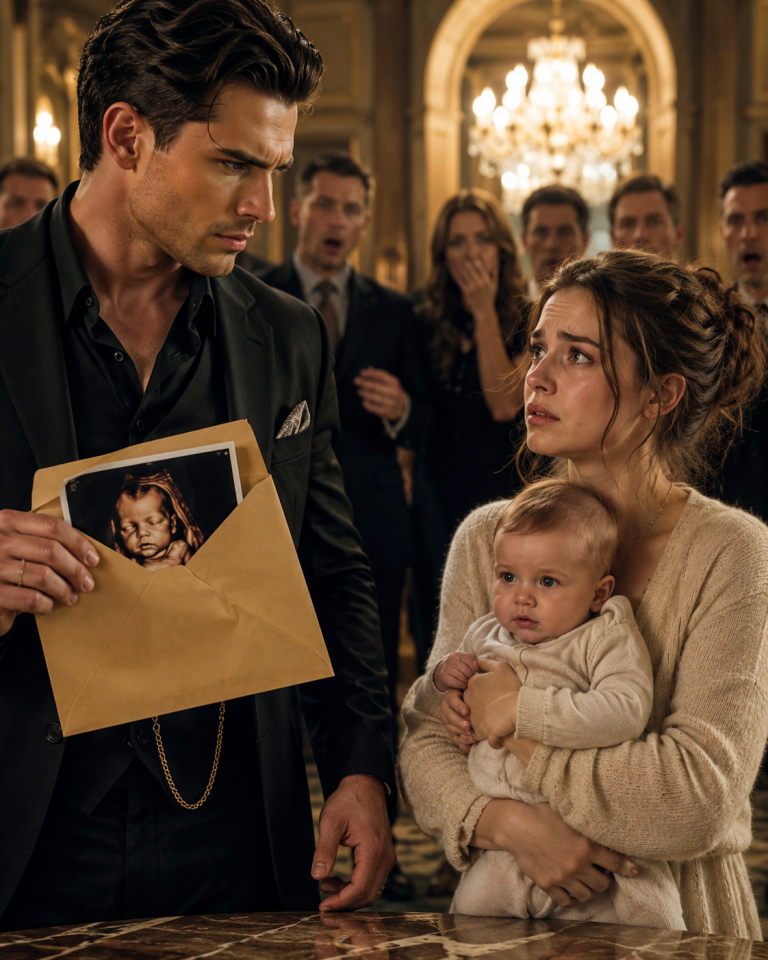
She Lent Her Coat to the Mafia Boss’s Shivering Daughter—Then He Showed Up and Reacted

## PART 1
My mother used to say the coat was ugly enough to repel bad luck.
She meant it affectionately. It was mustard yellow, thrift-store bright, missing one button at the third clasp, frayed at both cuffs from two Chicago winters of hard use. I bought it for eleven dollars on a day when eleven dollars felt reckless. But warmth, in my family, was never a luxury you weighed against appearance. Warmth was the point.
After she died, the coat became the last warm thing I owned that had ever touched her hands.
She had worn it once, the December before the diagnosis, when I forgot mine on a shift and she brought it to the diner in the middle of a snowstorm, walking four blocks in sleet to make sure I wasn’t cold. She handed it through the service door with the focused expression she always had when delivering something she considered non-negotiable, and said, “You cannot serve people with frozen hands.”
I kept working through that memory on the walk home. Three miles. The number 22 bus had stopped running its later routes by then, and a rideshare would have cost me what I needed for tomorrow’s groceries. My feet had gone past hurting into that particular numbness that sets in around the sixth hour of a double shift. The night was the kind of Chicago cold that doesn’t ask permission — it simply enters every layer you have and makes itself at home.
I pulled the coat tighter and thought about my mother.
I thought about her bill from Northwestern Memorial, which I had opened three months after she died and which had been sitting in my kitchen drawer since because opening it on the counter made the number visible and visible numbers at the end of a fourteen-hour shift had a way of becoming the last thing you thought about before sleep.
I took the shortcut behind Garfield Pharmacy.
Every waitress at Lena’s Diner knew not to take that alley.
We all took it anyway when our legs had run out of argument.
The shortcut was dark and narrow, dumpsters on one side, a fire escape rattling above, the wet smell of old brick and standing water that had been there longer than the buildings. I walked quickly, head down, heels sliding on the crust of ice along the center of the lane.
Then I heard the sound.
My first thought was an animal — something small, caught under a crate or behind a bin.
I stopped.
Breath white in front of me.
The sound came again.
Not a bird. Not a cat.
A sob.
Small. Thin. Barely holding together.
My body understood before my mind finished the sentence.
I stepped past the first dumpster.
Past the second.
Behind the third, half-hidden between a broken wooden pallet and the building’s back wall, I found her.
A little girl.
Six years old, maybe seven. Wearing a velvet dress — dark, expensive, the kind a child wears to a formal occasion — soaked through, useless against the cold. No coat. No hat. One black Mary Jane shoe. Her other foot bare, the toes the color of wax. Her dark hair plastered to her cheeks in wet ropes. Her lips a pale, frightening blue.
“Hey.” I was already on my knees before I’d decided to stop walking. Slush soaked through my jeans instantly. “Hey, look at me. Can you hear me?”
Her eyes opened. Dark brown. Wide with something that was trying to be hope and barely making it.
“I got lost,” she whispered.
“What’s your name?”
“Sofia.”
“Okay, Sofia. I’m Nadia. Can you tell me where your parents are?”
She shook her head. Her teeth were chattering so hard the sound was audible.
“Bad men chased my driver,” she said. “I ran.”
Three words that told me more than I wanted to know.
Driver. Bad men. The velvet dress. The quality of the hair ribbon coming loose from her curls.
This child was not from anyone’s block. She was from a world I had spent my whole working life adjacent to without ever crossing into — the kind of money that moved through Chicago as its own weather, that had its own rules and its own consequences, and whose children did not get lost in alleys without something very serious having occurred upstream.
But serious could wait.
Hypothermia could not.
I touched her face. The cold in her skin was the specific quality of something urgent.
Without thinking past the next ten seconds, I took off the mustard coat.
The winter hit me like a wall falling. The cold arrived in my chest before it arrived in my skin, and for a moment I could not breathe. My thin diner uniform and the worn cardigan beneath it offered nothing. My body convulsed.
I wrapped the coat around Sofia anyway.
I tucked it under her chin, pressed it around her shoulders, rubbed her arms through the heavy wool.
She leaned into it immediately, pressing her face into the collar, and some of the blue left her lips.
“Listen to me,” I said. “I’m going to get help. The main road is right there — a minute, maybe two. I’ll find police or an ambulance. I will come back. Stay inside the coat. Don’t move.”
She looked at me.
“Promise?”
“I promise,” I said.
Then I stood and ran.
The alley came apart around me in patches. The cold burned through my sleeves and up my arms and into my lungs. My shoe hit ice near the mouth of the alley and I went down hard on one knee, pain cracking up my leg, and I got up because there was no alternative and kept running.
I reached the street waving both arms at nothing.
No one.
Then a patrol car turned the corner.
I ran into its headlights.
The officers followed me back. I ran ahead, pointing past the dumpsters. “She was right here. I gave her my coat. She was—”
The space behind the third dumpster was empty.
Snow. Disturbed. Heavy boot prints. The velvet hair ribbon lying in the slush like evidence of something I could no longer prove.
“She was right here,” I said. My voice came out wrong. “Her name is Sofia. Dark curls. Velvet dress. She said men had chased her driver.”
The officers exchanged a look.
I knew what that look meant.
Waitress. Middle of the night. Coatless, shaking, no corroborating evidence.
They took my statement. Name. Address. Place of employment. The information traveled into a form where it would likely expire without being read. They drove away with the hair ribbon, telling me they would follow up.
I walked home.
Three miles coatless in below-freezing wind.
By the time I reached my building and climbed three flights to my apartment and got my key into the lock, my hands had stopped sending information to my brain about what they were doing. I sat on the edge of my bed and shook until something inside me ran out of the energy to shake, and then I lay down still dressed because undressing required more coordination than I had left.
In the dark, I thought about Sofia’s blue lips turning pink again inside the mustard wool.
I thought about my mother’s eleven-dollar coat, now somewhere in the hands of men who moved through the city without leaving names.
Across the city, Sofia Vieri was already safe.
I didn’t know that.
I didn’t know that forty minutes after I stopped waving at the patrol car, a fleet of black SUVs had located her in a staging area off Wentworth and returned her to the kind of household that had a private physician and a security wing.
I didn’t know that the man currently standing in a paneled study overlooking Lake Michigan, drinking bourbon he would not taste, had been awake for six hours and had sent more than forty men into Chicago’s streets on one instruction: find my daughter.
I didn’t know his name.
I would know it in two days.
And by then, the knowing would cost me everything.
—
## PART 2
Marco Vieri was not, in the ordinary sense, afraid of anything.
He had built his life on the specific immunity that comes from becoming the thing other people fear. He moved through Chicago understood to be its own category of consequence. Men did not raise their voices around him. Women at charity events spoke carefully. Politicians returned his calls. Enemies planned carefully and still usually miscalculated.
None of that mattered at 3:00 a.m. with Sofia missing.
He had been a father longer than he had been afraid of anything.
Ciro brought the news at 4:40.
“She’s home, boss. Medical wing. Alive.”
The bourbon glass hit the floor before Marco understood his hand had released it.
He ran.
Sofia, pale against the clinic sheets, looked impossibly small and completely whole. He held her for a long time without speaking, face pressed into her damp hair, feeling the steadiness of her breathing like a correction to everything that had gone wrong in the last six hours.
Then he saw the coat.
Mustard yellow.
Too large for her.
Worn at the cuffs.
Wrapped around his daughter like a second body.
Marco eased back.
“Where did this come from?”
Sofia looked down at the coat.
“An angel,” she said. “She found me in the alley. She took off her own coat and gave it to me. Then she ran to get the police.”
Marco was quiet for a moment.
Angels, in his experience, were the cover story for people who wanted something.
He removed the coat carefully and searched it: seams, collar, lining, pockets. A receipt from a laundromat. A punch card from a diner on the west side. A name written in ink that had gone soft.
N. Reyes.
“Ciro,” he said.
His underboss appeared in the doorway.
“Find Nadia Reyes.”
Sofia grabbed his sleeve.
“Papa. She helped me.”
Marco looked at his daughter’s face.
Then at the coat in his hands.
“I know, sweetheart,” he said. “I just want to understand why.”
What he meant was: I don’t trust kindness without motive.
What he should have meant was something else entirely.
But Marco Vieri had not yet learned that lesson.
He would learn it in two days. He would learn it the hard way. And the tuition would be shame he could not easily discharge.
He arrived at Nadia’s apartment building at 2:00 a.m.
Six men.
Himself.
The door came off with one kick.
Nadia came upright screaming, sick and disoriented, barely able to stand. She was pale, shaking, running a fever she hadn’t had resources to treat. The apartment was small and cold and contained the specific inventory of a person who had very little and organized what they had with great care.
She was not what he expected.
He had expected calculation behind the eyes.
He found fever. Exhaustion. Terror. And beneath all of it, the slow burn of someone who had been afraid before and had decided a long time ago not to let it win.
He dropped the coat at her feet.
He raised the gun.
And she looked at the barrel and said, “Is she safe? Thank God. I came back with police, but she was already gone. I thought—”
“Save the performance,” he said.
Something in her face changed.
She looked at the gun.
Then at him.
And she said, more quietly than he deserved: “I found a freezing little girl. I gave her my coat. I ran for help and she was gone when I came back.”
“You expect me to believe that’s all?”
“I don’t expect anything from you,” she said. “I don’t know who you are.”
He moved closer.
“Why did you help her?”
The quiet of the question was its own kind of pressure.
She met it.
“Because she was a child,” Nadia said. “Because her lips were turning blue. Because nobody was coming.” She looked at him with the steadiness of someone who has made peace with very bad outcomes. “Because I used to have a mother who would have wanted someone to stop.”
The room was still.
Marco searched her face for the lie that would make the gun make sense.
He did not find one.
He found grief.
He found poverty.
He found a woman who was genuinely sick and genuinely cold and genuinely telling the truth.
His pride would not let him lower the gun first.
“Search everything,” he said.
His men went through her apartment in twenty minutes.
They left it the way men who are looking for evidence always leave the spaces of people who have very little: turned over. Scattered. Broken in ways that seem incidental but cost the most to someone who has only a few things to break.
Her mother’s photographs on the floor. Medical bills stepped on. A coffee mug — her last decent one — cracked at the handle.
“Nothing, boss,” Ciro said.
Marco looked at Nadia one final time.
“If I find out you lied, there won’t be a door next time.”
He left.
No apology.
No repair.
No coat.
By noon, Nadia’s landlord had delivered a notice.
Armed men. Families in the building. Too much trouble. Thirty days, or sooner if she could manage it.
By two, her boss called before she even reached the diner entrance.
“I can’t have this kind of attention on the restaurant.”
“I didn’t do anything,” she said.
“I’m sorry,” he said.
She stood on the sidewalk outside Lena’s Diner in the cold without a coat, without a job, without the thirty days’ notice that would have been a kindness.
She was already sick.
She was about to get worse.
She packed what she could reach and lay on the stripped bed counting the hours until she would have to start the calculation of where to sleep when she no longer had this floor.
She had given warmth to a child.
The world had taken the rest of hers.
She did not know that across the city, in a sunlit room where everything cost what she earned in a month, Sofia Vieri was asking her father the same question every morning.
*Did you find the angel yet, Papa?*
*Did you give her coat back?*
*She must be cold.*
—
## PART 3
Marco Vieri had built a life on forward motion.
He did not examine his decisions after they were made. Examination was a luxury of men who could afford to second-guess themselves, and Marco had learned early that the empire he had inherited required certainty, or at least the performance of it. Every choice followed by another choice, no gaps, no visible doubt.
He allowed himself one exception.
The file Ciro prepared on Nadia Reyes.
He read it sitting at his desk, alone, at 11:00 at night, four days after the apartment.
Three pages.
Dead mother. Eight months prior. Northwestern Memorial, fourteen months of illness, treatment costs that had cleared out two bank accounts and left Nadia paying structured debt to a hospital that did not care about her grief timeline. Her wages from the diner. Her rent. Her utility schedule. The credit card she had maxed purchasing prescriptions.
Then the additions: eviction notice. Termination. A chest infection she had not been able to treat. A woman with one coat and a fourteen-hour shift and no reason to stop in an alley at three in the morning who had stopped anyway and ended up sleeping on a stripped mattress in an apartment she was losing because he had made her visible to a landlord who did not want complications.
Marco closed the file.
He did not move for a long time.
Ciro knocked and opened the door without waiting, which was his prerogative and usually Marco allowed it.
“Boss.”
Marco looked up.
“She was clean,” Ciro said. “No connection. No associates. Nothing. Ran it again tonight to be sure.”
Marco said nothing.
“She’s packing to move out. No clear destination. The cough is bad. She won’t go to a clinic because the walk without a coat is—”
“Get the car,” Marco said.
Ciro stopped.
“And call Dr. Osei. Have the medical wing prepared.”
“We’re bringing someone in?”
“We’re going to ask someone if she needs help,” Marco said. “And this time, we knock.”
He was almost too late.
He didn’t know that yet.
What he knew, pulling up to the corner of Fifth and Elm at two in the afternoon, was that the address Ciro gave him matched a woman carrying a box to a rusted sedan — a cardboard box, not heavy enough to be furniture, heavy enough to be everything that fit.
He saw Nadia before she saw him.
She moved carefully, the way people move when their body is issuing constant complaints and they have decided to outvote it. The cough had changed her posture. Her face was pale with the specific gray of illness that had gone on longer than it should. She wore two thin layers that accomplished nothing and solved nothing in the wind off the lake.
Across the street, a black town car pulled up in front of a bakery.
Sofia got out.
She wore a white winter coat. Her cheeks had color back.
Nadia stopped walking.
Marco watched her face.
She looked at his daughter and the expression she wore was not bitterness. It was not resentment. It was something closer to relief.
She was glad.
She was genuinely glad the child was alive and warm, even after everything Marco had done.
Then the van came.
Gray. Moving too fast for the street. It clipped the rear of the town car with a sound Marco had heard before — the specific register of intentional impact, nothing accidental about the speed or the angle.
The doors came open.
Masked men poured onto the street.
The bakery windows fractured. His lead bodyguard pushed Sofia behind the armored car door and fired back. His second man went down near the front wheel.
And across the street, Nadia Reyes dropped her box.
She didn’t pause. She didn’t calculate. She had every reason — every legitimate, earned, justified reason — to stay on her side of the street and let Marco Vieri’s world handle Marco Vieri’s problem.
She ran.
Her voice carried over the noise.
“Sofia!”
She crossed the street through the gunfire with the single-minded commitment of someone who has decided the math is simple: a child is in danger and she is close.
She reached Sofia and dragged her down behind the door, covering the girl with her own body, one arm over Sofia’s head, her face against the girl’s hair.
A masked man advancing on their position raised his weapon.
Marco’s SUVs came in hard from both ends of the block.
His men were already moving.
But the calculation in a firefight is always the same: someone fires before someone else arrives.
Marco saw it.
He was already out of the car.
He was not fast enough.
The shot caught Nadia in the shoulder.
She went forward. Her head hit the pavement. Sofia screamed. Marco reached them in four seconds that felt like something he would replay for a long time.
He went to his knees in the street.
Nadia’s face was tilted toward the sky, one arm still across Sofia, her body completing a protection she was no longer conscious to maintain.
“Clara — Nadia.” He pressed both hands to the wound. “Stay with me. You hear me?”
Sofia was crying into his neck.
Nadia’s lips moved.
She was trying to ask whether Sofia was safe.
She lost consciousness before she could ask.
Marco looked at his daughter.
Then at the woman who had covered her with a coat in an alley, and then with her body on a street, after he had destroyed everything he could reach of her life.
He understood something then.
Not in words.
In the specific weight of a debt that cannot be calculated.
Nadia woke in the Vieri estate’s medical wing three days later.
The first thing she noticed was warmth. Real warmth, the kind her apartment had not held since November. Silk sheets. Cream walls. Winter light through tall windows over a snow-covered garden.
For a moment she thought she was somewhere that made no sense.
Then her shoulder told her where she was.
She gasped and tried to sit up.
“Don’t.”
Marco Vieri sat beside the bed.
Jacket off. Sleeves rolled. The kind of tired that lives around the eyes when sleep hasn’t resolved anything.
“The bullet passed through,” he said. “You lost blood. Your lungs had a significant infection. Dr. Osei says you’re fortunate.”
“Sofia—”
“Unharmed.”
His voice changed on the word.
“Because of you.”
Nadia closed her eyes.
Opened them.
“Why am I here?” she said.
“Because you are owed more than I can manage to pay.”
She looked at him.
This was not the man who had come through her door. That man had been certainty wearing a gun. This man was what certainty looks like after it has met something it cannot explain.
“I investigated you,” he said. “After. I should have before, but before I was operating on a different assumption.” He stopped. “I saw the bills. The eviction. The infection. I saw what my visit did.”
Nadia’s jaw tightened.
“Your visit,” she said. “That’s what you’re calling it.”
“No,” he said. “I’m calling it damage. I don’t have a better word.”
She looked at the window.
“I was coming to find you,” he said. “When Cross’s men attacked. I was already in the car.”
“Too late to undo the notice. Too late to undo the job.”
“Yes.”
She looked at him then.
“Why did you run toward Sofia?” he asked. “After everything. Why?”
“Because she is a child,” Nadia said. “She is not your empire. She is not your debts or your enemies or your decisions. She is a child who was frightened and in danger.”
Marco said nothing.
“I didn’t cover her with my body to prove something to you,” Nadia said. “I didn’t do it to earn anything back. I did it because she was scared and I was the person standing there.”
The room was very quiet.
Then Nadia said the thing that nobody who sat in that chair in that room had ever been allowed to say.
“You are dangerous for her.”
Marco’s expression did not change.
“Not to her,” Nadia continued. “Dangerous *for* her. Everything you’ve built exists at the cost of her safety. The attack today wasn’t random. It found her because of who her father is and what that makes her worth to the people who want what he has.”
She watched him absorb it.
“You can love her completely,” Nadia said. “And still be the primary reason she is in danger.”
He stood.
He walked to the window.
He stood there long enough that Nadia thought he might not answer.
Then: “My father built the Vieri organization. I inherited it. I told myself if I controlled enough of the machinery, I could keep it pointed away from her.”
He turned back.
“I was wrong about the direction violence travels.”
He placed a thick envelope on the nightstand.
Nadia looked at it.
She understood what it was without being told.
She thought about the eleven-dollar coat. The laundromat receipt. Her mother walking four blocks in a snowstorm to make sure her daughter wasn’t cold.
She thought about what it would mean to take this envelope.
Not comfort. Not debt paid.
Participation.
“No,” she said.
“Nadia—”
“Whatever’s in that envelope was built on fear and debt and the specific suffering of people you decided were acceptable losses. I won’t take it.”
“It’s not a payment.”
“It’s a way for you to feel forgiven without changing.”
That sentence entered him the way cold water enters a crack — slowly, completely, finding every gap.
“I won’t be purchased,” she said. “I won’t become part of the thing that hurt me. If you want to do right by me, handle the bills you caused. Give me a job when I’m well — a real one, with authority and transparency and none of your money laundered into it. And then look at your daughter and decide whether what you inherited is worth what she costs.”
Marco stared at her.
A woman lying in his medical wing with a bullet wound and an infection and no home to return to.
Refusing his money.
He had met aldermen who sold themselves for introductions. He had watched men of principle negotiate away their principles for considerably less than two million dollars. He had operated for twenty years on the baseline assumption that everyone had a number.
Nadia Reyes did not appear to have a number.
That unsettled him more than anything she had said.
“You are extraordinary,” he said.
“I’m tired,” she replied. “And I have significant opinions about what kind of extraordinary gets you in my situation.”
He sat back down.
“Fair,” he said.
Recovery was not a montage.
It was three weeks of coughing hard enough to pull at the shoulder wound. It was physical therapy that made her jaw ache from not making noise. It was nights where she woke certain she was still on the pavement.
Nadia tried to maintain useful distance from the household. Marco mostly respected it.
Sofia did not.
She appeared every day with books and questions and a drawing she had made of an angel in a yellow coat that she wanted to show Nadia because Nadia was the angel and the coat was the mustard coat and the drawing was very important.
Nadia tried not to love her.
Attempted it sincerely.
Failed completely by the end of the first week.
Marco watched them from doorways. He did not come in unless asked. He watched his daughter curl beside Nadia reading, or laughing at something, or asking earnest questions about the diner and what it was like to carry plates for hours and whether Nadia missed it.
He watched his daughter be at ease in a way she never quite was in the polished formal spaces of the estate.
He understood what he was seeing.
Peace was what Sofia had always needed.
He had built a fortress and called it the same thing.
One afternoon when Sofia had fallen asleep in the armchair, her drawing of the angel still in her lap, Marco stepped in quietly and draped a blanket over her.
Nadia watched him.
“You love her,” she said.
“She’s everything I have that matters,” he said.
“Then make the world she lives in worth that.”
He looked at Nadia.
“You said I was the source of the danger. Not just adjacent to it.”
“Yes.”
“You were right.”
He said it the way people say things they have been carrying for a long time and have finally decided the carrying is not worth the weight.
Harlan Cross did not disappear in the dramatic way of Marco Vieri’s history.
He was dismantled with patience.
Financial records reached federal investigators through channels that did not require Marco’s name on any transfer. Witnesses were relocated. Shell companies, traced by accountants who asked no questions about their client’s motivation, produced a paper trail that prosecutors found legible. The Cross organization, stripped of its financial infrastructure, fragmented along the same fault lines Cross had always managed through money.
Within eight months, Cross was facing federal charges on six counts.
The dismantling cost Marco something else too.
He had started with the illegal operations that made him feared and ended with the recognition that they were the mechanism through which fear found Sofia. He closed gambling operations. Extraction networks. The port routes that moved things that were not listed on any manifest.
He lost half his empire by financial measure.
He lost the two capos who could not conceptualize a Vieri organization that was not the one they had served.
He handed those men to prosecutors.
Not elegantly.
Correctly.
One afternoon in early spring, Nadia Reyes walked through the lobby of Vieri Properties Tower in a tailored blazer that fit the way things fit when they are chosen rather than accommodated. The lobby staff knew her. The elevator opened onto the executive floor.
Marco looked up from contracts and smiled.
“You’re late,” he said.
“The contractor on the Pilsen building argued with me for forty minutes about load-bearing specifications he clearly had not read,” Nadia said, taking the chair across from him.
“What happened?”
“I told him I had a direct line to someone who had successfully argued with far more dangerous people and lost, which was instructive in terms of when to pick your battles.”
Marco raised his eyebrows.
“Did that work?”
“He’s reading the specifications now.”
Nadia had refused the envelope.
So Marco had taken the money and added eight million in clean funds and built something with her name on it: the Reyes Foundation. Emergency winter clothing distribution. Transitional housing for families in crisis. Medical grants for people navigating the specific debt spiral her mother had not survived. Job placement and crisis response services, staffed by people who understood what they were managing because they had managed it themselves.
He had offered her the role.
She had refused the first version because it was ceremonial.
He came back with: CEO. Independent board. Full authority. Transparent accounting. Salary commensurate with the work, not the donor’s guilt.
She took it.
Not because she had softened toward his history.
Because dignity sometimes meant insisting that the person who caused harm build the apology correctly, not just hand over money and wait for the feeling to pass.
“Ciro says you had words with the facilities director at the Halsted shelter,” Marco said.
“The HVAC system has been inadequate for the occupancy since November,” Nadia said. “I had this conversation twice through the normal channels. I went in person on the third round.”
“Did you mention me?”
“I mentioned that the facility’s funding source had extensive experience with the consequences of overlooking maintenance issues and that this experience informed their commitment to timely resolution.”
Marco looked at her.
“You threatened him with me.”
“I implied the existence of institutional accountability,” Nadia said. “He connected the dots himself.”
The corner of his mouth moved.
It kept doing that around her — the almost-smile that arrived unplanned and slightly surprised him each time.
“There’s something I want to show you,” he said.
He reached under the desk.
Nadia narrowed her eyes.
“If that’s a sealed envelope, I’m going to be significantly unhappy.”
“It is not an envelope,” he said.
He placed a box on the desk.
It was wrapped simply. She opened it carefully.
Inside was a coat.
Mustard yellow.
But not the frayed, missing-buttoned, twelve-dollar thrift store iteration. This one was deep, rich wool, cut properly, gold buttons, silk lining. The kind of mustard yellow that looked like it had been decided upon by someone with conviction rather than discovered by accident in a bin. The kind of coat that did not ask permission to be warm.
Nadia’s hands stilled on the fabric.
For a moment she was back in the alley. The cold. The sleet. Sofia’s blue lips. The specific sensation of the cold arriving in her chest the moment the coat left her shoulders.
She felt her eyes go hot.
“Dante—” She stopped. “Marco.”
“You gave your warmth to a stranger in an alley,” he said. “You gave it again on the street, in a different way, when you had every reason not to. I can’t undo the nights between those two moments. I can’t unbring the men to your door or return the things they broke.” He paused. “But you should never have to stand coatless in Chicago waiting for the world to remember you exist.”
Nadia held the coat for a moment.
“This doesn’t buy forgiveness.”
“I know.”
“Good.” She looked at him. “But it earns a little.”
The office doors opened before either of them could continue.
Sofia ran in with the energy of a child who has been released from whatever the previous obligation was and is now conducting extremely important personal business.
“Nadia!”
She crashed into Nadia’s arms with the force of a seven-year-old who has not learned to modulate enthusiasm yet and may never.
“Careful with the shoulder,” Nadia said.
Sofia immediately loosened her grip and then tightened it more gently.
“Sorry,” she said. “Papa said we can go for hot chocolate after your meeting if you say yes, and I think you should say yes, because it is very cold and hot chocolate is the correct response to cold, and also the place near the river has the kind with orange peel in it and it is extremely good.”
Nadia looked over Sofia’s head at Marco.
He held up both hands.
“The foundation CEO must approve all major afternoon operational decisions.”
“Hot chocolate sounds like a responsible use of foundation time,” Nadia said.
Sofia made the specific noise of a seven-year-old whose argument has been accepted.
Nadia stood and put on the new coat.
It fit as if it had been made for the person she was now rather than the person who had bought things for eleven dollars.
They walked out of the office together: a little girl who had survived a January alley, a man learning the difference between owning a city and being responsible to it, and a woman who had refused to be purchased and had instead forced the purchase to mean something.
The elevator descended.
The lobby opened to the street.
Spring had arrived in Chicago in the tentative way spring arrives in Chicago — cautiously, not committing — and the air was cold but different. The lake was visible at the end of the street.
Sofia took both their hands without asking.
This was a thing about Sofia: she decided who she was with and communicated it through contact. There was no negotiation. She had decided.
They walked toward the river.
This is not a story about a powerful man rescuing a struggling woman.
Nadia Reyes had been rescuing herself for years before Marco Vieri ever entered her life. She rescued herself every morning she woke up for work after grief should have kept her in bed. She rescued herself by staying honest when dishonesty would have been profitable. She rescued herself by standing in a ruined apartment, sick, coatless, with a gun in her face, and telling the man holding it the exact truth about what he was.
She rescued herself twice in that alley.
Once when she stopped.
And once when she kept the part of herself that stopped.
Because what Marco did — the door, the gun, the search, the damage — could have been the thing that calcified her. The thing that taught her that kindness was a liability and strangers were threats and it was better to walk past the alley the way everyone else walks past the alley.
It didn’t.
The coat she gave was mustard yellow and frayed at the cuffs.
The coat she received was tailored and warm.
What remained constant between them was the decision that had happened in the alley when she dropped to her knees in the slush and said: *I’m Nadia. I’m going to help you.*
Not because Sofia was Marco Vieri’s daughter.
Not because of what it might earn.
Because a child was cold and she was there and she had a coat.
That decision — small, costly, made in the dark — was the thread that everything else followed.
The child surviving.
The father’s assumptions cracking.
The truth landing.
The apology built correctly.
The coat replaced.
The empire dismantled from the inside, one sustainable choice at a time.
Everything followed from the moment Nadia Reyes decided that a stranger’s cold was her concern.
Sometimes one act of ordinary kindness — the kind that costs the person giving it something real — moves through the world like a line drawn under a page, and everything written below it is different from everything written above.
Nadia had drawn that line at 3:00 a.m. in an alley behind a pharmacy, kneeling in slush, giving a child the only coat she had.
Everything that followed was written in that warmth.
Even the parts that hurt.
Even the broken door.
Even the cold walk home without a coat.
Even the moment on the street when she ran toward the gunfire instead of away from it.
All of it followed from that first decision.
To stop.
To look.
To give what she had to someone who needed it more.
That is the smallest act of courage that exists.
And the longest-lasting.