She Burned the Ultrasound After Seeing His Engagement—Then the Chicago Mafia Boss Claimed the Baby

## PART 1
Boston was a good city for disappearing.
Nora Ashton had been doing it for eleven weeks.
She bought groceries from different stores and paid in cash. She wore shapeless sweaters and walked on the inside of the sidewalk so she wouldn’t catch her reflection in shop windows and have to see what she had become. She ate standing up, she slept with a chair wedged under the door handle, and every morning she pressed both palms against the gentle curve of her stomach and reminded herself: *small is safe. Small is alive.*
She worked under a different name, archiving documents for a Harvard professor who paid in envelopes and cared only that the work was done correctly. The apartment was basement level, one window that looked up at strangers’ feet, pipes that groaned like old arguments in the walls. She had chosen it because the landlord didn’t ask questions as long as rent arrived on time.
She had been an art appraiser once.
She had worked for Caldwell Fine Arts and catalogued other people’s beautiful things and believed, for a brief and foolish period, that the most dangerous man in Chicago brought her coffee after long nights not because she was useful to his organization but because she mattered to him specifically.
She had been wrong.
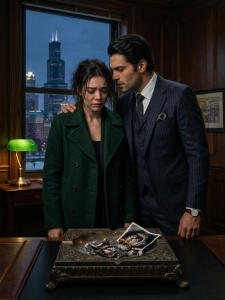
She had been standing outside his office door at the Voss Group tower, ultrasound tucked inside her coat, practicing the words, when she heard it.
*”The engagement goes public in an hour. Your art girl will be handled quietly. Severance from my life.”*
His voice. Cold. Precise. She had not heard that voice in five years without it meaning something true.
She ran.
She left her phone on the kitchen counter because Luca’s people could track anything with a signal. She took cash, her mother’s ring, her passport, and nothing else.
Chicago kept snowing as she left it.
In Boston, she had burned the ultrasound. Not because she wanted to destroy it — because she had thought, in those first hours of raw terror, that if no record existed, the child might be safe. The flame had eaten through the glossy paper quickly. She had watched the gray-blur shape of her baby curl into ash and told herself this was protection.
It had felt like the worst thing she had ever done.
It still did.
The baby started moving during a snowstorm, six weeks after she arrived. A flutter beneath her ribs while she was peeling an orange. She had gone completely still, then pressed both hands over her stomach and laughed until she cried.
“It’s just us,” she had whispered. “I know. I’m sorry. But we’re going to be okay.”
She believed it, mostly.
Until the white lilies appeared outside her door with no card.
Until the word *THIEF* was scratched into her mailbox.
Until the man who followed her home from the pharmacy three nights ago passed close enough to whisper: *Boston belongs to the Rossos now. Chicago lost.*
Nora had not told anyone. There was no one to tell.
She was seventeen weeks along and alone in a basement apartment and the wrong family had found her.
—
She was making tea when the knock came.
Three taps.
Controlled.
She moved for the kitchen drawer before she was conscious of moving — the small revolver she had bought with the last of her emergency cash, the one that made her feel both protected and horrified every time she looked at it.
The baby shifted.
“Easy,” she whispered.
The knock repeated.
Then a voice.
“Nora.”
Her blood stopped.
No one knew that name here.
“Nora,” Luca Voss said again, through the door. “Open it.”
She stood frozen in her kitchen with a gun in one hand and a mug of half-made tea in the other while the father of her child waited on the other side of a door that she had been hoping would never lead to him.
The lock felt very thin.
She opened it two inches on the chain.
He stood in the hallway looking like twelve weeks of not sleeping. The tailored coat was gone. His dark hair was damp from rain. The sharp bones of his face had gone sharper. He looked like someone who had been carving himself hollow from the inside.
Then his eyes dropped to her stomach.
The chain was the only thing between them when his face did what she had never seen it do in five years of knowing him.
It simply broke.
“Nora,” he said, and it was not the voice that had emptied rooms.
It was smaller than that. Much smaller.
“You shouldn’t be here,” she said.
“I know.”
“You lied to me.”
“Yes.”
No argument. No deflection.
She closed the door.
Not because she had forgiven him.
Because the neighbors would eventually notice if Chicago’s most feared man stood in the hallway of a Beacon Hill brownstone looking like that.
She slid the chain free.
—
He came in slowly, like he understood the apartment was not his to claim.
He looked at the worn couch. The cheap dishes. The stack of archive folders on the table. A woman’s life reduced to what fit in a duffel bag.
Something moved across his face that she recognized as rage turned inward.
“Don’t,” she said.
“Don’t what?”
“Don’t look at my apartment like you’re responsible for it.”
“I am responsible for it.”
“That’s not comforting.”
He was quiet.
The rain picked up outside, drumming against the basement window.
“You called me a severance package,” she said.
“I called you a civilian because Camilla Rosso’s family would have killed you if they understood what you were to me.”
“What am I to you?”
The question came out harder than she intended.
Luca looked at her.
“Everything,” he said.
She hated how badly she wanted to believe that.
“The engagement—”
“Never real. A stalling tactic while I ended a forced alliance.”
“You gave her a ring.”
“Leverage. Not love.”
“I heard you with my own ears.”
“You heard what I needed Camilla to hear.”
Nora pressed her lips together, holding back the thing that was threatening to come out of her as something embarrassing.
“You should’ve told me.”
“Yes,” he said. Simply. “I should have.”
He looked at her stomach.
“Is the baby—”
“Yes.”
His throat moved.
“Does it—” He stopped. Started again. “Does it move?”
The question was so careful it destroyed something in her resolve.
“Every day,” she said.
He looked at her for a long moment.
Then he reached into his jacket and removed three weapons — a gun from the inside pocket, another from his ankle, a knife from somewhere she hadn’t tracked — and placed them on her kitchen counter.
He left himself unarmed in front of her.
“I found your medical records,” he said. “From Northwestern Memorial. The day you left.”
She stared at him.
“Eleven weeks and four days. The day you came to tell me.”
She looked away.
“Nora.” His voice roughened. “You were pregnant. You came to tell me. And you heard me say what I said.”
“Yes.”
He closed his eyes.
“And you ran through a Chicago winter alone because you thought I would take the child.”
“You would have.”
“No.” He opened his eyes. “I would have protected you both. I was trying to protect you before you even knew you needed it.”
“You didn’t tell me.”
“I know.”
“You let me believe—”
“I know.” The words were very quiet. “I know exactly what I cost you.”
The baby kicked.
Hard.
Nora gasped softly and pressed her hand to her side.
Luca moved before she could stop him — not toward her, exactly, but toward the space where the baby was. He stopped three feet away, his hand half-raised.
“Can I?”
She stood very still.
Then she nodded.
His hand settled against the curve of her belly.
The baby kicked again.
Luca inhaled sharply.
Then he stood there with his eyes closed and his hand pressed to her stomach, and Nora watched something happen to him that she suspected no one else in Chicago had ever seen.
Then his phone rang.
He answered it, one hand still on her, and his expression changed from something private to something lethal in the time it took his enforcer’s voice to say three words: *we have a problem.*
When he looked at her, the warmth was gone.
Not gone. Submerged.
“The threats you received,” he said. “Tell me everything.”
She told him.
When she finished, his face was black ice.
“They found you before I did,” he said.
Before she could answer, three deliberate knocks sounded at the apartment door.
—
## PART 2
Luca moved her behind him with one arm and reached the counter in two steps.
The gun was in his hand before the second knock finished.
A voice: “Building maintenance, Miss Evans.”
There was no maintenance scheduled.
She had checked because she always checked.
Luca mouthed: *bathroom.*
She moved.
The front door came in with the second impact.
What happened afterward was very loud and very brief.
Two men. Professional suppressors. Luca met them with the particular cold efficiency of a man who had been doing this since he was nineteen years old, and when the silence returned to her apartment, both intruders were on the floor and Luca was checking tattoos.
A black serpent coiled around an anchor.
Rosso insignia.
He looked at her through the doorway.
“We have to go.”
“Where?”
“Anywhere that isn’t here.”
—
Massachusetts General received them through a private entrance. Luca had called ahead. The combination of his name and a large number moved things efficiently.
In the waiting room, he sat covered in blood that wasn’t his and looked like a man trying to calculate how much something had cost him. Every nurse who passed him found something urgent to attend to in another direction.
The doctor emerged after forty minutes.
Luca stood instantly.
“My wife,” he said. The lie arrived completely naturally, and she decided not to challenge it in a hospital hallway.
“Stress contractions,” the doctor said. “Elevated blood pressure. The baby’s heartbeat is strong. She needs rest.”
Luca closed his eyes.
When he opened them, she could see the specific quality of relief that crossed his face — not the composed, controlled relief of a man who had expected good news, but the desperate relief of someone who had been afraid of a different answer.
He came into the room slowly.
“You lied to the doctor,” she said.
“I needed them to prioritize you.”
“You called me your wife.”
He looked at her.
“You should have been.”
She couldn’t think of a response to that.
He sat in the chair beside her bed and said nothing for a long time.
“This isn’t over,” she said finally.
“No.”
“Camilla Rosso found me in Boston. Someone told her.”
His jaw tightened. “Someone inside my organization.”
“Then what do we do?”
He looked toward the window.
“I end it.”
“You say that like it’s one thing.”
“It’s many things.” His voice was very quiet. “But they all end.”
She looked at their joined hands — at some point she had taken his, or he had taken hers, and neither of them had acknowledged it.
“There’s something I haven’t told you,” he said.
The steadiness of the words made her afraid of them.
“Camilla isn’t trying to harm the baby,” he said.
“Then what does she want?”
“She believes the child belongs to her family.”
Nora frowned. “That doesn’t make sense.”
Luca’s expression became very careful.
“It will.”
Before he could continue, the hospital lights went out.
Every light. Together.
Red emergency panels flickered on one by one, casting the corridor in the color of old blood.
Then, through the hospital speaker system, a woman’s voice arrived — calm, almost amused, with the particular quality of someone who had been waiting for this moment:
“Luca, darling. I hope she’s comfortable.”
Camilla Rosso.
“I’ve been so patient,” the voice continued. “But I think it’s time we spoke about your child’s real family.”
Luca had Nora behind him and his gun raised before the last syllable landed.
She pressed both hands over her stomach.
“What does she mean?” Nora whispered.
Luca looked at her.
And said nothing.
Which was the most frightening answer he had ever given her.
—
## PART 3
**The Name Under the Name**
Camilla Rosso entered the hospital room like someone who had booked it in advance.
Cream wool coat. Diamonds. The unhurried movement of a woman who had never had to rush because the world arranged itself around her arrival.
Six armed men followed at a respectful distance.
Her eyes moved to Nora’s stomach with the particular attention of someone examining an inheritance.
“Look at you,” she said.
Luca stepped fully in front of the bed.
“You’re making a mistake,” he said.
“I’m making a correction.” Camilla’s gaze didn’t move from Nora. “We have some things to discuss, cousin.”
Nora went cold.
“I don’t know you.”
“No. You don’t.” Camilla’s smile was not warm. “But I know your mother.”
“My mother is dead.”
“Yes.” A pause. “She died because of that.”
Luca said: “Don’t.”
Camilla looked at him briefly. “You’ve been protecting her from a truth she deserved for years.”
“I’ve been keeping her safe.”
“You’ve been keeping her ignorant.”
Nora looked between them.
“What truth?” she said.
No one answered.
“What truth,” she said again, with the specific quality of a woman who had spent eleven weeks in a basement apartment surviving alone and had run out of patience for being managed.
Luca looked at her.
Then: “Your mother’s real name was Giulia Rosso.”
The room didn’t shift. The machines kept beeping. The emergency lights held their red.
Nora said nothing.
“She was Paulo Rosso’s younger sister,” Luca continued. “Camilla’s aunt. She left the family before you were born. She changed her name. She built a different life.”
“She was a schoolteacher,” Nora said. “From Milwaukee.”
“She became one.”
“That’s not—” She stopped.
Her mother flinching whenever an unfamiliar car slowed on their street. Moving three times before Nora finished high school. The way she sang Italian lullabies and denied knowing where they came from. The absolute prohibition on ancestry research.
“She ran,” Nora said.
“She ran,” Luca confirmed.
Camilla said: “She ran and she stole information on her way out. Ledgers. Names. Federal witnesses. Things that could have dismantled the entire organization.”
“She wanted freedom,” Nora said.
“She wanted leverage.”
“Don’t talk about her.”
Camilla’s eyes sharpened. “She died because my father found her.”
Nora’s breath left her body.
She looked at Luca.
He did not deny it.
“Your father ordered it,” she said.
“Yes.”
“And you knew.”
“Yes.”
“When?”
He was quiet.
“Since the day I met you.”
The full shape of it arrived at once.
Five years.
He had known from the first night — the museum gala, the blue light, the way he had looked at her from across the room like he recognized her — that she was the daughter of a woman his father had ordered killed.
And he had loved her anyway.
Or first because of it and then anyway.
She couldn’t quite sort those two things out yet.
“Tell me what else,” she said.
“Nora—”
“All of it. Now.”
Camilla smiled slightly.
Luca looked at his hands.
“Your mother took evidence before she disappeared,” he said. “Financial ledgers. Names. Politicians. Federal connections. Enough to destroy both families.”
“Where are they?”
“No one knew.”
Nora stared at him.
“She hid them,” he said.
Then Camilla reached into her coat and produced something. Old. Leather-bound. Thin.
She slid it across the floor toward Nora’s bed.
A ledger.
Nora stared at it.
“Not all of it,” Camilla said. “But enough to tell us where the rest was.”
Luca’s expression changed.
Camilla said: “Pick it up.”
Nora leaned forward and took it.
The names inside were judges, politicians, federal agents, union officials, mafia captains from two cities. Twenty years of corruption in handwriting she almost recognized.
The last page had a note.
*For my daughter.*
Nora’s breath stopped.
*If you are reading this, they found me. Run from all of them. Especially the Valentes.*
She turned to the next line.
*There is only one person who knows the truth about your father. His name is Luca Voss.*
She looked up.
Camilla said: “Ask him what truth that is.”
Luca said: “Your father didn’t die in the crash.”
Every sound in the room disappeared.
“He became a federal informant. The government relocated him. He’s been alive this entire time.”
Nora heard her own pulse.
“And you—”
“I’ve known where he was for three years.”
“You didn’t tell me.”
“If the Rosso family discovered he was alive, they would have used him to find you. Keeping him hidden kept you safer.”
Nora pressed both hands over her eyes.
Too much.
Too many years of grief, of burial, of crying at a grave that held no one.
Then Camilla said: “The child carries both bloodlines. Voss and Rosso. That’s why it matters. That’s why it has to come with us.”
Luca raised his gun.
“No.”
“You’re in no position—”
“I am in exactly the position,” Luca said, “of a man who will burn every port from Boston to Baltimore before he lets you near them.”
Something moved in Camilla’s face.
Recognition, perhaps, of an ending she hadn’t fully planned for.
Then the windows shattered.
—
**The Estate at Providence**
What happened in the hospital took eleven minutes and left five of Camilla’s men down and two of Luca’s.
Camilla disappeared into the chaos.
Luca carried Nora out himself.
Three hours later, in an estate outside Providence that had been turned into a fortress with every light blazing against the rain, Nora sat in a large bedroom and stared at the Atlantic through glass.
The ocean at night looked like what she felt.
A knock. Luca entered with tea. Not a staff member. Him.
She looked at this. He set the tray down and stood at a distance that said: *I know I have no right to be close.*
“Did you love me from the beginning?” she asked.
“I watched you first,” he said. “Because of your name.”
“And then?”
“You smiled at me at the Field Museum. You were arguing with a curator about attribution on an eighteenth-century bronze.” Something moved in his face. “You were completely wrong.”
“I was right.”
“You were wrong with absolute certainty. I had never seen that before.”
Despite everything, she felt something shift.
“And you stayed,” she said.
“Yes.”
“Even knowing what your father did to her.”
He sat on the edge of the chair across from her.
“When my father died, I spent two years trying to repair what he had destroyed. Money returned. Men released. Damage catalogued.” He looked at his hands. “Some of it couldn’t be repaired.”
“My mother.”
“No.”
“Me,” she said.
He looked up.
“I thought—” He stopped. Started again. “I thought if I could protect you from everything that came from that world, it would be something. Not enough. But something.”
“And instead you put me inside it.”
“Yes.” His voice was very quiet. “I know.”
The baby kicked, sudden and strong.
Luca’s eyes moved to her stomach.
She made a decision she wasn’t certain about and took his hand and pressed it against her side.
He sat there with his palm flat against her belly and his eyes closed, and she watched him be afraid in a way she had never seen from him — not afraid of losing power, but afraid of losing the specific irreplaceable thing.
Then the alarms went off downstairs.
—
**What Camilla Found**
Camilla Rosso had arrived at the Providence estate with twelve men and a second ledger her people had recovered from a storage unit in Newark.
Inside it was the rest of what Nora’s mother had taken.
Everything.
The full scope of it.
Camilla stood in the estate’s grand room with the ledger open and smiled at Luca like she had already won.
“Surrender the child and I’ll destroy this. Both of you walk away. Your whole operation untouched.”
“You’re not touching my child,” Nora said.
Camilla looked at her with something that was not quite contempt.
“You don’t understand what you’re carrying.”
“I understand perfectly.”
Luca positioned himself between them.
“Camilla.” His voice was the one that ended conversations. “You are in my house. With my men on every exit. You came because you thought I’d choose the organization over them.”
Camilla’s smile held.
“Won’t you?”
“No.”
She studied him.
“You’d give up everything.”
“Yes.”
“That’s not the man I knew.”
“That man didn’t have a reason.”
Something shifted in Camilla’s expression — not defeat, but the specific recalibration of someone realizing their map was wrong.
She reached for her weapon.
Luca reached for his.
Then the window behind Camilla exploded inward.
A single shot. Precise.
Camilla stumbled sideways, hand pressed to her shoulder.
The shooter entered through the broken window.
Gray-haired. Hard-eyed. Moving with the economy of someone trained a long time ago.
Nora knew his face.
From photographs her mother had burned, from the grave she had wept at, from the face she saw in the mirror sometimes without knowing why.
Her father said her name.
Just her name.
She began crying before she finished hearing it.
—
**What He Had Been Carrying**
After Camilla’s men surrendered — they did, when the federal tactical teams arrived four minutes later with warrants that had apparently been ready for months, waiting for exactly this situation — Nora’s father stood in the ruined room and looked at Luca with the specific expression of a man accounting for a debt.
“You protected her,” he said.
“With my life,” Luca said.
Her father nodded.
Nora said: “Someone tell me what I’m missing.”
Luca looked at the floor.
Her father said: “The night your mother died. Luca was there.”
She stared.
“He was nineteen. His father had arranged it but Luca didn’t know until it was happening. He got there in time to pull you out of the car.”
Nora had buried that memory under the way she had buried most things from that night. Smoke and broken glass and a teenage boy’s hands lifting her out of wreckage.
It had been him.
“He promised your mother,” her father said, “before she died.”
“That he’d protect me,” Nora said.
Luca looked at her.
“Yes.”
Five years of small kindnesses. Coffee after long nights. Learning her schedule. Being at every event she attended. A private key card and the guards who pretended not to notice.
Not an accident.
Not coincidence.
A nineteen-year-old boy’s promise carried across fifteen years.
She crossed the room and hit him.
Open palm across the chest. Once. Hard.
He let it happen.
“You should have told me,” she said.
“Yes.”
“Every year for five years.”
“Yes.”
“You let me fall in love with you without knowing—”
“Yes.”
“That’s not a sufficient answer.”
“No,” he said. “It isn’t.”
She hit him again.
He caught her hand.
She didn’t pull it back.
“I was afraid,” he said.
“Of what.”
“That if you knew everything from the beginning, you would only see what my family cost yours.”
“And instead I fell in love with you without knowing.”
“Yes.”
“And that was worse.”
“For you? Yes. For me?” He looked at their joined hands. “It was the only good thing I didn’t destroy.”
Nora closed her eyes.
Then a pain moved through her.
Sharp. Immediate. Wrong.
Her father said her name.
Luca caught her before she understood her knees had given.
—
**The Delivery Room**
The contractions were stress-induced. Twenty weeks too early to be labor, the doctors said. The baby’s position was fine. The heartbeat was strong.
They stabilized her within the hour.
Luca stood outside the room covered in other people’s blood, and when the doctor said *both mother and baby are safe*, the sound he made was not a mafia boss’s sound at all.
He sat beside her bed afterward and held her hand and didn’t speak.
She looked at his face in the dim hospital light.
This man had been carrying her family’s grief since he was a boy. He had spent fifteen years trying to repay a debt his father made and had made his own mess of it in the process, had hurt her worse than the debt required, had loved her badly and then tried to love her better.
She did not forgive him in the hospital room.
Forgiveness was not a single event. It was a practice.
But she held his hand.
And when he brought out the new ultrasound printout the technician had given them — the baby visible now in more detail, tiny spine curved in the particular shape of something that intended to survive — she watched him look at it the way she had seen him look at nothing else.
The burned edges of the first ultrasound were still in his coat pocket.
She had seen him put it there at the Boston apartment, touching the charred paper like it was the same as the whole thing.
“You kept the ashes,” she said.
“I would keep every piece of you,” he said.
—
**After**
The federal cases moved quickly once the ledgers were in the right hands.
Paulo Rosso was arrested in New York.
Camilla survived the shoulder wound and spent the next several months cooperating with prosecutors, which turned out to be more useful to everyone than her silence would have been.
Felix — Luca’s cyber expert, the one who had sold Nora’s location under duress because Rosso men had taken his daughter — was granted immunity once the girl was safely recovered.
Luca had found the girl himself.
His underboss Marco, who had worked for Luca for eleven years and had a comprehensive understanding of what made his employer dangerous, said later that the recovery operation was the most frightening thing he had ever witnessed — not because of the violence involved, but because of the absolute cold certainty on Luca’s face when he learned a child was being used as leverage.
Nora’s father entered witness protection again, properly, with arrangements made through channels that would keep him genuinely safe. He visited once before he disappeared. He sat in Nora’s kitchen and drank tea and apologized for twenty years in two sentences.
She told him she needed more time.
He said he understood.
He gave her his phone number, which he would have to change every six months, and told her to use it when she was ready.
—
**Elena**
The baby was born at thirty-eight weeks.
They had moved back to Chicago by then, to a townhouse overlooking Lake Michigan that Nora had chosen herself — she had specifications about natural light and she had insisted on seeing five properties before deciding, and Luca had said almost nothing throughout this process except *yes* to everything she wanted.
The labor was twelve hours.
Luca was there for all of it, and Nora would tell the story differently depending on who asked, but the truth was that at no point did he try to manage or arrange or control what was happening.
He simply stayed.
When the doctors placed the baby in her arms and she looked at the small, indignant, impossible person who had been traveling toward this room through gunfire and hospitals and burned paper and the whole weight of two families’ history —
she said her name.
“Elena.”
Her mother’s middle name.
Luca sat very still.
Then he reached up and touched Elena’s cheek with one careful finger, and Elena, who had opinions about her arrival that she was expressing loudly, paused briefly to examine him.
She fell asleep on his chest an hour later.
Nora watched this from the hospital bed.
“She trusts you already,” she said.
“She doesn’t know any better yet,” he said.
“Give her time.”
“She’ll have it.”
He looked up.
“Nora.”
“Yes.”
“I know I don’t deserve it.”
“You’re right.”
“I know the list of things I owe you.”
“It’s a long list.”
“Yes.” He looked at Elena. “I intend to work through it.”
She looked at him looking at their daughter.
The man who had promised a dying woman he would protect her child.
The man who had burned a key piece of the evidence against himself because it was the only ashes he had left.
The man who, when she’d hit him in that Providence parlor, had accepted it and caught her hand and not let go.
“One condition,” she said.
He waited.
“No more protecting me from truths.”
“Yes.”
“Everything. Even when it’s hard.”
“Yes.”
“Starting now.”
He looked at her.
“Are you sure?”
“Yes.”
“There are things about the organization I’m still dismantling that you don’t know.”
“Tell me.”
“Some of them are—”
“Luca.”
He stopped.
She held his gaze.
“Tell me,” she said again.
He told her.
It took most of an hour and two cups of bad hospital coffee and it was, as promised, not always easy to hear. Some of it she had suspected. Some of it was new. None of it changed the fundamental fact of them.
At the end, she said: “Okay.”
He looked at her.
“Okay?” he said.
“I didn’t say I was finished being angry about all of it.”
“No.”
“But I’m not leaving.”
He was quiet for a moment.
Then: “Why not.”
She looked at Elena sleeping on his chest.
At the man who had carried a promise since he was nineteen.
At the specific complicated wreck of love and history and damage and repair that had brought them here.
“Because the ashes became something,” she said. “I want to see what it grows into.”
—
**One Year Later**
Chicago glowed in winter light.
Inside the townhouse, Elena Voss was walking with the aggressive confidence of a twelve-month-old who had decided that furniture was for touching and floors were for falling and both of these were fine.
Nora watched from the kitchen doorway while Luca followed three feet behind his daughter with the expression of a man managing a very important logistical operation.
Elena touched the bookshelf.
Luca moved one step left.
Elena reversed.
Luca moved one step right.
“She’s not going to fall,” Nora said.
“She fell twice yesterday.”
“She stood back up.”
“I know. I was there. Both times.”
“You caught her the second time.”
“She was falling *toward the corner.*”
“She was fine.”
“I don’t accept statistically fine.”
Nora pressed her lips together.
Elena sat down deliberately on the rug and looked at her father with the serene expression of a person who had made her point.
Luca crouched to her level.
Elena held out her arms.
He picked her up.
On the refrigerator, held by a small ceramic magnet, was a photograph.
The second ultrasound — the one from Boston, taken at twenty weeks in the middle of everything that was happening. You could see Elena clearly in it: the tiny spine curved just so, the small clenched fists.
In the corner of the frame, burned slightly along one edge, was a fragment of the first one.
The one Nora had set alight over a kitchen sink on the worst night of her life.
Ash preserved.
Beginnings made from endings.
Luca caught her looking at it.
He crossed the room with Elena on his hip and stood beside Nora and looked at the photograph too.
“We almost lost all of it,” she said.
“Yes.”
“Multiple times.”
“Yes.”
Elena reached toward the photograph with obvious intentions.
Luca caught her hand.
“Not that one,” he said, very gently.
Elena considered this policy, found it unreasonable, and appealed to Nora.
Nora kissed her forehead.
“Some things we keep exactly where they are,” she said.
The baby accepted this.
Luca looked at Nora.
“Is that a general philosophy or specific to refrigerator photographs?”
“Both,” she said.
He said nothing.
But he took her hand.
And they stood in the kitchen while Elena informed the refrigerator of her grievances, and the lake outside glittered cold and white, and the city went about its business not knowing that one of its most feared men was losing an argument with a twelve-month-old about the appropriate location of ultrasound photographs.
They stayed like that for a while.
Not because it was perfect.
Because it was true.
**THE END**
—
—