On the Night His Ranch Burned, the Giant Begged for a Quiet Wife — But the Woman Sent to Him Carried a Loaded Rifle, a Broken Past, and One Sentence That Made Him Regret His Order.

## PART 1
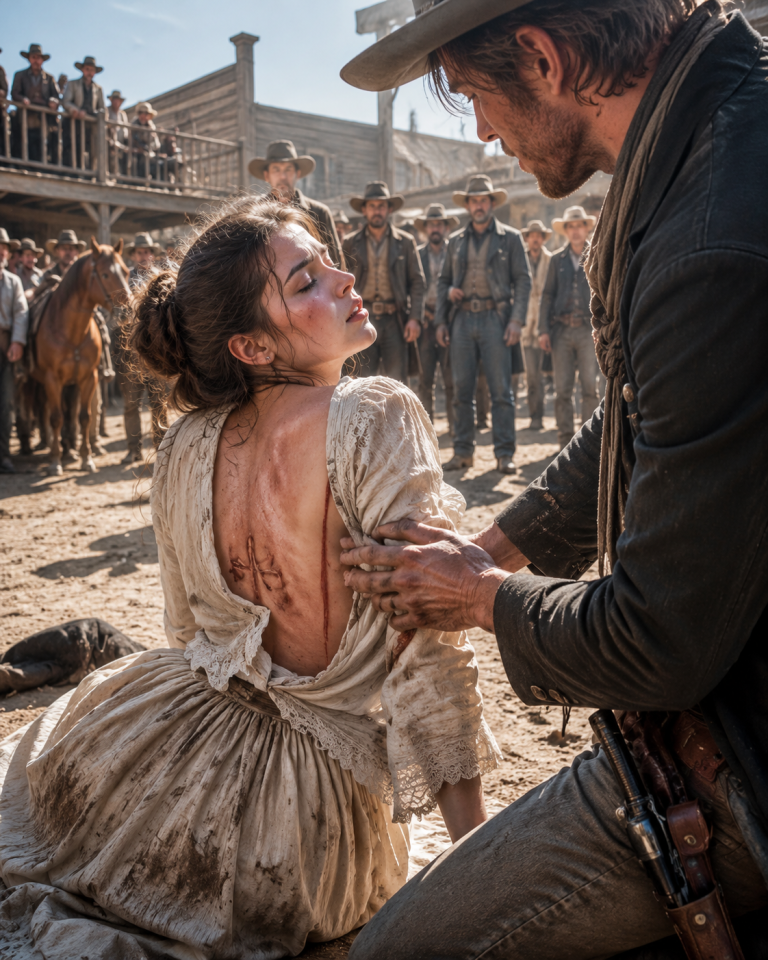
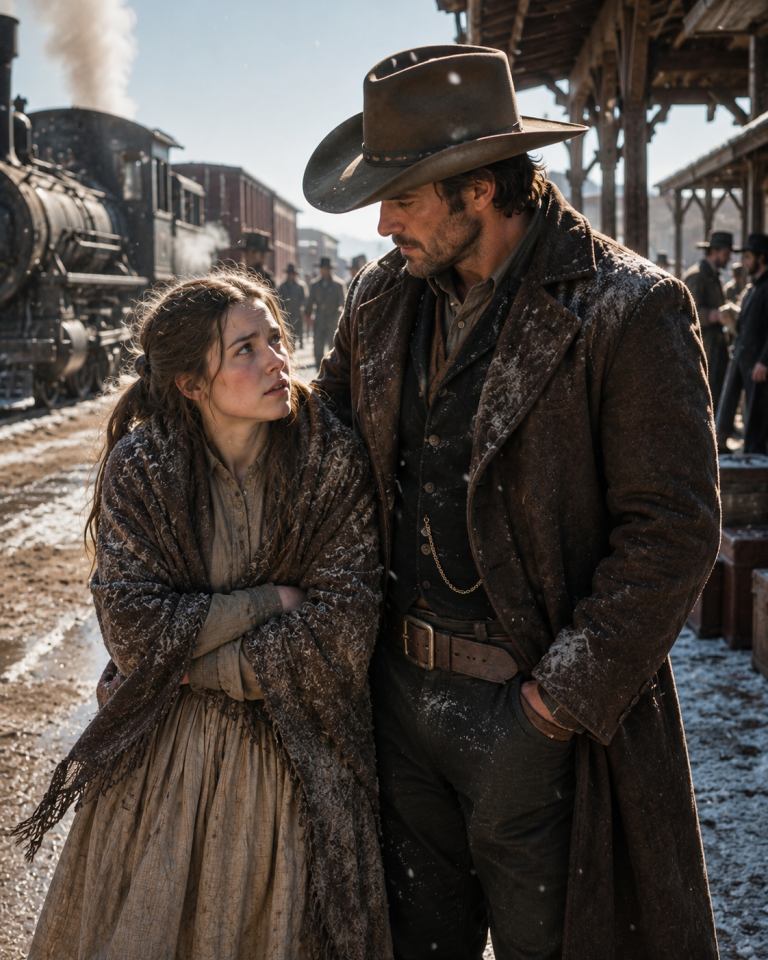
The first thing Nora Fenn did in Cedar Flat was step off the noon train with blood on her sleeve and ask the largest man on the platform whether he was afraid of women.
Every conversation stopped at once.
The train had come screaming out of the Colorado dust into a sky the color of bleached bone. Men in canvas coats squinted against the glare. Women clutched basket handles. The stationmaster had been mid-shout about something to do with freight when Nora Fenn appeared in the passenger car doorway.
Cedar Flat had been talking for two months about the fact that Emmett Cross, the giant of Ridgeback Mountain, had finally sent for a wife. They said he was six feet eight. Some said nine if you counted his hat. They said his voice could knock frost off pine branches and his hands were the size of a man’s shovel. They said no sensible woman would agree to live forty miles up a mountain with him unless poverty, scandal, or bad luck had swept her there.
So they expected something thin. Frightened. Some pale, grateful thing pleased with any roof that didn’t leak.
Nora Fenn came down the iron steps carrying a carpetbag and a battered leather satchel, with a look in her eye that suggested she had already made several decisions about this day and none of them were tentative. Her traveling dress was mud-stained from three days on the train and pulled across her hips in ways that fashion had opinions about. She was round-cheeked and broad-shouldered, with a body built for work rather than for looking at, and she had the bearing of someone who had been told her shape was a problem for long enough that she had stopped listening.
She crossed the platform directly.
Emmett Cross was impossible to miss. He stood near the freight office like a piece of the mountain that had decided to come down for supplies. Dark beard. Heavy coat stretched across a chest that had been built by axes and winters. He held himself very still, the way large men sometimes learned to when they discovered that sudden movement made people flinch.
Nora looked at the blood drying on her sleeve before he could mention it.
“You Emmett Cross?”
His eyes moved from the bloodstain to her face.
“Yes, ma’am.”
His voice was lower than she’d expected. Rougher, but not loud.
“Good,” she said. “I’m your wife, unless you plan on fainting.”
A sound somewhere between a gasp and a laugh moved through the platform crowd.
Emmett’s brow lowered. “You hurt?”
“No.”
“Whose blood is that?”
She glanced down. “A man on the train thought my seat was his because I was traveling alone. His nose had a different opinion.”
The silence that followed was the silence of a crowd deciding what to do with information.
Emmett looked at her for a long, unreadable moment.
“Where is he now?”
“Still on the train, reconsidering his decisions.”
The corner of Emmett’s mouth moved. It didn’t become a full smile. Almost.
Nora set down her carpetbag.
“Now answer me plain, Mr. Cross. Your advertisement said you wanted a quiet wife. If that’s true, we can save each other a lot of trouble right now, and I’ll sleep in your depot until the next train east.”
Emmett’s jaw tightened. “I wrote steady. The paper printed quiet.”
“That wasn’t your word?”
“No.”
“Good,” Nora said. “Because I have many qualities. Quiet has never been among them.”
A woman near the ticket window whispered something to the woman beside her. Nora heard it. She turned.
“Ma’am,” she said politely, “the Lord has had twenty-eight years to improve me and appears to have given up.”
The laugh came from Emmett Cross. A low, rough sound, like thunder learning to be human. It surprised him. She could tell. He looked startled by his own amusement.
In that moment, between the laughter and the gathering of it back, he stopped seeming like the mountain giant of the stories. He seemed tired. Lonely. A man who had forgotten what his own laugh sounded like and was startled to hear it.
Then it passed.
“Wagon’s here,” he said. “Ridgeback’s a long ride.”
“How long?”
“Six hours in good weather. More if the trail decides to argue.”
“Then we should start.”
He hesitated. “Usually stay in town the first night.”
“I didn’t cross half a country to admire your depot.”
Something in his expression settled, like a question that had been answered.
“Trail’s narrow after dark,” he said.
“I grew up in the Cumberland backwoods,” Nora said. “Roads there were rumors and the mules had better sense than the men. I’ll manage.”
He nodded once. Picked up her bags.
Behind them, the stationmaster, Mr. Talley, muttered something about how long she’d last.
Nora stopped.
Emmett stopped with her.
She turned, smiling with the specific pleasantness of a woman who had outlasted worse opinions than his. “Mr. Talley,” she said, reading the name off his vest badge, “I have survived hunger, flood, a county judge, and a corset maker from Nashville who told me my figure was a moral failing. I expect your opinion won’t be the thing that does me in.”
Emmett coughed into his fist, hiding something that might have been a grin.
Nora picked up her bag and walked toward the wagon.
—
By dusk, the road to Ridgeback Mountain had narrowed from wagon track to argument.
The town disappeared behind them, swallowed by pine and granite. Peaks rose blue-black against a sky fading toward purple. The wagon wheels caught stones. Branches scraped the sides. Below the trail, a ravine opened like a held breath.
Emmett drove with one hand, the other braced on the seat, every movement patient. Nora sat beside him refusing to clutch the bench despite the pitching.
“Rock on your left,” she said.
“I see it.”
“Washout ahead.”
“That too.”
“Low branch.”
He ducked before it reached him. “Do you intend to drive from the passenger seat the whole way?”
“Do you intend to pretend you’re not grateful?”
The corner of his mouth moved again.
They rode quietly for another mile. Nora studied him without making a production of it. His nose had been broken at least once. A scar cut through one eyebrow. His beard was overdue for attention. He was not handsome the way city men were handsome. He was something else — solid, functional, difficult to dismiss.
He did not crowd her. Did not ask if she could cook. Did not inventory her as though checking whether he’d received what he paid for.
Those were points in his favor.
“Why did you answer my letter?” he asked.
“Because it was honest.”
“How so?”
“You said the winters were hard. The work was harder. You said a woman who needed soft hands and daily praise would hate you by Christmas. Most men looking for wives write lies. They want a servant with a pleasant face and call it partnership.”
Emmett’s hands tightened briefly on the reins.
“What do you want?” he asked.
“A place where I don’t have to make myself smaller to be tolerated.”
The wagon creaked. Below, somewhere in the dark, water moved over stone.
“You think Ridgeback is that place?”
“I don’t know yet. That depends on you.”
He accepted this like weather.
“I didn’t ask for quiet,” he said, after a while.
“So you said.”
“I asked for someone who could stand the mountain.”
Nora looked up at the darkening peaks. “Then perhaps you got more than you bargained for.”
The cabin, when they reached it by starlight, was plain as a clenched fist — squared logs, stone chimney, everything useful, nothing soft. No curtains. No extra chair. A house built by a man who had not expected company to stay.
Nora walked a slow circle with the lantern, studying everything.
“Good bones,” she said.
Emmett stood near the wagon with her bags. “Is that praise?”
“It’s inspection. Praise comes after supper.”
“I have beans.”
“Then praise may take a while.”
He blinked. Then laughed again, quieter this time, as if he was deciding whether it was allowed.
Inside, she touched the back of the single rocking chair.
“You live like you’re apologizing for taking up space,” she said.
He frowned. “What does that mean?”
“It means this cabin is built to survive everything except company.”
He set her bags down. “Haven’t had much cause for company.”
“You have cause now.”
Something shifted in his face. Uncertainty — the honest kind that came from a person standing on new ground and not yet knowing whether it would hold.
“Nora,” he said, carefully. “We made promises by letter. But we’re strangers yet. I won’t demand a wife’s duties from a stranger.”
She had prepared for arrogance. For presumption. She had prepared arguments with edges.
She had not prepared for decency.
“Good,” she said, gentler than she’d planned. “Because I won’t be forced.”
“Take the bed. I’ll sleep in the loft.”
“That wasn’t—”
“The arrangement can wait until we know how to speak without stepping on each other.”
She studied him. “You always this honorable, Mr. Cross?”
“Sometimes I’m just tired.”
She unpinned her hat. “That makes two of us.”
—
## PART 2
For three weeks, Cedar Flat waited for Nora Cross to fail.
She declined to oblige.
She woke before dawn, braided her hair, and learned the ranch by working it. When Emmett tried to carry both water buckets, she took one from his hands and told him if he wanted a porcelain figurine he should have written to Chicago for one. She reorganized the hayloft by weather exposure. She repaired half the north fence before he finished explaining about the splinters.
She rode badly the first day and better the second.
On the fifth day, she demanded to try the black gelding no one from the neighboring spread would go near.
“No,” Emmett said.
The horse was called Saul, because he had thrown people toward a state of religiosity.
Nora stood in the corral with her hands on her hips. Her work dress strained across her full body, and she knew a hired hand from two farms over had smirked when she climbed the fence. She knew what the smirk meant. Too round. Too soft. Too much woman for actual work.
The old shame rose, familiar and specific.
She burned it.
“Is it because I’m a woman,” she asked, “or because you’re afraid I’ll actually do it?”
“I’m afraid you’ll break your neck,” Emmett said.
“That wasn’t one of the options.”
“Nora.”
“Emmett.”
Saul snorted and stamped.
Emmett looked from the horse to his wife.
“He bites,” he said.
“So did my first husband.”
He went very still.
The words had left her before she could decide about them. She had mentioned a previous marriage in her letters only briefly — ended, no children, no remaining claim. She had not described Martin Bell, his careful cruelty, his patient insistence that a good wife lowered her voice and her appetite and her expectations until she became comfortable to stand next to. The way she had looked in a mirror one morning and not recognized herself.
Emmett did not ask.
He opened the corral gate.
“Fine,” he said. “But you’ll listen to me first.”
“I listen,” Nora said. “I just don’t always obey.”
By sunset she had been thrown twice, bruised her hip purple, cursed in multiple regional dialects, and climbed back into the saddle each time with the stubbornness of someone who had decided that giving up was what other people did.
At midnight Emmett came to check the stock and found her still in the corral, walking Saul under a moon that turned everything pale.
“You’re still out here,” he said.
“He’s almost decided I’m not worth killing.”
“You’re limping.”
“He’s reconsidering.”
“Nora.”
She looked down from the saddle, hair loose, face dirty, eyes bright. “Your quiet wife is occupied.”
Before dawn, Saul let her ride him across the clearing without a fight.
—
The scandal reached Cedar Flat by breakfast.
By noon it had acquired momentum.
“She rode his devil horse all night,” the storekeeper said, in the particular tone of a person offering one meaning while technically saying another.
“No,” said Mrs. Talley, the stationmaster’s wife. “They say she rode *him* all night.”
The pause that followed was thick with the specific delight of small-town malice.
Nora was near enough to hear. She turned from the flour sacks.
“Mrs. Talley,” she said pleasantly, “if you’re going to tell a filthy story, at least commit to it.”
The store went quiet.
Emmett, beside her, lowered his head as though inspecting a barrel with great personal interest. His ears went red.
Mrs. Talley made an indignant sound.
From behind the counter, Gerald Pryce smiled without warmth.
He was a narrow man wearing clothing too careful for a mountain town, with silver hair, clean gloves, and the measuring eyes of someone who saw every person primarily as a negotiation. He owned the mill, the valley grazing leases, and the only freight contract within sixty miles. His wife, Helena, had the bearing of a woman who considered her social position a virtue she had earned rather than inherited.
“Mrs. Cross,” Pryce said. “You’ve made quite an impression.”
“I do try,” Nora said.
“Cedar Flat is a traditional community.”
“I’ve noticed. The nosiness especially has real consistency.”
Someone choked.
Helena Pryce stepped forward. “A wife’s conduct reflects on her husband.”
“Then Emmett must look very interesting these days.”
Helena’s smile sharpened. “Some women confuse attention with respect.”
Nora felt Emmett shift beside her. Not stepping in front of her. Not silencing her. Just present — steady as a post in current.
She found she appreciated this more than she expected.
“And some women confuse cruelty for manners,” she said.
The Pryces’ expressions cooled in unison.
That was the day Cedar Flat decided Nora Cross was dangerous.
Not because she carried anything threatening. Because she refused to be embarrassed back into compliance.
—
That night, at the woodpile, Emmett split kindling by lantern light.
Nora sat on the chopping block, wrapping her bruised palm.
“Do you regret it?” she asked.
The axe stopped.
“Regret what?”
“Me.”
She wished she hadn’t asked. The question had come from somewhere below her pride, some place she didn’t like visiting.
Emmett leaned the axe against the stack.
“No,” he said.
“You took a wife hoping town would stop looking at you sideways. Instead, you got me, and now they look at both of us like a touring circus.”
“I didn’t marry the town.”
“That’s not an answer.”
“It’s mine.”
She looked away.
He came closer, leaving her room, the way he always left her room.
“I thought having a wife would make me seem ordinary,” he said. “Foolish thought. I’ve never been ordinary. Neither are you.”
“That’s a generous way to say I’m difficult.”
“You are difficult.”
She glanced at him.
“So am I,” he said. “The mountain is difficult. Winter is difficult. Most things worth keeping are.”
The words landed somewhere no compliment had reached.
She looked at the lantern until the light blurred.
“My first husband wanted me quiet,” she said. “He said my laugh embarrassed him. Said my body embarrassed him. Said a respectable woman didn’t fill a room the way I did. He watched what I ate and called it concern. He corrected my walk, my speech, my opinions. By the end I could sit in a room for an hour without making a sound and people praised him for it.” She paused. “One morning I looked in a mirror and didn’t know the woman looking back. So I left. Took my mother’s comb, my boots, and twenty-two dollars. He kept everything else and told everyone I was ungrateful and unstable.”
Emmett stood very still.
“For what it’s worth,” he said, after a moment, “I like your laugh.”
She blinked.
He picked up the axe and appeared to find the firewood very interesting.
Nora smiled into the cold dark.
—
## PART 3
By December, the mountain stopped being romantic and became a problem that needed solving.
Snow came in early and hard. It buried fence lines, sealed the trail, and turned every chore into a contest. The spring above the barn slowed to a thin thread. Drought, Emmett said, had been advancing for two years — not the kind that looked like drought in winter, but the kind that would show itself come spring when the water that should have been there wasn’t.
Livestock bawled at empty troughs.
They both worked until their hands cracked. When Emmett told her to rest, Nora asked whether he preferred being cursed in English or Irish. He stopped telling her.
But hardship did what comfort couldn’t. It made them honest.
Nights at the fire, with socks steaming near the hearth, Emmett told her about being sixteen and boys in town daring each other to touch his coat sleeve, as if his size made him a kind of exhibit. He told her about his father dying in a rockslide and his mother’s second husband, who called him a freak until Emmett left at fifteen and built the Ridgeback cabin with his own hands because logs didn’t whisper.
Nora told him about hunger in Tennessee, her father teaching her to read creek beds and cloud patterns, the way Martin Bell had smiled in public while pressing his fingers into the back of her hand under a table where no one could see.
“You ever think of going back?” Emmett asked, one night. “To somewhere easier?”
She considered lying. “Sometimes,” she said. “On days my bones hurt and everyone in town looks at me like a stain.”
“But?”
“Easy has never loved me particularly well.”
He looked into the fire. “I don’t know much about love.”
“Neither do I.”
“I know loyalty.”
“That’ll do to start on.”
Outside, wind hit the cabin like something testing a door.
Inside, two difficult people sat shoulder to shoulder and did not move apart.
—
Gerald Pryce arrived in January.
He came with three riders and Helena, who wore black fur and sympathy she hadn’t paid for. Emmett was repairing a barn hinge when they rode in. Nora was in the loft, pitching hay down through the floor hatch.
She heard everything.
“Stone,” Pryce called down. “Cold day for stubbornness.”
“Every day’s cold up here.”
“I came as a neighbor.”
“No, you didn’t.”
“The whole valley is suffering,” Pryce said. “Springs failing. Feed prices rising. Smaller holdings won’t survive. A practical man sells before he’s forced to.”
“I’m practical.”
“Then consider my offer.”
“No.”
Helena sighed with practiced pain. “Mr. Cross, surely your wife deserves better than freezing on a mountain with no society and no comfort.”
Nora dropped the pitchfork.
It struck the ground near Helena’s horse with a sound like a bell. The horse sidestepped. Helena yelped.
Nora appeared at the loft opening.
“Your concern, Mrs. Pryce, is about as thin as your manners.”
Pryce looked up, amused. “Ah. The famous bride.”
“The one and only.”
“I was explaining to your husband that Ridgeback could be valuable under better management.”
“It is under better management.”
“With respect, Mrs. Cross, you’ve been here barely three months.”
“And in that time I know when a man looks at land like he’s pricing a coffin.”
Pryce’s amusement cooled.
Emmett looked up at her. His eyes held a caution she understood — not fear for himself, but the kind of warning a person gave someone they’d started to care about.
Naturally, she continued.
“If you want the ranch, say so plainly. If you came to frighten us, try harder.”
One of the riders laughed. Pryce silenced him.
“Winter reveals weakness,” Pryce said softly. “Remember that when the spring runs dry.”
Nora came down the ladder and stood beside Emmett, though even at her full height she barely cleared his shoulder.
“Winter reveals thieves too,” she said.
Pryce mounted slowly. “Pride is expensive.”
“So is underestimating a large woman with a pitchfork.”
For the first time, Gerald Pryce looked at Nora without amusement.
When they rode away, Emmett turned to her.
“Large?” he said.
“That the only part you caught?”
“No. I was just wondering why you gave him a word people use to hurt you.”
“Because it loses power when I use it first.”
He studied her.
“You are not what he expected,” he said.
“I’ve spent my life being punished for that. I might as well get some use out of it.”
—
By February, the situation became serious in ways that could not be argued with.
The spring stopped.
Calves died. A mare went down and did not rise. Emmett stood over her in the snow with his shoulders bearing a weight that had nothing to do with his body.
Nora led him inside.
He did not speak through supper. Afterward he stood at the window, looking into the dark.
“We could sell,” he said.
The quietness of it made it worse than shouting.
Nora held very still. “Is that what you want?”
“No.”
“Then why say it?”
“Because wanting doesn’t keep animals alive.”
“No. But neither does surrendering them.”
He turned, and she saw what was underneath the giant’s composure: something young and devastated and not entirely sure it would survive this.
“You didn’t come here to watch livestock die and melt snow until your hands bleed,” he said.
“I came to build a life.”
“This may not be enough of one.”
“It is if we keep at it.”
His jaw worked. “What if I’m the reason this fails?”
The cabin went still.
Nora had been hiding her morning sickness for several days — blaming smoke from the stove, saying she was tired, anything except the truth she had not known how to offer.
There was no room left for hiding.
“You are not failing me,” she said. “But something is happening.”
He looked at her.
She touched her middle. Not visibly changed yet. But no longer only hers.
His face emptied.
For one terrible second she thought she had broken something. Not in anger — in fear so complete it had displaced everything else.
Then he crossed the cabin in three strides and dropped to his knees in front of her.
“Nora.”
Her name, in his voice, broken in two.
“I’m scared,” she said.
“So am I.”
“That’s not reassuring.”
“I know.”
She laughed first and cried right after and resented doing both. He put his arms around her with the carefulness of a man handling something that had become sacred, which annoyed her enough to steady her.
“Don’t you dare start treating me like glass,” she said into his shirt.
“You broke a man’s nose on a train.”
“Remember that.”
His hand trembled against her back.
“I won’t sell to Pryce,” he said. “Not unless you ask me.”
“And if I never ask?”
“Then I’ll dig through the mountain with my teeth before I let him have Ridgeback.”
Nora closed her eyes.
For the first time in weeks, she felt warm.
—
The baby came early.
It happened during the worst storm of March, when wind screamed hard enough to make the cabin walls talk back and the trail had vanished under drifts taller than a man’s head. Nora woke with pain running up her spine and a cold, terrible knowledge spreading through her.
“No,” she said.
Emmett was awake immediately. “Nora?”
“Too soon.”
What followed was a country without time.
Emmett had delivered foals, calves, lambs. He had set bones and stitched wounds with his own hands. Nothing had prepared him for this — for watching Nora fight something that bent her body like a bow while he boiled water and stripped sheets and knelt beside her and let her crush his hand.
“I hate you,” she said, at one point.
“I know.”
“I don’t actually hate you.”
“I know that too.”
“Stop being reasonable while I’m in the middle of this!”
He shut up.
Near dawn, the baby arrived silent.
A girl. Tiny. Pale-gray and absolutely still in Emmett’s enormous hands.
Nora raised her head. “Why isn’t she crying?”
He cleared the infant’s mouth. Rubbed her back. “Come on,” he whispered. “Come on, little one.”
Nothing.
The silence had a shape to it.
“Give her to me,” Nora said.
“She’s not—”
“Give me my daughter.”
He placed the child against Nora’s bare skin. Nora curled around her, tears running into her hair.
“No,” Nora said. “You do not come all the way through me just to leave. You hear me? You are my daughter and you are not permitted to be polite about living.” She rubbed the baby’s back. “Scream. Be rude. Be greedy. Take up space.”
The baby moved.
Then a thin, furious cry cracked the cabin.
Emmett made a sound Nora had never heard from him — something raw and animal and relieved — and collapsed to his knees.
Nora laughed through sobbing. The baby cried harder, offended by the cold and the world and possibly the entire concept of existence.
“She’s angry,” Emmett whispered.
“She’s mine,” Nora said.
They named her Clara. Not for gentleness. For clarity. For the specific, hard-won kind of sight that came from looking at the world straight.
—
The storm held them for four days.
Nora bled too much. Fever came on the second night. Emmett kept Clara warm in a padded drawer near the stove, fed Nora broth spoonful by spoonful, and spoke to both of them with the stubborn continuity of a man who believed words were a kind of anchor.
“You stay,” he told Nora when she drifted. “You told me we don’t run. So don’t you run somewhere I can’t follow.”
Her eyes opened briefly. “Bossy.”
“Yes.”
“A quiet wife would obey.”
“Then I ordered wrong.”
Her mouth moved. Almost a smile.
On the fifth day, Emmett forced his way down the mountain and brought back Dr. Eliza Marsh, who had enough medical knowledge to terrify and more practical courage than sense.
“Premature,” she said, after examining Clara. “Small. But stubborn.”
“Is that good?” Emmett asked.
“It’s something.” She looked at Nora. “You: no lifting, no hauling, no riding, no proving anything to anyone until I say so.”
Nora opened her mouth.
Dr. Marsh pointed at her. “I mean you.”
Nora closed it.
For two weeks, Emmett did nearly everything. He cooked with the grim determination of someone who viewed every meal as a structural challenge. He washed diapers with the solemn focus of a man defusing something. He slept in pieces, sitting near the fire with Clara against his chest, one enormous hand cupped around her head to block drafts.
Nora watched him and fell in love so quietly it frightened her.
Not the dramatic kind. Not anything that announced itself. This was the kind that came in the shape of a giant man learning to pin a diaper without waking a sleeping baby. A man who apologized in a whisper when his beard scratched her cheek. A man who never complained because the people he loved were alive to be a reason for complaint.
That was more dangerous than passion.
Passion burned and cooled.
This looked like something that might last.
—
By April, the last spring was mud.
They had Clara. They had each other. They had barely any livestock and no reliable water source.
One evening Nora stood in the doorway with Clara sleeping against her shoulder, watching smoke rise from seven homesteads in the valley below. Seven families burning what they couldn’t carry before leaving.
Emmett came up behind her.
“How many now?” she asked.
“Eight. Maybe more.”
“Pryce will collect them all.”
“Yes.”
“Then us.”
“No.”
Nora looked toward the northern hollow where snow melted earliest every year. She remembered her father walking her through creek beds, teaching her to read land like a face. Water left signs even when it hid. Grass stayed greener over secrets. Willows leaned toward underground veins. Certain stones sweated in shaded cuts.
“There’s water under the north hollow,” she said.
Emmett looked where she was looking. “The old spring?”
“Deeper than that.”
“We’d have to dig.”
“Yes.”
“How deep?”
“Until we find it.”
He was quiet for a moment. “That could mean twenty feet or more.”
“Then we’d better start before breakfast.”
He looked at her. “Dr. Marsh said—”
“Dr. Marsh is welcome to come dig in my place.”
“Nora.”
She turned, Clara between them. “I’m not saying I’ll be reckless. I’m saying I won’t sit in a chair watching my daughter’s future dry up.”
“If we dig and find nothing—”
“If we don’t dig, we’re already finished.”
He looked at Clara. At Nora. At the land that had demanded everything and was still asking.
Then he nodded.
“We dig.”
—
They began at dawn.
Emmett took the pit. Nora rigged the pulley, sorted stone, hauled what her body allowed, rested when it demanded more than that, and cursed when it demanded too much. Clara slept in a sling against her chest through the first two weeks, growing ounce by ounce with the fierce incrementalism of a person who had decided to stay.
Cedar Flat heard within days.
People came to watch. Some pitied. Some laughed. Some offered advice from clean saddles.
Gerald Pryce arrived on the twelfth day, looked down into the hole, and smiled with the specific pleasure of a man who had confused someone else’s difficulty with his own success.
“This is hard to watch, Cross.”
Emmett, fifteen feet below, drove his shovel into dry earth. “Then look somewhere else.”
“You’re digging your defeat.”
Nora stood at the pulley rope, Clara sleeping against her, hair escaping her braid, body aching in places she didn’t mention. She knew what Pryce saw when he looked at her. A large woman with rough hands and a sling instead of a house in town.
“If you want the ranch, Mr. Pryce, make your offer. If you came to gloat, you’ve managed it. You can leave now.”
Pryce looked at Clara. “That child deserves a warm house.”
“That child deserves parents who don’t sell her future to the first thief in good gloves,” Nora said.
Pryce’s eyes cooled.
“You will regret insulting me.”
“I’ve regretted better men.”
One of his riders, after a moment, said: “Boss, let’s just break the rig and be done.”
Pryce turned on him sharply. “Shut your mouth.”
But everyone had heard.
Nora smiled.
“There it is,” she said, quietly. “The civilized man’s patience, running out.”
Pryce looked at her with something that was no longer amusement.
Emmett shifted at the bottom of the pit.
The riders moved toward their weapons.
Then a voice came from the tree line: “I’d think twice.”
Dr. Eliza Marsh rode out of the pines with Sheriff Tom Breckett beside her and a half-dozen townspeople behind them — including Mr. Talley, who looked deeply uncomfortable to find himself on the correct side of something.
Dr. Marsh lifted her chin. “Mrs. Cross sent me a note last week. Said Mr. Pryce might get impatient once the well came in.”
Emmett, from the pit, looked up at Nora.
She shrugged. “I was resting. I had time to think.”
Sheriff Breckett dismounted. “Pryce. Tell your men to keep their hands where I can see them.”
Pryce’s face went white with the specific fury of a man who has been outmaneuvered.
“You have no authority in a private negotiation,” he said.
“One of your own men just described your plan to break a functioning well on a property with an infant,” Breckett said. “That’s not negotiation.”
The rider who had spoken looked from Pryce to the sheriff and made the quick calculation of a coward facing options. “He told us if the rig broke, couldn’t be proved,” he said.
Pryce turned on him.
Nora laughed.
She could not help it. It came out of her the way real laughter always came — without permission, from somewhere below all the thinking she had been doing. It burst across the yard and carried to the treeline.
Even Emmett smiled.
—
On the twenty-third day, Emmett’s shovel struck damp earth.
He thought at first it was exhaustion playing tricks. Then he put his hand in and felt it: dark, cold, alive.
“Nora,” he called.
She appeared at the lip of the well, Clara’s small head visible against her chest.
“What?”
He dug with his hands. Water seeped between his fingers.
Her mouth opened.
He laughed. Then he dug faster. The seep became a thread. The thread became a trickle. By noon, water pooled around his boots.
“Is it clean?” Nora shouted.
Abel cupped his hands and drank. Earth and stone and mineral and cold that hurt his teeth.
“Clean,” he called up.
Nora covered her mouth.
Then she began to cry in the way she never cried — not the controlled kind, not the private kind, but great, shaking sobs that bent her forward around Clara.
Emmett climbed out of the well, soaked to the knees, covered in mud, grinning with the uncomplicated joy of a man who had been afraid for a very long time and had just run out of reason to be.
Nora met him at the edge and he put both arms around her and their daughter.
“We did it,” she said.
“You did.”
“No,” she said, fierce. “We did.”
—
The news spread fast.
By the next morning, people who had laughed were riding up with empty barrels. Emmett sold water at a fair price and gave it free to families with children and no coin. Nora kept the ledger and did not let herself be underpaid by men who assumed a woman with a baby was distracted.
Then Gerald Pryce arrived with five hired men.
This time, Helena was not with him.
Nora handed Clara to Emmett. “Take her.”
He looked outside. “Stay inside.”
“No.”
“Nora—”
“No.”
They stepped out together.
Pryce stood near the new well, looking at the ground the way men looked at things they had already decided to own.
“I’ll buy it,” he said.
“No,” Emmett said.
“You haven’t heard the offer.”
“No.”
Pryce looked at Nora. “Make him see reason.”
“She already did,” Emmett said.
One of the riders moved toward the well. Emmett shifted his weight, and the man stopped.
Pryce sighed. “You found water that affects the whole valley. This is bigger than household sentiment.”
“It’s bigger than your wallet too,” Nora said.
“Careful.”
“I’ve been careful. You mistook it for weakness because I was holding a baby.”
Pryce stepped closer. “I can ruin you legally. I can claim underground water rights. I can bury you in court until your legal fees accomplish what winter couldn’t.”
Nora felt fear — cold, practical, honest.
She knew what that kind of power looked like from the inside. Martin Bell had used it smaller, in private rooms. Pryce used it in courtrooms. The machinery was the same.
Then one of the riders said, again, “Boss, let’s just—”
Pryce cut him off.
But everyone had heard. Again.
“Oh,” Nora said. “Still the same plan.”
She looked at Pryce calmly.
“Your man just described your intentions out loud, in front of witnesses, for the second time,” she said. “You might consider what that says about your hiring practices.”
Pryce stared at her.
From the tree line, Dr. Marsh and Sheriff Breckett rode out again, with the same townspeople, and two more who had not come the first time.
Breckett looked at the riders. “Hands up. All of you.”
This time, Pryce’s men complied without theater.
One of them had apparently had enough of Pryce by now. His statement, given to the sheriff that afternoon, described specific instructions Pryce had given about the well, about Emmett, about what should happen to Nora Cross if she proved difficult.
Gerald Pryce was arrested before sunset.
The hired men scattered by morning.
—
He sued them in June, from a jail cell, because men like him believed law was a tool they had purchased permanently.
The trial was scheduled for September in Mineral Creek.
Cedar Flat divided itself.
Some feared Pryce’s connections. Some owed him money. Some believed the legal system was what rich men had bought it to be. Others remembered the water given free to families with empty troughs. Others remembered Pryce’s rider speaking twice.
Nora prepared with the focus of someone who had learned that the room you entered already tilted toward the person who had arranged it.
She gathered testimony from every family who had drawn water. She mapped the land. She found an old county surveyor, half-blind but sharply opinionated, who had surveyed the valley in 1849. She sat with Clara in a basket beside her, copying notes by lamplight, while Emmett watched her with an expression she had learned to recognize as wonder.
“What?” she asked, one night.
“You started building the defense before he even sued.”
“I learned that being surprised is expensive.” Her pen paused. “My first husband always won because he controlled the room before I got there. I promised myself never again.”
At trial, Pryce arrived with two lawyers in polished boots. Nora and Emmett arrived with one tired attorney, the half-blind surveyor, Dr. Marsh, the sheriff, and fourteen families who had drunk from the Ridgeback well.
When Nora took the stand, she wore her best dress, altered twice since giving birth.
She knew how she looked. Large. Mountain-roughened. Hands that had been through more than parlor work.
She knew some people in that room were looking at her and reaching conclusions.
Let them.
“Mrs. Cross,” the attorney said, “how did you determine the well site?”
“My father taught me to read land. How grass grows over hidden water. How old root lines point to drainage. How willows lean toward underground veins. Water leaves memory in the ground even when it hides.”
Pryce’s lawyer stood. “Are you a trained engineer?”
“No.”
“A hydrologist?”
“No.”
“A surveyor?”
“No.”
“Then your assessment was guesswork.”
Nora looked at him. “Sir, most survival is.”
Several people in the room made sounds.
The surveyor testified next. He produced the 1849 map showing a natural underground basin beneath Ridgeback Mountain, wholly within the Cross property boundaries. Pryce’s land drew from seasonal surface springs. Not the deeper basin.
And then: the map showed an abandoned mining shaft on land Pryce had recently acquired, illegally blocked years earlier to redirect surface runoff toward his lower fields.
The courtroom changed temperature.
Pryce stood. “That map is forty years old.”
The surveyor leaned on his cane. “So am I. We’re both still accurate.”
Sheriff Breckett testified about the blocked shaft, found exactly where the map had indicated.
The judge ruled in favor of Abel and Nora Cross by afternoon.
He also ordered an inquiry into water diversion on Pryce’s land.
Outside, Pryce approached Nora with hatred arranged carefully behind his composure.
“You think this is over,” he said.
“No,” Nora said. “I think we survived you. What comes after is up to us.”
He looked at Emmett. “She’ll be the ruin of you.”
Emmett put one hand on Nora’s shoulder.
“She’s the making of me,” he said.
For the first time, Gerald Pryce had nothing to say to that.
—
Years passed, without gentleness and without apology.
Ridgeback Ranch did not become wealthy quickly. The herd rebuilt slowly. The cabin needed more rooms. Clara grew from a furious infant into a furious child who was, Emmett said, going to either run the territory or exhaust it. Drought returned and retreated. Winters kept coming with personal grudges.
But the valley changed.
Families challenged unfair contracts once they understood what Pryce had been doing. Women came to Nora quietly, then less quietly, asking how to read deeds, keep accounts, speak in rooms arranged to silence them. Emmett built extra troughs near the well. Dr. Marsh started a monthly clinic that Nora bullied the town council into funding.
The story of the giant and his wild wife got bigger with every telling.
Some said she had broken a man’s jaw on the train. It had been his nose.
Some said she had ridden Saul through the streets until dawn. Nora laughed longest at that one and said if she ever did, she would charge admission.
Some said Emmett had dug twenty feet through solid granite in one night because his wife dared him. The truth was twenty-three days, three broken shovels, two fevers, and more fear than either of them liked to revisit.
Clara grew up hearing all the versions.
At twelve, she asked her mother which one was true.
Nora was kneading bread, sleeves rolled up, her hair gone partly silver now. Emmett sat at the table repairing tack, older but still immense, his beard streaked white at the edges.
“The true one,” Nora said, “is that your father wanted a steady wife. The newspaper printed quiet. And I arrived angry enough to correct both.”
Clara grinned. “Were you scared?”
Nora looked at Emmett.
He looked back.
“Yes,” Nora said.
“But you were brave.”
“Brave is what people call fear after it has done the work.”
Emmett nodded. “Your mother taught me that.”
Nora snorted. “Your father taught me that a gentle man can still be strong enough to hold up a house.”
Clara considered this with the seriousness of a child gathering what she would need.
“Did you ever want to leave?” she asked.
Nora set the bread to rise.
“Yes,” she said. “Many times. When you were blue around the mouth and not breathing. When fever took me. When the water stopped. When men with money told us that survival was arrogance.” She looked at her daughter. “I wanted to leave because I was tired. Because I was afraid. Because sometimes the hard thing is hard enough to make cowards of honest people.”
“But you stayed.”
“We chose,” Nora said. “Day after day. Staying once is a speech. Staying daily is a life.”
Emmett reached across the table. Nora put her hand in his.
Clara looked at their joined hands and understood something she did not yet have words for: that she had been raised inside a decision her parents kept making, in the specific way that the most important things were always decisions rather than events.
—
Forty years after Nora Fenn stepped off the train with blood on her sleeve, she sat on the porch of the expanded Ridgeback house with Emmett beside her and watched sunset burn gold and copper over the valley.
The cabin was no longer plain. Clara had carved a band of flowers into the porch rail when she was sixteen. There were curtains now — bright ones Nora had chosen specifically because Helena Pryce had once implied that respectable homes used muted colors. There were three rocking chairs. There were apple trees fighting the altitude and mostly winning.
Below, lights glowed from homesteads that had survived because water had been shared rather than hoarded. The old Pryce mill belonged to a cooperative. Gerald had died rich and disliked, which Nora considered a tidy moral arrangement. Helena had moved east. She had written once asking for money. Nora had sent a Bible passage and no cash.
Emmett’s hand rested over hers. Scarred. Warm.
“You ever regret not getting quiet?” Nora asked.
He looked at her with the expression of a man asked whether he regretted breathing.
“No.”
“You hesitated.”
“I was remembering the station.”
“The blood on my sleeve.”
“And you asking whether I was afraid of women.”
“You weren’t.”
“I was a little.”
She laughed — the same large laugh that had once scandalized a general store and filled an empty cabin with the first real sound it had ever held.
Emmett smiled. “Still am.”
“Wise man.”
The sun dropped. The mountains darkened. Wind moved through pines old enough to have watched every foolish human claim on the land and endured them all.
“Do you think they’ll remember it right?” Nora asked.
“No.”
“That doesn’t bother you?”
“Not anymore.”
She leaned into his shoulder. He was still enormous. She was still solid beside him. Age had bent them both, but never into smaller shapes. That was the one thing neither of them had ever agreed to.
“What matters, then?” she asked.
He thought about it, the way he thought about serious things — slowly, without hurrying toward an answer.
“That we know,” he said. “That Clara knows. That some woman down there speaks louder because you did. That some man holds his child more gently because he watched me figure out how. That some family drinks water because we dug instead of sold.”
Nora’s eyes stung. “You always were dangerous when you found words.”
He kissed her hair.
Night settled. Stars came out over Ridgeback Mountain, hard and bright as the day she arrived.
Nora closed her eyes and listened: wind, crickets, the sound of Emmett breathing, distant laughter from a neighboring cabin. Not silence. Never silence again.
Once, a lonely man had asked the world for a steady wife.
The world, in its mischief and mercy, sent him a woman too stubborn to be reduced, too scarred to be ornamental, too loud to let fear have the final word.
And together they learned that love was not the softening of two people into something easier to tolerate.
It was two people becoming brave enough to remain fully themselves, and still build one shelter strong enough for both.
*THE END*