My Stepfamily Sold Me to a Ruthless Monster — Then the Most Feared Mafia Boss Called Me His Wife


—
## PART 1
Rain soaked through the thin soles of Nora’s canvas sneakers, chilling her toes to the bone. She stood in an alley behind a dying strip mall, a failing liquor store’s neon sign bleeding sickly pink light across the wet asphalt.
“Stand up straight, Nora. Stop looking so pathetic.”
Diane’s voice barely carried over the downpour. Her stepmother smelled of cheap vanilla spray and nervous sweat, acrylic nails digging crescent-moon bruises through Nora’s damp sweater. Beside her, Khloe stared at her phone, thumbs moving fast, pretending none of this was happening. Her designer boots — bought with the last of Nora’s father’s life insurance — splashed through a puddle as she shifted her weight.
Nora didn’t scream. Screaming took energy, and she’d been running on empty for three years, ever since her father’s heart gave out and she became the maid, the punching bag, and the paycheck for two women who never once looked at her like family.
Tonight, she was currency.
Headlights cut through the rain. A black SUV rolled to a stop, tires crunching over broken glass. Diane’s grip turned agonizing. A man stepped out first — tailored suit, umbrella, opening the rear door like a man who did this often. Then Gabriel Costa emerged.
He didn’t look like the boogeyman the news made him out to be. No horns, no grin. Just a tall man in a dark wool coat, hair damp against his forehead, profoundly tired. Under the pink neon, his eyes were flat slate — uninterested, unreadable.
“Mr. Costa,” Diane simpered, and the desperation in her voice turned Nora’s stomach. “I brought her, just like we agreed.”
Gabriel didn’t look at her. He looked at Nora — the line of her jaw, the frayed cuffs of her sweater, her trembling knees. No lust. Not even pity. Just the look of a man appraising a piece of machinery.
“This is the collateral,” he said. His voice was gravel and smoke.
“Yes.” Diane was practically vibrating. “She’s a hard worker. Doesn’t complain much. She’ll do whatever you need. The debt’s clear, right?”
The man beside Gabriel tossed a thick envelope onto the wet pavement at Diane’s feet. “Your markers. Don’t come back to the golden room. Next time, we don’t take trade-ins.”
Diane snatched it up without caring that her knees dragged through an oily puddle. Khloe pulled her mother back by the shoulder. Neither of them looked at Nora again. No goodbye. They just backed into the shadows, leaving her alone in the rain.
Gabriel nodded at the open car door. “Get in.”
Nora looked at her shaking hands, raw and red with cold. She could run — she knew these alleys — but her boots were waterlogged, her lungs ached, and she had exactly zero dollars. Survival instinct was a luxury for the rested and the funded. She was neither.
She walked toward the car.
The leather interior smelled of vetiver, stale cigarettes, and gun oil. It was warm. She sank into the seat, pulling her knees to her chest. Gabriel got in beside her. The door shut, cutting off the rain, and the silence in the cabin was sudden and heavy.
“You’re dripping on the leather,” Gabriel said, almost soft.
“Sorry.” Her throat felt like sandpaper. “You can bill my stepmother for the cleaning.”
A slow exhale beside her — not quite a laugh, but close. “There’s a towel in the compartment by your feet.”
She dried her face, inhaling clean cotton, and for the first time that night, she closed her eyes. She was at the mercy of a man the local news called a cartel boss, a man who allegedly gutted his rivals and left them in shipping containers. And yet, as the heater blasted over her frozen skin, she felt something terrifyingly close to relief.
The Costa estate wasn’t a dungeon. It was a cliffside fortress disguised as mid-century architecture, glass and stone over black churning water. Gabriel didn’t drag her by the hair or throw her in a basement. He simply walked through the glass doors, dropped his keys on a marble console, and pointed down a hallway.
“Third door on the left. Stay out of the east wing. Breakfast is at seven. Don’t touch the thermostat.”
“That’s it?” The words tumbled out before she could stop them.
He paused, half-turned, brow furrowed. “Were you expecting a tour? It’s late. Go to sleep.”
“I was expecting—” The reality clawed at her throat. “I was expecting to be locked in a cage. Or worse.”
He looked at her for a long, uncomfortable moment. The house was utterly silent — no ticking clock, no refrigerator hum, only the distant crash of waves against rock.
“Your stepmother owed me fifty thousand dollars,” Gabriel said, conversational, like discussing the price of groceries. “She spent it on rigged baccarat and cheap gin. I don’t run a brothel, Nora. I run a business. You’re here because she needed to lose something that hurt, and she convinced herself you were valuable. Judging by how she left you in the dirt, I’m guessing you aren’t.”
The words landed like a slap — not because they were cruel, but because they were true.
“So why take me?” she challenged, voice shaking. “If I have no value, why agree to the trade?”
“Because,” he said, turning fully toward her, the flat deadness in his eyes shifting into something colder, sharper, “she thinks I’m going to tear you apart. She thinks she sacrificed you to the devil to save her own skin. Let her live with that ghost. It’s better leverage than cash.”
He walked away, footsteps fading down a different corridor, leaving her alone in a house that smelled of lemon polish and old secrets.
Nora found the room he’d mentioned — large, sterile, achingly clean. Gray walls, a king bed with white linens, a closet of neutral, practical clothes in her exact size. She locked the door, though the click felt absurd in a house owned by a mob boss. She peeled off her filthy clothes and stood under a shower so hot it turned her skin red, scrubbing until the smell of the alley, of Diane’s cheap perfume, of the dirty rain, was finally gone.
When she finally climbed into the memory-foam bed — the most comfortable thing she’d ever felt — she lay in the dark waiting for the panic to arrive.
It never came. Instead, all she could think was: she didn’t have to cook breakfast for Diane tomorrow. She didn’t have to scrub Khloe’s vomit off the rug. She didn’t have to work a double shift just to watch her paycheck vanish into her stepmother’s purse.
The safest she had felt in years was in the bed of a monster.
—
## PART 2
The weeks that followed fell into a strange, suffocating routine. Nora became a ghost haunting a beautiful machine — guards at the perimeter, a quiet young one named Leo who brought her meals and never spoke, and Gabriel, who existed mostly at the edges of morning light, drinking black coffee over a tablet while the silence between them sat heavy but never threatening.
One evening he told her to sit at the far end of his enormous dining table. “The food here is good,” he said, cutting into a piece of asparagus. “But you’re losing weight. You eat like a stray dog expecting to be kicked from the bowl.”
“I was sold for fifty grand by my own mother,” she snapped. “Forgive me if my trust issues are acting up.”
“Fifty grand is nothing,” he said coldly. “A rounding error. You’re not here because of the money, Nora. You’re here because you were discarded, and I collect things people throw away.”
“Do you enjoy looking at the wreckage?”
“No,” he said, holding her gaze. “I enjoy knowing exactly what things are worth — especially when everyone else gets it wrong.”
The illusion of peace shattered on a Tuesday. A coastal storm lashed the windows past midnight when the front door slammed open below. Nora crept from the library and found Gabriel leaning against the console table, soaked — not just with rain. Blood, dark and unmistakable, bloomed across his side. Leo pressed a wad of cloth to his ribs, panic in his voice.
“Boss, we need to call the doctor.”
“No doctors,” Gabriel snarled. “Not for this. The leak came from inside. We handle it.”
Nora stood frozen at the edge of the light, watching blood pool around his expensive shoes, the copper smell cutting through lemon polish. She could walk away right now. If he bled out on that marble floor, the debt would be void. She could disappear.
Instead, she stepped forward. “Where’s the trauma kit?”
Both men turned. Gabriel’s face had gone the color of ash. “Go back to your room, Nora.”
“You’re ruining the floor,” she said flatly, and turned to Leo. “Where.”
What happened next would change everything between them — and it would still take a violent betrayal, a burning empire, and a locked bunker door before Nora understood exactly how far the ground beneath her had already shifted, and how much of the man bleeding in front of her she would one day become.
—
## PART 3
Leo hesitated only a second before answering. “Under the sink in the downstairs half bath. Black duffel.”
Nora retrieved it, dropped to her knees in front of Gabriel, and snapped on a pair of latex gloves with a sound that seemed enormous in the empty foyer. “Sit on the bench,” she told him. He tried to argue that he was fine and his knee buckled before he finished the sentence. Leo hauled him onto the oak bench and, at Gabriel’s order, disappeared out into the rain to watch the perimeter, leaving her alone with the devil.
“You know how to use that?” Gabriel asked, eyeing the curved needle in her hand.
“My father was sick a long time. I learned to patch things up when we couldn’t afford the ER.” She stepped between his knees. “Coat off, or I cut it off.”
He complied, wincing. Beneath his ruined shirt, his torso was a map of old scars — burns, punctures, a decade of violence — and a fresh, jagged knife wound across his lower ribs. Deep, but it had missed anything vital.
She flushed the wound with saline. His hand shot out and closed around her wrist like a vice, cold and clammy with shock.
“If you break my wrist,” she said, without flinching, “you’re stitching this yourself. Left-handed. Let go.”
He searched her face for fear. He found none, and slowly released her.
“You’re remarkably calm for a girl who was shaking in an alley three weeks ago,” he said, strained, as she swabbed the wound.
“I panic when I don’t know what’s going to happen,” she replied, threading the needle. “I know exactly how to fix a cut. I like things with logical solutions.”
“And if I had died?”
She paused, needle in the forceps, and looked at the pulse hammering at his throat. “I would have taken the cash from the safe behind that painting in your office. Very cliché, by the way. And caught a bus to Seattle.”
A low laugh rumbled out of him, cut short by pain. “You found my safe.”
“The optical scanner’s coated in a film of your finger oils. It wouldn’t take much.” She pushed the needle through his skin. “Breathe. This is going to suck.”
For twenty minutes the only sounds were the storm outside, the wet slide of thread, and his ragged breathing. She was close enough to smell gunpowder beneath the blood, close enough to feel the heat radiating from him — the most intimate contact she’d had with another person in years, and entirely clinical.
“Why didn’t you run?” he asked suddenly.
“I just told you. You aren’t dead.”
“No,” he said, voice dropping. “In the alley. You didn’t fight. You didn’t scream. Diane handed you to a cartel boss and you just got in the car.”
She pressed the bandage into place, hands lingering a fraction too long against his warm skin before pulling away. “Because I was already living with monsters. Diane made me sleep on the floor. She made me skip meals so Khloe could buy makeup. She hit me when she lost at the track. Getting in your car wasn’t a surrender, Gabriel.” She met his eyes. “It was an upgrade.”
She picked up the kit and walked away, leaving him bleeding on the marble. She didn’t know it yet, but the lock on her gilded cage hadn’t just opened. It had dissolved.
—
Morning arrived to the grind of the espresso machine. Nora found Gabriel in his office the next day, shirtless, a fresh bandage over his ribs, a glass of untouched scotch beside a stack of unread files.
“I checked the safe,” he said. “The scanner was wiped clean.”
“I told you it was a vulnerability.”
He studied her, wincing as he leaned back. “My accountant disappeared three days ago. He took a significant amount of encrypted data with him. That’s why I was bleeding in my foyer. I was extracting a name from a low-level associate who thought he could sell me out.”
Her stomach turned slowly at the word *extracting*, but she focused on the practical problem instead. “So your books are a mess.”
“Functionally non-existent,” he corrected. “And I have shipments to clear, payoffs to route, and shell companies that need fabricated quarterly audits by Friday.”
“I did the bookkeeping at the diner where I worked. I also managed Diane’s debts. I know how to move money so people don’t ask questions.”
A long silence. The grandfather clock in the corner ticked. “You’re offering to cook the books for a crime syndicate,” Gabriel said slowly. “You realize what that makes you?”
“Useful.” It was the truest thing she’d ever said. In her world, if you weren’t useful, you were dead weight, and dead weight got sold in alleyways.
Something flickered at the corner of his mouth — the shadow of a grim smile. He slid the files across the desk. “Passwords are in the red notebook. Don’t mess up the routing numbers. If a wire goes to the wrong account, I have to kill people to get it back, and I’m too tired for that today.”
For the next four days, his office became her sanctuary. She learned the anatomy of a criminal empire — not cinematic at all, mostly spreadsheets and tax loopholes and endless columns of numbers. She balanced accounts that funneled illegal gambling profits into legitimate real estate holdings, and her hands never once shook.
—
Friday night arrived heavy with the promise of a storm. Gabriel had summoned his inner circle — a dinner meant to prove the rumor of him bleeding out in a ditch was exaggerated. He was functional. In control. And he wanted her at the table.
“I’m not a show dog,” she told him an hour before the guests arrived, helping him settle a shoulder holster over his healing ribs.
“No,” he agreed. “You’re my bookkeeper. And the woman who stitched me up. They know you’re here. If I hide you, they’ll think you’re a weakness. If I put you at my right hand, they’ll know you’re an asset — or a target.” He reached out, brushing the collar of the emerald dress he’d sent to her room. “Only if you look like prey. Don’t look like prey, Nora.”
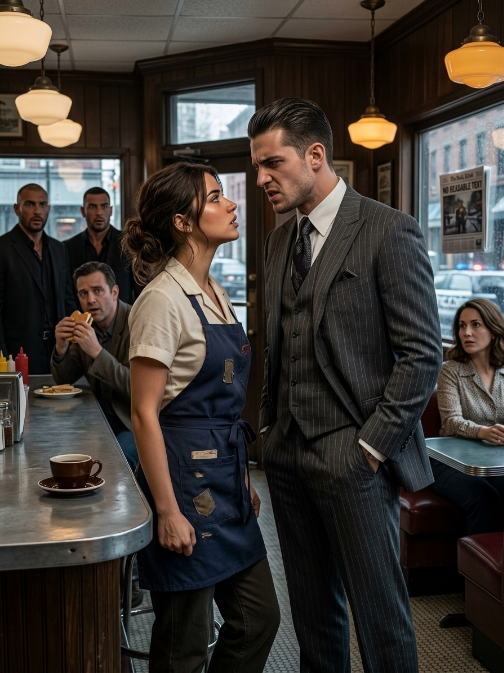
The dining room was a theater of cruelty disguised as a civilized meal. Four men besides Gabriel — Victor, thick-necked and staring; Dante, Gabriel’s lean, sharp-featured second-in-command, dragging his knife across his steak with unnecessary force.
“So,” Dante said, “this is the stray you picked up from the Costa Mesa game. I heard she cost you fifty large. Seems steep for a maid.”
The table went silent. Gabriel lifted his wine glass and drank, watching, waiting. Testing her.
Nora set her fork down with a sharp, deliberate click. “Fifty thousand is an interesting number for *you* to scoff at, Dante,” she said, calm and low. “Especially considering you authorized a sixty-two-thousand-dollar payment to a shell company in the Caymans last month for logistical oversight on a shipment that never required customs clearance. I audited the books this week. That money bypassed the central holding account entirely. It just vanished. If we’re discussing steep prices and useless assets, maybe we should start with your accounting practices.”
Dante’s sneer drained from his face. “You lying little—”
Gabriel moved faster than she could track — one hand shooting across the table, hauling Dante’s collar down into the wood, crystal toppling, wine bleeding across white linen.
“Finish that sentence,” Gabriel whispered, “and I will cut your tongue out and feed it to you in front of this table.”
Dante went pale and shook his head. “My mistake, boss. Just a misunderstanding.”
Gabriel held him three more agonizing seconds before shoving him back. He calmly dabbed a drop of wine from his cuff. “Nora is not a stray. She is not a maid. She’s the reason this organization isn’t hemorrhaging cash right now. Her word is my word. If she finds a discrepancy, I find a body. Understood?”
A chorus of tight, frightened *yes, boss* answered him. No one spoke to her for the rest of the meal. Nora sat in the emerald silk, pulse settling into something steady and powerful, and caught Gabriel’s eye across the table — no warmth in it, just raw, unadulterated approval.
The wine tasted like victory. She hated how much she loved the flavor.
—
By two in the morning the house was empty, rain hammering the windows again. Nora stood barefoot in the kitchen, pouring cold water, the adrenaline long since crashed into something hollow.
Gabriel’s footsteps came up behind her — she didn’t flinch anymore. He’d shed his jacket and tie, top buttons open, smelling of scotch and cigar smoke.
“You missed a discrepancy in the Cayman file,” he said, staring out at the black night.
“I double-checked the routing numbers. Sixty-two thousand was the only anomaly.”
“I didn’t say there was a financial error. I said you missed a discrepancy. You implied Dante stole the money. He didn’t.”
Her mouth went dry. “Then who did?”
“I did,” Gabriel said. “I funneled it to a private account. It was a test — to see if Dante was tracking my blind spots.”
She stared at him, processing the layers of manipulation. “You let me accuse him. You let me put a target on my own back, knowing he was innocent.”
“I needed to see if you had teeth.” He stepped closer, the air between them compressing. “I needed to know if you were just a victim who knew how to hide, or if you knew how to bite back. You bit.”
“You used me.” Her voice trembled — not with fear, but with a sudden, hot surge of anger. “I’m not one of your soldiers, Gabriel. I’m not a piece on your chessboard.”
“Aren’t you?” Another step. She had to tilt her head back to hold his gaze. “You sat at my table. You wore my colors. You ruined a man’s reputation with one sentence. You’re on the board, Nora.”
“I don’t have a choice.”
“There’s always a choice.” His gaze dropped to her mouth and back up, heavy, possessive. “You could have stayed quiet. But you liked it. I watched you drink that wine after you gutted him. You enjoyed the power.”
“I hate it,” she lied, and the words tasted like ash.
Gabriel reached out — she braced for pain, but his hand simply cupped the side of her neck, thumb brushing her jaw, rough and deliberate.
“You are a terrible liar,” he murmured.
She couldn’t breathe. The scent of him — smoke, alcohol, danger — was intoxicating, and the anger and adrenaline and sheer exhausting relief of being *seen*, not as a victim, not as collateral, but as something dangerous, snapped the last wire in her brain. She grabbed the front of his shirt and pulled him down.
The kiss wasn’t romance. It was collision — teeth, friction, bruising pressure. He groaned low into it, one hand tangling in her hair, the other banding around her waist, lifting her off the floor entirely. She kissed him back with all the rage and terror she’d swallowed for three years, until her back hit the marble counter and he tore away with a sharp wince, his stitches protesting.
“Your stitches,” she gasped.
“Screw the stitches,” he rasped, but he didn’t pull back — just rested his forehead against her shoulder, chest heaving, breath hot against her collarbone. They stood like that a long time, rain washing the windows, the silence heavy with the certainty they’d crossed a line.
She wasn’t just his bookkeeper anymore. She was his accomplice. And holding the monster in the dark, feeling his blood and breath against her skin, she realized the most terrifying truth of all — she didn’t want to be anywhere else.
—
Sunlight felt like an assault the next morning. Nora woke with bruised lips and an aching back, Gabriel long gone from the kitchen, only the ghost of scotch left on her tongue and a profound shift in her reality. She scrubbed her skin in the shower as if she could wash away the complicity. It didn’t work. The woman in the fogged mirror wasn’t the terrified girl from the alley anymore. She was someone who had tasted power and swallowed it whole.
The illusion of a quiet morning shattered at 9:14 a.m. — not with an explosion, but a subtle drop in air pressure, followed by a heavy crack as the reinforced front doors buckled. Then the house alarm, a low bone-rattling pulse, and gunfire — chaotic, deafening, nothing like the movies.
Plaster exploded in the hallway. A framed photograph disintegrated into glass dust. Nora’s knees gave out on the hardwood.
“Nora!” Gabriel’s voice tore through the alarm. Her bedroom door came off its hinges as he filled the frame — tactical vest, rifle, a smear of blood across his cheekbone. “Get up! Dante sold the gate frequency to the Russian syndicate. They bypassed the perimeter. We have four minutes before they breach the inner doors.”
He hauled her into a hallway thick with acrid smoke. “Where’s Leo?” she choked out.
“Holding the foyer.” He fired twice down a stairwell without breaking stride, dragging her toward a heavy steel door at the end of the east-wing corridor — the wing she’d been told never to enter. He slammed his palm against a biometric scanner. Red light. Access denied.
“Dante wiped the local network,” Gabriel snarled, drawing his sidearm. “He’s locking us out of the bunker. He’s executing a hostile takeover of the digital infrastructure while his new friends slaughter my men.”
Nora’s terror crystallized into something else — clarity. She didn’t know how to shoot. But she knew Dante’s mind; she’d spent a week inside his ledgers, and Dante was no tactician, just a parasite who relied on automation. “The server room,” she said. “Where’s the physical hardware?”
“Basement level. Why?”
“Because Dante routes his secondary overrides through the main accounting terminal. If we get to the servers, I can bypass the biometric firewall through a backdoor I found in his offshore software.”
Boots pounded on the stairs behind them, men shouting in a language she didn’t know. “If we go to the basement, we’re cut off from the extraction point,” Gabriel said flatly. “If you can’t open that door from the terminal, we die down there.”
She looked at the blood on his face, at the dark hallway, and remembered the rain in the alley — the feeling of being entirely powerless, waiting for someone else to decide her fate.
“I can open it.”
He didn’t hesitate. He grabbed her hand, fingers lacing through hers. “Run.”
—
The basement smelled of damp concrete and hot server racks, the cooling fans masking the sounds of the dying house above. Gabriel shoved her into the glass-walled server room and turned his back to guard the steel door.
“Two minutes, Nora.” He leaned against the frame, pressing a hand to ribs already seeping blood through his shirt. “They’re sweeping the ground floor. They’ll find the stairwell soon.”
She dropped into the chair, fingers — dusted with plaster, shaking slightly — finding the keyboard by muscle memory. Black screen, white text, a logical, bloodless battlefield. Dante had reused the same encryption key for the security grid that he used for his slush funds — a classic mistake made by arrogant men who believed themselves untouchable.
“They’re on the stairs,” Gabriel said, terrifyingly calm, ejecting a spent magazine.
“I’m in the local network,” she called back, locating the biometric lock directory. Another window popped open — an active transfer protocol. Dante wasn’t just locking them out. He was draining Gabriel’s primary operational accounts into a blind trust in Malta, stripping the empire to the studs while they were trapped underground.
“Gabriel — he’s draining the accounts. All of them.”
“Let it go. Just open the bunker.”
She stared at the progress bar. Forty-two percent. If Dante emptied the accounts, the cartel would collapse — no money for soldiers, no loyalty to buy. Even if they survived tonight, Gabriel would rule over ashes, and rival syndicates would tear him apart within a week. If Gabriel fell, she fell. She’d be right back in the alley, a penniless widow of a dead man who was never even her husband.
“No,” she whispered.
“Nora, open the damn door!” Bullets shattered plaster in the hall outside.
“I’m opening it. But I’m doing something else first.” She didn’t try to stop the transfer — that would trigger fail-safes. Instead she opened a second terminal and altered the destination, routing it through a dummy shell corporation she’d quietly set up two days earlier, signatory: Nora, and nobody else. She deleted Dante’s Malta account number. She pasted her own.
Enter.
The progress bar stuttered, turned green, resumed. Sixty-five percent. Eighty. Gabriel fired twice — a body hit the floor outside with a wet thud. She tabbed back, found the bunker’s lock protocol, and typed *open*.
A massive mechanical groan shuddered through the concrete. The vault door swung inward.
“It’s open!” She grabbed the external drive from the console, shoved it in her pocket. Gabriel hauled her out of the server room toward the vault as gunfire erupted behind them, concrete chips stinging her legs like angry wasps. They dove through. He slammed the manual override; the steel hinges shrieked shut, sealing them into absolute pitch-black silence.
Emergency lights flickered on, sickly yellow over a sparse concrete room — cots, rations, a medical kit, a communications terminal. Gabriel slumped against the vault door, his shirt soaked through, his stitches torn open by the exertion.
“You’re bleeding,” Nora said, crawling toward the medical kit.
“Leave it.” His grip on her wrist was weak. “We’re secure. Two feet of reinforced concrete. They can’t get in.” He opened his eyes, adrenaline fading into naked exhaustion, and underneath it, a heavy, dark awe. “You got the door open.”
“I did more than that.” She pulled the encrypted drive from her pocket and set it on the floor between them. “Dante tried to take the operational funds. I hijacked the transfer.”
His brow furrowed. “You stopped him?”
“No. I let him initiate the drain so the bank wouldn’t flag it. But I changed the destination.” She looked at her hands, covered in concrete dust and his blood. “The money’s in an account only I control. Sixty-eight million dollars.”
Silence, but for the hum of the air filtration system. Gabriel stared at her — not angry, not betrayed. He looked like a man who’d watched a storm tear the roof off his house and found he admired the lightning.
“You stole my entire empire,” he said softly.
“I secured your empire,” she corrected, meeting his eyes without flinching. “Dante thought you were weak because you bled. He thought I was weak because I was bought. He was wrong on both counts.”
A rough laugh broke into a grimace of pain. He reached out, bloody hand cupping the back of her neck, pulling her forehead to his. “You could have routed it to yourself and left me to die in that hallway. With that kind of money, you could have vanished. No one would ever find you. Why didn’t you run, Nora?”
She closed her eyes, leaning into the rough warmth of his hand. The truth was ugly and beautiful and deeply contradictory — she had traded a suburban hell for a cartel war zone, and sitting in a concrete box that smelled of copper and cordite, she felt entirely rooted for the first time in her life.
“Because running is for prey,” she whispered, opening her eyes to his. “And I am tired of being prey.”
“You aren’t prey, Nora.” His thumb traced her jaw. “You’re the apex.”
He kissed her, tasting of dust and adrenaline — not a kiss of possession this time, but something closer to a coronation.
—
It took three months for the blood to fully wash out of the estate’s hardwood floors. The retaliation had been swift, quiet, and absolute. Gabriel didn’t wage a loud war on the streets — he used the digital footprint Nora had ripped from Dante’s servers to dismantle the Russian syndicate’s supply chains piece by piece, freeze their assets, leak their shipping routes to the DEA. Without money or product, their soldiers scattered. Dante was found a week later, locked inside a shipping container at the docks. Nora never asked how long he’d been alive in there. She didn’t want to know, and the terrifying truth was that she didn’t care.
Autumn turned the coastal air brittle. Nora stood on the catwalk of a heavily guarded warehouse overlooking the bay, watching crates of untaxed goods loaded onto freight trucks below, the logistics flawless after eight weeks of stripping out every inefficiency Dante had left behind. She wore a tailored charcoal suit that fit like a second skin, her hair pulled into a severe knot. She didn’t look like the girl in the oversized sweater anymore. She didn’t feel like her either.
Gabriel climbed the catwalk stairs, handing her a paper cup of black coffee, moving with a slight permanent stiffness on his left side. “The offshore accounts cleared,” he said, leaning on the railing. He never asked for the passwords. He never had — he trusted her with the lifeblood of his organization because he knew she was the one keeping its heart beating.
“Good. The shell companies are fully insulated. We’re liquid, untraceable, and twenty percent more profitable than last quarter.”
“You’re a terrifying woman, Nora.”
“I learned from a terrifying man.”
A heavy door rolled open at the far end of the warehouse with a screech. A black SUV pulled in, flanked by armed guards. A new enforcer named Hayes hauled two figures out onto the concrete. Nora’s stomach gave an old, unwelcome lurch.
Diane and Khloe. The veneer of cheap suburban polish was entirely gone — Diane’s dyed hair a greasy tangle, her tracksuit stained; Khloe thin and hollow in an oversized hoodie, both of them shaking in the cold warehouse air.
“Boss,” Hayes called up, “found these two trying to secure a loan from a family down south. Dropped your name as collateral. Said they were family.”
Gabriel said nothing. He stepped back, arms crossed, yielding the floor. Nora handed him her coffee and walked down the metal stairs, each step ringing out like a gavel.
Diane’s eyes went wide with frantic relief. “Nora!” She tried to run forward; Hayes yanked her back by the collar. “Thank God. Sweetie, you have to help us.”
Nora stopped ten feet away and looked at the woman who had made her childhood a ledger of debts and bruises. She expected rage. She expected the old urge to hit her, to make her feel an ounce of what she’d inflicted. Instead she felt nothing at all — a void colder than the concrete under her feet.
“You owe someone money,” she said. It wasn’t a question.
“Just a little,” Diane babbled, mascara running. “Eighty thousand. A bad run at the tables. You can pay it, right? Look at you, you’re doing so well. Tell Mr. Costa to cover it. We’re family.” Khloe wouldn’t meet her eyes, jaw trembling, staring at the concrete.
“You sold me for fifty thousand dollars,” Nora said quietly, and it carried clearly through the cavernous space. “You depreciated my value to cover your own failures.”
“We did what we had to do to survive,” Diane sobbed, dropping to her knees. “Please, Nora. They’ll break Khloe’s legs. You can’t let that happen. You were always such a good, helpful girl.”
The audacity of it was almost impressive — pulling strings on a puppet that no longer existed. Nora looked up at the catwalk. Gabriel was watching, expression unreadable. This wasn’t his ledger to balance. It was hers.
“I was a good girl,” Nora agreed softly. “But good girls don’t survive the dark, Diane. You taught me that.” She turned to Hayes. “What’s the standard penalty for dropping our name without authorization?”
“Usually we take a hand,” Hayes said, without blinking. “Since they’re civilian debt risks, we just hand them back to their creditors with a message that they have no backing from us.”
Diane screamed, a raw, animal sound. “No — you owe me! I kept a roof over your head. I fed you.”
Nora walked closer, close enough to smell the stale alcohol and fear on her stepmother’s breath. “You kept me as a slave. And then you sold me to a monster.” Her voice dropped, venomous and calm. “But you made a fatal miscalculation, Diane. You assumed the monster was going to break me.”
She straightened, smoothing her jacket. “I’m not a charity, and I don’t pay off bad debts. Hand them over.”
“Yes, boss,” Hayes said, dragging a thrashing, screaming Diane toward the SUV. Khloe followed numbly, crying without a sound. Nora didn’t watch them go. She turned and climbed the metal stairs, a heavy, imperfect, brutal satisfaction settling in her chest.
At the top, Gabriel handed her coffee back without a word. He didn’t ask if she was okay. He knew she was.
“The shipment clears customs at midnight,” she told him, looking out over the warehouse floor.
He stepped close behind her, his chest against her back, one arm circling her waist and pulling her securely into him. She leaned her head back against his shoulder, breathing in cologne and cold warehouse air.
“Let it clear,” Gabriel murmured, pressing his lips to the side of her neck. “The empire runs on your schedule now.”
She closed her eyes. The girl shivering in the wet alley was gone. In her place stood the architect of the underworld, held in the arms of the devil himself — and the terrifying truth was that the dark had never once felt more like home.
**THE END**