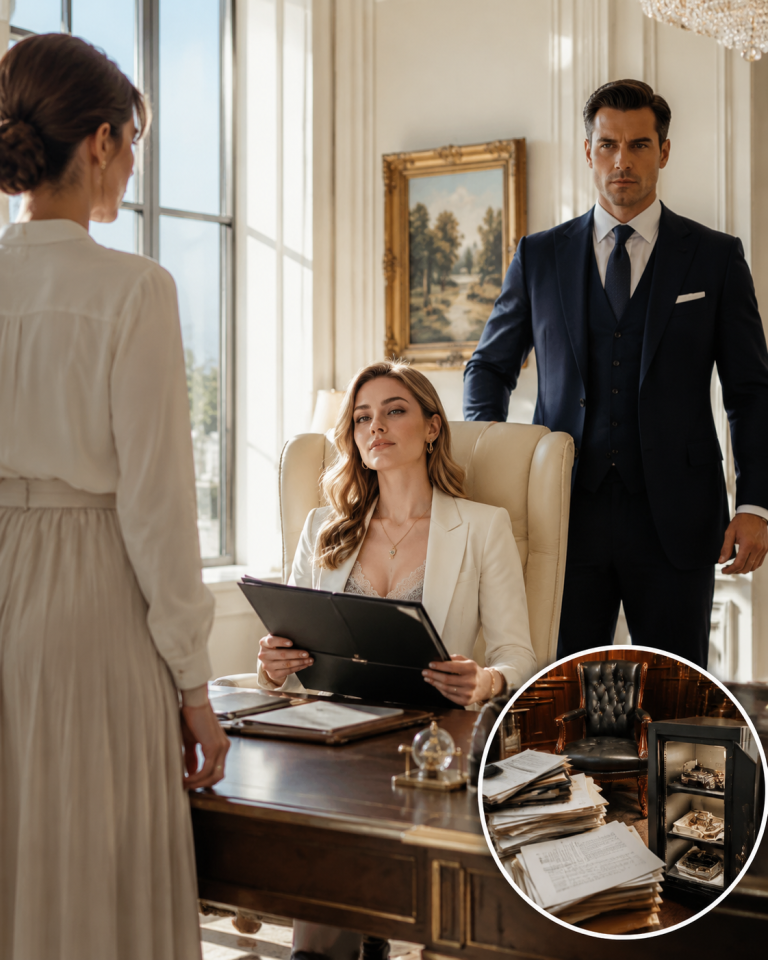
HIS MISTRESS PINNED A BADGE TO MY DRESS THAT SAID “FORMER MRS. ELLISON” — SHE DIDN’T KNOW I WAS ALREADY THE CHAIRWOMAN OF HIS FAMILY’S FOUNDATION

PART 1
Henry Ellison was the only person in his family who looked Nora in the eye.
He had been gruff, old-fashioned, and allergic to flattery — the kind of man who built things and then watched with bemusement while his descendants argued about who deserved credit for them. He had watched Nora for ten years. He had watched her write the foundation’s speeches, visit the hospitals, remember donors’ children’s names, send handwritten notes after funerals, sit beside Margaret at luncheons where she was introduced as *Grant’s wife* and never once as *Nora.*
Two years before he died, he called her into his study while Grant was in Palm Beach on a *business retreat.*
Henry sat in his leather chair with an oxygen tube under his nose and a stack of foundation reports in his lap. *Do you know why this foundation still functions?*
She smiled because she thought he was about to praise his son. *Because your name still opens doors.*
*My name opens doors. Your work keeps them from closing.*
Then he told her to take the blue folder home.
She did not open it until after his funeral. Inside were trust amendments, board documents, handwritten notes, and a letter with her name on it. Henry had appointed her chairwoman of the Ellison Foundation. Not Margaret. Not Grant. Her. The appointment was legal, signed, witnessed, and deliberately delayed for public announcement until the annual gala, because Henry knew what his family was and knew what they would do if they had time to stop it.
The letter ended with one sentence she had read so many times the paper had gone soft at the fold.
*Do not confuse their volume for power.*
For six months, she said nothing. The board knew. The foundation attorney knew. The bank knew. Evan Mercer knew. The public did not. Margaret still walked through foundation offices like a queen returning to a throne she had never been promised. Grant still told donors he would *lead the next era.* Piper still posted discreet photos from charity lunches, always angled so Grant’s hand appeared in the frame.
Nora let them.
Silence is not weakness when you are gathering proof. It is a locked drawer.
—
She had met Grant at Duke, where he liked that she didn’t care who his grandfather had been. He used to say she was *real.* She was young enough to believe that was a compliment. By the time she understood that wealthy people call you *real* when they mean *useful,* she had already spent a decade helping Grant polish his family’s name.
The affair had not arrived like thunder. It arrived like weather.
Late meetings. New cologne. Phone turned face down. Passwords changed. Credit card statements missing. A husband who called her dramatic whenever she reacted to the life he was dismantling.
The first day she knew — truly knew — was the morning Grant brought Piper into their kitchen while Nora was unloading groceries. *This is Piper. She’s helping us modernize the foundation.* Piper gave her a smile so smooth it looked laminated. *I’ve heard so much about you.*
Nora looked at Grant’s collar. A pale pink lipstick mark. She looked back at Piper.
*I’m sure you have,* she said.
That was the first day she stopped begging her marriage to become something it was not.
Grant was not careless — that was what made it cruel. He did not leave, did not confess, did not ask for a divorce. He simply moved another woman into the emotional rooms of their marriage and expected Nora to keep dusting the furniture.
—
The night of the gala, Nora arrived alone.
She found Grant near the stage, laughing with Piper while Margaret adjusted Piper’s necklace.
Not a necklace.
Her necklace. A sapphire drop Henry had given her after the foundation opened its first women’s shelter.
Something inside her tore. Not loudly. Not dramatically. A clean, final tear, like silk ripping in the dark.
Margaret saw her looking and gave a soft little wave.
Then Piper walked toward her with the silver tray of badges and the rehearsed smile and the four words pressed in clean black letters, and the ballroom blurred at the edges.
For one second, Nora saw herself from far away. A wife. A woman. A public joke.
They wanted the scene. They wanted tears and a raised voice and her dignity cracked open under chandeliers, recorded from three angles, documented as evidence that she was unstable. They wanted her pain to look like a personality flaw.
So she smiled.
She unpinned the badge. Walked to Evan. Handed it over. And felt the first door open when he turned it over, scanned the QR code, and said the words that would spend the rest of the evening doing their work:
*Only the foundation chairwoman’s office could print these badges.*
Margaret’s face carved itself into marble.
Grant grabbed Nora’s elbow — not hard enough to bruise, hard enough to remind her he knew where bruises would show. She looked at his hand. Then at his face.
*Remove your hand.*
He smiled for the room. *Nora, please.*
*Remove your hand, Grant.*
Three people heard the second time. He let go.
Margaret leaned close, pearl earring brushing Nora’s cheek. *You are still here because I have allowed it.*
For ten years, Nora had believed her.
Marriage shrinks a woman in invisible ways. Not all at once. Not with one cruel sentence. It happens when your husband corrects the way you laugh at dinner. When his mother says your dress is *brave.* When your grief is inconvenient. When your anger is unattractive. When your intelligence is useful only if it serves the family. Eventually, you learn to make yourself smaller before anyone asks.
That night, she stopped.
*Enjoy the gala,* she told Margaret.
Then she walked away. Not fast. Not proudly. Just away.
The silence behind her told her it was enough.
At Table Seventeen — where her place card had been moved, two seats down from her rightful spot beside Grant, now occupied by Piper in white — a retired dentist named Dr. Halpern looked at her face and pushed the bread plate across the table.
*I saved you the better roll.*
It nearly made her cry.
Kindness is most dangerous when you are trying not to feel anything.
She thanked him and placed the roll on her plate.
Across the ballroom, Grant was laughing too loudly. Piper leaned into him. Margaret whispered into the ear of a board member named Charles Whitcomb, who looked at Nora and then quickly away.
At eight o’clock, the lights dimmed for the video.
The editors had tried to cut Nora out. They had not succeeded.
A sleeve here. A hand there. The back of her head beside Henry in the rain. Her voice reading names during a memorial fund announcement. Her handwriting on a giant donation check.
You can erase a woman from a caption.
It is harder to erase the work she did.
After the video, Margaret walked to the podium and used gentle words for brutal things. *Transition. Closure. Fresh energy.* She thanked the woman who had helped her son *rediscover joy.* Piper rose from her chair in white — white, at a charity gala, the bold choice of a woman who wanted to look like a bride — and Grant stood beside her and took her hand.
Then Margaret said: *Sometimes love asks us to be brave enough to step into the future.*
Piper touched the sapphire at her throat.
Nora looked at it. The necklace had not been in Grant’s safe. It had been in hers. Grant could not have taken it without the code. Only three people knew that code.
Only one of them would have called this an emergency.
She picked up her water glass. Her hand was steady.
That surprised her. There is a stage of heartbreak beyond shaking — the place where something inside you has already left the building, and what remains is the cold, clear capacity to act.
Then Grant took the microphone and performed the public mercy.
*She has been part of this family’s story for a long time.* Not wife. Not partner. Part of the story. Like a chapter he had finished reading. *I hope tonight can be the beginning of healing for all of us.*
Healing.
He was not asking for healing. He was asking for applause for stabbing her carefully.
Margaret began clapping.
Nora did not.
She sat still. That made the applause uncomfortable.
Good.
Then the ballroom doors opened.
Not dramatically. No thunder. No music. Just a quiet click of old brass handles.
A man entered carrying a black leather portfolio.
Behind him walked a woman in a charcoal suit with cropped gray hair and the expression of a judge who had heard every lie twice.
—
PART 2
Silas Reed had been Henry Ellison’s attorney for thirty-one years.
He had a voice like dry paper and a spine made of courthouse marble. People underestimated him because he moved slowly. That was foolish. Silas did not move slowly because he was weak. He moved slowly because he had never needed to chase anyone.
He reached the stage and waited.
Grant gripped the microphone. *Silas. We are in the middle of the program.*
*I know. The program has been amended.*
Margaret stepped forward. *By whose authority?*
Silas looked at her. *By the foundation chairwoman’s authority.*
The room felt the shift. Not enough to understand it yet. Enough to lean in.
Grant laughed once. *Nora is not —*
He stopped.
Nora watched the exact second it arrived: the memory of the board packets he hadn’t read, the meetings he’d skipped because Piper wanted him in Miami, the documents he’d assumed his mother had handled. The accumulated cost of trusting his own assumptions.
Silas opened the portfolio. *Before we continue tonight’s awards, the board will record a formal compliance matter.*
Margaret’s voice went cold. *This is neither the time nor the place.*
Judge Alma Carver, retired from the South Carolina Court of Appeals and newly appointed independent board trustee, took the microphone from Grant’s hand. He let her, because men like Grant obey authority when it wears the right suit.
*This is precisely the time,* Alma said. *And unfortunately, this is the place chosen by the parties involved.*
A murmur spread across the ballroom.
Piper looked at the side exit.
Evan was already there. Not blocking it. Just standing near it with a polite expression.
Silas removed a document and began to read.
*On June nineteenth of last year, Henry Ellison executed the final amendment to the Ellison Foundation governance trust. Upon his death, the office of foundation chair transferred not to Margaret Ellison, nor to Grant Ellison, but to Nora Walker Ellison.*
The room made a sound Nora had never heard before.
A wealthy gasp. Soft. Controlled. Devastated.
Margaret’s face drained of color.
Grant looked at Nora as if she had committed a crime by standing where Henry had placed her.
Piper said, *What?*
Silas turned a page.
*The appointment was accepted in writing, certified by the board, and filed with the state. It has been in effect for six months.*
Six months.
The words moved through the room like candle flame. Every donor who had spoken around her recalculated. Every cousin who had pitied her reconsidered. Every board member who had ignored her emails remembered urgent respect.
Margaret recovered first. She always did. *That appointment was ceremonial.*
Alma looked at her.
*No.*
The word landed cleanly. Margaret’s mouth shut.
—
PART 3
Silas continued without pause, because truth rarely needs to run — it knows everyone else is trapped.
*The chairwoman delayed public announcement at counsel’s recommendation pending a review of foundation expenditures.*
Grant’s hand tightened around Piper’s.
That was the second mistake. The first had been the badge. The second was showing the room exactly who he was afraid for.
Silas lifted another document. *Over the past ninety days, the foundation’s independent compliance review has identified irregular charges submitted under development, brand consulting, hospitality, travel, and donor engagement.*
Piper’s face went pale beneath her makeup.
Margaret smiled again, but this one was brittle. *Administrative confusion is hardly gala entertainment.*
*No,* Alma said. *Humiliation is apparently gala entertainment.*
The room went silent.
Nora looked down at her hands. She did not want to enjoy this. That was the strange thing about justice — people imagined it felt like fireworks. Often, it felt like grief finally receiving paperwork.
Silas nodded toward Evan.
Evan stepped forward with the clear evidence sleeve. Inside was the badge.
*Former Mrs. Ellison.*
The words looked smaller in the sleeve. Cheap. Almost silly.
Silas held it up. *This item was issued tonight to the foundation chairwoman under a false title. It was printed at 4:13 p.m. from the chairwoman’s office printer using an administrative override code.*
Margaret looked at Nora.
Her eyes were not frightened. They were furious. That was her confession before any document could speak.
*The office camera shows Margaret Ellison entering at 4:07 p.m. with Piper Wells.*
Piper whispered, *No.*
Silas looked at her. *Yes.*
The word was not cruel. It was worse. It was factual.
Evan handed Silas a second sleeve. Inside was a glossy photograph from the security feed. Margaret at Nora’s office desk. Piper leaning over the badge printer. Both of them smiling.
The room did not gasp this time. It absorbed.
Absorption is worse than shock. Shock can fade. Absorption becomes memory.
Margaret stepped toward the stage. *That office was mine for twenty years.*
*It was Henry’s,* Silas said. *Then it became Nora’s.*
Margaret’s lips parted. She looked suddenly older. Not weak — never weak — but less permanent. As if the frame she had built around herself had developed a fault line that the room could now see.
Grant stepped forward. *This is a private family matter.*
That was when Nora stood.
The chair legs made a soft sound against the ballroom floor. Every face turned.
She did not walk quickly. A woman rushing toward her own defense looks desperate. She had been desperate. But not anymore.
By the time she reached the podium, Alma handed her the microphone. Her hand squeezed Nora’s once. Not pity. Permission.
She looked out at the room. Donors. Board members. Cousins. Reporters from society pages. Women who had smiled at Piper and avoided her eyes. Men who had known about Grant’s affair and called it complicated. People who had watched a mistress pin a badge to a wife’s dress and waited to see if the wife would bleed.
She took one breath.
*My name is Nora Walker Ellison.*
Grant looked down.
Piper looked at the floor.
Margaret stared with a hatred pure enough to polish silver.
*I am Grant Ellison’s legal wife.* A few people shifted. *I am also the chairwoman of the Ellison Foundation.*
The microphone made her voice sound stronger than she felt. Or perhaps she had been stronger all along and only needed amplification.
*I did not authorize the badge given to me tonight.*
She paused.
*I did not authorize the use of foundation funds for private travel to Aspen, Palm Beach, or Miami under the name of donor engagement.*
Piper’s hand flew to her throat. To the sapphire.
*I did not authorize the transfer of a family jewelry item from my personal safe to a foundation contractor.*
Grant’s eyes snapped to hers.
He thought she would not say *jewelry* in public. He thought class meant silence. Men like Grant depend on women confusing dignity with self-erasure.
*For the record, my husband and I have not announced a divorce.*
She looked at Piper.
*So any public reference to me as his former wife is not only false.*
Then she looked at Margaret.
*It is premature.*
The room went completely still.
That word cut deeper than any insult would have. It turned their little joke into evidence. Their celebration into planning. Their confidence into motive.
Grant’s voice dropped. *Nora, stop.*
She looked at him.
*No.*
It was the first time she had said it to him in public.
It may have been the first time he understood it.
—
Silas placed another document on the podium.
*By unanimous emergency resolution, the board has suspended all discretionary spending privileges for Grant Ellison, Margaret Ellison, and Piper Wells pending completion of the forensic review.*
Grant stared. *You can’t do that.*
Alma answered before Silas could. *We just did.*
A donor near the front coughed into his napkin. It might have been laughter.
Margaret lifted her chin. *You are making a terrible mistake.*
Alma smiled without warmth. *Mrs. Ellison, I have spent forty years listening to people say that when they meant they had been caught.*
A few women looked down to hide smiles.
Piper touched Grant’s arm. *Grant.*
He did not look at her.
That was when she began to understand what mistresses often learn too late: a man who betrays one woman does not become brave for another. He simply looks for the nearest exit.
Silas continued. *The review also found that Ms. Wells’s consulting contract was extended without competitive approval, that several invoices lacked deliverables, and that an apartment in New York was billed as temporary donor accommodation while being occupied by Ms. Wells.*
Piper’s mouth opened. Nothing came out.
Nora remembered that apartment. Grant had told her it belonged to a shipping partner. He had spent four weekends there in the fall. She had spent those weekends repainting the guest room because she couldn’t sleep in their bed. Pain is strange — you can know the truth and still be wounded when it finally learns your address.
Grant’s voice sharpened. *Nora, this is enough.*
She turned to him. *Was it enough when she pinned that badge to my dress?*
His jaw flexed. *That was a joke.*
*No.* Her voice did not rise. *That was a plan.*
Piper started crying. Small, beautiful tears that slid without damaging her makeup. *I never wanted to hurt anyone.*
That sentence has been used to cover more harm than any lie in history.
*You wore my necklace,* Nora said.
Piper’s hand dropped from the sapphire.
Margaret stepped in front of Piper as if protecting a child. *That necklace belongs to the Ellison family.*
Nora smiled faintly. *No, Margaret. Henry gave it to me in writing.*
Silas removed a small envelope. He unfolded a note in Henry’s heavy script.
*To Nora, who turned our name into something useful.*
He paused.
*The sapphire is hers outright.*
Margaret’s face cracked. Just for a second. But Nora saw it, and so did Grant.
Piper slowly unclasped the necklace. Her fingers shook. She held it toward Grant.
He did not take it.
So she looked at Nora.
There are humiliations people plan for you. And there are humiliations they accidentally reserve for themselves.
Nora did not step forward. Evan did. He took the necklace with a white cloth and placed it into a sleeve. *Personal property. Documented.*
Piper stared at the empty space where the sapphire had been. Without it, without Grant, without Margaret’s protection, she looked like what she was: a young woman in a borrowed dress who had believed a man’s lies had a special exemption for her.
Nora did not hate her.
That surprised her. She had hated Piper in pieces for months — in the grocery store, in bed, at red lights, at three in the morning when Grant’s phone lit up with her name. But standing there, she saw something colder than hatred. She saw the pattern. Piper had not invented Grant. She had simply believed she was different.
Margaret touched Grant’s arm. *Say something.*
Grant looked at the crowd. He was calculating — she had watched him do it for years. Donors first. Family second. Truth last.
*Nora.* He tried tenderness. That old weapon. *We have both made mistakes.*
A sound moved through the room. Not sympathy. Disgust.
She almost thanked him. Of every sentence he could have chosen, he chose the one that split the room open.
*We. Both. Mistakes.*
She nodded. *You’re right.*
His face changed with relief.
*My mistake,* she continued, *was thinking silence would make you decent.*
The relief vanished.
Several people looked away. Not because she was wrong. Because she was clear.
She turned back to the guests.
*I apologize to every donor, partner, doctor, nurse, volunteer, and family represented here tonight.* She looked at the badge in its sleeve. *This foundation was built to serve people in crisis. It was not built to fund private cruelty.*
That sentence landed.
Not as applause. As recognition.
Every person in the room had seen cruelty disguised as tradition somewhere. A family dinner. A wedding toast. A hospital hallway. A will reading. A mother-in-law smiling with poison behind her teeth. A husband saying *calm down* while holding the match.
She was not just speaking about the badge anymore.
Silas leaned toward her. *There is one more item.*
Henry’s sealed letter. The one addressed to be read at the gala.
Margaret whispered, *No.* The first honest word she had spoken all night.
Nora opened it.
Henry’s handwriting filled one page. Her eyes blurred. She blinked and forced herself to read.
*My friends, if Nora is reading this, it means I am gone and my family is probably behaving worse than they think I knew.*
A startled laugh broke from the room.
Even Grant looked wounded.
Henry continued through her voice:
*I loved my wife, Margaret, but love did not make me blind. I loved my son, Grant, but blood did not make him entitled to stewardship. And I trusted Nora, not because she married into this family, but because she worked when others performed.*
Her voice shook on *worked.*
She stopped.
The ballroom stayed quiet. Nobody coughed. Nobody whispered. Nobody rescued her from the emotion. They waited.
*If you are tempted to ask whether she belongs in the chair, ask yourself who learned the names of the nurses, who stayed after storms, who read the grant applications, and who took my calls when everyone else was at lunch.*
A tear fell onto the paper. She did not wipe it away. This tear was not for Grant. It was not for Margaret. It was not for Piper. It was for the younger Nora who had done so much invisible labor and called it love because nobody had called it work.
She read the final paragraph.
*They will call you cold when you stop being convenient. They will call you ungrateful when you stop accepting crumbs. They will say you changed when you finally return to yourself.*
*Let them.*
She lowered the letter.
Applause rose without training. It started at Table Seventeen.
Dr. Halpern stood first. Then a nurse from the outreach program. Then a woman from the shelter board. Then a donor whose wife had died in a foundation-funded hospice wing.
Not everyone stood. Some remained seated because cowardice also likes formalwear.
Grant did not move.
Piper cried silently.
Margaret stared straight ahead, her hands folded, her empire shrinking around her.
Nora did not smile. This was not victory the way people imagine victory. Her marriage was still a ruin. Her heart was still tired. Her body still remembered Grant’s hand on her elbow. The badge still existed.
But the lie had lost its room.
And sometimes that is the first clean breath after years underwater.
—
After the applause faded, the dinner was served. The awards were given. The nurses were honored. The scholarship recipients spoke. A seventeen-year-old girl named Maya said the foundation had paid for her mother’s treatment and her own college applications. Her voice shook. Her mother cried. The room remembered why it had gathered before Margaret turned it into an execution.
Nora sat at Table Seventeen and ate two bites of salmon.
Dr. Halpern offered her the better roll again.
She laughed. It felt strange in her chest. Rusty. Alive.
Grant approached during dessert, after the photographers moved away. He had waited because Grant always arranged his face before performing.
*Nora. Can we talk somewhere private?*
*No.*
He lowered his voice. *You blindsided me.*
*You gave your mistress a badge that called me your former wife while I was still wearing your ring.*
*I did not print it.*
*No.* She tilted her head. *You just enjoyed it.*
That landed harder. Grant could deny actions. Enjoyment was harder to explain.
He sat in the empty chair beside her — she did not invite him — and tried the sacrifice. *My mother went too far.*
When cornered, weak men offer a woman older than them to the fire.
*She did not move your hand to Piper’s back,* Nora said. *She did not put lipstick on your collar. She did not use your phone to text “I miss your skin” while I sat beside you at Henry’s hospice bed.*
Grant’s face collapsed. *You saw that?*
*I saw everything.*
That was not completely true. She had not seen everything. But she had seen enough. Enough is a country women reach long before they announce arrival.
*I was lonely,* he said.
She almost felt sorry for him. Lonely was the word people used when they didn’t want to say selfish.
*You had a wife. You had a home. You had a family name, a foundation, a trust, a room full of people trained to forgive you before you apologized.* She looked at him. *You had a daughter-in-law who stayed when anyone with less patience would have left.*
His eyes filled. Once that would have moved her. Once she would have reached for his hand and mistaken his tears for transformation. But a woman can love a man for years and still finally learn the difference between remorse and fear.
*What happens now?* he asked.
She looked at her ring. A platinum band with a diamond Grant had chosen because his mother said oval stones looked more refined. She slid it off. Slowly. Not for drama. For accuracy.
She placed it on the table between them.
*Now you call your lawyer.*
His breath caught. *Nora.*
She took the ring from the table and placed it in his palm.
*Do not lose this. You will need it for the inventory.*
Then she walked away.
Behind her, Dr. Halpern muttered, *Good girl.*
She turned back. He looked embarrassed. *I apologize.*
She smiled at him. *No need.*
—
At the lobby entrance, she found Piper.
Standing near a marble column, wiping her cheeks with a cocktail napkin. Without the sapphire, without Grant, without Margaret’s protection, she looked younger. Almost unbearably young.
She stiffened when she saw Nora. *I didn’t know.*
Nora waited.
*I didn’t know you were the chairwoman.*
Not: *I didn’t know you were his wife.* Not: *I didn’t know I was hurting you.* Not: *I didn’t know this was cruel.*
I didn’t know you had power.
*Now you do,* Nora said.
Piper’s eyes dropped. *Grant told me your marriage was over. He said you were cold.*
*Men call women cold when they can no longer warm themselves at our expense.*
A pause. *I’m sorry.*
Nora studied her. Maybe she was. Maybe she was sorry for the wrong reasons. Maybe that was all she had access to. Nora was too tired to sort her soul for her.
*The next time a man invites you to help humiliate his wife,* she said, *ask yourself why he needs an audience.*
Piper’s mouth trembled.
Nora left her there and walked out into the Charleston night.
The live oaks along the street held their moss like old secrets. For the first time all evening, nobody was looking at her.
Her phone buzzed. Messages arriving like rain — board members, friends, women she barely knew. *I’m so sorry. You were incredible. I wish I had stood up sooner.* She deleted most of them. Apology after public proof is not the same as courage before it.
One message she kept.
Her mother: *Come home when you are ready, baby.*
That was when she cried. Not loudly. Not beautifully. She cried like a woman whose body had waited all night for permission.
Evan found her ten minutes later.
He did not ask if she was okay. Smart man.
*Your car is here, Madam Chairwoman.*
She laughed through tears. *That sounds ridiculous.*
*It sounds accurate.* He handed her a small envelope. Inside: the badge record, security stills, the incident log. *For what it is worth, Mrs. Ellison, I have done events for many families. Most of them mistake silence for weakness.*
*What do you mistake it for?*
*Timing.*
—
She slept that night at a small hotel near the harbor. Not in the bridal suite at The Wentworth. Not in the house on Tradd Street where Grant and she had lived inside wallpaper chosen by Margaret.
She took off her dress and hung it over a chair. There was a tiny hole where Piper had pinned the badge. She touched it. That hole should have made her angry.
Instead, it felt like a period at the end of a sentence.
Silas arrived in the morning with coffee and documents. The board had confirmed the suspensions. Margaret had threatened litigation. Grant’s attorney had called. Piper’s contract was terminated. The New York apartment lease canceled. Foundation accounts secured. A folder with divorce attorney referrals, financial inventory, property list, photos of Piper in the necklace, copies of the charges.
A marriage converted into paper.
She should have felt hollow. Instead, she felt organized. That is not a romantic word. But after chaos, organized feels like oxygen.
Grant fought the divorce for exactly thirteen days. Then his personal accounts were reviewed. Then he became very cooperative. It is remarkable how quickly a man discovers civility when discovery becomes literal.
He asked to keep the house.
She gave him the wallpaper.
She kept the shelter fund. The sapphire. Henry’s letter. Her name until the divorce was final.
Then she changed it back.
Nora Walker.
Not because Ellison had no value. Because Walker had carried her before Ellison tried to own her.
—
The foundation changed.
Not by erasing Henry’s name — that would have been small. Instead, it became honest. An ethics firewall. Published audited reports. A grant program for women rebuilding after financial abuse. Hospital advocates for spouses quietly isolated by powerful families. The room that tried to shame her became a budget line for women who needed doors.
The first recipient of the Walker Resilience Grant was a woman named Denise from Greenville. Her husband had locked her out of every account after she filed for separation. She arrived with a grocery bag full of documents and a face that looked like Nora’s had looked for years: careful, apologetic, exhausted.
*I don’t want to ruin him,* Denise said.
*You are not ruining a man by surviving what he did.*
She cried. Nora passed her tissues. Then called the attorney they funded for exactly these cases.
That afternoon, Nora took Henry’s letter from her drawer and read the last lines.
*They will say you changed when you finally return to yourself.*
*Let them.*
She placed it back carefully.
Then she looked at the framed badge on her shelf.
Yes. She had framed it.
People expected her to burn it. But some evidence deserves a frame. Not because it hurt her. Because it failed.
—
A year after the gala, she returned to The Wentworth House for the foundation’s annual dinner.
The orchids were different. The chandeliers the same. The room still full of crystal and money and people who knew how to stare politely.
But she was different. Not louder. Not harder. Whole in places she had abandoned to keep peace.
At registration, Evan handed her a badge.
Simple. Clean.
*Nora Walker. Chairwoman.*
No joke. No cruelty. No borrowed title.
She pinned it to her own dress.
Across the room, a young woman from the shelter program waved. Beside her stood her small son in a suit too big for his shoulders, holding a cookie in each hand with the satisfaction of a child who has recently discovered abundance.
Nora waved back.
For the first time in years, she felt no need to search the room for Grant. Did not wonder if Margaret approved of her dress. Did not wonder who was whispering. Did not wonder whether she looked graceful enough while surviving.
That was the warmest kind of freedom.
Not revenge. Not applause. Not the collapse of the people who had hurt her.
Freedom was standing in a room that had once tried to rename her and knowing exactly who she was.
A badge can label a woman.
It cannot define her.
And sometimes the thing they pin on you to mark your ending becomes the first piece of evidence in your beginning.
—
*THE END*