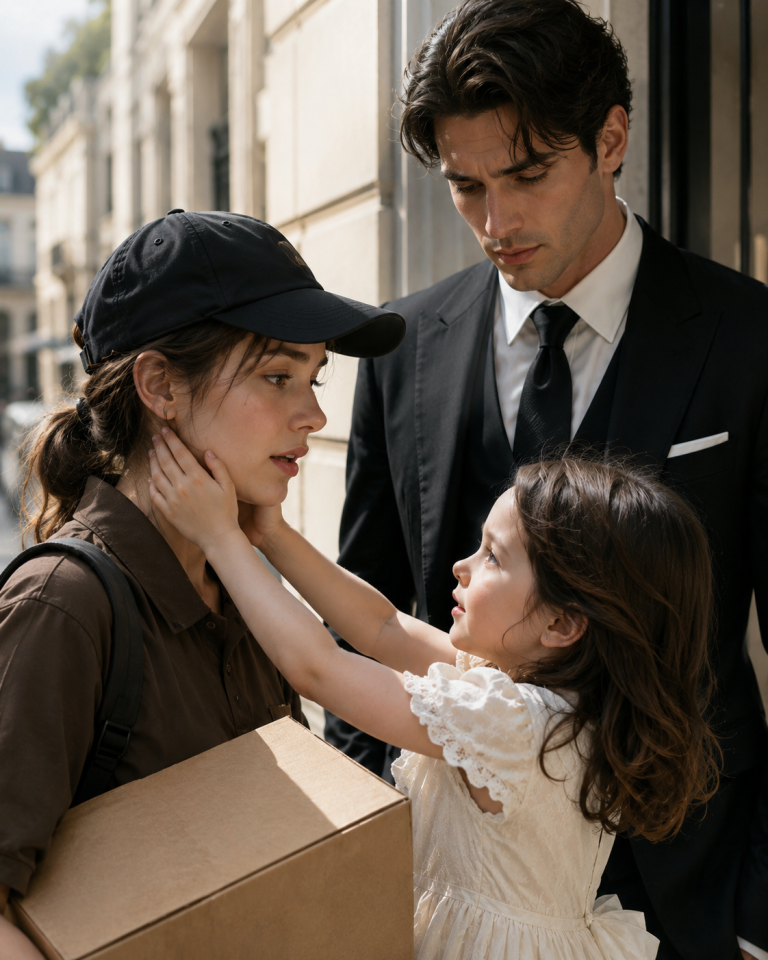
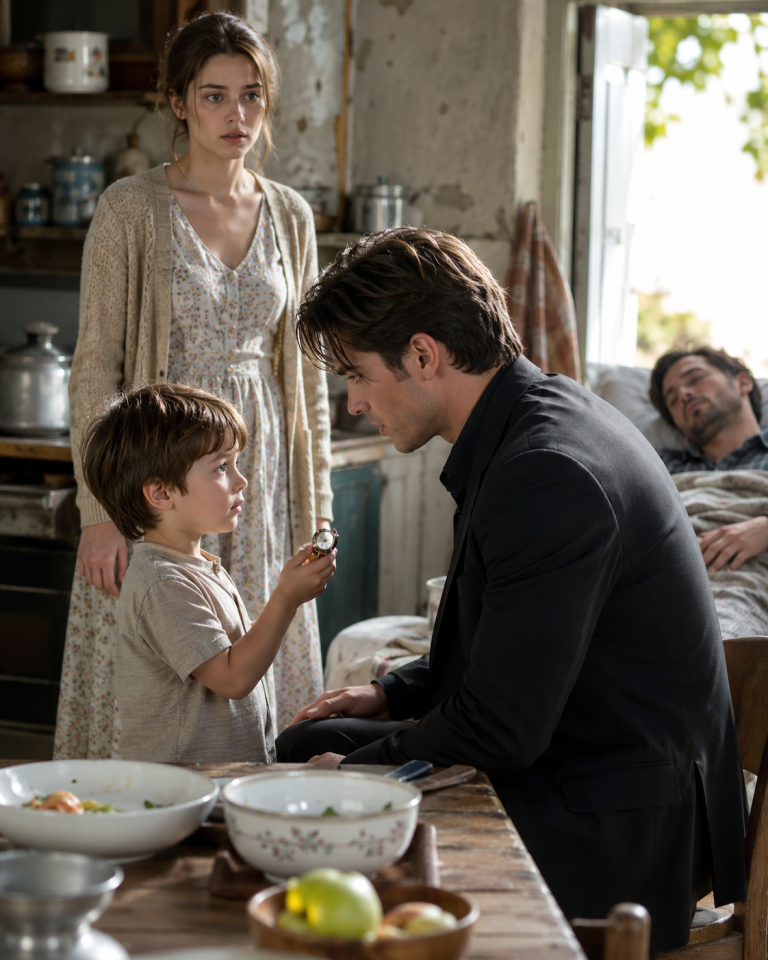
Mafia Boss’s Wife Called the Waitress Illiterate—Then One Sentence Left Everyone on Their Knees

## PART 1
She had worked the room for six months without anyone looking at her.
That was the plan.
Not the surface plan — anyone watching would have seen a competent server navigating the private dining floor of Elysian with quiet efficiency. She knew which table wanted the Burgundy decanted early, which hedge fund manager couldn’t be interrupted during his starter, which art consultant was conducting a discreet negotiation with the man across from him who wasn’t actually in the art business.
She knew all of it.
She had spent six months learning it.
The deeper plan — the one she had carried from Geneva to New York inside the memory of a dead man and the encrypted contents of a USB drive she wore around her wrist beneath her uniform sleeve — was something else entirely.
The woman sitting at table seven was the key to it.
Claudia Ferraro Resti wore rubies at her throat and the particular confidence of someone who had never once imagined a room would refuse her. Her husband, Nico Resti, controlled the largest private shipping network on the Eastern Seaboard through a chain of businesses that looked, on paper, like the kind of portfolio a prosperous shipping family accumulated over generations. Clean and old and unimpeachable.
He was not clean.
He was not old money.
And Valentina Greco, standing near the wine station with a bottle of Barolo she had not been asked to bring, knew exactly where the money came from.
She also knew what Claudia had been doing with some of it.
That was a recent discovery, and it had changed the shape of tonight.
The incident began, as incidents at Elysian always did, with Claudia.
Valentina had brought the wrong wine.
Not actually — she had brought what the sommelier had told her to bring — but Claudia looked at the label and her expression performed offense with theatrical precision.
“I said the other one,” Claudia said. “The Gaja. Not this.”
Valentina kept her face neutral. “Of course. I’ll bring it now.”
“Wait.” Claudia set down her fork. “Have you ever even heard of Gaja?”
“Yes.”
“You don’t look like someone who has.”
This was the kind of thing that happened at Elysian roughly once a month, and the protocol was simple: absorb it, apologize, redirect. Valentina had done it many times. She was very good at it.
Tonight she did not do it.
She set the Barolo down.
“The vintage you ordered,” she said, “was the 2016. This is the 2016. The Gaja allocation for this evening is spoken for by table three.” She held the bottle so the label faced Claudia. “If you’d like the other Gaja, I can check whether the reservation holds. But this is what you ordered, Claudia.”
The first name landed like a slap.
In the specific register of rooms like Elysian, you did not use a guest’s first name without invitation. Valentina knew this. She had never done it before.
Claudia’s expression changed — not to anger, not immediately. To something more interesting. Confusion. The confusion of a person who had just heard a familiar voice coming from an unexpected direction.
Nico, who had been very still since the moment Valentina approached — still in the particular way of someone who noticed things — said nothing. He watched.
He had been watching her in that way since her third week here. She had expected it. Men in his position watched their environments the way meteorologists watched satellite images: systematically, looking for the deviation from pattern.
She was very careful not to be a deviation.
Until tonight.
Because tonight was the last night she had.
“You’ll bring me what I asked for,” Claudia said, her voice dropping to the register reserved for servants who had forgotten their station.
“I’ve explained what you asked for,” Valentina said. “I can also explain, if you’d like, what happens to the secondary accounts registered in your name in the Caymans when the quarterly audit goes through next week.”
The silence that fell across table seven was not the comfortable kind.
Valentina heard a wine glass tremble on an adjacent table. She heard, at the perimeter of the room, one of Nico’s security detail shift his weight from one foot to the other.
Nico Resti had not moved.
He was looking at her with the absolute attention of someone who had stopped performing dinner and started performing something else.
Claudia laughed.
It was not a convincing laugh.
“This is absurd,” she said. “Nico, she’s clearly—”
“Leave us,” Nico said.
Not to Valentina.
To his security detail.
Three men exchanged glances. Then withdrew to the perimeter. The maître d’ appeared briefly in the doorway, read the room, and disappeared.
Valentina had not moved.
Nico looked at her.
“Sit down,” he said.
“I prefer to stand.”
“That was not a request.”
“I know.” She held the Barolo at her side. “Neither was mine.”
The dining room around them had gone very quiet in the way that expensive rooms went quiet when money and danger occupied the same space and everyone with sense had decided to be somewhere else.
Nico’s eyes were not angry. They were assessing. She had expected anger and found something worse.
“Who are you?” he said.
Valentina untied her apron. Folded it. Set it on the edge of the table with the precision of a person who had rehearsed this moment many times without knowing when it would arrive.
“My name is Valentina Greco,” she said.
Something moved in Nico Resti’s face. Fast and deep.
Claudia made a small sound.
“That name is impossible,” Nico said.
“I know,” Valentina replied. “But here I am.”
—
## PART 2
Claudia stood up.
The movement was too fast, too uncontrolled for a woman who usually performed composure like a profession.
“This woman is lying,” she said. “Nico, she’s a waitress, she walked in here with someone’s name and a rehearsed speech—”
“Claudia.”
One word. Claudia stopped.
Nico Resti looked at his wife with an expression Valentina had not expected. Not fury. Not disbelief. Something much colder.
He had already understood something.
She filed that away.
“Valentina Greco died in the Amalfi explosion,” Nico said slowly, still looking at his wife. “With her father.”
“With her father,” Valentina agreed. “My father died in the water. He burned before he drowned. I have known that for a long time.” She paused. “He was wearing the wrong coat when it happened. Specifically, he was wearing your contact’s coat, because someone had arranged for him to find it.”
Claudia’s hands were shaking.
Valentina turned toward her.
“You recognized the name.”
“I didn’t—”
“You made a sound when I said it.” Valentina’s voice remained even. “You didn’t look at your husband. You looked at the table. That means you knew my name before tonight.”
Nico had turned toward Claudia fully now.
“Six months ago,” Valentina said, “someone accessed the internal transfer protocols for the Resti maritime accounts. The access came from a proxy server registered in Malta. But the routing was personal — it came from a device that appeared on your household network three days before the access.”
Claudia opened her mouth.
“You were not working for the Caviello group,” Valentina continued. “You were working for yourself. You diverted eleven million across a period of eighteen months. Small amounts. Disciplined.”
Nico went very still.
“How much?” he said.
Valentina looked at him.
“I believe,” she said, “that’s the exact question you should ask her.”
Claudia’s voice cracked. “Nico, this is theater. She’s obviously here with someone—”
“Eleven point two million,” Valentina said. “Seven transfers, three institutional vehicles, one direct draw from the Palermo account that your compliance team hasn’t flagged yet because the quarterly cycle doesn’t close until Thursday.”
The room was completely silent.
Nico stood.
He was tall. Broader than she’d expected. The charcoal suit was perfectly constructed to look like something a man wore because he preferred quality, not to conceal the body underneath it.
He looked at his wife for a very long time.
Then back at Valentina.
“You built the account structure,” he said quietly.
Not a question.
“My father built it,” she said. “I learned from him. And I spent four years taking it apart, transaction by transaction, from inside two other organizations, before I got to yours.”
“Why?”
“Because four years ago, someone told your father that mine was stealing from him.”
Nico’s jaw tightened.
“And someone was wrong?”
Valentina held his gaze.
“Someone lied,” she said.
Silence expanded around the table.
Then Claudia lunged for Valentina’s wrist.
Valentina stepped back, and the small USB drive she wore beneath her sleeve landed on the tablecloth between the glasses.
Claudia grabbed for it.
Nico’s hand came down on the table between them.
“Don’t,” he said.
Claudia froze.
Nico picked up the drive.
He looked at it.
Then at Valentina.
“What’s on this?”
Valentina looked at the drive in his hand.
“Everything,” she said. “Including who gave your father the lie.”
Nico closed his fingers around the drive.
His expression was unreadable.
Then a phone rang on the other side of the room, and the security man who answered it went pale, and Valentina recognized the shape of the moment before the man even opened his mouth.
Something was wrong elsewhere.
And everyone at table seven was about to find out what.
—
## PART 3
The security man crossed the room quickly, leaned toward Nico, and spoke quietly for ten seconds.
Nico’s expression did not change.
But Valentina watched his breathing stop and restart, which was different from his expression.
“What?” she asked.
He looked at her.
“The warehouse on Pier 19 was accessed forty minutes ago,” he said. “Internal access code.”
“Which account authorization?”
“My father’s,” he said. The word carried its full weight. “Active account. Dead man’s code.”
Valentina had not planned for this.
She had planned for many things. She had spent four years planning. She had infiltrated two organizations, built a financial case that could bring down three interconnected criminal structures, and stationed herself in a restaurant for six months to get close enough to the woman who had given the lie that killed her father.
She had not planned for a dead man’s account to move.
“Your father,” she said carefully.
Nico looked at her.
“My father had a condition,” he said. “Ten years ago. Pulmonary. He was supposed to have died in his home in Positano four years after your father.”
“Supposed to,” she repeated.
“No body confirmed.”
“Because?”
“Because the fire.”
Another fire. Valentina turned this over.
“Who benefits from your father being dead?” she asked.
“Half the people in this organization,” Nico said. “But primarily the person who would inherit his seat.”
He looked at Claudia.
Claudia’s face had gone the color of new marble.
“I don’t know anything about a code,” she said.
“No,” Nico agreed quietly. “But you know someone who does.”
Valentina watched Claudia’s hands. Both of them, the way she had watched them all evening. The right hand was still. The left was very slightly contracted around the edge of her chair.
“The man who coordinated your transfers,” Valentina said. “He’s not Caviello.”
Claudia said nothing.
“The transfer routing you used went through a proxy in Valletta,” Valentina continued. “The same proxy that ran the financial side of the Amalfi arrangements four years ago.”
Nico turned sharply.
“How do you know what routing was used for Amalfi?”
“Because my father built the proxy,” Valentina said. “He showed me when I was nineteen. He was proud of it. He trusted the man he built it with.”
“Who?”
Valentina looked at Nico directly.
“Someone who told your father that mine was stealing. Someone who needed the Greco family to disappear so the proxy could be reassigned without anyone who understood it still alive.”
Nico was very still.
“You’re saying the proxy was the motive.”
“The proxy was worth approximately forty million over ten years to anyone with full access,” Valentina said. “My father had built it clean. No exposure. No paper trail from the legitimate side. It was the single most protected financial instrument in either of our families’ networks.”
“And now someone else controls it.”
“Someone has controlled it for four years.”
“The same someone who moved my father’s account tonight.”
“Or someone using it to move your father,” Valentina said. “They’re not necessarily the same thing.”
The implication settled into the room.
Nico’s security chief appeared in the doorway with two men behind him.
“Car,” Nico said.
Then he looked at Valentina.
“You’re coming.”
“I know.”
—
The drive to Pier 19 took eleven minutes in the rain.
Valentina sat across from Nico in the back seat of the armored car. Between them on the leather seat lay the USB drive. Neither touched it.
Claudia was in a separate vehicle behind them, under escort. She had stopped arguing. When people stopped arguing, Valentina had learned, it meant they were calculating.
“Your father and mine,” Nico said, watching the rain streak the windows. “They were allies.”
“From before either of us was born.”
“I know. My father used to speak of Emilio Greco as though he were the last honest man in the room.”
“He was,” Valentina said quietly. “That was the problem.”
Nico looked at her.
“An honest man who controlled a financial instrument worth forty million has a target on his back the moment anyone else understands what he holds.”
“Yes.”
“And you spent four years—”
“Finding out who understood.”
Nico looked at the drive.
“How many organizations?”
“Three. Yours was the last.”
“You came here because of Claudia.”
“I came here because the proxy is still running. Someone is still using it. And the transfers I traced led back through Claudia to a man who I believe was responsible for Amalfi.”
Nico’s voice dropped.
“My father’s death was natural causes. The documentation—”
“The documentation was prepared by a physician whose license in three countries was quietly suspended two years after Positano,” Valentina said. “I found him in Marseille eighteen months ago.”
Nico went very still.
“He told you my father wasn’t dead.”
“He told me he had prepared paperwork for a patient who was not present at the time of signing.”
“Who paid him?”
Valentina looked at him.
“The same man who gave your father the lie about mine.”
The car slowed.
Pier 19 loomed ahead through rain and dock lights, a warehouse structure that looked ordinary and was not.
“If your father is alive,” Valentina said quietly, “then everything that happened four years ago was staged.”
“For what purpose?”
“To remove him from the equation while the proxy was being transferred.”
“But he built most of the structures.”
“Which means he also knew where the vulnerabilities were.”
Nico looked toward the warehouse.
“He could have come back at any point.”
“Yes.”
“So why wait until now?”
Valentina opened the car door.
“That,” she said, “is what I came to find out.”
—
The warehouse interior was wide and cold, lit by industrial overhead lights that threw long shadows between stacked pallets. The smell was salt and diesel and something older.
Nico’s men swept the perimeter. Valentina walked beside him, moving through the space with the practiced attention of someone who had learned to read danger in the geometry of a room.
At the far end, behind a false wall that the security chief opened with a code he visibly had not expected to work, was a space that was not a storage area.
Books. A cot. Medical supplies in organized rows. A desk with a laptop that was still running.
And a man in his sixties, seated in a chair by the desk, looking toward the door with the expression of someone who had been expecting this visit for quite some time.
Nico stopped in the doorway.
For several seconds he did not move.
“Father.”
The older man — gray-haired, thinner than the photographs Valentina had studied, but unmistakably Giulio Resti — looked at his son with the complicated expression of someone who had made a decision a long time ago and was only now being required to explain it.
“Nico.”
“You’ve been here.”
“Not always here. But available.”
“Four years.”
“Yes.”
Nico’s voice was entirely controlled, which was how she knew the opposite was also true.
“Who knew?”
“Three people, not counting myself.” Giulio’s eyes moved to Valentina. “And now four.”
Valentina stepped forward.
Giulio looked at her.
“You have your father’s way of coming in a room,” he said.
“You knew him.”
“Better than almost anyone.”
“Then tell me who killed him.”
Giulio’s expression changed.
Not denial.
Not grief.
Something that looked like the specific exhaustion of a man who had been carrying a name in his chest for four years and was finally being asked to set it down.
“His name is Ferrante,” Giulio said. “He was never visible. He moved through organizations the way a needle moves through cloth — you only see the entry and exit points. The path in between is hidden.”
Valentina was still.
“Ferrante arranged the accusation against your father.”
“Who is he to you?”
Giulio’s expression hardened.
“He was my financial director for twelve years.”
The silence that followed had physical weight.
“He used the proxy,” Giulio continued. “For four years he has controlled it. The transfers, the routing, the entire architecture your father built — all of it redirected to serve Ferrante’s network.”
“Where is he now?”
Giulio looked at his son.
Then back at Valentina.
“He’s coming here,” Giulio said. “Tonight. He thinks Nico is occupied with the information I arranged to surface from Claudia’s account. He thinks the warehouse will be clear for the handover.”
Valentina understood.
“You staged tonight.”
“I arranged that the quarterly audit irregularity would surface at a moment when a particular person would be in the room to escalate it,” Giulio said. “Claudia was the instrument. She didn’t know she was being used. She thought she was acting on her own initiative.”
Nico’s jaw tightened.
“She was stealing from me.”
“Yes,” Giulio said. “Ferrante encouraged her. Debt, then pressure, then dependency. She believed she was in business with him independently. She was not.”
“The eleven million.”
“Will be recovered. Ferrante holds it in trust accounts he created for her. The documentation exists.”
Valentina looked at the old man carefully.
“You spent four years building the case.”
“I spent four years becoming invisible so I could see clearly,” Giulio said. “Ferrante believed I was gone. Gone people become careless with their record-keeping.”
“And the proxy?”
“The proxy records the transfers. All of them. For four years.” He looked at the laptop on the desk. “Everything is there.”
Valentina took a breath.
“My father,” she said. “He was innocent.”
“He was entirely innocent,” Giulio said simply. “And I am responsible for the fact that innocence was not enough to protect him.”
The admission was clean. No performance of regret, no elaborate qualification.
Valentina looked at him for a long moment.
“If Ferrante comes tonight,” she said.
“When Ferrante comes tonight,” Giulio corrected.
“What do you need from us?”
Giulio looked at his son.
Then at Valentina.
“The same thing I needed from your father,” he said. “To stand in the room.”
—
They waited.
It took forty minutes.
Valentina spent most of it reviewing the files on the laptop with Nico beside her, both of them reading the same records, occasionally asking the other to confirm a transaction they were seeing for the first time.
She was aware of the strangeness of it: standing beside the son of the man who had run the organization that had taken everything from her, reading documents that proved her father’s innocence, preparing to stand in the same room as the man who had arranged his death.
She was also aware, without choosing to think about it, that Nico read financial records the way she did — from the anomaly backward, looking for the pattern behind the deviation. This was not common. Most people in his position delegated analysis. He did not.
She filed this observation away with everything else.
Giulio sat in his chair and said very little. When Valentina asked questions, he answered them precisely. He had the manner of a man who had spent years thinking through exactly what he would say when this moment arrived.
At ten forty-seven, two of Nico’s men spoke quietly into earpieces at the outer edge of the building.
“Vehicle,” Nico said.
Valentina closed the laptop.
The man who entered through the south loading dock ten minutes later was not what she had imagined. She had imagined someone the photograph of a villain: broad, cold-faced, a man who looked like what he was. Instead, Ferrante was slight, white-haired, with the careful movement of a person whose power had never required size. He dressed precisely. He carried a soft leather briefcase.
He walked into the inner room and stopped.
He saw Giulio first.
“Giulio,” he said. Without surprise, without particular alarm. Just the name, weighted.
“Ferrante.”
Then Ferrante saw Nico.
And then Valentina.
Something changed in his face.
“Greco,” he said.
“Valentina,” she said. “Not Emilio. Though I suspect you knew Emilio better than you’d like to be reminded of.”
Ferrante looked at the briefcase in his hand. Then set it down on the nearest surface with the deliberate calm of someone disarming a weapon.
“You’ve been busy,” he said, to no one in particular.
“For four years,” Valentina said.
“All for this.”
“All for this.”
Ferrante looked at Giulio.
“You let her build the case.”
“I helped where I could.”
“And the proxy?”
“Documented in full,” Giulio said. “Forty million in transfers, twelve financial instruments, three governments, one dead man’s code repurposed for eleven million in secondary theft your friend Claudia thought was hers.”
Ferrante was quiet for a moment.
“You could have done this differently,” he said, to Giulio.
“You killed my partner’s daughter’s father,” Giulio said.
Ferrante accepted this without expression.
“What do you want?” he asked. Not threatening. Just the question.
“Everything on record,” Valentina said. “Everything you built with the proxy, every transfer, every arrangement, every name you protected and every one you erased. You go on record, and the relevant authorities receive the full documentation.”
“Or?”
“Or we send what we have now, which is enough,” Nico said. “You lose everything either way. But one way you’re a witness. The other way you’re just a subject.”
Ferrante looked at Valentina for a long time.
“Your father would have made this offer years ago,” he said.
“He would have,” she agreed. “You didn’t give him the chance.”
Something flickered in Ferrante’s expression.
Regret.
She had not expected that.
She was not prepared for it, and she was aware that she was not prepared for it, and she kept her face entirely still while something inside her registered that the man who had killed her father was not, at his core, a man without conscience. That he was a man who had made a calculation and lived inside it until it swallowed him.
This was worse than cold cruelty.
It was ordinary.
“All right,” Ferrante said.
He opened the briefcase.
Inside were paper files — originals, she realized, not copies. A lifetime of records kept by a man who had understood, all along, that documentation was the only currency that outlasted everything else.
He set them on the desk.
“Start with Amalfi,” Valentina said.
He did.
—
The official account — the one that appeared in the reports filed by three separate jurisdictions over the following months — described the dismantling of the Ferrante network as a coordinated multi-agency investigation that had been building for years. The proxy was forensically reconstructed. The forty million in transfers was traced and frozen. Several individuals were arrested. Several others cooperated in exchange for reduced charges.
Giulio Resti was not named in those reports.
He existed, instead, in a two-line statement from a Positano physician who had revised an earlier medical certification under circumstances the report described as administrative review.
Valentina was not named in those reports either.
She had given her full account to a federal financial investigator in a closed session and been thanked, formally, for her assistance. The investigator had looked at her documentation with the expression of someone who had been doing this for twenty years and occasionally encountered a case that reminded them why.
Nico met her outside the federal building afterward.
He had waited on the steps in November rain without apparent impatience.
“How was it?” he asked.
“Formal,” she said.
“Are you satisfied?”
She thought about this.
“I don’t know what satisfaction looks like yet,” she said honestly. “I’ve been moving toward this for four years. I’m not sure what I do when I stop.”
He was quiet.
“My father would like to meet you formally,” he said. “Without a warehouse and an ambush as context.”
“I imagine he would.”
“Would you be willing?”
Valentina looked at the rain on the pavement.
“Your father sheltered a dead woman’s daughter and spent four years building the case that exonerated her father,” she said. “The least I can do is have dinner with him.”
Nico’s expression shifted slightly. Not quite a smile — he was not a man who smiled easily, she had noticed, which was not the same as saying he was not a man who felt things.
“He would appreciate that,” Nico said.
They walked down the steps together into the rain.
“The proxy,” Valentina said. “The legitimate structure my father built. The accounts that were in our family’s name.”
“Fully restored,” Nico said. “My father ensured the documentation. Your lawyers should have the transfer confirmation by now.”
She stopped walking.
He stopped beside her.
“That’s not nothing,” she said.
“No,” he agreed.
“It doesn’t undo what happened.”
“No.”
“But it’s something.”
She thought about her father. She thought about what she knew of him — the records, the pride in the work, the photograph she had found of him and Giulio Resti standing at a boat dock in Positano with their arms around each other, young and laughing in a way that suggested they had believed, at that age, that the world was broadly manageable.
She thought about the USB drive, now in federal custody. The work of her father’s life and then the work of her own, rendered into evidence and filed and sealed.
“What do you do now?” Nico asked.
“I was planning to leave New York,” she said.
“Were you?”
“That was the plan before tonight changed the timeline.”
He looked at her.
“Tonight changed more than the timeline,” he said.
She met his eyes.
There was something in his expression she recognized — the particular quality of attention that came from someone who was looking at a thing they had not expected to value and were still in the process of deciding what to do with that.
She recognized it because she was experiencing the same thing.
“I still have a restaurant apron,” she said.
“I believe Elysian will manage without it.”
“Probably.”
The rain continued.
“Dinner,” he said. “With my father. And then — if you’re willing — a longer conversation.”
“About what?”
“About what you do with four years of expertise in financial structures that no longer need to be dismantled covertly.”
She looked at him.
“You’re offering me a job.”
“I’m suggesting that someone who spent four years taking apart three criminal networks from the inside has skills that have legitimate applications, in the right structure.”
“And you’re building the right structure.”
“I’m trying,” he said. “My father built something. I’m deciding what to keep and what to dismantle. That requires someone who can read the difference.”
Valentina looked at the rain on the street. At the lights of the city moving through it. At the ordinary persistence of a city that continued regardless of what happened inside its buildings.
“I’ll have dinner with your father,” she said.
“And the conversation?”
“Ask me after dinner.”
He accepted this.
They walked.
At some point, without deciding to, they walked in the same direction, which happened to be away from the federal building and toward the part of the city where the rain looked almost beautiful on the river, and they talked about the proxy, about her father’s methods, about what Giulio had done in the four years of disappearing, about what it had cost each of them.
She did not feel, for the first time in four years, that she was moving toward something.
She felt, instead, that she had arrived.
Not at an ending. There was no ending that was clean enough for what had happened to her family, and she had long ago made peace with that. But at a place that was different from the place she had been. A place where the work was done, the record was corrected, and the name of Emilio Greco existed again in documents that said, clearly, what he had been.
Innocent.
Careful.
Worth grieving.
—
Two months later, she attended a dinner at a house in Westchester that looked, from the outside, like any other house in the kind of neighborhood where money had settled into permanence.
Giulio Resti had chosen it because it was unremarkable.
He was, she discovered, unremarkable in the same way — not the granite patriarch she had imagined, but a man in his seventies who made his own coffee, read dense financial histories for pleasure, and spoke about her father with the specific grief of someone who had known a person’s quality and spent four years being unable to say so publicly.
“He would have liked this,” Giulio said, gesturing vaguely at the table, the dinner, the two of them together.
“He would have asked you about the proxy immediately,” she said.
Giulio laughed.
It was a real laugh. The kind that arrived from somewhere old.
“Yes,” he said. “He would have.”
Nico sat across from her.
He watched his father laugh with the expression of someone who had not seen that particular laugh in four years and was now experiencing the specific relief of having it back.
After dinner, in the garden, while Giulio argued on the phone with his doctor about a supplement regimen in a way that suggested the argument had been ongoing for some time, Valentina stood beside Nico in the November cold.
“He’s well?” she asked.
“Better than expected,” Nico said. “The condition was real, originally. He managed it. He wanted the world to believe the management had failed.”
“He could have come back earlier.”
“He didn’t trust the case to hold without more evidence.”
“He trusted the evidence over his own relationship with you.”
Nico was quiet.
“Yes,” he said.
She looked at him.
“I understand that,” she said.
“I know you do.” He paused. “That’s one of the things that’s—”
He stopped.
“Strange,” he said. “That someone should understand it.”
She looked at the garden, at the late November hedge and the last brown leaves on the apple tree in the corner.
“I spent four years thinking that when I got here — whenever here was — I would feel finished,” she said.
“And?”
“I feel like I stopped running,” she said. “That’s not the same thing. But it might be better.”
He considered this.
“The position,” he said.
“I’ve been thinking about it.”
“And?”
She looked at the lit window where Giulio was still arguing about supplements, and beyond it, at the unremarkable house that contained, improbably, the living and the recovered and the beginning of something she could not yet name.
“I’ll take it,” she said.
“Good.”
“On one condition.”
“Name it.”
She looked at him.
“You stop calling it a position,” she said. “It sounds like you’re asking me to manage inventory.”
He looked at her for a moment.
Then, for the first time in her experience, Nico Resti smiled. Not the quarter-smile she had catalogued across the six months in the restaurant. The real one. The one that changed his face into something human and unexpected.
“Agreed,” he said.
Inside, Giulio won the argument about supplements, declared this loudly, and invited the person on the other end to make their case in person.
Outside, the cold moved through the garden.
Two people stood in it, not touching, each carrying years of damage and careful work, looking at a house where a dead man had come back to life and an innocent man’s name had been restored.
Nothing was clean.
Nothing was finished.
But something had shifted.
Some weight had been set down, and where it had been, there was space for something else.
—
—
—