I Walked Into the Wrong Wedding—Then a Mafia Boss Married Me in Front of 400 Strangers for $10 Million

## PART 1
She said yes because the word *no* had become something her body could no longer afford.
That was the truth of it, stripped of romance, stripped of destiny, stripped of every narrative that made a terrible decision sound like fate. She said yes because her mother’s name appeared on hospital invoices that came in the night like small quiet disasters, because her own name appeared on loan documents that had developed the habit of sending her to voicemail when she tried to explain, and because the man standing in front of her with a diamond ring and a deadline had offered her more money in thirty seconds than she would earn in the next eleven years.
She said yes.
And by the time she understood what she had said yes *to*, the priest had already closed his book.
—
The wrong chapel was Nora Chen’s fault, if anyone was counting.
Nora was the maid of honor for Priya Kapoor’s wedding, which was being held at St. Agatha’s Church on the corner of 76th and Amsterdam, and she had been running fifteen minutes late because the Q train had been held at DeKalb for reasons the conductor described as *minor mechanical issue* in the tone of a man describing a catastrophic engineering failure.
She ran four blocks in rain that felt personal. Her umbrella had inverted twice and given up on the second attempt. Her bridesmaid dress — the color of lavender that Priya had selected from a swatch and called *whispered lilac* — had absorbed enough of Manhattan’s November weather to weigh approximately twice what it had when she put it on.
The cathedral at the end of the block was imposing, grand, and absolutely identical to St. Agatha’s from a distance of forty rain-blurred feet.
Nora ran up the stone steps.
She pushed the heavy doors open.
She stepped into an entrance hall that smelled of old incense and marble cold enough to carry winter in its surface.
She followed the sound of voices.
She pushed through a second set of doors.
She was inside before she understood.
The room was wrong.
Not obviously wrong. Not in the way of a costume party instead of a funeral. More subtly wrong. Quietly, expensively, dangerously wrong.
Four hundred people sat beneath carved stone and stained glass, and none of them were Priya’s family, and none of them looked like the kind of guests who brought cards with money inside and argued warmly about which corner table had the better view of the first dance.
These people did not argue.
They sat with the particular stillness of people who had learned that loud things attracted attention, and that attention in their world was a liability.
Men in suits whose tailoring spoke of old money and older debts lined the pews. A senator Nora recognized from campaign posters occupied the third row, jaw rigid, pretending to look reverent. Twice she spotted faces she recognized from financial news — a name associated with shipping contracts, another with private equity that had survived three federal investigations intact.
And along the walls stood men who were not security in the private-event sense. They were security in the older, colder sense. Hands at rest. Eyes in constant motion. Jackets that fell slightly differently on one side.
At the altar: a priest with silver hair gone rigid with nerves, a groom with a face like polished marble and a woman beside him whose lace veil trembled.
Not from wind.
Nora understood, in the way a body understood danger before the mind caught up, that she needed to leave.
She began stepping backward.
Then the bride spoke.
*I cannot do this.*
Three words. Clear. Final. Carrying something beneath them that Nora recognized before she could name it: a woman who had arrived at the end of a very long patience.
The groom’s head turned with the slowness of someone managing something dangerous.
*We will discuss this later,* he said.
*No.* The bride faced the congregation. Her veil shook. Her voice did not. *He has been sleeping with my sister for six months.*
The room fractured.
Gasps. A shout from the front row. Phones appearing. Cameras flashing like a storm trapped inside stone walls.
Nora pressed herself against the back wall and prayed she was invisible.
Then a voice from the side of the altar spoke one word:
*Enough.*
And the cathedral obeyed it.
He stepped from a shadow beside a stone column. She had not noticed him there. No one had, and Nora understood that was a choice he had made — to be unseen until he chose otherwise.
He wore black. Black suit, black shirt, nothing to catch or reflect the candlelight. His face was sharp in the way of something refined under pressure. Dark hair. A jaw that had learned not to give anything away. Eyes that absorbed the gold light around them and gave back nothing.
He was beautiful in the way a specific category of dangerous things could be beautiful: completely, and in a way that made the danger worse.
The groom went still. The bride stepped backward. The room rearranged itself around his gravity.
He walked down the aisle at a pace that communicated complete disregard for urgency, stopped in front of the groom, and looked at him with the expression of a man who had found an error he was tired of tolerating.
*You embarrassed the family,* he said. *In front of everyone who matters.*
*Dante—* the groom began.
*Dante.* The name settled into Nora’s throat and stayed there.
She knew that name.
She knew it the way New Yorkers knew the names that appeared in news segments that described alleged and reputed and sources close to without ever using the word *crime*. She knew it the way people who worked too many events in private rooms in this city eventually learned which names to recognize across crowded rooms.
Dante Ferrara.
The kind of name that made shipping companies reroute their schedules and made police commissioners go quiet when asked about specific docks.
Nora had walked into his family’s wedding.
Dante continued to the groom, voice low enough that not all of it carried but the shape of the words did: *disgrace*, *alliance*, *consequences*.
Then he turned back.
His eyes found Nora.
All four hundred faces followed.
*Where are you going?*
Nora stopped.
Her hand was on the door.
Her voice came out thinner than she would have liked.
*Wrong chapel. I was looking for another wedding. I’ll just—*
*Stay.*
Not a request.
Nora’s hand fell.
Dante Ferrara studied her the way analysts studied variables — not with desire, not with cruelty, but with the focused attention of a man rapidly reassessing something.
He turned back to the altar.
*This wedding is over,* he said. *Both of you leave the city tonight. If I see either of you before this family resolves the embarrassment you created, I will forget we share blood.*
The groom’s mouth opened. Two men appeared at his shoulders before words came out. The disgraced couple was escorted away in under forty seconds. The doors closed behind them with a sound like a sentence ending.
Dante lifted one hand.
The whispers died.
*My grandfather’s decree,* he said to the room, *required a married heir before inheritance transfers. My thirty-fifth birthday is in seventy-two hours. The ceremony I planned as my cousin’s wedding has just ended eight minutes early.*
He turned.
His eyes found Nora again.
*What is your name?*
*Nora.* She heard herself answer before fear could stop her. *Nora Chen. I’m looking for a different wedding.*
*Do you have a husband, Nora Chen?*
*No.*
*Anyone who will come looking for you tonight?*
The question was the worst kind: simple, specific, and designed to understand exactly how alone she was.
*My mother,* Nora said. *She’ll wonder where I am.*
*I will make sure she knows you are safe.* He reached into his jacket. *I need a wife. You walked in at the right time.*
Nora looked at the ring he was holding and felt the floor list beneath her shoes.
*One year,* Dante said. *A contractual marriage. You appear with me in public. You play the role convincingly. At the end of twelve months, we dissolve it and you receive ten million dollars.*
The number landed in her head and did not behave.
Ten million dollars was not money. Ten million dollars was her mother’s medical debt erased. It was her own student loans buried. It was the freelance illustration work she did at midnight not because she loved the clients but because the invoices had started arriving with the particular frequency of things that would not wait.
*That is insane,* Nora said.
*Yes,* Dante agreed. *But you are still calculating whether to say yes, which means part of you already understands the alternative.*
He pulled out his phone and turned it to face her.
An account balance.
*One million tonight,* he said. *Yours whether the year goes well or badly. Consider it the cost of your inconvenience.*
Nora stared at the number until it stopped looking like a number and started looking like a different version of her life.
She thought of her mother’s face the last time a hospital envelope arrived. The specific way she picked it up — briskly, like a woman who had practiced not flinching.
She thought of her own apartment, the water stain on the ceiling she had named Gerald because naming it made it less frightening, the bills she kept in a kitchen drawer because proximity was better than ignorance.
She thought of being tired in a way that sleep never fixed.
She looked at Dante Ferrara.
A criminal. Almost certainly. A man who had silenced four hundred people with one word and exiled his family in under a minute.
This was not rescue.
This was a different kind of locked door.
*Why me?* she asked. *You have an entire room full of people. You could choose anyone here.*
Something moved behind his eyes.
*Because you are nobody in my world,* he said. *No ties to my enemies. No history they can use. No reason for anyone to expect you.*
A pause.
*And because you look like a woman who understood exactly how dangerous this room was the second you walked in, and stayed standing anyway.*
He extended the ring.
*Twenty seconds.*
Nora looked at the congregation. The faces told her everything: pity from some, calculation from others, entertainment from the rest.
No one looked surprised that a woman might be purchased in a cathedral if the price was sufficient.
She thought of her mother.
She thought of the drawer full of bills.
She thought of how tired tired could get before it became something worse.
*Okay,* she said.
Her voice was barely a sound.
*I’ll do it.*
Dante placed the ring on her finger.
His expression did not soften.
*Good,* he said. *We are doing this now.*
The priest looked ill.
Dante looked at him once.
The priest nodded.
The ceremony was six minutes.
Nora stood beside a stranger beneath vaulted stone while rain struck the windows, and when the priest asked whether she took Dante Ferrara as her husband, she said *I do* in the voice of someone signing a form they had read but not processed.
When it ended, Dante turned to her.
He did not kiss her immediately.
He looked at her face as if reading for something — collapse, resolve, regret, the particular fault line that would become his problem later.
Then he kissed her.
Brief. Professional. His mouth on hers for long enough to register as real and not long enough to mean anything, except that heat moved through her anyway, sudden and unwanted, before she could direct it elsewhere.
*Welcome to the Ferrara family, Mrs. Ferrara,* he murmured.
Nora’s knees registered their objection.
Dante steadied her with one hand at her elbow.
They walked back down the aisle through a storm of voices. The cathedral doors opened. Cold air. Flashbulbs. A crowd of photographers who had materialized with the specific speed of people who had been waiting nearby.
Dante pulled her against his side.
*Smile,* he said near her ear. *This is the story they will write for us.*
Nora smiled.
It felt like cracking glass.
She climbed into the black SUV that waited at the curb. The door closed. The noise outside became something separate, happening to someone else.
Dante slid in beside her.
The car moved.
Manhattan dissolved into rain-blurred lights.
For one full minute neither of them spoke.
Then Nora started laughing.
It came out wrong — too high, too thin, one half sob and one half the specific hysteria of a person who has crossed a line they cannot uncross and is finding the view from the other side incomprehensible.
Dante watched without concern.
He waited.
When she could breathe again, Nora pressed a hand over her mouth.
*Check your bank account,* he said.
She fumbled for her phone.
The balance loaded.
$1,000,000.
*That is real,* Dante said. *Yours. Whatever happens next.*
She stared at the number until her vision blurred.
She had sold a year of her life.
She had done it in a chapel.
She had done it to a man whose name appeared in news segments about federal investigations.
And the money was already there.
*Where are we going?* she asked.
*My penthouse. You will live there for the next twelve months.* He looked at his phone. *By tomorrow morning we will have announced a six-month private courtship. Secret romance. Public commitment. The media will believe whatever narrative we build consistently.*
*And your family?*
Dante’s expression changed by the smallest possible degree.
*My uncle Cosimo,* he said, *will not believe it. He was next in line. He will spend the next twelve months trying to prove this is fraudulent.*
*Can he?*
*If we are not careful.* Dante’s eyes moved to her. *He is experienced and patient. Do not mistake his charm for tolerance.*
The SUV stopped before a tower of glass and steel that seemed to have been designed to communicate *above you* to everything in its sight line.
Dante got out and opened her door himself.
The moment her feet touched the sidewalk, flashbulbs erupted again.
Dante put his arm around her.
His body was tense against hers. The warmth of it was inappropriate information to be registering.
*Inside,* he said.
The lobby swallowed the noise. A private elevator. His key card.
The doors opened onto a penthouse that occupied the entire floor.
Nora did not move.
Floor-to-ceiling windows held Manhattan like a painting. Below, the city glittered in its rain. Above, nothing visible but sky.
The space was enormous, cold, and perfect in the specific way of rooms where money had substituted for every other form of human effort. Black stone. Gray furniture. Art on the walls that looked like it had been selected to communicate wealth rather than joy.
*Your room is down the hall,* Dante said. *Second door. Everything you need has been arranged.*
Nora turned.
*How? We’ve been married for forty minutes.*
*I made the decision when you walked into the chapel. My staff prepared the room while the ceremony was in progress.*
He poured whiskey.
*You have people who can furnish a guest room in forty minutes?*
*I have people who do what I need them to do.*
*That doesn’t answer the question.*
Something shifted in his expression — surprise, or the near-relation of it.
*Get used to this,* he said. *Your life is different now.*
*For twelve months.*
He looked at her over the rim of the glass.
*For twelve months,* he agreed.
But something in the way he said it — not quite confirming, not quite denying — sat in the room after the words left it.
—
## PART 2
Nora’s bedroom was beautiful in the particular way of things that had been chosen entirely for appearance.
The bed was too wide for one person and covered in white linens so fine they felt like a different category of material than the sheets she owned. A closet stood open, already filled with clothes in her size — sizes she had not given anyone. A phone charger on the nightstand. Silk pajamas laid out with the impersonal precision of a hotel.
Someone had thought of everything.
Except the part where Nora might want to understand the shape of the trap before the door closed.
She locked the door.
She sat on the floor against it, knees drawn up, and finally let herself shake.
She cried for approximately seven minutes — not prettily, not with the compact grace of movie grief, but with the specific ugly productivity of a woman releasing something that had been held under pressure too long. She cried for the money that would rescue her mother. She cried for the year she had just signed away. She cried because the ring on her finger felt more real than anything in the room.
When she ran out of tears, she stood up.
She showered until the water ran cold.
She put on the stranger’s pajamas.
She thought about the million dollars.
Then she thought about the man at the windows with his whiskey and his controlled face, and the way the room had reformed around him at the cathedral, and the look he had given her when she was still deciding — not threatening, not coaxing. Just waiting. As if he understood desperation well enough to recognize when it was making its calculations.
Outside her door, she heard the sound of ice in a glass.
She did not open the door.
Morning arrived like an allegation.
Sixty-two missed calls. A hundred and forty messages. Priya had called eleven times. Nora’s best friend Dev had left a voicemail in the specific register of a man oscillating between panic and hilarity.
She listened to the first three seconds of Priya’s messages before her courage failed.
She opened a news app.
*Mystery Bride Marries Dante Ferrara as Cathedral Scandal Erupts.*
*Who Is Nora Chen? The Unknown Woman Behind Ferrara’s Sudden Wedding.*
*Did New York’s Most Feared Crime Boss Just Marry a Stranger?*
There were photographs. She was in all of them. Lavender dress, rain-soaked hair, Dante’s arm locked around her waist, and an expression on her own face that she barely recognized — hollow-eyed, straight-backed, the specific look of someone who has decided on a course of action and is refusing to flinch.
She looked, to the cameras, like a woman who belonged beside him.
She did not know whether that was a compliment or a warning.
Part 2 Cliffhanger: A knock at her door.
Three taps. Precise.
*Come in,* she said.
A woman entered. Fifties. Gray hair. Black suit that had been tailored within an inch of its life. The face of someone who had managed complicated situations for a long time and had developed the specific calm of a person who was rarely surprised.
*Mrs. Ferrara,* she said. *My name is Louisa. I manage Mr. Ferrara’s household and security arrangements. He asked me to help you prepare for the press conference.*
*Press conference.*
*Yes. Eleven o’clock. You have fifty minutes.*
Nora looked at the closet full of clothes that were not hers and understood, with the particular clarity of someone who has just seen the full size of the game they agreed to play, that the previous night had been prologue.
The real performance was about to begin.
*One more thing,* Louisa said, with the neutral delivery of someone who had learned to present bad news as housekeeping. *Mr. Ferrara’s uncle has already begun making inquiries. He contacted three council members before sunrise.*
Nora kept her face still.
*What kind of inquiries?*
Louisa closed the closet door with careful hands.
*The kind that suggest he has already decided this marriage is fraudulent, and is now working backward to find the evidence that proves it.*
She picked up a dress — navy, elegant, the kind of simple that required considerable money to achieve.
*You have fifty minutes to become a woman who has been in love with Dante Ferrara for six months.*
She laid the dress on the bed.
*I suggest you start now.*
—
## PART 3
The press conference was held downtown in a hotel conference room that had been designed for exactly this kind of controlled disclosure — neutral backdrop, good lighting, a podium that communicated authority, and enough space to accommodate the fifty-odd journalists who had apparently rearranged their entire morning to attend.
Louisa had transformed Nora in forty-four minutes.
Hair smooth. Skin glowing. The navy dress achieving its intended effect of woman-who-does-not-need-to-try. She looked, as she caught herself in the corridor mirror, like someone who had every right to stand beside Dante Ferrara.
It was unsettling how much of identity was surface.
Dante waited in the private garage beside a black SUV, four security personnel arranged at calculated distances. He wore charcoal today. His face was the same controlled landscape it had been last night, except — she noticed, cataloguing against her will — that there were shadows under his eyes that had not been visible in candlelight.
He had not slept.
His eyes moved over her once. Approval registered and was filed away.
*You look like you belong here,* he said.
*Is that a compliment or an instruction?*
Something shifted in his face.
Not quite amusement. The topographical precursor to it.
*Both,* he said. *Come.*
The press conference was forty-three minutes of controlled theater.
Dante answered every question with the smooth efficiency of someone who had spent years giving people exactly enough truth to satisfy and not enough to matter. He did not lie outright. He redirected. He acknowledged what could be verified and framed everything else.
Nora stood beside him and breathed.
Once, when a reporter pushed past the third follow-up question about the timeline of their relationship, she touched his arm.
His hand came to her lower back immediately.
Protective. Possessive. Convincing.
She told herself the warmth was stage management.
When it ended, they turned toward the exit.
*Roman.*
The name came from the side of the room, and the change in Dante’s body was immediate — not a flinch, not fear, but the specific tightening of a man who has just heard something he was expecting and had not finished dreading.
A man stood near the edge of the crowd.
Late fifties. Silver hair. A suit that cost more than Nora earned in a month and fit him with the ease of something worn thousands of times. His face had the same structural elements as Dante’s — strong jaw, dark eyes, authority that assumed rather than announced itself — but where Dante’s features had been refined into something controlled, this man’s held a particular warmth that Nora’s instincts filed immediately under *wrong*.
Warmth that arrived before it had any reason to.
*Congratulations,* the man said. *I only heard this morning. What a surprise.*
*I’m sure it was,* Dante said.
*This must be the bride.* The man’s eyes moved to Nora. She felt them the way you felt a door close in a room you thought was open. *Nora Chen. Graphic designer. Queens. No family connections. No history in our world.*
He smiled.
*How convenient for you.*
*My wife,* Dante said, stepping slightly in front of her, *is not a topic for public discussion.*
*Family dinner tomorrow,* the man said. *You would not refuse that.*
*We have prior commitments.*
The warmth left the man’s face.
*I insist.* His voice had dropped one register. *There is a great deal we need to discuss. As a family.*
Cameras lifted around them. Reporters sensed the temperature change the way animals sensed weather.
*Fine,* Dante said. *Tomorrow. Louisa will send details.*
The man — *Cosimo,* Dante said in the car, the way you’d name a poison — looked at Nora one final time.
*Welcome to the family, my dear.* His smile had returned. *I hope you understand what you’ve joined.*
—
The SUV had barely cleared the block before Dante was on the phone.
*Scrub everything about her that is scrubbable. Employment. Social. Photo archive. I want nothing left that looks like exposure.* A pause. *Surveillance on Cosimo. Round the clock. If he contacts the council, I want the transcript before he finishes the call.*
He ended it.
Nora watched him.
*He knows the marriage is fraudulent.*
*He suspects.* Dante did not look away from the window. *Suspicion and proof are different problems.*
*He had my name and my background before the press conference ended. He knew I was from Queens.*
*Yes.*
*He has resources.*
*Considerable ones.* Dante finally turned. *The dinner tomorrow is not a celebration. It is an interrogation with better food. He will test us. He will try to find inconsistencies in our timeline, our details, our body language. He will look for any fracture he can widen.*
*So we prepare.*
*We have eighteen hours.*
*Then we should start.*
—
What followed felt like studying for a test where the penalty for failure was her mother’s safety.
Louisa produced two files. One held Dante’s life — curated, verified, specific to what Cosimo might ask. The other held Nora’s own life in black ink on white pages, and sitting across a conference table from the man who had ordered her documented made her feel simultaneously observed and erased.
*You had me investigated.*
*I had everyone at the cathedral investigated.* He did not apologize. *You were the only one I asked to stay.*
Nora opened his file.
*Favorite food.*
*Espresso and rare beef, according to that.* He glanced at the folder. *The real answer is my mother’s arrosto. She made it every Sunday. The recipe died with her and I have never found anything close.*
Nora looked up.
*That is not in here.*
*No.*
*Why not?*
*Because some answers belong to me.*
The guard was back in his voice. But for one sentence, it had been absent. She filed that.
*Ask me something,* he said.
She flipped to her own file and hated the intimacy of seeing her debts printed in someone else’s careful handwriting.
*What is my mother’s name?*
*Mei Lin Chen. Retired teacher. Yonkers. Cancer treatment three years ago. Currently in remission. Medical debt significant enough to affect every major financial decision you have made since.*
Nora’s jaw tightened.
*You make her sound like a balance sheet.*
*In Cosimo’s analysis, she is.* His voice sharpened. *He will use her. He will use your debt. He will use your fear. He will find every soft place and press on it in front of witnesses. If you want to survive tomorrow, you cannot react when he touches them.*
Nora looked at him.
*What do you know about surviving soft places?*
Dante’s face changed. Not dramatically. A single small adjustment behind the eyes that altered the whole equation.
*Everything,* he said.
And then he was standing.
*Get some rest. Tomorrow will be worse than today.*
*You said that last night.*
*It remains true.*
He left.
Nora sat alone with the folders and the ring and the specific sensation of standing at the edge of something she could not see the bottom of, and had already agreed to jump.
—
She found him at the windows that night.
2 a.m. She had been awake since midnight, lying in the too-wide bed counting reasons to be afraid. Eventually fear had become tedious and she had gotten up.
He stood in the dark with a glass he was not drinking from. Same clothes. No jacket. His shoulders carried something that Nora, who had been watching people carefully her whole life, recognized as the particular fatigue of a man who had spent years maintaining something that cost him.
*Can’t sleep,* she said.
*I don’t sleep much.*
*Why not?*
He was quiet long enough that she thought he would not answer.
*Because the last people I trusted were killed while I was sleeping.* His voice was flat. *I learned to be a lighter sleeper. Then no sleeper. Then a man who stands at windows.*
The words stripped the room of air.
She moved to stand beside him.
Below, Manhattan pulsed in rain and light, indifferent, enormous.
*Tell me something real,* she said. *Not the file version. Not what Cosimo might ask.*
*Why?*
*Because tomorrow you’re going to sit across from your uncle and watch him try to break us, and I need to know whether the man I’m defending is worth it.*
A long pause.
*Cosimo killed my parents.*
The words arrived quietly.
*Made it look like a rival family. Paid the right people to believe it, investigate it, close it. I was sixteen. I spent four years believing the story before someone who owed me a favor showed me the paper trail.* His jaw moved. *He was at the funeral. He held my shoulder. He told me they would have been proud of how I carried myself.*
Nora looked at his profile in the city light.
*And you didn’t—*
*I tried twice.* The words were matter-of-fact. *He is protected. Old alliances, legitimate businesses, legal walls stacked in front of the man he actually is. You cannot go at someone like that from the front.* His glass touched the window. *You have to take the ground out from under him.*
*The inheritance.*
*Control of the family structure means I can dismantle his protection piece by piece. Make him vulnerable through the systems he built his safety inside.* Dante finally looked at her. *That is why I need the marriage. Not the money. Not the title. The legal standing to dismantle what he is before he dismantles me.*
*I’m sorry,* Nora said. *About your parents.*
*Don’t be. It was a long time ago.*
*That doesn’t actually help.*
Something moved across his face.
*No,* he said. *It doesn’t.*
They stood in silence. Not uncomfortable silence. The kind that meant neither person needed to fill it.
*Why did you choose me?* she asked. *The real reason.*
He looked at her for long enough that the city lights shifted between them.
*Because you reminded me of my mother,* he said. *She was not born into this world either. My father found her working at a gallery on Prince Street. Everyone told him she was wrong for the family. She spent twenty years trying to be right for a world that had never wanted her, and she never stopped trying to make it something worth being right for.*
He paused.
*And because you had that look. When you were standing against the wall calculating whether to run. Like you already knew the room was dangerous and had decided to stay standing anyway.*
*That was fear.*
*Fear that did not collapse is something else.*
Nora looked at the ring.
*I am going to ask you something that you don’t have to answer,* she said.
He waited.
*Are you the kind of man who could become better than what this family made you? Or are you the kind who has already decided he isn’t?*
The question hung in the wet dark between them and the city.
Dante did not answer immediately.
When he did, his voice was lower than before.
*I do not know,* he said. *But I have not stopped asking the question. Which is probably the only honest thing I can tell you.*
That was enough.
Not because it was reassuring.
Because it was true.
—
The next morning began with a phone ringing in Dante’s office and Nora hearing, through the door she had left open, the specific shift in his voice from controlled to contained.
She stepped into the hall.
He appeared in the doorway.
*Two warehouses,* he said. *Arson. Overnight. Cosimo.*
His voice was flat.
*Can it be traced?*
*He made sure it can’t be.* He looked at her. *This is what he does. He destroys things and stands next to you at the funeral.*
Nora absorbed that.
*We still go to dinner.*
*Yes.*
*Good.* She looked at her hands. *Then we go to dinner and we give him nothing.*
The restaurant was old Lower Manhattan money — no sign outside, a door that required knowing someone to find, a room that smelled of dark wood and the specific restraint of people for whom showing off had become passé.
Cosimo had chosen the venue.
Of course he had.
He rose when they arrived. His sons — broad, watchful, with Dante’s structural bones but none of his interior discipline — sat flanking their father. A woman named Renata occupied the third seat, older, elegant, with the eyes of someone who had been assessing threats for so many years it had become involuntary.
*My nephew,* Cosimo said warmly. *And his beautiful wife.*
He kissed Nora’s cheek.
She felt the performance of it. The warmth arriving ahead of the feeling, like a stage light before the scene.
*Nora,* he said. *Tell me how you met him.*
She told him. Gallery opening, six months ago, a friend’s show, Dante there with clients. She told it simply, without flourish, which was the right instinct — elaborate lies had more surface area to fail on.
*And you were not afraid?* Renata asked. *When you learned who he was?*
*Of course I was,* Nora said.
*Yet you stayed.*
Nora looked at the woman directly.
*Fear isn’t the only thing that tells you the truth about someone.*
Renata blinked.
Cosimo smiled.
*You have an interesting way with words.*
He lifted his wine glass.
*I took the liberty of reviewing your background,* he said. *Professionally, financially.*
A tablet appeared. Louisa had scrubbed Nora’s digital presence as thoroughly as possible in eighteen hours, but financial records were harder to erase.
Her debt. Her mother’s medical invoices. Her overdraft history from the year of the cancer treatment. Everything that told the story of a woman who had been treading water for three years.
*You were struggling financially six months ago,* Cosimo said. *Now you are married to a billionaire. One might wonder whether this romance has a number attached.*
*With respect—* Dante began.
*He did not pay me to marry him,* Nora said.
The table went quiet.
She held Cosimo’s gaze.
*I know what you’re suggesting,* she said. *And I know why. But I am telling you what is true.*
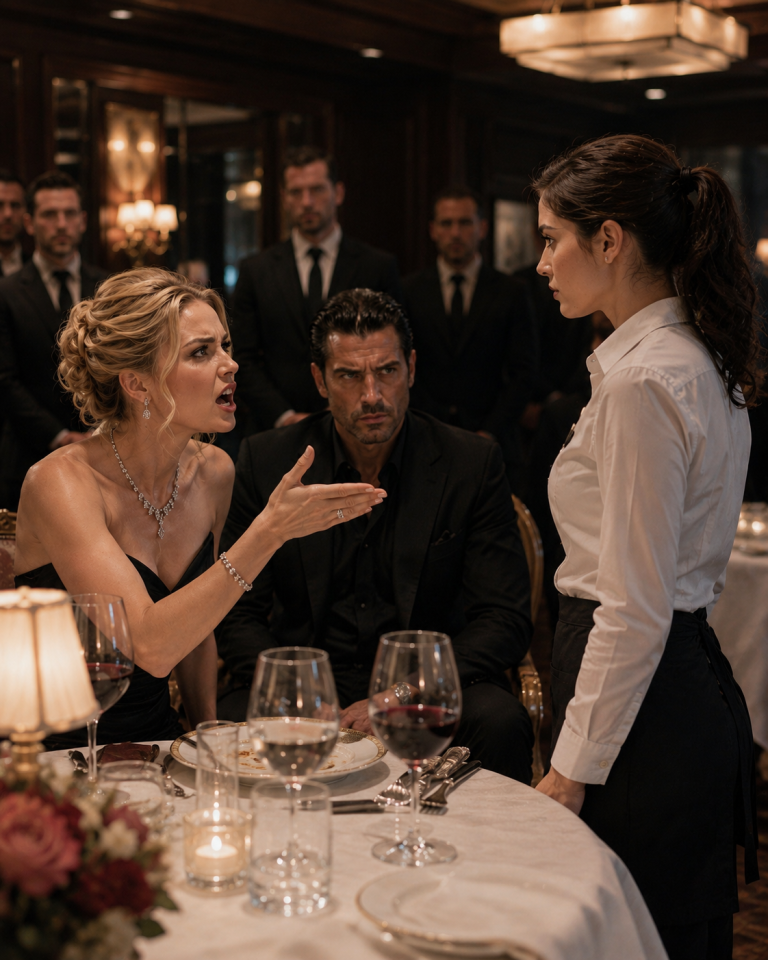
*Then tell me,* Cosimo said. *What do you love about my nephew? Since you speak of truth so freely.*
The trap arrived.
She felt it close around her before she had an answer.
Under the table, Dante’s hand found hers.
Two squeezes.
*Trust me.*
But the words that came out of Nora’s mouth were hers.
*I love that he does not perform,* she said.
Cosimo tilted his head.
*Everyone in a room like this performs,* Nora continued. Her voice had gone quieter and more honest than she intended. *Every meal I have ever catered, every event I have ever worked, people perform. They perform wealth. They perform power. They perform love.*
She looked at Dante.
*He doesn’t. He says what he means, even when what he means is hard to hear. He sees clearly, even when the clear thing is ugly. And when he looks at me—*
She stopped.
*When he looks at me, I don’t feel like furniture.*
The table was silent.
Dante had gone very still.
Cosimo looked between them.
For one second, the warmth left his face completely — not into coldness, but into something more honest than either. Assessment. Real assessment, not performance.
*How charming,* he said finally.
*I hope that survives what is coming.*
—
In the car home, Dante did not speak for twelve blocks.
Nora watched the city through the window.
*He knows,* she said.
*He suspects.* Dante’s voice was quiet. *Knowing and proving are still different.*
*He had my financial records on a tablet.*
*He had access to what we couldn’t scrub in time.*
*What do we do?*
*We go back to the penthouse. We prepare for the council review. We—*
*Roman.*
His head turned sharply.
*Cosimo filed a formal challenge,* she said. *Before dinner, I think. You can see it in the way Renata was watching us. She was there as a witness.*
Dante looked at the window.
*Yes,* he said.
*The council meets when?*
*Tomorrow night. If they vote with Cosimo, the marriage is voided within the family structure. Inheritance transfers at midnight on my thirty-fifth birthday.* He paused. *Which is in forty hours.*
Nora did the math.
*We have less than two days.*
*Yes.*
*Then we need to do something other than wait for them to decide.*
Dante looked at her.
*What I am considering,* he said carefully, *is not legal, not safe, and will require you to trust me in ways you have no reason to trust me.*
*Tell me.*
*If I expose Cosimo before the council meets — not through the family structure, which he controls, but through federal channels, through public record, through making his crimes undeniable in front of the people whose protection he needs—*
*You make him too toxic to back.*
*Yes.* Dante’s voice was controlled. *But to do it, I need to move everything I have been building for three years in the next twenty-four hours. And I need you visible beside me when it happens, because the moment I make this move, Cosimo will look for pressure points.*
He looked at her directly.
*You are the most obvious one.*
*My mother.*
*Yes.*
Nora looked at her hands.
*When?*
*Tonight.*
*Then let’s go.*
—
The next eighteen hours were the architecture of a reckoning.
In the warehouse off the water where Dante’s remaining loyal people assembled — not many, but specific; people who had reasons to hate Cosimo that predated loyalty to Dante — Nora sat at a metal desk and watched a man she had married forty hours ago become, incrementally, someone she understood.
Not someone she was certain of. Not someone safe. But someone whose motivations had become legible.
He worked phones until three in the morning. Some calls ended with refusals and silences. Others lasted seconds and produced results. A federal prosecutor named Heller who had spent four years building a racketeering case that kept collapsing when witnesses recanted — Dante offered her documented financials, shipping records, and the names of two intermediaries who could be flipped.
An investigative journalist named Bauer who had been writing around the Ferrara family for six years — Dante offered him the full story, on record, authenticated, in exchange for timing that aligned with the charity gala Cosimo had planned as his celebration of succession.
*He planned a party,* Nora said, when Dante explained this. *For the night he expects to take over.*
*He has been planning it for months.* Dante pulled up a file. *Four hundred guests. Judges, politicians, business leaders. The people whose support he needs. He intends to announce the council decision at the gala as a legitimizing act.*
*Then we crash it.*
*We do more than crash it.* Dante looked at her. *We expose him in front of every person whose protection he counts on. We make him radioactive before they have decided whether to stand beside him.*
*With what? The documents?*
*The documents. Vincent Morales, a man who helped execute the hit on my parents twenty years ago, who has been waiting for the case to be strong enough to come forward. And Cosimo’s own actions of the past forty-eight hours — the arson, the challenge, the intimidation — all documented and timestamped.*
*Will it be enough?*
Dante looked at the file.
*I do not know,* he said. *But it is what we have.*
Nora looked at the ring.
*I am not doing this for the money,* she said.
He looked at her.
*I know.* His voice was quieter. *You stopped doing it for the money about eighteen hours ago.*
*How can you tell?*
*Because you stopped calculating whether to run.*
She looked at her hands.
*My mother—*
*Marco has someone at her building. She is safe.*
*You thought of that.*
*She matters to you.* He said it simply. *Which means she matters to the arrangement.*
Nora looked at him.
*I don’t want to be an arrangement.*
The words arrived before she could organize them. Too honest, too direct, the specific honesty of three in the morning in a warehouse when the performance had become exhausting.
Dante looked at her for a long time.
*You have not been an arrangement,* he said, *since approximately the moment you told the whole table you did not feel like furniture.*
*That was true.*
*I know.*
*Which part?*
*All of it.*
The warehouse was very quiet.
*You kissed me at the press conference,* Nora said. *The real one. Not the cathedral. You—*
*Nora.*
*I know it is not the time.*
*It is not.*
*But I need you to know that I am not staying because of the money.*
He was very still.
*Why are you staying?*
She looked at the file, at the years of evidence organized by a man who had spent two decades planning this.
*Because Cosimo killed your parents and you have been carrying that alone, and I think you have been waiting for someone to finally know the whole shape of it.* She met his gaze. *And because I don’t want to go back to the apartment with the water stain and the bills in the drawer and the feeling that my whole life is waiting for something.*
*This is not safe,* he said.
*Neither is staying invisible my whole life.*
He looked at her for a long, measured moment.
Then he crossed the warehouse floor and kissed her.
Not brief. Not professional.
His hands found her face. The kiss was the real thing — desperate and careful simultaneously, the specific combination of a man who was allowing himself something he had been refusing for reasons that had, somewhere in the past twenty-four hours, stopped being reasons.
When they separated, he rested his forehead against hers.
*This was not part of the contract,* he said.
*No.*
*It complicates everything.*
*Probably.*
*If Cosimo realizes—*
*If Cosimo realizes, it’s because it’s true,* Nora said. *And truth is harder to discredit than performance.*
His hands were still on her face.
*You are going to make the next twelve months extremely difficult,* he said.
*You started it,* she said. *You put a ring on a stranger’s finger.*
Something broke open in his expression — not the controlled almost-amusement she had been watching for, but the actual thing. He laughed. Short, real, surprised by itself.
*I did,* he said. *Yes.*
—
The gala at the Grand Meridian Hotel occupied an entire floor of one of Midtown’s oldest buildings — the kind of space where power had been celebrated and assigned for a hundred years, where chandeliers had witnessed things that never appeared in any record.
Cosimo had chosen it for exactly that history.
It was now hosting his humiliation instead.
Five hundred guests had gathered to watch his coronation. Judges in black tie. Senators who had stopped mentioning his name in public years ago. Business leaders who had built considerable enterprises in the spaces between his operations and theirs.
All of them, without exception, would be watching when the story they had agreed to believe collapsed.
Dante walked in with Nora at his side and no announcement.
He did not need one.
The room quieted the way rooms quieted for him — not all at once, but in widening circles, table by table, conversation by conversation, until even the orchestra sensed the new physics of the room and softened.
Cosimo saw them from twenty feet away.
He did not stop smiling.
*What are you doing here?* he said. *This is a private event.*
*So was my wedding,* Dante said.
He raised his voice by a fraction.
Not much. Just enough.
*Forty years ago,* he said, *my grandfather built this family on one principle: we answer for what we do.*
The room was still.
*Cosimo Ferrara had my parents killed.*
He said it the way you said something that had been true for twenty years.
*He paid for it. He arranged it. He stood beside me at the funeral and held my shoulder and told me my parents would have been proud of how I was handling my grief.*
Cosimo laughed, too smoothly, too quickly.
*He has been building a case for this fantasy for years—*
The ballroom screens activated.
Dante’s people had reached the venue ahead of them. Bauer’s equipment was running.
On screen: Vincent Morales. Scarred, gray, and absolutely certain.
*My name is Vincent Morales. Thirty-nine years ago I was part of a crew hired to make the deaths of Thomas and Camilla Ferrara look like a rival family operation. We were paid one hundred and twenty thousand dollars through a holding company owned by Cosimo Ferrara. This is the account number. This is the transfer record. This is the name of the man who handed me the cash.*
The gala erupted.
Cosimo lunged.
His sons moved.
Dante’s people had anticipated both.
The room became controlled chaos — not a fight, but the specific noise and motion of a social structure understanding it had been wrong about something it had built itself around.
Prosecutor Heller entered through the east door.
*Cosimo Ferrara.* Her voice carried. *You are under arrest for murder in the first degree, conspiracy, racketeering, and five additional counts to be read at processing.*
Cosimo looked at Dante.
For one moment, all the warmth was gone.
What remained was the face of the actual man — calculating, cold, genuinely surprised only by the timing.
*This is not over,* he said.
*For you,* Dante said, *it is.*
Federal agents reached Cosimo.
Nora, who had stayed close to Dante’s shoulder through all of it, watched the man who had killed his parents be walked toward the gala’s service exit.
She felt Dante’s hand find hers.
She gripped it.
*Nora.*
She turned.
Dante’s face was the most open she had seen it.
Not unguarded exactly — too many years of discipline for that. But present. Fully.
*Your mother,* he said.
*Is she—*
*Marco is bringing her here. She is fine.* His thumb moved over her knuckles. *I thought you should see it.*
*The arrest.*
*Yes. I thought—* He paused. *I thought you deserved to see that it was real.*
Nora looked at him.
*Was any of this what you expected?*
*None of it,* he said.
*The marriage?*
*Not a second of it.*
*Me?*
He looked at her for a long time.
*You especially.*
Outside, prosecutors and federal agents processed the gala’s less cooperative guests. Inside, five hundred people recalibrated their understanding of who had been right and who had been protected and what the next year of the city’s power structure would look like.
Nora stood in the middle of all of it and felt, for the first time in years, that she was somewhere instead of nowhere.
—
Her mother arrived twenty minutes later.
Margaret Chen — Mei Lin, to those who had known her long enough — was not the kind of woman who showed fear on her face if she could help it. She walked into the Grand Meridian still wearing the cardigan she’d had on when Marco arrived at her Yonkers apartment, and she looked around at the aftermath of federal arrests and ballroom chaos with the specific expression of a woman reassessing her evening plans.
Then she saw Nora.
They embraced in the middle of the Grand Meridian ballroom with the kind of grip that was about more than tonight.
*Are you hurt?* her mother asked.
*No.*
*Good.* Margaret pulled back and looked at her daughter’s face for a long time. *This was a very dramatic way to pay your student loans.*
Nora laughed, which turned into something more wet, which she collected before it could embarrass her.
*I know.*
Margaret looked past her to Dante, who had given them space with the deliberateness of someone who understood what it looked like.
*He looks exhausted,* her mother said.
*He hasn’t slept in two days.*
*His fault.*
*Partly.*
Margaret studied him.
*Does he love you?*
*Mom.*
*That was not a no.*
*We have known each other for forty-eight hours.*
*Some people take longer.* Her mother straightened her cardigan. *He kept you safe. He thought about me before I was a problem. That is information about someone’s character.*
Nora looked at the ring.
*The marriage was a contract,* she said. *A business arrangement.*
*Was.*
*Is.*
*That was not past tense,* Margaret said gently. *That was defensive present.*
She took her daughter’s hands.
*You deserve to choose, sweetheart. Not fear. Not debt. Not a contract.* She squeezed once. *Choose.*
—
The weeks after Cosimo’s arrest moved with the specific speed of things that had been compressed under pressure and were now expanding.
The council, convened in an emergency session and presented with Vincent Morales’s testimony and the federal indictment, voted eight to four to uphold the marriage.
Not because they were convinced it was genuine.
Because Cosimo had given them reasons to need Dante more than they feared his choices.
Nora testified before a federal grand jury about her kidnapping — which had lasted forty-five minutes in the back of a car before Marco extracted her, and which she described with the flat precision of someone who had decided that giving it drama was giving it power.
Dante’s thirty-fifth birthday came and went.
The inheritance transferred legally.
Nora did not sign the divorce papers that arrived three weeks later — not because she had decided to stay, but because she had not yet decided anything, and she had promised herself she would stop making irreversible choices out of exhaustion.
She opened a studio in Brooklyn.
Not a large one. A rented space in a building that smelled of turpentine and old wood, with windows that faced north and let in the specific quality of light that made colors honest.
*Nora Chen Design.*
She paid for it with the money Dante had transferred — the first million and then the rest, which arrived the week after the gala in the specific matter-of-fact way he handled everything.
She paid her mother’s bills. She paid her own loans. She donated to three organizations that her mother’s cancer diagnosis had introduced her to.
And she kept working.
Not because she had to.
Because it was hers.
—
The divorce papers sat on her desk for six weeks.
She thought about them with the frequency of a thing she was avoiding thinking about.
Then one morning a package arrived.
No return address. Her name in handwriting she recognized.
Inside: an original sketch, framed simply. Her own work — the piece she had mentioned to him that night at the conference table, the logo for a small bakery in Astoria whose owner had cried when she saw it, a piece Nora had described as the closest she had come to making something that mattered. She had not known anyone outside her own hard drive had a copy.
A note on plain paper.
*I found the original client file. She wanted you to have this back. I told her to mail it to me because I am not yet good at doing things the sensible way.*
*I am trying.*
*— D*
Nora sat with the framed sketch for a long time.
She picked up her phone.
She typed: *The divorce papers have been on my desk for six weeks.*
She sent it.
The response came in four minutes.
*I know.*
She typed: *Did you know I wasn’t going to sign them?*
A pause. Then:
*No. I hoped.*
She looked at the sketch. At the ring she had not taken off.
She typed: *Come see the studio.*
—
He arrived the next afternoon.
He wore jeans and a dark sweater and he looked, in the north light of the studio, like a man trying on a version of himself he had not been certain would fit.
Nora watched him walk through the space.
He touched a paint swatch pinned to the wall. He read the names she had written on the whiteboard — current clients, projects, deadlines.
He stopped at the window.
*This is you,* he said.
*Yes.*
*Not performing.*
*I have spent enough time performing.* She came to stand beside him. *I don’t want to do it anymore.*
*Even with me?*
*Especially with you.* She turned to face him. *I need you to understand something before we figure out what this is.*
He waited.
*I am not going to live inside your world,* she said. *I will not disappear into your penthouse and your security and your family structure. I have a life. A real one. I am not leaving it.*
*I know.*
*You cannot control who I see or where I go or how I—*
*Nora.* His voice was quiet. *I know.*
She looked at him.
*How do you know?*
*Because you are the person who told Cosimo she did not feel like furniture, in a room full of people who would have used that against you, and you said it anyway.* He stepped closer. *The last thing I want is to make you furniture.*
*Then what do you want?*
He looked at her.
*I want to deserve what you said about me,* he said. *In that restaurant. About seeing clearly and not performing.* A pause. *I am not there yet. But I want to try.*
*What does trying look like?*
*Building something legitimate from the wreckage.* His voice was measured. *Disbanding the parts of the family structure that cannot survive daylight. Keeping the parts that can. Making it hard for the next Cosimo to take root.* He paused. *And asking you to help me understand what that looks like from the outside.*
*Why me?*
*Because you see clearly. And you tell the truth, even when it costs you.*
Nora looked at the studio.
At the framed sketch on her desk.
At the ring.
*I am not signing the divorce papers,* she said.
Something in his face.
Not relief exactly. The internal equivalent of a door opening.
*You’re not.*
*No.* She turned to him. *But I am also not agreeing to the contract.*
*What are you agreeing to?*
*Something without a deadline,* she said. *Without a number. Without an exit clause written into the beginning.*
*That is more frightening,* he said.
*Yes.*
*No guarantees.*
*None.*
*You could still decide I am not worth it.*
*I could.* She held his gaze. *Or you could stop making yourself smaller than you are because you’re afraid of what I’ll do if I see the full size.*
He looked at her for a long time.
Then he closed the distance between them.
He kissed her in the north light of the studio, with the paint swatches on the wall and the city outside the window, and it was nothing like the cathedral kiss — nothing like brief, professional, or controlled.
It was the real thing.
—
Three months later, on a Tuesday morning, Dante sat at one end of Nora’s studio drafting table while she worked at the other.
He had started coming on Tuesday mornings.
Then Thursday afternoons.
Then most days, which neither of them named as a pattern yet.
He worked on the restructure. She worked on whatever had been commissioned that week. Sometimes they talked. Sometimes they didn’t.
Her mother had been twice and had given Dante a specific kind of quiet approval that expressed itself as neither warmth nor coldness but the careful respect of a woman who had raised her daughter to make serious decisions and was watching one be made.
*You look different,* Nora said without looking up from her screen.
*How?*
*Less like someone waiting for the next thing to go wrong.*
He considered this.
*Is that good?*
*I think so.* She glanced at him. *You still sleep badly.*
*Less badly.*
*Progress.*
He looked at the sketch on her desk — the bakery logo, still there.
*I spoke to Heller yesterday,* he said.
Nora looked up.
*Cosimo’s trial date has been set. They have added four additional counts based on the financial records we provided.* He paused. *She said it is the strongest racketeering case her office has built in fifteen years.*
Nora set down her pen.
*How do you feel about it?*
He looked at the window.
*Like I have been holding a wire for twenty years that I can finally set down.* He turned back. *Except the hand does not know how to open yet.*
*It will.*
*How do you know?*
*Because you came to a design studio on a Tuesday morning.* She looked at him. *A person who cannot let go does not do that.*
Something shifted in his face.
*You have been studying me.*
*Quietly.*
*What have you concluded?*
Nora looked at the ring on her hand.
*That you are exactly what you said you were in that warehouse at three in the morning,* she said. *A man still asking the question. Not there yet.* She looked at him. *But asking.*
*That is enough for you?*
*It is enough to start with.*
He stood and came to her side of the table.
He was quiet for a moment.
Then: *I did not expect you.*
*You said that.*
*I am still processing it.*
She turned her chair to face him.
*You have been processing it for four months.*
*Some things take time.*
*Is that what I am? A thing that takes time?*
*You,* he said, *are the thing that made time feel like it was moving in the right direction.*
Nora looked at him.
*That was almost romantic.*
*Almost?*
*You would have to try harder.*
He sat on the edge of the table.
*Nora Chen.* He said her name the way he had at the cathedral — like it had weight, like it deserved all of its syllables. *I think I have been in love with you since you looked at a room full of very dangerous people and said *wrong chapel* like it was an administrative error.*
She laughed.
*That was shock, not bravery.*
*The distinction stopped mattering somewhere around the time you told my uncle you did not feel like furniture.*
She looked at her hands.
The ring on her finger.
No contract. No deadline. No ten million dollars waiting at the other end.
Just a man she had accidentally married, and an apartment she had moved back into part-time, and a studio full of light where the most feared person in her new life came to sit quietly on Tuesday mornings.
*I love you,* she said.
Plain. Certain. Not for performance.
His expression broke open in a way she had been watching it build toward for months.
*I love you,* he said.
The city moved outside the window.
The north light shifted.
The studio held exactly what it was supposed to hold.
—
They married again six months later.
Not in a cathedral. Not with four hundred witnesses and armed men along the walls.
In the back garden of a restaurant in Brooklyn, with Nora’s mother in the front row and Dev beside Nora and Dante’s one remaining cousin — a woman named Cate who had taken the family’s name and done something entirely different with it — standing next to Dante with an expression of cautious hope.
The judge officiated.
The vows were their own.
*I take you,* Nora said, *in full knowledge of who you are. Not who you were performing. Not who you think you should be. The actual you, including the parts you’ve been trying to dismantle and the parts you’re still figuring out how to build.* She held his gaze. *I am not here to save you or complete you. I am here to be beside you while you do it yourself.*
Dante’s vows arrived the way he arrived at most things — controlled, specific, and entirely honest.
*I take you, Nora Chen. I take you knowing I asked you to do the most unreasonable thing one person can ask another, and you said yes because you had no other options, and then you stayed when the options opened.* He paused. *I take you knowing that every good decision I have made in the past year had your fingerprints on it somewhere. I take you knowing you are more afraid than you look, and braver than you believe, and that the best thing that will ever happen to me was that you ran into the wrong building in the rain.*
*To beautiful accidents,* the judge said.
The garden laughed.
Dante kissed her.
Not brief.
Not professional.
Not for any audience.
For them.
Nora pressed her forehead to his and felt the weight of everything — the wrong chapel, the ring, the million dollars, the cold conference rooms and the warehouse at three in the morning and the studio on Tuesday and the gala and the arrest and the six weeks of unsigned divorce papers — settle into the shape of something that had been building toward this point all along.
Not fate.
Choice.
The most expensive and most earned version of it.
*Welcome home,* she said.
He smiled. The real one. The one she had been collecting.
*I’ve been home,* he said, *since you stayed.*
—