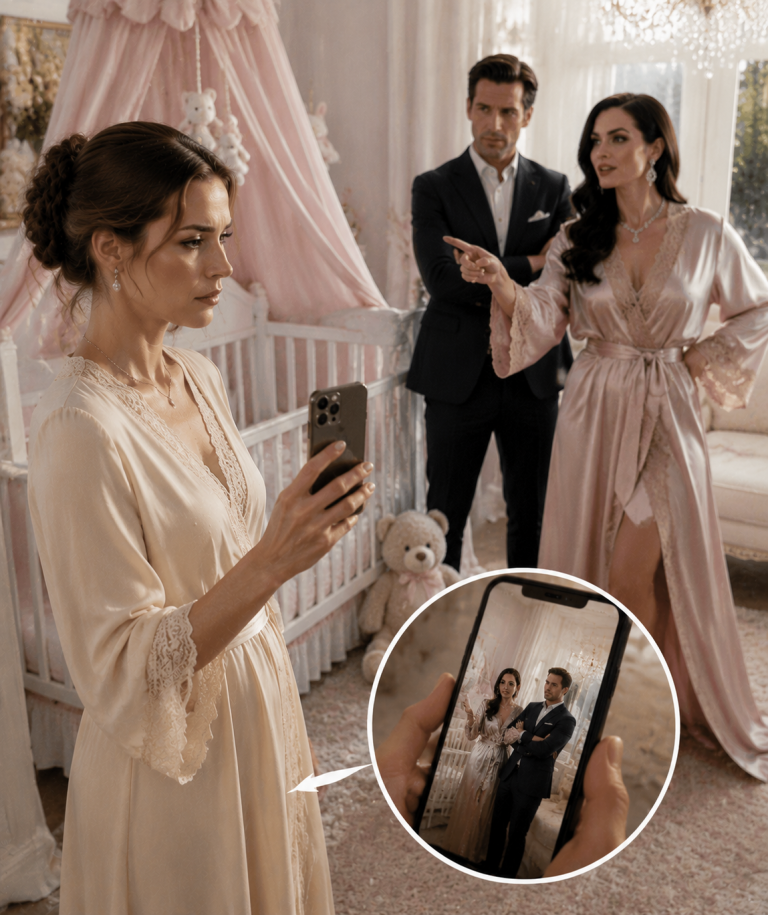
His Mistress Slapped Me Before 300 Guests — Then My Husband Begged the Wrong Woman to Stay Silent

PART 1
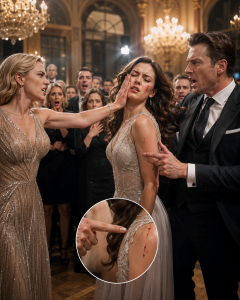
The music stopped first. Then the room itself seemed to stop, three hundred faces beneath the crystal chandeliers turning as one toward the center of the Ashford Crown ballroom, where Vivien Ashford stood with her cheek already reddening and a thin line of blood at the corner of her mouth.
Madison Cole’s hand was still in the air.
She wore a silver gown, a diamond bracelet that had belonged to Vivien’s mother, and the satisfied smile of a woman who believed the most important man in the room had already chosen her.
Alexander crossed the floor in three hard steps. He did not ask his wife if she was hurt. He caught Madison by the shoulders and pulled her behind him like something worth shielding.
“If you touch her,” he warned Vivien, voice low and urgent, “we divorce tonight.”
The silence thickened. Vivien looked at her husband and understood, in the space of a single breath, exactly what he was afraid of — not that she was bleeding, but that she might embarrass him in front of three hundred donors and a stage rigged with cameras. For twelve years he had praised her composure whenever it protected his reputation. Tonight, after his mistress struck her at the very gala Vivien had funded, he expected that same composure to save him one more time.
Vivien lifted a white napkin from the nearest table and pressed it to her lip.
Behind Alexander’s shoulder, Madison’s eyes brightened with triumph. Only minutes earlier she had taken Vivien’s assigned seat at the central table, and when Vivien asked her to move, Madison had laughed and announced that Alexander had promised her everything Vivien no longer deserved — then lifted her wrist and displayed the bracelet as proof. It was Eleanor Ashford’s bracelet. Vivien had simply asked for it back. Madison had answered with her palm.
Now Alexander stood between them as though the woman in silver were the one who needed protecting from the wife bleeding quietly into a napkin.
“Did you hear me?” Alexander said.
“Perfectly.” Vivien lowered the cloth. A red mark spread across her cheek, but her eyes had gone very steady.
Alexander mistook the calm for surrender. His shoulders loosened. “Good. This event is important. Go upstairs, fix your face, and don’t make a scene.”
Several guests looked down at their plates. Others raised their phones, discreetly, beneath the tablecloths. The gala celebrated the tenth anniversary of the Asheford Children’s Relief Fund, and Alexander was scheduled to deliver the keynote in less than an hour. He believed, in that moment, that the entire room still belonged to him.
That belief was his first mistake.
The hotel carried the Ashford name, but the name had never been his. It belonged to Vivien’s mother, Eleanor Ashford, who had built the first thirty-room hotel from nothing and grown it into a national hospitality group before Alexander had ever set foot in it. He had married into the name and spent twelve years speaking as though he had built it himself. Vivien had rarely corrected him in public.
Tonight, that would change.
She looked past him toward the enormous screen behind the stage, where his portrait still glowed beside the words *Vision. Compassion. Legacy.* Madison’s name appeared beneath it — creative director of the gala. Vivien’s own name sat in smaller letters near the bottom. Madison had changed the program that morning. Alexander had approved it.
The slap, Vivien understood now, had never been an accident of anger. It was the final move in a humiliation careful enough to have assigned seating.
She folded the stained napkin once and set it on the table. “You want a divorce?”
Alexander glanced toward the cameras. “We’ll discuss that privately.”
“You just announced it to three hundred people.”
His jaw tightened. “Don’t test me.”
Vivien turned instead to Madison, who lifted her chin and touched the bracelet like a woman confirming she’d won. “He chose me,” Madison said.
Vivien’s cheek throbbed. She did not raise her hand. Instead, she reached for the microphone resting on the central table and switched it on. Her voice filled the ballroom before Alexander could stop her.
“Alexander has asked for a divorce.”
A wave of whispers broke across the tables. His face drained of color. “Turn that off.”
“He has also warned me not to touch Madison Cole,” Vivien continued, “after she struck me in front of everyone here.” Madison’s smile faltered. Vivien looked out at the guests, then at the cameras, then at the screen still carrying her husband’s borrowed legacy.
“I will respect his request,” she said. “I will not touch her.”
Alexander exhaled — and Vivien smiled.
“I will return the slap another way.”
She lifted one finger. Then, slowly, deliberately, nine more.
PART 2
The ballroom doors closed. Hotel security took position beside them without being asked, and for the first time all evening, something close to fear crossed Alexander’s face.
Vivien gave one small nod toward the head of security, and two officers walked, unhurried, straight to Madison.
They didn’t grab her. They didn’t raise their voices. One simply held out his hand for the black access card hanging from her clutch.
“What is this?” Madison stared at the outstretched palm.
“Her access was issued under my family account,” Vivien said, her voice still carrying through the ballroom speakers. That card opened the presidential suite, the private spa, the executive elevator, the rooftop lounge, the owner’s floor — all of it, for six months, while Madison photographed herself in rooms she called her second home and told friends Alexander had given her permanent access.
He had given away something that had never been his to give.
“Return the card,” Vivien said. Madison looked to Alexander, who stepped forward and held his hand out to the officer instead. “I authorized it.”
The officer didn’t move.
Vivien lifted a second finger — and behind her, the enormous screen changed. Alexander’s portrait vanished. In its place appeared a single ownership page: *Ashford Crown Hotel. Majority Owner: Vivien Ashford.* No explanation, no fine print. Just her name, her photograph, and a fact every guest in the room could read at a glance.
Madison’s face lost its color. Alexander looked from the screen to his wife. “Take that down.”
No one obeyed him.
The card dropped into the officer’s palm. “This is humiliating,” Madison whispered.
Vivien touched the mark still darkening on her own cheek. “That was the first.”
A murmur moved through the tables. Someone near the back had begun recording openly now, not bothering to hide the phone. Alexander forced a smile toward the lens. “My wife is upset,” he announced. “We should pause the program.”
But the orchestra stayed seated. The catering staff kept serving dinner. The event did not pause — only Alexander’s control over it did.
Vivien crossed to Madison and stopped two steps away. “Take it off,” she said, looking at the bracelet.
Madison covered it with her other hand. “Alexander gave me this.”
“Alexander stole it from my mother’s safe.”
The screen behind them answered before Alexander could. A photograph of Eleanor Ashford wearing the very bracelet at the hotel’s opening, twenty-seven years earlier. Beside it, a security still of Alexander entering the family archive room — and leaving it with a narrow velvet box in hand.
No one needed an expert to connect the images.
“You said it was yours,” Madison said slowly, staring at him.
“It was in the family collection.”
“*My* family,” Vivien said. Her husband’s confidence cracked visibly, right there beneath the chandeliers, and three hundred guests watched it happen. “We are married,” he tried. “That collection belongs to both of us.”
“No.” One word. Beneath the photograph, a new line appeared on the screen: *Personal property of Eleanor Ashford, left to her daughter, Vivien.*
Madison’s fingers shook on the clasp. It caught. Her breathing quickened, the bracelet that had made her feel chosen now glittering like evidence under three hundred pairs of eyes.
Alexander reached to help her. Vivien raised one hand, and he stopped.
The clasp finally gave. Madison set the bracelet on the table with trembling fingers, and Vivien lifted it with the same napkin still stained by her own blood — not to wear it again, but to hand it, wrapped and untouched, to hotel security for safekeeping.
“Second,” Vivien said.
Alexander leaned close to his wife, his voice dropping to something almost pleading. “End this now.”
Vivien looked at him for a long moment, the ballroom holding its breath around them, the screen behind her still glowing with her mother’s name.
“You asked for a divorce,” she said quietly. “That’s one of them.” She lifted a third finger. “There are eight more coming — and I don’t think you’re going to like any of them.”
PART 3
The third slap took Madison’s job.
For nearly a year she had called herself creative director of the Asheford Children’s Relief Fund, appeared in its promotional videos, chosen its gowns and flowers and camera angles, and rarely once visited the hospital wards the fund actually supported. Vivien had questioned the appointment when Alexander first made it. He had called her jealous.
Now the screen displayed the evening’s real spending — gold table décor, imported perfume gifts, a private dressing suite, three days of limousine service logged as *donor transport* — a running total that finally settled on $840,000.
Guests shifted in their seats. Madison looked from the number to Alexander. “You approved this budget.”
“Stop talking,” he said, low, urgent.
The microphone caught it anyway. A sharp ripple of whispers moved through the room.
“The children’s programs can afford medicine, transport, meals, and family housing,” Vivien said, turning to the gala coordinator. “They will not pay for your friends to drink champagne in my hotel.”
Madison’s title vanished from the program screen as she watched — her portrait, her seat number, her place in the closing presentation, all removed in real time. “You can’t fire me in front of everyone,” she said.
“You struck the chair of this fund during its anniversary gala,” Vivien said simply. “Third.”
Security didn’t move to escort her out yet. Vivien wanted her to see exactly what came next — because Madison had walked into that ballroom believing Alexander’s protection could overrule ownership, evidence, and three hundred witnesses. Leaving too early would let her keep believing it.
Alexander pulled Vivien toward the side of the stage, his grip light enough to look private on camera. “You’re destroying our name.”
“My name,” Vivien said, removing his hand from her arm. “You think these guests care about technical ownership? They care that you stole from sick children to impress your mistress.”
“I never touched the children’s fund.”
The fourth slap answered him. A photograph appeared — Alexander and Madison on a private yacht, then a ski resort, then a Paris hotel suite, each one pulled from Madison’s own public account. Beneath each image, the expense description Alexander had filed alongside it: *donor meeting. Hospital partnership. Regional outreach.*
The ballroom went completely silent.
“Those are private financial records,” Alexander said.
“They’re charity card statements.” Vivien watched his face change as Madison stepped away from him.
“You told me the company paid for everything,” Madison said.
“Not now.”
“You said every trip was covered by your executive account.”
“Be *quiet*.” The command came out too hard. Madison flinched — and Vivien watched the alliance split, exactly where stolen luxury ended and blame began.
The fund’s treasurer walked to the stage without a word and set a sealed envelope in front of Alexander. Vivien spoke into the microphone. “Your charity spending privileges ended at six o’clock this evening. And you cannot remove me from my own fund.” The screen behind her scrolled to the founding document: *Founder — Eleanor Ashford. Chair — Vivien Ashford. Honorary Ambassador — Alexander Ashford.*
*Honorary.* The word seemed to shrink him beneath the lights. He had spent years introducing himself as the man behind the fund. He had never once owned it, chaired it, or directed it — only worn its reflected shine because the cameras liked him and he had once, briefly, seemed sincere.
That permission had just ended. “Fourth,” Vivien said. Somewhere near the back, a nurse’s table began to applaud.
The fifth slap took the stage itself. Alexander’s keynote had been scheduled for nine o’clock, rehearsed for weeks, its closing line describing the Ashford name as a promise he carried for future generations. The gala host walked to the podium, lifted his printed speech, and handed it not to Alexander but to Vivien.
“I’m still the keynote speaker,” Alexander said. The host looked at Vivien. She shook her head — and walked away without another word, which cut deeper than any argument could have.
“You need me,” Alexander told her, forgetting the microphone was still live. Laughter rippled through the tables, quiet but unmistakable.
“Enough,” Vivien said, folding the speech once. “The hospitals need donors. The families need support. None of them need a man who billed his mistress’s vacations as outreach.” She dropped it into the wastebasket beside the stage. “Fifth.”
Madison stood several feet behind him now — no title, no bracelet, no access card, the silver gown still glittering uselessly. She looked toward the exit. “You may leave,” Vivien told her.
“I’m staying with Alexander,” Madison said, lifting her chin.
He didn’t turn toward her. The answer was written in his back, and Madison saw it too. Fear finally replaced the arrogance in her face — because she had struck a wife on the promise that the wife would soon be gone, and instead his borrowed world was collapsing while he quietly calculated whether she’d become too expensive to defend.
The sixth slap waited upstairs. The hotel manager set a small envelope on the table — two black room cards. For eight months Alexander had used the presidential residence with Madison, telling Vivien the suite was reserved for visiting investors while Madison kept gowns in its closets and replaced Eleanor Ashford’s photographs with modern art.
“Your belongings have been packed,” Vivien said. “My staff removed your property from my residence.”
“Alexander gave me that suite.”
“Alexander cannot give away a room he does not own.”
The pattern had become impossible to miss by now — seat, bracelet, title, money, stage, suite. Every gift he’d given Madison had come from Vivien’s life. “Where are we staying tonight?” Madison asked him. His eyes stayed on Vivien.
“This is still my marital residence.”
“No,” Vivien said. “Our marital residence is the house on Lake Avenue. You moved your clothes out three months ago.” The screen displayed his own message to the hotel manager: *Move my wardrobe to the presidential floor. Vivien rarely comes upstairs. Don’t mention Madison on the invoices.*
Alexander stared at his own words on the screen. Madison stepped away from him again. The manager set two suitcases for Madison and four for Alexander beside the ballroom doors, and three hundred guests watched them arrive.
“Sixth,” Vivien said. He had entered the room tonight as its most important man. He was, by degrees, becoming a guest whose room had simply expired.
Pride kept him standing anyway, long after reason should have carried him out. He believed, still, that a man who looked defeated became defeated — one of his own favorite sayings — and so he stayed, which only gave Vivien time to take his chair. Not the ballroom chair. The company one.
At nine-fifteen, twelve members of the Ashford Crown Hospitality board appeared on the ballroom screen through a live connection from the executive room one floor above. Alexander turned toward the image, confused. “What is this?”
“A scheduled vote,” Vivien said, setting the microphone on the podium. He had planned to use tonight’s anniversary to unveil a new luxury lifestyle division — with Madison as its public director — introducing her to investors under warm, respectable lighting. Vivien had learned of the plan two days earlier and changed exactly one item on the agenda.
The screen showed the evidence in plain images, no explanations needed: a company apartment transferred to Madison for one dollar; a marketing contract paying her four times the standard rate; hotel staff quietly reassigned to renovate her private home.
“You said those were gifts from *you*,” Madison said.
“Stop saying that.”
The board’s vote appeared one name at a time. *Remove. Remove. Abstain. Remove.* By the seventh, the result was final. Alexander Ashford was no longer executive chairman. His photograph disappeared from the company page, and the ballroom watched him become unemployed from a company he had spent years claiming to have built alone.
“You built nothing without me,” he said.
“Then it should collapse tomorrow.” The screen cut to live footage from the group’s hotels — front desks, kitchens, housekeeping carts, event teams — all of it running exactly as it always had, entirely without him. “It looks fine,” Vivien said. Laughter spread through the room. “Seventh.”
Madison’s face had gone blank. She was no longer watching Vivien at all — she was watching Alexander the way a passenger watches a pilot admit the plane had never been his to fly. He turned to her at last. “This happened because you hit her.”
The betrayal arrived that fast. “You told me to put her in her place,” Madison said.
He froze. Three hundred guests heard it, and Vivien didn’t need to ask her to repeat it.
“You said she’d never fight back,” Madison went on, anger burning through the fear now. “You said if I embarrassed her in public, she’d sign whatever you put in front of her.”
“You’re upset—”
“You gave me the bracelet this morning. You moved my name above hers on the program. You told me to take her seat.” Each sentence landed harder than anything on Vivien’s screen had managed. The mistress he’d used as a weapon had just become a witness against him.
The eighth slap was already in Vivien’s hand. She lifted a sealed folder from beneath the podium, and Alexander recognized it before she opened it. Divorce papers. His own warning came back to him — *touch her and we divorce tonight* — and Vivien had kept her word exactly. She had never touched Madison at all.
“You wanted a divorce,” she said.
“I said that in anger.”
“You said it as a threat.” She set the folder on the table. “This is eight.” A woman in a dark suit crossed from the side of the ballroom and delivered the papers into his hands without a word beyond his name.
Alexander refused to take them. They sat beside his luggage receipt instead — an image simple enough for every guest in the room to read without translation. No chair. No suite. No charity title. No marriage.
“You prepared these before tonight,” he said, something like disbelief in his voice.
“Yes.”
“Then the slap had nothing to do with any of this.”
“The slap showed me exactly how far you expected my silence to stretch.”
Madison stepped closer to the papers on the table. “You told me she’d never leave,” she said to Alexander.
“You’re the reason this exploded. You slapped her.”
“Because you told me she was *nothing*.”
The words landed in front of Vivien, and for the first time all night, something that resembled shame reached Alexander’s face — not enough to soften him, but enough to show. “Madison misunderstood,” he tried.
Madison’s mouth fell open. Vivien almost admired the speed of the pivot — an hour earlier he’d threatened divorce to protect his mistress; now he was already rehearsing how to call her unstable, confused, alone.
Madison understood it too. She pulled her phone from her clutch. “Should I play the messages?”
His face changed instantly. “Put that away.”
She didn’t. “You said the company apartment would be mine. You said Vivien would sign over the hotel shares after the gala. You said you’d announce our engagement before Christmas.”
Whispers turned to open conversation across the tables. *An engagement. Before the divorce was even signed.* Alexander had apparently planned every future except the one where his wife read the documents first.
“I have the messages,” Madison told Vivien.
“Keep them,” Vivien said. “You may need them.” No forgiveness in it — just a fact, offered plainly.
Alexander, watching both women stand outside his control at once, lost the last of his public discipline. “Neither of you would have anything without me.”
The room reacted with open disbelief. Vivien looked around at the hotel her mother had built. Madison looked at the luggage stacked by the door. Then both women looked at him, and he heard, for the first time, exactly how ridiculous the sentence sounded.
“Eighth,” Vivien said again, and moved on.
The ninth slap, she didn’t deliver herself. Alexander did it to himself, turning on the mistress he’d defended in front of three hundred people and beginning to strip back every promise he’d made her. The apartment had only ever been temporary. The contract was a trial arrangement. There had never been an engagement plan at all.
“There’s never been a ring,” he said.
Madison’s eyes filled, though she refused to let them fall. She looked at her bare wrist where the bracelet used to sit, then at the luggage, then at the screen still displaying his removal. Everything he had given her, she understood now, had come from someone else. Even the future.
“You told me to slap her,” she said again, quieter this time.
“Keep your voice down.”
“You said she needed to understand the hotel had a new woman in it.”
“You made your own choice.” He said it like a man closing a door, and Madison flinched as if he’d struck her.
Vivien watched without satisfaction. Madison had humiliated her, stolen from her, and raised a hand against her — she would answer for all of it. But Vivien wasn’t going to let Alexander make the woman he’d used into the only villain in the room.
Madison connected her phone to the ballroom screen herself. One message appeared, Alexander’s name above it: *Wear Eleanor’s bracelet. Vivien needs to see who matters now.* Then another: *Take her seat. If she complains, remind her — I choose who stands beside me.* Then the last: *If she touches you, I’ll divorce her in front of everyone. She won’t risk the scene.*
Three hundred guests read it in silence. Vivien didn’t need to defend herself at all. His entire plan sat on the screen in his own handwriting.
“You knew she wouldn’t hit me back,” Madison said slowly. “You wanted me to look cruel so you could look protective.”
He said nothing, because there was nothing left to say. Madison had finally understood the role she’d been given — publicly dependent, disposably useful — and understood, too, that if Vivien had stayed silent, Alexander won; if Vivien had struck back physically, he’d still have won, calling her unstable and presenting Madison as the woman he’d rescued.
Vivien had refused to play either part.
Madison set her silver clutch on the table and opened it — hotel cards, gift receipts, a small jewelry box. Inside the box, an engagement ring glittered. Alexander’s face went white. “A sample?” she asked. No one laughed this time. The cruelty of it had become too plain.
She turned to Vivien. “I knew he was married. I knew you didn’t approve of my position. I knew the bracelet might be yours. I wanted you humiliated because I thought that meant I’d won.” It wasn’t an apology yet. It was only responsibility, offered flatly.
“You hit me,” Vivien said.
“Yes. I’ll answer for that.”
She handed her phone to the fund’s treasurer. “Every message is there.” Alexander’s ninth humiliation was complete — the woman he’d used to attack his wife had just handed over the entire record of his plan. Vivien raised nine fingers.
The ballroom doors opened. For a moment everyone expected him to walk through them. He didn’t. He looked at Vivien instead. “What’s the tenth?”
She didn’t answer right away. The mark on her cheek had darkened; her lip had finally stopped bleeding. Three hundred guests held their phones and their breath in equal measure.
“The tenth comes tomorrow,” Vivien said.
Alexander laughed — a short, relieved sound, as though one more night might give him room to repair, bargain, or hide. “Then this performance is over.”
“The gala continues,” Vivien said, turning to the tables. “Every dollar raised tonight goes directly to the children’s programs. The luxury expenses have already been replaced from Alexander’s frozen compensation.”
Applause started at the hospital tables and rolled outward. His face tightened at the word *frozen*. “Dinner will be served,” Vivien went on. “The family housing presentation begins in ten minutes. No child loses support because two adults used a charity as a stage.”
The applause grew. He reached for the microphone; security stepped between him and the podium before his hand got close.
By morning, the tenth slap arrived exactly as promised — not with noise, but with a single broadcast. Vivien stood in the hotel lobby, the same red mark still visible on her cheek, unhidden by makeup, and announced three changes: every employee tied to the canceled lifestyle division would keep their job; every dollar charged to charity would be restored; and the presidential residence — the room where Alexander had hidden Madison, stored his gifts, and quietly planned his wife’s replacement — would become temporary housing for the families of children receiving emergency treatment nearby.
“A room gains its value from who it protects,” Vivien said into the camera, “not from who believes they own it.”
Alexander, watching from a rented hotel room across town, threw the remote at the wall. No one saw it break. No one applauded. His rage had finally become entirely private — exactly where he had once expected hers to remain.
*
Three days later, a seven-year-old named Lily moved into the former presidential suite after emergency heart surgery, carrying one small bag while her mother held the other and her father, still in his work uniform, stood overwhelmed in what used to be a room built for scandal. Vivien handed the girl a simple blue access card printed with a yellow sun, not the black executive card that had once hung from Madison’s wrist. Lily held it like treasure.
Madison came to Vivien’s office a week after that, in a plain black coat with no jewelry at all, and set a phone and a folder on the table — messages, receipts, a recording from the night before the gala in which Alexander’s own voice promised that once Vivien disappeared upstairs in shame, Madison would stand beside him for the keynote by morning. “I’m sorry I hit you,” Madison said. “I knew the bracelet might be yours. I wanted you to react so he’d choose me.”
“He chose himself,” Vivien said. There wasn’t much more to add. “Will you report the assault?”
“Yes.”
Madison faced a hearing weeks later without Alexander beside her, and received community service, counseling, and a permanent order to stay away from Vivien’s private events. Outside the courthouse, reporters asked Vivien if she wanted a harsher sentence. “The consequence is decided,” she said, and kept walking. Alexander, waiting across the street, drove off the moment he saw the cameras. Madison watched the car disappear and turned to the reporters instead. “I hit Vivien Ashford,” she said simply. “Alexander encouraged the confrontation, but the hand was mine.” The sentence traveled farther than his three-page denial ever did.
Alexander did not go quietly. He tried to force his way back into the hotel with a camera crew and a claim that Vivien had removed him without proper authority; his access card flashed red at the elevator on live television. He tried to steer the city’s largest medical conference to a rival hotel, only for the inspection committee to find four accessible rooms and no hospital transport where the Ashford Crown offered forty and a fully staffed family residence. He tried to sell the very first hotel his mother-in-law had built by hand, a deal Vivien tore in half in front of the staff the same afternoon a housekeeper brought her the plan. He forged her signature to move charity money into Madison’s canceled division, a lie the board unwound the moment his own message — *Vivien never reads the small pages; sign her name and send it back* — surfaced on a screen. Each attempt cost him a little more of what remained.
Madison, for her part, refused to help him one final time — turning down a smear campaign he tried to commission through her old design studio under a false name, and forwarding the material straight to Vivien instead. *I helped him create the first lie,* she wrote. *I won’t help with the second.*
*
Years unspooled the way they do after a single loud night — mostly quiet, occasionally punctuated. The original family residence filled every month with parents cooking midnight meals and children drawing on the rooftop terrace where Madison had once posed for photographs beneath a promise that never came true. Vivien opened a second residence, then a third, named for her mother: the Eleanor Ashford House, a building with no presidential suite at all, just family apartments, a shared kitchen, and a garden shielded from cameras.
At the fifth anniversary, a reporter asked whether the new house was really an eleventh slap — whether everything Vivien had built since that night was simply revenge with better branding. She looked through the glass at families carrying bags into their rooms.
“No,” she said. “This has nothing to do with them.”
That answer ended the story where it needed to end. Alexander’s losses had never been the real measure of what came after — the measure was the fifty families housed, the vans covered in children’s star stickers ferrying kids to hospital appointments, the brass front doors of her mother’s very first hotel, reopened rather than sold, still holding forty-three years of wedding photographs on its staircase wall.
Alexander saw Vivien one last time, years later, at an exhibition of her mother’s history. He found her near a photograph of the two of them cutting a ribbon a decade earlier, his hand on the scissors, hers a half-step behind. “I thought all of this became mine because I made it larger,” he admitted, something unguarded in his voice for once. “Was I ever good at anything?”
“You were good at making people believe in a project,” Vivien said. “Then you started believing every project belonged to you.”
He didn’t argue. For the first time all night, he simply accepted the sentence whole. “I’m sorry about that night,” he said. “All of it. Especially standing between you and what I let Madison do.”
Vivien nodded once. She didn’t forgive him aloud, and she didn’t offer him another meeting. She turned back toward a group of visitors waiting by her mother’s first brass room key, and began explaining its history, and Alexander let himself out through the public doors. He never contacted her again.
*
On the tenth anniversary of the gala, three hundred guests filled the same ballroom, and Vivien noticed the number on the seating chart and smiled at it, quietly, to herself. Lily, a teenager now, spoke for two minutes about returning to school after her surgery. The screen behind the stage showed the same ten consequences from that first night — but reframed, one by one, as what they had actually become. The bracelet, a family archive. The stolen expenses, medicine and transport. The lost stage, a platform for nurses. The presidential suite, a hundred nights of ordinary, unremarkable safety for families who needed exactly that and nothing more.
“Ten years ago,” Vivien told the room, “someone believed one slap could decide who mattered here. It couldn’t.” She gestured toward the staff tables, the family tables, the hospital coordinators seated where donors used to sit alone. “What mattered was what happened next.”
That was the whole speech. She left the stage before the applause could turn her into a monument, and later that evening she walked the garden path with Lily and Nora — the waitress who had once stepped toward her in the instant after the slap, now director of both family residences — past children chasing string lights between the tables.
“Did you ever want to slap Madison back?” Lily asked at the garden gate.
“For one second,” Vivien admitted.
“Why didn’t you?”
Vivien looked back toward the ballroom, its windows glowing gold above the garden. “Because one second was too small for what they’d done.”
She no longer counted her victories against what Alexander had lost. She counted occupied family rooms, protected staff jobs, completed treatments, restored buildings, and doors that had finally stopped opening for the wrong people. The night Madison struck her remained part of the hotel’s history — sealed once, eventually destroyed along with the stained napkin once its legal retention period lapsed — but it had long since stopped being the title of Vivien’s life.
The final key arrived at her office weeks later — the brass emergency key Alexander had once carried, the one that had let him reach the presidential floor without ever crossing the public lobby. The hotel manager asked if she wanted it archived.
“Melt it,” Vivien said.
The workshop melted it down with a handful of outdated room keys, and a local artist shaped the metal into a small plaque, mounted not in the lobby where guests might photograph it, but beside the staff training room where new employees read it during orientation, long before anyone handed them an access card of their own:
*No private door is more important than the truth behind it.*
That evening, Vivien rode the elevator up to the family residence with an ordinary blue card, past the floor where a ballroom full of chandeliers still hung silent and gold, past every locked room that had once belonged to someone else’s secret. A child held the door for her. Parents carried grocery bags past. Somewhere down the hall, a kettle whistled.
She no longer remembered the slap as the moment she lost control of the room.
She remembered it as the moment control finally stopped belonging to the people who had spent twelve years mistaking her patience for permission — and started belonging, quietly and for good, to her.
THE END